Dollarization in Latin America A study of Argentina
- Slides: 24
Dollarization in Latin America A study of Argentina - Ecuador Jeff Cotter, Delphine Pape, James Phillips, Victor Pinto, Gary Sidell, Betsy Townsend
Dollarization • A country uses the dollar/another currency alongside or instead of the domestic currency • Uses include: – Payment for wages, Consumer purchases, Tax Payments, Government Payments • Unofficial vs. Official dollarization
How Unofficial Dollarization Works • Informal/Unofficial • Formal/Unofficial Dollarization – Currency Board established • Authority to issue domestic currency at fixed exchange rate in concordance with the international reserve. • Maintains full, unlimited convertibility. – Orthodox/Unorthodox Currency Boards
How Official Dollarization Works • Dollarized country relinquishes its monetary policy and adopts the policy of the issuing country. • Inflation and interest rates tend to be the same between the two countries. • Money Supply is determined by the Balance of Payments. • Financial integration occurs as foreign and domestic financial institutions compete.
Why Consider Dollarization? • Create Fiscal and Monetary discipline • Lower and stabilize inflation • Increase reliability of financial markets • interest rates & access to long term debt • Create a more stable business environment
Costs/Benefits of Dollarization Costs Benefits • Loss of flexibility in monetary policy • What is good for US may not be for others • Lost revenues of seigniorage • No central bank as lender of last resort • Fosters budgetary discipline/credibility • Lower international transaction costs • Lower inflation today and lower risk of future inflation • Stable interest rates
Cost of Dollarization Seignorage 1991 -1997
Argentina: History • Pre-1991: Hyperinflation (up to 5000%) – unofficial dollarization • 1991: Convertibility Law passes • 1994: Foreign financial institutions compete on equal basis with Argentine institutions • February 1999: Propose official dollarization
Convertibility Law = Unofficial Dollarization • Central Bank must hold reserves = 100% of monetary base (currently $13. 9 bil. ) • 1: 1 exchange rate - 10, 000 australes per $1, new Peso equal to 10, 000 australes • Law prevents central bank from printing money (limits powers as lender of last resort)
Convertibility Plan Performance • Relative economic stability since 1991 • Interest rate spikes – during Mexico’s currency crisis in 1994 -5 – during Asian and Brazil currency crises since 1997 • Speculative pressure against Argentine peso until government threatened to dollarize
Argentine Inflation after Economic Restructuring
Dollarization Goals • Eliminate speculation about the Peso devaluation. • Lower/eliminate spread between U. S. and Argentine interest rates. • Restore confidence in the Argentine monetary system.
Dollarization Concerns: Applicability to Argentina • The peso, a symbol of Argentina / loss of independence • Lose revenue derived from seignorage • Lose ability to cope with external shocks • Argentines already use $ under Convertibility Law. • Revenue is minimal because they do not have freedom to print • Not proven (evidence shows dollarized countries do better).
Argentina Today • Convertibility Law still in effect. • No immediate plans to officially dollarize under new President Fernando de la Rua. • Debate/discussion continues - Argentine and American officials met last month in Washington to discuss dollarization.
Ecuador: All is not Well • Worst economic crisis in five decades. – Economic and Natural environment • Social consensus for economic reform needed – President proposes ending the severe recession with implementing dollarization, in 180 days. – President overthrown, new president implements • International Reception: – Well internationally, along with a belief of “Dollarization out of Desperation” -IMF head Stanley Fischer
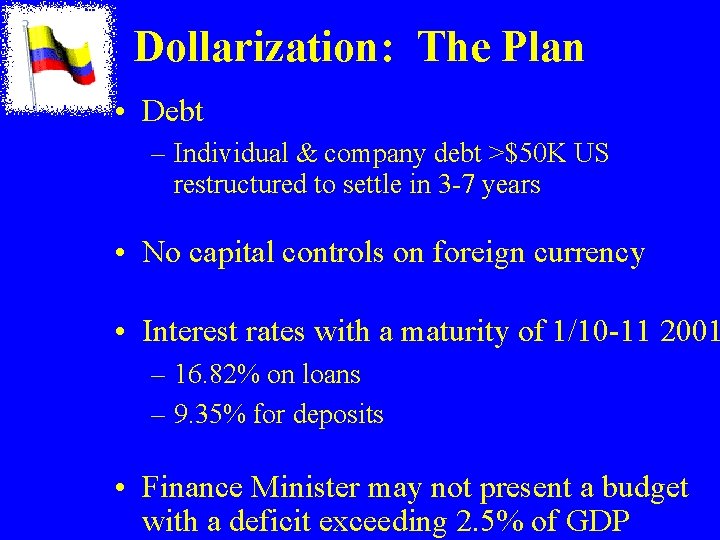
Dollarization: The Plan • Swap Rate – 25000: 1 • Central Bank 180 days to exchange currency – $936 M in reserves • Financial Institutions – Transact in $US • Accounting (public/private entities & individual) – Expressed in $US
Dollarization: The Plan • Debt – Individual & company debt >$50 K US restructured to settle in 3 -7 years • No capital controls on foreign currency • Interest rates with a maturity of 1/10 -11 2001 – 16. 82% on loans – 9. 35% for deposits • Finance Minister may not present a budget with a deficit exceeding 2. 5% of GDP
Goals • Increased confidence spurs foreign investment and trade – remove currency risk – curbs hyperinflation • Privatization of SOE’s – pipeline investment
Dollarization Has Occurred: Now What? • $900 M in loans--IMF • Stimulate new capital inflows • Gain full domestic support through additional legislation. – Guarantee of part time wage of $. 50 per hour • May receive 85% of seignorage benefits of dollarization from US.
Dollarization • Brings discipline & stability to financial markets. • Not a formula. • Difficult and expensive to implement depending on circumstances. • Often has proven to achieve objectives. – GDP growth , lower inflation, lower interest rates
Effects on US & other countires • US has broader responsibility to consider effects of fiscal policies on dollarized nations. • Caution: IMF funding Programs should not be regarded as surrogate central bank opportunities.
Sources • Central Bank of Argentina (www. bcra. gov. ar) • Hanke, Steve H. and Schuler, Kurt, A Dollarization Blueprint for Argentina, “Friedberg’s Commodity and Currency Comments Experts’ Report”, February 1, 1999. • Calvo, Guillermo, Argentina’s Dollarization Project: A Primer, February 18, 1999. • Argentina Mulls Dollarization, (www. oir. com)Optima Investment Research, 1999 • “Dollars enticing South of the Boarder, US Passive to Trend Despite Benefits” -Washington Times, February 17, 2000 • Calvo, Guillermo A. , “Testimony on Full Dollarization” Presentation before Joint Hearing of the Subcommittees on Economic Policy and International Trade & Finance. April 22, 1999. • Cardosa and Franko texts
More Sources • Reuters news service, 2/29/00, 3/1/00 and 3/3/00 • Casey, Michael Dow Jones Newswires “Ecuador’s Dollarization Plan Fuels Talk, If Little Else” 3/3/00. • Casey, Michael Dow Jones Newswires “A Wary Wall Street Welcomes Ecuador Dollarization Bill” 3/1/00 • http: //sica. gov. ec/ingles/docs/basics_of_dollarization. htm • http: //www. odci. gov/cia/publications/factbook/ec. html • ABC-CLIO, Inc. , Kaleidoscope
Sources • Dollarization, July 1999, Joint Economic Committee Staff Report Office of the Chairman, Connie Mack Prepared by Kurt Schuler, Senior Economist to the Chairman* • U. S. Senate Banking Committee “Citizens Guide to Dollarization” 1999 • Should there be five currencies or one dundred and five? Ricardo Hausmann • U. S. Senate Joint Economic Committee Report “Basics of Dollarization, ” January, 2000 (www. senate. gov/~jec/basics. htm) • Three cheers for Dollarization. Euromoney, London 1999. Steve Hanke • http: //users. erols. com/kurrency/ intro. htm * • http: //users. erols. com/kurrency/, OFFICIAL OR "FULL" DOLLARIZATION: CURRENT EXPERIENCES AND ISSUES by Zeljko Bogetic, International Monetary Fund, June 9, 1999. * *copy included in Word document “doll 2”