DEXTER CATTLE Colour inheritance Tony Cutten Ph D

- Slides: 24
DEXTER CATTLE - Colour inheritance Tony Cutten Ph. D #59 DCSNZ
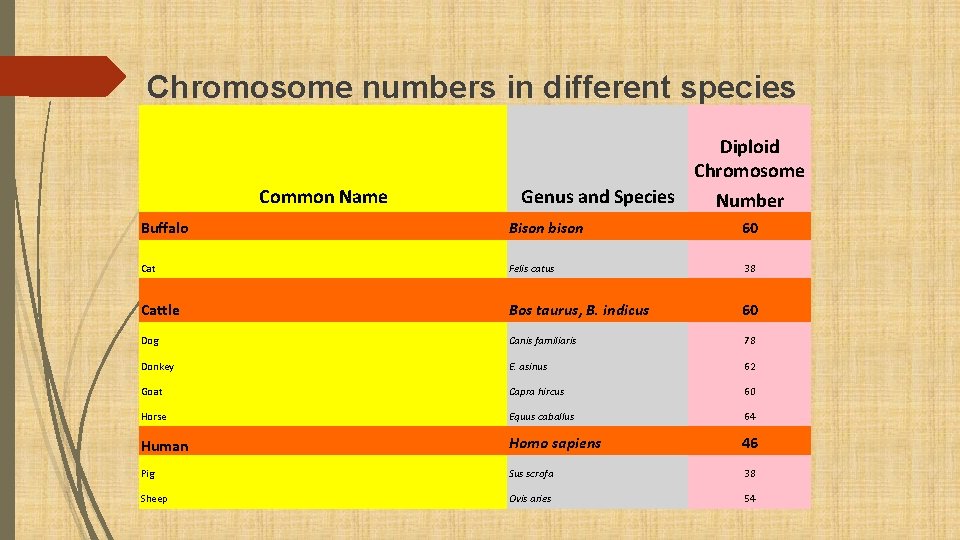
Chromosome numbers in different species Diploid Chromosome Common Name Genus and Species Number Buffalo Bison bison 60 Cat Felis catus 38 Cattle Bos taurus, B. indicus 60 Dog Canis familiaris 78 Donkey E. asinus 62 Goat Capra hircus 60 Horse Equus caballus 64 Human Homo sapiens 46 Pig Sus scrofa 38 Sheep Ovis aries 54
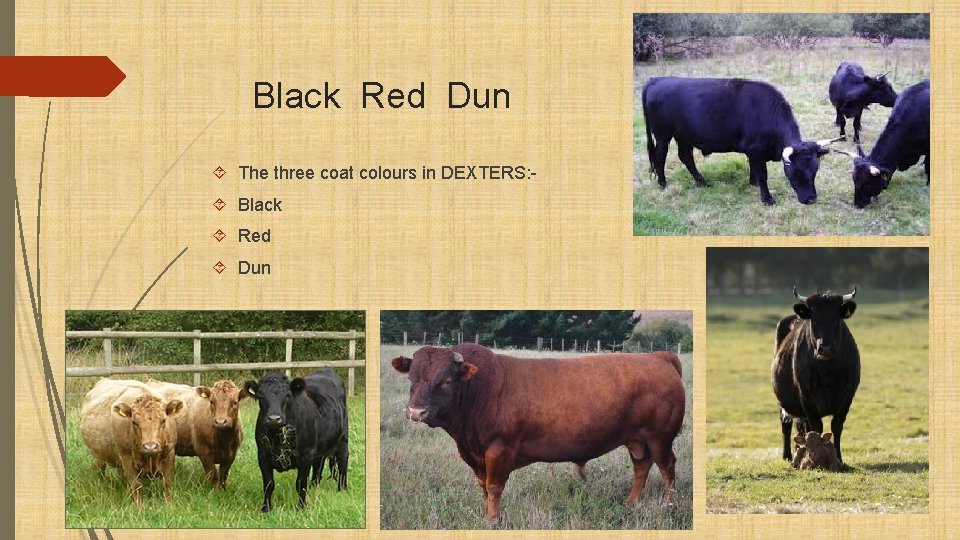
Black Red Dun The three coat colours in DEXTERS: Black Red Dun
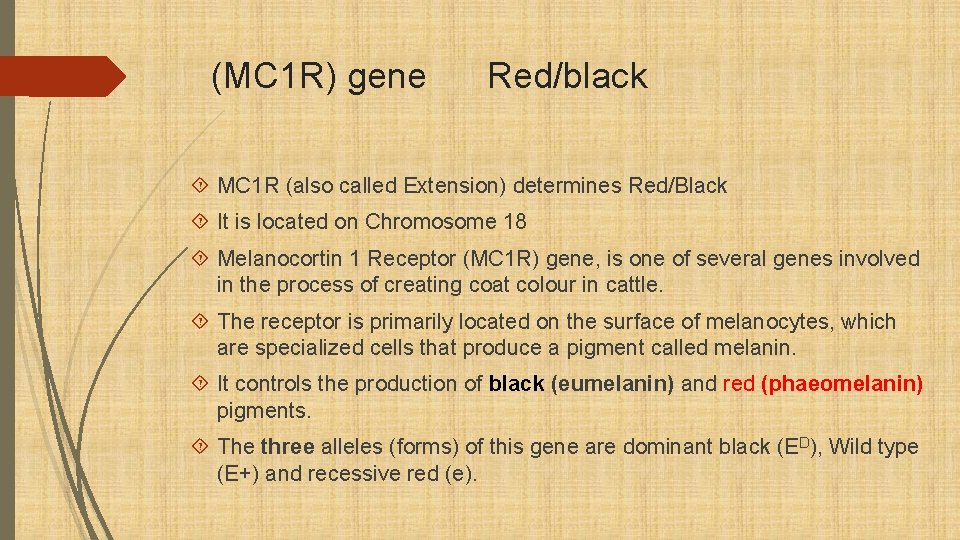
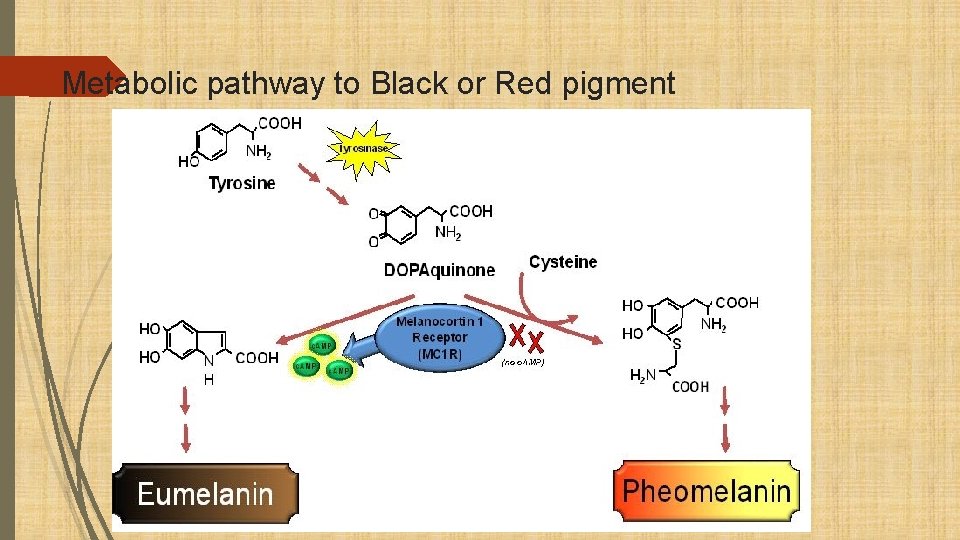
(MC 1 R) gene Red/black MC 1 R (also called Extension) determines Red/Black It is located on Chromosome 18 Melanocortin 1 Receptor (MC 1 R) gene, is one of several genes involved in the process of creating coat colour in cattle. The receptor is primarily located on the surface of melanocytes, which are specialized cells that produce a pigment called melanin. It controls the production of black (eumelanin) and red (phaeomelanin) pigments. The three alleles (forms) of this gene are dominant black (ED), Wild type (E+) and recessive red (e).
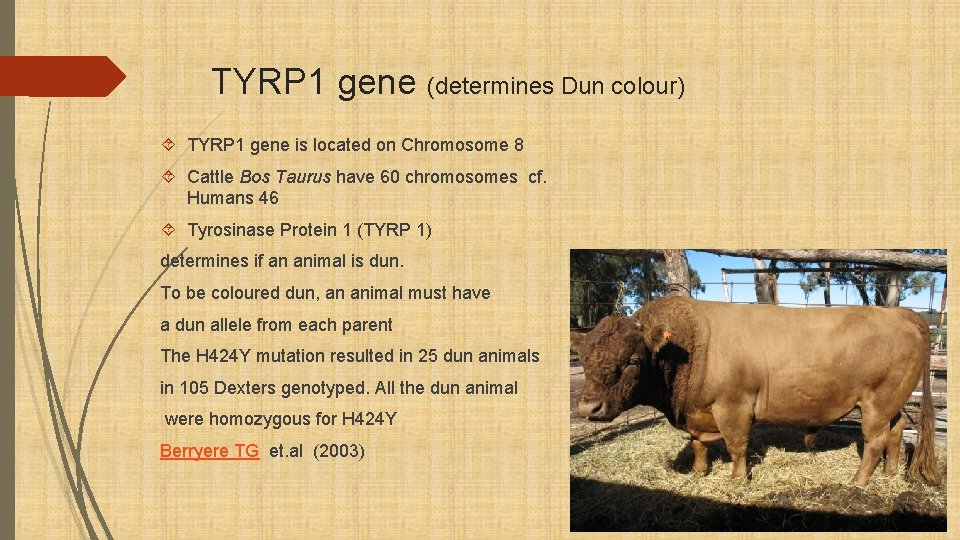
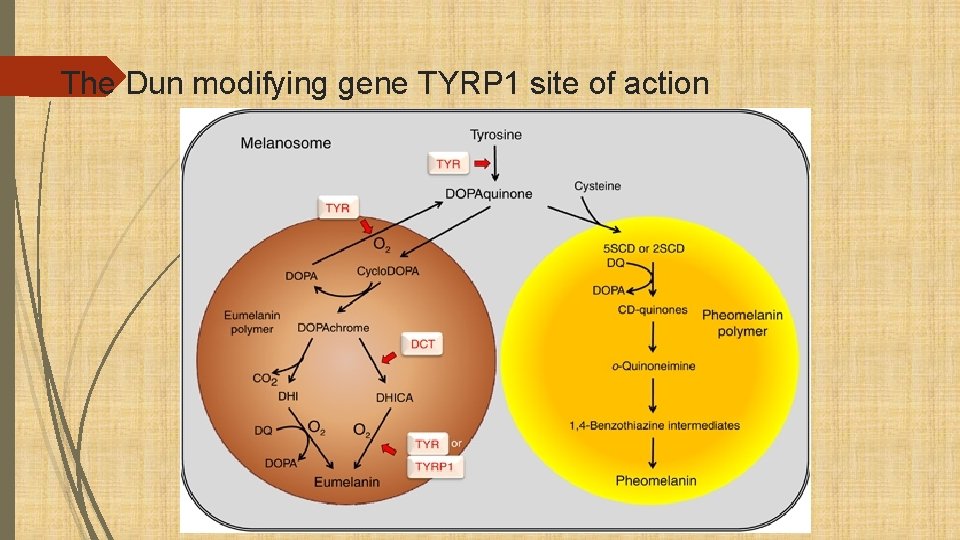
TYRP 1 gene (determines Dun colour) TYRP 1 gene is located on Chromosome 8 Cattle Bos Taurus have 60 chromosomes cf. Humans 46 Tyrosinase Protein 1 (TYRP 1) determines if an animal is dun. To be coloured dun, an animal must have a dun allele from each parent The H 424 Y mutation resulted in 25 dun animals in 105 Dexters genotyped. All the dun animal were homozygous for H 424 Y Berryere TG et. al (2003)
Tyrosinase is the vital enzyme making melanin Tyrosinase (TYR) is the rate-limiting enzyme in the melanin production pathway. High levels of this enzyme are required for the production of eumelanin (black colour) whereas low enzyme levels result in the production of phaeomelanin MCR 1 regulates Tyrosinase enzyme activity
Metabolic pathway to Black or Red pigment
The Dun modifying gene TYRP 1 site of action
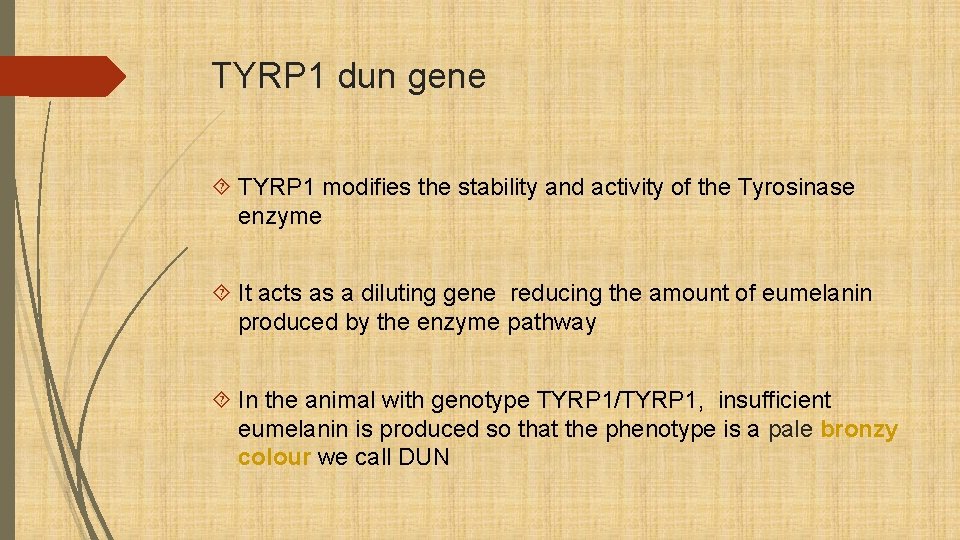
TYRP 1 dun gene TYRP 1 modifies the stability and activity of the Tyrosinase enzyme It acts as a diluting gene reducing the amount of eumelanin produced by the enzyme pathway In the animal with genotype TYRP 1/TYRP 1, insufficient eumelanin is produced so that the phenotype is a pale bronzy colour we call DUN
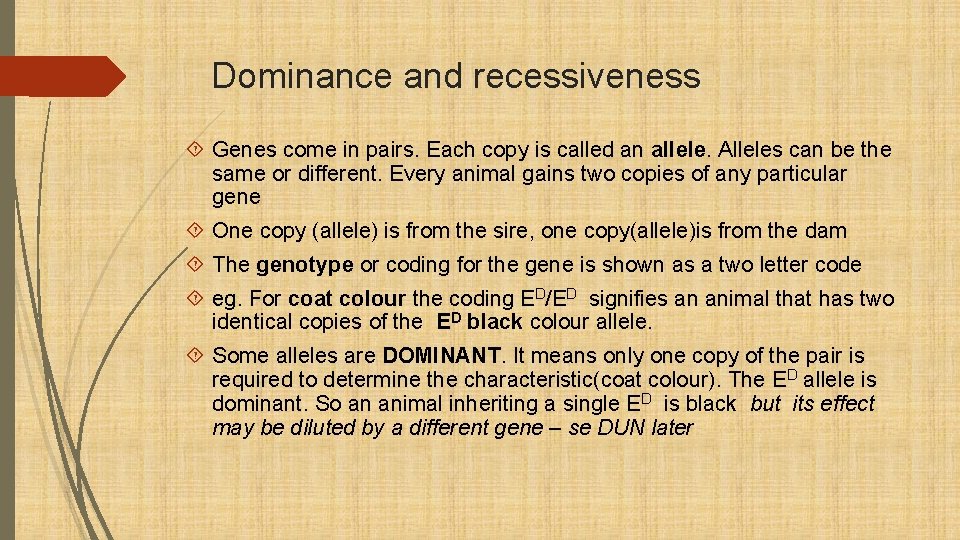
Dominance and recessiveness Genes come in pairs. Each copy is called an allele. Alleles can be the same or different. Every animal gains two copies of any particular gene One copy (allele) is from the sire, one copy(allele)is from the dam The genotype or coding for the gene is shown as a two letter code eg. For coat colour the coding ED/ED signifies an animal that has two identical copies of the ED black colour allele. Some alleles are DOMINANT. It means only one copy of the pair is required to determine the characteristic(coat colour). The ED allele is dominant. So an animal inheriting a single ED is black but its effect may be diluted by a different gene – se DUN later
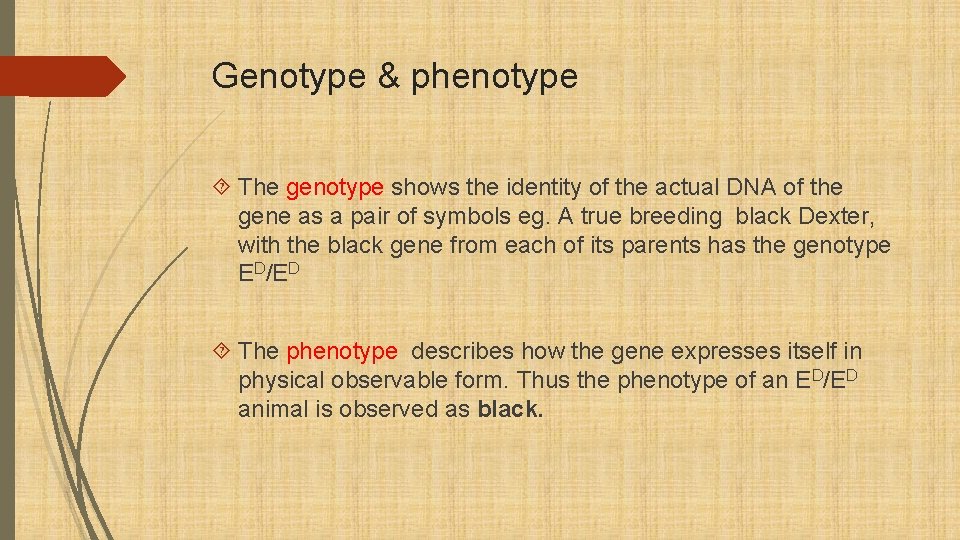
Genotype & phenotype The genotype shows the identity of the actual DNA of the gene as a pair of symbols eg. A true breeding black Dexter, with the black gene from each of its parents has the genotype ED/ED The phenotype describes how the gene expresses itself in physical observable form. Thus the phenotype of an ED/ED animal is observed as black.
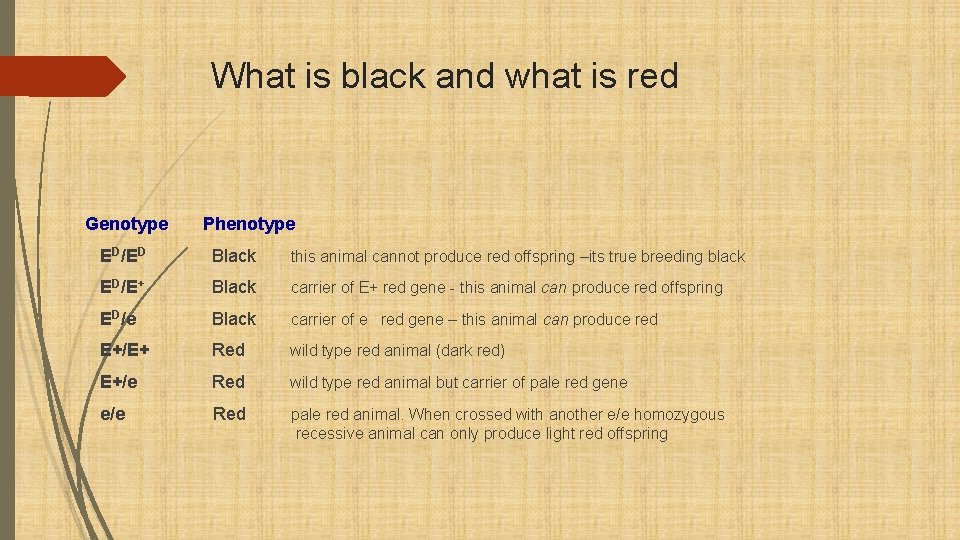
What is black and what is red Genotype Phenotype ED/ED Black this animal cannot produce red offspring –its true breeding black ED/E+ Black carrier of E+ red gene - this animal can produce red offspring ED/e Black carrier of e red gene – this animal can produce red E+/E+ Red wild type red animal (dark red) E+/e Red wild type red animal but carrier of pale red gene e/e Red pale red animal. When crossed with another e/e homozygous recessive animal can only produce light red offspring
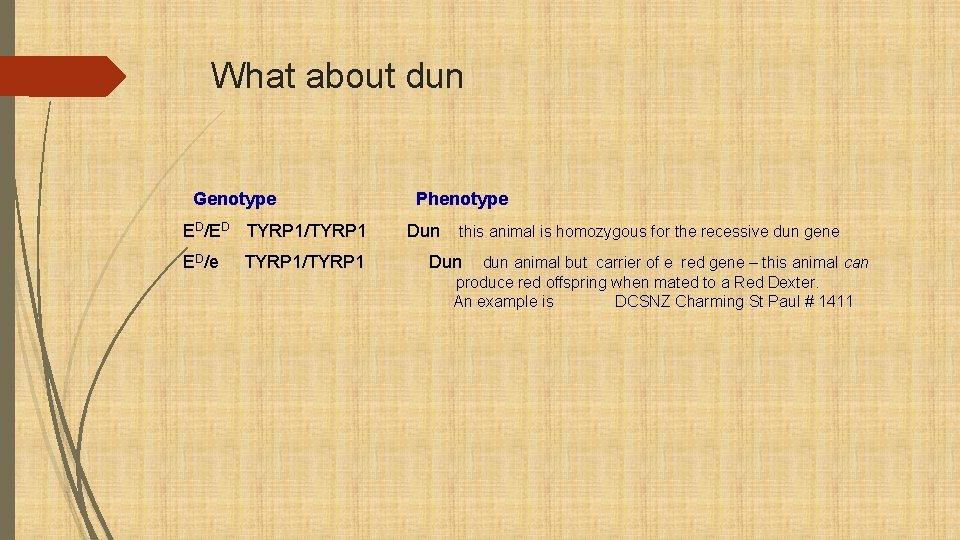
What about dun Genotype ED/ED TYRP 1/TYRP 1 ED/e TYRP 1/TYRP 1 Phenotype Dun this animal is homozygous for the recessive dun gene Dun dun animal but carrier of e red gene – this animal can produce red offspring when mated to a Red Dexter. An example is DCSNZ Charming St Paul # 1411
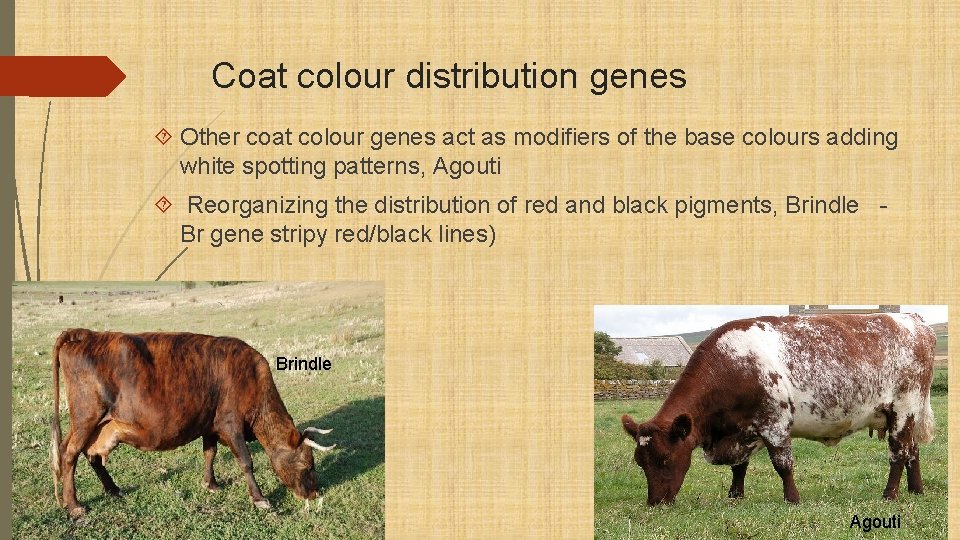
Coat colour distribution genes Other coat colour genes act as modifiers of the base colours adding white spotting patterns, Agouti Reorganizing the distribution of red and black pigments, Brindle Br gene stripy red/black lines) Brindle Agouti
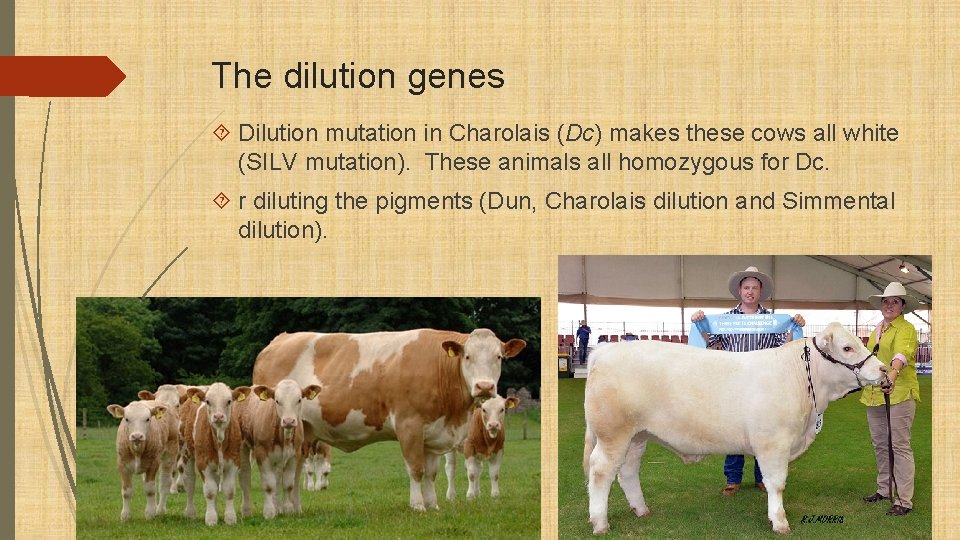
The dilution genes Dilution mutation in Charolais (Dc) makes these cows all white (SILV mutation). These animals all homozygous for Dc. r diluting the pigments (Dun, Charolais dilution and Simmental dilution).
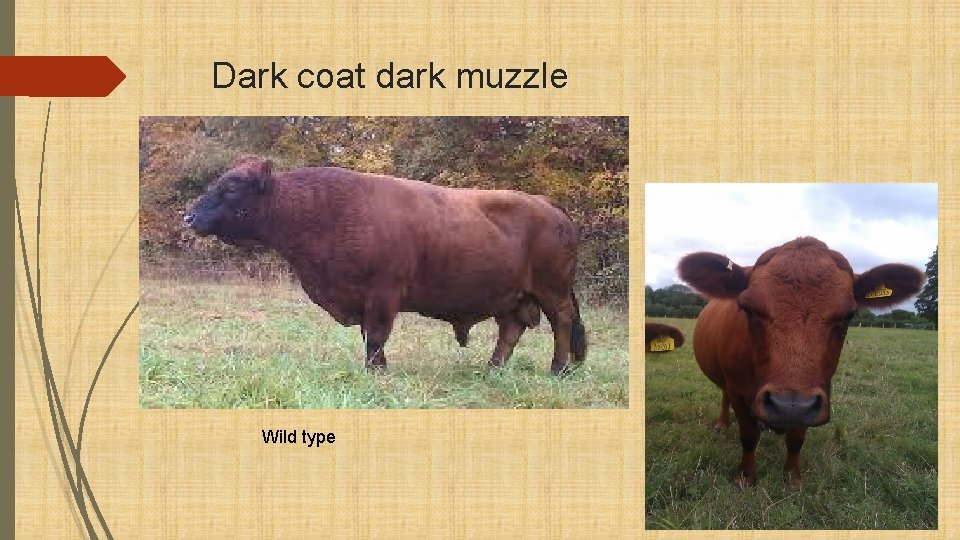
Dark coat dark muzzle Wild type
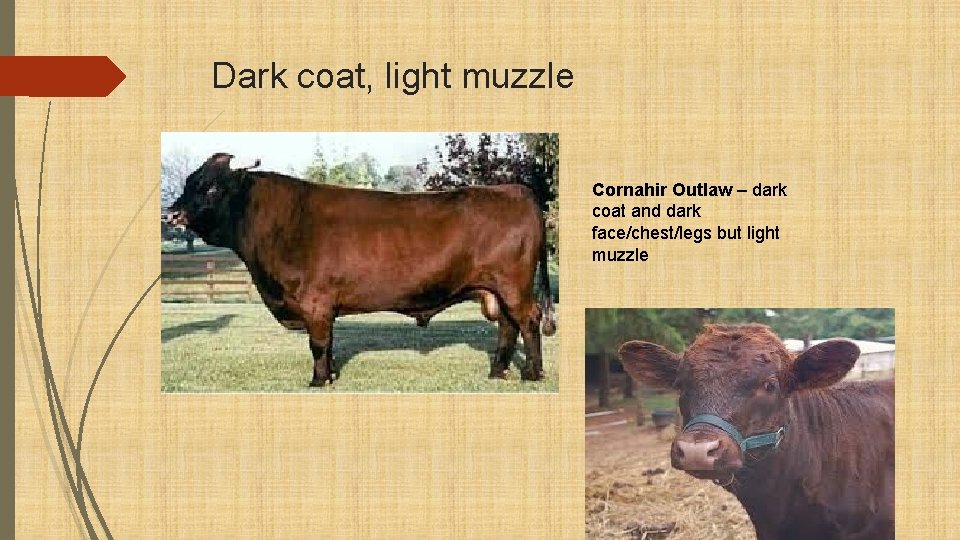
Dark coat, light muzzle Cornahir Outlaw – dark coat and dark face/chest/legs but light muzzle
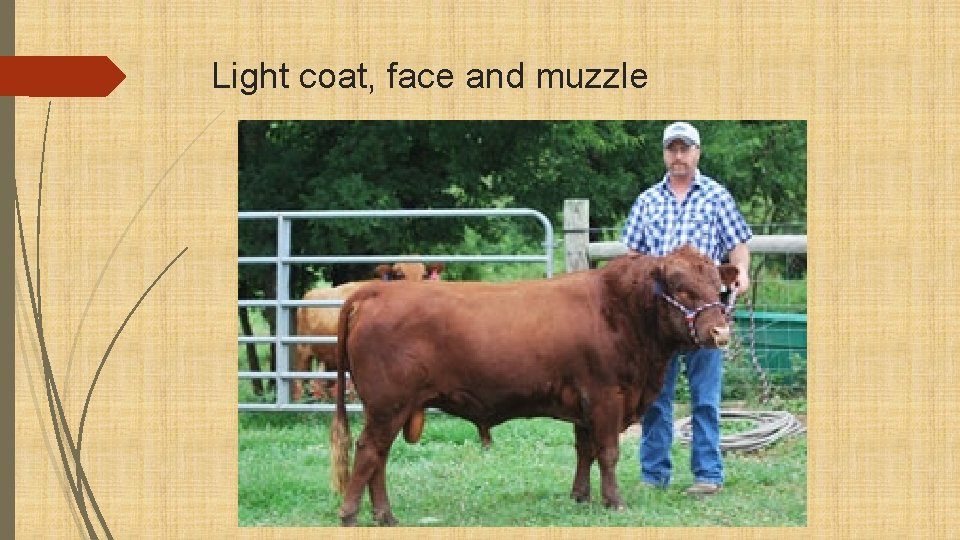
Light coat, face and muzzle
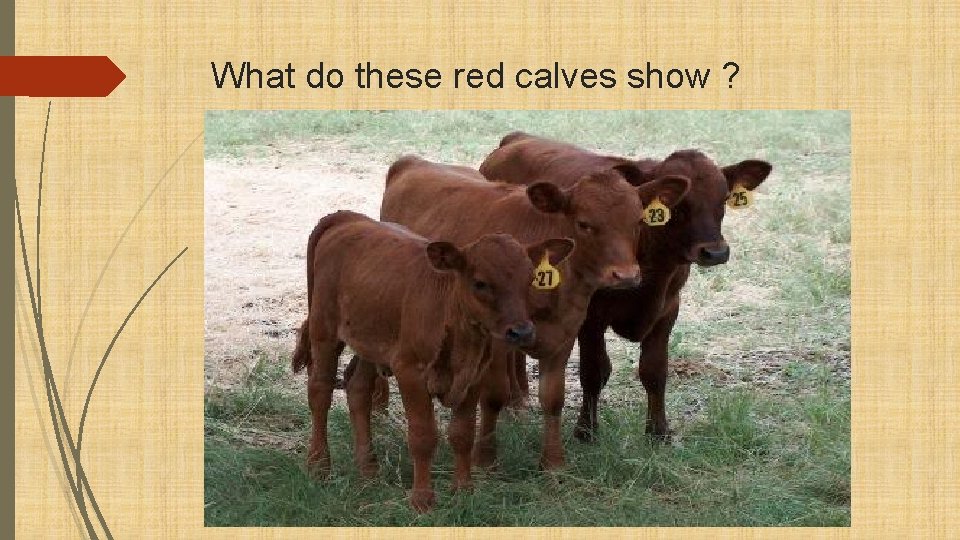
What do these red calves show ?
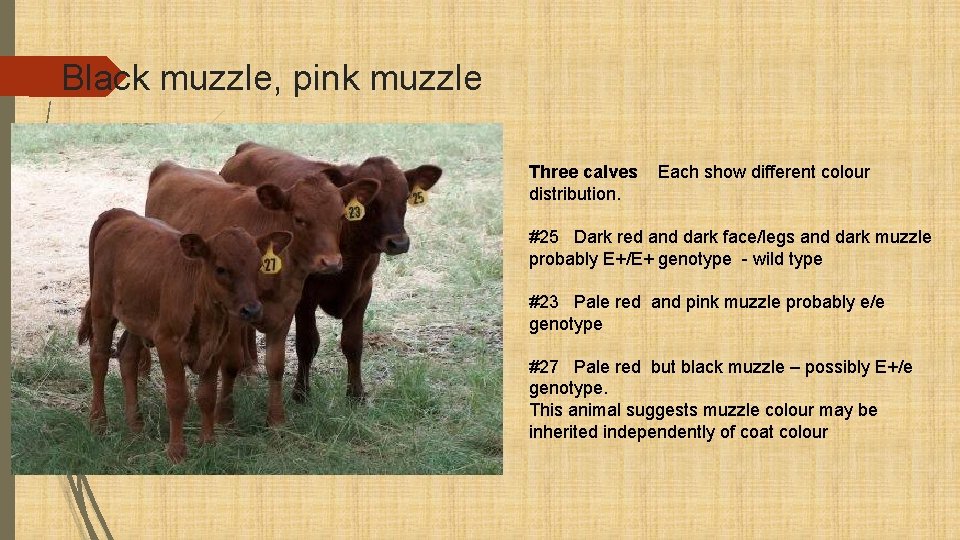
Black muzzle, pink muzzle Three calves distribution. Each show different colour #25 Dark red and dark face/legs and dark muzzle probably E+/E+ genotype - wild type #23 Pale red and pink muzzle probably e/e genotype #27 Pale red but black muzzle – possibly E+/e genotype. This animal suggests muzzle colour may be inherited independently of coat colour
Muzzle/face colour While true breeding Red is associated with the e/e homozygous recessive genotype And Dark rich Red (Irish setter mahogany wildtype) associated with E+/E+ genotype Distribution of muzzle colour seems to be more variable ? why
SUMMARY Melanocortin 1 Receptor gene MCR 1 determines Black or Red Tyrosinase related protein TYRP 1 diluting gene as homozygote determines Dun (H 424 Y mutation) Black is dominant over Red is dominant over Dun R>D B> Black coat colour is from Eumelanin pigment Red coat colour is from Phaeomelanin Breeding for colour is only one characteristic of the many that constitute structure, soundness and quality of the Dexter breed.
References ADA (US) website Basic Concepts of Dexter Colour Genetics Ruvinski, A ( 2015 ) Molecular genetics of coat colour variation - the brown locus TYRP 1 in The Genetics of Cattle ( 2 nd Ed) pp 76 -77, DG Garrick & A Ruvinsky eds DCA website. Jan 2014 Postings from kansasdexters (Patti) with donlindexters (Donna) Dexter Color Genetics Charts http: //www. dexters 4 u. com/2012/04 University of California, Davis. Article on coat colour https: //www. vgl. ucdavis. edu/services/coatcolorcattle. php Olson, TE The genetics of colour variation Ch 3 in The genetics of cattle Eds R. Fries & A. Ruvinsky. CAB International 1999
References Gutiérrez-Gil, B, Wiener, P & Williams, JL. Genetic effects on coat colour in cattle: dilution of eumelanin and phaeomelanin pigments in an F 2 -Backcross Charolais × Holstein population. BMC Genetics 20078: 56 http: //bmcgenet. biomedcentral. com/articles/10. 1186/1471 -2156 -8 -56 DOI: 10. 1186/1471 -21568 -56 Berryere TG 1, Schmutz SM, Schimpf RJ, Cowan CM, Potter J. TYRP 1 is associated with dun coat colour in Dexter cattle or how now brown cow? Anim Genet. 2003 Jun, 34(3) 169 -175 Dorshorst B 1, Henegar C 2, Liao X 3, Sällman Almén M 4, Rubin CJ 4, Ito S 5, Wakamatsu K 5, Stothard P 3, Van Doormaal B 6, Plastow G 3, Barsh GS 7, Andersson L 8. Dominant red coat color in Holstein Cattle is Associated with a missense mutation in the coatomer protein complex, subunit alpha (COPA) gene. PLo. S One. 2015 Jun 4; 10(6): e 0128969. doi: 10. 1371/journal. pone. 0128969. e. Collection 2015. https: //ghr. nlm. nih. gov/gene/MC 1 R melanocortin 1 receptor