Developing faculty for future education Vijaya Sherry Chand
- Slides: 16
Developing faculty for future education Vijaya Sherry Chand Indian Institute of Management Ahmedabad
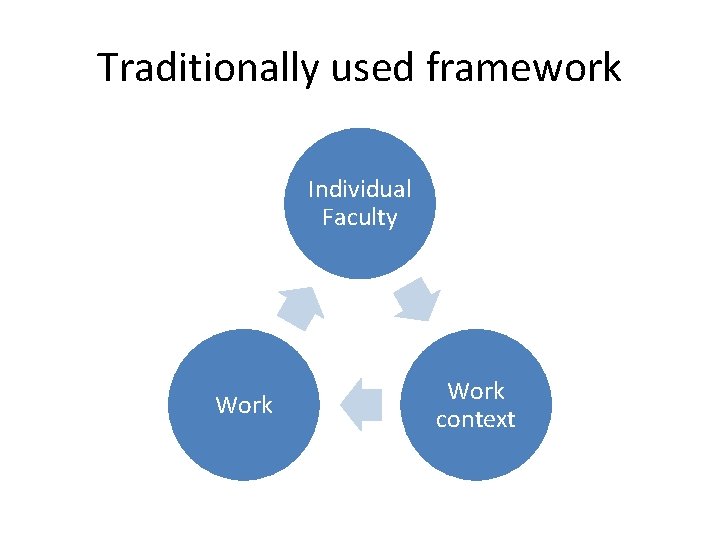
Traditionally used framework Individual Faculty Work context
Individual Faculty member One of the earliest series of handbooks on faculty development: 3 -volume set (ed. ) Bergquist and Phillips (1975, 1977, 1981) • privileges the development of the individual faculty member, but • it is a function of his or her “integrity – professional, societal, personal”
How does a new teacher entrant learn to teach? • Prescribed qualification assumed enough for a good academic experience to the student • No place for Mentoring in an average institute’s vocabulary • From here, short step to devaluation of the academic experience
Role for leaders in defining acceptable ‘good academic experience’ • Are teachers investing quality time in the classroom? • In the absence of a valued academic experience: lack of interest, demotivation, disregard for academic honesty. • For an average college teacher: load vs concept of quality classroom time. • Work out levels of student academic experience that are acceptable to them, and monitor these.
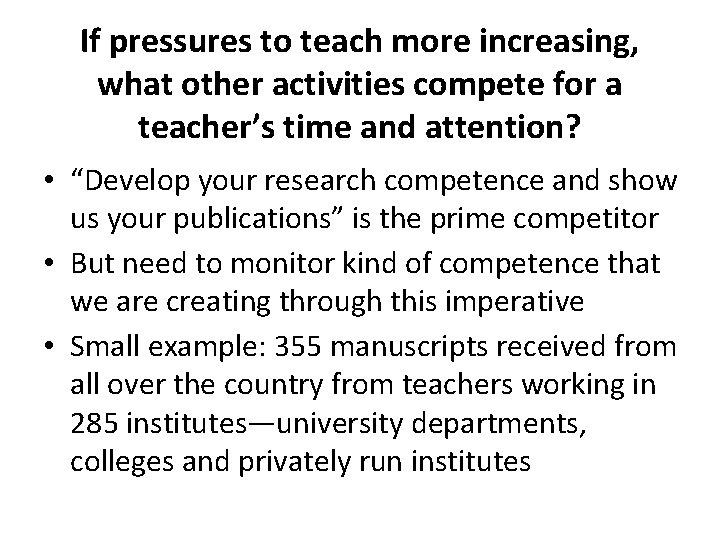
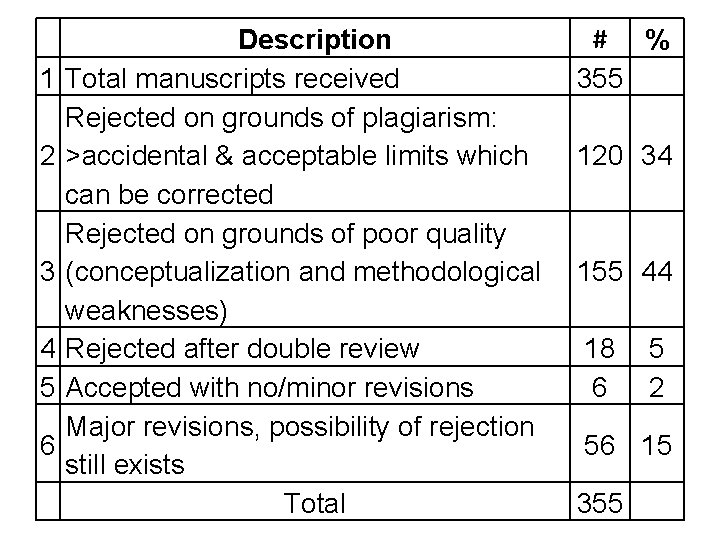
If pressures to teach more increasing, what other activities compete for a teacher’s time and attention? • “Develop your research competence and show us your publications” is the prime competitor • But need to monitor kind of competence that we are creating through this imperative • Small example: 355 manuscripts received from all over the country from teachers working in 285 institutes—university departments, colleges and privately run institutes
Description 1 Total manuscripts received Rejected on grounds of plagiarism: 2 >accidental & acceptable limits which can be corrected Rejected on grounds of poor quality 3 (conceptualization and methodological weaknesses) 4 Rejected after double review 5 Accepted with no/minor revisions Major revisions, possibility of rejection 6 still exists Total # % 355 120 34 155 44 18 6 5 2 56 15 355
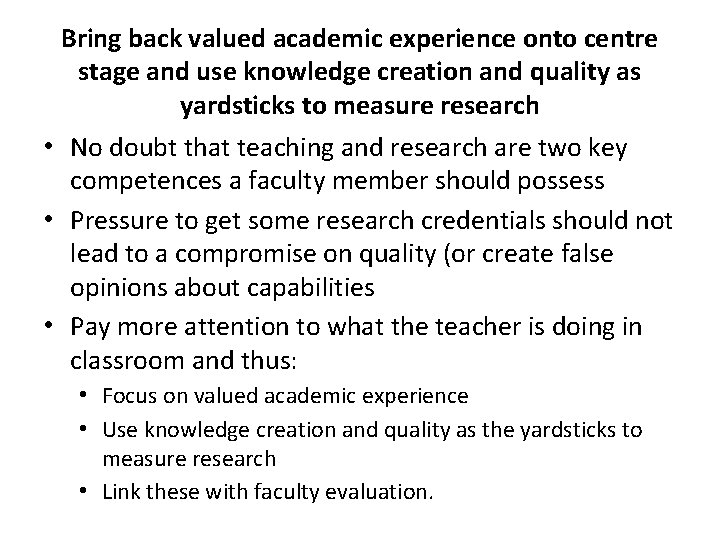
Bring back valued academic experience onto centre stage and use knowledge creation and quality as yardsticks to measure research • No doubt that teaching and research are two key competences a faculty member should possess • Pressure to get some research credentials should not lead to a compromise on quality (or create false opinions about capabilities • Pay more attention to what the teacher is doing in classroom and thus: • Focus on valued academic experience • Use knowledge creation and quality as the yardsticks to measure research • Link these with faculty evaluation.
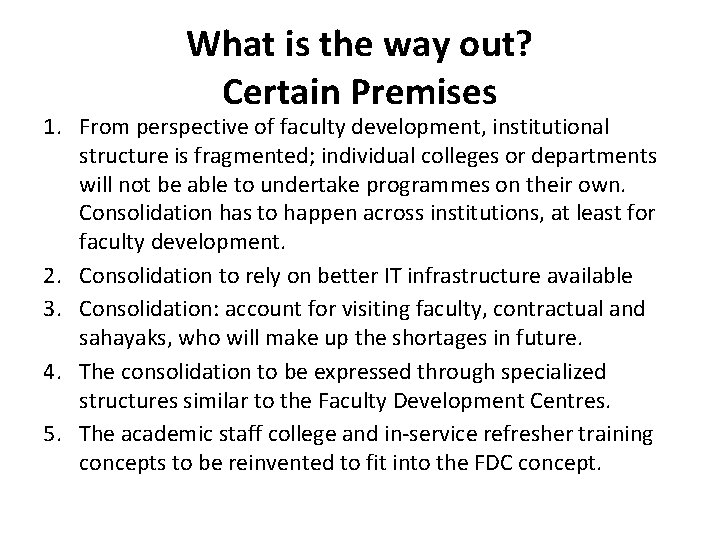
What is the way out? Certain Premises 1. From perspective of faculty development, institutional structure is fragmented; individual colleges or departments will not be able to undertake programmes on their own. Consolidation has to happen across institutions, at least for faculty development. 2. Consolidation to rely on better IT infrastructure available 3. Consolidation: account for visiting faculty, contractual and sahayaks, who will make up the shortages in future. 4. The consolidation to be expressed through specialized structures similar to the Faculty Development Centres. 5. The academic staff college and in-service refresher training concepts to be reinvented to fit into the FDC concept.
The implication of this need for consolidation is that the responsibility for faculty development has to be shared by the institutions and a suprainstitutional faculty development centre
What does the institute retain? (2011) 1. Monitoring development of a good academic experience for students 2. Funding opportunities for research and conference travel: less fortunate institutes not eligible for state grants should create a small fund; monitoring quality of conferences attended and papers presented responsibility of the institutes’ leadership 3. Teaching improvement activities like skill-building workshops, seminars, conferences, or retreats, within the institution, depending on resources
4. Peer visits to classrooms for observations and feedback, depending on the culture of openness 5. Internal newsletters: ideas/achievements of faculty 6. Publication of annual newsletter highlighting meritorious accomplishments of departmental personnel or alumni. Development of system for nominating people for awards programs. Photographs with name plates of winners of the awards displayed in a prominent place. 7. Summer Research Fellowships, small stipends for summer research; many students are willing to work on interesting projects on a small subsistence honorarium
Faculty development Entrepreneurship What can a Faculty Development Centre do?
What can a Faculty Development Centre do? 1. Help in implementing the concept of reflective practice through action research 2. Set up coaching and mentoring networks: mentoring so that expertise available within profession passed on through nurturing process. 3. The same networks can also be leveraged for research collaborations 4. Help teachers develop a teaching portfolio 5. Create a library of resources on teaching, and other open-access or paid material
6. Create a repository of innovations that teachers can share 7. Conduct short programmes, either online or faceto-face, on specialized topics like data analysis or language teaching, etc. 8. Facilitate inter-disciplinary collaboration by allowing experts to team up 9. Provide diagnostic services to teachers, and remedial help if needed 10. Access to sources of review and publication of work
• Faculty development can happen only when the importance of providing students a good academic experience guides our actions. • The time has come for institutions to share faculty development responsibilities with entrepreneurial faculty development ventures.