NEPAL RECOVERY TO RESILIENCE Vijaya Rana Joint Secretary
- Slides: 9
NEPAL RECOVERY TO RESILIENCE Vijaya Rana, Joint Secretary, NRA Marc Forni, Senior DRM Specialist, World Bank 17 Meeting of the GFDRR Consultative Group April X, 2016
Nepal – Risk Profile q Vulnerable to a range of natural hazards, particularly earthquakes, flood, drought, and landslides; q Nepal is the 11 th most earthquake-prone country in the world; q As a result of the April 2015 earthquake, weakened and destabilized slopes have become even more susceptible to flooding and landslides; q Susceptible to very high losses from disaster, both in terms of mortality as well as economic losses; q The earthquake exposed the high degree of vulnerability of the poverty reduction effort in Nepal.
Engagement prior to the April 2015 Earthquake GFDRR support prior to the earthquake: q Search and Rescue Equipment and Training q Community based risk reduction in Kosi River Basin q Open Cities Initiative q Strengthening of hydro meteorological services GFDRR support after the earthquake q PDNA Exercise q Household Damage Survey q Support to Housing Reconstruction Program q Safe Schools Program q Disaster Recovery Framework
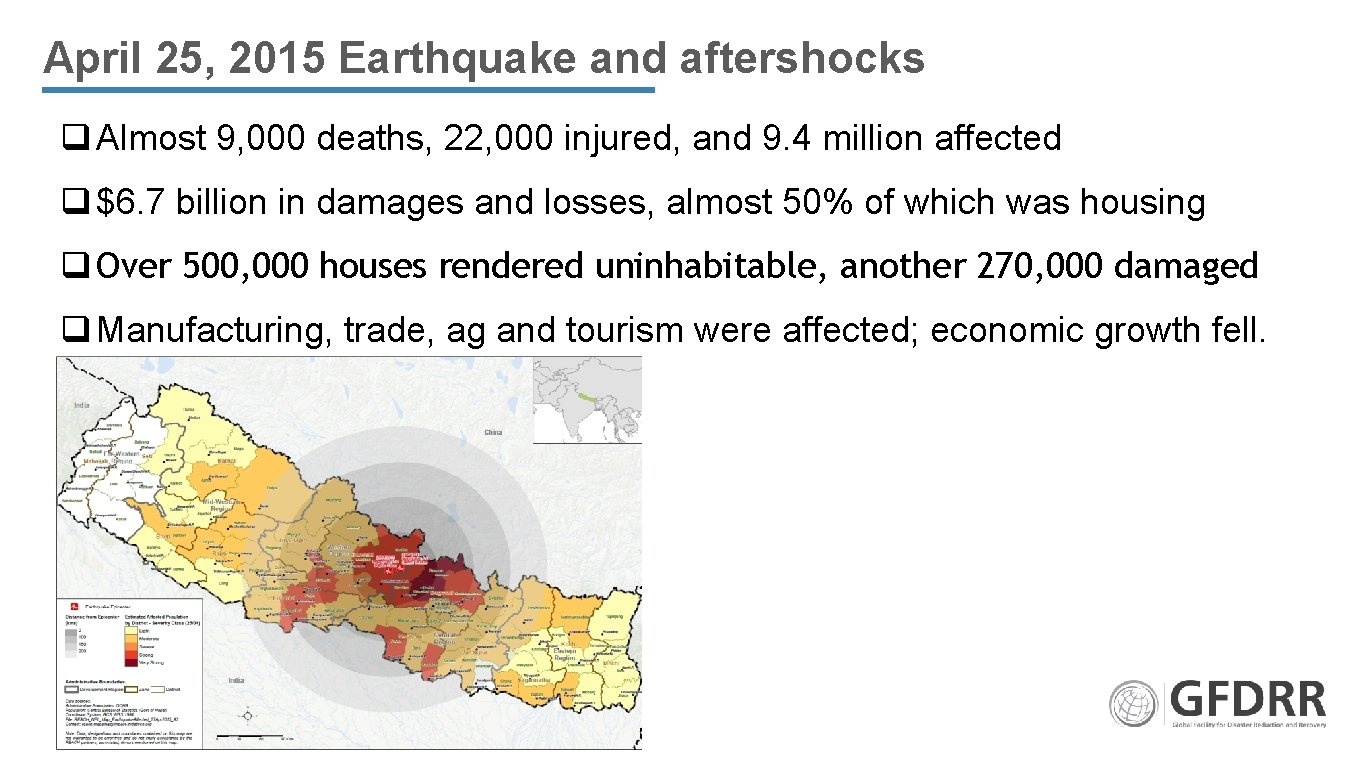
April 25, 2015 Earthquake and aftershocks q Almost 9, 000 deaths, 22, 000 injured, and 9. 4 million affected q $6. 7 billion in damages and losses, almost 50% of which was housing q Over 500, 000 houses rendered uninhabitable, another 270, 000 damaged q Manufacturing, trade, ag and tourism were affected; economic growth fell.
Post Disaster Needs Assessment q GFDRR, together with the ADB, EU, JICA and the UN, supported the Go. N in preparing the PDNA, which was launched less than a month after the earthquake; q The PDNA was based on the agreed UN-EU-WB methodology; q Based on the PDNA findings, donors pledged US$4. 1 billion for reconstruction; q The earthquakes is estimated to push an additional 2. 5 -3. 5% into poverty; q Just finalized Recovery Framework exercise to operationalize PDNA; q Critical exercises for reconstruction planning and allocating pledged reconstruction financing through budget process.
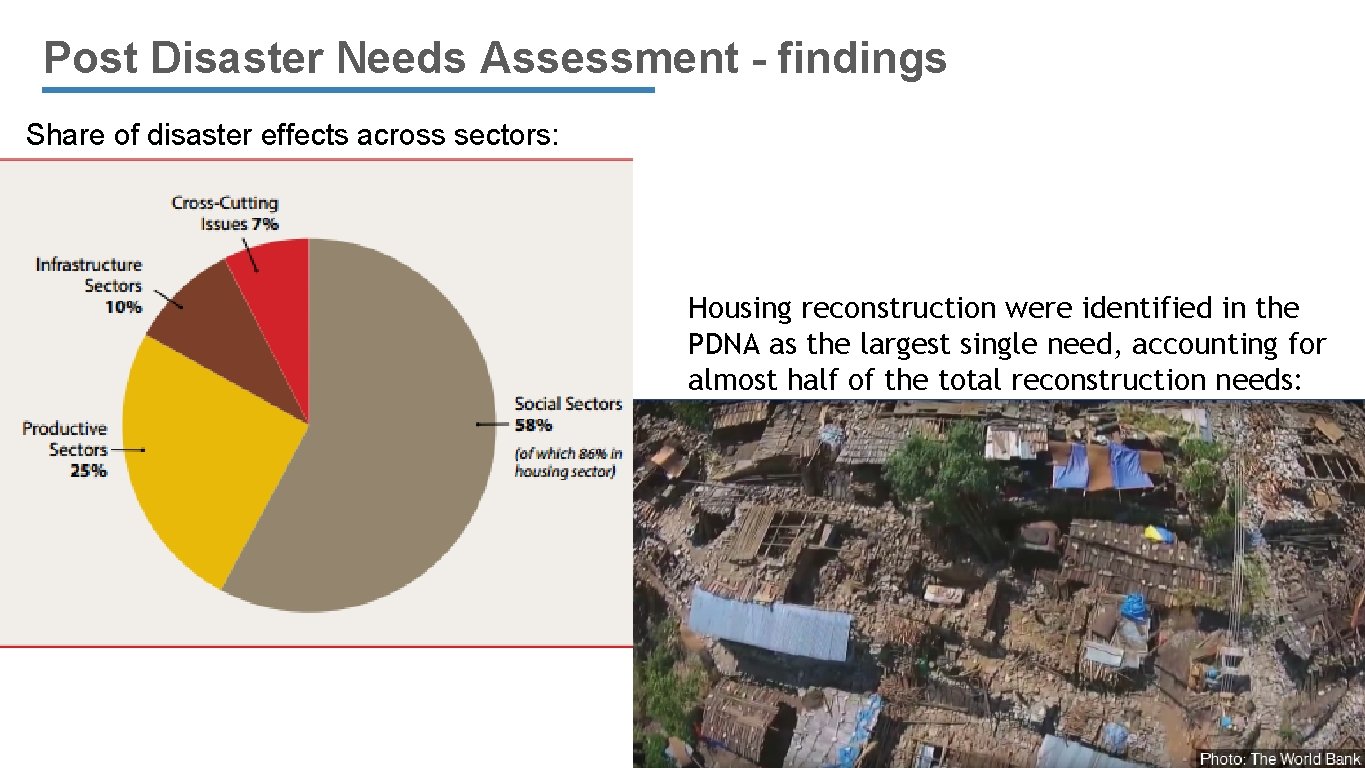
Post Disaster Needs Assessment - findings Share of disaster effects across sectors: Housing reconstruction were identified in the PDNA as the largest single need, accounting for almost half of the total reconstruction needs:
Safe Schools Program q 19, 000 classrooms destroyed and 11, 000 damaged q GFDRR’s safe school program carried out a damage assessment of school buildings in the most affected districts q The results of the assessment will be the basis for prioritization of ongoing school reconstruction and retrofitting programs funded by JICA and ADB q The Safer Schools program is producing an investment plan that can be taken up as a project supported by donor/WB financing.
Earthquake Housing Reconstruction Program q Housing was the largest hit sector ($1. 2 billion in needs); q Go. N’s budget appropriation for its overall reconstruction activities is $900 m for FY 16, most of which will be allocated for housing; q Earthquake Housing Reconstruction Program ($200 m from WB, $100 m from JICA and $25. 5 m Multi-Donor Trust Fund managed by the WB (US, Switzerland, and Canada); q While reconstruction has seen some delay, the first group of beneficiaries have already been enrolled and received the first installment for housing reconstruction; q GFDRR supported the design of the program and is providing technical assistance to the National Reconstruction Authority to develop policies and procedures for the program’s implementation.
Post-Disaster Recovery Framework q This is the first time a Recovery Framework has been prepared following a major disaster; q GFDRR, together with the PDNA partners, supported the Go. N in this process; q The report, launched yesterday in Kathmandu, outlines the recovery vision and strategic objectives, the policy and institutional framework, and implementation arrangements that will guide recovery activities.