
International Tax Policy in the Post BEPS world
International Tax Policy in the Post BEPS world Dr. Vikram Chand Executive Director, Executive Tax Education, University of Lausanne vikram. chand@unil. ch
Recap of the International Tax Policy Standards 1. States exercise tax jurisdiction on cross border income based on the residence and source principles – Concurrent application of residence vs source rules leads to double taxation 2. States enter into Tax Treaties (TT) on a bilateral basis – The operative provisions primarily allocate taxing rights and eliminate double taxation – Agreements based on the OECD Model favor residence State taxation. For example the provision on business income and royalties 3. States enact Transfer Pricing (TP) rules to ensure arm’s length profit allocation among members of a Multinational Enterprise – At the core, the rules are based on the principle that higher the risks, the higher the return (positive or negative)
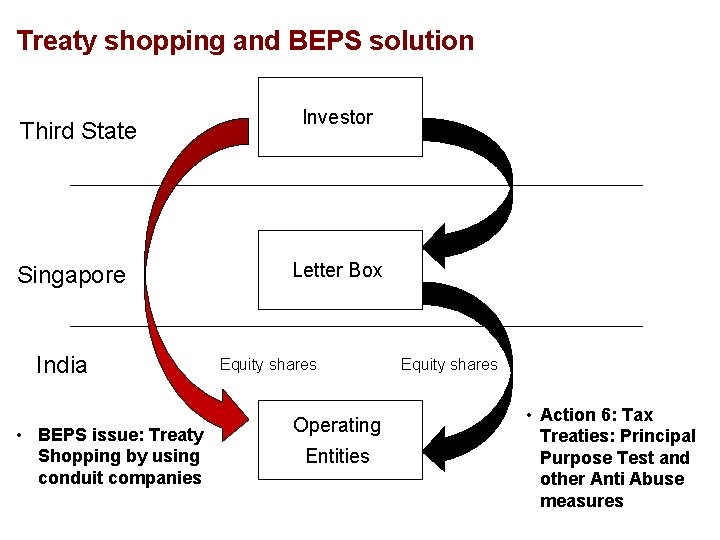
Treaty shopping and BEPS solution Third State Singapore India • BEPS issue: Treaty Shopping by using conduit companies Investor Letter Box Equity shares Operating Entities Equity shares • Action 6: Tax Treaties: Principal Purpose Test and other Anti Abuse measures
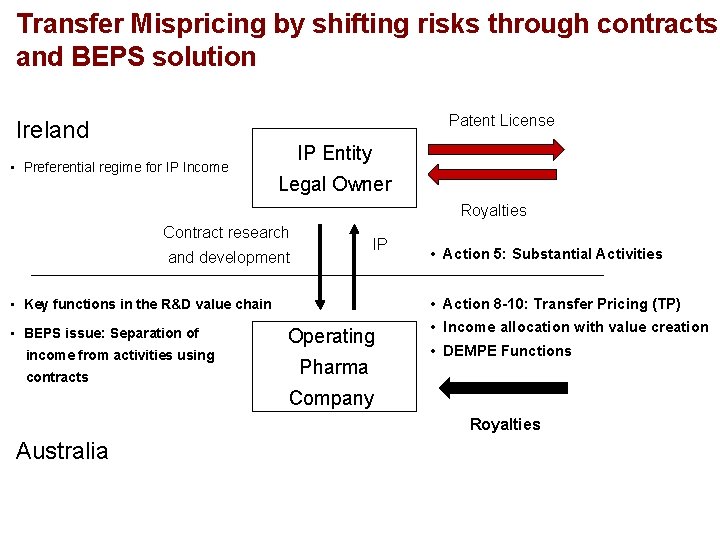
Transfer Mispricing by shifting risks through contracts and BEPS solution Patent License Ireland • Preferential regime for IP Income IP Entity Legal Owner Royalties Contract research IP and development • Action 8 -10: Transfer Pricing (TP) • Key functions in the R&D value chain • BEPS issue: Separation of income from activities using contracts • Action 5: Substantial Activities Operating Pharma • Income allocation with value creation • DEMPE Functions Company Royalties Australia
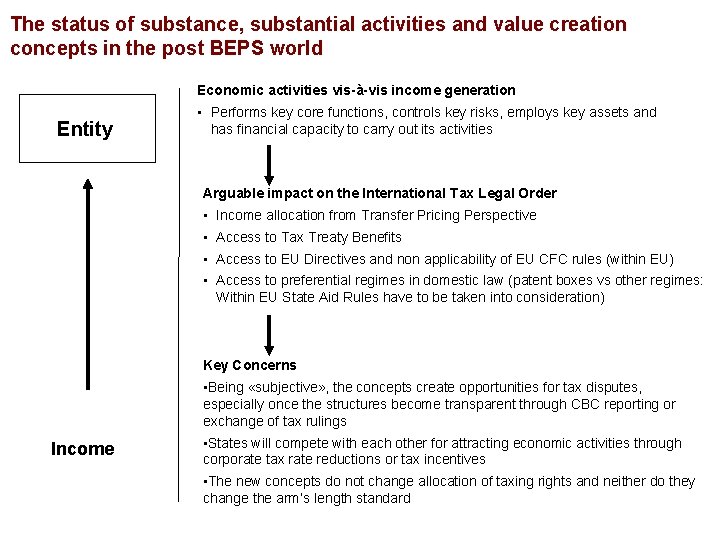
The status of substance, substantial activities and value creation concepts in the post BEPS world Economic activities vis-à-vis income generation Entity • Performs key core functions, controls key risks, employs key assets and has financial capacity to carry out its activities Arguable impact on the International Tax Legal Order • Income allocation from Transfer Pricing Perspective • Access to Tax Treaty Benefits • Access to EU Directives and non applicability of EU CFC rules (within EU) • Access to preferential regimes in domestic law (patent boxes vs other regimes: Within EU State Aid Rules have to be taken into consideration) Key Concerns • Being «subjective» , the concepts create opportunities for tax disputes, especially once the structures become transparent through CBC reporting or exchange of tax rulings Income • States will compete with each other for attracting economic activities through corporate tax rate reductions or tax incentives • The new concepts do not change allocation of taxing rights and neither do they change the arm’s length standard
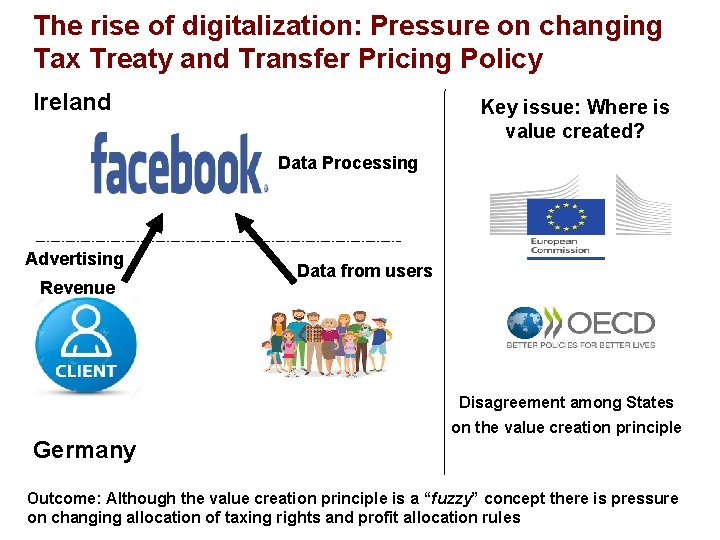
The rise of digitalization: Pressure on changing Tax Treaty and Transfer Pricing Policy Ireland Key issue: Where is value created? Data Processing Advertising Revenue Data from users Disagreement among States on the value creation principle Germany Outcome: Although the value creation principle is a “fuzzy” concept there is pressure on changing allocation of taxing rights and profit allocation rules
International Tax Policy Standards: Future outlook 1. The residence and source principle will continue to exist unless radical tax policy reforms are undertaken such as introducing Destination Based Cash Flow Taxes 2. Tax Treaty Policy: Allocation of taxing rights – The State of source will receive enhanced taxing rights either through a new PE definition or a shared taxing rights mechanism. The open question: Selected digitalized businesses, all digitalized businesses or all businesses in general 3. Transfer Pricing Policy: Profit allocation within a Multinational – Opinions will be voiced to move towards multi factor or sales based formulary apportionment – Arguments will be made to flip the current transfer pricing system and allocate the « entrepreneur » / residual profits to the market State – Personal ongoing research: A more balanced approach needs to be adopted by members of the inclusive framework i. e. between developed and developing States which would entail the movement from a FAR to FARM analysis
- Slides: 7