
Image Processing with Slicer Chand T John Neuromuscular
- Slides: 12
Image Processing with Slicer Chand T. John Neuromuscular Biomechanics Lab Computer Science Department
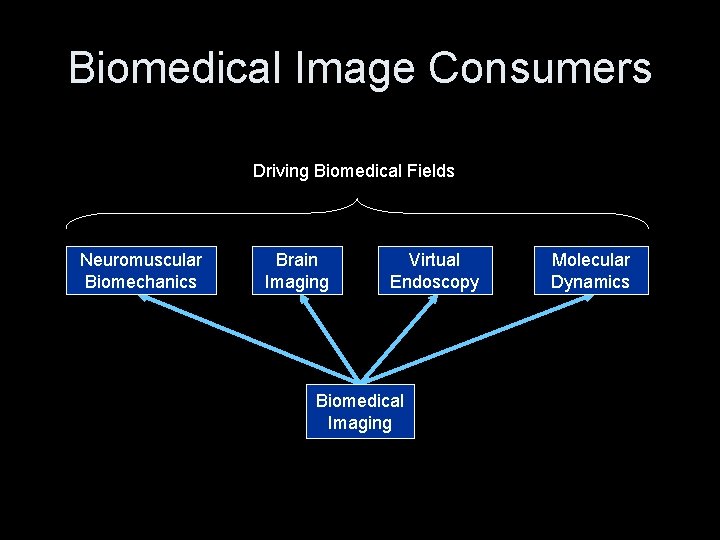
Biomedical Image Consumers Driving Biomedical Fields Neuromuscular Biomechanics Brain Imaging Virtual Endoscopy Biomedical Imaging Molecular Dynamics
Biomedical Image Processing • • Different fields, similar general needs Different fields, different specific needs Currently: context-specific solutions only Where’s the good, cheap, non-pirated software? ! • Bold claim: a single extensible, opensource application can satisfy the image processing needs of all fields
A Solution Was Born • SPL (Harvard) Image Guided Surgery and Visualization • Slicer pulled together by David Gering 1997 -1999 at MIT using VTK and Tcl • Lauren O’Donnell’s further development 1999 -2001 • Ongoing development of Slicer’s Base by Steve Pieper and Nicole Aucoin • Individual developers inject their modules
What Slicer Does • • • Registration (manual, automatic) Segmentation (manual, automatic) Model Construction Visualization Measurements Individual modules…
Simbios and NAMIC • Simbios – Biomedical simulation – Modeling of muscles, blood, RNA, myosin • NA-MIC – Biomedical modeling, image processing – Modeling of brain tissue, some other organs
NMBL-SPL Similarities • Need good general segmentation tools – Automatic – Manual • Need accurate, fast model building tools for clinical non-programmer end users • Need software to manipulate models: modification, registration, Boolean operations
NMBL-SPL Differences • Conventional segmentation practices – NMBL: All manual – SPL: Some automatic, some manual • Conventional segmentation detail level – NMBL: Subpixel accuracy – SPL: Pixel-level accuracy • Modeling pipeline – NMBL: Points, cardinal spline, samples, model via 3 D Delaunay-based lofting – SPL: Points, marching cube, decimation, smoothing
What did Chand Do, and Why? • Slicer developers focused mostly on automated segmentation tools – Thresholding – Mathematical morphological operators – Level set segmentation • As a result, the image editor was largely untouched since David Gering’s initial version • Clinical researchers want that extra level of manual control (e. g. NMBL) – I developed more sophisticated manual segmentation tools based on users’ needs and existing commercial software
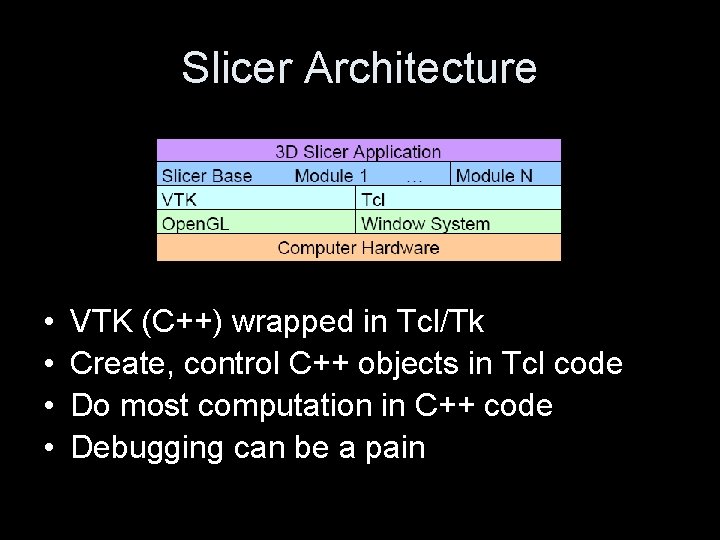
Slicer Architecture • • VTK (C++) wrapped in Tcl/Tk Create, control C++ objects in Tcl code Do most computation in C++ code Debugging can be a pain
Slicer Demo! • Load Dicom knee data, 6 -slices only • Manual segmentation of cartilage – Draw; intuitive select, move, insert* – Sample density*, cardinal splines* – Clear before apply*, delete after apply – Unapply* and edit operations* • Model construction (note Sim. TK export*, greater compatibility, reusability) • Visualization: turn off backface culling * My contributions
Neuromusculoskeletal…gezundheit • Musculoskeletal modeling – More accurate biomechanical models of muscle, tendon, bone, cartilage – Current pipeline mixes (too? ) many shape representations • Neuromusculoskeletal simulation – Conventionally: dynamic optimization, slow – New methods: computed muscle control