DEESCALATION AND TACTICAL DECISION MAKING 2019 2020 APD

- Slides: 15
DE-ESCALATION AND TACTICAL DECISION MAKING (2019 -2020) APD TRAINING DETAIL Community, Teamwork, Excellence
WHAT IS DE-ESCALATION? A systems-based approach for using opportunities, knowledge, skills and abilities to resolve problems with minimal force where possible—which means there has to be an opportunity for it to occur. NOT a magic formula Community, Teamwork, Excellence
PERSON IN CRISIS VS CRIMINAL SUSPECT De-escalation most appropriate on person in crisis De-escalation can backfire on noncompliant criminal suspect (Someone can be both) Community, Teamwork, Excellence
WHEN SHOULD DE-ESCALATION BE CONSIDERED? Do you have discretionary time? Who is at risk? Who is causing the risk? Community, Teamwork, Excellence
IS TIME ON YOUR SIDE? Discretionary Time (DT)—Situation reasonably appears to allow for time to consider possible available options. No Discretionary Time (NDT)—Situation requires an immediate response, without time to safely or effectively consider other options. Is Time on Your Side? Community, Teamwork, Excellence
PRESERVATION OF LIFE Isolate or disengage unless intervention is perceived necessary Avoid placing yourself or others at risk –can trigger “state-created danger” No legal duty to prevent a person from harming him/herself Community, Teamwork, Excellence
CAN YOU MAKE CONTACT? Focus on the behavior, not the diagnosis Try to understand their purpose Remember that sometimes you can’t establish contact Community, Teamwork, Excellence
MAKING CONTACT DO…. Appear confident Want to succeed Actively listen Provide clear instructions Demonstrate patience and concern Community, Teamwork, Excellence
MAKING CONTACT DON’T… Don’t patronize or insult Don’t use a raised voice or shout (except selectively) Ask person over and over to do the same thing Community, Teamwork, Excellence
BUILD RAPPORT AND INFLUENCE Communicate you are there to solve a problem Ask relevant questions Use emotional persuasion: Show cooperating with you will help resolve their distress Community, Teamwork, Excellence
IF UNSUCCESSFUL, WHAT’S NEXT? Maintain safe positioning to contain/control Tactical intervention Disengagement Specialized take-down techniques Remember: Traditional pain compliance techniques may not work on persons in crisis; increased risk to them and officer Community, Teamwork, Excellence
TAKEAWAYS De-escalation is a systems-based approach for using opportunities, knowledge, skills and abilities to resolve problems with minimal force where possible It is especially applicable when dealing with persons in crisis in situations with limited risk Community, Teamwork, Excellence
TAKEAWAYS Individual’s mental state is part of the Graham factors test Officers need to be able to identify the difference between a noncompliant person and a person in crisis. Courts don’t make a formal definition but do distinguish. Community, Teamwork, Excellence
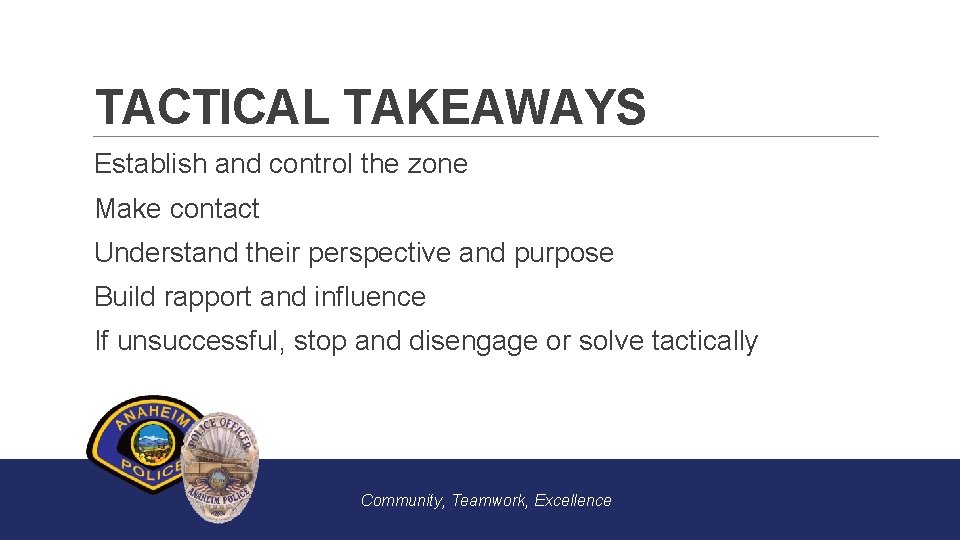
TACTICAL TAKEAWAYS Establish and control the zone Make contact Understand their perspective and purpose Build rapport and influence If unsuccessful, stop and disengage or solve tactically Community, Teamwork, Excellence
info. lexipol. com/deescalation-fsi Community, Teamwork, Excellence