Deconstructing Datacenter Packet Transport Mohammad Alizadeh Shuang Yang



- Slides: 22
Deconstructing Datacenter Packet Transport Mohammad Alizadeh, Shuang Yang, Sachin Katti, Nick Mc. Keown, Balaji Prabhakar, Scott Shenker Stanford University Hot. Nets 2012 U. C. Berkeley/ICSI 1
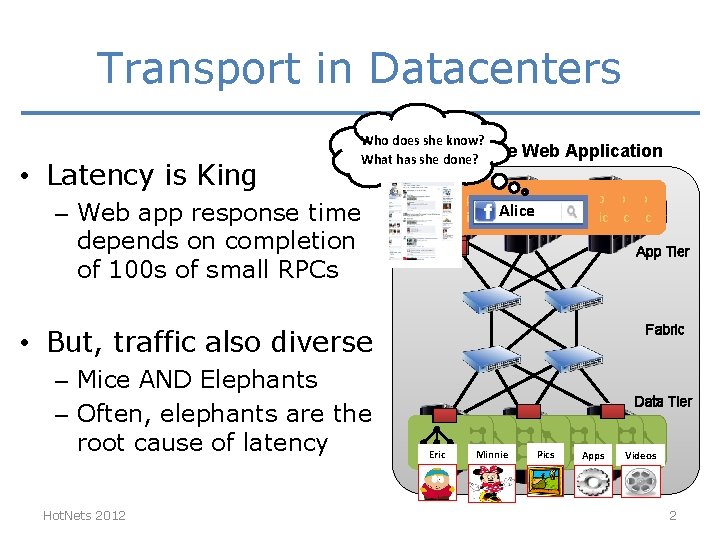
Transport in Datacenters • Latency is King Who does she know? What has Large-scale she done? – Web app response time depends on completion of 100 s of small RPCs Web Application App Alice Logic Logic Logic App Tier Fabric • But, traffic also diverse – Mice AND Elephants – Often, elephants are the root cause of latency Hot. Nets 2012 Data Tier Eric Minnie Pics Apps Videos 2
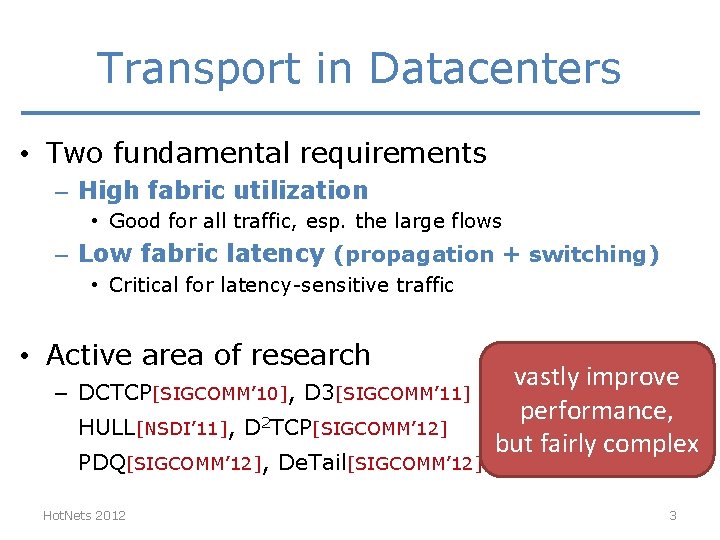
Transport in Datacenters • Two fundamental requirements – High fabric utilization • Good for all traffic, esp. the large flows – Low fabric latency (propagation + switching) • Critical for latency-sensitive traffic • Active area of research – DCTCP[SIGCOMM’ 10], D 3[SIGCOMM’ 11] HULL[NSDI’ 11], D 2 TCP[SIGCOMM’ 12] PDQ[SIGCOMM’ 12], De. Tail[SIGCOMM’ 12] Hot. Nets 2012 vastly improve performance, but fairly complex 3
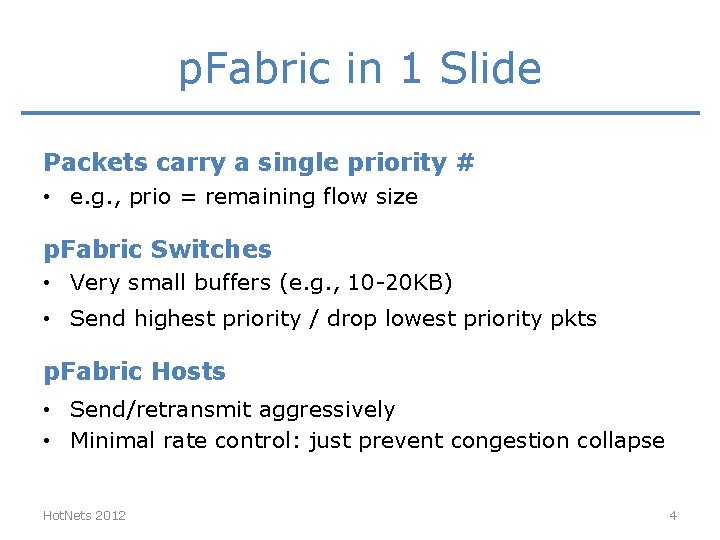
p. Fabric in 1 Slide Packets carry a single priority # • e. g. , prio = remaining flow size p. Fabric Switches • Very small buffers (e. g. , 10 -20 KB) • Send highest priority / drop lowest priority pkts p. Fabric Hosts • Send/retransmit aggressively • Minimal rate control: just prevent congestion collapse Hot. Nets 2012 4
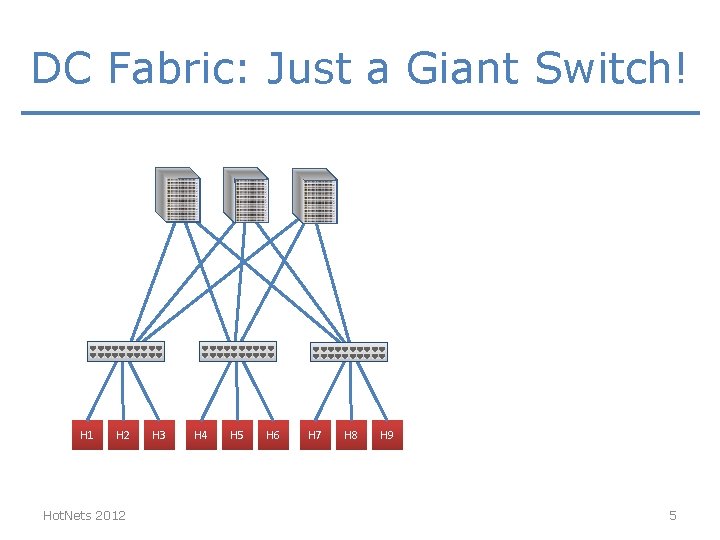
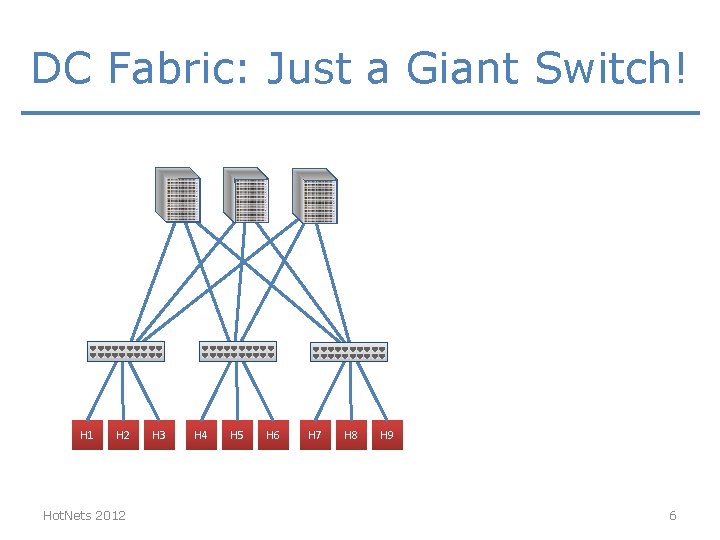
DC Fabric: Just a Giant Switch! H 1 H 2 Hot. Nets 2012 H 3 H 4 H 5 H 6 H 7 H 8 H 9 5
DC Fabric: Just a Giant Switch! H 1 H 2 Hot. Nets 2012 H 3 H 4 H 5 H 6 H 7 H 8 H 9 6
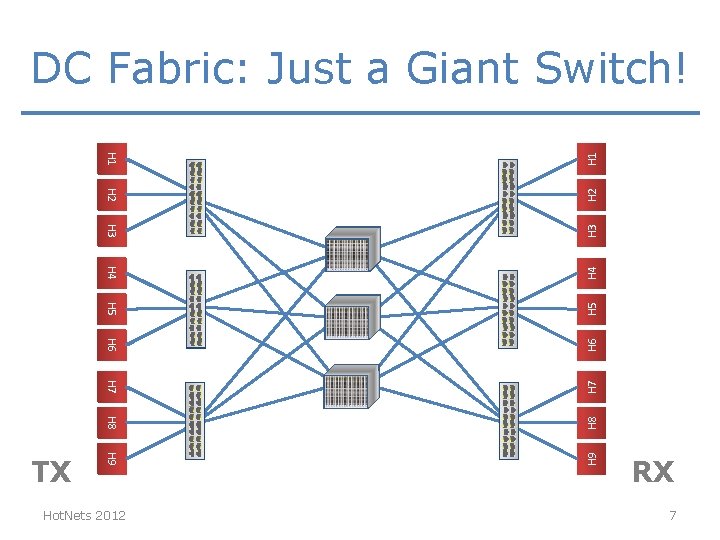
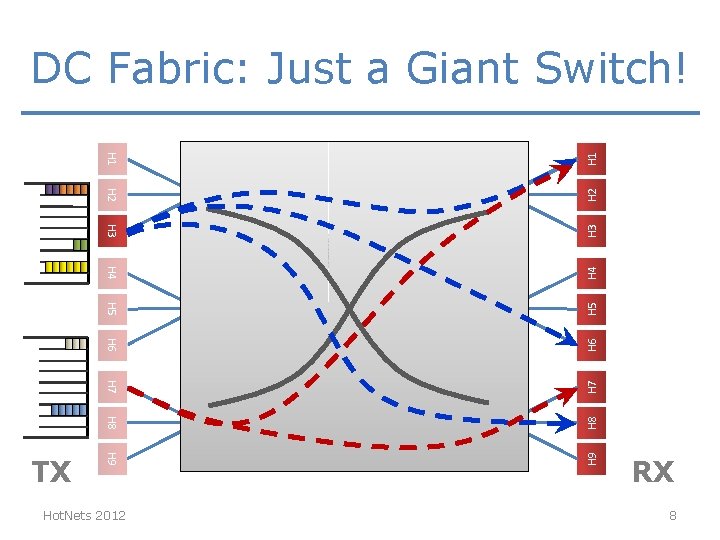
H 2 H 3 H 4 H 5 H 3 H 6 H 2 H 8 H 9 H 7 H 1 TX H 1 DC Fabric: Just a Giant Switch! Hot. Nets 2012 RX 7
H 2 H 3 H 4 H 5 H 3 H 6 H 2 H 8 H 9 H 7 H 1 TX H 1 DC Fabric: Just a Giant Switch! Hot. Nets 2012 RX 8
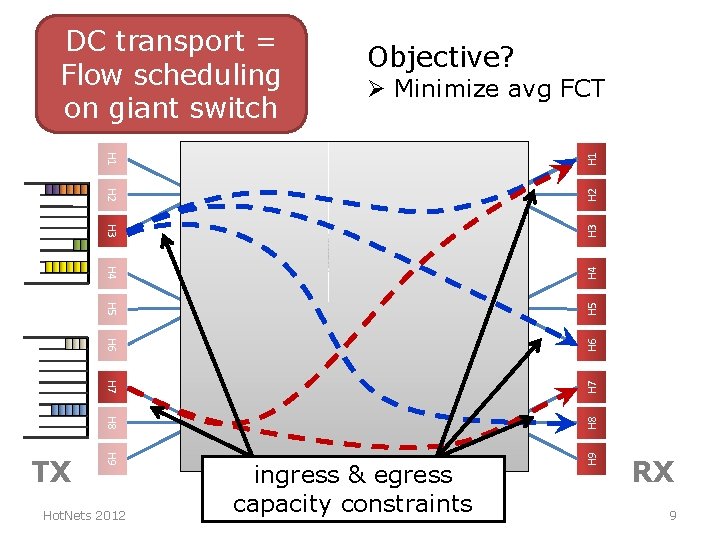
DC transport = Flow scheduling on giant switch Objective? Ø Minimize avg FCT H 1 H 2 H 3 H 4 H 5 H 6 H 7 ingress & egress capacity constraints H 9 Hot. Nets 2012 H 8 TX RX 9
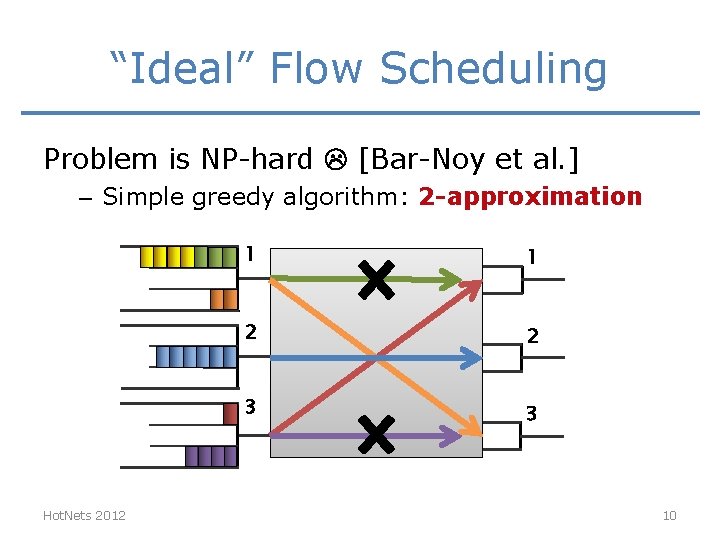
“Ideal” Flow Scheduling Problem is NP-hard [Bar-Noy et al. ] – Simple greedy algorithm: 2 -approximation Hot. Nets 2012 1 1 2 2 3 3 10
p. Fabric Design Hot. Nets 2012 11
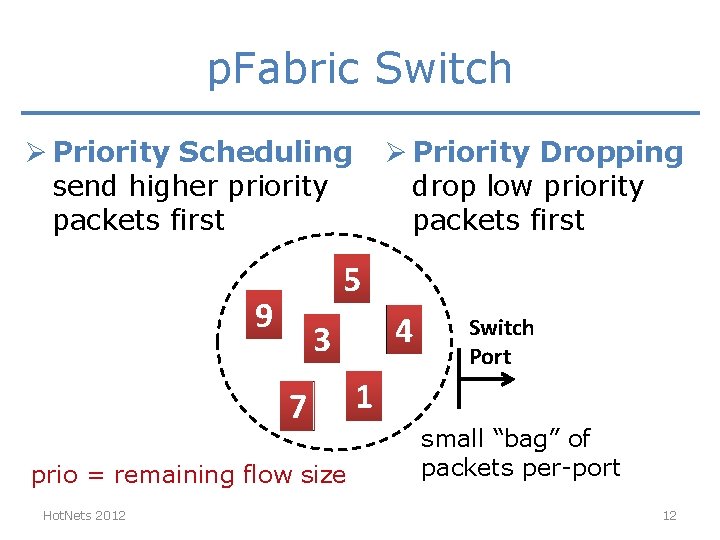
p. Fabric Switch Ø Priority Scheduling send higher priority packets first 5 9 4 3 7 prio = remaining flow size Hot. Nets 2012 Ø Priority Dropping drop low priority packets first Switch Port 1 small “bag” of packets per-port 12
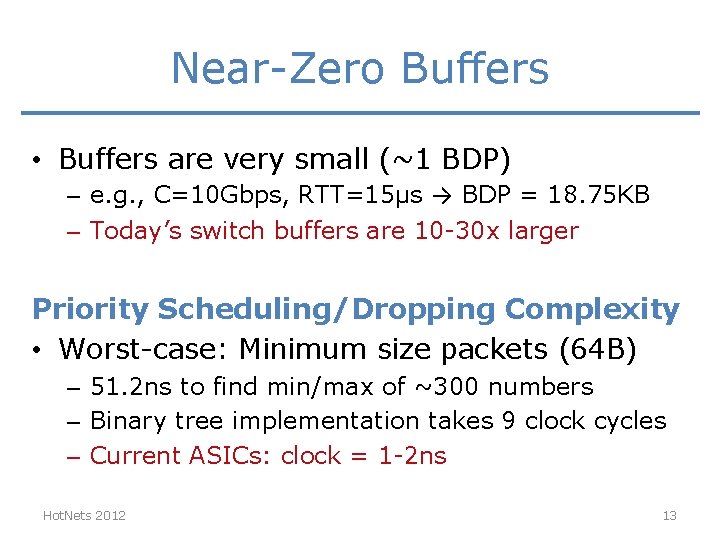
Near-Zero Buffers • Buffers are very small (~1 BDP) – e. g. , C=10 Gbps, RTT=15µs → BDP = 18. 75 KB – Today’s switch buffers are 10 -30 x larger Priority Scheduling/Dropping Complexity • Worst-case: Minimum size packets (64 B) – 51. 2 ns to find min/max of ~300 numbers – Binary tree implementation takes 9 clock cycles – Current ASICs: clock = 1 -2 ns Hot. Nets 2012 13
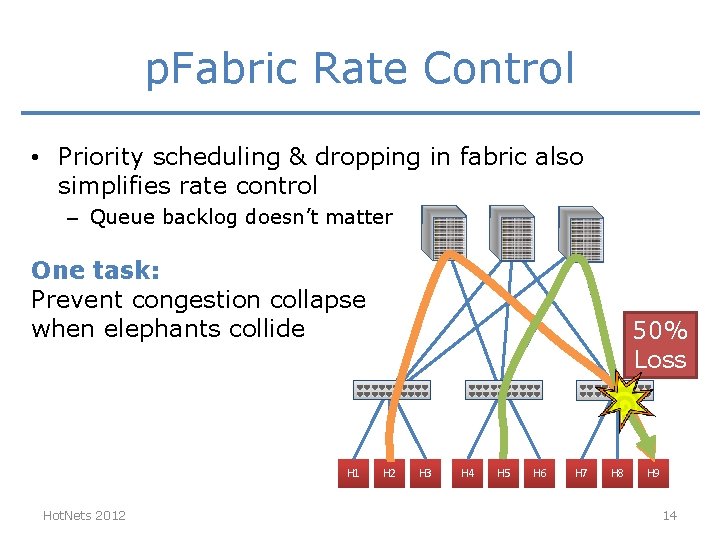
p. Fabric Rate Control • Priority scheduling & dropping in fabric also simplifies rate control – Queue backlog doesn’t matter One task: Prevent congestion collapse when elephants collide H 1 Hot. Nets 2012 50% Loss H 2 H 3 H 4 H 5 H 6 H 7 H 8 H 9 14
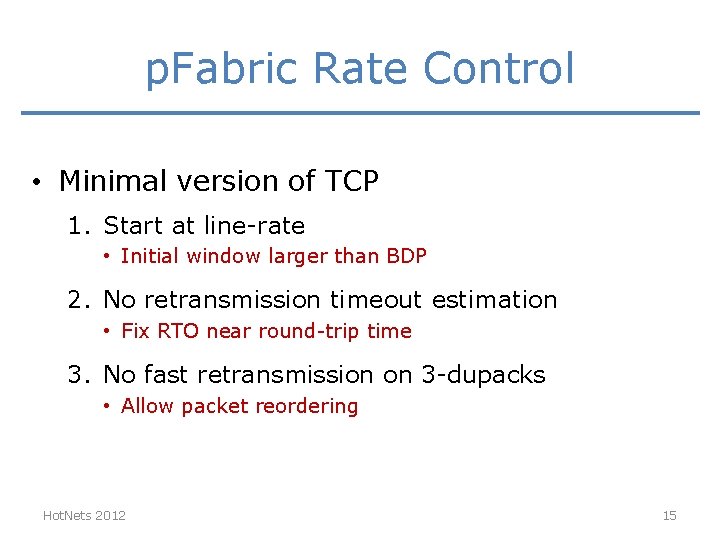
p. Fabric Rate Control • Minimal version of TCP 1. Start at line-rate • Initial window larger than BDP 2. No retransmission timeout estimation • Fix RTO near round-trip time 3. No fast retransmission on 3 -dupacks • Allow packet reordering Hot. Nets 2012 15
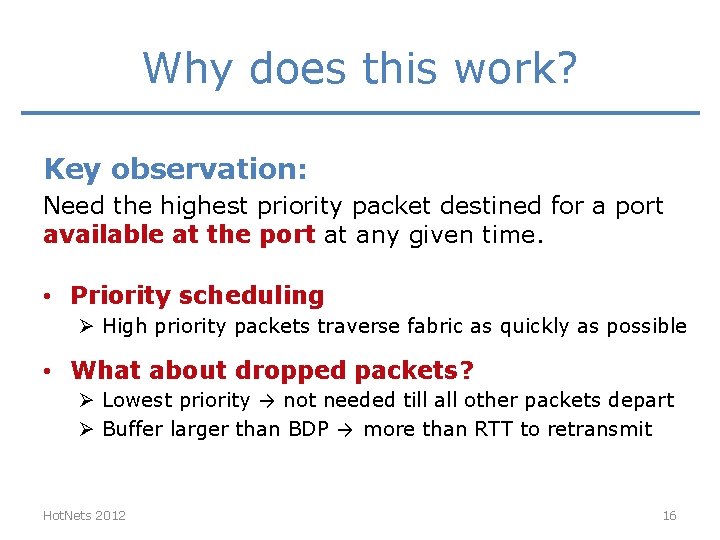
Why does this work? Key observation: Need the highest priority packet destined for a port available at the port at any given time. • Priority scheduling Ø High priority packets traverse fabric as quickly as possible • What about dropped packets? Ø Lowest priority → not needed till all other packets depart Ø Buffer larger than BDP → more than RTT to retransmit Hot. Nets 2012 16
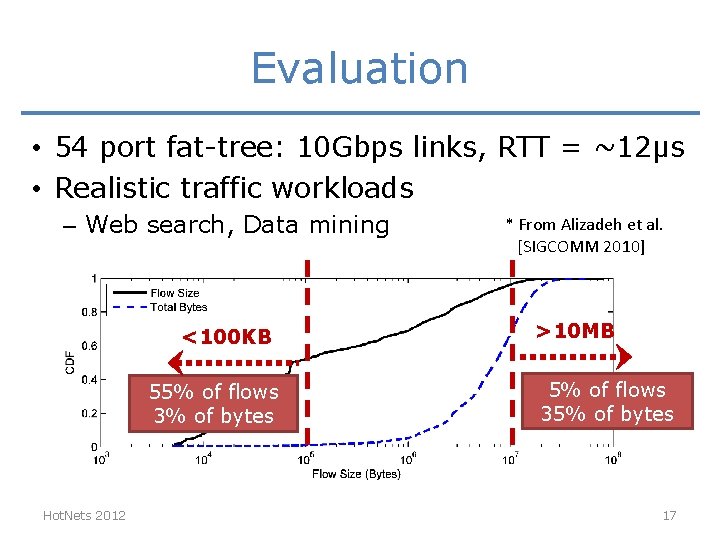
Evaluation • 54 port fat-tree: 10 Gbps links, RTT = ~12µs • Realistic traffic workloads – Web search, Data mining <100 KB 55% of flows 3% of bytes Hot. Nets 2012 * From Alizadeh et al. [SIGCOMM 2010] >10 MB 5% of flows 35% of bytes 17
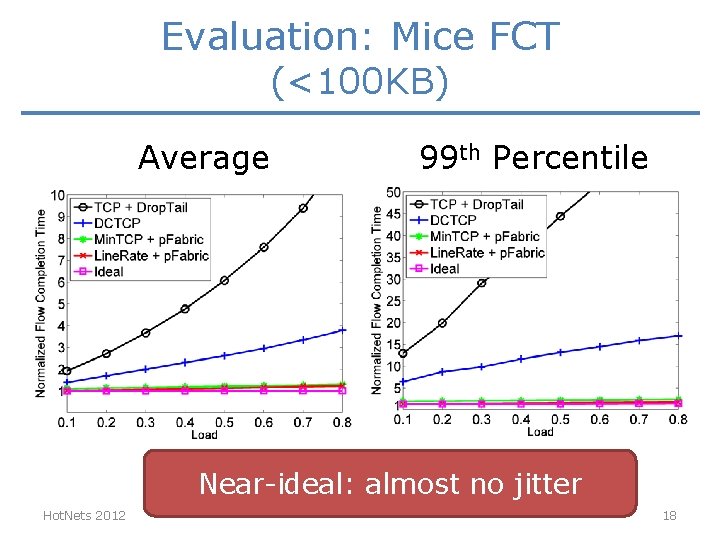
Evaluation: Mice FCT (<100 KB) Average 99 th Percentile Near-ideal: almost no jitter Hot. Nets 2012 18
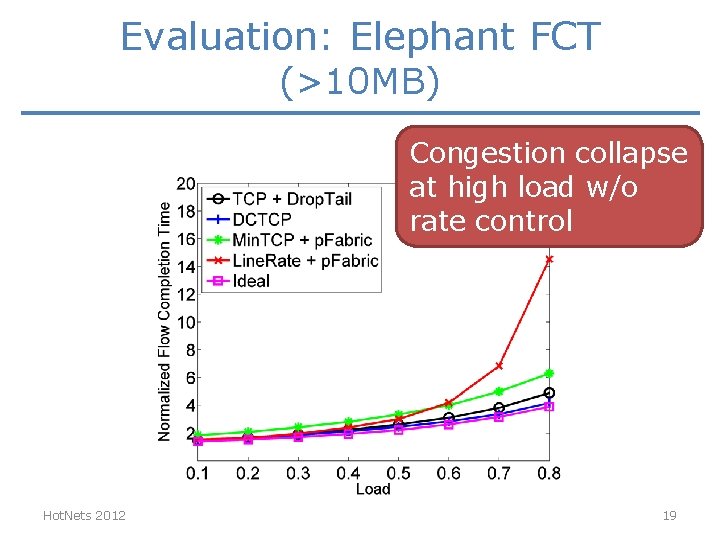
Evaluation: Elephant FCT (>10 MB) Congestion collapse at high load w/o rate control Hot. Nets 2012 19
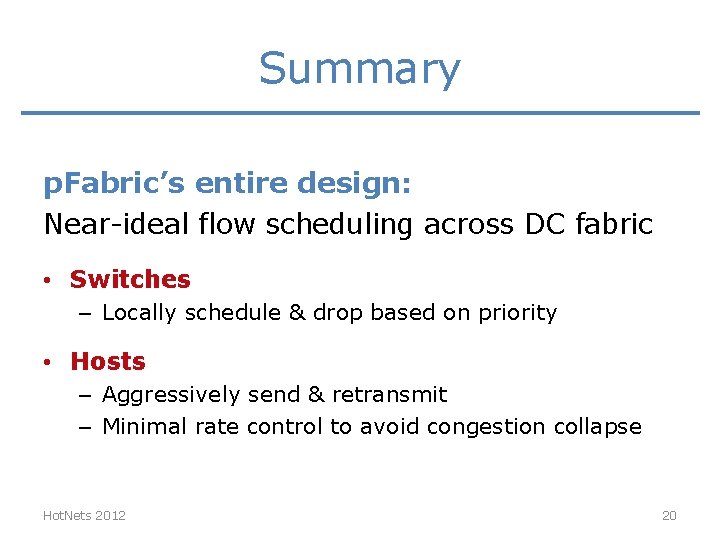
Summary p. Fabric’s entire design: Near-ideal flow scheduling across DC fabric • Switches – Locally schedule & drop based on priority • Hosts – Aggressively send & retransmit – Minimal rate control to avoid congestion collapse Hot. Nets 2012 20
Thank You! Hot. Nets 2012 21
Hot. Nets 2012 22