Decision Trees and their Pruning CART Classific and





- Slides: 17
Decision Trees and their Pruning
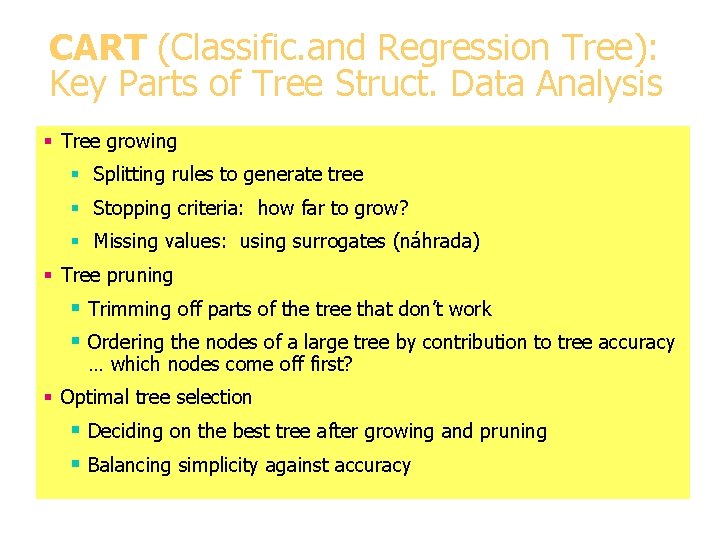
CART (Classific. and Regression Tree): Key Parts of Tree Struct. Data Analysis § Tree growing § Splitting rules to generate tree § Stopping criteria: how far to grow? § Missing values: using surrogates (náhrada) § Tree pruning § Trimming off parts of the tree that don’t work § Ordering the nodes of a large tree by contribution to tree accuracy … which nodes come off first? § Optimal tree selection § Deciding on the best tree after growing and pruning § Balancing simplicity against accuracy
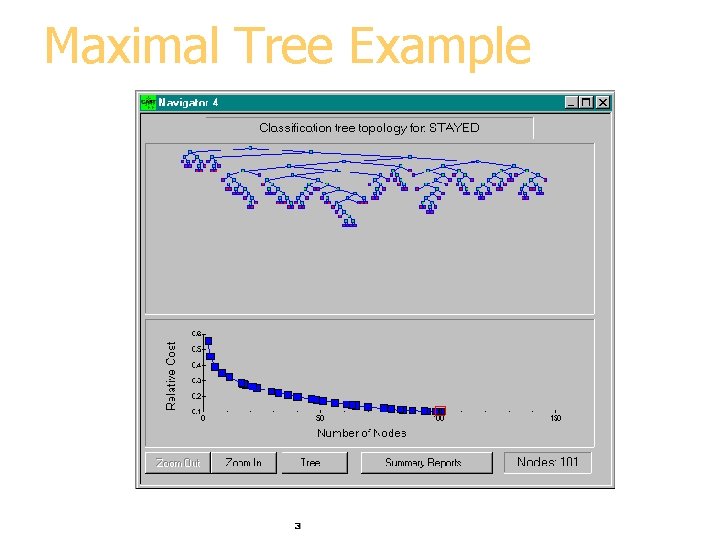
Maximal Tree Example 3
Stopping criteria for growing the tree § All instances in the node belong to the same class § The maximum tree depth has been reached § Size of the data in the node is below a threshold (e. g. 5% of the original dataset) § The best splitting criteria is below a threshold §… 4
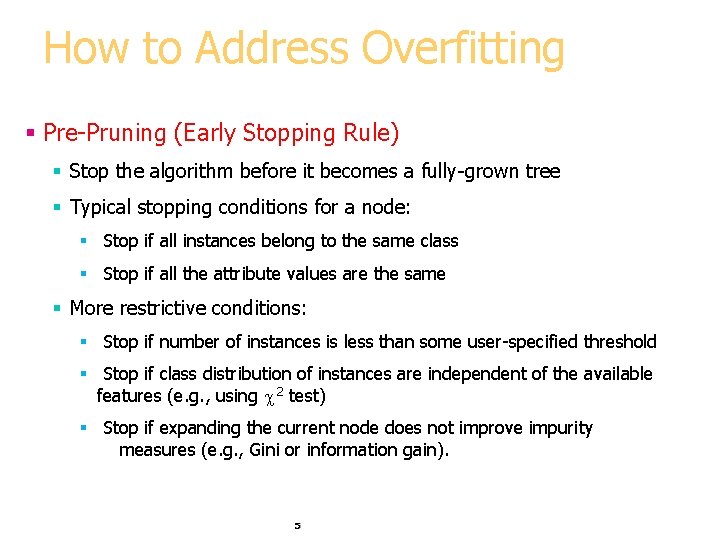
How to Address Overfitting § Pre-Pruning (Early Stopping Rule) § Stop the algorithm before it becomes a fully-grown tree § Typical stopping conditions for a node: § Stop if all instances belong to the same class § Stop if all the attribute values are the same § More restrictive conditions: § Stop if number of instances is less than some user-specified threshold § Stop if class distribution of instances are independent of the available features (e. g. , using 2 test) § Stop if expanding the current node does not improve impurity measures (e. g. , Gini or information gain). 5
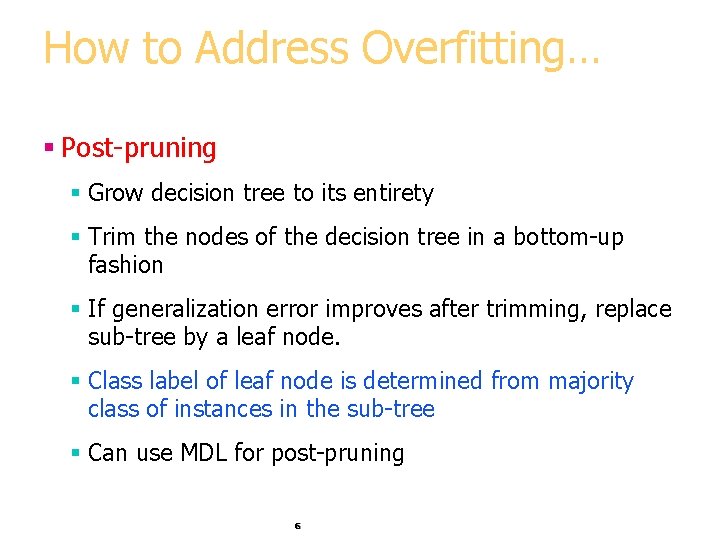
How to Address Overfitting… § Post-pruning § Grow decision tree to its entirety § Trim the nodes of the decision tree in a bottom-up fashion § If generalization error improves after trimming, replace sub-tree by a leaf node. § Class label of leaf node is determined from majority class of instances in the sub-tree § Can use MDL for post-pruning 6
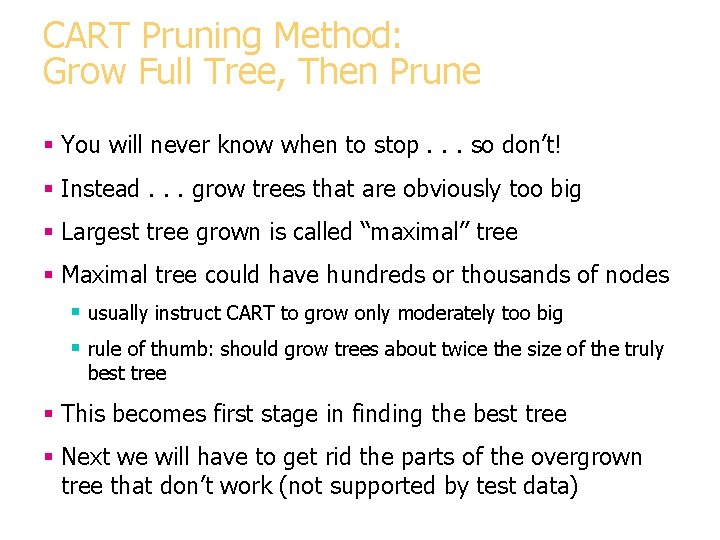
CART Pruning Method: Grow Full Tree, Then Prune § You will never know when to stop. . . so don’t! § Instead. . . grow trees that are obviously too big § Largest tree grown is called “maximal” tree § Maximal tree could have hundreds or thousands of nodes § usually instruct CART to grow only moderately too big § rule of thumb: should grow trees about twice the size of the truly best tree § This becomes first stage in finding the best tree § Next we will have to get rid the parts of the overgrown tree that don’t work (not supported by test data)
Tree Pruning § Take a very large tree (“maximal” tree) § Tree may be radically over-fit § Tracks all the idiosyncrasies of THIS data set § Tracks patterns that may not be found in other data sets § At bottom of tree splits based on very few cases § Analogous to a regression with very large number of variables § PRUNE away branches from this large tree § But which branch to cut first? § CART determines a pruning sequence: § the exact order in which each node should be removed § pruning sequence determined for EVERY node § sequence determined all the way back to root node
Pruning: Which nodes come off next? 9
Order of Pruning: Weakest Link Goes First § Prune away "weakest link" — the nodes that add least to overall accuracy of the tree § contribution to overall tree a function of both increase in accuracy and size of node § accuracy gain is weighted by share of sample § small nodes tend to get removed before large ones ! § If several nodes have same contribution they all prune away simultaneously § Hence more than two terminal nodes could be cut off in one pruning § Sequence determined all the way back to root node § need to allow for possibility that entire tree is bad § if target variable is unpredictable we will want to prune back to root. . . the no model solution
Pruning Sequence Example 24 Terminal Nodes 21 Terminal Nodes 20 Terminal Nodes 11 18 Terminal Nodes
Now we test every tree in the pruning sequence § Take a test data set and drop it down the largest tree in the sequence and measure its predictive accuracy § how many cases right and how many wrong § measure accuracy overall and by class § Do same for 2 nd largest tree, 3 rd largest tree, etc § Performance of every tree in sequence is measured § Results reported in table and graph formats § Note that this critical stage is impossible to complete without test data § CART procedure requires test data to guide tree evaluation 12
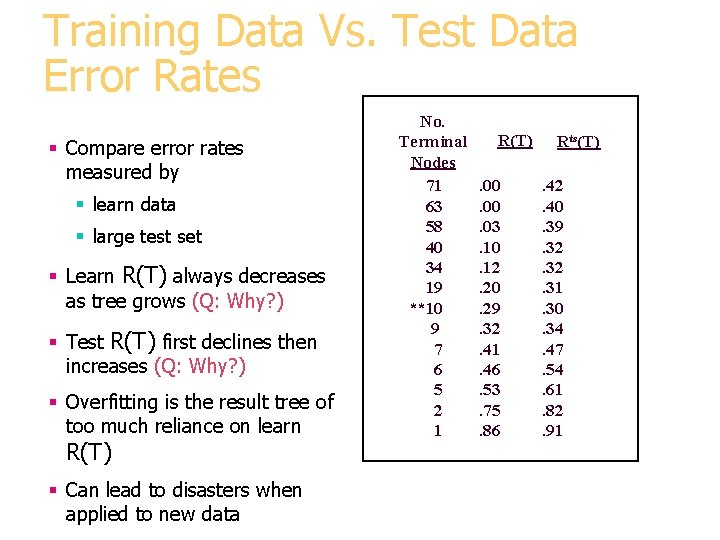
Training Data Vs. Test Data Error Rates § Compare error rates measured by § learn data § large test set § Learn R(T) always decreases as tree grows (Q: Why? ) § Test R(T) first declines then increases (Q: Why? ) § Overfitting is the result tree of too much reliance on learn R(T) § Can lead to disasters when applied to new data No. Terminal Nodes 71 63 58 40 34 19 **10 9 7 6 5 2 1 R(T). 00. 03. 10. 12. 20. 29. 32. 41. 46. 53. 75. 86 Rts(T). 42. 40. 39. 32. 31. 30. 34. 47. 54. 61. 82. 91
Why look at training data error rates (or cost) at all? § First, provides a rough guide of how you are doing § Truth will typically be WORSE than training data measure § If tree performing poorly on training data error may not want to pursue further § Training data error rate more accurate for smaller trees § So reasonable guide for smaller trees § Poor guide for larger trees § At optimal tree training and test error rates should be similar § if not something is wrong § useful to compare not just overall error rate but also within node performance between training and test data
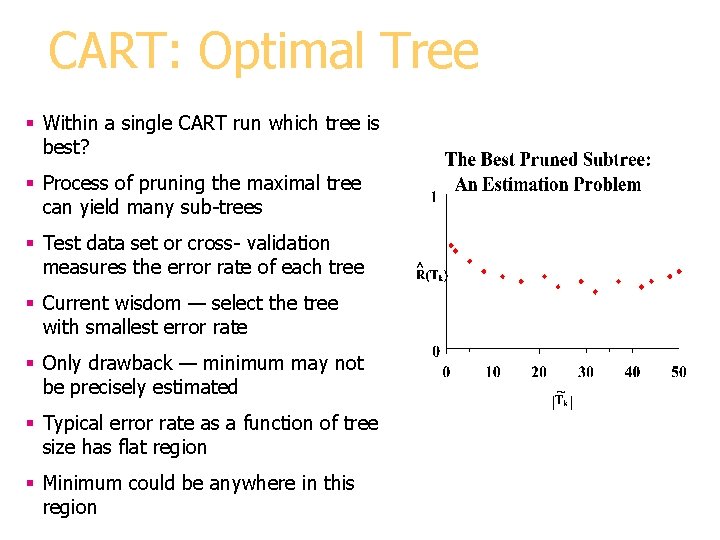
CART: Optimal Tree § Within a single CART run which tree is best? § Process of pruning the maximal tree can yield many sub-trees § Test data set or cross- validation measures the error rate of each tree § Current wisdom — select the tree with smallest error rate § Only drawback — minimum may not be precisely estimated § Typical error rate as a function of tree size has flat region § Minimum could be anywhere in this region
In what sense is the optimal tree “best”? § Optimal tree has lowest or near lowest cost as determined by a test procedure § Tree should exhibit very similar accuracy when applied to new data § BUT Best Tree is NOT necessarily the one that happens to be most accurate on a single test database § trees somewhat larger or smaller than “optimal” may be preferred § Room for user judgment § judgment not about split variable or values § judgment as to how much of tree to keep § determined by story tree is telling § willingness to sacrifice a small amount of accuracy for simplicity
Decision Tree Summary § Decision Trees § splits – binary, multi-way § split criteria – entropy, gini, … § missing value treatment § pruning § rule extraction from trees § Both C 4. 5 and CART are robust tools § No method is always superior – experiment! witten & eibe 17