
How to Prune Trees Introduction The objective of
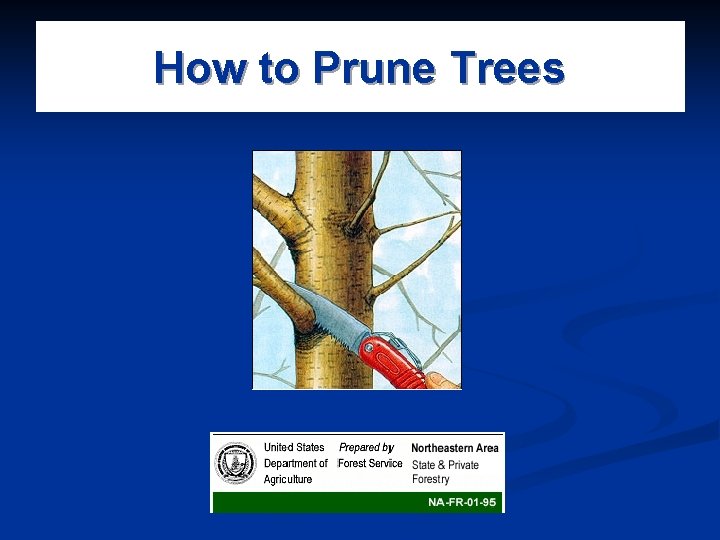
How to Prune Trees
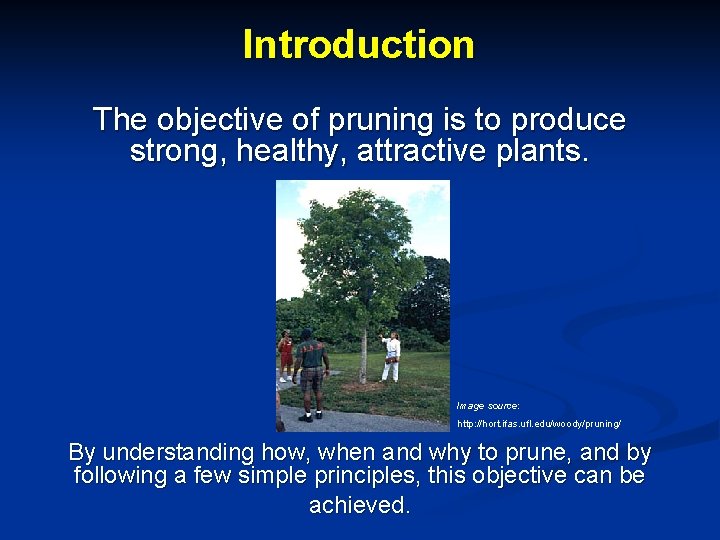
Introduction The objective of pruning is to produce strong, healthy, attractive plants. Image source: http: //hort. ifas. ufl. edu/woody/pruning/ By understanding how, when and why to prune, and by following a few simple principles, this objective can be achieved.
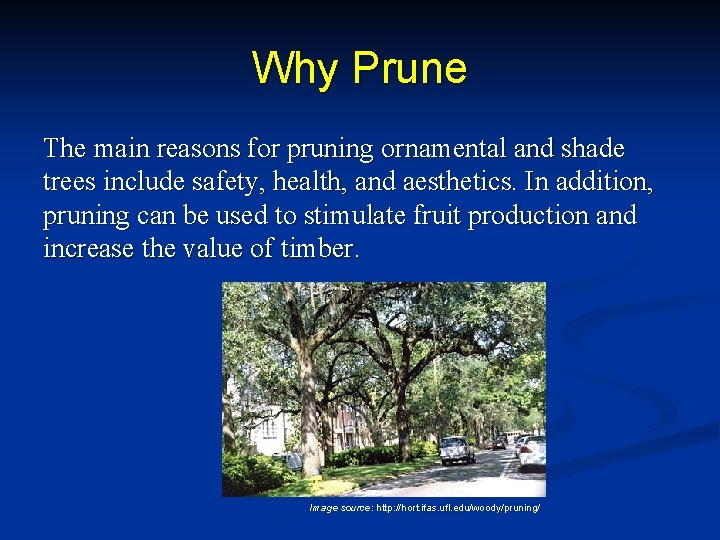
Why Prune The main reasons for pruning ornamental and shade trees include safety, health, and aesthetics. In addition, pruning can be used to stimulate fruit production and increase the value of timber. Image source: http: //hort. ifas. ufl. edu/woody/pruning/
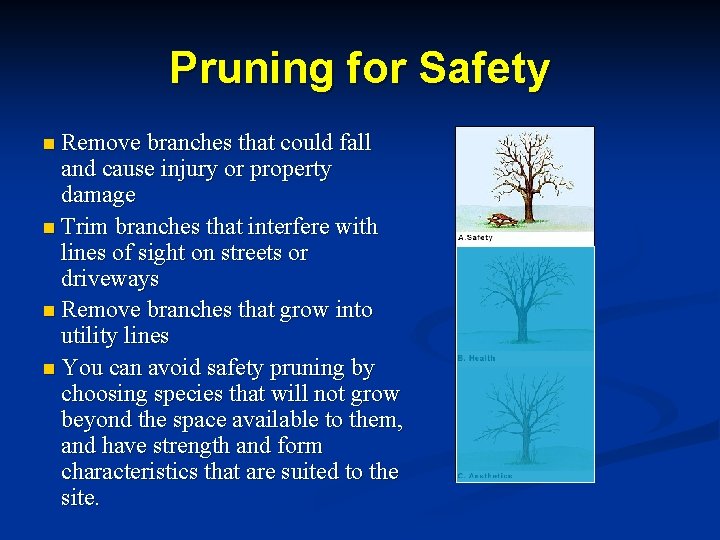
Pruning for Safety n Remove branches that could fall and cause injury or property damage n Trim branches that interfere with lines of sight on streets or driveways n Remove branches that grow into utility lines n You can avoid safety pruning by choosing species that will not grow beyond the space available to them, and have strength and form characteristics that are suited to the site.
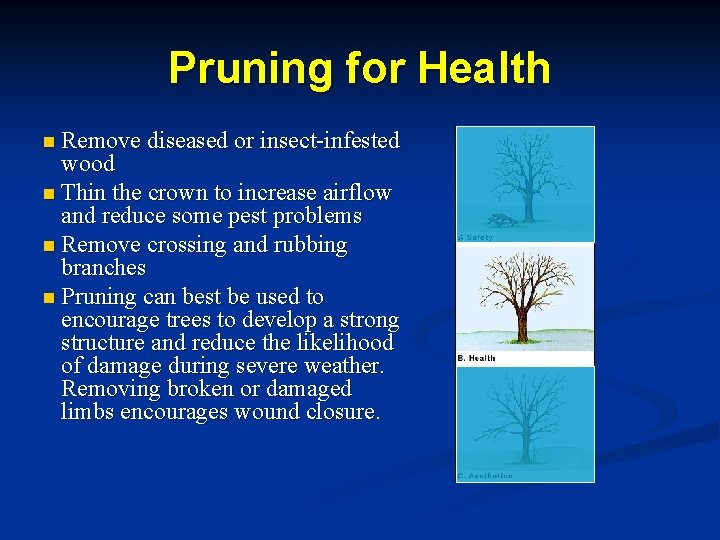
Pruning for Health n Remove diseased or insect-infested wood n Thin the crown to increase airflow and reduce some pest problems n Remove crossing and rubbing branches n Pruning can best be used to encourage trees to develop a strong structure and reduce the likelihood of damage during severe weather. Removing broken or damaged limbs encourages wound closure.
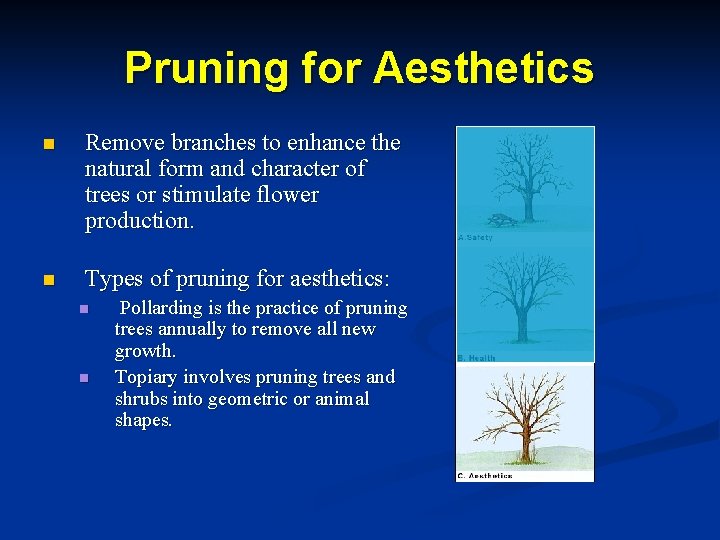
Pruning for Aesthetics n Remove branches to enhance the natural form and character of trees or stimulate flower production. n Types of pruning for aesthetics: n n Pollarding is the practice of pruning trees annually to remove all new growth. Topiary involves pruning trees and shrubs into geometric or animal shapes.
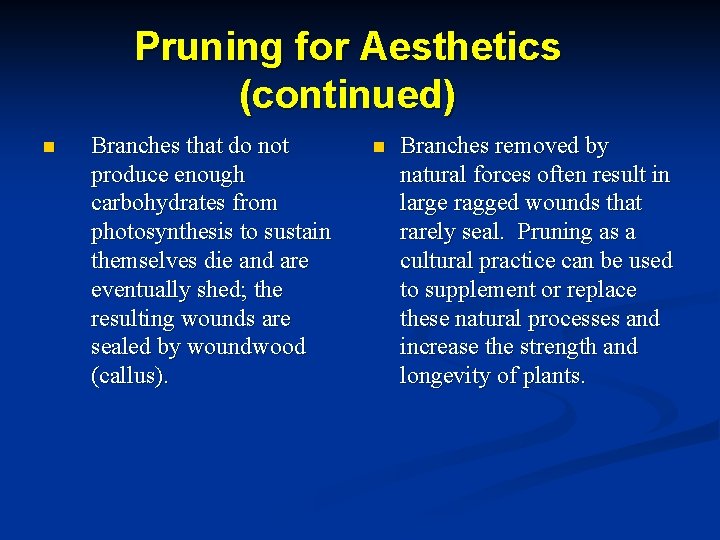
Pruning for Aesthetics (continued) n Branches that do not produce enough carbohydrates from photosynthesis to sustain themselves die and are eventually shed; the resulting wounds are sealed by woundwood (callus). n Branches removed by natural forces often result in large ragged wounds that rarely seal. Pruning as a cultural practice can be used to supplement or replace these natural processes and increase the strength and longevity of plants.
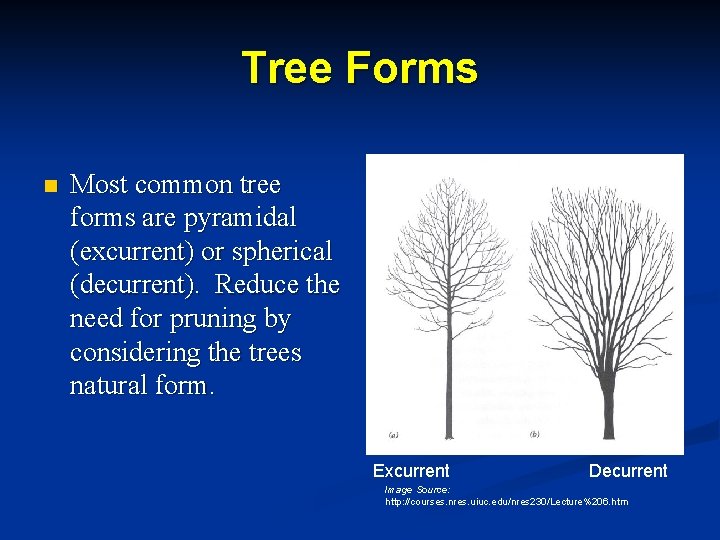
Tree Forms n Most common tree forms are pyramidal (excurrent) or spherical (decurrent). Reduce the need for pruning by considering the trees natural form. Excurrent Decurrent Image Source: http: //courses. nres. uiuc. edu/nres 230/Lecture%206. htm
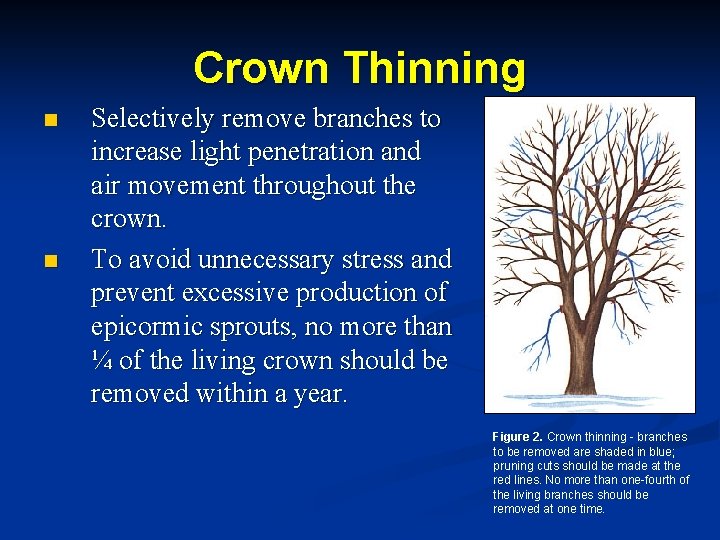
Crown Thinning n n Selectively remove branches to increase light penetration and air movement throughout the crown. To avoid unnecessary stress and prevent excessive production of epicormic sprouts, no more than ¼ of the living crown should be removed within a year. Figure 2. Crown thinning - branches to be removed are shaded in blue; pruning cuts should be made at the red lines. No more than one-fourth of the living branches should be removed at one time.
Crown Thinning n Avoid producing “lion’s tails, ” tufts of branches and foliage at the ends of branches, caused by removing all inner lateral branches and foliage. Lion’s tails can result in sun scalding, abundant epicormic sprouts, and weak branch structure and breakage. Branches that rub or cross another branch should be removed.
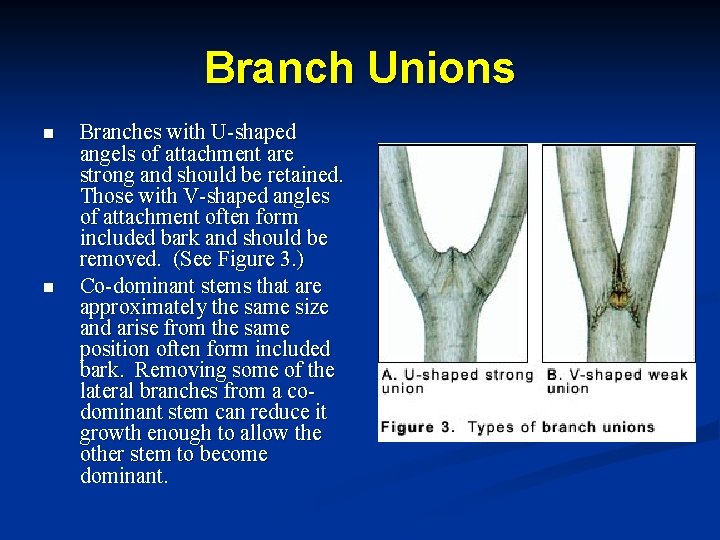
Branch Unions n n Branches with U-shaped angels of attachment are strong and should be retained. Those with V-shaped angles of attachment often form included bark and should be removed. (See Figure 3. ) Co-dominant stems that are approximately the same size and arise from the same position often form included bark. Removing some of the lateral branches from a codominant stem can reduce it growth enough to allow the other stem to become dominant.

Conifers n Conifers rarely need crown thinning. Occasionally, the leader of a tree may be damaged and multiple branches may become codominant. Select the strongest leader and remove competing branches to prevent the development of co-dominant stems. Image source: http: //www. br. fgov. be/PUBLIC/IMAGES/conifer. jpg
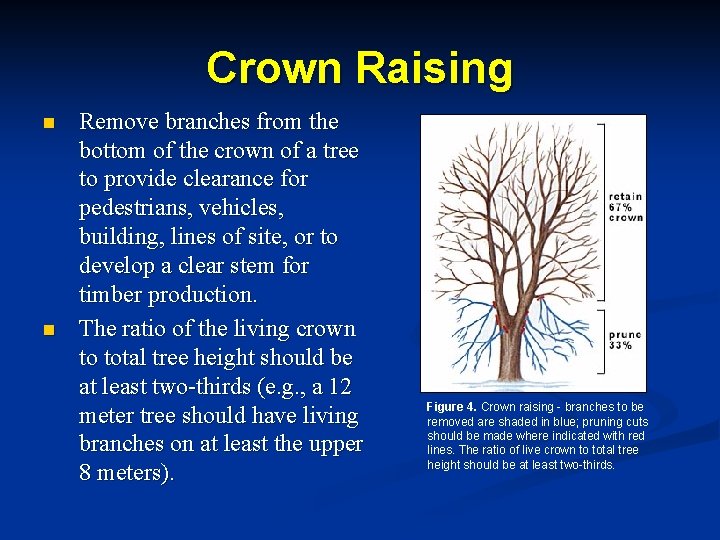
Crown Raising n n Remove branches from the bottom of the crown of a tree to provide clearance for pedestrians, vehicles, building, lines of site, or to develop a clear stem for timber production. The ratio of the living crown to total tree height should be at least two-thirds (e. g. , a 12 meter tree should have living branches on at least the upper 8 meters). Figure 4. Crown raising - branches to be removed are shaded in blue; pruning cuts should be made where indicated with red lines. The ratio of live crown to total tree height should be at least two-thirds.
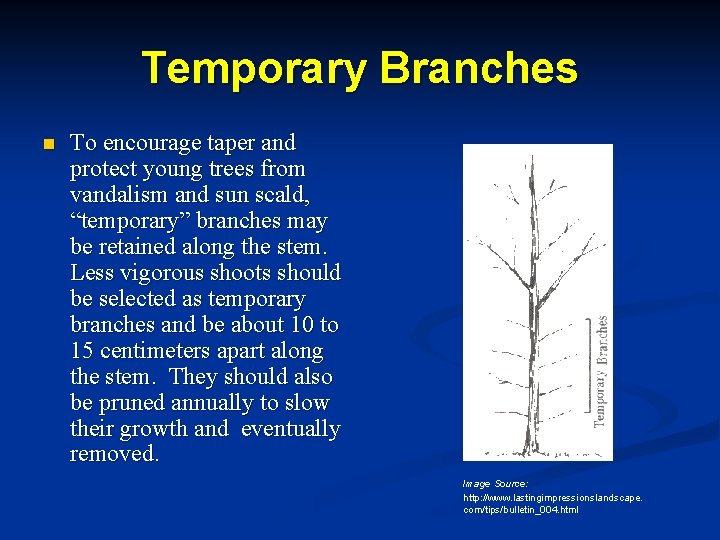
Temporary Branches n To encourage taper and protect young trees from vandalism and sun scald, “temporary” branches may be retained along the stem. Less vigorous shoots should be selected as temporary branches and be about 10 to 15 centimeters apart along the stem. They should also be pruned annually to slow their growth and eventually removed. Image Source: http: //www. lastingimpressionslandscape. com/tips/bulletin_004. html
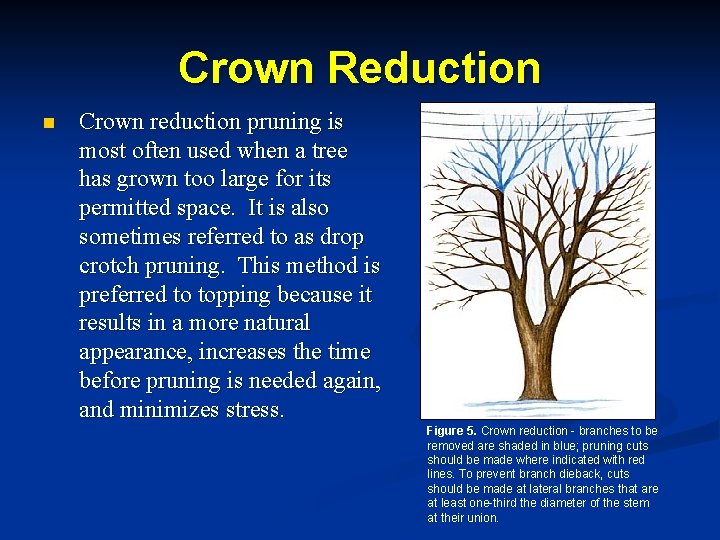
Crown Reduction n Crown reduction pruning is most often used when a tree has grown too large for its permitted space. It is also sometimes referred to as drop crotch pruning. This method is preferred to topping because it results in a more natural appearance, increases the time before pruning is needed again, and minimizes stress. Figure 5. Crown reduction - branches to be removed are shaded in blue; pruning cuts should be made where indicated with red lines. To prevent branch dieback, cuts should be made at lateral branches that are at least one-third the diameter of the stem at their union.
Crown Reduction This method should never be used on trees with pyramidal growth forms. A better long term solution is to remove the tree and replace it with a tree that will not grow beyond the available space. n Use this method as a last resort since it often times results in large pruning wounds to stems that may lead to decay. n
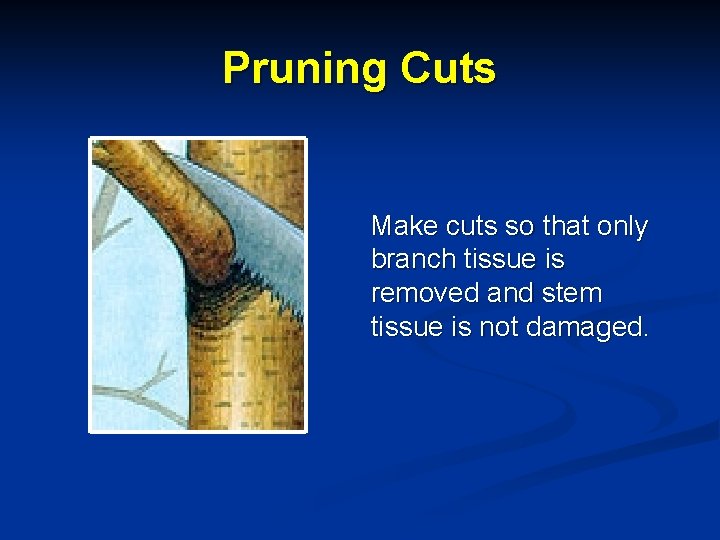
Pruning Cuts Make cuts so that only branch tissue is removed and stem tissue is not damaged.
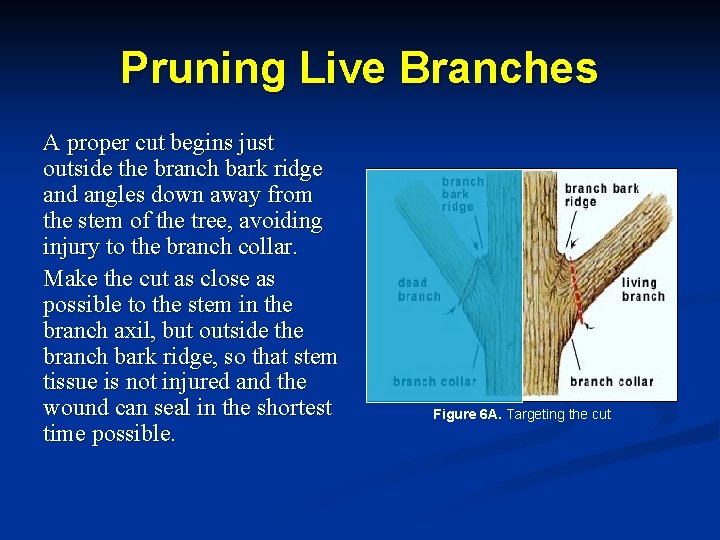
Pruning Live Branches A proper cut begins just outside the branch bark ridge and angles down away from the stem of the tree, avoiding injury to the branch collar. Make the cut as close as possible to the stem in the branch axil, but outside the branch bark ridge, so that stem tissue is not injured and the wound can seal in the shortest time possible. Figure 6 A. Targeting the cut
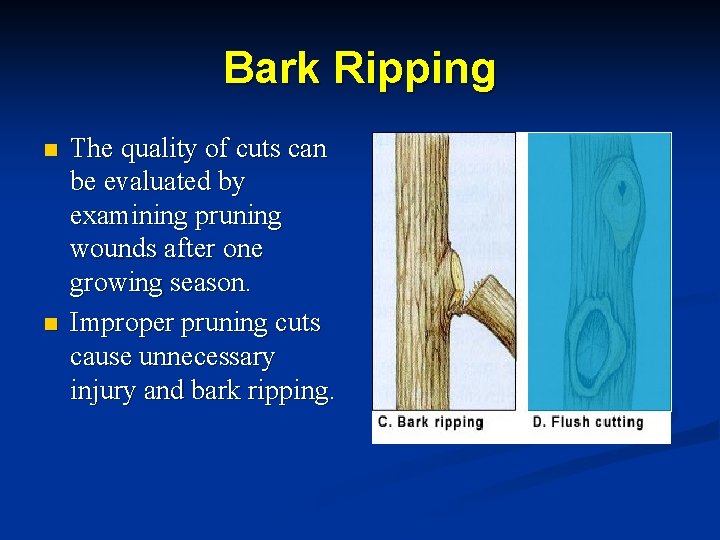
Bark Ripping n n The quality of cuts can be evaluated by examining pruning wounds after one growing season. Improper pruning cuts cause unnecessary injury and bark ripping.
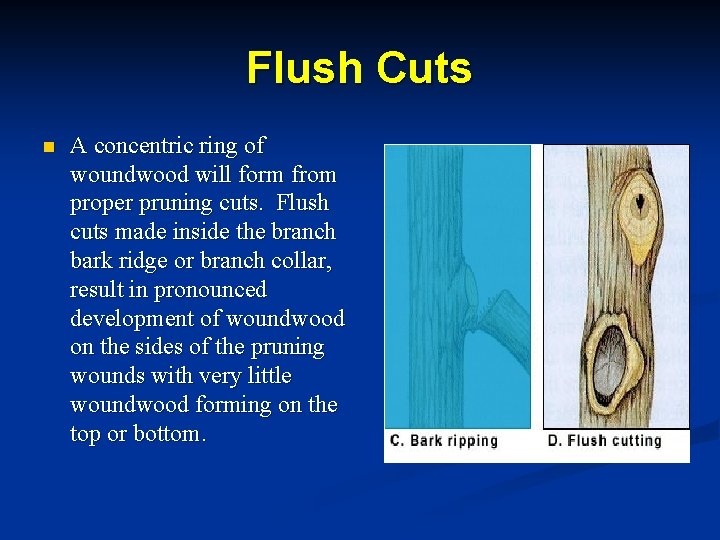
Flush Cuts n A concentric ring of woundwood will form from proper pruning cuts. Flush cuts made inside the branch bark ridge or branch collar, result in pronounced development of woundwood on the sides of the pruning wounds with very little woundwood forming on the top or bottom.
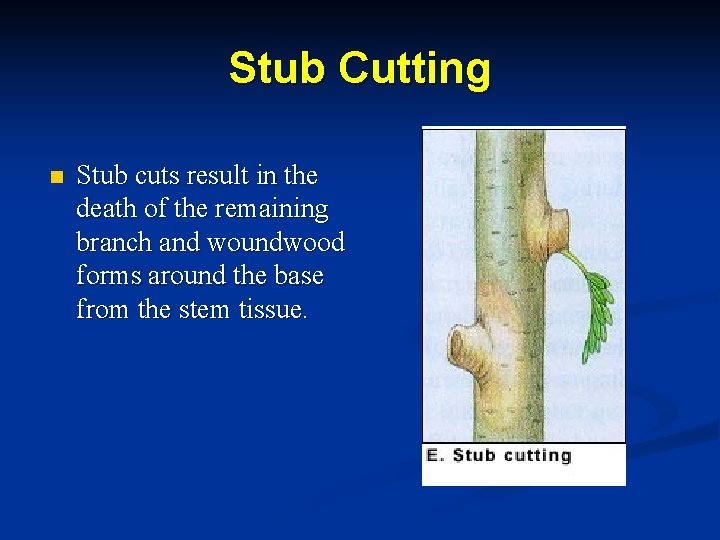
Stub Cutting n Stub cuts result in the death of the remaining branch and woundwood forms around the base from the stem tissue.
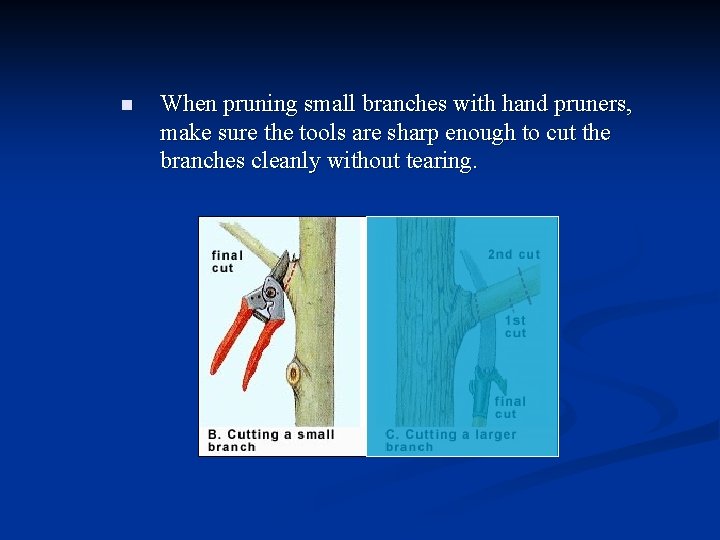
n When pruning small branches with hand pruners, make sure the tools are sharp enough to cut the branches cleanly without tearing.
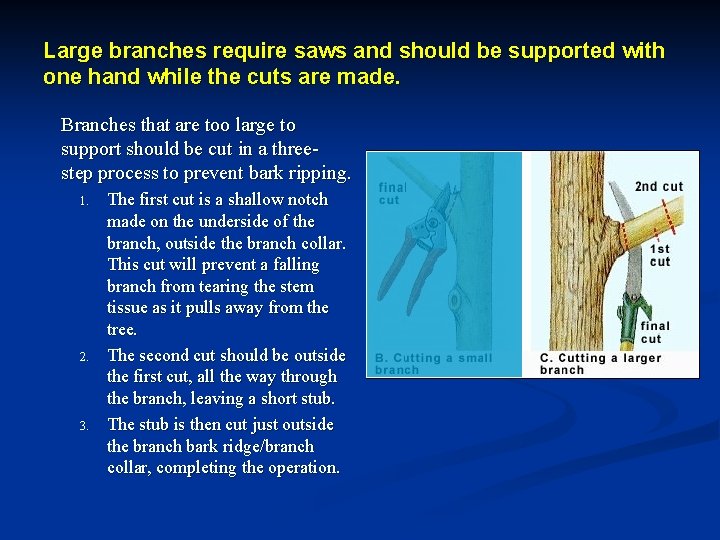
Large branches require saws and should be supported with one hand while the cuts are made. Branches that are too large to support should be cut in a threestep process to prevent bark ripping. 1. 2. 3. The first cut is a shallow notch made on the underside of the branch, outside the branch collar. This cut will prevent a falling branch from tearing the stem tissue as it pulls away from the tree. The second cut should be outside the first cut, all the way through the branch, leaving a short stub. The stub is then cut just outside the branch bark ridge/branch collar, completing the operation.
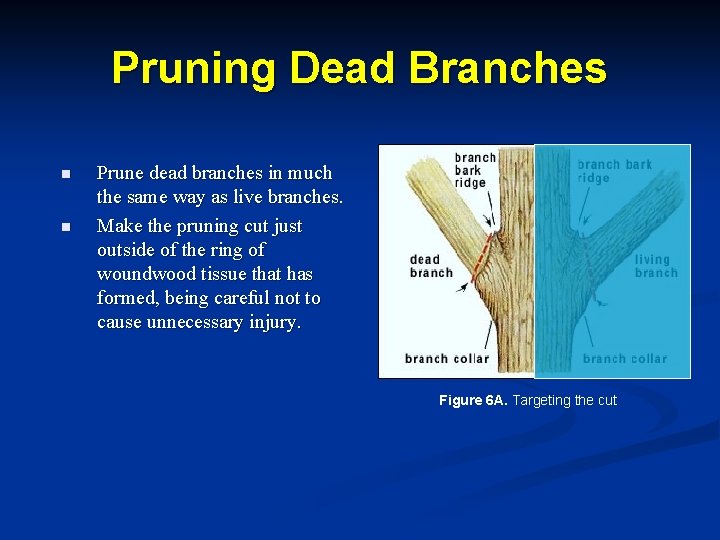
Pruning Dead Branches n n Prune dead branches in much the same way as live branches. Make the pruning cut just outside of the ring of woundwood tissue that has formed, being careful not to cause unnecessary injury. Figure 6 A. Targeting the cut
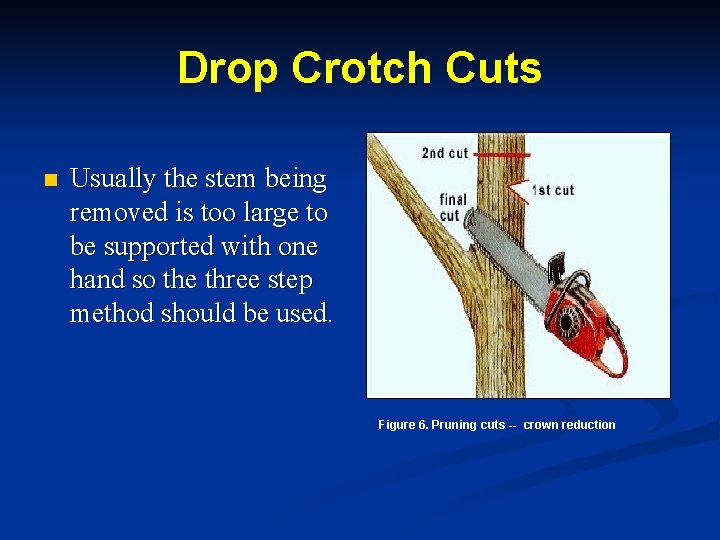
Drop Crotch Cuts n Usually the stem being removed is too large to be supported with one hand so the three step method should be used. Figure 6. Pruning cuts -- crown reduction
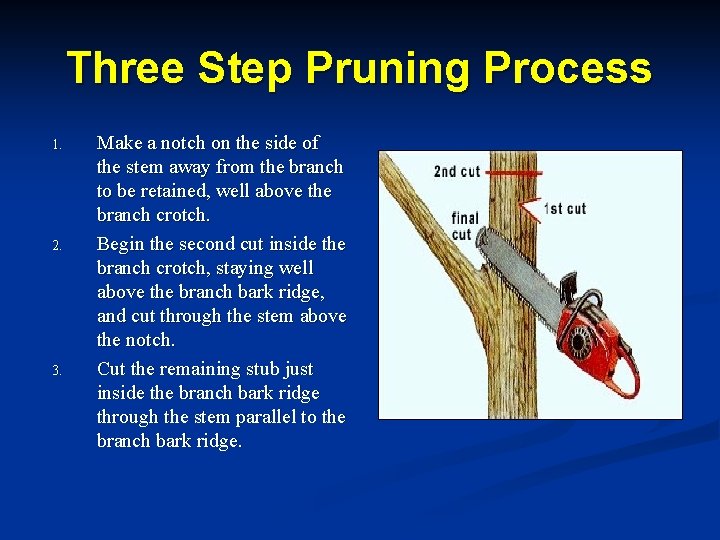
Three Step Pruning Process 1. 2. 3. Make a notch on the side of the stem away from the branch to be retained, well above the branch crotch. Begin the second cut inside the branch crotch, staying well above the branch bark ridge, and cut through the stem above the notch. Cut the remaining stub just inside the branch bark ridge through the stem parallel to the branch bark ridge.
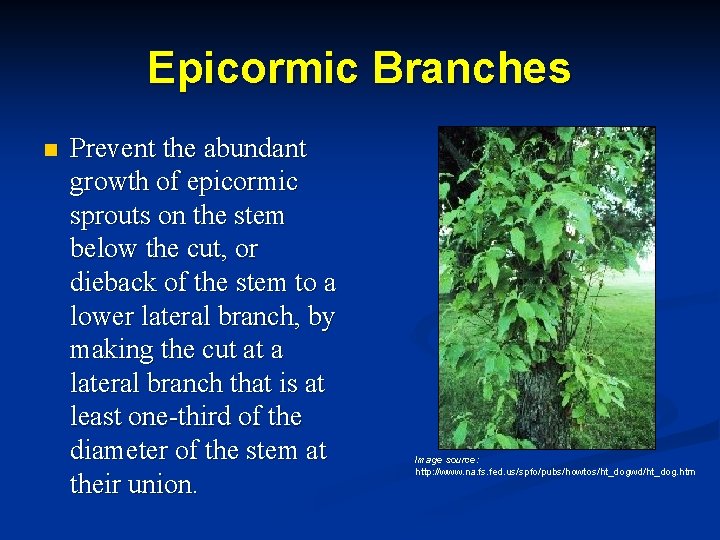
Epicormic Branches n Prevent the abundant growth of epicormic sprouts on the stem below the cut, or dieback of the stem to a lower lateral branch, by making the cut at a lateral branch that is at least one-third of the diameter of the stem at their union. Image source: http: //www. na. fs. fed. us/spfo/pubs/howtos/ht_dogwd/ht_dog. htm
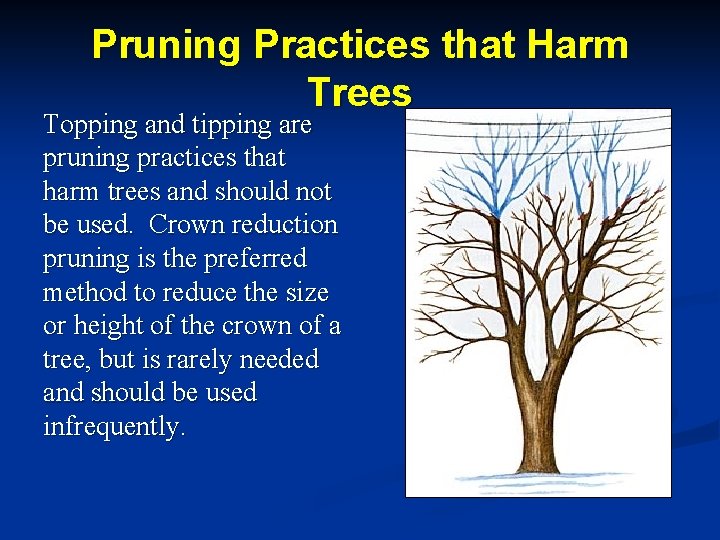
Pruning Practices that Harm Trees Topping and tipping are pruning practices that harm trees and should not be used. Crown reduction pruning is the preferred method to reduce the size or height of the crown of a tree, but is rarely needed and should be used infrequently.
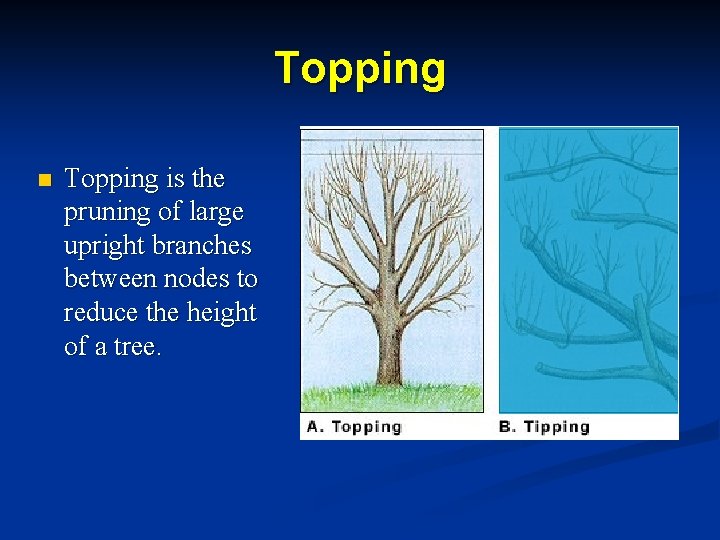
Topping n Topping is the pruning of large upright branches between nodes to reduce the height of a tree.
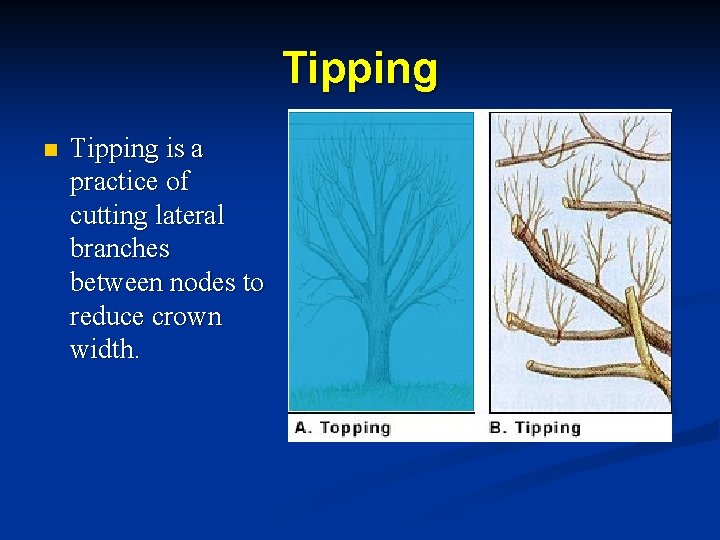
Tipping n Tipping is a practice of cutting lateral branches between nodes to reduce crown width.
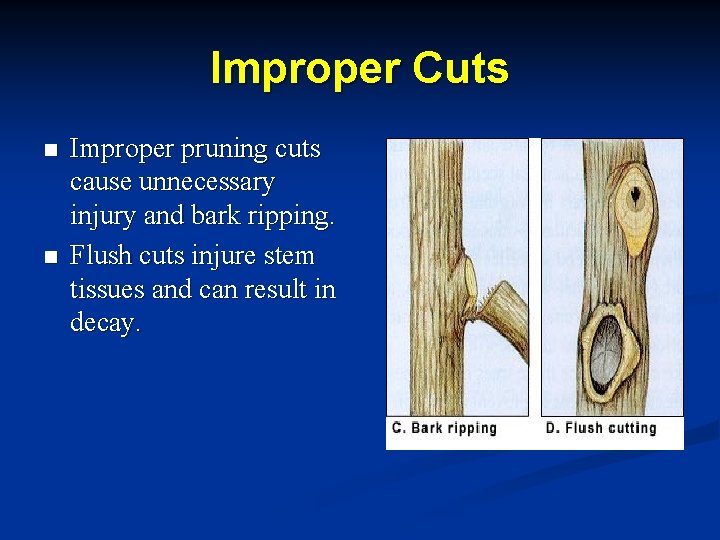
Improper Cuts n n Improper pruning cuts cause unnecessary injury and bark ripping. Flush cuts injure stem tissues and can result in decay.
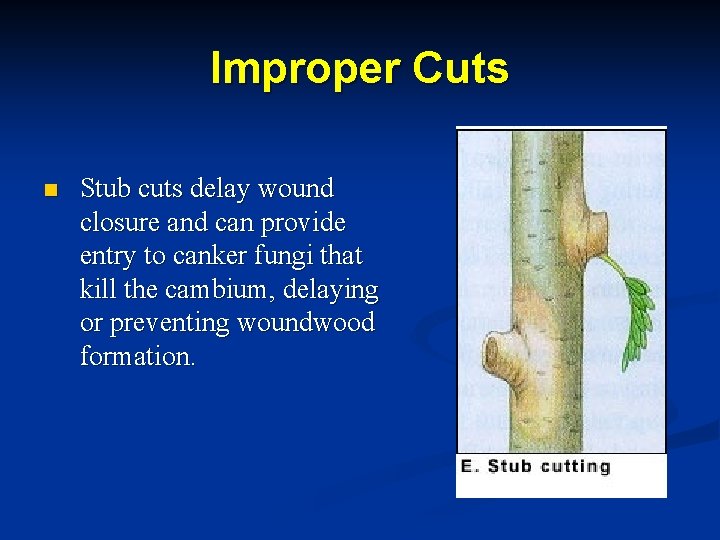
Improper Cuts n Stub cuts delay wound closure and can provide entry to canker fungi that kill the cambium, delaying or preventing woundwood formation.
When to Prune n n Conifers may be pruned any time of year, but pruning during the dormant season may minimize sap and resin flow from cut branches. Dead branches, of any species, can be removed any time of the year.
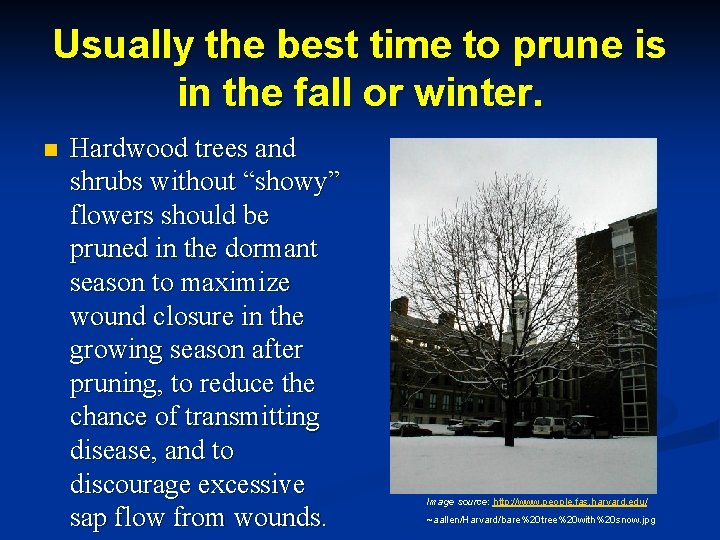
Usually the best time to prune is in the fall or winter. n Hardwood trees and shrubs without “showy” flowers should be pruned in the dormant season to maximize wound closure in the growing season after pruning, to reduce the chance of transmitting disease, and to discourage excessive sap flow from wounds. Image source: http: //www. people. fas. harvard. edu/ ~aallen/Harvard/bare%20 tree%20 with%20 snow. jpg
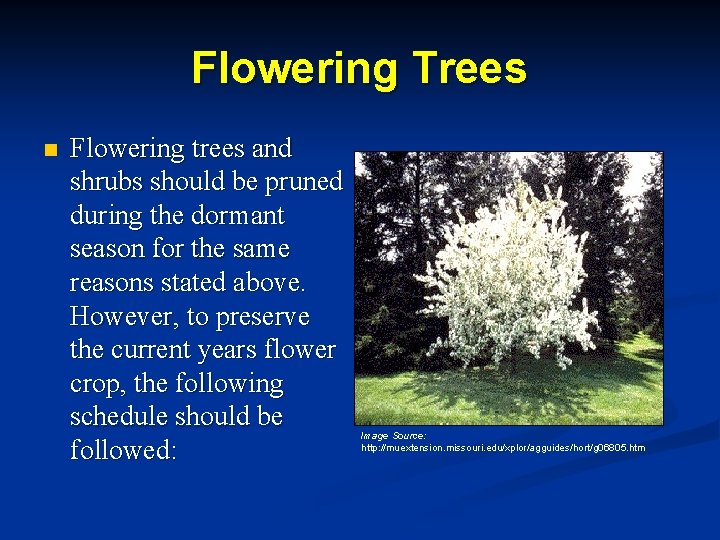
Flowering Trees n Flowering trees and shrubs should be pruned during the dormant season for the same reasons stated above. However, to preserve the current years flower crop, the following schedule should be followed: Image Source: http: //muextension. missouri. edu/xplor/agguides/hort/g 06805. htm
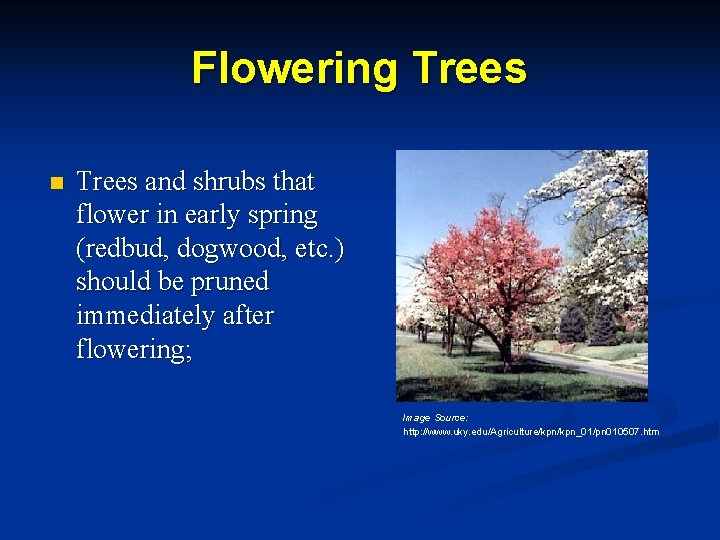
Flowering Trees n Trees and shrubs that flower in early spring (redbud, dogwood, etc. ) should be pruned immediately after flowering; Image Source: http: //www. uky. edu/Agriculture/kpn_01/pn 010507. htm
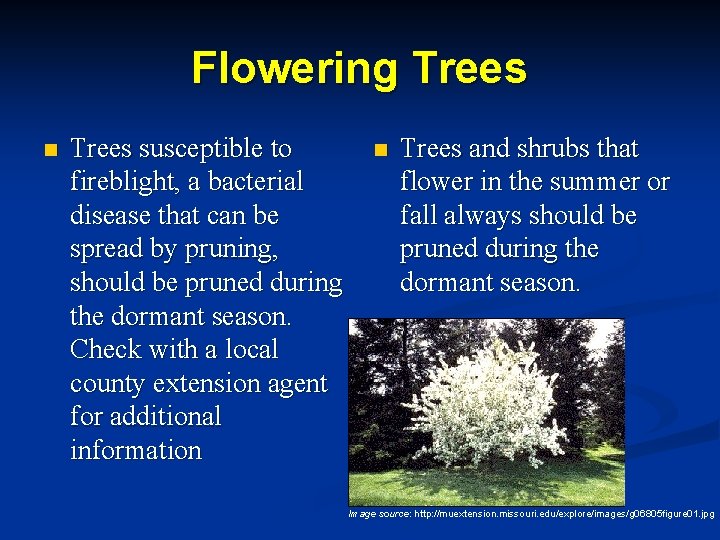
Flowering Trees n Trees susceptible to fireblight, a bacterial disease that can be spread by pruning, should be pruned during the dormant season. Check with a local county extension agent for additional information n Trees and shrubs that flower in the summer or fall always should be pruned during the dormant season. Image source: http: //muextension. missouri. edu/explore/images/g 06805 figure 01. jpg
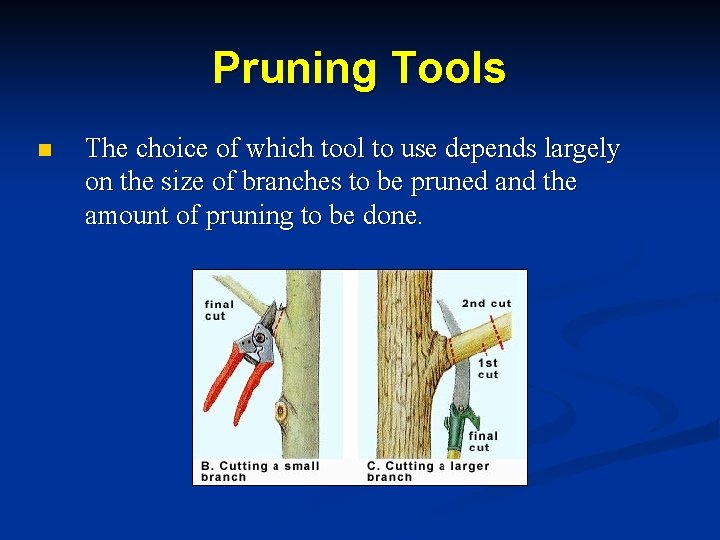
Pruning Tools n The choice of which tool to use depends largely on the size of branches to be pruned and the amount of pruning to be done.
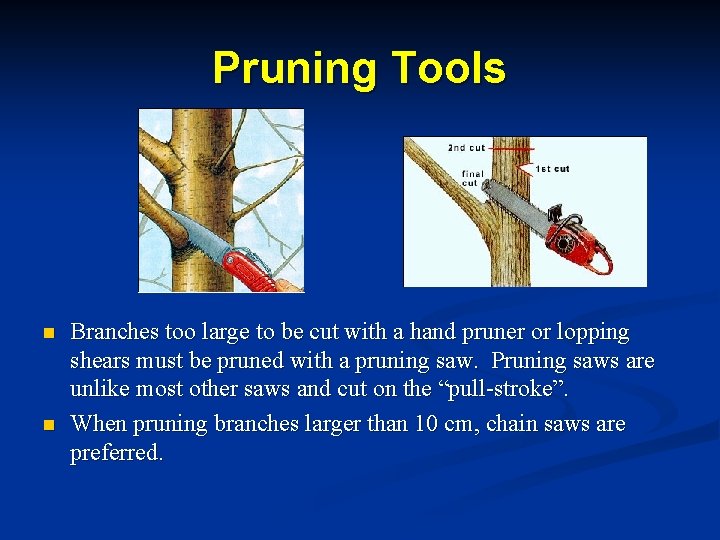
Pruning Tools n n Branches too large to be cut with a hand pruner or lopping shears must be pruned with a pruning saw. Pruning saws are unlike most other saws and cut on the “pull-stroke”. When pruning branches larger than 10 cm, chain saws are preferred.
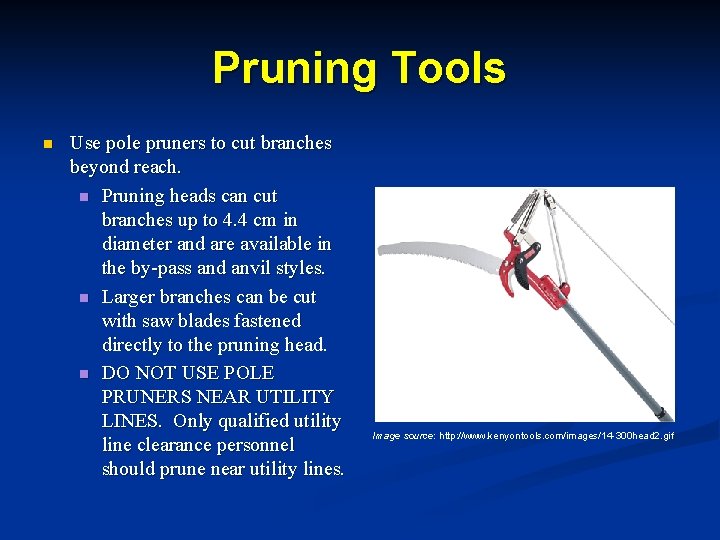
Pruning Tools n Use pole pruners to cut branches beyond reach. n Pruning heads can cut branches up to 4. 4 cm in diameter and are available in the by-pass and anvil styles. n Larger branches can be cut with saw blades fastened directly to the pruning head. n DO NOT USE POLE PRUNERS NEAR UTILITY LINES. Only qualified utility line clearance personnel should prune near utility lines. Image source: http: //www. kenyontools. com/images/14 -300 head 2. gif
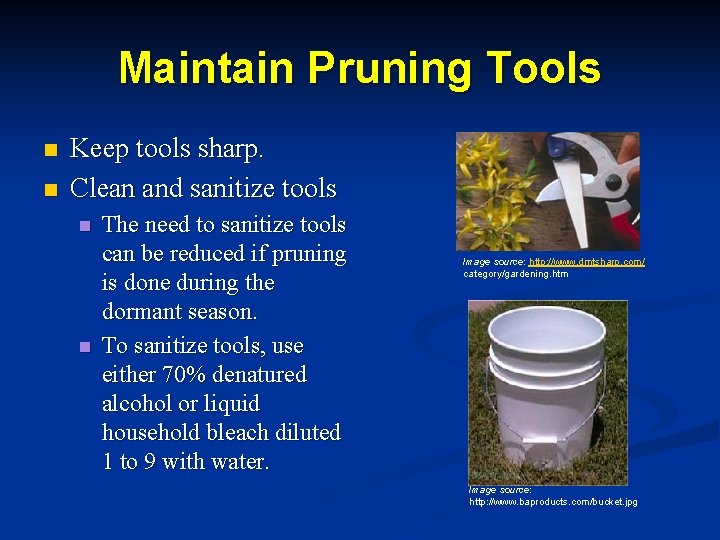
Maintain Pruning Tools n n Keep tools sharp. Clean and sanitize tools n n The need to sanitize tools can be reduced if pruning is done during the dormant season. To sanitize tools, use either 70% denatured alcohol or liquid household bleach diluted 1 to 9 with water. Image source: http: //www. dmtsharp. com/ category/gardening. htm Image source: http: //www. baproducts. com/bucket. jpg
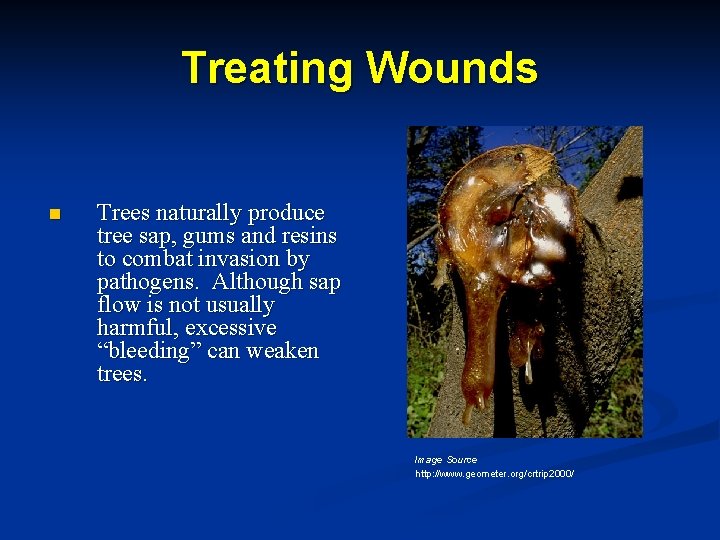
Treating Wounds n Trees naturally produce tree sap, gums and resins to combat invasion by pathogens. Although sap flow is not usually harmful, excessive “bleeding” can weaken trees. Image Source http: //www. geometer. org/crtrip 2000/
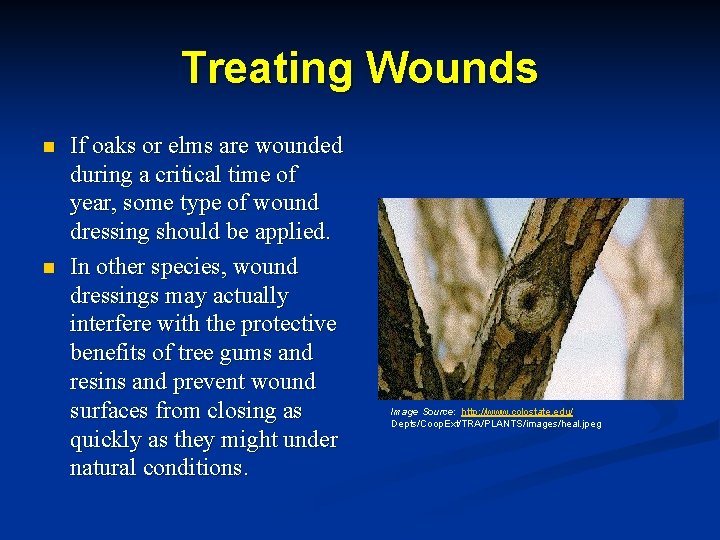
Treating Wounds n n If oaks or elms are wounded during a critical time of year, some type of wound dressing should be applied. In other species, wound dressings may actually interfere with the protective benefits of tree gums and resins and prevent wound surfaces from closing as quickly as they might under natural conditions. Image Source: http: //www. colostate. edu/ Depts/Coop. Ext/TRA/PLANTS/images/heal. jpeg
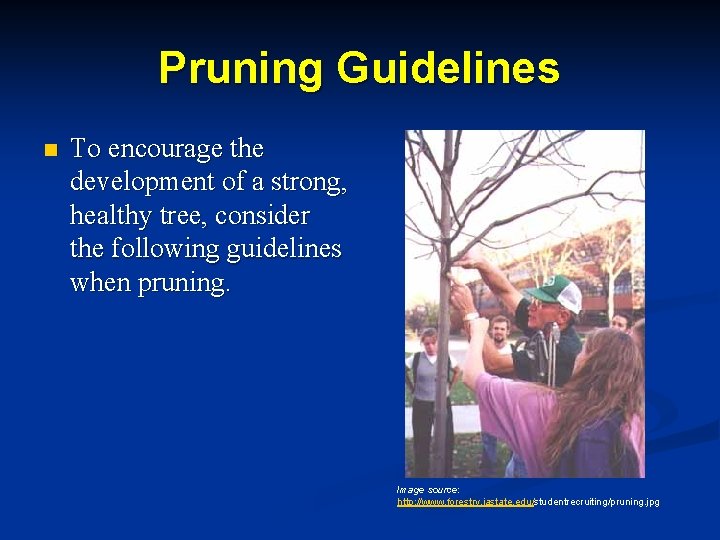
Pruning Guidelines n To encourage the development of a strong, healthy tree, consider the following guidelines when pruning. Image source: http: //www. forestry. iastate. edu/studentrecruiting/pruning. jpg
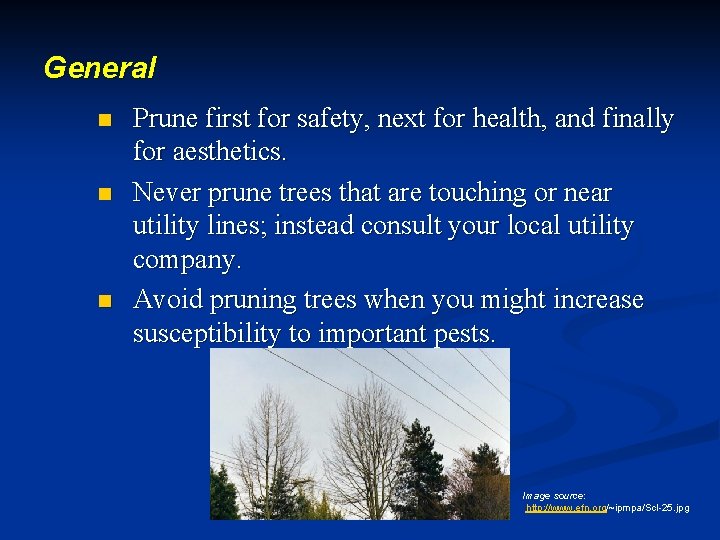
General n n n Prune first for safety, next for health, and finally for aesthetics. Never prune trees that are touching or near utility lines; instead consult your local utility company. Avoid pruning trees when you might increase susceptibility to important pests. Image source: http: //www. efn. org/~ipmpa/Scl-25. jpg
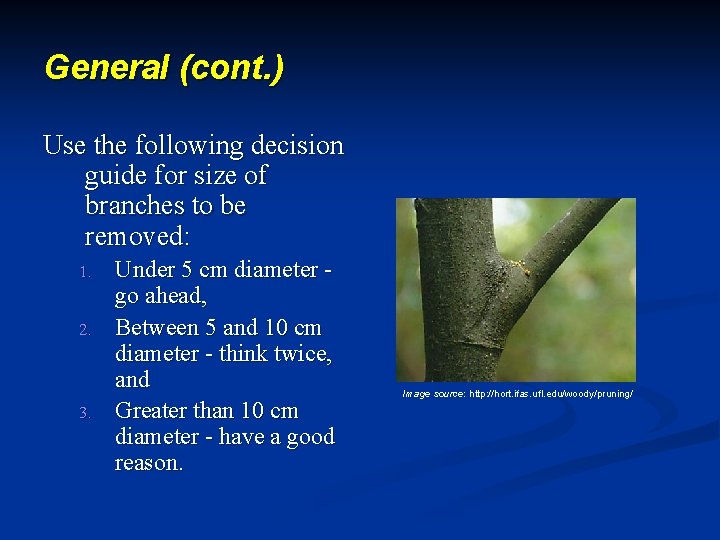
General (cont. ) Use the following decision guide for size of branches to be removed: 1. 2. 3. Under 5 cm diameter go ahead, Between 5 and 10 cm diameter - think twice, and Greater than 10 cm diameter - have a good reason. Image source: http: //hort. ifas. ufl. edu/woody/pruning/
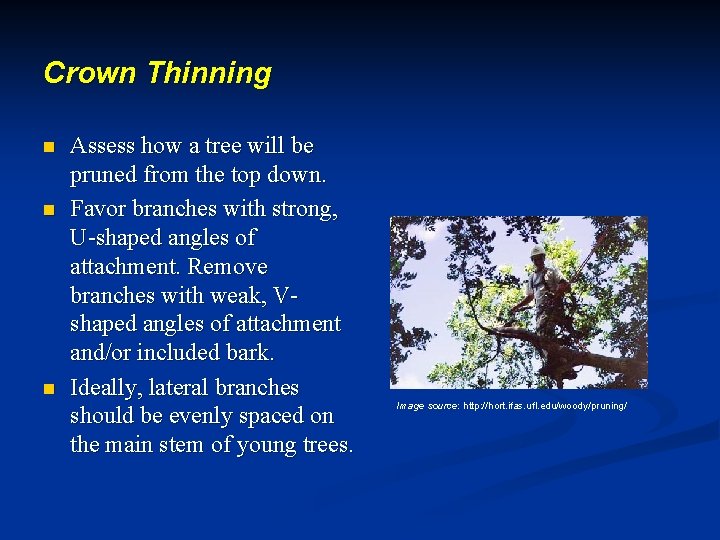
Crown Thinning n n n Assess how a tree will be pruned from the top down. Favor branches with strong, U-shaped angles of attachment. Remove branches with weak, Vshaped angles of attachment and/or included bark. Ideally, lateral branches should be evenly spaced on the main stem of young trees. Image source: http: //hort. ifas. ufl. edu/woody/pruning/
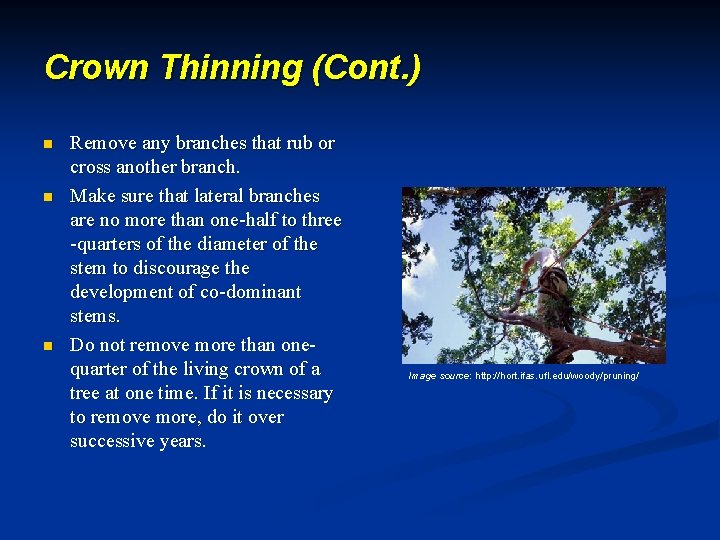
Crown Thinning (Cont. ) n n n Remove any branches that rub or cross another branch. Make sure that lateral branches are no more than one-half to three -quarters of the diameter of the stem to discourage the development of co-dominant stems. Do not remove more than onequarter of the living crown of a tree at one time. If it is necessary to remove more, do it over successive years. Image source: http: //hort. ifas. ufl. edu/woody/pruning/
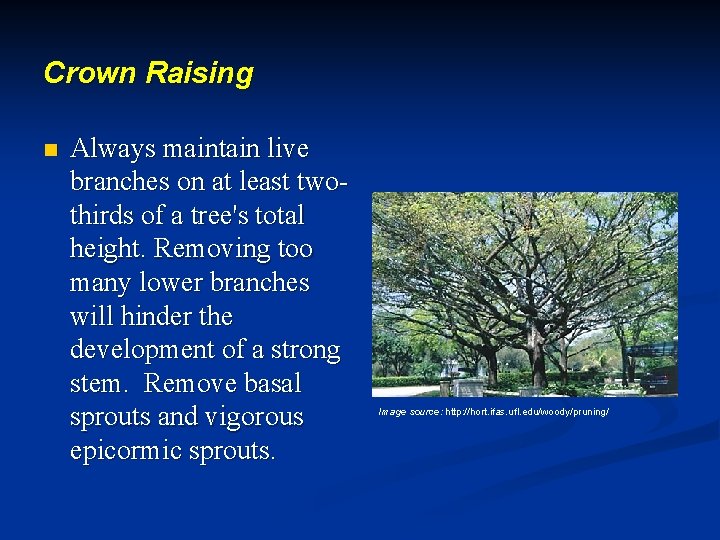
Crown Raising n Always maintain live branches on at least twothirds of a tree's total height. Removing too many lower branches will hinder the development of a strong stem. Remove basal sprouts and vigorous epicormic sprouts. Image source: http: //hort. ifas. ufl. edu/woody/pruning/
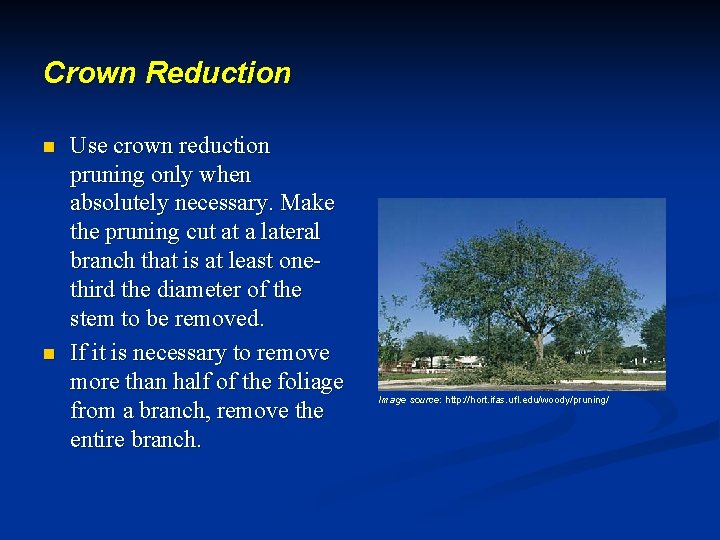
Crown Reduction n n Use crown reduction pruning only when absolutely necessary. Make the pruning cut at a lateral branch that is at least onethird the diameter of the stem to be removed. If it is necessary to remove more than half of the foliage from a branch, remove the entire branch. Image source: http: //hort. ifas. ufl. edu/woody/pruning/
Glossary n Branch Axil: the angle formed where a branch joins another branch or stem of a woody plant. n Branch Bark Ridge: a ridge of bark that forms in a branch crotch and partially around the stem resulting from the growth of the stem and branch tissues against one another. n Branch Collar: a "shoulder" or bulge formed at the base of a branch by the annual production of overlapping layers of branch and stem tissues. n Crown Raising: a method of pruning to provide clearance for pedestrians, vehicles, buildings, lines of sight, and vistas by removing lower branches. n Crown Reduction Pruning: a method of pruning used to reduce the height of a tree. Branches are cut back to laterals that are at least one-third the diameter of the limb being removed. n Crown Thinning: a method of pruning to increase light penetration and air movement through the crown of a tree by selective removal of branches.
n Callus: see woundwood n Decurrent: a major tree form resulting from weak apical control. Trees with this form have several to many lateral branches that compete with the central stem for dominance resulting in a spherical or globose crown. Most hardwood trees have decurrent forms. n Epicormic Sprout: a shoot that arises from latent or adventitious buds; also known as water sprouts that occur on stems and branches and suckers that are produced from the base of trees. In older wood, epicormic shoots often result from severe defoliation or radical pruning. n Excurrent: a major tree form resulting from strong apical control. Trees with this form have a strong central stem and pyramidal shape. Lateral branches rarely compete for dominance. Most conifers and a few hardwoods, such as sweetgum and tuliptree, have excurrent forms. n Flush Cuts: pruning cuts that originate inside the branch bark ridge or the branch collar, causing unnecessary injury to stem tissues. n Included Bark: bark enclosed between branches with narrow angles of attachment, forming a wedge between the branches.
n Pollarding: the annual removal of all of the previous year's growth, resulting in a flush of slender shoots and branches each spring. n Stub Cuts: pruning cuts made too far outside the branch bark ridge or branch collar, that leave branch tissue attached to the stem. n Tipping: a poor maintenance practice used to control the size of tree crowns; involves the cutting of branches at right angles leaving long stubs. n Topping: a poor maintenance practice often used to control the size of trees; involves the indiscriminate cutting of branches and stems at right angles leaving long stubs. Synonyms include rounding-over, heading-back, dehorning, capping and hat-racking. Topping is often improperly referred to as pollarding. n Topiary: the pruning and training of a plant into a desired geometric or animal shape. n Woundwood: lignified, differentiated tissues produced on woody plants as a response to wounding (also known as callus tissue).
References n ANSI Z 133. 1. 1994. Safety standards. American national standard for tree care operators. Washington, DC: American National Standards Institute. ANSI A 300. 1995. Standard practices for tree, shrub, and other woody plant maintenance. Washington, DC: American National Standards Institute. n Fazio, J. R. ed. 1992. Don't top trees. Tree City USA Bulletin No. 8. Nebraska City, NE: The National Arbor Day Foundation. n Harris, R. W. 1994. Clarifying certain pruning terminology: thinning, heading, pollarding. Journal of Arboriculture 20: 50 -54. n ISA Performance Guidelines Committee. 1994. Tree-pruning guidelines. Savoy, IL: International Society of Arboriculture. n Ryan, H. D. P. III. 1994. Arboricultural pruning methodologies. Arborist News Volume 3(4): 33 -38. n Shigo, A. 1991. Modern arboriculture. Durham, NH: Shigo & Trees, Associates. n Shigo, A. 1989. Tree pruning: a worldwide photo guide. Durham, NH: Shigo & Trees, Associates.
Authors Peter J. Bedker, Plant Pathologist, USDA Forest Service, Northeastern Area State and Private Forestry Joseph G. O'Brien, Plant Pathologist, USDA Forest Service, Northeastern Area State and Private Forestry Manfred E. Mielke, Forest Health Specialist, USDA Forest Service, Northeastern Area State and Private Forestry Illustrations by: Julie Martinez, Scientific Illustrator, Minneapolis, Minnesota Project Coordinator: Gerard D. Hertel, Assistant Director, Forest Health and Management, USDA Forest Service, Northeastern Area State and Private Forestry
"How to Prune Trees" was written to help people properly prune the trees they care about. If you doubt your ability to safely prune large trees, please hire a professional arborist. Information in this publication can be used to interview and hire a competent arborist.
Acknowledgments This publication was adapted from its online version by Allyson Lawrence, Educational Program Specialist of the Southern Region Extension Forestry Office. n Southern Region Extension Forestry Forest Resources Building 4 -433 The University of Georgia Athens, Georgia 30602
- Slides: 57