Decentralization and Corruption Maksym Ivanyna and Anwar Shah

- Slides: 35
Decentralization and Corruption Maksym Ivanyna and Anwar Shah, World Bank ashah@worldbank. org International Conference : The Political and Economic Consequences of Decentralization Santiago de Compostela, Galicia, Spain November 5 -6, 2009
Outline Brief survey of decentralization and corruption literature Missing pieces of the Puzzle Development of a comprehensive worldwide decentralization index Identifying appropriate measures of corruption and other drivers of corruption (control variables) Results so far Road Ahead
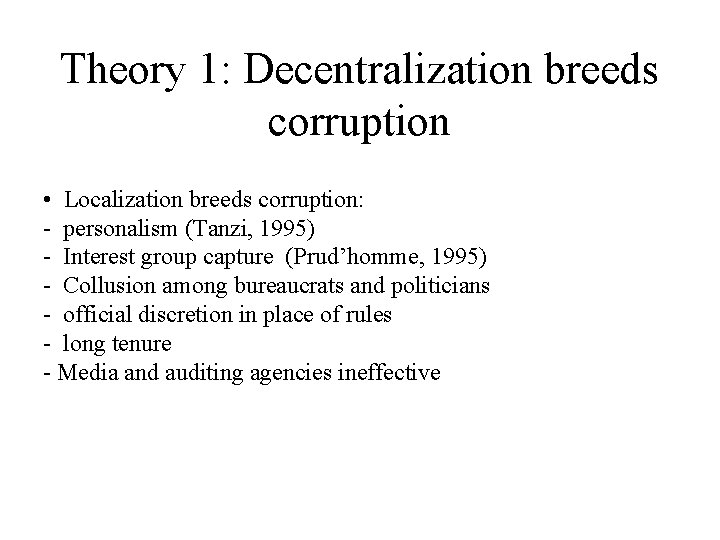
Theory 1: Decentralization breeds corruption • Localization breeds corruption: - personalism (Tanzi, 1995) - Interest group capture (Prud’homme, 1995) - Collusion among bureaucrats and politicians - official discretion in place of rules - long tenure - Media and auditing agencies ineffective
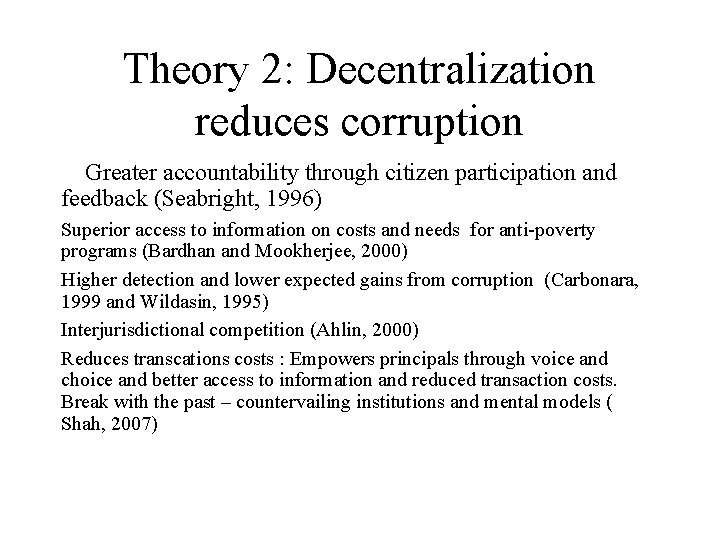
Theory 2: Decentralization reduces corruption Greater accountability through citizen participation and feedback (Seabright, 1996) Superior access to information on costs and needs for anti-poverty programs (Bardhan and Mookherjee, 2000) Higher detection and lower expected gains from corruption (Carbonara, 1999 and Wildasin, 1995) Interjurisdictional competition (Ahlin, 2000) Reduces transcations costs : Empowers principals through voice and choice and better access to information and reduced transaction costs. Break with the past – countervailing institutions and mental models ( Shah, 2007)
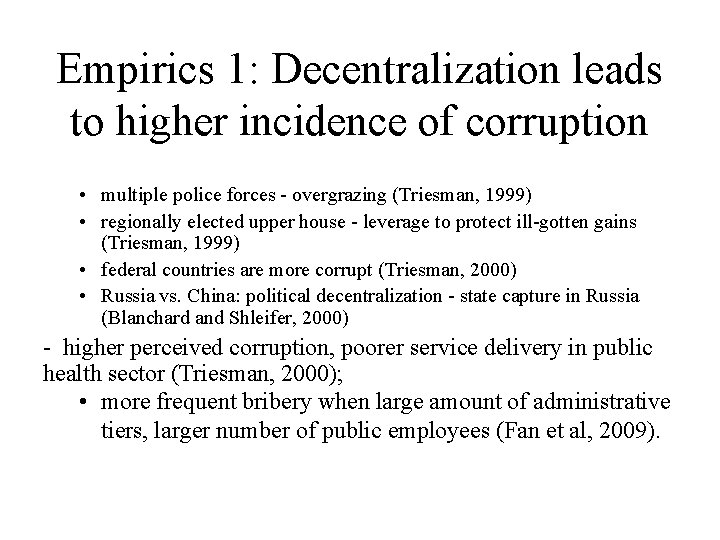
Empirics 1: Decentralization leads to higher incidence of corruption • multiple police forces - overgrazing (Triesman, 1999) • regionally elected upper house - leverage to protect ill-gotten gains (Triesman, 1999) • federal countries are more corrupt (Triesman, 2000) • Russia vs. China: political decentralization - state capture in Russia (Blanchard and Shleifer, 2000) - higher perceived corruption, poorer service delivery in public health sector (Triesman, 2000); • more frequent bribery when large amount of administrative tiers, larger number of public employees (Fan et al, 2009).
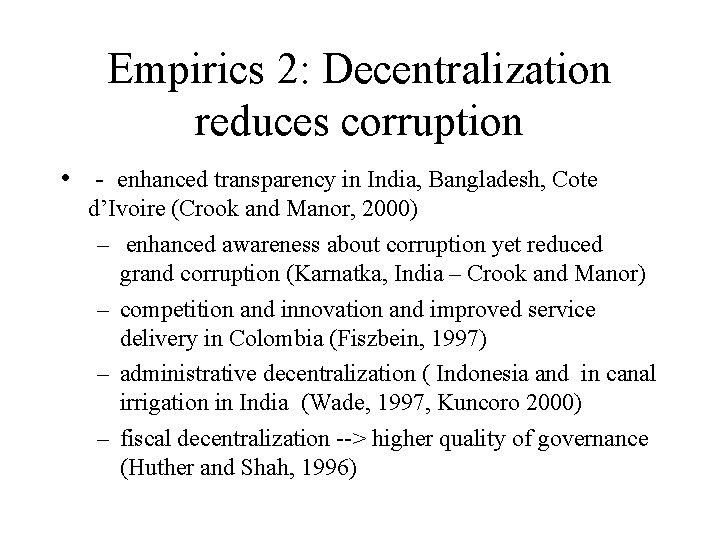
Empirics 2: Decentralization reduces corruption • - enhanced transparency in India, Bangladesh, Cote d’Ivoire (Crook and Manor, 2000) – enhanced awareness about corruption yet reduced grand corruption (Karnatka, India – Crook and Manor) – competition and innovation and improved service delivery in Colombia (Fiszbein, 1997) – administrative decentralization ( Indonesia and in canal irrigation in India (Wade, 1997, Kuncoro 2000) – fiscal decentralization --> higher quality of governance (Huther and Shah, 1996)
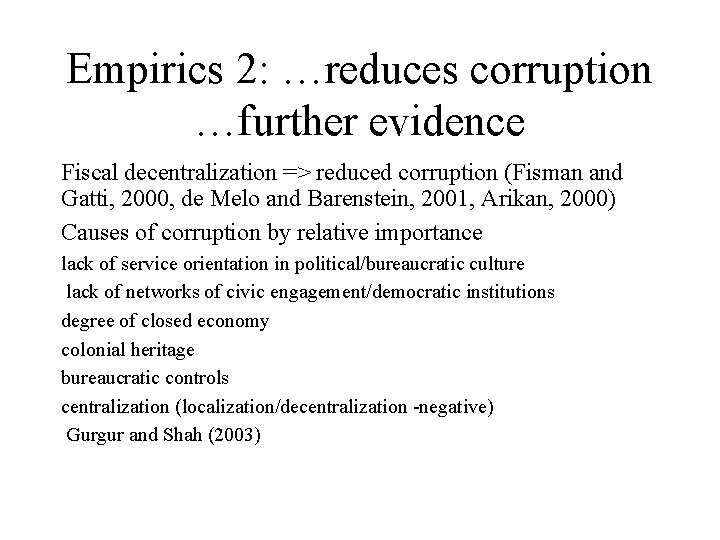
Empirics 2: …reduces corruption …further evidence Fiscal decentralization => reduced corruption (Fisman and Gatti, 2000, de Melo and Barenstein, 2001, Arikan, 2000) Causes of corruption by relative importance lack of service orientation in political/bureaucratic culture lack of networks of civic engagement/democratic institutions degree of closed economy colonial heritage bureaucratic controls centralization (localization/decentralization -negative) Gurgur and Shah (2003)
The Day of the Black Swan Whatever we have learned is false and whatever we know is half-truth? We really do not know what we do know or do not know. - Joel Slemrod, University of Michigan
But can good econometrics overcome bad data and value laden judgments? “Governments are very keen on amassing statistics. They collect them, add them, raise them to the nth power, take the cube root and prepare wonderful diagrams. But you must never forget that everyone of these figures comes in the first instance from the village watchman, who just puts down what he damn well pleases. ” -Rudyard Kipling
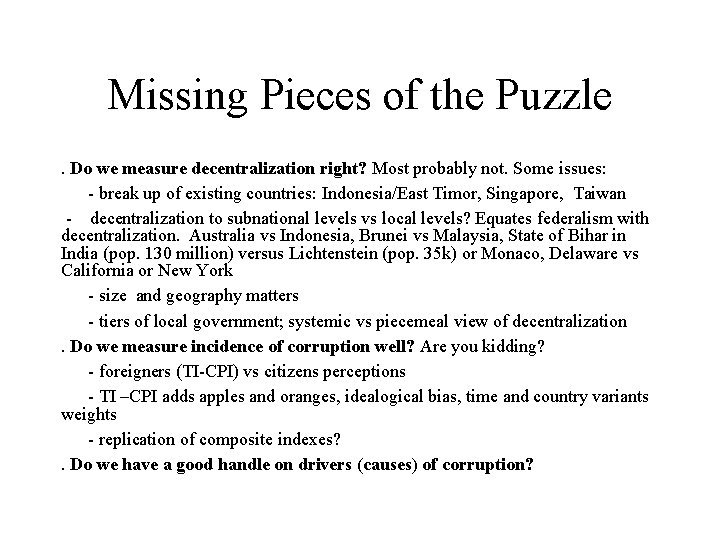
Missing Pieces of the Puzzle. Do we measure decentralization right? Most probably not. Some issues: - break up of existing countries: Indonesia/East Timor, Singapore, Taiwan - decentralization to subnational levels vs local levels? Equates federalism with decentralization. Australia vs Indonesia, Brunei vs Malaysia, State of Bihar in India (pop. 130 million) versus Lichtenstein (pop. 35 k) or Monaco, Delaware vs California or New York - size and geography matters - tiers of local government; systemic vs piecemeal view of decentralization. Do we measure incidence of corruption well? Are you kidding? - foreigners (TI-CPI) vs citizens perceptions - TI –CPI adds apples and oranges, idealogical bias, time and country variants weights - replication of composite indexes? . Do we have a good handle on drivers (causes) of corruption?
References on the critiques of existing corruption/governance indicators Thompson, Theresa and Anwar Shah (2004). TI’s Corruption Perception Indexes: Whose Perceptions Are They Any Way? . www. worldbank. org/governance Kaqi, Iqbal and Anwar Shah (2008). Truth in Advertisement. How Worldwide Governance Indicators Stack Up? www. worldbank. org/wbi/govenance Ivanyna, Maksym and Anwar Shah (2009). Citizen-Centric Governance Indicators: Measuring and Monitoring Governance by Listening to People and Not Interest Groups. Economics e-journal discussion paper.
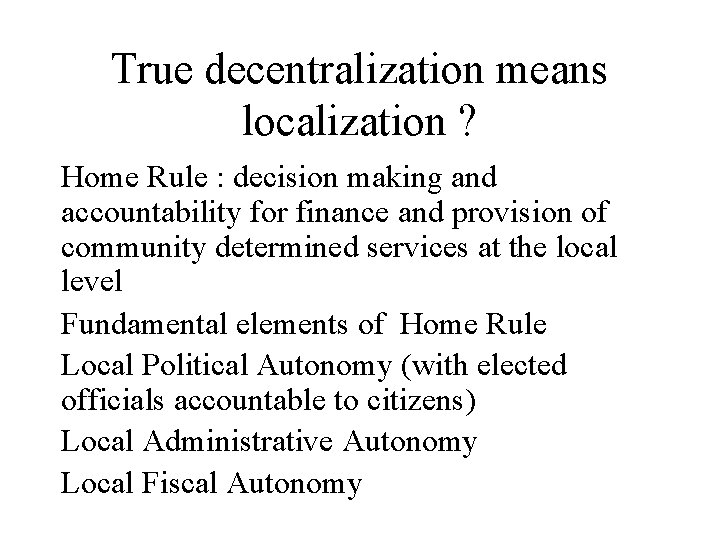
True decentralization means localization ? Home Rule : decision making and accountability for finance and provision of community determined services at the local level Fundamental elements of Home Rule Local Political Autonomy (with elected officials accountable to citizens) Local Administrative Autonomy Local Fiscal Autonomy
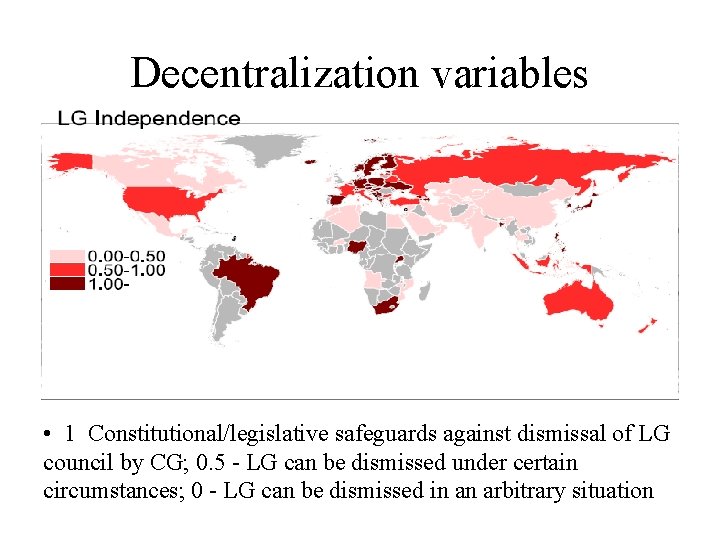
Decentralization variables • 1 Constitutional/legislative safeguards against dismissal of LG council by CG; 0. 5 - LG can be dismissed under certain circumstances; 0 - LG can be dismissed in an arbitrary situation
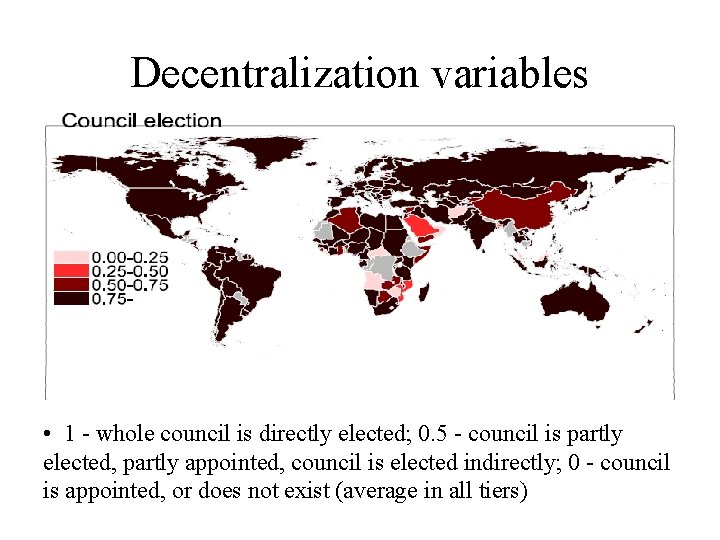
Decentralization variables • 1 - whole council is directly elected; 0. 5 - council is partly elected, partly appointed, council is elected indirectly; 0 - council is appointed, or does not exist (average in all tiers)
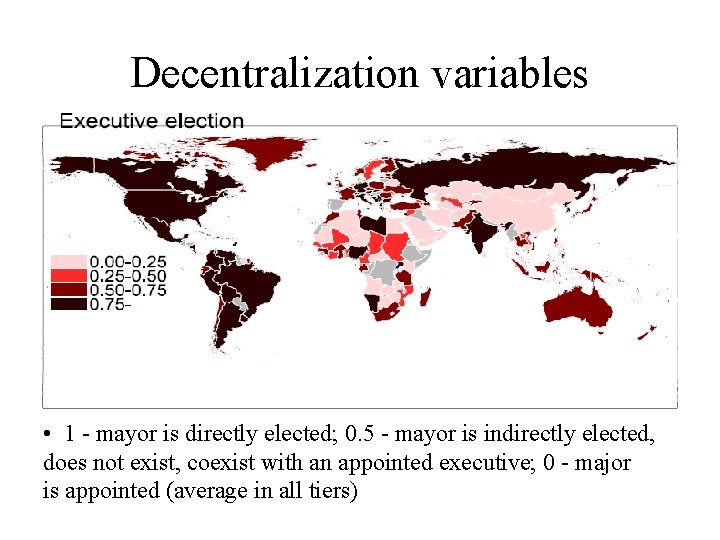
Decentralization variables • 1 - mayor is directly elected; 0. 5 - mayor is indirectly elected, does not exist, coexist with an appointed executive; 0 - major is appointed (average in all tiers)
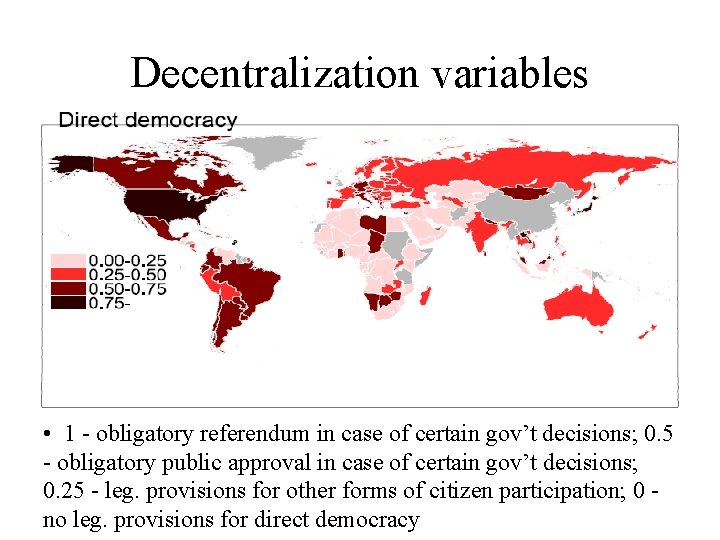
Decentralization variables • 1 - obligatory referendum in case of certain gov’t decisions; 0. 5 - obligatory public approval in case of certain gov’t decisions; 0. 25 - leg. provisions for other forms of citizen participation; 0 no leg. provisions for direct democracy
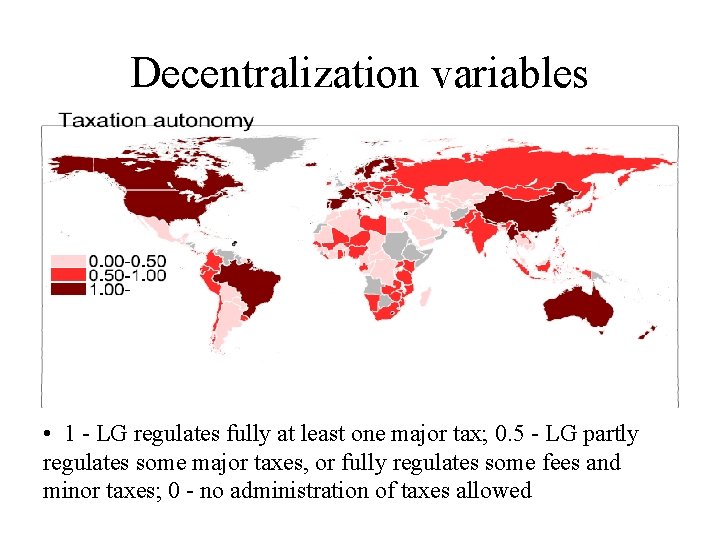
Decentralization variables • 1 - LG regulates fully at least one major tax; 0. 5 - LG partly regulates some major taxes, or fully regulates some fees and minor taxes; 0 - no administration of taxes allowed
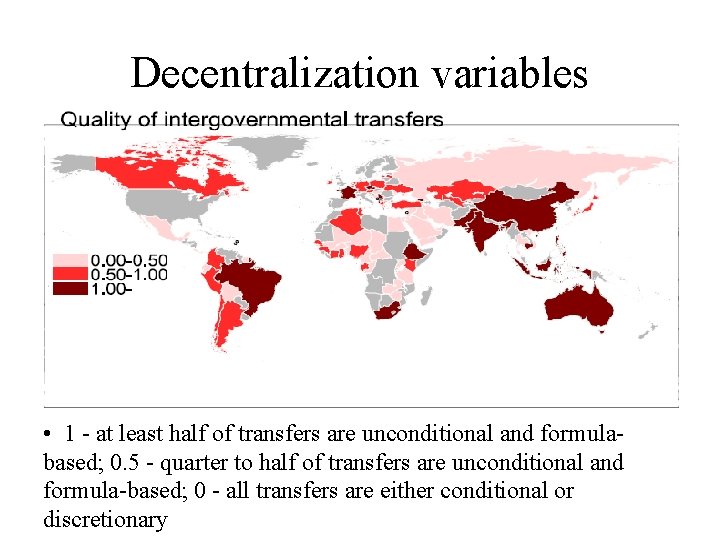
Decentralization variables • 1 - at least half of transfers are unconditional and formulabased; 0. 5 - quarter to half of transfers are unconditional and formula-based; 0 - all transfers are either conditional or discretionary
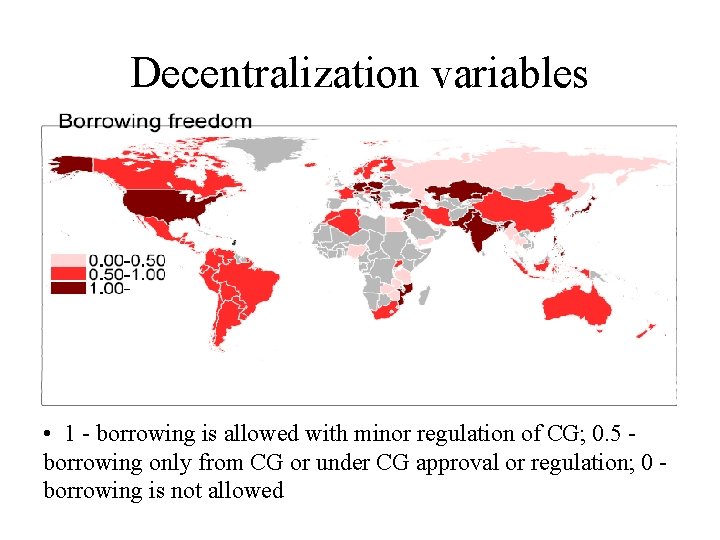
Decentralization variables • 1 - borrowing is allowed with minor regulation of CG; 0. 5 borrowing only from CG or under CG approval or regulation; 0 borrowing is not allowed
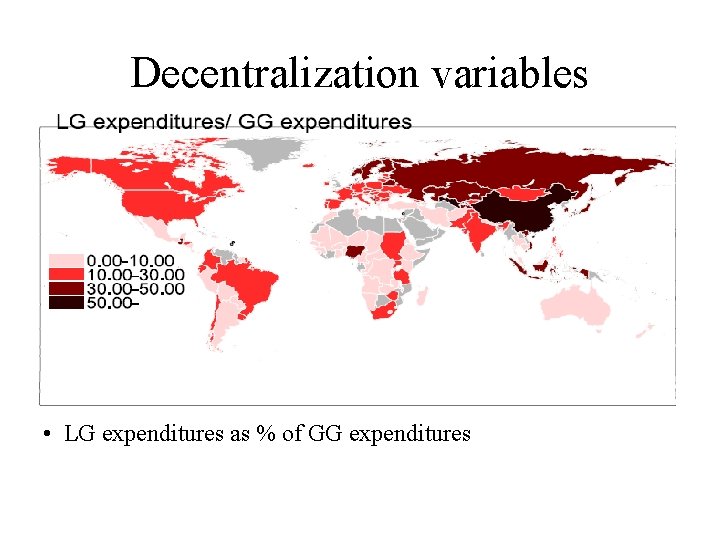
Decentralization variables • LG expenditures as % of GG expenditures
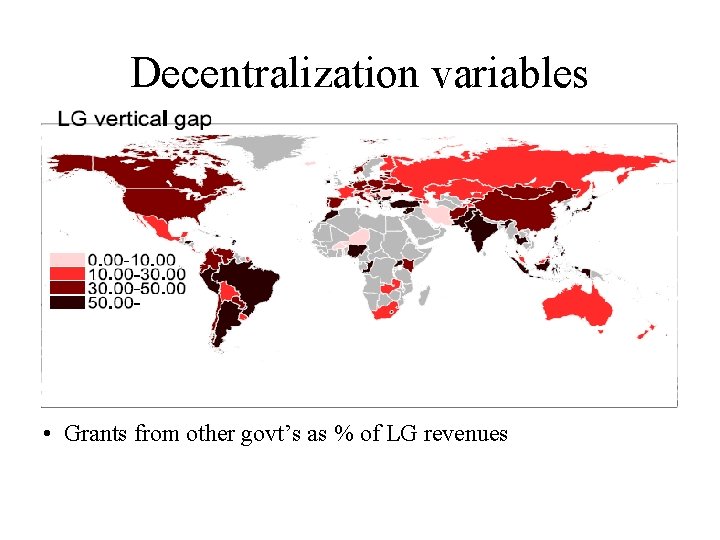
Decentralization variables • Grants from other govt’s as % of LG revenues
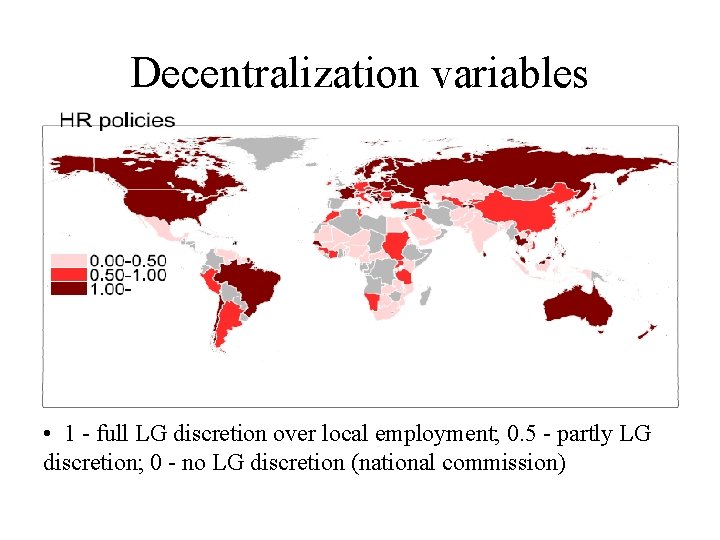
Decentralization variables • 1 - full LG discretion over local employment; 0. 5 - partly LG discretion; 0 - no LG discretion (national commission)
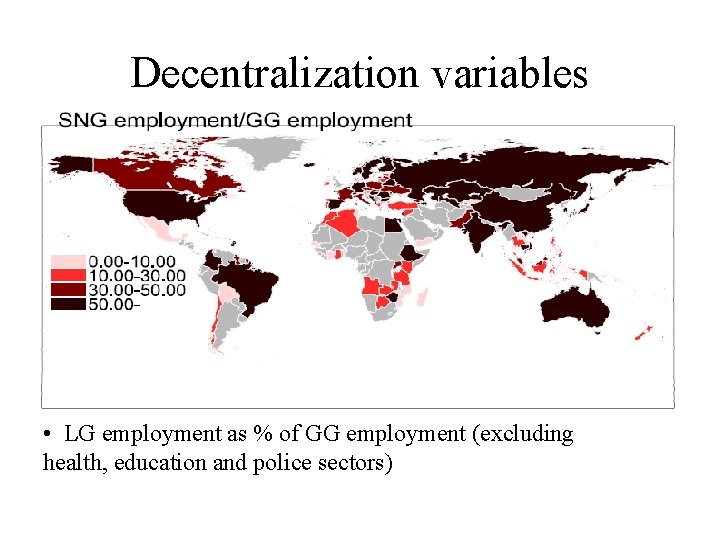
Decentralization variables • LG employment as % of GG employment (excluding health, education and police sectors)
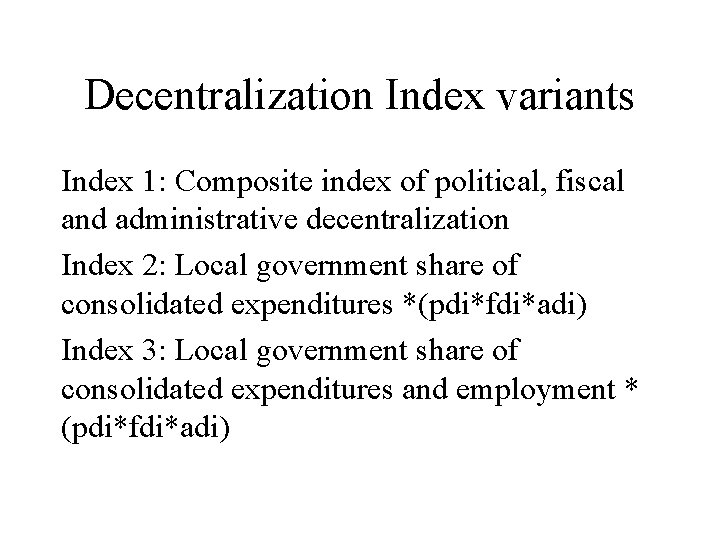
Decentralization Index variants Index 1: Composite index of political, fiscal and administrative decentralization Index 2: Local government share of consolidated expenditures *(pdi*fdi*adi) Index 3: Local government share of consolidated expenditures and employment * (pdi*fdi*adi)
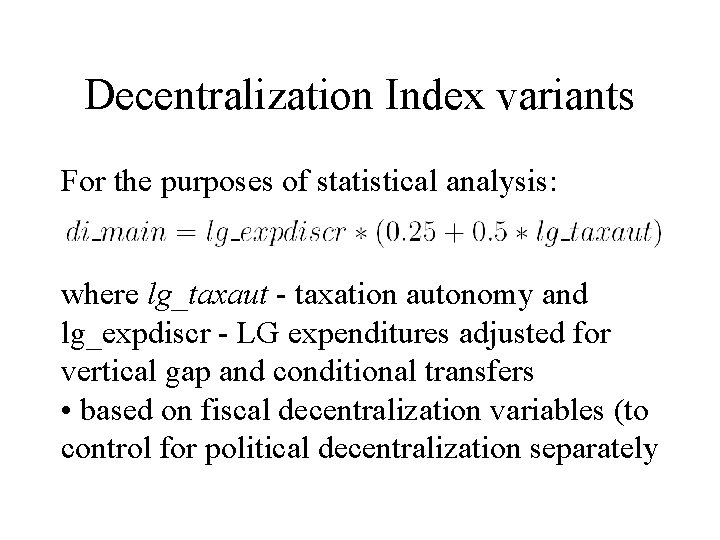
Decentralization Index variants For the purposes of statistical analysis: where lg_taxaut - taxation autonomy and lg_expdiscr - LG expenditures adjusted for vertical gap and conditional transfers • based on fiscal decentralization variables (to control for political decentralization separately
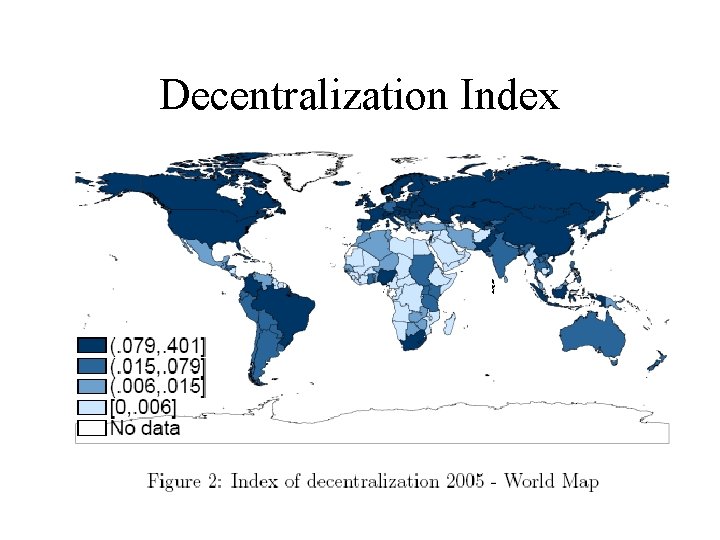
Decentralization Index
Corruption is inevitable “Just as it is not possible to not to taste honey placed on the surface of the tongue, even so it is not possible for one dealing with the money of the king not to taste the money in however a small quantity. ” – Kautilya, 4 century BCE th
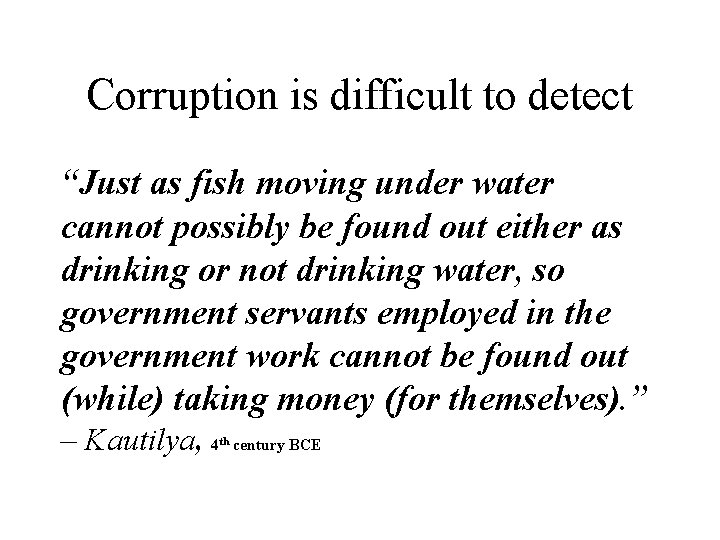
Corruption is difficult to detect “Just as fish moving under water cannot possibly be found out either as drinking or not drinking water, so government servants employed in the government work cannot be found out (while) taking money (for themselves). ” – Kautilya, 4 th century BCE
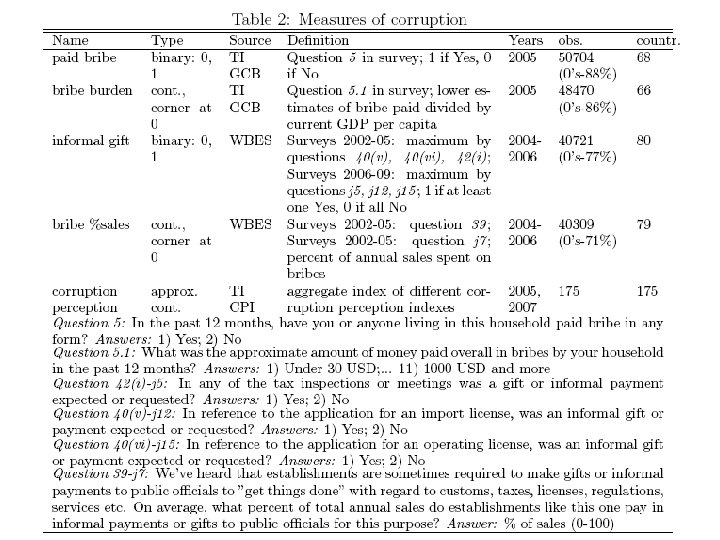
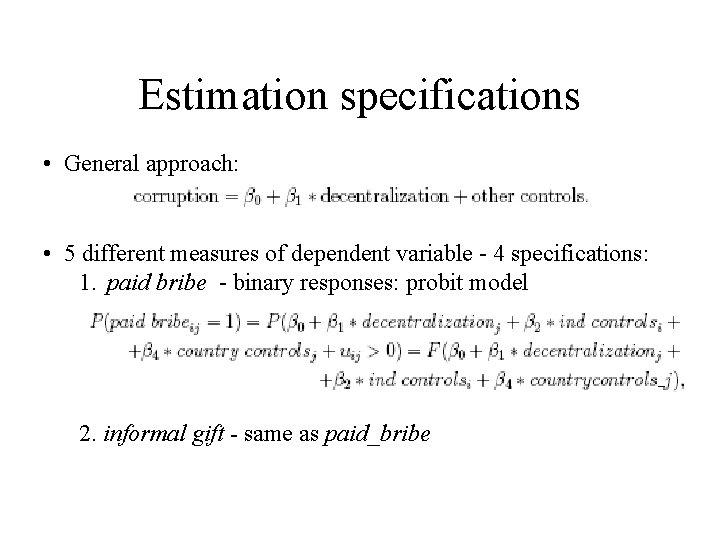
Estimation specifications • General approach: • 5 different measures of dependent variable - 4 specifications: 1. paid bribe - binary responses: probit model 2. informal gift - same as paid_bribe
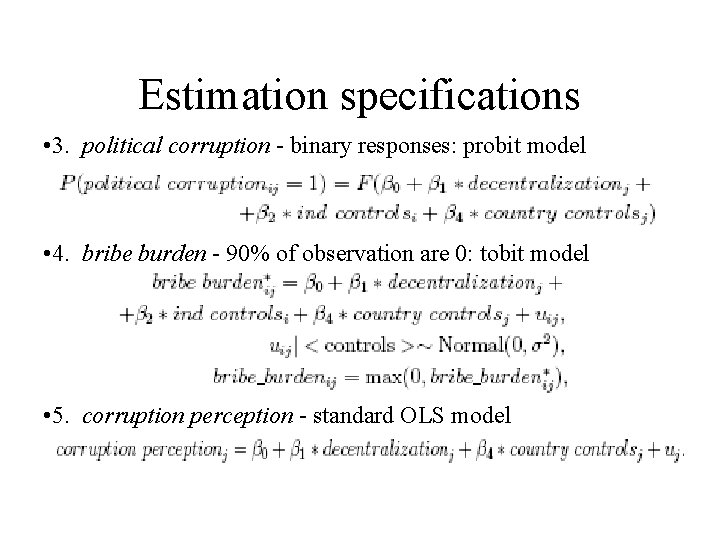
Estimation specifications • 3. political corruption - binary responses: probit model • 4. bribe burden - 90% of observation are 0: tobit model • 5. corruption perception - standard OLS model
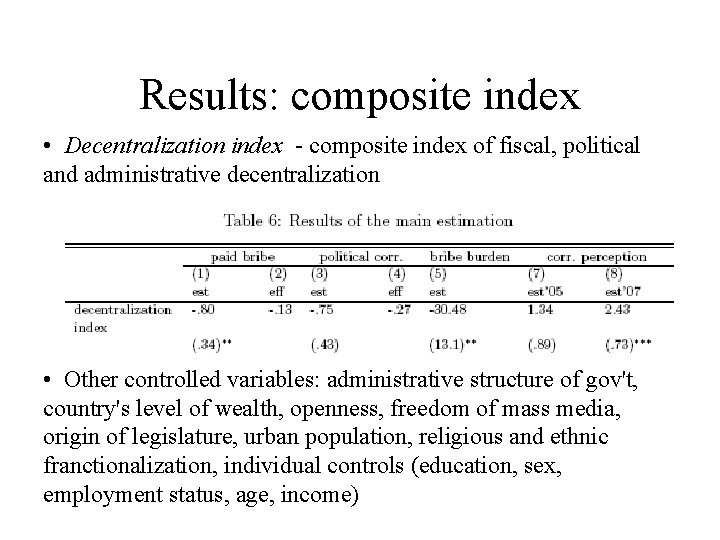
Results: composite index • Decentralization index - composite index of fiscal, political and administrative decentralization • Other controlled variables: administrative structure of gov't, country's level of wealth, openness, freedom of mass media, origin of legislature, urban population, religious and ethnic franctionalization, individual controls (education, sex, employment status, age, income)
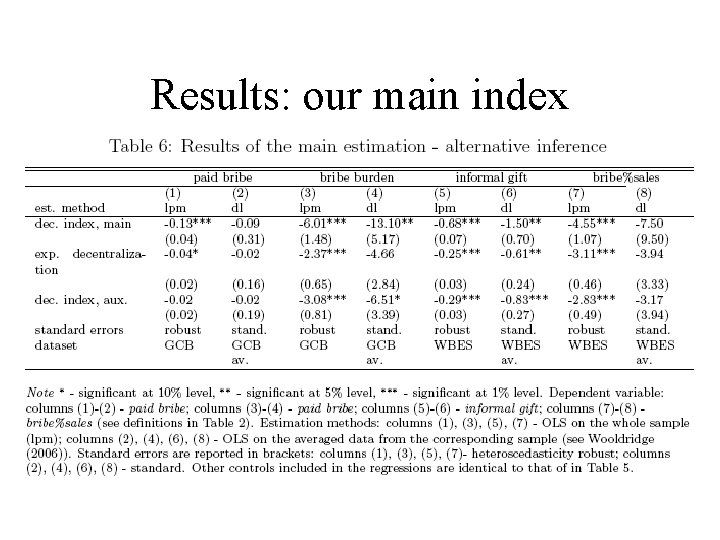
Results: our main index
Results: summary • Statistically significant negative effect of decentralization on corruption in almost all specifications; • Significant and substantial impact: 10% increase in decentralization -> 1. 3% decrease (on average) in probability of paying bribe (mean - 11%); 3% decrease of bribe burden (amount of bribes per average income in a country); • Probit/tobit specifications: effects are different in different countries – substantial impacts in Sub-Saharan Africa and Latin America, less in developed countries.
Further results • No conclusive evidence that decentralization works through “exit” (“voice” is more likely to work) • Political decentralization matters even when we control for fiscal decentralization • Causal effect of decentralization is hard to establish: • If corruption drives centralization the effect is underestimated • Controlling for decentralization in 90 s (Treisman's dataset) evidence is mixed, but the measurement error is very high