CPSC 531 System Modeling and Simulation Carey Williamson
- Slides: 18
CPSC 531: System Modeling and Simulation Carey Williamson Department of Computer Science University of Calgary Fall 2017
Outline § Random number generation — Properties of random numbers — Linear Congruential Generator — Seed selection and random streams 2
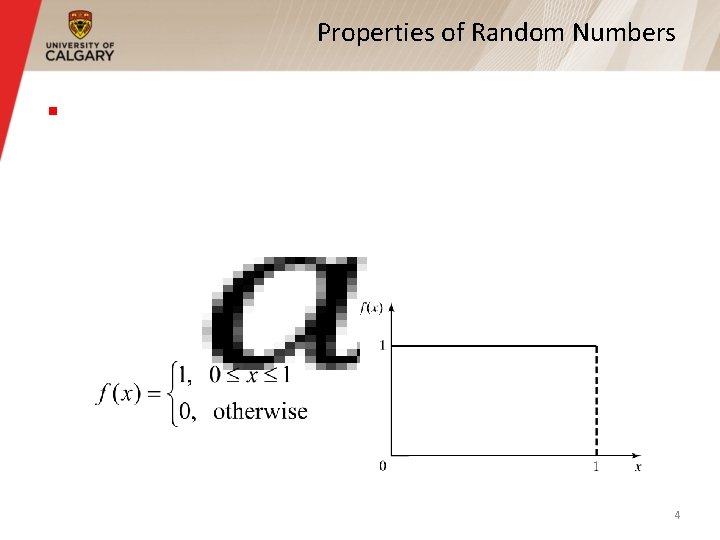
Random Number Generators (RNG’s) § Requirements — Sequence generated has uniform distribution (continuous) between 0 and 1 — The numbers in the sequence are independent of each other § RNG’s in computer simulation are pseudorandom — Each number in the sequence is determined by one or several of its predecessors — Statistical tests can be used to determine how well the requirements of uniformity and independence are met 3
Properties of Random Numbers § 4
Desirable Properties § Uniformity and independence § Should be able to reproduce a given sequence of random numbers — Helps program debugging — Helpful when comparing alternative system design § Should have provision to generate several streams of random numbers § Computationally efficient 5
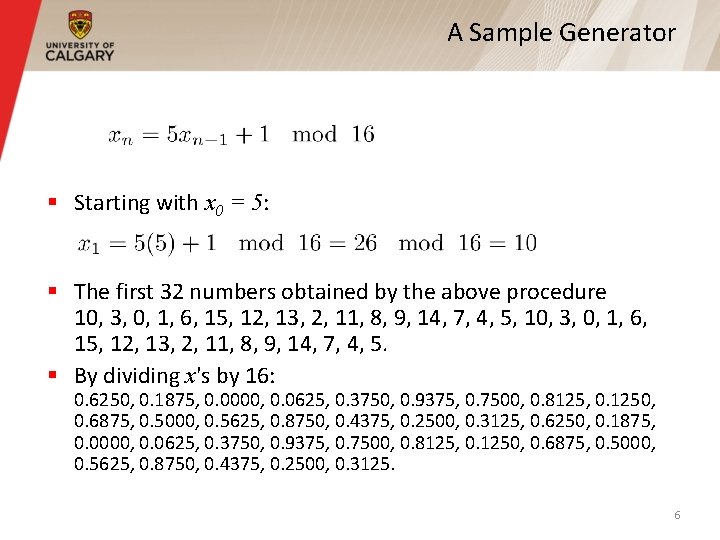
A Sample Generator § Starting with x 0 = 5: § The first 32 numbers obtained by the above procedure 10, 3, 0, 1, 6, 15, 12, 13, 2, 11, 8, 9, 14, 7, 4, 5, 10, 3, 0, 1, 6, 15, 12, 13, 2, 11, 8, 9, 14, 7, 4, 5. § By dividing x's by 16: 0. 6250, 0. 1875, 0. 0000, 0. 0625, 0. 3750, 0. 9375, 0. 7500, 0. 8125, 0. 1250, 0. 6875, 0. 5000, 0. 5625, 0. 8750, 0. 4375, 0. 2500, 0. 3125, 0. 6250, 0. 1875, 0. 0000, 0. 0625, 0. 3750, 0. 9375, 0. 7500, 0. 8125, 0. 1250, 0. 6875, 0. 5000, 0. 5625, 0. 8750, 0. 4375, 0. 2500, 0. 3125. 6
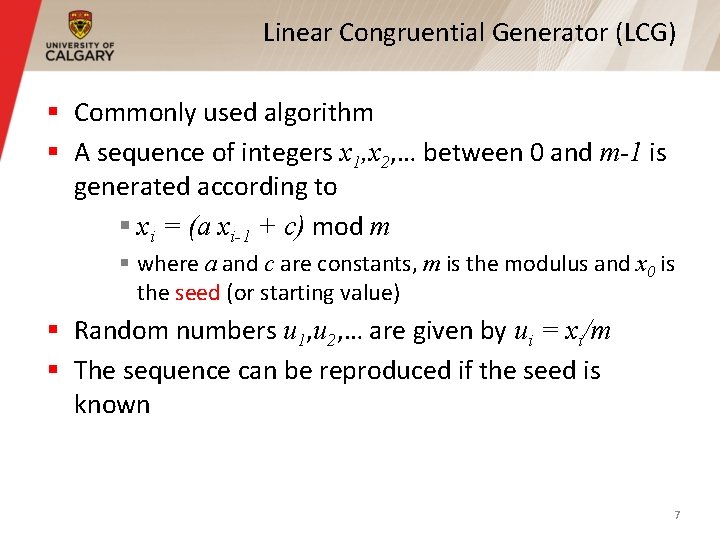
Linear Congruential Generator (LCG) § Commonly used algorithm § A sequence of integers x 1, x 2, … between 0 and m-1 is generated according to § xi = (a xi-1 + c) mod m § where a and c are constants, m is the modulus and x 0 is the seed (or starting value) § Random numbers u 1, u 2, … are given by ui = xi/m § The sequence can be reproduced if the seed is known 7
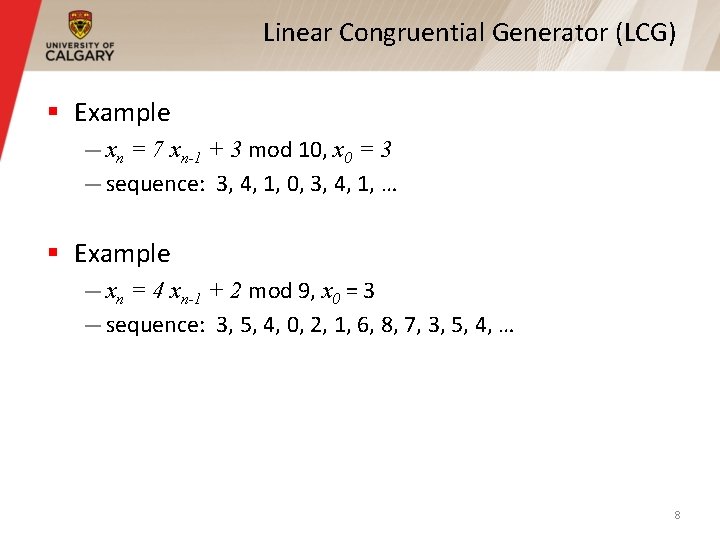
Linear Congruential Generator (LCG) § Example — xn = 7 xn-1 + 3 mod 10, x 0 = 3 — sequence: 3, 4, 1, 0, 3, 4, 1, … § Example — xn = 4 xn-1 + 2 mod 9, x 0 = 3 — sequence: 3, 5, 4, 0, 2, 1, 6, 8, 7, 3, 5, 4, … 8
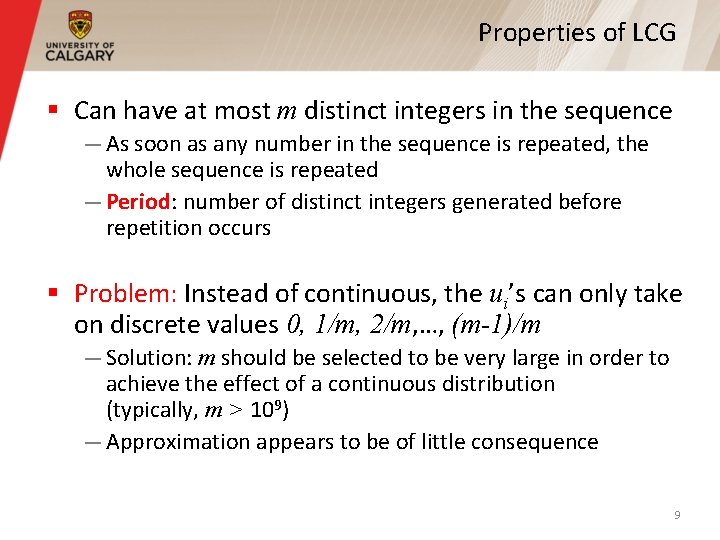
Properties of LCG § Can have at most m distinct integers in the sequence — As soon as any number in the sequence is repeated, the whole sequence is repeated — Period: number of distinct integers generated before repetition occurs § Problem: Instead of continuous, the ui’s can only take on discrete values 0, 1/m, 2/m, …, (m-1)/m — Solution: m should be selected to be very large in order to achieve the effect of a continuous distribution (typically, m > 109) — Approximation appears to be of little consequence 9
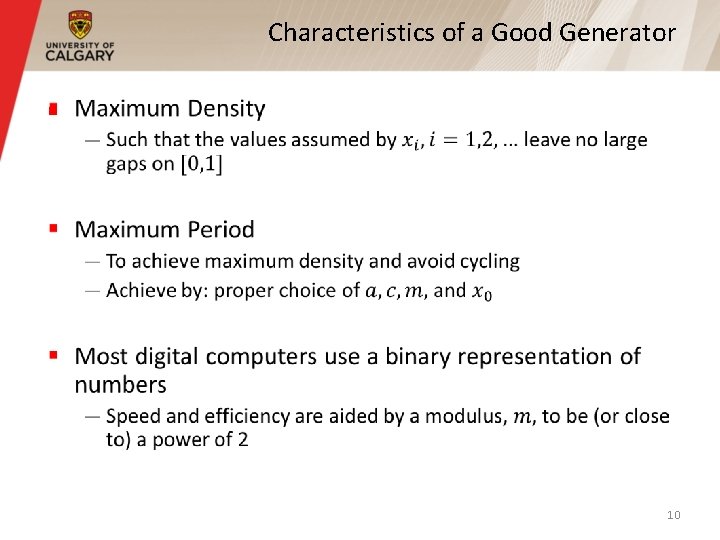
Characteristics of a Good Generator § 10
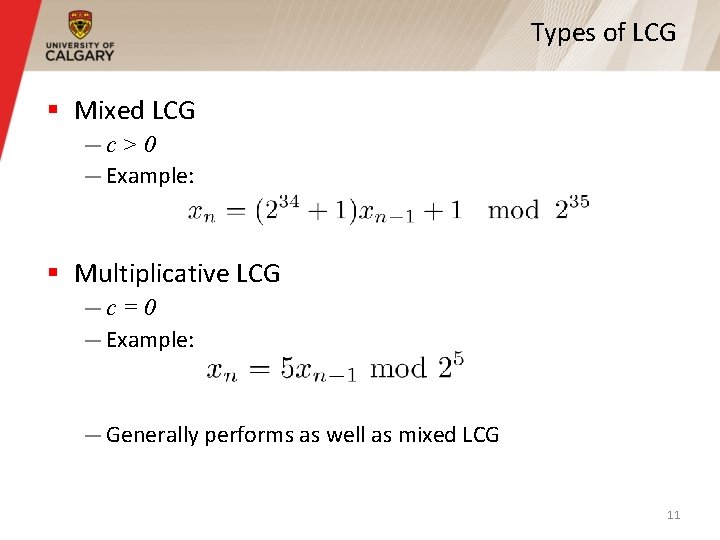
Types of LCG § Mixed LCG —c > 0 — Example: § Multiplicative LCG —c = 0 — Example: — Generally performs as well as mixed LCG 11
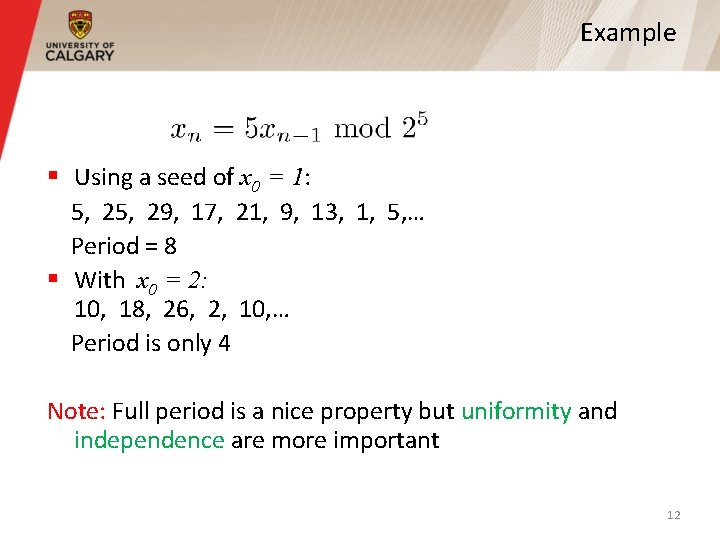
Example § Using a seed of x 0 = 1: 5, 29, 17, 21, 9, 13, 1, 5, … Period = 8 § With x 0 = 2: 10, 18, 26, 2, 10, … Period is only 4 Note: Full period is a nice property but uniformity and independence are more important 12
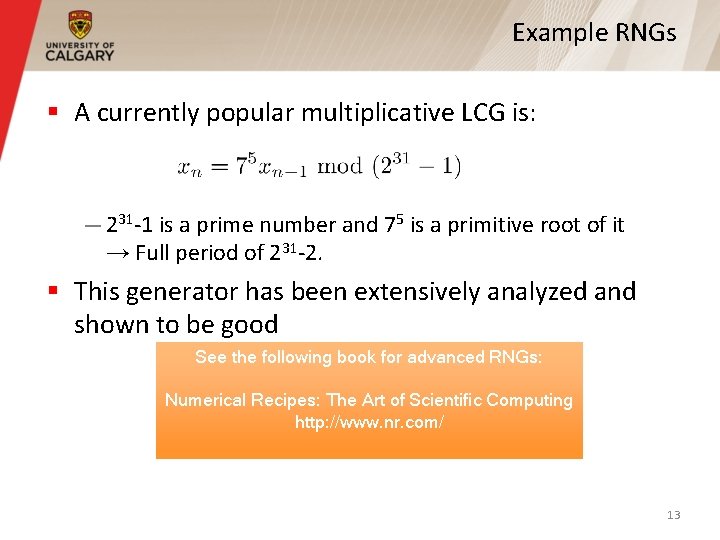
Example RNGs § A currently popular multiplicative LCG is: — 231 -1 is a prime number and 75 is a primitive root of it → Full period of 231 -2. § This generator has been extensively analyzed and shown to be good See the following book for advanced RNGs: Numerical Recipes: The Art of Scientific Computing http: //www. nr. com/ 13
Tips for Seed Selection § Seed selection — Any value in the sequence can be used to “seed” the generator § Do not use random seeds: such as the time of day — Cannot reproduce. Cannot guarantee non-overlap. § Do not use zero: — Fine for mixed LCGs — But multiplicative LCGs will be stuck at zero § Avoid even values: — For multiplicative LCG with modulus m=2 k, the seed should be odd § Do not use successive seeds — May result in strong correlation Better to avoid generators that have too many conditions on seed values or whose performance (period and randomness) depends upon the seed value. 14
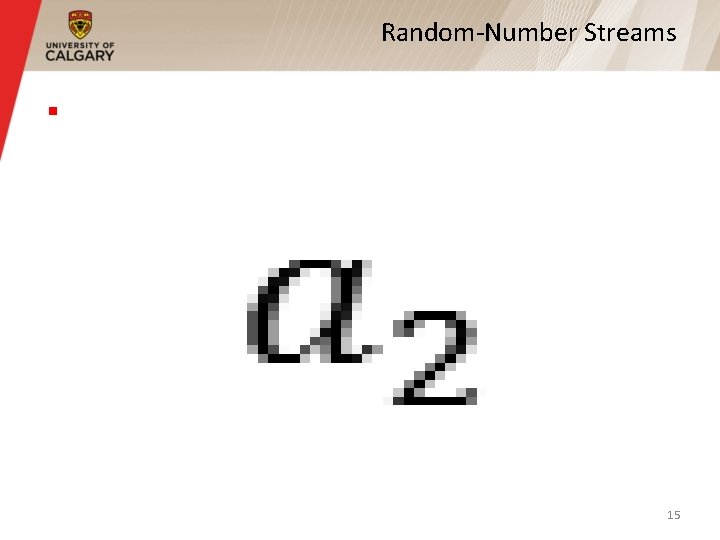
Random-Number Streams § 15
Myths About Random-Number Generation (1 of 3) § A complex set of operations leads to random results. It is better to use simple operations that can be analytically evaluated for randomness. § Random numbers are unpredictable. Easy to compute the parameters, a, c, and m from a few numbers => LCGs are unsuitable for cryptographic applications 16
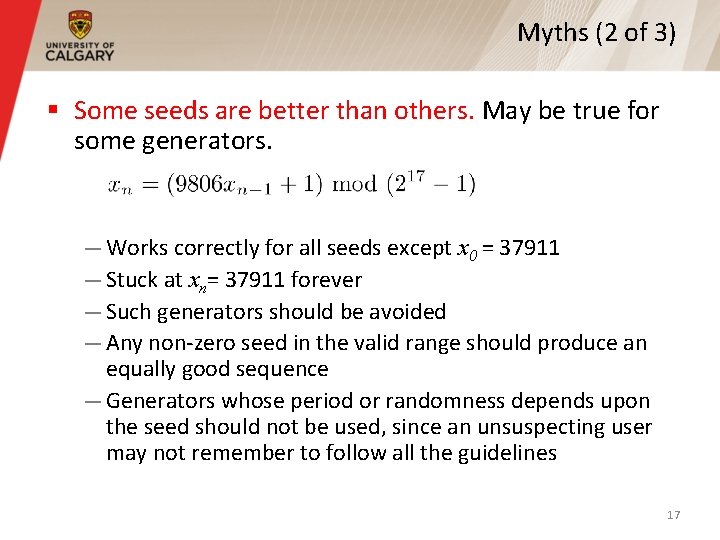
Myths (2 of 3) § Some seeds are better than others. May be true for some generators. — Works correctly for all seeds except x 0 = 37911 — Stuck at xn= 37911 forever — Such generators should be avoided — Any non-zero seed in the valid range should produce an equally good sequence — Generators whose period or randomness depends upon the seed should not be used, since an unsuspecting user may not remember to follow all the guidelines 17
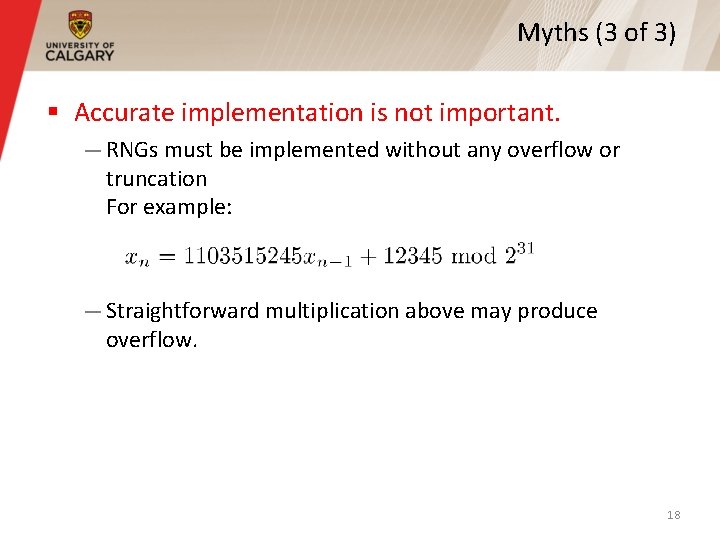
Myths (3 of 3) § Accurate implementation is not important. — RNGs must be implemented without any overflow or truncation For example: — Straightforward multiplication above may produce overflow. 18