CPD engagement support and community Professional Standards Authority
- Slides: 29
CPD: engagement, support and community Professional Standards Authority Conference: Building trust in people and places 10 March 2017 Fiona Browne
Aims • To introduce challenges in osteopathic regulation and regulation more widely • To explain CPD policy and implementation for addressing challenges • Measuring our baseline • Checking our approach using a behavioural framework • Next steps
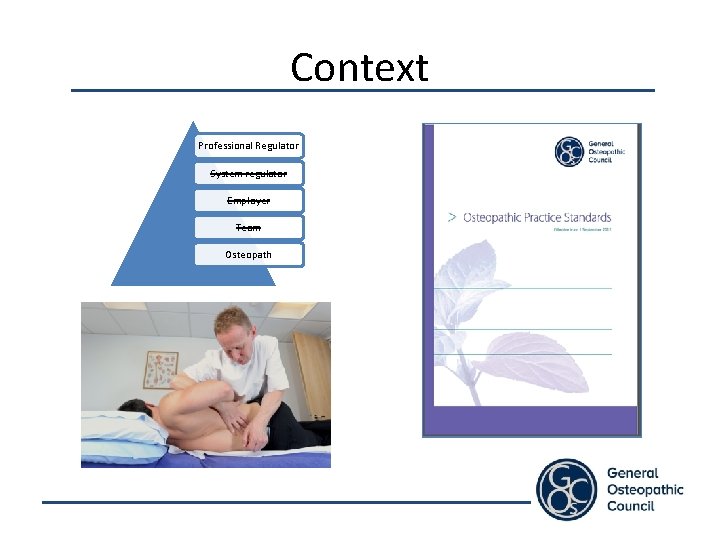
Context Professional Regulator System regulator Employer Team Osteopath
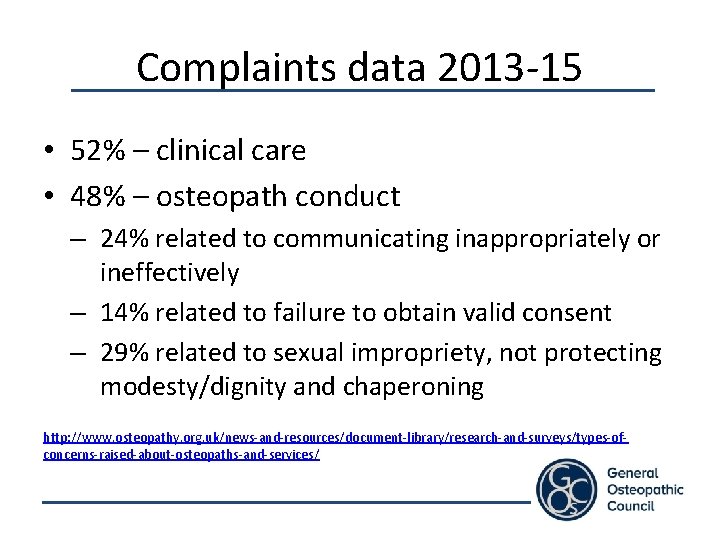
Complaints data 2013 -15 • 52% – clinical care • 48% – osteopath conduct – 24% related to communicating inappropriately or ineffectively – 14% related to failure to obtain valid consent – 29% related to sexual impropriety, not protecting modesty/dignity and chaperoning http: //www. osteopathy. org. uk/news-and-resources/document-library/research-and-surveys/types-ofconcerns-raised-about-osteopaths-and-services/
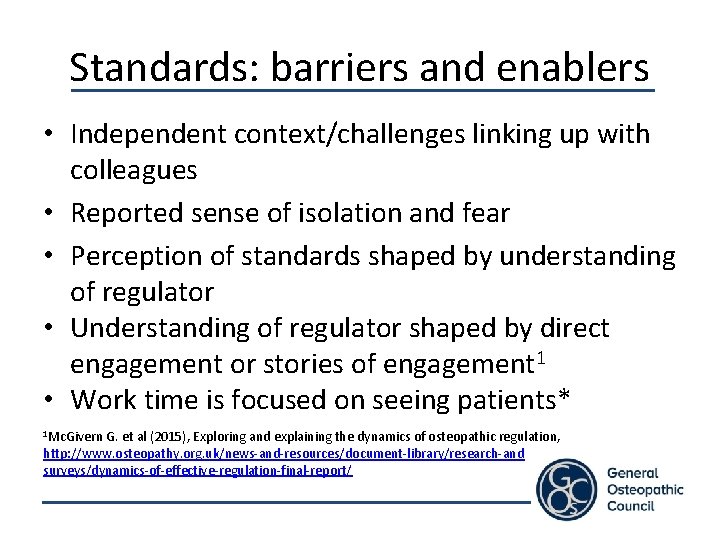
Standards: barriers and enablers • Independent context/challenges linking up with colleagues • Reported sense of isolation and fear • Perception of standards shaped by understanding of regulator • Understanding of regulator shaped by direct engagement or stories of engagement 1 • Work time is focused on seeing patients* 1 Mc. Givern G. et al (2015), Exploring and explaining the dynamics of osteopathic regulation, http: //www. osteopathy. org. uk/news-and-resources/document-library/research-and surveys/dynamics-of-effective-regulation-final-report/
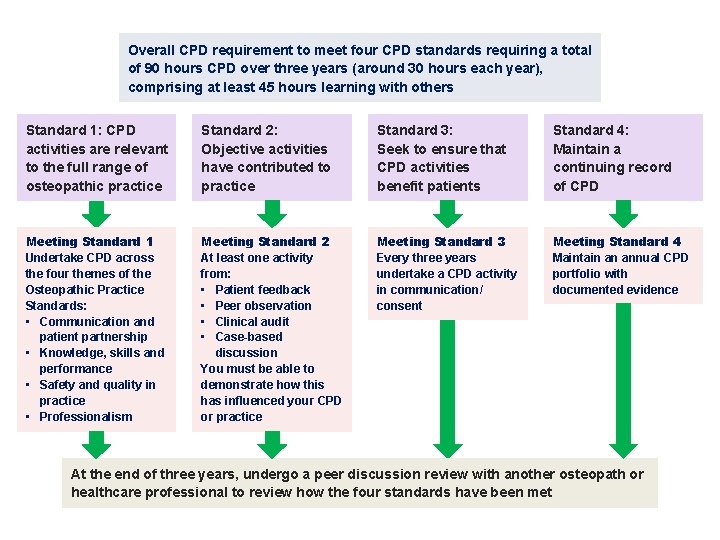
Overall CPD requirement to meet four CPD standards requiring a total of 90 hours CPD over three years (around 30 hours each year), comprising at least 45 hours learning with others Standard 1: CPD activities are relevant to the full range of osteopathic practice Standard 2: Objective activities have contributed to practice Standard 3: Seek to ensure that CPD activities benefit patients Standard 4: Maintain a continuing record of CPD Meeting Standard 1 Undertake CPD across the four themes of the Osteopathic Practice Standards: • Communication and patient partnership • Knowledge, skills and performance • Safety and quality in practice • Professionalism Meeting Standard 2 At least one activity from: • Patient feedback • Peer observation • Clinical audit • Case-based discussion You must be able to demonstrate how this has influenced your CPD or practice Meeting Standard 3 Every three years undertake a CPD activity in communication/ consent Meeting Standard 4 Maintain an annual CPD portfolio with documented evidence At the end of three years, undergo a peer discussion review with another osteopath or healthcare professional to review how the four standards have been met
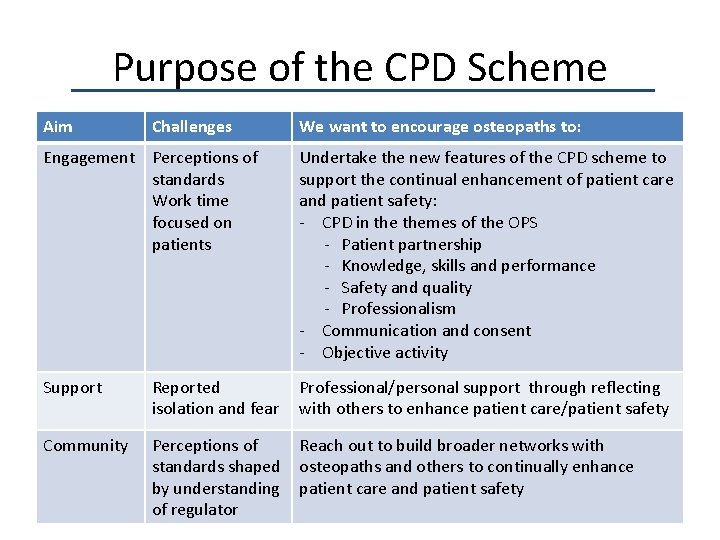
Purpose of the CPD Scheme Aim Challenges We want to encourage osteopaths to: Engagement Perceptions of standards Work time focused on patients Undertake the new features of the CPD scheme to support the continual enhancement of patient care and patient safety: - CPD in themes of the OPS - Patient partnership - Knowledge, skills and performance - Safety and quality - Professionalism - Communication and consent - Objective activity Support Reported isolation and fear Professional/personal support through reflecting with others to enhance patient care/patient safety Community Perceptions of standards shaped by understanding of regulator Reach out to build broader networks with osteopaths and others to continually enhance patient care and patient safety
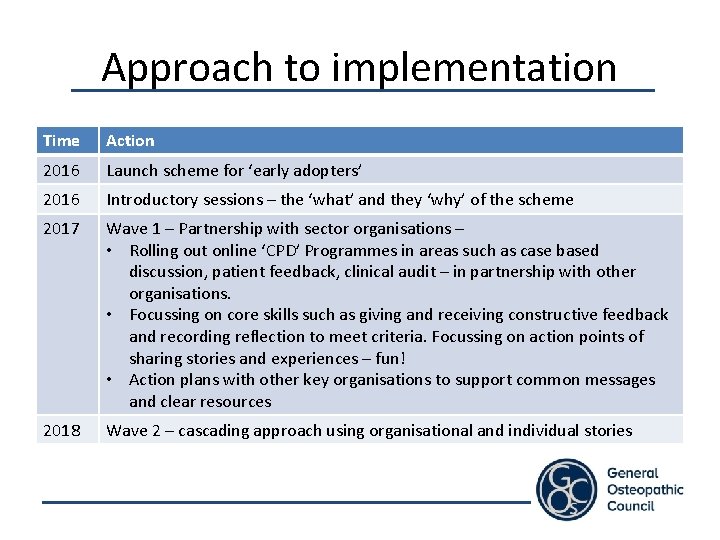
Approach to implementation Time Action 2016 Launch scheme for ‘early adopters’ 2016 Introductory sessions – the ‘what’ and they ‘why’ of the scheme 2017 Wave 1 – Partnership with sector organisations – • Rolling out online ‘CPD’ Programmes in areas such as case based discussion, patient feedback, clinical audit – in partnership with other organisations. • Focussing on core skills such as giving and receiving constructive feedback and recording reflection to meet criteria. Focussing on action points of sharing stories and experiences – fun! • Action plans with other key organisations to support common messages and clear resources 2018 Wave 2 – cascading approach using organisational and individual stories
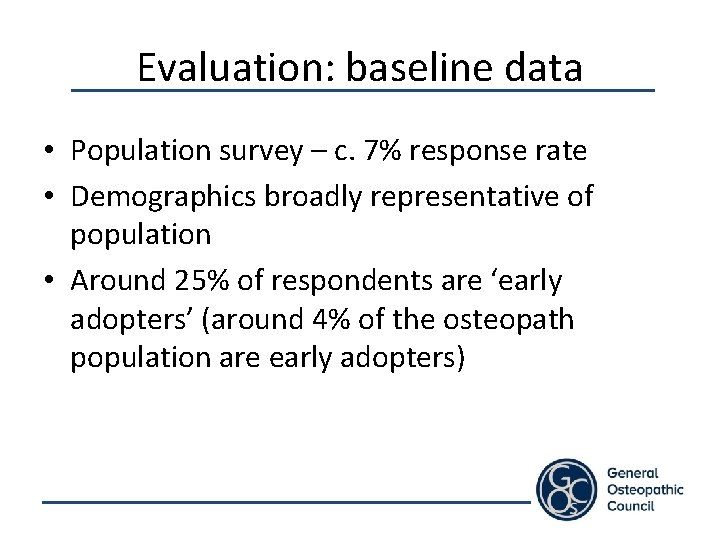
Evaluation: baseline data • Population survey – c. 7% response rate • Demographics broadly representative of population • Around 25% of respondents are ‘early adopters’ (around 4% of the osteopath population are early adopters)
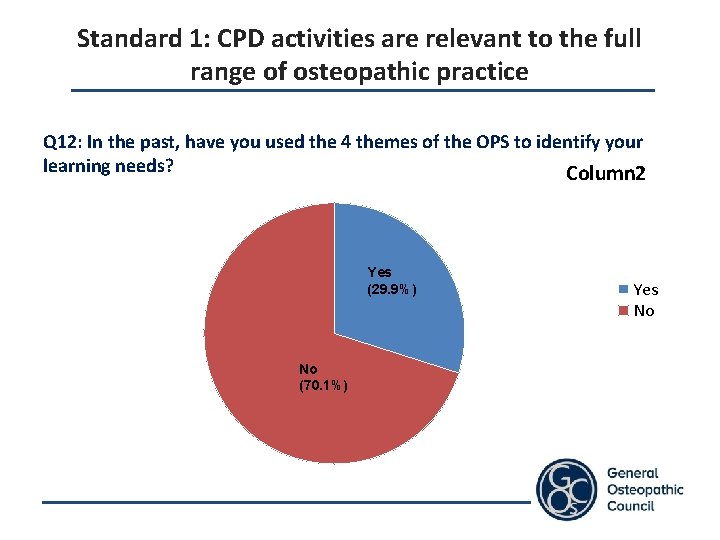
Standard 1: CPD activities are relevant to the full range of osteopathic practice Q 12: In the past, have you used the 4 themes of the OPS to identify your learning needs? Column 2 Yes (29. 9%) No (70. 1%) Yes No
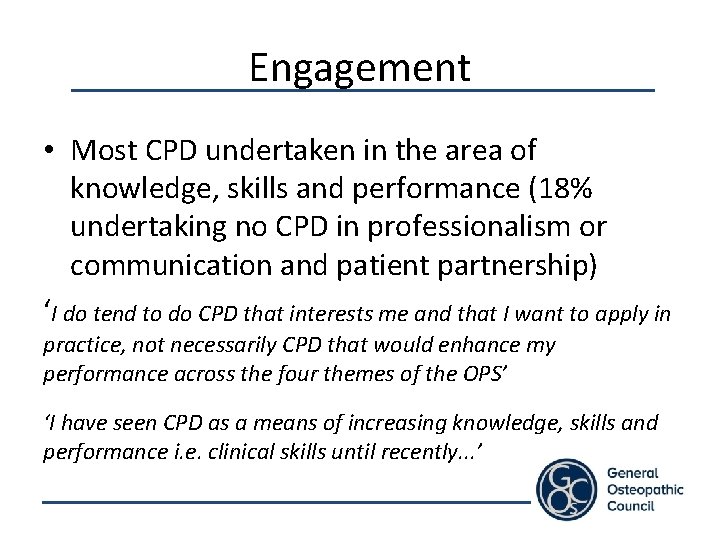
Engagement • Most CPD undertaken in the area of knowledge, skills and performance (18% undertaking no CPD in professionalism or communication and patient partnership) ‘I do tend to do CPD that interests me and that I want to apply in practice, not necessarily CPD that would enhance my performance across the four themes of the OPS’ ‘I have seen CPD as a means of increasing knowledge, skills and performance i. e. clinical skills until recently. . . ’
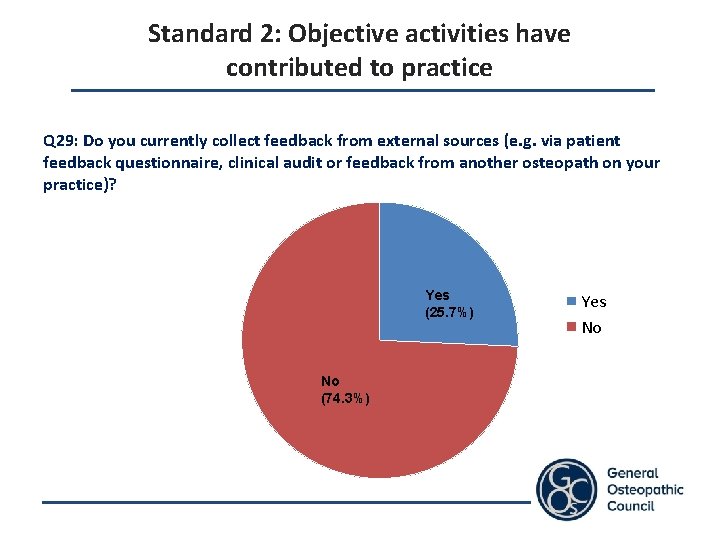
Standard 2: Objective activities have contributed to practice Q 29: Do you currently collect feedback from external sources (e. g. via patient feedback questionnaire, clinical audit or feedback from another osteopath on your practice)? Yes (25. 7%) No (74. 3%) Yes No
Engagement • High numbers of osteopaths are not undertaking feedback on their practice from external sources
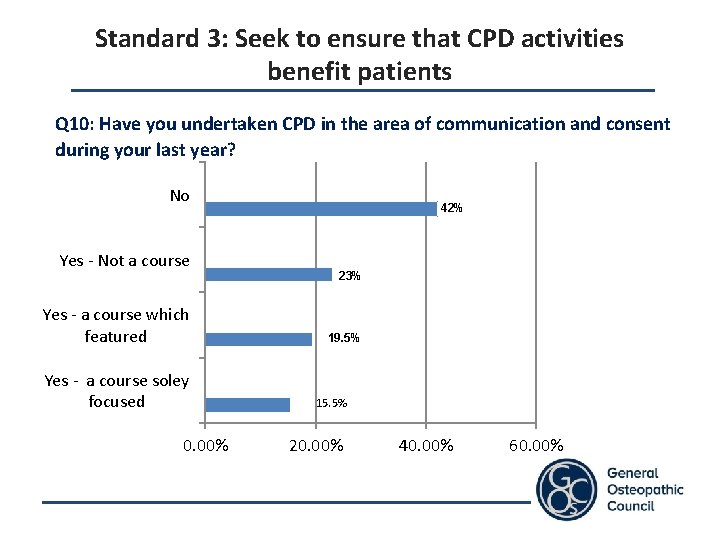
Standard 3: Seek to ensure that CPD activities benefit patients Q 10: Have you undertaken CPD in the area of communication and consent during your last year? No Yes - Not a course Yes - a course which featured Yes - a course soley focused 0. 00% 42% 23% 19. 5% 15. 5% 20. 00% 40. 00% 60. 00%
Engagement • 58% of osteopaths undertook an activity in communication and consent in the last CPD year (this figure was much lower a few years ago) • Methods included: – – – Group meetings GOs. C events Institute of Osteopathy conference CPD providers Fitness to practise workshops
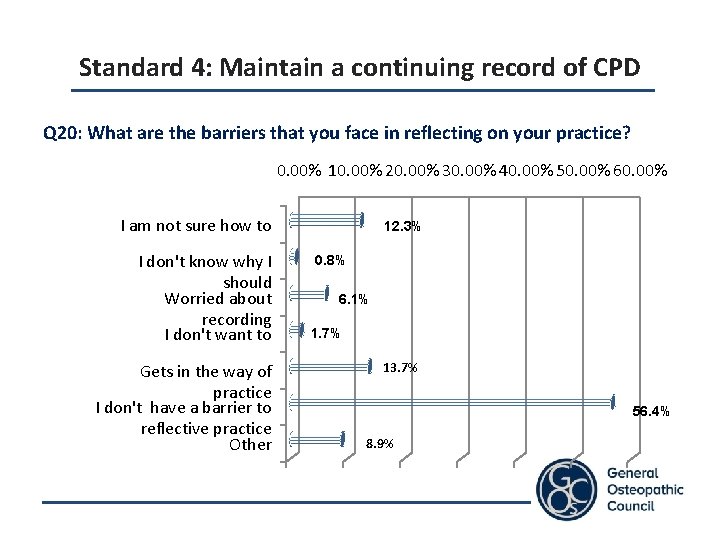
Standard 4: Maintain a continuing record of CPD Q 20: What are the barriers that you face in reflecting on your practice? 0. 00% 10. 00% 20. 00% 30. 00% 40. 00% 50. 00% 60. 00% I am not sure how to I don't know why I should Worried about recording I don't want to Gets in the way of practice I don't have a barrier to reflective practice Other 12. 3% 0. 8% 6. 1% 1. 7% 13. 7% 56. 4% 8. 9%
Support • Barriers to reflecting on practice with others – ‘There aren’t any barriers – we reflect all the time, but the profession seems obsessed with recording such things’ – ‘Osteopaths are more likely to work in isolation and not work in teams, which reduces stimulus for reflection and discussion’ • Focus groups show that getting to the ‘now what’ is difficult even in groups which have developed trust and confidence • Regulatory conundrum!
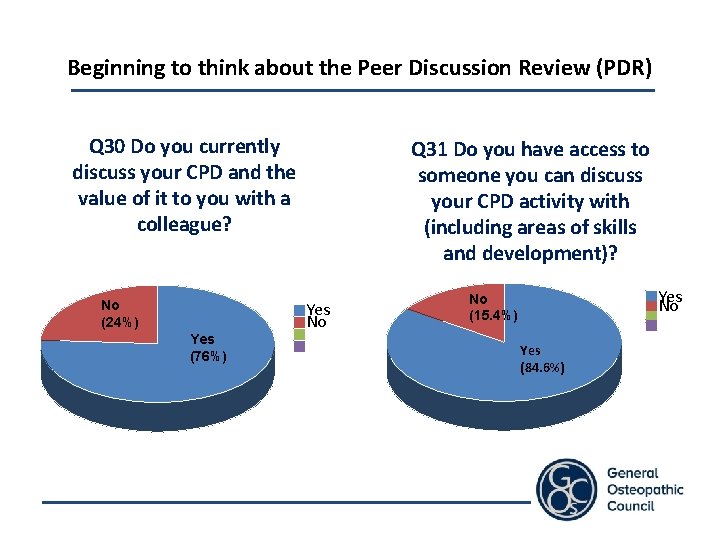
Beginning to think about the Peer Discussion Review (PDR) Q 30 Do you currently discuss your CPD and the value of it to you with a colleague? No (24%) Yes (76%) Q 31 Do you have access to someone you can discuss your CPD activity with (including areas of skills and development)? Yes No No (15. 4%) Yes (84. 6%)
Community • Thinking forward and the implementation of the requirement to discuss practice with others – high numbers of osteopaths indicate that they could identify a peer • The question is how to gain reassurance and confidence from that discussion but also to go further and identify changes and improvements to practice and CPD
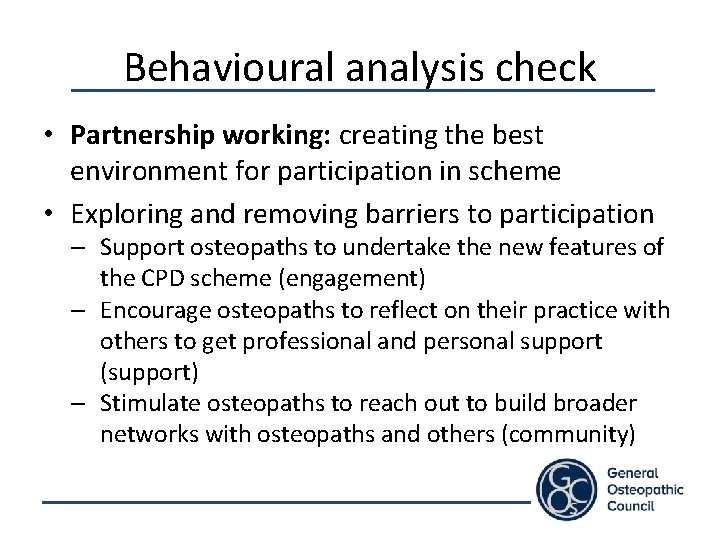
Behavioural analysis check • Partnership working: creating the best environment for participation in scheme • Exploring and removing barriers to participation – Support osteopaths to undertake the new features of the CPD scheme (engagement) – Encourage osteopaths to reflect on their practice with others to get professional and personal support (support) – Stimulate osteopaths to reach out to build broader networks with osteopaths and others (community)
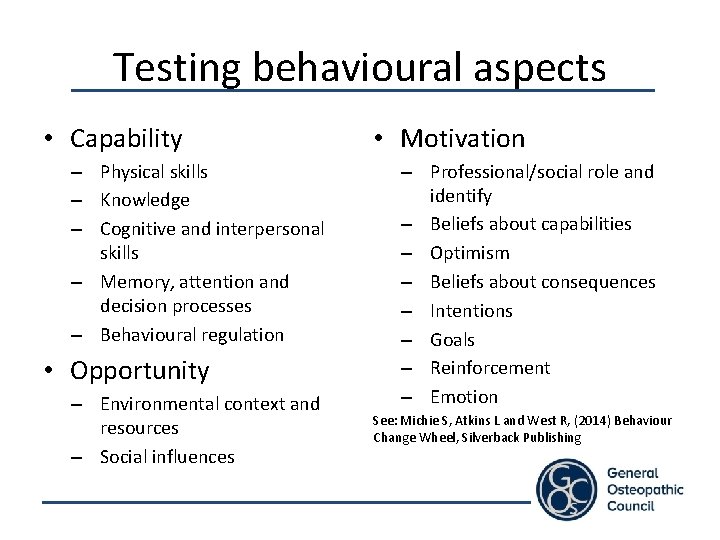
Testing behavioural aspects • Capability – Physical skills – Knowledge – Cognitive and interpersonal skills – Memory, attention and decision processes – Behavioural regulation • Opportunity – Environmental context and resources – Social influences • Motivation – Professional/social role and identify – Beliefs about capabilities – Optimism – Beliefs about consequences – Intentions – Goals – Reinforcement – Emotion See: Michie S, Atkins L and West R, (2014) Behaviour Change Wheel, Silverback Publishing
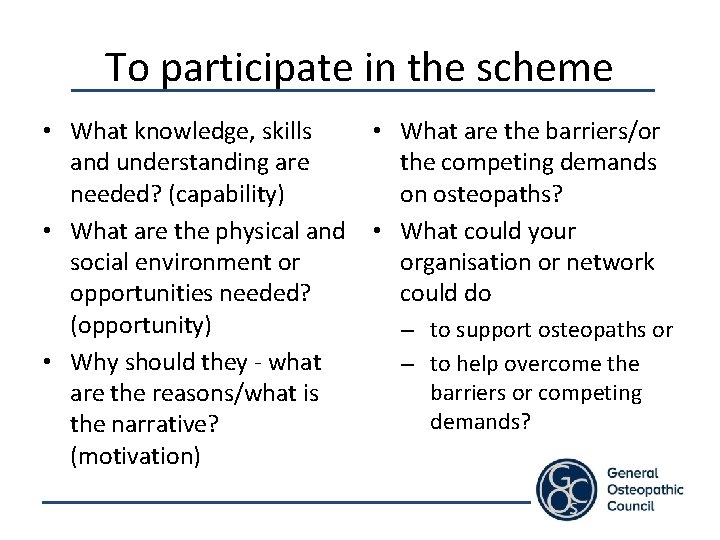
To participate in the scheme • What knowledge, skills and understanding are needed? (capability) • What are the physical and social environment or opportunities needed? (opportunity) • Why should they - what are the reasons/what is the narrative? (motivation) • What are the barriers/or the competing demands on osteopaths? • What could your organisation or network could do – to support osteopaths or – to help overcome the barriers or competing demands?
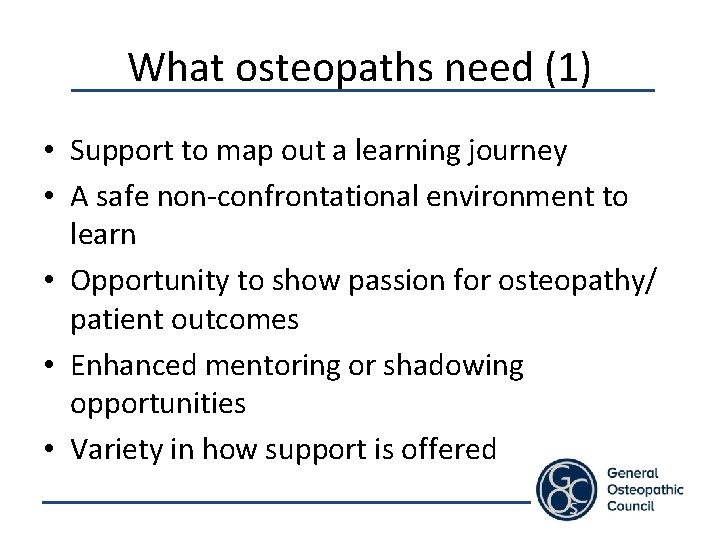
What osteopaths need (1) • Support to map out a learning journey • A safe non-confrontational environment to learn • Opportunity to show passion for osteopathy/ patient outcomes • Enhanced mentoring or shadowing opportunities • Variety in how support is offered
What osteopaths need (2) • Consistent communications about the benefit of the CPD scheme and what’s in it for me • To see role modelling about positive participation in the scheme • Connecting the outcomes of the CPD scheme to more patients experiencing better care • CPD delivery highlighting links to OPS • Case studies showing importance of patient feedback both to patient and practitioner
Barriers to be overcome (1) • Individual isolation - fear of identifying gaps in knowledge and skills/lack of confidence to discuss practice with others • Focusing CPD on practical skills is comfortable • Lack of knowledge about benefits of CPD scheme
Barriers to be overcome (2) • Perception of lack of time and money, geographical barriers • Competing life demands (not seeing CPD as a chargeable part of practice in the same way that sickness or holidays)
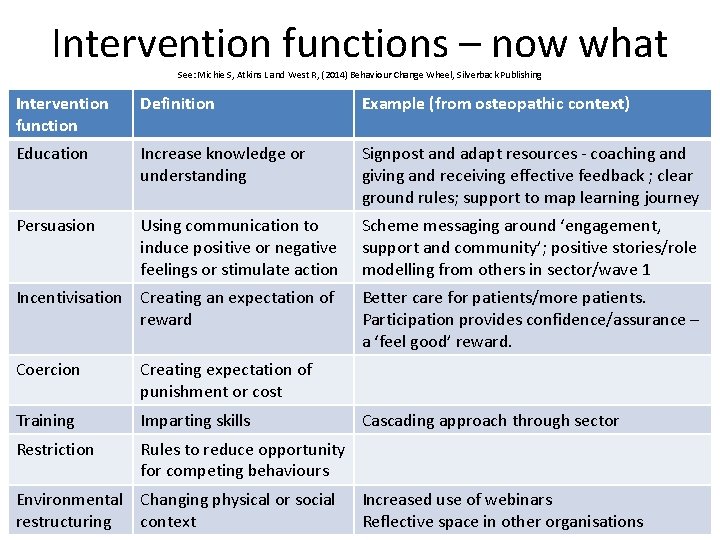
Intervention functions – now what See: Michie S, Atkins L and West R, (2014) Behaviour Change Wheel, Silverback Publishing Intervention function Definition Example (from osteopathic context) Education Increase knowledge or understanding Signpost and adapt resources - coaching and giving and receiving effective feedback ; clear ground rules; support to map learning journey Persuasion Using communication to induce positive or negative feelings or stimulate action Scheme messaging around ‘engagement, support and community’; positive stories/role modelling from others in sector/wave 1 Incentivisation Creating an expectation of reward Better care for patients/more patients. Participation provides confidence/assurance – a ‘feel good’ reward. Coercion Creating expectation of punishment or cost Training Imparting skills Restriction Rules to reduce opportunity for competing behaviours Environmental Changing physical or social restructuring context Cascading approach through sector Increased use of webinars Reflective space in other organisations
Challenges • ‘Hard to reach’ • Introverts – do messages of ‘engagement, support and community’ work for all? • Those who don’t want to hear us – understanding why • Recognising ‘regulation’ as one component of the structures of change – working together in policy solutions
Thank you Thank for participating in our discussion today. Any questions? Please contact: • Fiona Browne – fbrowne@osteopathy. org. uk • Stacey Clift – sclift@osteopathy. org. uk • Steven Bettles – sbettles@osteopathy. org. uk