Conflict And Its Management 1 Scope and Severity
- Slides: 22
Conflict And Its Management 1
Scope and Severity of the Problem ©Injury and violence is one of the 10 leading health indicators identified by the Healthy People 2010 initiative. ©In 1995, the cost of injury and violence in the U. S. was estimated at more than $224 billion per year. These costs include direct medical care and rehabilitation as well as productivity losses to the Nation’s workforce. 2
Scope and Severity of the Problem ©In 1997, homicide was the third leading cause of death for children aged 5 to 14 years, an increasing trend in childhood violent deaths. ©Many factors that contribute to injuries also are closely associated with violent and abusive behavior, such as low income, discrimination, lack of education, and lack of employment opportunities. 3
Conflict Resolution ©Interpersonal conflict is unavoidable, but we can learn to manage it. ©Conflict: Conflict A condition that exists anytime two or more people disagree. 4
Conflict Resolution ©Conflict is a natural phenomenon, neither inherently good or bad, but there may be positive or negative outcomes. 5
Conflict Resolution © General perceptions of conflict as “negative: ” © Anger © Disagreement © Hostility © Threat © Anxiety © Competition © Tension © Violence © Destruction © Pain © War 6
Conflict Resolution © Potential Productive Outcomes of Conflict: © Clarifying © Learning © Stimulating © Intimate © Courageous © Strengthening © Creative © Helpful © Enriching © Caring © Opportunity © Inclusive 7
Conflict Resolution ©Managing conflict in a dysfunctional way is a learned behavior and can be changed. 8
Conflict Resolution ©How do/did we learn our own styles of conflict management? ©Role Models? ©Family role models ©Celebrity role models ©Teachers/mentors/coaches ©Media examples/role models 9
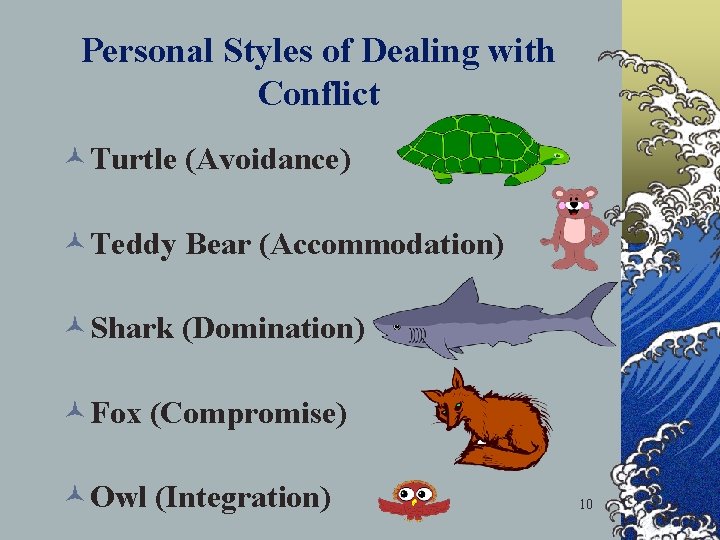
Personal Styles of Dealing with Conflict ©Turtle (Avoidance) ©Teddy Bear (Accommodation) ©Shark (Domination) ©Fox (Compromise) ©Owl (Integration) 10
Conflict Resolution ©It’s likely that a person employs more than one style, depending on the situation, but usually one style dominates. ©Certain styles may be appropriate for certain situations. 11
Conflict Resolution ©Managing conflict constructively depends in large measure on clear, open, and honest communication 12
Elements of Communication ©Source - Person that begins or initiates message ©Message - Information or the meaning ©Channel - Medium through which message is transmitted ©Receiver - Person who is targeted for the message 13
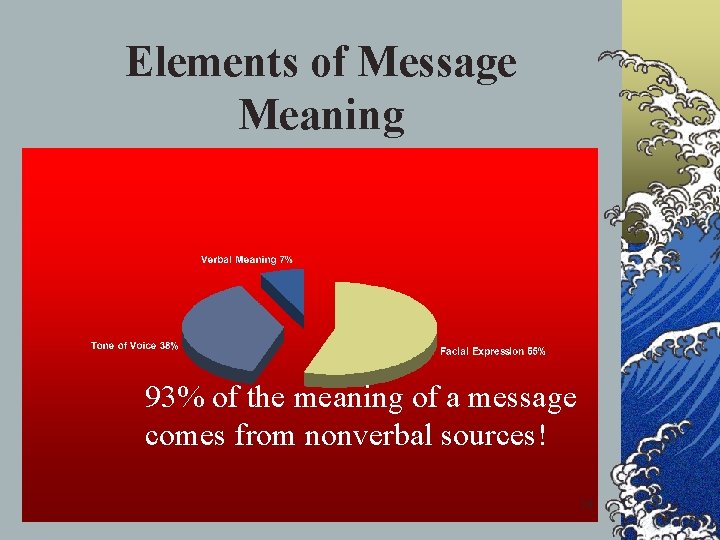
Elements of Message Meaning 93% of the meaning of a message comes from nonverbal sources! 14
Conflict Resolution Skills ©Getting the facts ©Active/Reflective Listening ©Defusing/managing anger ©Empathy skills ©Cognitive restructuring ©Negotiating outcomes 15
Conflict Resolution Process ©Find a good time and place to talk. ©Discuss the problem - Clarify issues ©Get all the facts ©Use active (aka reflective) listening ©Use “I” messages ©Focus on the problem, not the person ©Avoid communication blockers 16
Conflict Resolution Process ©Generate a variety of options; brainstorm ©Choose a solution that works for everybody ©Try the solution. If it doesn’t work, go back to step three and renegotiate. 17
Active Listening © Look at the person speaking © Maintain an open mind © Pay attention © Ask questions © Repeat what the speaker says © Listen for the feelings of the speaker © Don’t: Interrupt, change the subject, make up your mind before the person finishes speaking 18
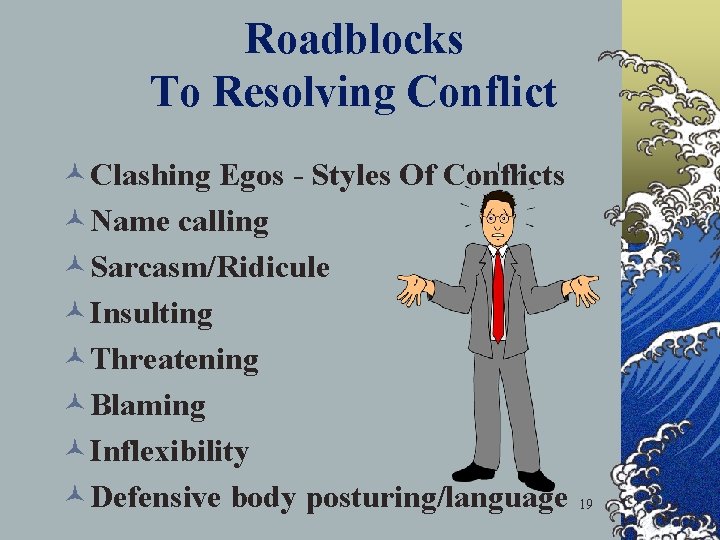
Roadblocks To Resolving Conflict ©Clashing Egos - Styles Of Conflicts ©Name calling ©Sarcasm/Ridicule ©Insulting ©Threatening ©Blaming ©Inflexibility ©Defensive body posturing/language 19
“No-Lose Method” Steps To Follow: 1. Defining the problem in terms of needs. 2. Generating possible solutions (brainstorming). 3. Evaluating and testing the various solutions. 4. Deciding on mutually acceptable solutions. 5. Implementing the solution. (Try it out. ) 6. Evaluating the solution. 20
“No-Lose Method” ©Some Assumptions about the No-Lose Method: ©Your needs are important ©My needs are equally important ©We will approach this conflict from a needs standpoint, not a solution standpoint. ©I will never use my power. 21
Methods of Conflict Resolution - Behjat Sharif ©Denial ©Suppression ©Power ©Compromise ©Collaboration 22