COMS E 6261 Advanced Cryptography Minimalist Cryptography Spring

- Slides: 20
COMS E 6261 Advanced Cryptography: Minimalist Cryptography Spring 2016, Lecture 5 Tal Malkin
Zero Knowledge Interactive Proof System • Definitions (PZK, SZK, CZK): • Completeness • Soundness • Zero Knowledge • Examples • Graph Isomorphism • DH tuples • … • Next (completing from last time): • Commitments 3 COL has an ZK proof system • Corollary: If OWF exist, every language in NP has a ZK proof system • Disclaimer: Very (very) informal today!!
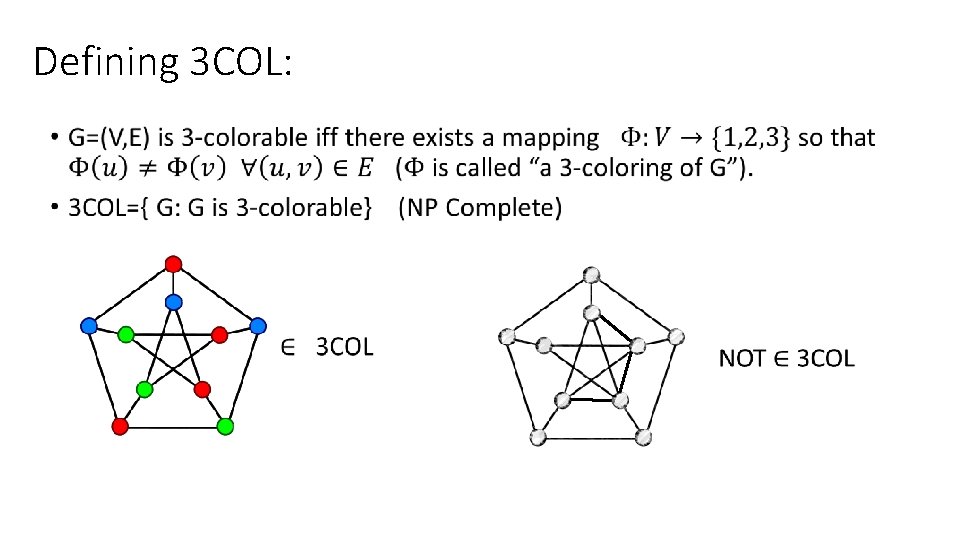
Defining 3 COL: •
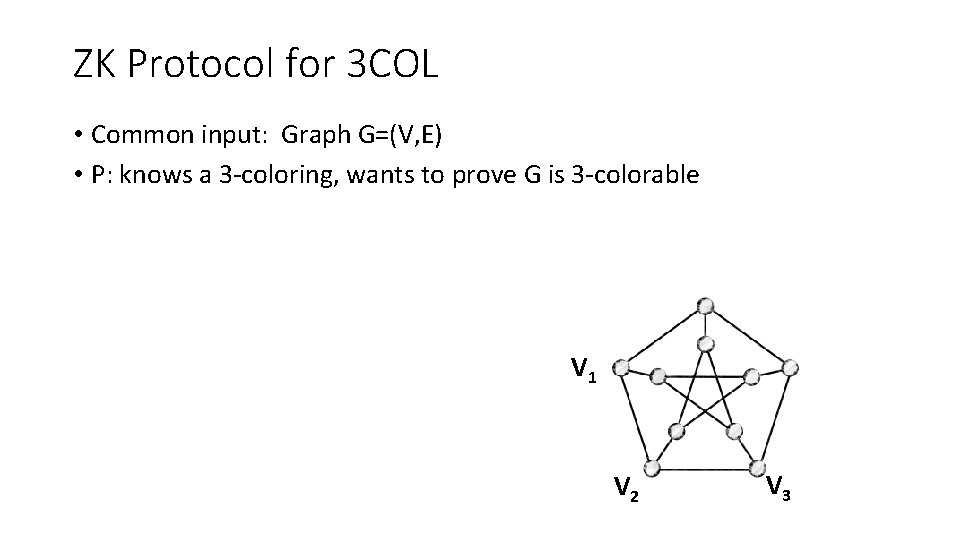
ZK Protocol for 3 COL • Common input: Graph G=(V, E) • P: knows a 3 -coloring, wants to prove G is 3 -colorable V 1 V 2 V 3
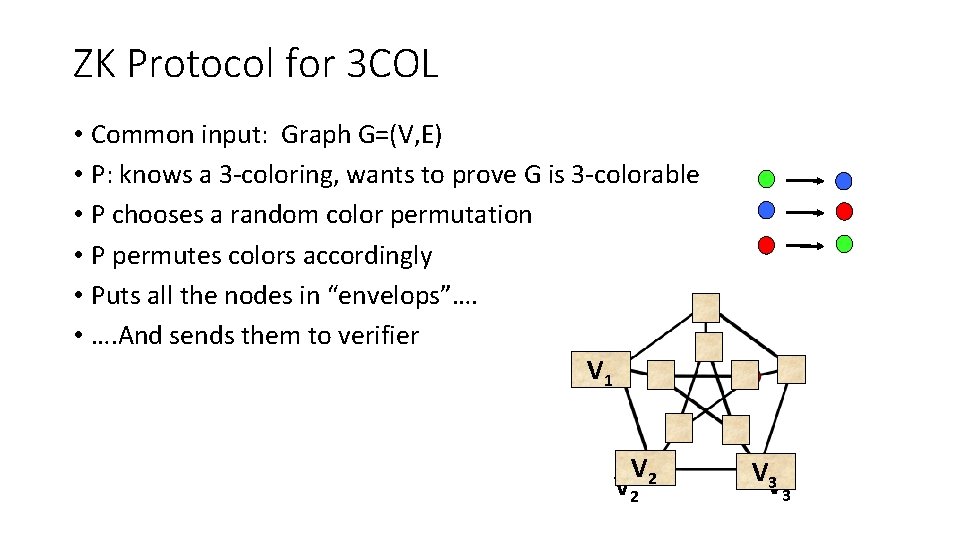
ZK Protocol for 3 COL • Common input: Graph G=(V, E) • P: knows a 3 -coloring, wants to prove G is 3 -colorable • P chooses a random color permutation • P permutes colors accordingly • Puts all the nodes in “envelops”…. • …. And sends them to verifier VV 11 V 2 VV 3 3
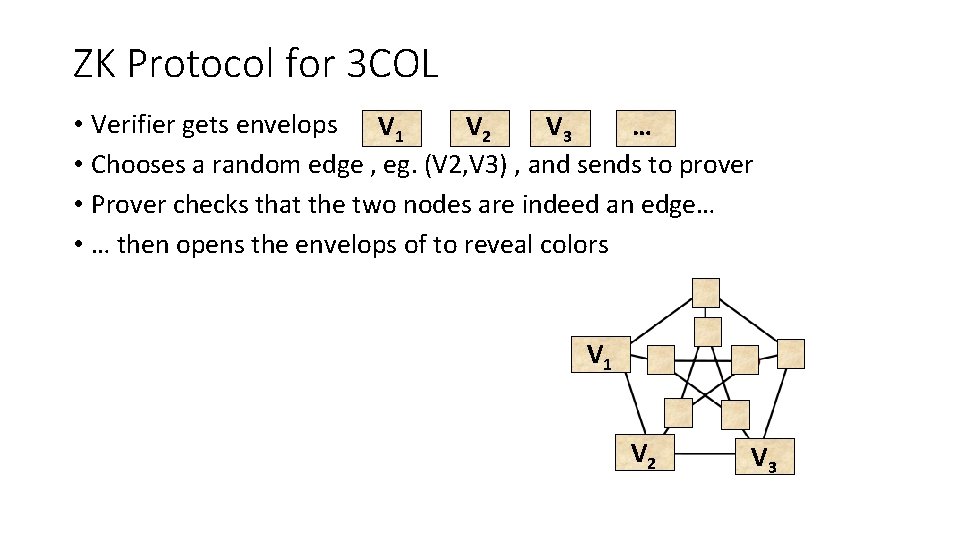
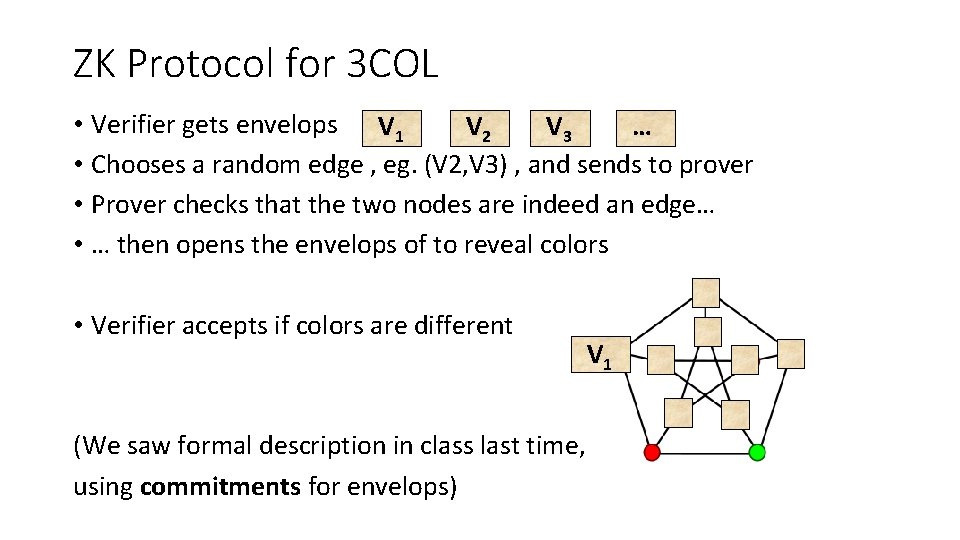
ZK Protocol for 3 COL • Verifier gets envelops V 1 V 2 V 3 … • Chooses a random edge , eg. (V 2, V 3) , and sends to prover • Prover checks that the two nodes are indeed an edge… • … then opens the envelops of to reveal colors V 1 V 2 V 3
ZK Protocol for 3 COL • Verifier gets envelops V 1 V 2 V 3 … • Chooses a random edge , eg. (V 2, V 3) , and sends to prover • Prover checks that the two nodes are indeed an edge… • … then opens the envelops of to reveal colors • Verifier accepts if colors are different (We saw formal description in class last time, using commitments for envelops) V 1
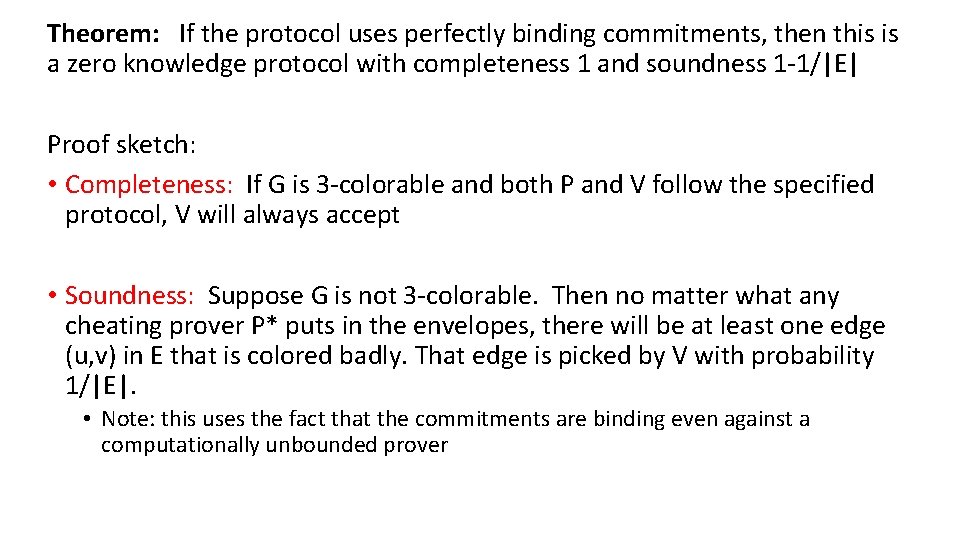
Theorem: If the protocol uses perfectly binding commitments, then this is a zero knowledge protocol with completeness 1 and soundness 1 -1/|E| Proof sketch: • Completeness: If G is 3 -colorable and both P and V follow the specified protocol, V will always accept • Soundness: Suppose G is not 3 -colorable. Then no matter what any cheating prover P* puts in the envelopes, there will be at least one edge (u, v) in E that is colored badly. That edge is picked by V with probability 1/|E|. • Note: this uses the fact that the commitments are binding even against a computationally unbounded prover
We proved: Theorem: If the protocol uses perfectly binding commitments, then this is a zero knowledge protocol with completeness 1 and soundness 1 -1/|E| Comments: • Why is it important that we use perfectly binding commitments? • Recall we showed in class that such commitments can be constructed from oneway permutations. We also mentioned that if you allow another round of interaction, such commitments can be achieved from one-way functions (OWF). • Corollary: If OWF exist, ZK proof for all NP (!) (proof through NP reduction – not very efficient, but certainly poly time) • Note: this proof is public coin and black-box simulation • Other popular NP complete problems for which people show protocols include Hamiltonian cycle and Sudoku • See slides 14, 15 (+overlays) from Mike Rosulek's ZK presentation • Sketched Hamiltonian cycle protocol on the board (Briefly).
ZK: Randomness and Interaction are Essential Statements without proof (you can find proof in [Gol], or better yet, prove for yourself): • If L has a ZK proof system with a single message sent, then L in BPP • If L has a ZK proof system with a deterministic V, then L in BPP • Cor: If L has a ZK proof system with no soundness error, then L in BPP • If L has ZK proof system with deterministic P, then L in BPP
Composition • Types of composition of protocols: sequential, parallel, concurrent • Theorem: ZK proof systems are closed under sequential composition • Theorem: ZK proof systems are NOT generally closed under parallel composition (let alone concurrent). • What about the 3 COL protocol we saw? Is it ZK if we run several parallel executions? (to reduce soundness error to negligible) • Answer: We do not know! (simple simulation strategy does not work)
ZK: Round Complexity •
Witness Indistinguishability • Weaken ZK property so that the distributions induced by <P(w 1), V*>(x) and <P(w 2), V*>(x) are indistinguishable for any witnesses (w 1, w 2) • ZK WI • But not other direction (e. g. , WI meaningless when language with a unique witness for each input) • WI is closed under parallel composition • Useful tool!
Proof of Knowledge, and ZKPOK • Po. K: instead of proving “there exists a solution” prove “I know the solution” • Example: Po. K for discrete log • Defined via an “EXTRACTOR”: for all x and all provers P* for which soundness of <P*, V>(x) holds with non-negligible probability, there exists a ppt extractor that can run P* to obtain a witness w. • Examples we saw so far (without the parallel repetitions), eg 3 COL protocol, were in fact ZK Po. K • Useful on its own, and as a tool towards efficient ZK proofs.
Non Interactive ZK (NIZK) Non-interactive = single message sent from P to V • Many applications!! But… recall: • If L has a ZK proof system with a single message sent, then L in BPP • Solution: Add CRS (common reference string) to the model: uniformly random poly length string accessible by both prover and verifier. • Theorem: If trapdoor permutations (TDP) exist, then any language in NP has a NIZK proof system (with efficient prover) • Note: strong(er) assumption
Applications of ZK Proofs and Arguments (and friends) • Identification (prove that you know password) • Note on Fiat-Shamir paradigm in RO model • Security of protocols: • Design protocol in the semi-honest (honest but curious) model • Compile to protocol for malicious parties, using ZK proofs • CCA secure encryption (possible from CPA plus NIZK) • Outsourcing / verifiable computation • ….
Much more… • Designing efficient ZK proofs for specific languages that are useful • Sigma Protocols, SNARKS, SNARGS, … • Several recent implementation efforts (that efficient!) , e. g for verifiable computation and for cryptocurrencies • Multi Prover proofs and PCP (including ZK aspects…) • … Lots of stuff we didn’t cover here…
The end