
local COMS W 4115 Programming Languages and Translators
- Slides: 19
local COMS W 4115 Programming Languages and Translators Professor Alfred V. Aho 20120507 GROUP 13 Project Manager - Neeraja Ramanan (nr 2404) Language and Tools Guru - Michael Costello (mc 3401) System Architect - Yang Song (ys 2592) System Integrator - Aayush Beri (ab 3591) Verification and Validation - Julianna Eum (jme 2134)
local’s Lineage a lightweight location calculation language, designed to elegantly solve problems in a specific domain: those involving twodimensional geospatial coordinates • • Seamless mobile application design Simplify ground navigation programming Easily handle unit conversion Can be used by programmers of any skill level a simple, fast, safe, robust and extensible language
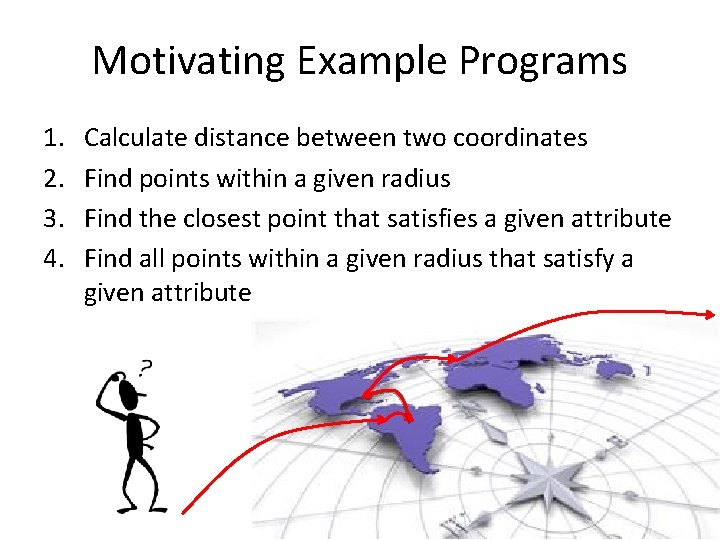
Motivating Example Programs 1. 2. 3. 4. Calculate distance between two coordinates Find points within a given radius Find the closest point that satisfies a given attribute Find all points within a given radius that satisfy a given attribute
Solution • Existing techniques Ø Ø Ø Mongo. DB Post. GIS in Postgre. SQL Libraries in Java • Convenient? - No! Complex and unwieldy No native support • local aims to bridge this gap + Native coordinate data types + “Python-esque” + Strong string manipulation
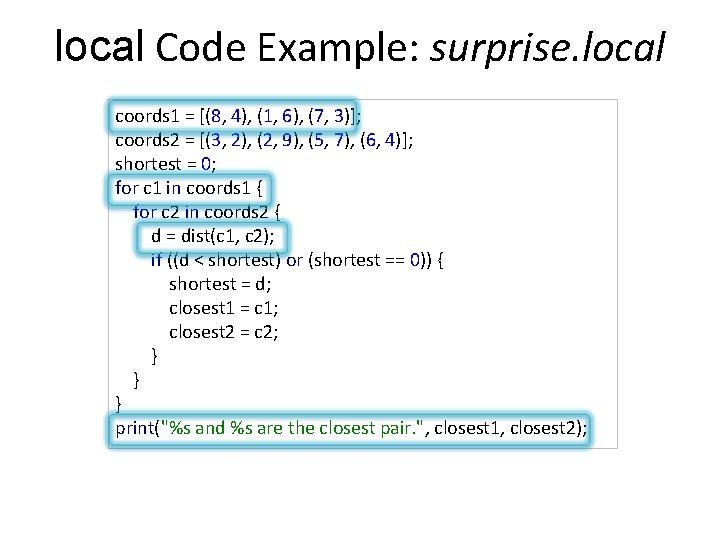
local Code Example: surprise. local coords 1 = [(8, 4), (1, 6), (7, 3)]; coords 2 = [(3, 2), (2, 9), (5, 7), (6, 4)]; shortest = 0; for c 1 in coords 1 { for c 2 in coords 2 { d = dist(c 1, c 2); if ((d < shortest) or (shortest == 0)) { shortest = d; closest 1 = c 1; closest 2 = c 2; } } } print("%s and %s are the closest pair. ", closest 1, closest 2);
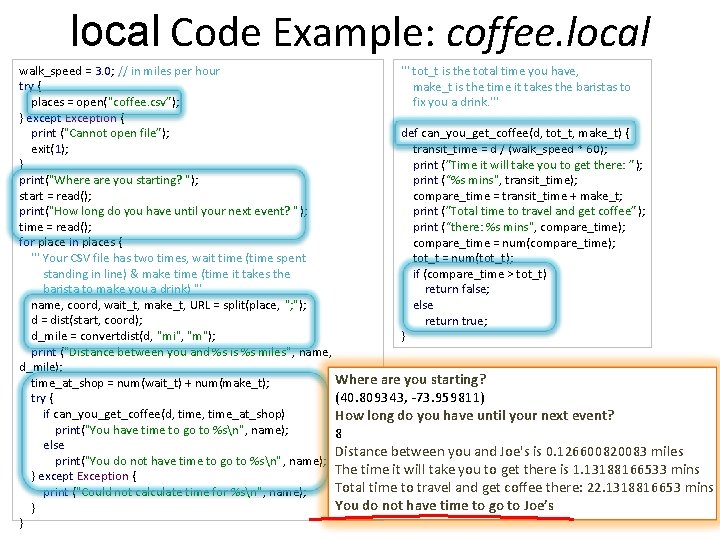
local Code Example: coffee. local walk_speed = 3. 0; // in miles per hour ''' tot_t is the total time you have, try { make_t is the time it takes the baristas to places = open("coffee. csv”); fix you a drink. ''' } except Exception { print ("Cannot open file”); def can_you_get_coffee(d, tot_t, make_t) { exit(1); transit_time = d / (walk_speed * 60); } print (”Time it will take you to get there: ”); print("Where are you starting? "); print (“%s mins", transit_time); start = read(); compare_time = transit_time + make_t; print("How long do you have until your next event? " ); print (”Total time to travel and get coffee” ); time = read(); print (“there: %s mins", compare_time); for place in places { compare_time = num(compare_time); ''' Your CSV file has two times, wait time (time spent tot_t = num(tot_t); standing in line) & make time (time it takes the if (compare_time > tot_t) barista to make you a drink) ''' return false; name, coord, wait_t, make_t, URL = split(place, "; "); else d = dist(start, coord); return true; d_mile = convertdist(d, "mi", "m"); } print ("Distance between you and %s is %s miles" , name, d_mile); Where are you starting? time_at_shop = num(wait_t) + num(make_t); (40. 809343, -73. 959811) try { if can_you_get_coffee(d, time_at_shop) How long do you have until your next event? print("You have time to go to %sn", name); 8 else Distance between you and Joe's is 0. 126600820083 miles print("You do not have time to go to %sn" , name); The time it will take you to get there is 1. 13188166533 mins } except Exception { Total time to travel and get coffee there: 22. 1318816653 mins print ("Could not calculate time for %sn", name); You do not have time to go to Joe’s } }
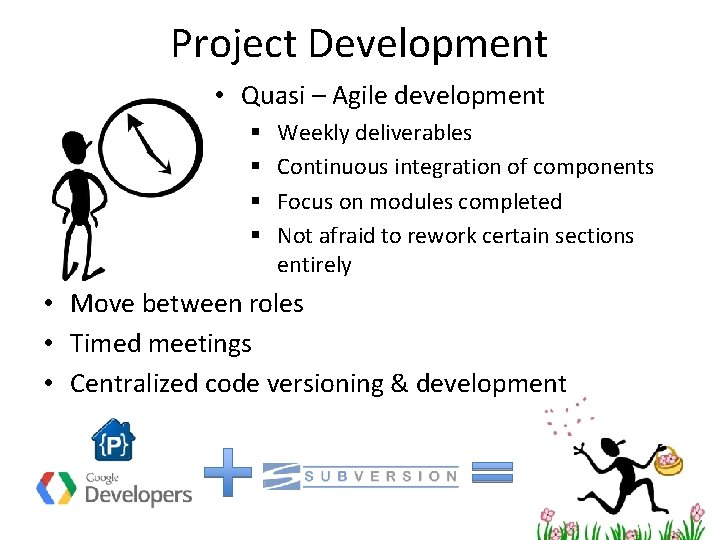
Project Development • Quasi – Agile development § § Weekly deliverables Continuous integration of components Focus on modules completed Not afraid to rework certain sections entirely • Move between roles • Timed meetings • Centralized code versioning & development
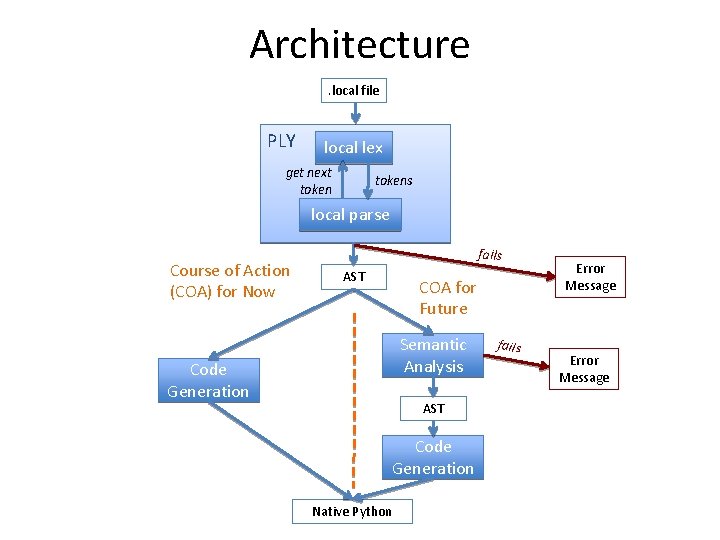
Architecture. local file PLY local lex get next tokens local parse Course of Action (COA) for Now fails AST COA for Future Semantic Analysis Code Generation AST Code Generation Native Python fails Error Message
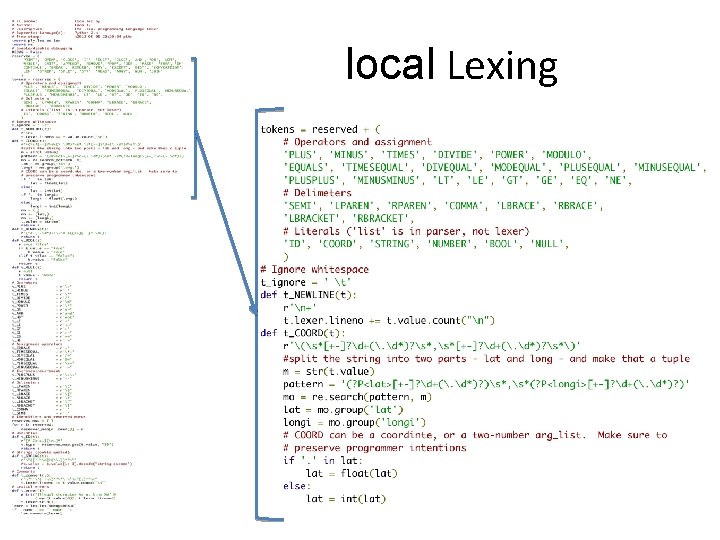
local Lexing
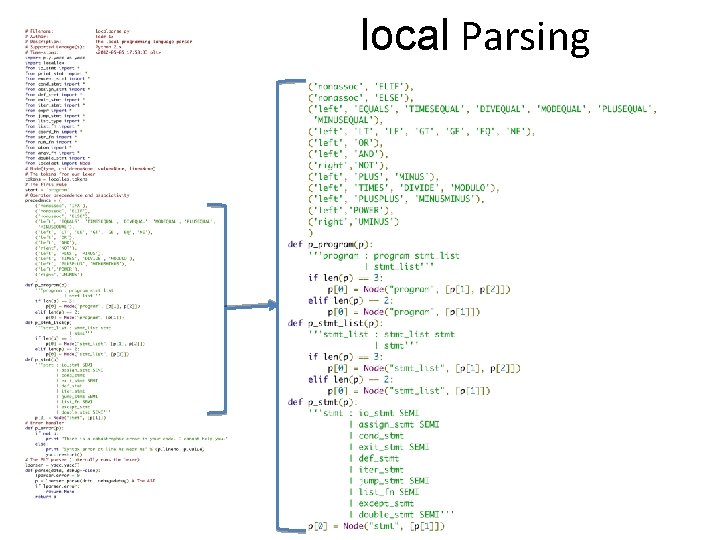
local Parsing
Run Time Environment • Python 2. 7. 2 v Python 2. 7 series: last major release in 2. X series v Most supported version of python v Contain features from the 3. X series to help with portability v Has faster IO module than its predecessors
Software Development Environment
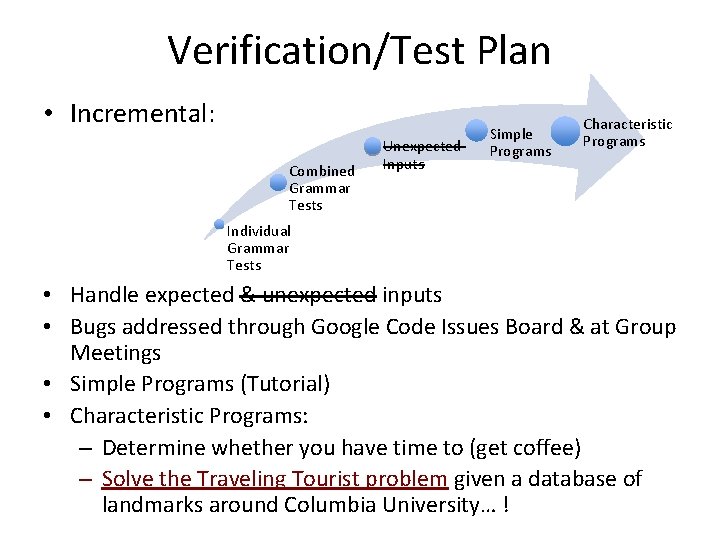
Verification/Test Plan • Incremental: Combined Grammar Tests Unexpected Inputs Simple Programs Characteristic Programs Individual Grammar Tests • Handle expected & unexpected inputs • Bugs addressed through Google Code Issues Board & at Group Meetings • Simple Programs (Tutorial) • Characteristic Programs: – Determine whether you have time to (get coffee) – Solve the Traveling Tourist problem given a database of landmarks around Columbia University… !
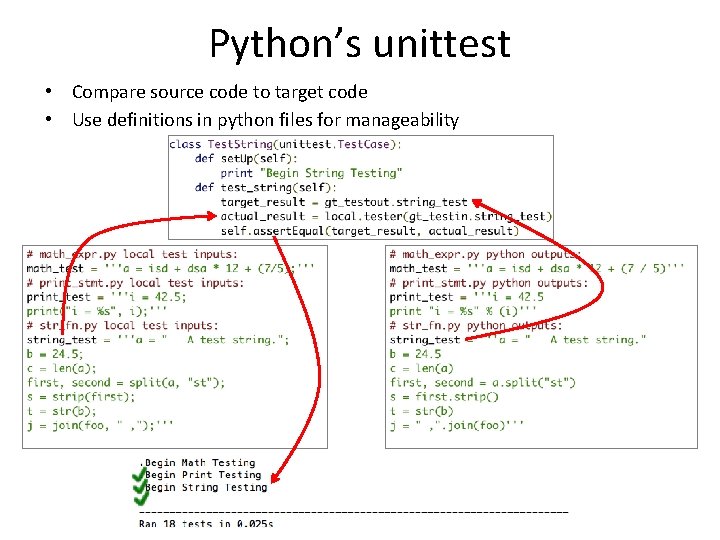
Python’s unittest • Compare source code to target code • Use definitions in python files for manageability
Lessons Learned • Grammar is powerful – so don’t spend too much time on it! • Don’t be afraid of building the AST • Conflicts are inevitable, handling them is an art • Paradigm shift: can’t take our favorite programming languages for granted anymore
The good. The bad + + Wonderfully organized team! Updated each other often Mature about conflicts Completed on schedule - Too much time spent on grammar - Less time on AST - Didn’t get complex local programs up and running until the last week
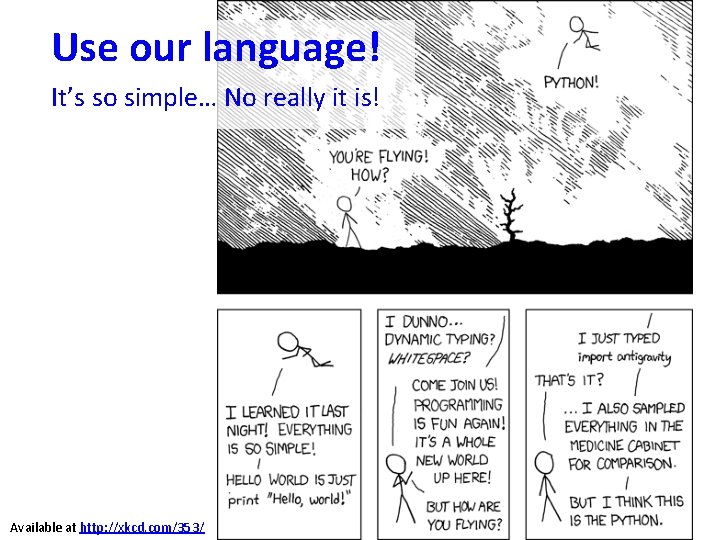
Use our language! It’s so simple… No really it is! Available at http: //xkcd. com/353/
DEMO
Questions?