COMS E 6998 2 INAF U 6518 001
- Slides: 16
COMS E 6998 -2, INAF U 6518 -001, Law L 8989. 00 — Cybersecurity: Technology, Policy and Law Steven M. Bellovin, Jason Healey, Evan Wolff Fall 2019
Us • Steven M. Bellovin: smb@cs. columbia. edu • Jason Healey: jh 3639@sipa. columbia. edu • Evan Wolff: EWolff@crowell. com 2 cybersec
What is this Class? • Cybersecurity is an obvious national security problem • What do we do? • • Fix the technology? Pass laws? Negotiate with other countries? All of the above? • Solving the problem is an interdisciplinary effort 3 cybersec
The Legal Side • How should the law cope with new technology? • Computers and phones, and all they hold • Encryption • How can new technology help law enforcement? • The Internet is international, with boundaries that aren’t apparent to people or apps 4 cybersec
Policy • How do things “cyber” affect and are affected by normal public policy and international affairs? • What does “winning” mean in cyberspace? • What are our “cyberrelations” with other countries? What are the norms for cyber espionage and conflict? • Does deterrence work in cyberspace? Is that even the right question? 5 cybersec
Technology • How does all of this technology work? • What are the technical underpinnings of the problems? Of the solutions? • Are there things technology can’t do? • Where is it going? • Smartphones are ~12 years old, but they’ve completely changed the cybersecurity world. What happens next? 6 cybersec
Who’s This Course For? • You don’t have to be a budding lawyer—but you have to be willing to grapple with legal concepts • You don’t have to know how to program—but you have to be willing to understand computers • You don’t have to be a policy wonk—but you have to be willing to understand how all of this fits into existing policy frameworks 7 cybersec
Course Structure • Lecture with an ample helping of interaction—we want to hear from you • • Each class starts with the week’s news: come prepared to talk about the cybersecurity events that have been in the news. Example: https: //techcrunch. com/2019/08/31/china-googleiphone-uyghur/ • Group projects plus presentation to the class • No exams 8 cybersec
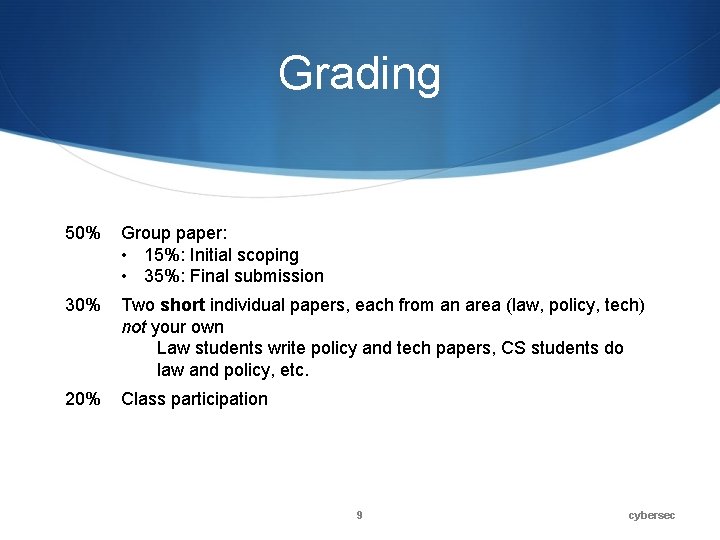
Grading 50% Group paper: • 15%: Initial scoping • 35%: Final submission 30% Two short individual papers, each from an area (law, policy, tech) not your own Law students write policy and tech papers, CS students do law and policy, etc. 20% Class participation 9 cybersec
Groups • Six people, two from each of the three schools • You’re expected to contribute your area’s expertise • Because of the groups, we want you to commit now to not dropping the course (and there’s a long wait list, so if you want to drop, drop now) 10 cybersec
Scoping Paper • It must be about a cybersecurity problem • More or less three semi-independent sections • Use perspectives and tools from each of the three areas to define the problem and possible solutions • Find the fundamental references and literature • About 2000 words • We will put you in touch with professionals in the field 11 cybersec
Final Paper • About 6000 words • An integrated whole—what is the problem, and how can it be solved? • Due two weeks after the last class meeting 12 cybersec
Academic Honesty • Discussing homework with others is encouraged—but all programs and written material must be individual work unless otherwise instructed. • Please use appropriate file permission mechanisms to protect your homework. • Zero tolerance for cheating • Please see your school’s academic honesty policy 13 cybersec
Citations • You must cite to the appropriate literature • Your quotations must be textually distinctive (e. g. , in quotation marks or in a separate, indented paragraph) • You must have a bibliography • Note to law students: This should be in precise Blue Book style • Group papers should use a single citation style 14 cybersec
Contacting Us • We’re all busy and travel a lot • We all like to meet with students • Initial email contact is probably best, if only to make an appointment • Note: email to Prof. Wolff should clearly identify it as coming from a student • See the class web page for office hours 15 cybersec
Responsibility • You’re all adults • You’re all responsible for your own actions • If there’s a problem, you have to tell us 16 cybersec