Complexity and Strategy EIASM Academic Council Prof Joan


- Slides: 21
Complexity and Strategy EIASM Academic Council Prof. Joan E. Ricart IESE Business School October 11, 2006 University of Navarra
Agenda 2 1. Limits on classical organizational dynamics 2. Complex adaptive systems 3. Complexity in management literature 4. An example: Corporate level decision in turbulent environments. University of Navarra Prof. Joan Enric Ricart ricart@iese. edu
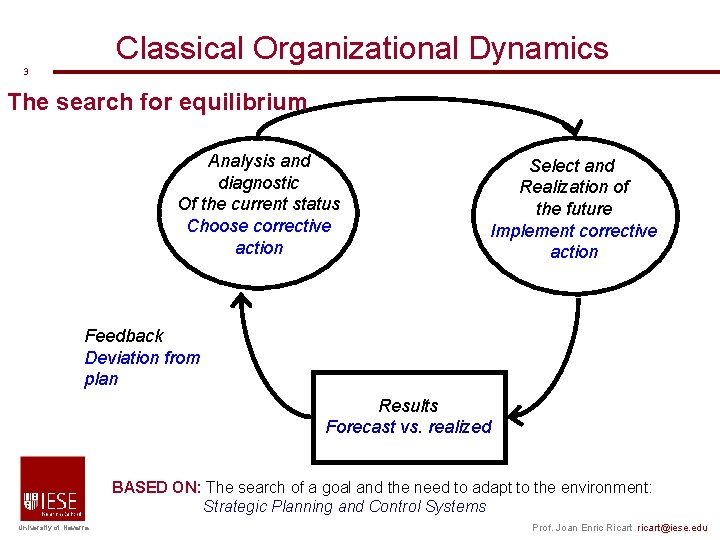
Classical Organizational Dynamics 3 The search for equilibrium Analysis and diagnostic Of the current status Choose corrective action Select and Realization of the future Implement corrective action Feedback Deviation from plan Results Forecast vs. realized BASED ON: The search of a goal and the need to adapt to the environment: Strategic Planning and Control Systems University of Navarra Prof. Joan Enric Ricart ricart@iese. edu
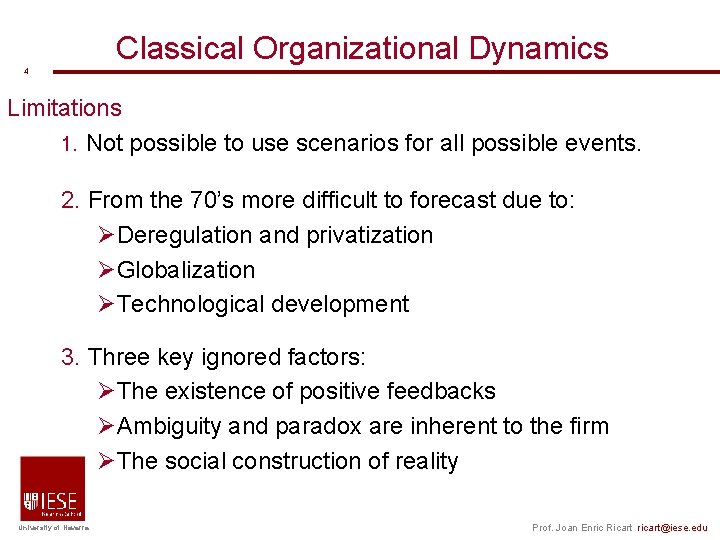
Classical Organizational Dynamics 4 Limitations 1. Not possible to use scenarios for all possible events. 2. From the 70’s more difficult to forecast due to: ØDeregulation and privatization ØGlobalization ØTechnological development 3. Three key ignored factors: ØThe existence of positive feedbacks ØAmbiguity and paradox are inherent to the firm ØThe social construction of reality University of Navarra Prof. Joan Enric Ricart ricart@iese. edu
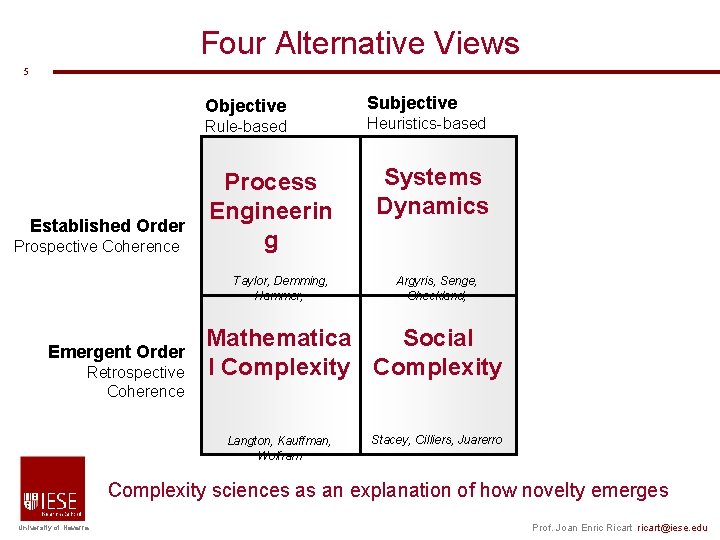
Four Alternative Views 5 Objective Rule-based Established Order Prospective Coherence Process Engineerin g Taylor, Demming, Hammer, Emergent Order Retrospective Coherence Subjective Heuristics-based Systems Dynamics Argyris, Senge, Checkland, Mathematica Social l Complexity Langton, Kauffman, Wolfram Stacey, Cilliers, Juarerro Complexity sciences as an explanation of how novelty emerges University of Navarra Prof. Joan Enric Ricart ricart@iese. edu
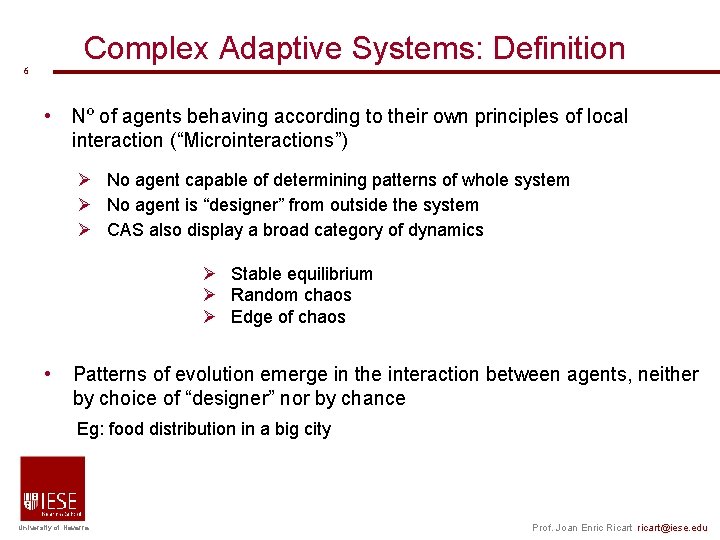
Complex Adaptive Systems: Definition 6 • Nº of agents behaving according to their own principles of local interaction (“Microinteractions”) Ø No agent capable of determining patterns of whole system Ø No agent is “designer” from outside the system Ø CAS also display a broad category of dynamics Ø Stable equilibrium Ø Random chaos Ø Edge of chaos • Patterns of evolution emerge in the interaction between agents, neither by choice of “designer” nor by chance Eg: food distribution in a big city University of Navarra Prof. Joan Enric Ricart ricart@iese. edu
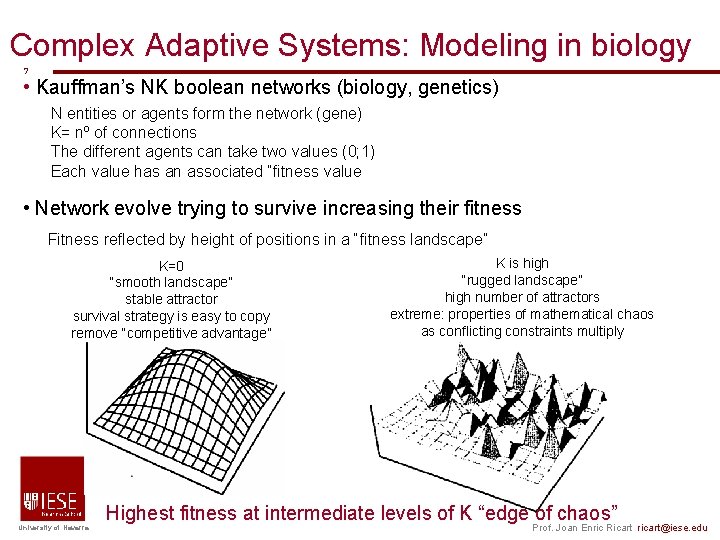
Complex Adaptive Systems: Modeling in biology 7 • Kauffman’s NK boolean networks (biology, genetics) N entities or agents form the network (gene) K= nº of connections The different agents can take two values (0; 1) Each value has an associated “fitness value • Network evolve trying to survive increasing their fitness Fitness reflected by height of positions in a “fitness landscape” K=0 “smooth landscape” stable attractor survival strategy is easy to copy remove “competitive advantage” University of Navarra K is high “rugged landscape” high number of attractors extreme: properties of mathematical chaos as conflicting constraints multiply Highest fitness at intermediate levels of K “edge of chaos” Prof. Joan Enric Ricart ricart@iese. edu
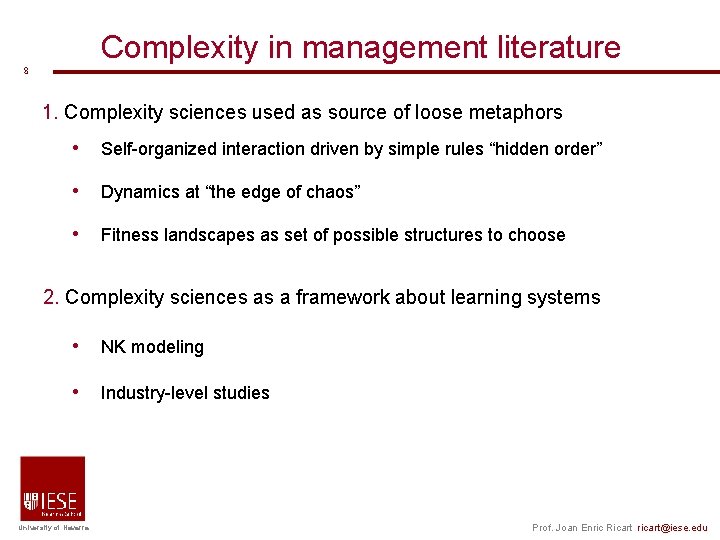
Complexity in management literature 8 1. Complexity sciences used as source of loose metaphors • Self-organized interaction driven by simple rules “hidden order” • Dynamics at “the edge of chaos” • Fitness landscapes as set of possible structures to choose 2. Complexity sciences as a framework about learning systems • NK modeling • Industry-level studies University of Navarra Prof. Joan Enric Ricart ricart@iese. edu
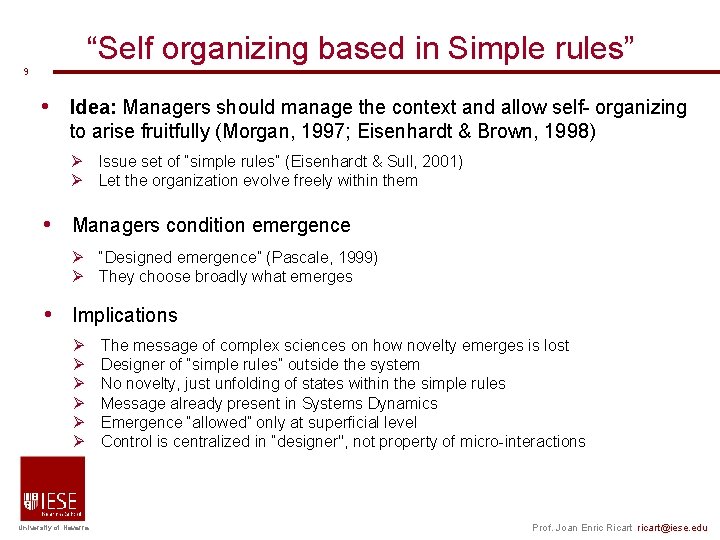
“Self organizing based in Simple rules” 9 • Idea: Managers should manage the context and allow self- organizing to arise fruitfully (Morgan, 1997; Eisenhardt & Brown, 1998) Ø Issue set of “simple rules” (Eisenhardt & Sull, 2001) Ø Let the organization evolve freely within them • Managers condition emergence Ø “Designed emergence” (Pascale, 1999) Ø They choose broadly what emerges • Implications Ø Ø Ø University of Navarra The message of complex sciences on how novelty emerges is lost Designer of “simple rules” outside the system No novelty, just unfolding of states within the simple rules Message already present in Systems Dynamics Emergence “allowed” only at superficial level Control is centralized in “designer", not property of micro-interactions Prof. Joan Enric Ricart ricart@iese. edu
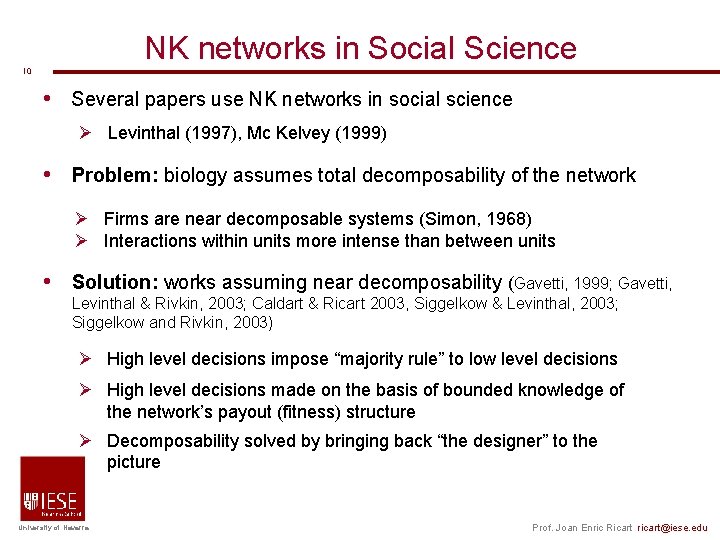
NK networks in Social Science 10 • Several papers use NK networks in social science Ø Levinthal (1997), Mc Kelvey (1999) • Problem: biology assumes total decomposability of the network Ø Firms are near decomposable systems (Simon, 1968) Ø Interactions within units more intense than between units • Solution: works assuming near decomposability (Gavetti, 1999; Gavetti, Levinthal & Rivkin, 2003; Caldart & Ricart 2003, Siggelkow & Levinthal, 2003; Siggelkow and Rivkin, 2003) Ø High level decisions impose “majority rule” to low level decisions Ø High level decisions made on the basis of bounded knowledge of the network’s payout (fitness) structure Ø Decomposability solved by bringing back “the designer” to the picture University of Navarra Prof. Joan Enric Ricart ricart@iese. edu
An example ”Corporate Level Decisions in Turbulent Environments: A View from Complexity Theory” Adrián Caldart & Joan Enric Ricart University of Navarra
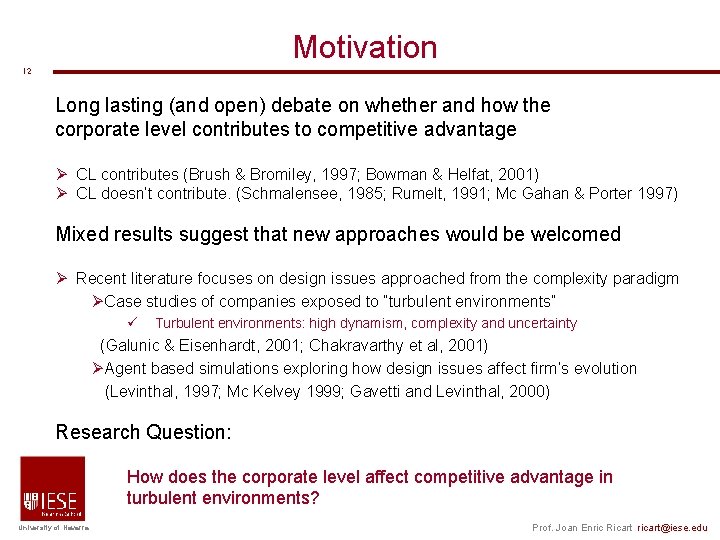
Motivation 12 Long lasting (and open) debate on whether and how the corporate level contributes to competitive advantage Ø CL contributes (Brush & Bromiley, 1997; Bowman & Helfat, 2001) Ø CL doesn’t contribute. (Schmalensee, 1985; Rumelt, 1991; Mc Gahan & Porter 1997) Mixed results suggest that new approaches would be welcomed Ø Recent literature focuses on design issues approached from the complexity paradigm ØCase studies of companies exposed to “turbulent environments” ü Turbulent environments: high dynamism, complexity and uncertainty (Galunic & Eisenhardt, 2001; Chakravarthy et al, 2001) ØAgent based simulations exploring how design issues affect firm’s evolution (Levinthal, 1997; Mc Kelvey 1999; Gavetti and Levinthal, 2000) Research Question: How does the corporate level affect competitive advantage in turbulent environments? University of Navarra Prof. Joan Enric Ricart ricart@iese. edu
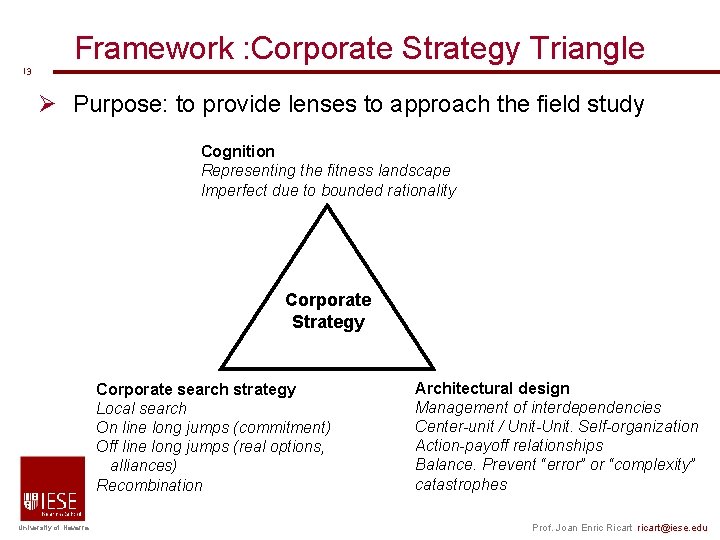
13 Framework : Corporate Strategy Triangle Ø Purpose: to provide lenses to approach the field study Cognition Representing the fitness landscape Imperfect due to bounded rationality Corporate Strategy Corporate search strategy Local search On line long jumps (commitment) Off line long jumps (real options, alliances) Recombination University of Navarra Architectural design Management of interdependencies Center-unit / Unit-Unit. Self-organization Action-payoff relationships Balance. Prevent “error” or “complexity” catastrophes Prof. Joan Enric Ricart ricart@iese. edu
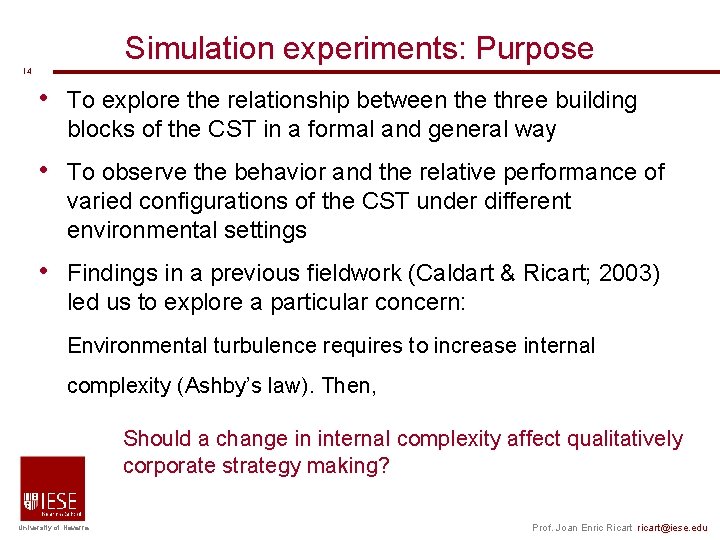
14 Simulation experiments: Purpose • To explore the relationship between the three building blocks of the CST in a formal and general way • To observe the behavior and the relative performance of varied configurations of the CST under different environmental settings • Findings in a previous fieldwork (Caldart & Ricart; 2003) led us to explore a particular concern: Environmental turbulence requires to increase internal complexity (Ashby’s law). Then, Should a change in internal complexity affect qualitatively corporate strategy making? University of Navarra Prof. Joan Enric Ricart ricart@iese. edu
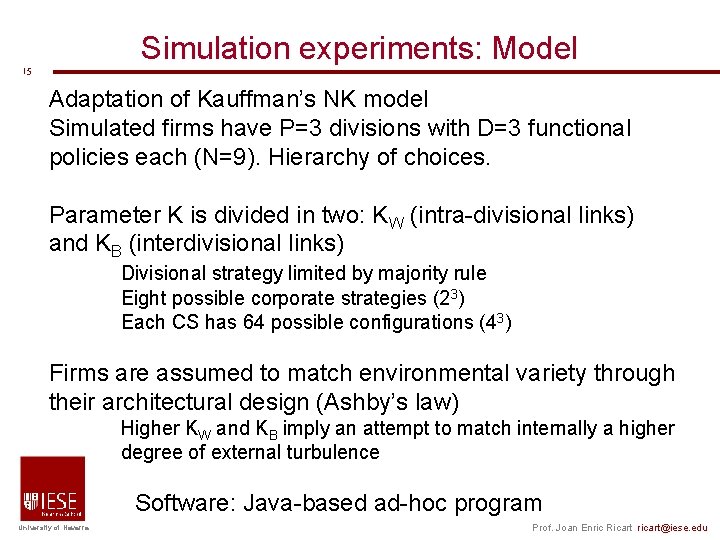
15 Simulation experiments: Model Adaptation of Kauffman’s NK model Simulated firms have P=3 divisions with D=3 functional policies each (N=9). Hierarchy of choices. Parameter K is divided in two: KW (intra-divisional links) and KB (interdivisional links) Divisional strategy limited by majority rule Eight possible corporate strategies (23) Each CS has 64 possible configurations (43) Firms are assumed to match environmental variety through their architectural design (Ashby’s law) Higher KW and KB imply an attempt to match internally a higher degree of external turbulence Software: Java-based ad-hoc program Prof. Joan Enric Ricart ricart@iese. edu University of Navarra
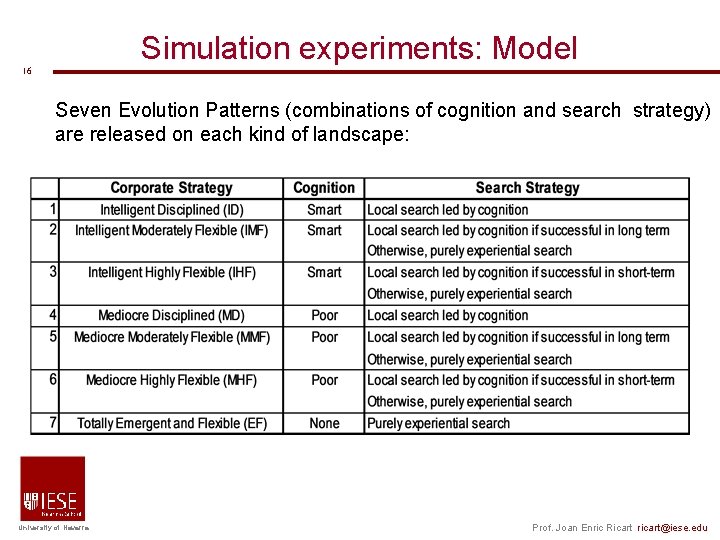
16 Simulation experiments: Model Seven Evolution Patterns (combinations of cognition and search strategy) are released on each kind of landscape: University of Navarra Prof. Joan Enric Ricart ricart@iese. edu
17 Simulation experiments: Model Each evolution pattern is released on eight kinds of fitness landscapes, each of them reflecting different structural designs Ø A Kb=0 implies an M-form design Ø As Kb increases, we have increasingly complex CM-form designs Ø 7 different patterns of evolution under eight different architectural designs conform 56 configurations of the CST University of Navarra Prof. Joan Enric Ricart ricart@iese. edu
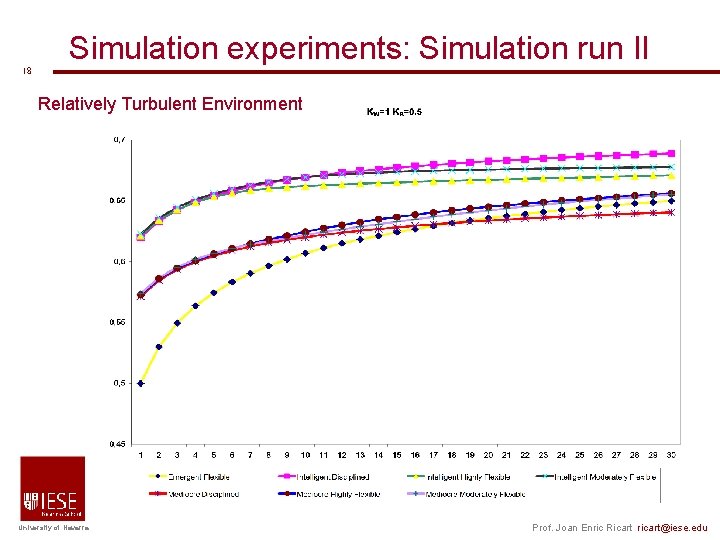
18 Simulation experiments: Simulation run II Relatively Turbulent Environment University of Navarra Prof. Joan Enric Ricart ricart@iese. edu
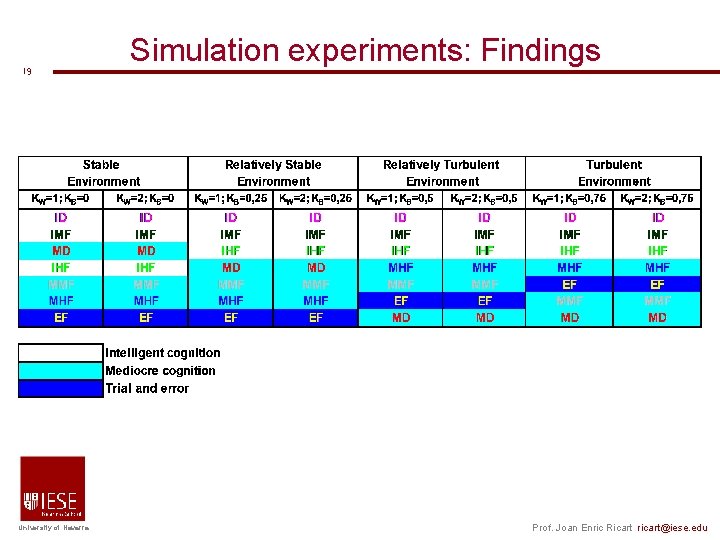
19 University of Navarra Simulation experiments: Findings Prof. Joan Enric Ricart ricart@iese. edu
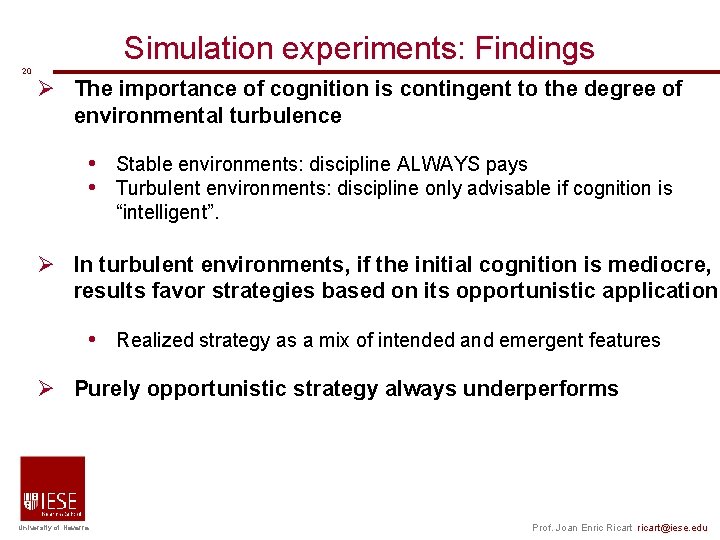
20 Simulation experiments: Findings Ø The importance of cognition is contingent to the degree of environmental turbulence • Stable environments: discipline ALWAYS pays • Turbulent environments: discipline only advisable if cognition is “intelligent”. Ø In turbulent environments, if the initial cognition is mediocre, results favor strategies based on its opportunistic application • Realized strategy as a mix of intended and emergent features Ø Purely opportunistic strategy always underperforms University of Navarra Prof. Joan Enric Ricart ricart@iese. edu
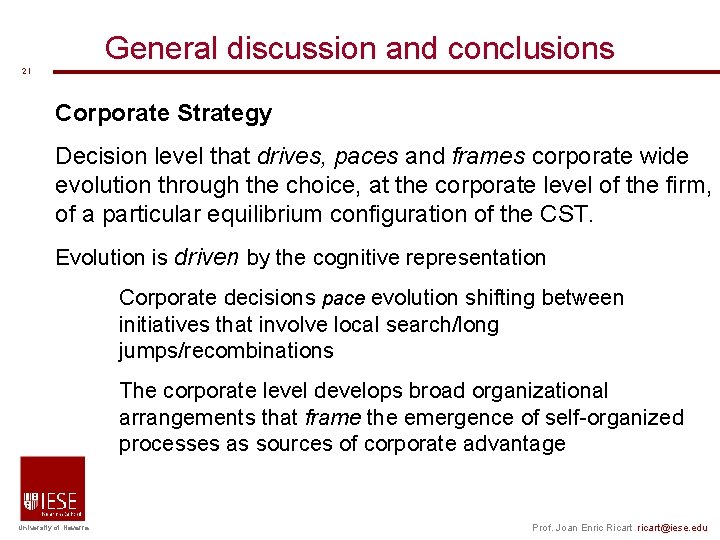
General discussion and conclusions 21 Corporate Strategy Decision level that drives, paces and frames corporate wide evolution through the choice, at the corporate level of the firm, of a particular equilibrium configuration of the CST. Evolution is driven by the cognitive representation Corporate decisions pace evolution shifting between initiatives that involve local search/long jumps/recombinations The corporate level develops broad organizational arrangements that frame the emergence of self-organized processes as sources of corporate advantage University of Navarra Prof. Joan Enric Ricart ricart@iese. edu