Compilers and Language Translation Gordon College Whats a

- Slides: 40
Compilers and Language Translation Gordon College
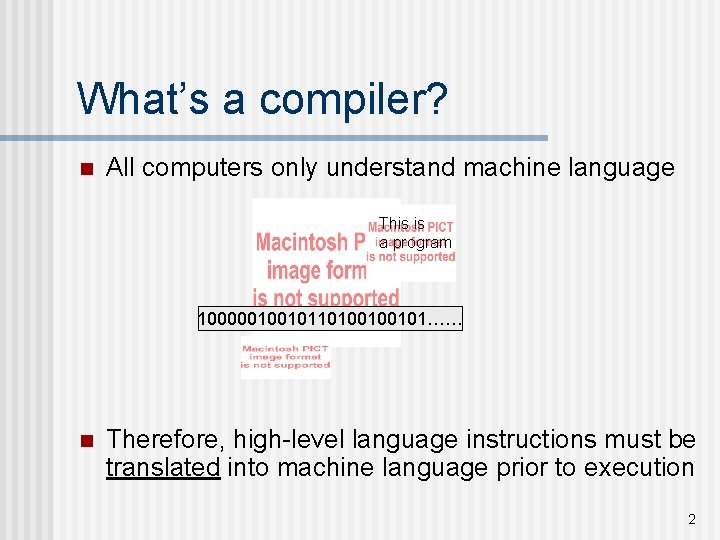
What’s a compiler? n All computers only understand machine language This is a program 10000010010110100100101…… n Therefore, high-level language instructions must be translated into machine language prior to execution 2
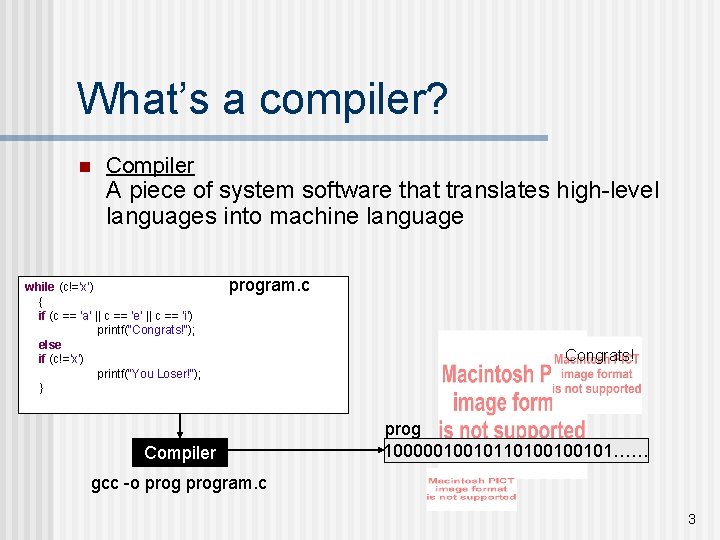
What’s a compiler? n Compiler A piece of system software that translates high-level languages into machine language while (c!='x') { if (c == 'a' || c == 'e' || c == 'i') printf("Congrats!"); else if (c!='x') printf("You Loser!"); } program. c Compiler Congrats! prog 10000010010110100100101…… gcc -o program. c 3
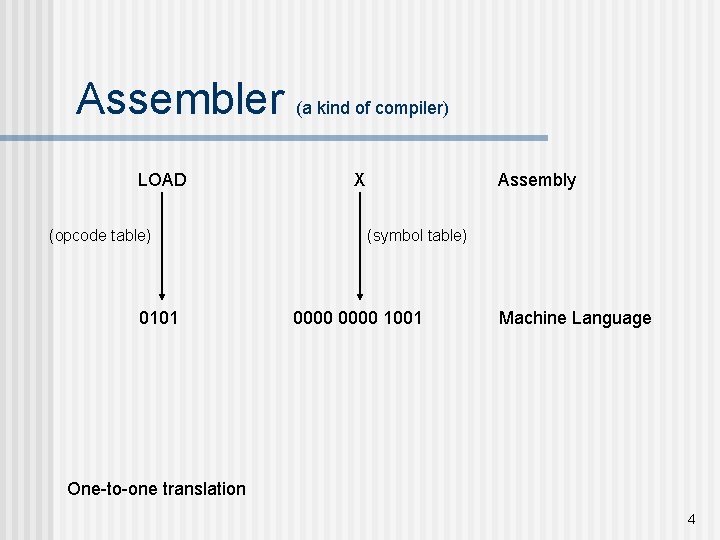
Assembler (a kind of compiler) LOAD (opcode table) 0101 X Assembly (symbol table) 0000 1001 Machine Language One-to-one translation 4
Compiler (high-level language translator) a = b + c - d; 0101 00001110001 0111 00001110010 0110 00001110011 0100 00001110100 LOAD B ADD C SUBTRACT D STORE A 0101 00001110001 0111 00001110010……. One-to-many translation 5
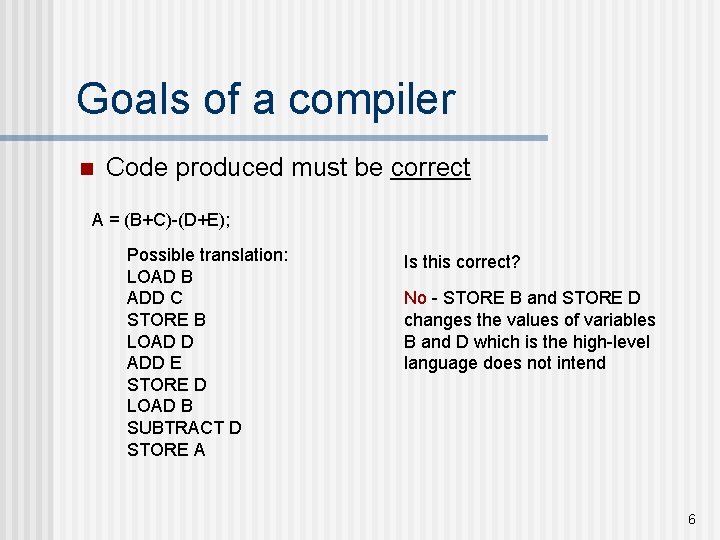
Goals of a compiler n Code produced must be correct A = (B+C)-(D+E); Possible translation: LOAD B ADD C STORE B LOAD D ADD E STORE D LOAD B SUBTRACT D STORE A Is this correct? No - STORE B and STORE D changes the values of variables B and D which is the high-level language does not intend 6
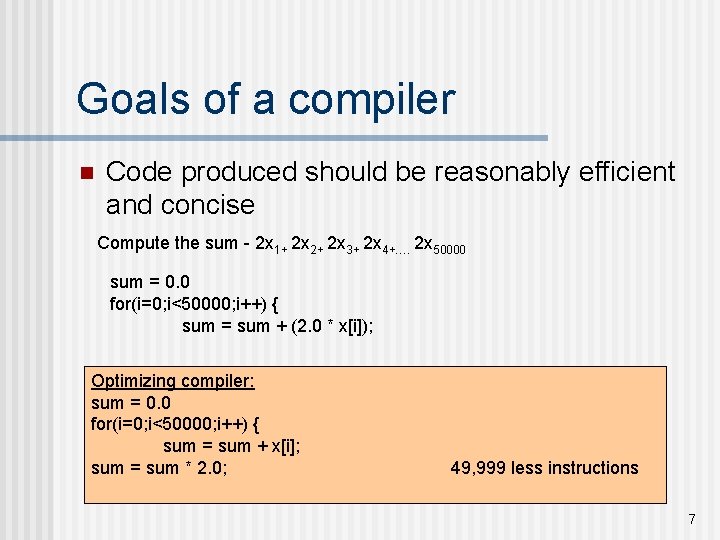
Goals of a compiler n Code produced should be reasonably efficient and concise Compute the sum - 2 x 1+ 2 x 2+ 2 x 3+ 2 x 4+…. 2 x 50000 sum = 0. 0 for(i=0; i<50000; i++) { sum = sum + (2. 0 * x[i]); Optimizing compiler: sum = 0. 0 for(i=0; i<50000; i++) { sum = sum + x[i]; sum = sum * 2. 0; 49, 999 less instructions 7
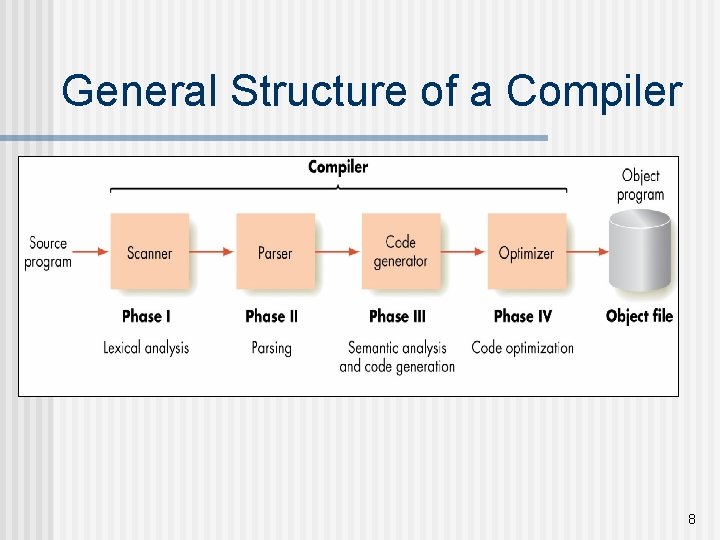
General Structure of a Compiler 8
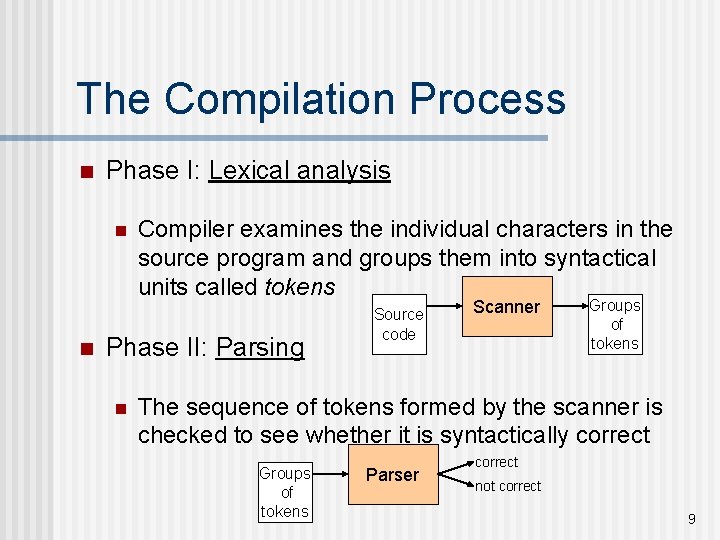
The Compilation Process n Phase I: Lexical analysis n n Compiler examines the individual characters in the source program and groups them into syntactical units called tokens Phase II: Parsing n Source code Scanner Groups of tokens The sequence of tokens formed by the scanner is checked to see whether it is syntactically correct Groups of tokens Parser correct not correct 9
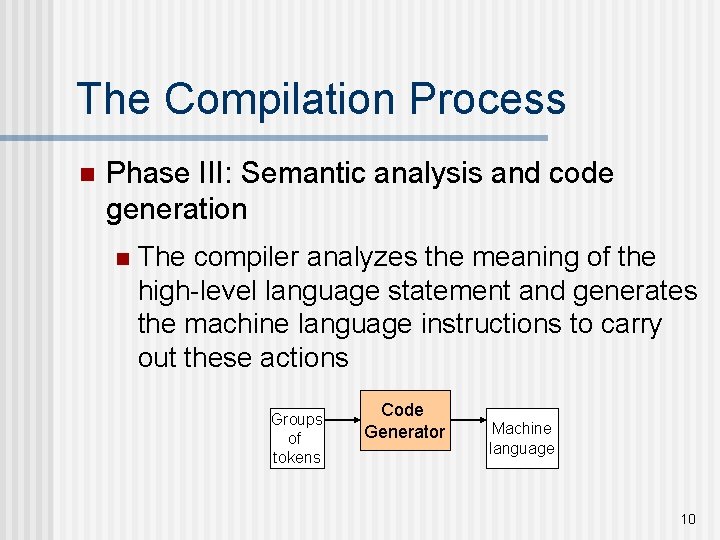
The Compilation Process n Phase III: Semantic analysis and code generation n The compiler analyzes the meaning of the high-level language statement and generates the machine language instructions to carry out these actions Groups of tokens Code Generator Machine language 10
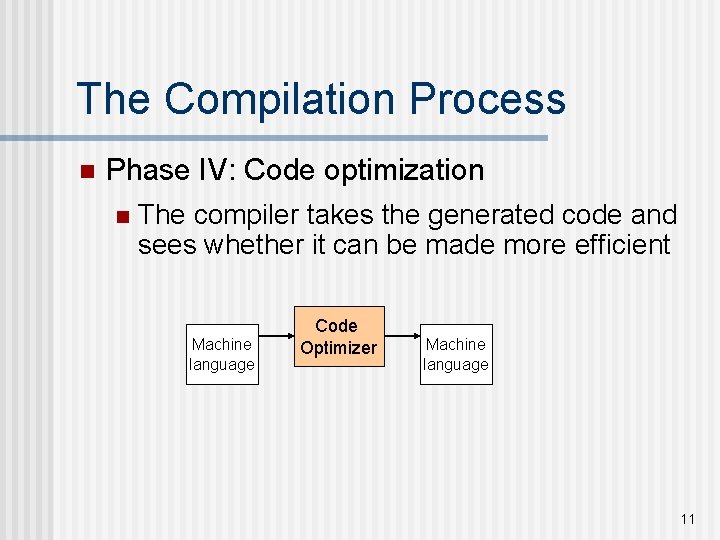
The Compilation Process n Phase IV: Code optimization n The compiler takes the generated code and sees whether it can be made more efficient Machine language Code Optimizer Machine language 11
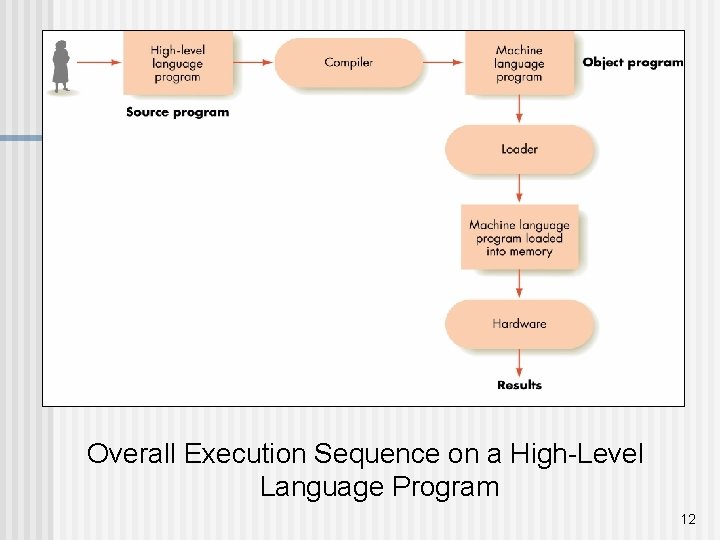
Overall Execution Sequence on a High-Level Language Program 12
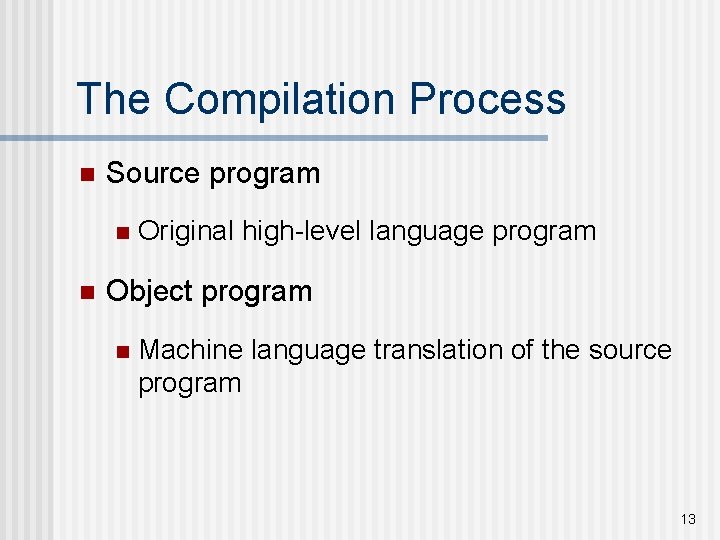
The Compilation Process n Source program n n Original high-level language program Object program n Machine language translation of the source program 13
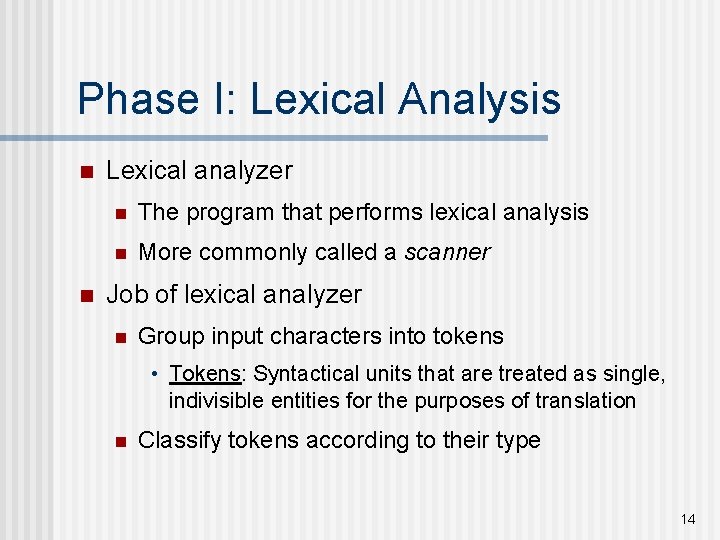
Phase I: Lexical Analysis n n Lexical analyzer n The program that performs lexical analysis n More commonly called a scanner Job of lexical analyzer n Group input characters into tokens • Tokens: Syntactical units that are treated as single, indivisible entities for the purposes of translation n Classify tokens according to their type 14
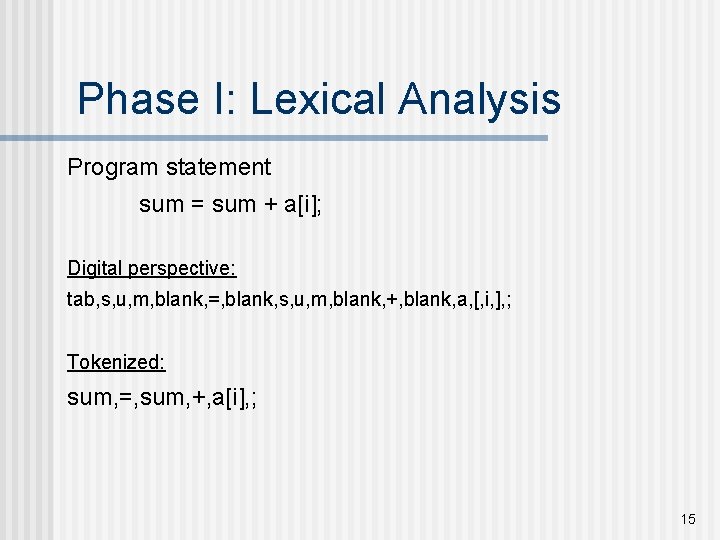
Phase I: Lexical Analysis Program statement sum = sum + a[i]; Digital perspective: tab, s, u, m, blank, =, blank, s, u, m, blank, +, blank, a, [, i, ], ; Tokenized: sum, =, sum, +, a[i], ; 15
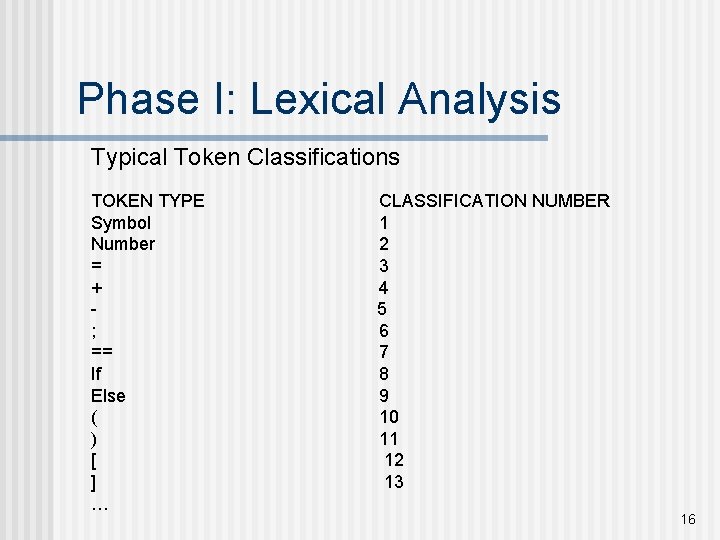
Phase I: Lexical Analysis Typical Token Classifications TOKEN TYPE Symbol Number = + ; == If Else ( ) [ ] … CLASSIFICATION NUMBER 1 2 3 4 5 6 7 8 9 10 11 12 13 16
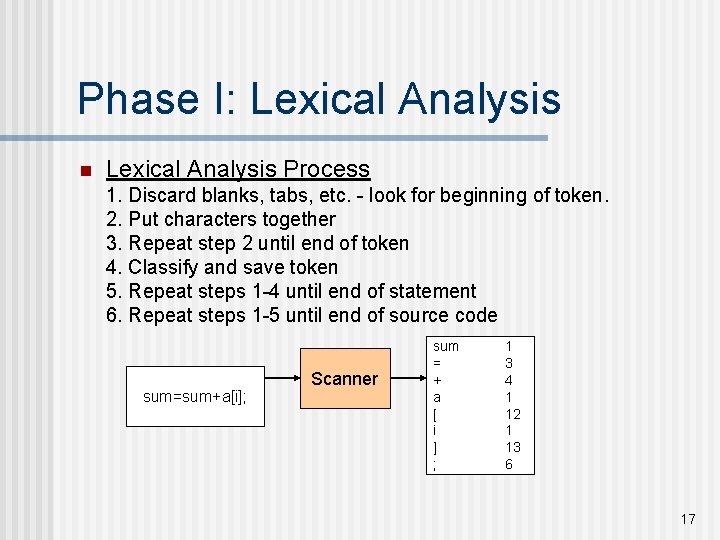
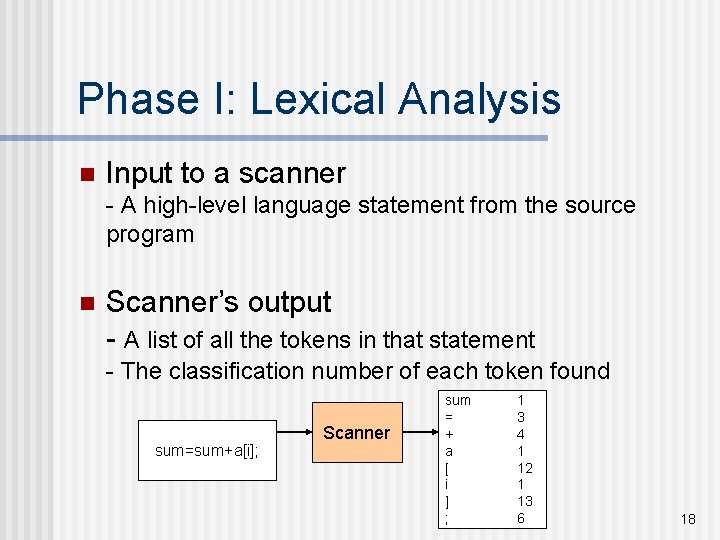
Phase I: Lexical Analysis n Lexical Analysis Process 1. Discard blanks, tabs, etc. - look for beginning of token. 2. Put characters together 3. Repeat step 2 until end of token 4. Classify and save token 5. Repeat steps 1 -4 until end of statement 6. Repeat steps 1 -5 until end of source code sum=sum+a[i]; Scanner sum = + a [ i ] ; 1 3 4 1 12 1 13 6 17
Phase I: Lexical Analysis n Input to a scanner - A high-level language statement from the source program n Scanner’s output - A list of all the tokens in that statement - The classification number of each token found sum=sum+a[i]; Scanner sum = + a [ i ] ; 1 3 4 1 12 1 13 6 18
Phase II: Parsing n Parsing phase n A compiler determines whether the tokens recognized by the scanner are a syntactically legal statement n Performed by a parser 19
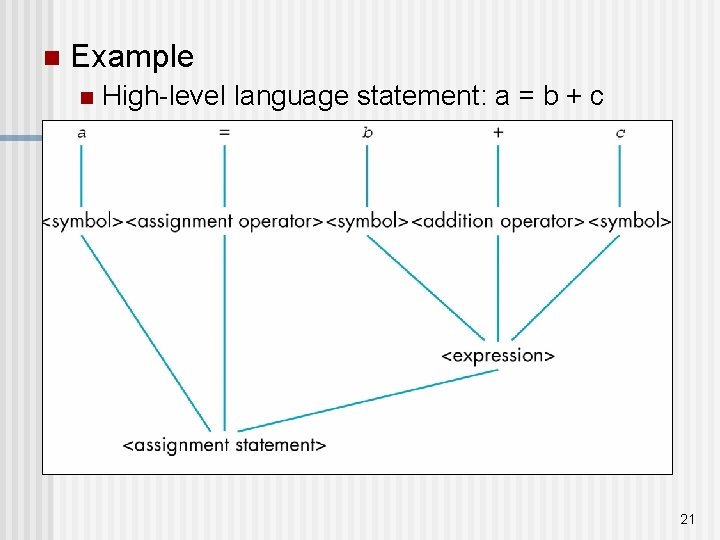
Phase II: Parsing n n Output of a parser n A parse tree, if such a tree exists n An error message, if a parse tree cannot be constructed Successful construction of a parse tree is proof that the statement is correctly formed 20
n Example n High-level language statement: a = b + c 21
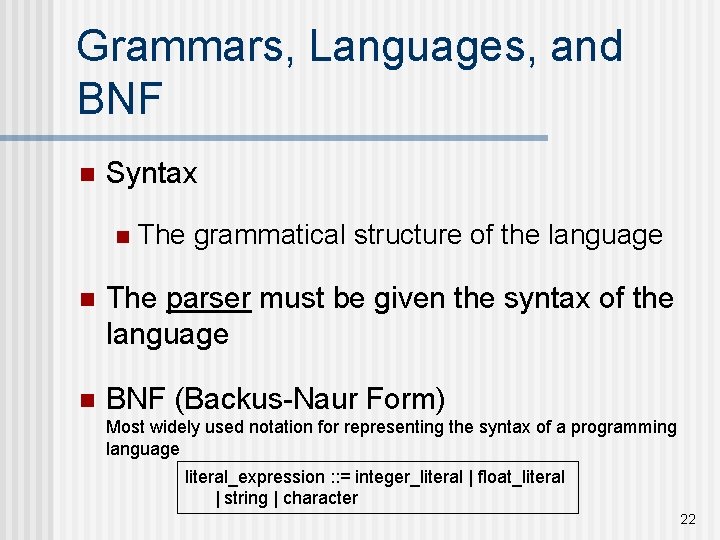
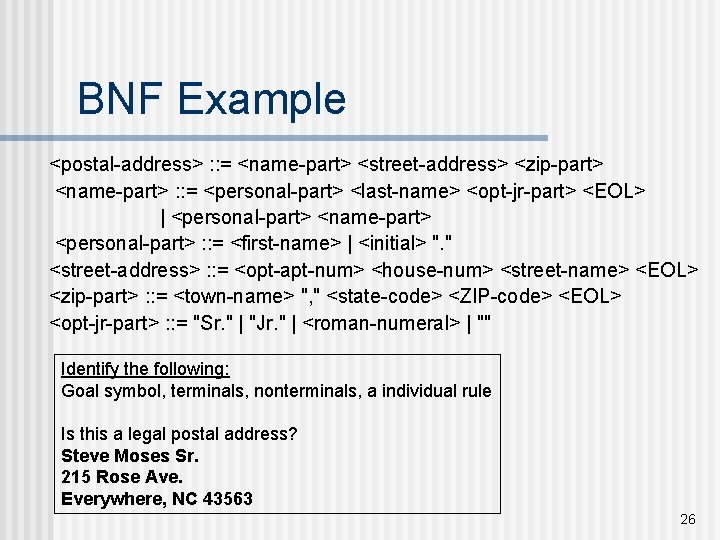
Grammars, Languages, and BNF n Syntax n The grammatical structure of the language n The parser must be given the syntax of the language n BNF (Backus-Naur Form) Most widely used notation for representing the syntax of a programming language literal_expression : : = integer_literal | float_literal | string | character 22
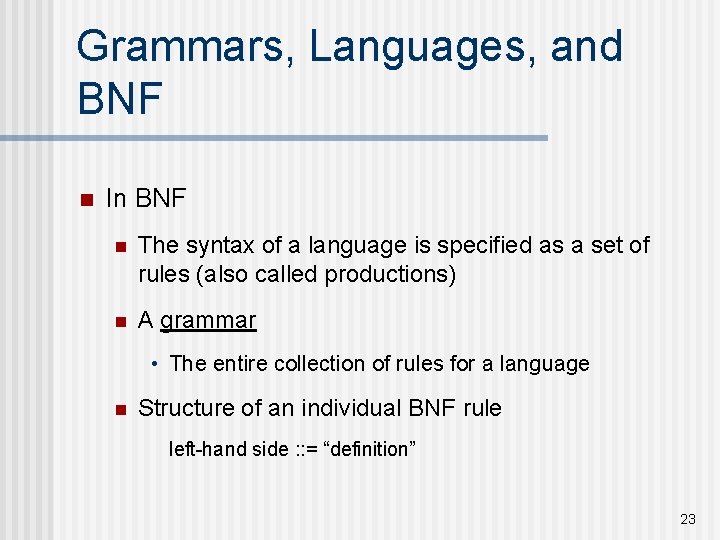
Grammars, Languages, and BNF n In BNF n The syntax of a language is specified as a set of rules (also called productions) n A grammar • The entire collection of rules for a language n Structure of an individual BNF rule left-hand side : : = “definition” 23
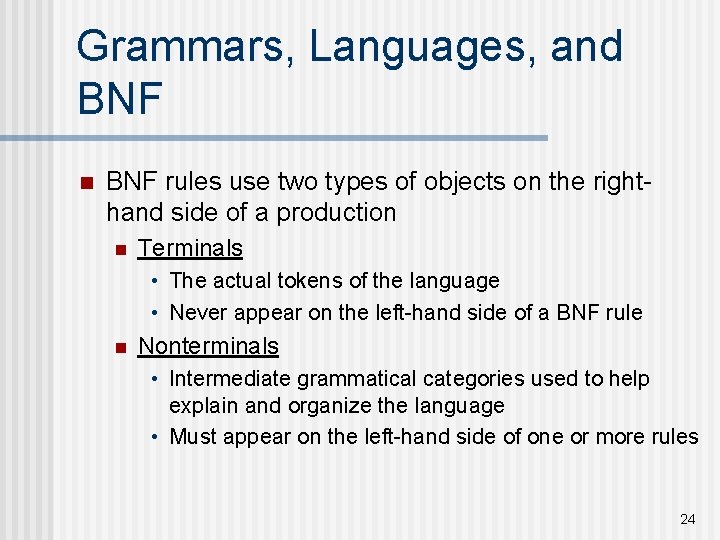
Grammars, Languages, and BNF n BNF rules use two types of objects on the righthand side of a production n Terminals • The actual tokens of the language • Never appear on the left-hand side of a BNF rule n Nonterminals • Intermediate grammatical categories used to help explain and organize the language • Must appear on the left-hand side of one or more rules 24
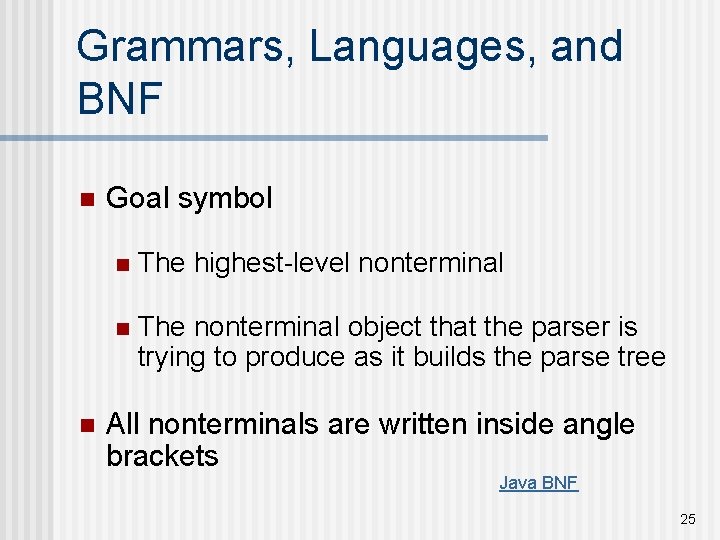
Grammars, Languages, and BNF n n Goal symbol n The highest-level nonterminal n The nonterminal object that the parser is trying to produce as it builds the parse tree All nonterminals are written inside angle brackets Java BNF 25
BNF Example <postal-address> : : = <name-part> <street-address> <zip-part> <name-part> : : = <personal-part> <last-name> <opt-jr-part> <EOL> | <personal-part> <name-part> <personal-part> : : = <first-name> | <initial> ". " <street-address> : : = <opt-apt-num> <house-num> <street-name> <EOL> <zip-part> : : = <town-name> ", " <state-code> <ZIP-code> <EOL> <opt-jr-part> : : = "Sr. " | "Jr. " | <roman-numeral> | "" Identify the following: Goal symbol, terminals, nonterminals, a individual rule Is this a legal postal address? Steve Moses Sr. 215 Rose Ave. Everywhere, NC 43563 26
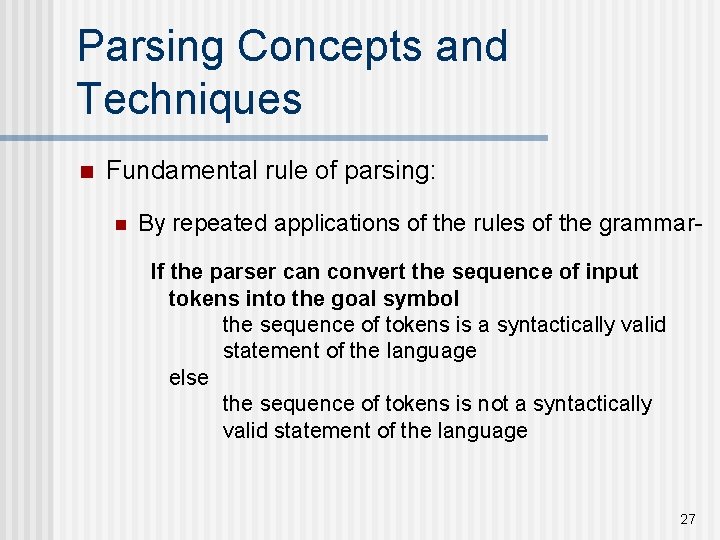
Parsing Concepts and Techniques n Fundamental rule of parsing: n By repeated applications of the rules of the grammar. If the parser can convert the sequence of input tokens into the goal symbol the sequence of tokens is a syntactically valid statement of the language else the sequence of tokens is not a syntactically valid statement of the language 27
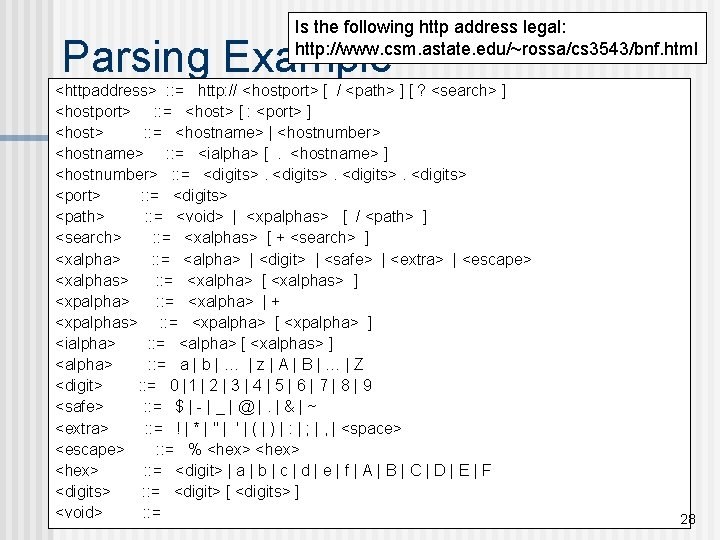
Is the following http address legal: http: //www. csm. astate. edu/~rossa/cs 3543/bnf. html Parsing Example <httpaddress> : : = http: // <hostport> [ / <path> ] [ ? <search> ] <hostport> : : = <host> [ : <port> ] <host> : : = <hostname> | <hostnumber> <hostname> : : = <ialpha> [. <hostname> ] <hostnumber> : : = <digits> <port> : : = <digits> <path> : : = <void> | <xpalphas> [ / <path> ] <search> : : = <xalphas> [ + <search> ] <xalpha> : : = <alpha> | <digit> | <safe> | <extra> | <escape> <xalphas> : : = <xalpha> [ <xalphas> ] <xpalpha> : : = <xalpha> | + <xpalphas> : : = <xpalpha> [ <xpalpha> ] <ialpha> : : = <alpha> [ <xalphas> ] <alpha> : : = a | b | … | z | A | B | … | Z <digit> : : = 0 |1 | 2 | 3 | 4 | 5 | 6 | 7 | 8 | 9 <safe> : : = $ | - | _ | @ |. | & | ~ <extra> : : = ! | * | " | ' | ( | ) | : | ; | , | <space> <escape> : : = % <hex> : : = <digit> | a | b | c | d | e | f | A | B | C | D | E | F <digits> : : = <digit> [ <digits> ] <void> : : = 28
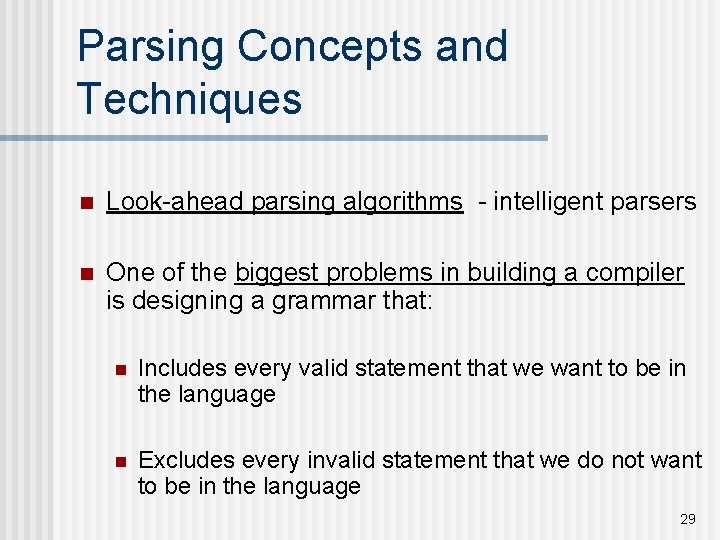
Parsing Concepts and Techniques n Look-ahead parsing algorithms - intelligent parsers n One of the biggest problems in building a compiler is designing a grammar that: n Includes every valid statement that we want to be in the language n Excludes every invalid statement that we do not want to be in the language 29
Parsing Concepts and Techniques n Another problem in constructing a compiler: Designing a grammar that is not ambiguous n An ambiguous grammar allows the construction of two or more distinct parse trees for the same statement NOT GOOD - multiple interpretations 30
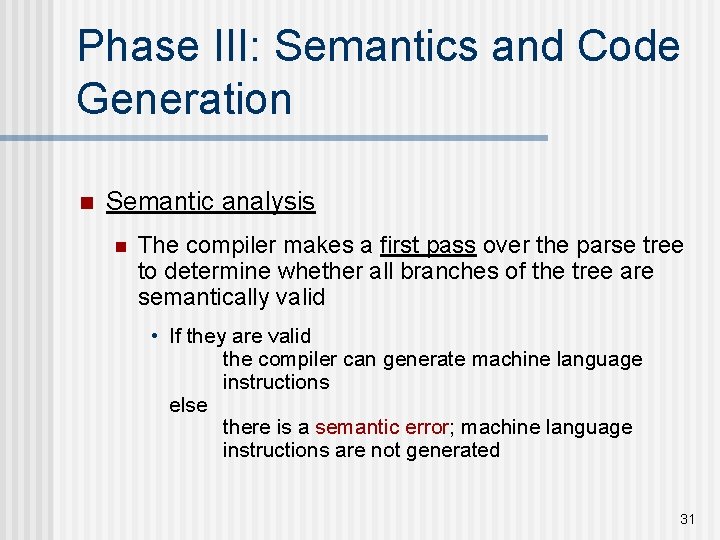
Phase III: Semantics and Code Generation n Semantic analysis n The compiler makes a first pass over the parse tree to determine whether all branches of the tree are semantically valid • If they are valid the compiler can generate machine language instructions else there is a semantic error; machine language instructions are not generated 31
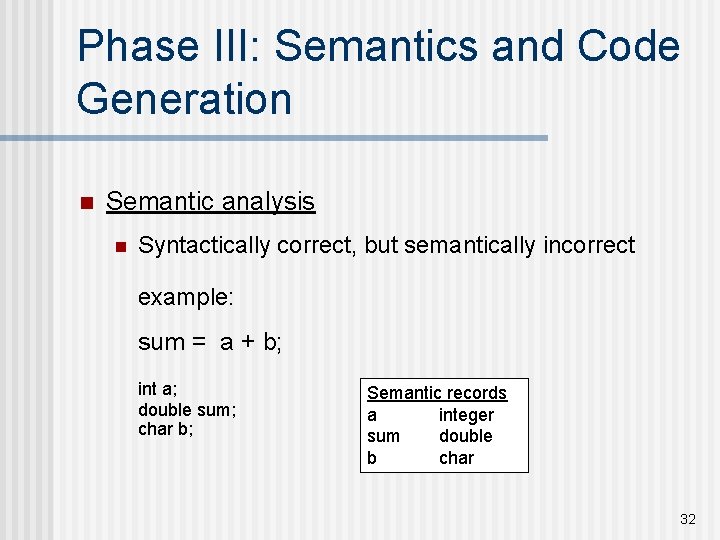
Phase III: Semantics and Code Generation n Semantic analysis n Syntactically correct, but semantically incorrect example: sum = a + b; int a; double sum; char b; Semantic records data typeinteger mismatch a sum double b char 32
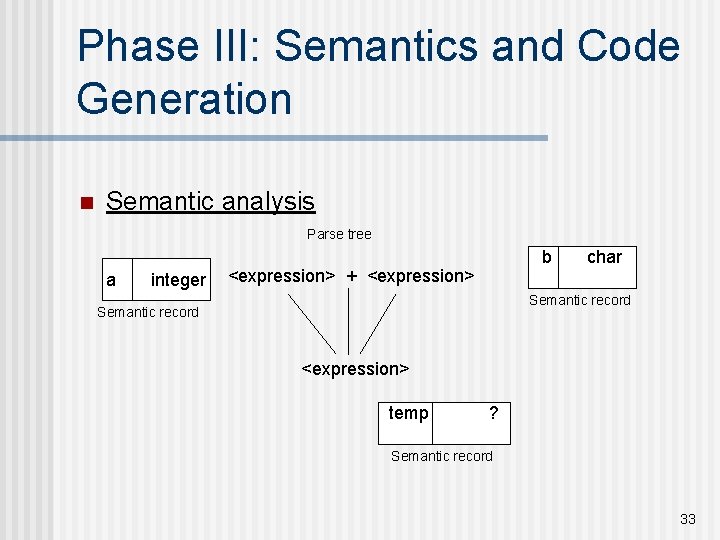
Phase III: Semantics and Code Generation n Semantic analysis Parse tree a integer b <expression> + <expression> char Semantic record <expression> temp ? Semantic record 33
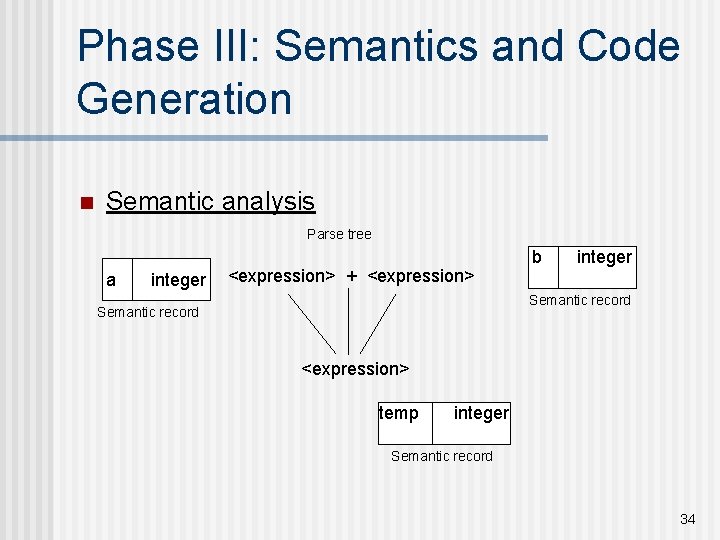
Phase III: Semantics and Code Generation n Semantic analysis Parse tree a integer <expression> + <expression> b integer Semantic record <expression> temp integer Semantic record 34
Phase III: Semantics and Code Generation n Code generation n Compiler makes a second pass over the parse tree to produce the translated code 35
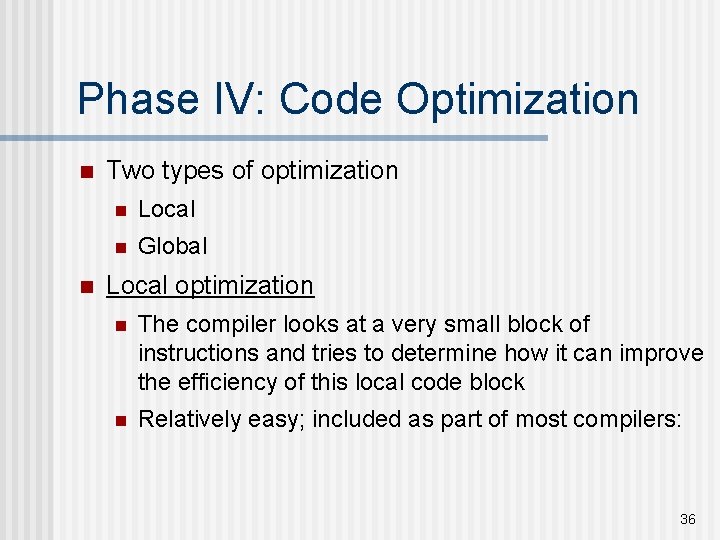
Phase IV: Code Optimization n n Two types of optimization n Local n Global Local optimization n The compiler looks at a very small block of instructions and tries to determine how it can improve the efficiency of this local code block n Relatively easy; included as part of most compilers: 36
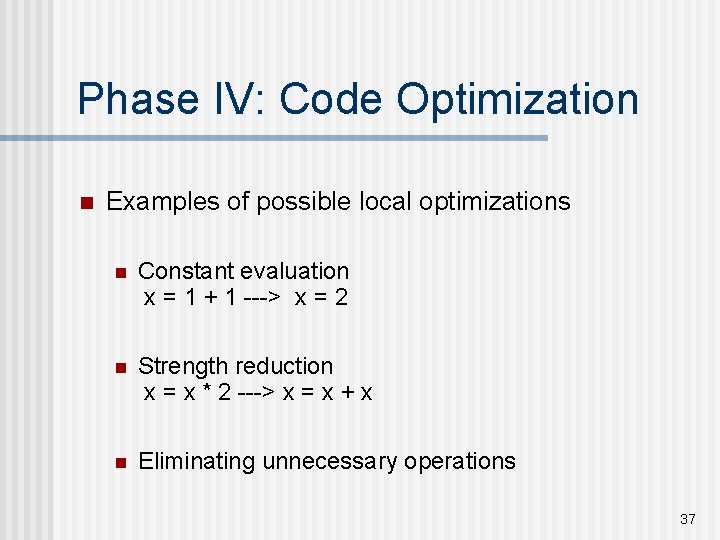
Phase IV: Code Optimization n Examples of possible local optimizations n Constant evaluation x = 1 + 1 ---> x = 2 n Strength reduction x = x * 2 ---> x = x + x n Eliminating unnecessary operations 37
Phase IV: Code Optimization n n Global optimization n The compiler looks at large segments of the program to decide how to improve performance n Much more difficult; usually omitted from all but the most sophisticated and expensive production-level “optimizing compilers” Optimization cannot make an inefficient algorithm efficient - “only makes an efficient algorithm more efficient” 38
Summary n A compiler is a piece of system software that translates high-level languages into machine language n Goals of a compiler: Correctness and the production of efficient and concise code n Source program: High-level language program 39
Summary n Object program: The machine language translation of the source program n Phases of the compilation process n Phase I: Lexical analysis n Phase II: Parsing n Phase III: Semantic analysis and code generation n Phase IV: Code optimization 40