Cognitive Psychology and the Salience of Austerity Sorin
- Slides: 13
Cognitive Psychology and the Salience of Austerity Sorin Mitrea (Mc. Master University, Canada) Austerity: Coping is Not Enough – February 21 -22, 2019 Freidrich-Ebert-Stiftung, Berlin, Germany
Introduction • Austerity typically = policy practices to reduce deficits/debt; • Alt. Austerity’s goal: encourage debate among policy makers and influencers re: the assumptions, impacts, alts to austerity; • To achieve above, need to understand why austerity at times internalized as ‘common sense’; • Will examine cognitive dimensions to austerity, why it may become common sense, and how to encourage rational deliberation.
Presentation • Policy and political context of austerity in Canada; • Cognitive foundations of ‘common sense’ ideas; • The historical-cultural roots of austerity; • Approaches to ‘dislodging stuck ideas’.
Context of Austerity • Austerity = more than retrenchment • Canada: federal transfers restructured and reduced = subnational cuts • Also: P 3 s, privatization, outsourcing, corporate tax cuts/subsidies • Surface: less interest in austerity in Canada in past few years
Cognitive Foundations of ‘Common Sense’ • Info stored in memory as ‘schemas’ – shape how we perceive, evaluate, assume, interpret = basis of stereotypes, common sense; • • Strong schema = multiple facets, more easily activated = automatic cognition; • = impediment to rational deliberation because auto-cog is unconscious, has greater retention, harder to alter once learned, precedes + informs rational thought. If austerity repeated consistently = more likely to be internalized as ‘common sense’ (i. e. ‘automatic cognition’ or ‘automaticity’);
Salience of Austerity • Auto-cog = how ‘common sense’ develops, but what is internalized also important to encouraging rational deliberation; • Austerity schema made up of concepts, feelings, reactions which may be informed by historically salient ideas… • Individual responsibility, reduced consumption, self-discipline, threat to individual/community; • Seen in: religion, healthcare, personal finance, personal health.
Salience of Austerity • Austerity discourses remain prevalent in Canada in politics, media, public opinion; • e. g. federal budgets of an ‘activist’ government, political campaigning, news stories on minutia of public spending; • Does not mean austerity is ‘common sense’ for all or that public spending is above scrutiny, but consistent repetition of similar ideas across time/contexts = greater chance of building strong austerity schema = impede rational deliberation on topic.
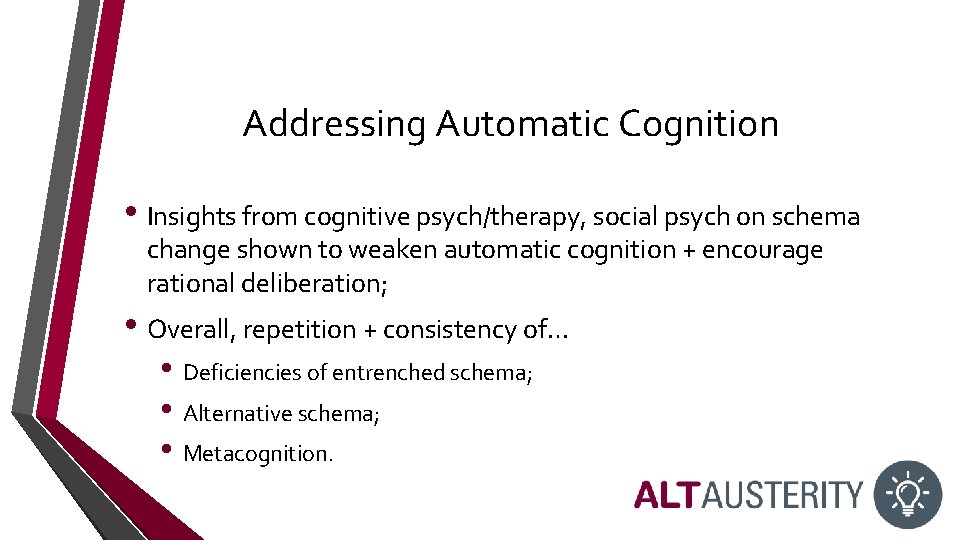
Addressing Automatic Cognition • Insights from cognitive psych/therapy, social psych on schema change shown to weaken automatic cognition + encourage rational deliberation; • Overall, repetition + consistency of… • Deficiencies of entrenched schema; • Alternative schema; • Metacognition.
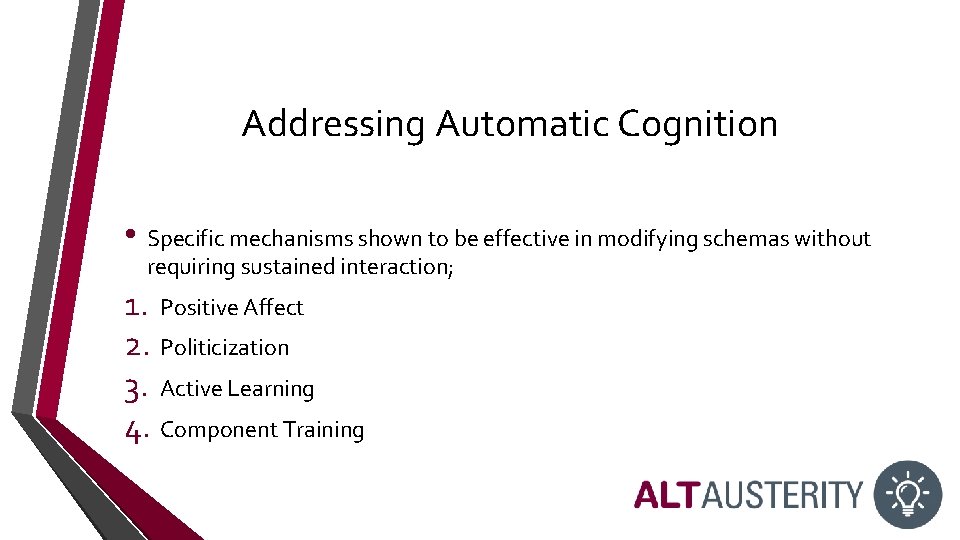
Addressing Automatic Cognition • Specific mechanisms shown to be effective in modifying schemas without requiring sustained interaction; 1. Positive Affect 2. Politicization 3. Active Learning 4. Component Training
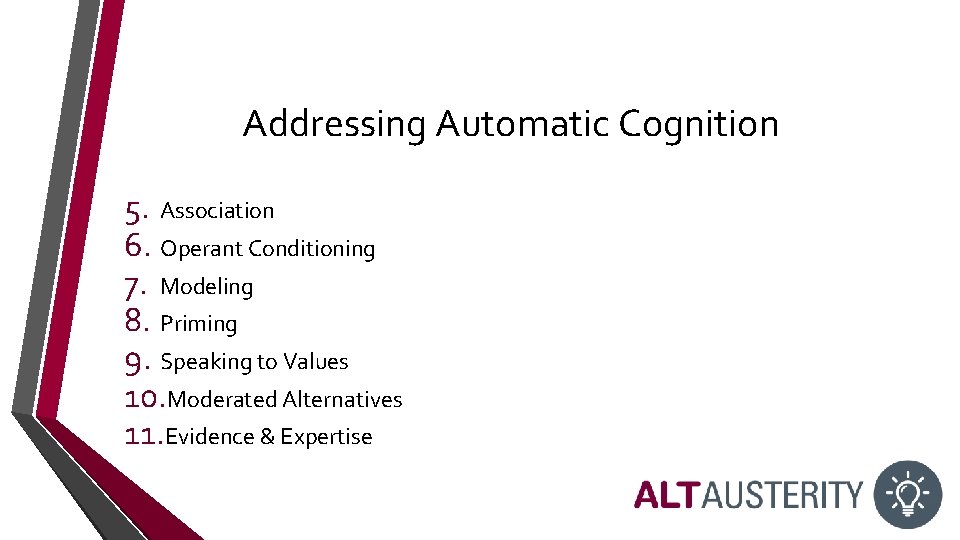
Addressing Automatic Cognition 5. Association 6. Operant Conditioning 7. Modeling 8. Priming 9. Speaking to Values 10. Moderated Alternatives 11. Evidence & Expertise
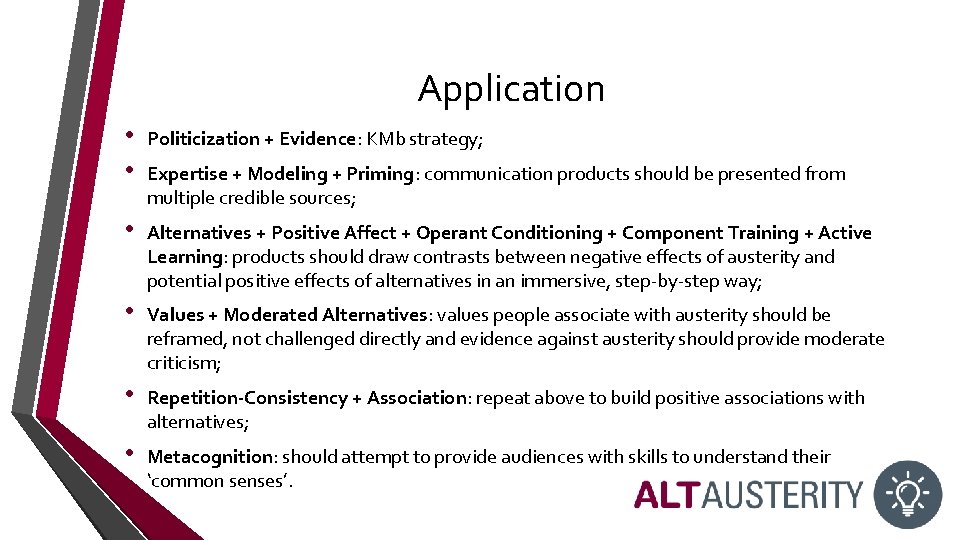
Application • • Politicization + Evidence: KMb strategy; • Alternatives + Positive Affect + Operant Conditioning + Component Training + Active Learning: products should draw contrasts between negative effects of austerity and potential positive effects of alternatives in an immersive, step-by-step way; • Values + Moderated Alternatives: values people associate with austerity should be reframed, not challenged directly and evidence against austerity should provide moderate criticism; • Repetition-Consistency + Association: repeat above to build positive associations with alternatives; • Metacognition: should attempt to provide audiences with skills to understand their ‘common senses’. Expertise + Modeling + Priming: communication products should be presented from multiple credible sources;
Discussion • Complicating factors and possible directions: 1. 2. 3. More research needed on how people understand austerity as policy/discourse; 4. 5. Content informed by psych must be paired with targeted KMb, including coalitions; Schemas are social = biggest challenge is in-group echo chambers/epistemologies; Indirect value change cannot control motivation, openness, accuracy motivation, schema variations; Any efforts to combat entrenched schemas must be done with consistency and repetition.
Join the Conversation Learn about our project and see more of our research and media: http: //altausterity. mcmaster. ca/ https: //twitter. com/altausterity #altausterity