CLASSROOM DYNAMICS CREATING AND MAINTAINING A COOPERATIVE LEARNING







- Slides: 22
CLASSROOM DYNAMICS CREATING AND MAINTAINING A COOPERATIVE LEARNING GROUP RÁDAI PÉTER Nyíregyházi Főiskola, CETT (Budapest) 1
CLASSROOM DYNAMICS MOTTO “Success depends less on materials, techniques and linguistic analysis and more on what goes on inside and between people in the classroom. ” (Stevick 1980: 84) 2
CLASSROOM DYNAMICS CONTENTS i What is group dynamics? i What is a group? i Why study groups? F The importance of group processes i Stages of group life: F Forming F Maintaining F Disbanding i The role of the teacher as group leader 3
CLASSROOM DYNAMICS WHAT IS A GROUP? A group is a “resource pool that is greater in any given area than the resources possessed by any single member” (Douglas, 1983 in Dörnyei & Malderez, 1997: 66) „Groups are particularly good at combining talents and providing innovative solutions to possible unfamiliar problems; […] the wider skill and knowledge set of the group has a distinct advantage over that of the individual. ” (Blair, 1991) 4
CLASSROOM DYNAMICS GROUP DYNAMICS GD is concerned with the scientific analysis of the behaviour of small groups. A group of language learners in a school setting will become part of a social context, in which morale, motivation, self-image – both the presence and lack of them – will have a significant impact on the quality of individual and collaborative learning. Aims: F to study a wide range of issues concerning group life and F F F group characteristics; to define general tendencies in the development and functioning of different types of groups; to identify factors that affect the behaviour of a particular group (e. g. the physical environment, the amount of time learners spend together, if it’s a language or a state education setting); 5 to study the role of the teacher as group leader.
CLASSROOM DYNAMICS RATIONALE FOR STUDYING GROUPS 1. Groups have been found to have a ‘life on their own’ – that is, individuals in groups behave differently from the way they do outside the group […]. 2. Although groups vary in size, purpose, composition and character, even the most different kinds of groups appear to share some fundamental common features, making it possible to study ‘the group’ in general. (Dörnyei & Murphey 2003: 3) 6
CLASSROOM DYNAMICS RATIONALE FOR STUDYING GROUPS Groups can be a fundamental source of motivation for its members to learn the target language: they serve as reference groups providing guidelines and standards for their members to enable them to evaluate themselves, to measure themselves, to adjust their attitudes, beliefs and behaviour. (Dörnyei & Malderez, 1997) 7
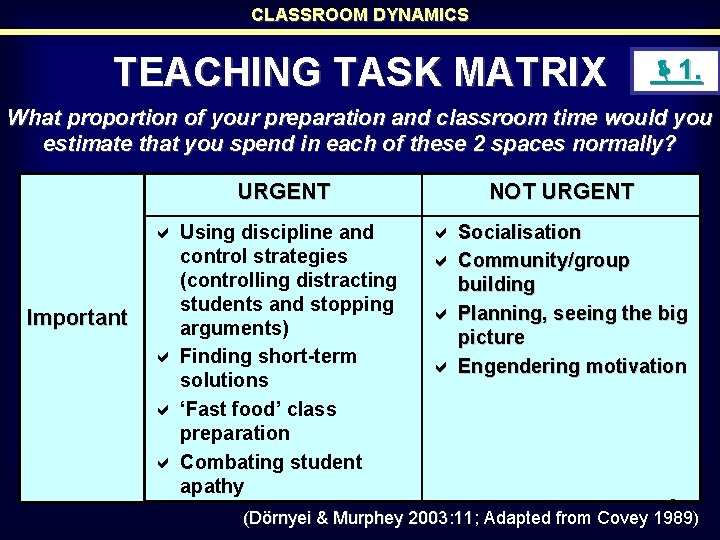
CLASSROOM DYNAMICS TEACHING TASK MATRIX 1. What proportion of your preparation and classroom time would you estimate that you spend in each of these 2 spaces normally? URGENT a Using discipline and Important control strategies (controlling distracting students and stopping arguments) a Finding short-term solutions a ‘Fast food’ class preparation a Combating student apathy NOT URGENT a Socialisation a Community/group building a Planning, seeing the big picture a Engendering motivation 8 (Dörnyei & Murphey 2003: 11; Adapted from Covey 1989)
CLASSROOM DYNAMICS EFFECTS OF GROUP PROCESSES Groups can facilitate (or hinder) L 2 learning since group processes are responsible for: a individual involvement; a co-operation between group members; a the quality and quantity of interaction between members; a student behaviour, order and discipline; a students’ relationship with their peers and the teacher; a learner and teacher satisfaction (cf. Dörnyei & Malderez, 1997; Ehrman & Dörnyei, 1998). 9
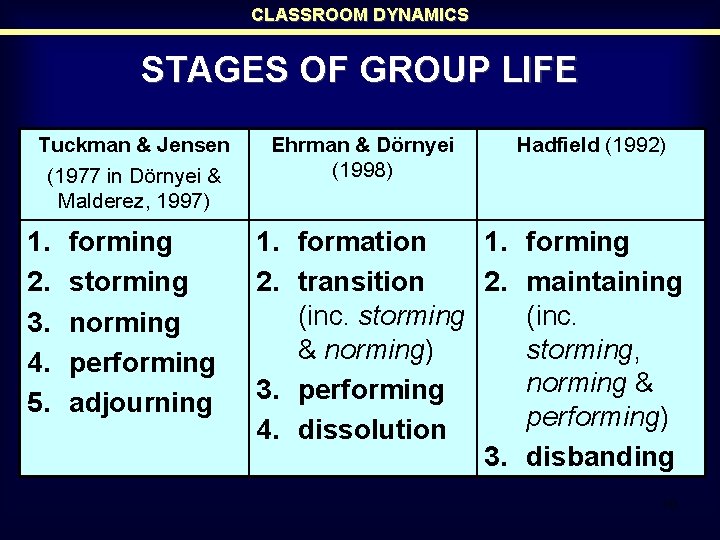
CLASSROOM DYNAMICS STAGES OF GROUP LIFE Tuckman & Jensen (1977 in Dörnyei & Malderez, 1997) 1. 2. 3. 4. 5. forming storming norming performing adjourning Ehrman & Dörnyei (1998) Hadfield (1992) 1. formation 1. forming 2. transition 2. maintaining (inc. storming (inc. & norming) storming, norming & 3. performing) 4. dissolution 3. disbanding 10
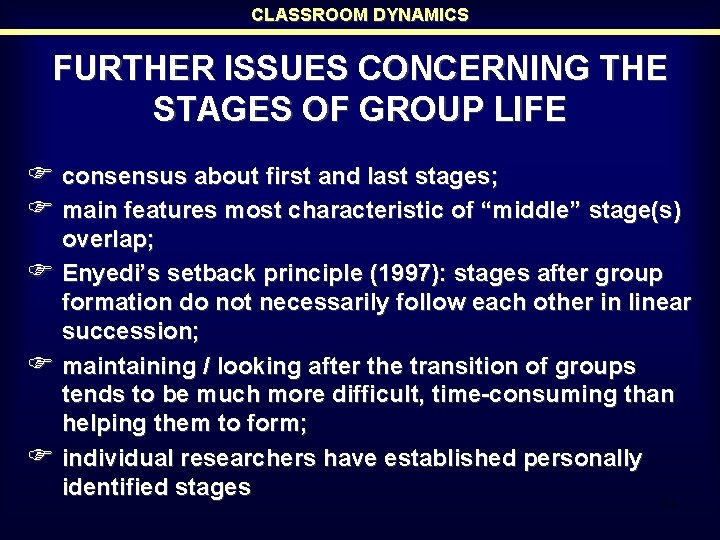
CLASSROOM DYNAMICS FURTHER ISSUES CONCERNING THE STAGES OF GROUP LIFE F consensus about first and last stages; F main features most characteristic of “middle” stage(s) overlap; F Enyedi’s setback principle (1997): stages after group formation do not necessarily follow each other in linear succession; F maintaining / looking after the transition of groups tends to be much more difficult, time-consuming than helping them to form; F individual researchers have established personally identified stages 11
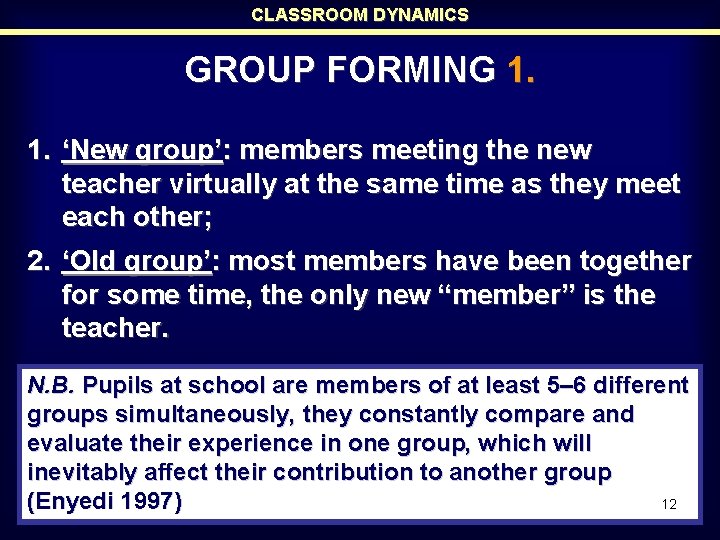
CLASSROOM DYNAMICS GROUP FORMING 1. 1. ‘New group’: members meeting the new teacher virtually at the same time as they meet each other; 2. ‘Old group’: most members have been together for some time, the only new “member” is the teacher. N. B. Pupils at school are members of at least 5– 6 different groups simultaneously, they constantly compare and evaluate their experience in one group, which will inevitably affect their contribution to another group (Enyedi 1997) 12
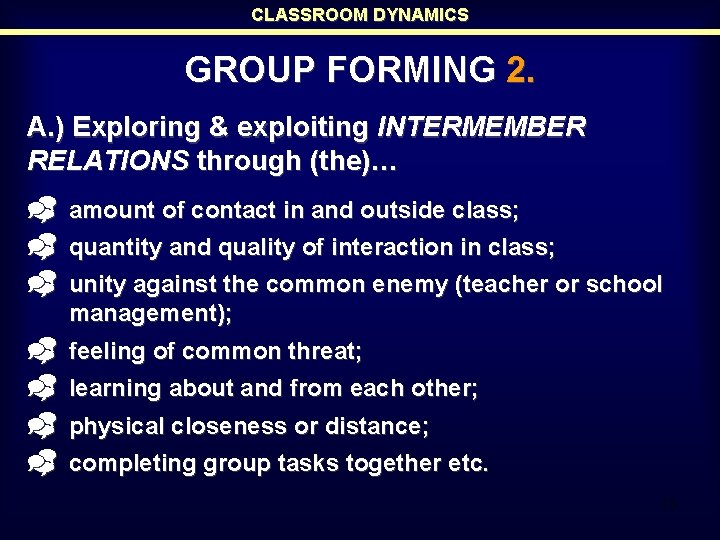
CLASSROOM DYNAMICS GROUP FORMING 2. A. ) Exploring & exploiting INTERMEMBER RELATIONS through (the)… _ amount of contact in and outside class; _ quantity and quality of interaction in class; _ unity against the common enemy (teacher or school management); _ _ feeling of common threat; learning about and from each other; physical closeness or distance; completing group tasks together etc. 13
CLASSROOM DYNAMICS GROUP FORMING 3. B. ) Establishing GROUP NORMS * x setting groundrules; establishing code of conduct (obligatory); 2. x creating and signing learning contracts (optional); x re-negotiate rules during process if necessary (optional) * A norm is an implied agreement among the group's membership regarding how members in the group should behave. From the perspective of the group, norms generally fall into three categories: positive, negative, and neutral. In other words, norms either support, obstruct, or have no effect on the aims of the organization. 14 (© 2000 Accel-Team. Com)
CLASSROOM DYNAMICS GROUP MAINTAINING 1. Aim: F to achieve a certain degree of group cohesion, which is “manifested by members seeking each other out, providing mutual support, and making one another welcome in the group. ” (Ehrman & Dörnyei, 1998: 76 -77) 15
CLASSROOM DYNAMICS GROUP MAINTAINING 2. To maintain a group, teachers need: a to continue work on intermember relationships; a to make sure all members interact with all the others (change seating, a a a a pairing and grouping activities are used to break territoriality etc. ); to help learners establish trust for each other; to participate in activities to offer learners a chance to know her or him better; to offer learners feedback on their performance / development as a group; to keep cool and find solutions to deal with conflicts; to exploit the group as source of knowledge, experience and emotions (e. g. through student-generated tasks, projects etc. ); to check regularly whether established norms are kept, if they need revising; to rely on the group as resource; to make group members assume responsibility for their own learning 16 (i. e. for things they do in and out of the classroom); etc.
CLASSROOM DYNAMICS TERRITORIALITY “Human beings are territorial by nature. [. . . ] Territorial instincts are also manifested in language classrooms. Even in classes with no fixed seating pattern, students soon develop marked preferences for certain areas and specific seats within the room. These position preferences can lead to emergence of rigid, fossilised patterns of ‘private spaces, ’ which can negatively affect proximity, contact, and interaction among members and thus can hinder group development and lead to the formation of subgroups and cliques. ” (Ehrman & Dörnyei, 1998: 92 -93) 17
CLASSROOM DYNAMICS GROUP DISBANDING Main focus on: F gathering feedback on the experience from the point of view of individuals (learner and teacher) and the group as a whole; F establishing modes of networking after group experience has finished; F looking ahead and see how common learning experience will affect similar experience in the future. 18
CLASSROOM DYNAMICS TEACHER AS GROUP LEADER The leader is “a member of a group who influences the group’s progress towards a goal. ” (Gall & Gall, 1994 in Enyedi 1997: 6) Since every “group has both beneficial and detrimental features; it is a function of leadership to enhance the former and minimise the latter”. (Ehrman & Dörnyei, 1998: xii) 19
CLASSROOM DYNAMICS LANGUAGE TEACHER AS GROUP LEADER 1. As EFL lessons are “only partly about the foreign language, partly they are about the pupils and their ideas, [. . . ] the role of the language teacher is different from that of most other subject teachers. Instead of being sources of information who hand down this information to a largely passive audience, language teachers can be seen as orchestra conductors who co-ordinate and facilitate the work of the group. At the same time, the teacher may be expected to undertake the bulk of the maintenance function in her groups (and not just in one group!). . . ” (Enyedi, 1997: 8) 20
CLASSROOM DYNAMICS LANGUAGE TEACHER AS GROUP LEADER 2. M Even the most group-dynamics conscious, student- centred teacher reverts to high levels of control when facing crisis or overdemanding, confronting group issues. M A school teacher is the only member of the group who is absent from the group 80– 90% of the time. M As learners have to adjust their attitudes, modes of working, behaviour to the expectations and norms of several teachers, language teachers have to do the same with the different groups they have. Norms and modes that work well in and with one group may fail in another. 21
CLASSROOM DYNAMICS ANNOTATED BIBLIOGRAPHY: Blair, G. M. (1991). Groups that Work. IEE Engineering Management Journal. Vol 1. Issue 3. http: //www. see. ed. ac. uk/~gerard/Management/art 0. html? http: //oldeee. see. ed. ac. uk/~gerard/M anagement/art 0. html [Accessed 3 rd January, 2003] Excellent and easily accessible overview from a business management point of view, most of which is applicable in education contexts. Hadfield, J. (1992). Classroom dynamics. Oxford: Oxford University Press. The classic resource book with more than 100 tasks, ideas. It also contains short but also very practical introductory passages to chapters and sub-chapters the reading of which is highly recommended! Dörnyei Z. , & Malderez, A. (1997). Group dynamics and foreign language teaching. System, 25/1. 65– 81. A great theoretical summary which contains plenty of practical suggestions as well. Dörnyei, Z. & Murphey, T. (2003). Group Dynamics in the Language Classroom. Cambridge: Cambridge University Press. The most recent, highly practical and accessible handbook. Ehrman M. E. , & Dörnyei, Z. (1998). Interpersonal Dynamics in Second Language Education. Thousand Oaks: Sage. The first comprehensive account of the relevant body of knowledge and of research findings, both theoretical and practical: a rare example of researchers speaking EFL teachers’ language. Enyedi. Á. (1997). “Whose group is it anyway? Ph. D assignment at Eötvös University. (Unpublished in this form) A critical look at research and theory: focus on the Hungarian 22 state education teacher, learner and their groups