
KAGAN COOPERATIVE LEARNING P I E S ositive




- Slides: 17
KAGAN COOPERATIVE LEARNING P I E S ositive Interdependence ndividual Accountability qual Participation imultaneous Interaction By Veronica Dillard
The Four Basic Principles to Cooperative Learning & Essential Questions P Positive Interdependence Q: Are students on the same side? Q: Does the task require working together? I Individual Accountability Q: Is individual, public performance required? E Equal Participation S Simultaneous Interaction once? Q: Is participation approximately equal? Q: What percent of students are overtly interacting at (Kagan, 2009, p.
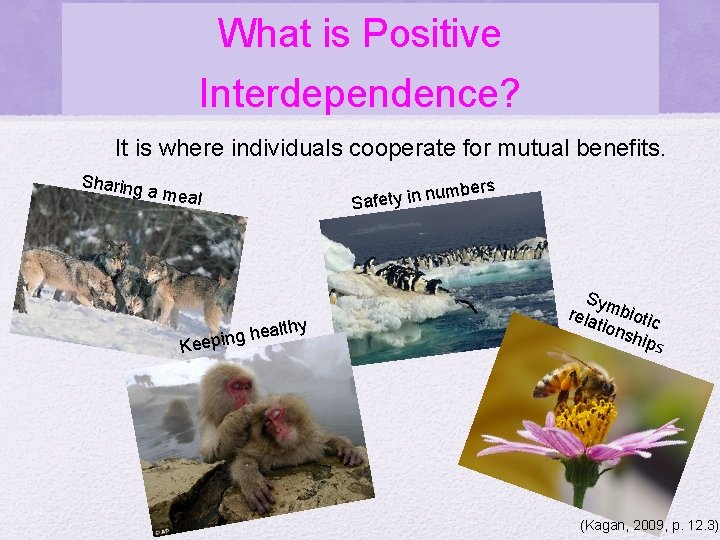
What is Positive Interdependence? It is where individuals cooperate for mutual benefits. Sharing a meal K lthy a e h g eepin umbers n n i y t e f Sa Sym rela biotic tion ship s (Kagan, 2009, p. 12. 3)
How can we create Positive Interdependence? • • To create a positive correlation of outcomes: Team Goals-teammates share the goal of creating an end product Team Rewards-recognition, praise, or celebration based on team performance Pooled Knowledge or Skills-knowledge/skill of one student benefits teammates Structures-activities that have all the above! (Kagan, 2009, pgs. 12. 5 -12.
How can we create Positive Interdependence? Continued… • • To create task interdependence: Pooled knowledge or skills Challenging tasks-task difficulty ensures no one can do it alone. Division of Labor-each teammate taking responsibility for their portion of the task Roles-assignment of unique roles that are necessary to complete the task Resource Access-each student given own access to different resources Rules-promotes helping, encouragement, and tutoring Structures-activities that have ALL of the above! (Kagan, 2009, pgs. 12. 7 -12. 8
Individual Accountability INDIVIDUAL PUBLIC REQUIRED
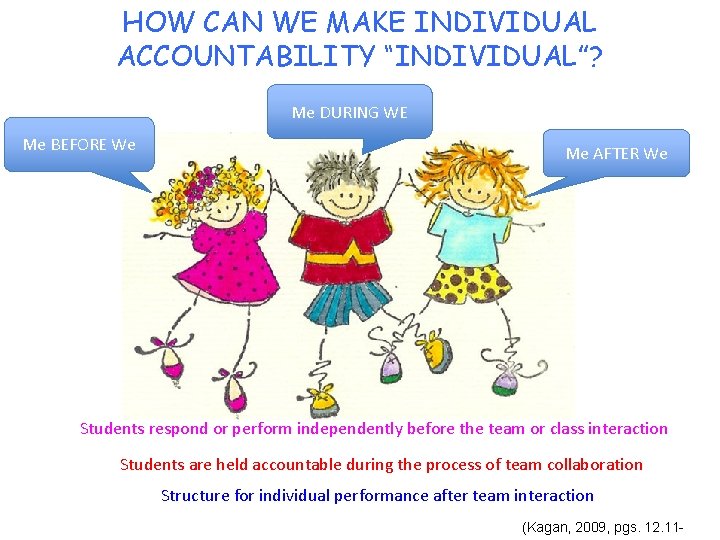
HOW CAN WE MAKE INDIVIDUAL ACCOUNTABILITY “INDIVIDUAL”? Me DURING WE Me BEFORE We Me AFTER We Students respond or perform independently before the team or class interaction Students are held accountable during the process of team collaboration Structure for individual performance after team interaction (Kagan, 2009, pgs. 12. 11 -
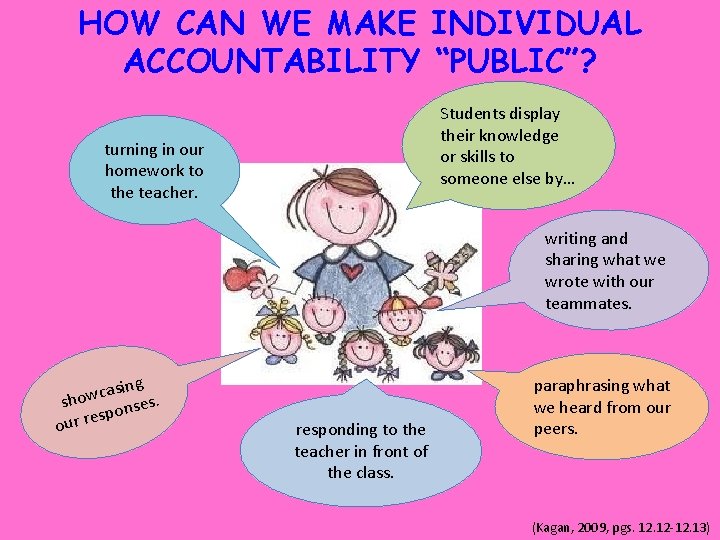
HOW CAN WE MAKE INDIVIDUAL ACCOUNTABILITY “PUBLIC”? Students display their knowledge or skills to someone else by… turning in our homework to the teacher. writing and sharing what we wrote with our teammates. asing c w o sh es. s n o p s our re responding to the teacher in front of the class. paraphrasing what we heard from our peers. (Kagan, 2009, pgs. 12 -12. 13)
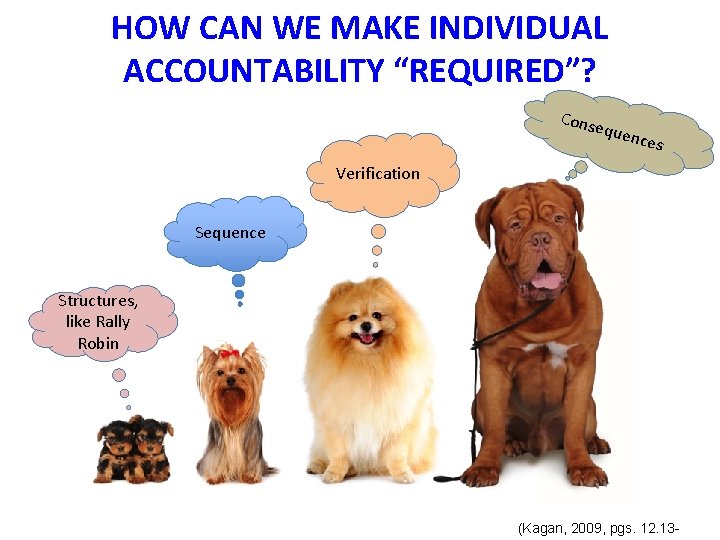
HOW CAN WE MAKE INDIVIDUAL ACCOUNTABILITY “REQUIRED”? Cons eque nces Verification Sequence Structures, like Rally Robin (Kagan, 2009, pgs. 12. 13 -
EQUAL PARTICIPATION
Why don’t some students participate? • SHYNES S AND INTROVE RSON • DEVELOPM ENTALLY INAPPORPR AITE • POOR ACHEIVE MENT AND LOW SELFESTEEM • CULTURA L AND LANGUA GE (Kagan, 2009, p. 12. 17)
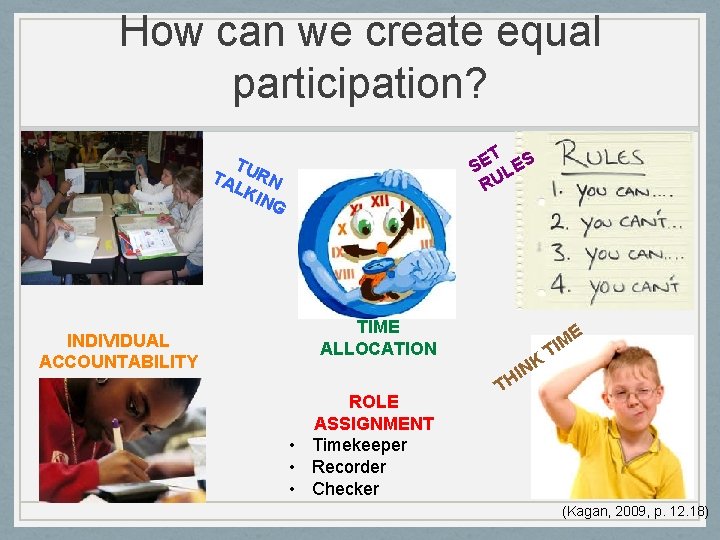
How can we create equal participation? T SE LES RU T TA URN LK ING INDIVIDUAL ACCOUNTABILITY TIME ALLOCATION ROLE ASSIGNMENT • Timekeeper • Recorder • Checker E NK I H M TI T (Kagan, 2009, p. 12. 18)
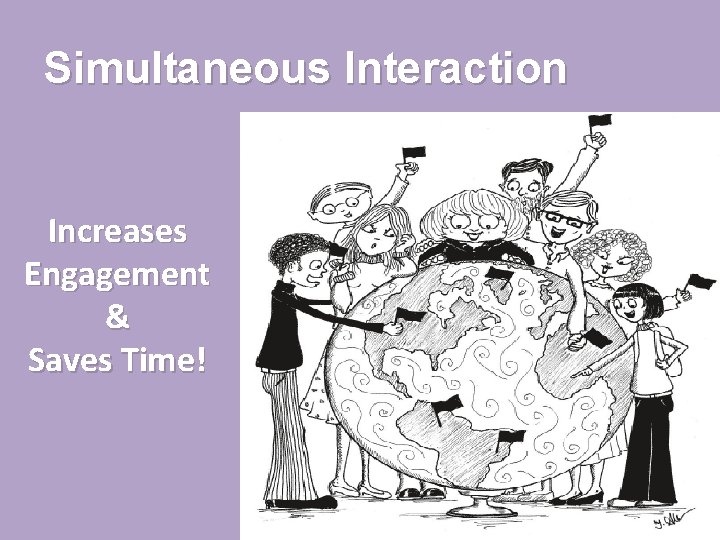
Simultaneous Interaction Increases Engagement & Saves Time!
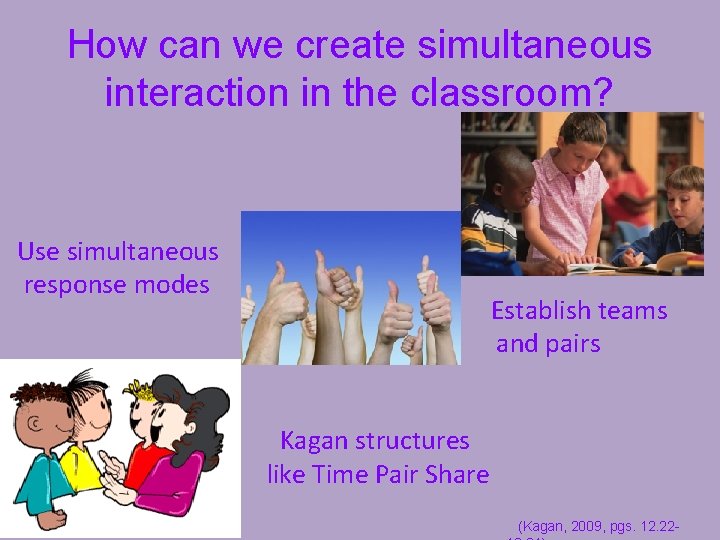
How can we create simultaneous interaction in the classroom? Use simultaneous response modes Establish teams and pairs Kagan structures like Time Pair Share (Kagan, 2009, pgs. 12. 22 -
Final Word: When the four basic principles of PIES is in place, cooperative learning will consistently produce academic gains, improve race relations, develop social skills, educate for character, Promote self-esteem, enhance class climate, and foster leadership and teamwork skills! (Kagan, 2009, p. 12. 1)
REFERENCES Dillard, V. (Photographer). (2011). Soccer girl [Photograph]. Dillard, J. (Photographer). (2011). Daughter at the City of Rocks, NM [Photograph]. Lennon, J. & Mc. Cartney, P. (1963). I want to hold your hand [Music]. Retrieved from i. Tunes. Kagan, S. & Kagan M. (2009). Kagan Cooperative Learning. San Clemente, CA: Kagan publishing. Kajiyama, S. (Photographer). (n. d. ). Japanese Macaque monkey [Photograph]. Retrieved from http: //msnbcmedia 4. msn. com/j/ap/0555 cb 43 -80 a 0 -47 e 0 -86 b 6 -9 cf 64 c 493 aee. grid-6 x 2. jpg Severns, J. (n. d. ) European honey bee [Image]. Retrieved from http: //en. wikipedia. org/wiki/File: European_honey_bee_extracts_nectar. jpg Todd, F. (Photographer). (2010). Adelie Penguins gather to jump into the water off an ice floe [Photograph]. Retrieved from http: //www. arcticphoto. co. uk/supergal/ft/ft 0028 -00. htm [Untitled image of rules]. Retrieved from http: //www. statzpack. com/blog/wp-content/uploads/2011/03/rules_1668. gif [Untitled photograph of all thumbs up]. Retrieved from http: //3. bp. blogspot. com/-En. Z 2 Fxr. Arm 8/Tqgu. GVHHg. RI/AAAADIA/J 7 -ksf. DY_j 4/s 1600/all-thumbs [Untitled photograph of all types of dogs]. Retrieved from http: //alltypesofdogs. org/wp-content/uploads/2011/12/different-types-different-size 1. jpg [Untitled photograph of gray wolves]. Retrieved from http: //www. msnbc. msn. com/id/33607114/ns/technology_and_science-science/t/study-middle-age-wolves-retire-hunt/#. T 2 UIPph 8 u. JU [Untitled photograph of kid thinking]. Retrieved from http: //www. activityvillage. co. uk/kid_thinkers 2. jpg [Untitled photograph of students working together]. Retrieved from http: //cpt. fsu. edu/Uploads/1/img/UWF 20 Spotlight%20 Picture%202. J [Untitled photograph of three students]. Retrieved from http: //catechistsjourney. loyolapress. com/wp-content/uploads/2009/03/00002888. jpg
REFERENCES [Untitled picture of cartoon children playing]. Retrieved from http: //2. bp. blogspot. com/_-R 4 j 8 V_yv. DM/TPf. Xp 33 t. Tu. I/ AAAAABI/hkr. FI 6 f. Ns 5 k/s 1600/cartoon-children-playing. jpg [Untitled picture of question smiley face]. Retrieved from http: //4. bp. blogspot. com/_2 C 7 M 5 VTUGKw/S 5 z 0 lyz-p. LI/ AAAAACM/Xvd. Jn. Mgm. Wp. A/s 320/question_smiley_face. jpg [Untitled picture of students around the globe]. Retrieved from http: //www. itl. usyd. edu. au/synergy/pics/cartoon 2301. gif [Untitled picture of teachers with students]. Retrieved from http: //www. christluth. com/stick_figure_teacher_with_students. jpg [Untitled picture of time pair share]. Retrieved from http: //www. kaganonline. com/images/freearticles/timed_pair_share. gif