
Cooperative Learning To Get To Know Each Other





- Slides: 11
Cooperative Learning To Get To Know Each Other Anne René Elsbree School of Education https: //sites. google. com/site/cooperativelearning resources/ 1
There are 6 basic elements of COOPERATIVE LEARNING known as PIGS Face (Brown & Ciuffetelli, 2009; Johnson, 2010; Johnson, Johnson & Holubec, 1988; Siltalia, 2010) 2
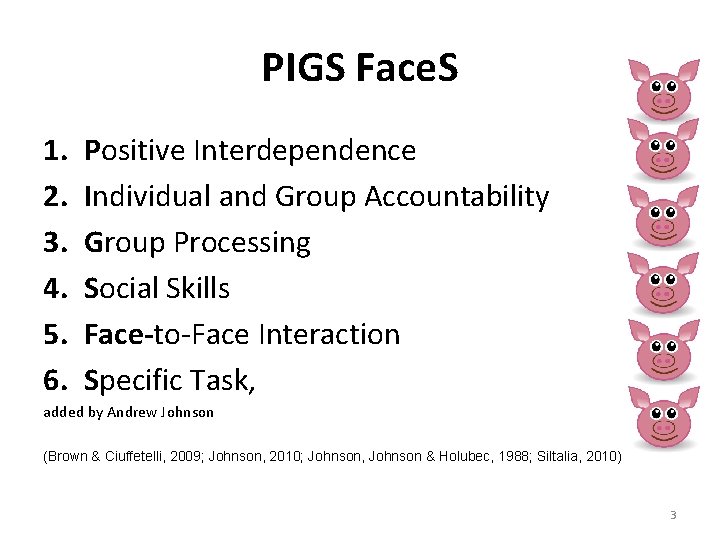
PIGS Face. S 1. 2. 3. 4. 5. 6. Positive Interdependence Individual and Group Accountability Group Processing Social Skills Face-to-Face Interaction Specific Task, added by Andrew Johnson (Brown & Ciuffetelli, 2009; Johnson, 2010; Johnson, Johnson & Holubec, 1988; Siltalia, 2010) 3
COOPERATIVE LEARNING GROUPS Structured Positive Interdependence TRADITIONAL LEARNING GROUPS No Structured Interdependence Individual Accountability Individuals are accountable to self, not teammates Team Membership is heterogeneous Team membership is homogenous Teambuilding activities promote trust, commitment, and group cohesion Social Skills are taught, practiced, and processed One teammate is appointed leader Teammates share leadership responsibilities No teambuilding activities Teacher continually monitors group work, document observations, provides feedback on group functioning and intervenes when necessary Social Skills are assumed , but often lacking Teacher does not monitor group work or provide feedback on group functioning Adapted from Johnson, D. W. , Johnson, R. T. & Holubec, E. J. (1990). Cooperation in the Classroom. Edina, MN: Interaction Book Company. 4
Get To Know Team 1. Count off to form groups - meet w/ group 2. Assign a letter to each team member 3. Find your coordinate on the handout, 1 a, or 2 a … and fill in your name, a passion & a pet peeve 4. Learn your team’s names, passions & pet peeves & fill in corresponding coordinates 5. Strategize how you can learn about all people in room 6. Acknowledge good ideas from teammates 5
Get To Know Others 1. Find your letters a’s meet at 12 O’Clock d’s meet at 9 O’Clock b’s meet at 3 O’Clock c’s meet at 6 O’Clock 2. Learn their new names, passions and pet peeves 3. Fill in info on corresponding coordinates 6
Get Your Team in the Know 1. Return to team and teach teammates new info. 2. Make sure all teammates have correct info on their handouts. 3. Self-Assess Your Team … Prepare for Challenge 4. Discuss how your team is working together. a. What was the group climate? b. What strategies are you using? Successful? Why or not? c. What can be done more effectively? 6. Self-Assess Again 7. Did you improve? Why or why not? What strategies help? 8. If you had 100 points to split on the team who would get what & why? 7
CHALLENGE Which team can name each person in the room, their passions and pet peeves? 8
Cooperative Learning Parts Example 1. ___________ 2. _____ & _________ 3. __________ 4. ______ 5. ___-__-______ 6. ____ 1. 2. 3. 4. 5. 6. 1. Make a T Chart 2. Individually – Write 6 Components of Cooperative Learning & Identify example for each component from this activity. 3. Turn to team & see what you still need to add. 4. If needed look at handout/website 5. What helped you be successful? 9
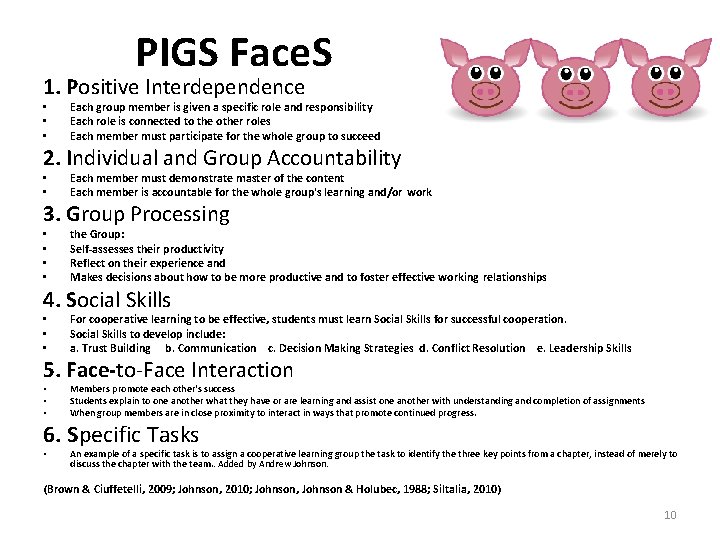
PIGS Face. S 1. Positive Interdependence • • • Each group member is given a specific role and responsibility Each role is connected to the other roles Each member must participate for the whole group to succeed 2. Individual and Group Accountability • • Each member must demonstrate master of the content Each member is accountable for the whole group's learning and/or work 3. Group Processing • • the Group: Self-assesses their productivity Reflect on their experience and Makes decisions about how to be more productive and to foster effective working relationships 4. Social Skills • • • For cooperative learning to be effective, students must learn Social Skills for successful cooperation. Social Skills to develop include: a. Trust Building b. Communication c. Decision Making Strategies d. Conflict Resolution e. Leadership Skills 5. Face-to-Face Interaction • • • Members promote each other's success Students explain to one another what they have or are learning and assist one another with understanding and completion of assignments When group members are in close proximity to interact in ways that promote continued progress. 6. Specific Tasks • An example of a specific task is to assign a cooperative learning group the task to identify the three key points from a chapter, instead of merely to discuss the chapter with the team. . Added by Andrew Johnson. (Brown & Ciuffetelli, 2009; Johnson, 2010; Johnson, Johnson & Holubec, 1988; Siltalia, 2010) 10
Application THINK-PAIR-SHARE (3 minutes) 1. How could you use Cooperative Learning? 2. How could you create positive interdependence? 3. How could you hold each person individually accountable? 4. How could you have teams group process? 5. What social skills might you need to teach/reinforce? 6. How would you grade the group and the individual? 11