
Marzanos Cooperative Groups Learning Strategy Benefits and dos

Marzano’s Cooperative Groups’ Learning Strategy Benefits and do’s and don’ts of using cooperative grouping
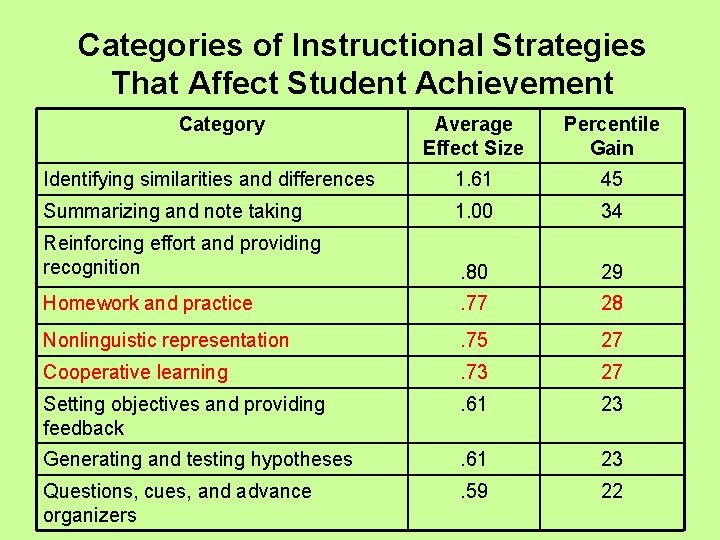
Categories of Instructional Strategies That Affect Student Achievement Category Average Effect Size Percentile Gain Identifying similarities and differences 1. 61 45 Summarizing and note taking 1. 00 34 Reinforcing effort and providing recognition . 80 29 Homework and practice . 77 28 Nonlinguistic representation . 75 27 Cooperative learning . 73 27 Setting objectives and providing feedback . 61 23 Generating and testing hypotheses . 61 23 Questions, cues, and advance organizers . 59 22
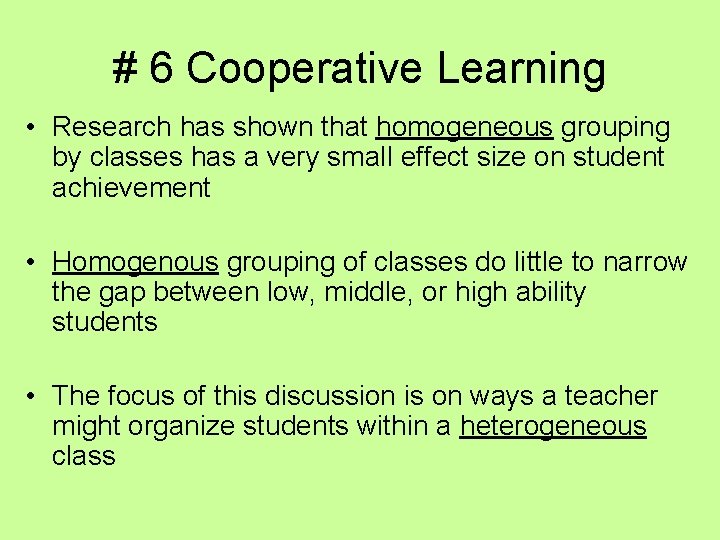
# 6 Cooperative Learning • Research has shown that homogeneous grouping by classes has a very small effect size on student achievement • Homogenous grouping of classes do little to narrow the gap between low, middle, or high ability students • The focus of this discussion is on ways a teacher might organize students within a heterogeneous class
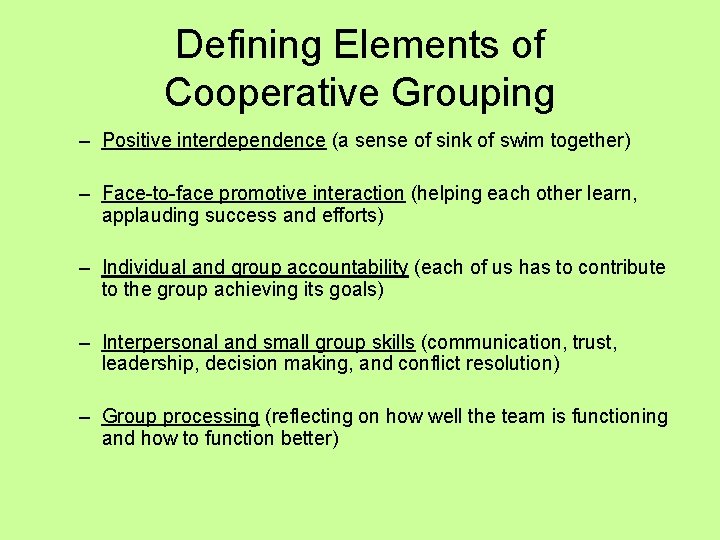
Defining Elements of Cooperative Grouping – Positive interdependence (a sense of sink of swim together) – Face-to-face promotive interaction (helping each other learn, applauding success and efforts) – Individual and group accountability (each of us has to contribute to the group achieving its goals) – Interpersonal and small group skills (communication, trust, leadership, decision making, and conflict resolution) – Group processing (reflecting on how well the team is functioning and how to function better)
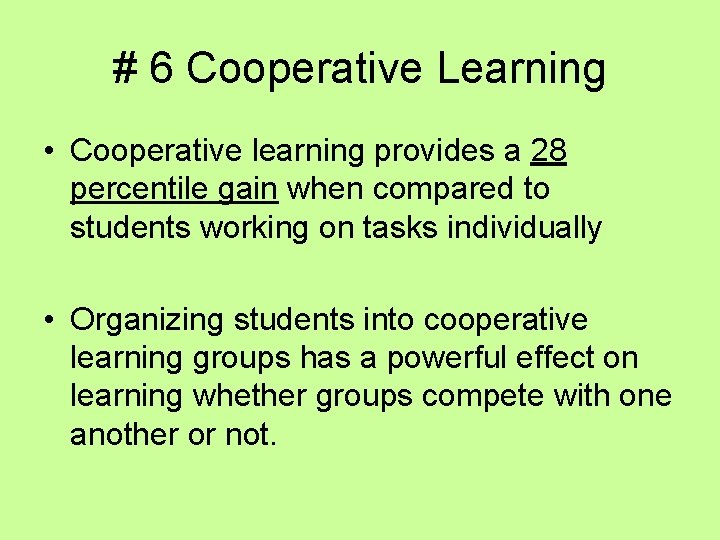
# 6 Cooperative Learning • Cooperative learning provides a 28 percentile gain when compared to students working on tasks individually • Organizing students into cooperative learning groups has a powerful effect on learning whether groups compete with one another or not.

Organizing Groups Based on Ability Levels Should be Done Sparingly Homogeneous Versus Heterogeneous Groups Ability Level of Students Percentile Gain Low ability - 23 Medium ability 19 High ability Data from Lou et al. , 1996 3
Cooperative Learning Tips • Cooperative groups should be kept rather small in size (3 -4 members) • Cooperative learning should be applied consistently and systematically but not over used (suggested once per week) – It is misused when not groups are not well structured – It is overused when it is implemented so that students have insufficient time to practice independently
Criteria for Grouping Students • Informal – Ad hoc groups that last for a few minutes or a class period (pair-share, elbow partner etc) • Formal – Designed to complete an academic assignment (may last several days) • Base Groups – Long term groups (for a semester or a year) to provide student support for errands, checking homework etc
- Slides: 8