Cinematic Elements as they relate to Film Sound


- Slides: 16
Cinematic Elements …as they relate to Film
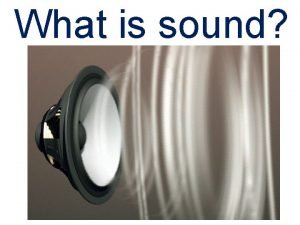
Sound � Why would a director use sound in a film? � Sound can add to a film in many ways: � Add depth � Create mood – (what we hear is what we see) � sound track: all of the music and sounds that are featured in a film; sounds chosen by a composer � Three classifications of sound � Diegetic: sound that comes from something in the environment � Nondiegetic: sound that is not part of the logical environment; sound that is added for the effect (underscoring) � Internal: a mix of the other two types; when a character hears a sound in their thoughts http: //vime o. com/3499 33 2962 86251 3 / m o c. o e http: //vim
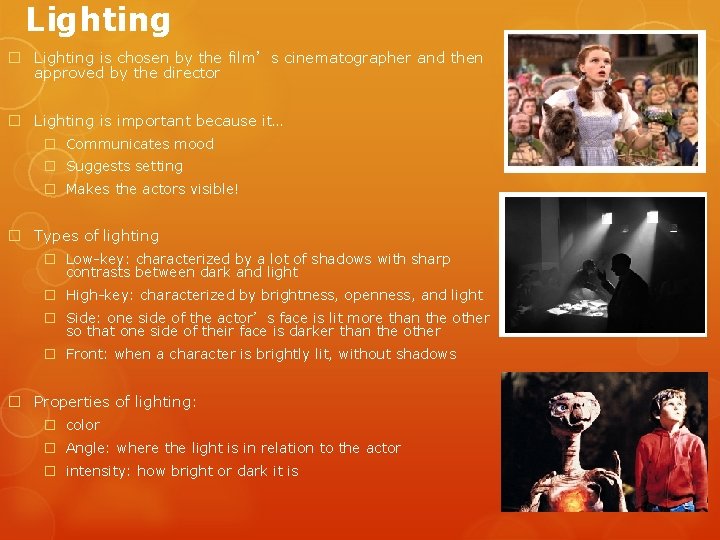
Lighting � Lighting is chosen by the film’s cinematographer and then approved by the director � Lighting is important because it… � Communicates mood � Suggests setting � Makes the actors visible! � Types of lighting � Low-key: characterized by a lot of shadows with sharp contrasts between dark and light � High-key: characterized by brightness, openness, and light � Side: one side of the actor’s face is lit more than the other so that one side of their face is darker than the other � Front: when a character is brightly lit, without shadows � Properties of lighting: � color � Angle: where the light is in relation to the actor � intensity: how bright or dark it is
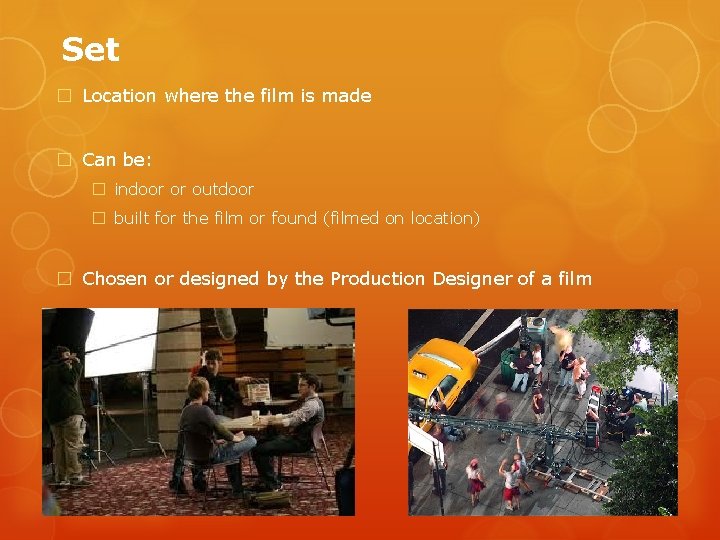
Set � Location where the film is made � Can be: � indoor or outdoor � built for the film or found (filmed on location) � Chosen or designed by the Production Designer of a film
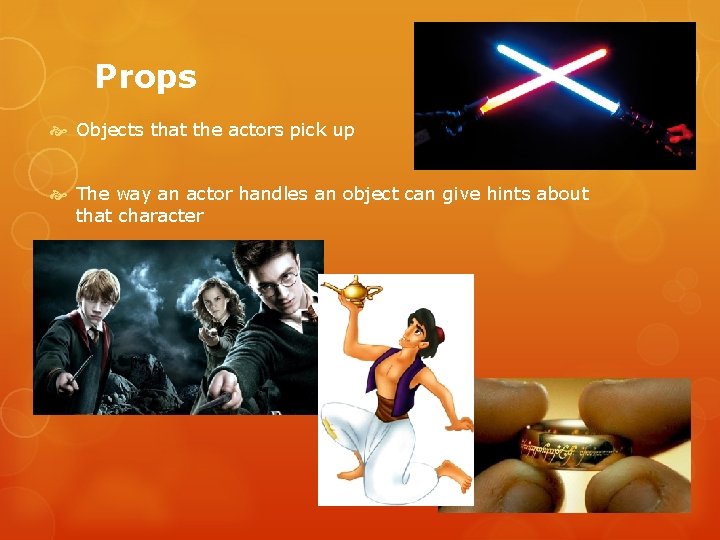
Props Objects that the actors pick up The way an actor handles an object can give hints about that character
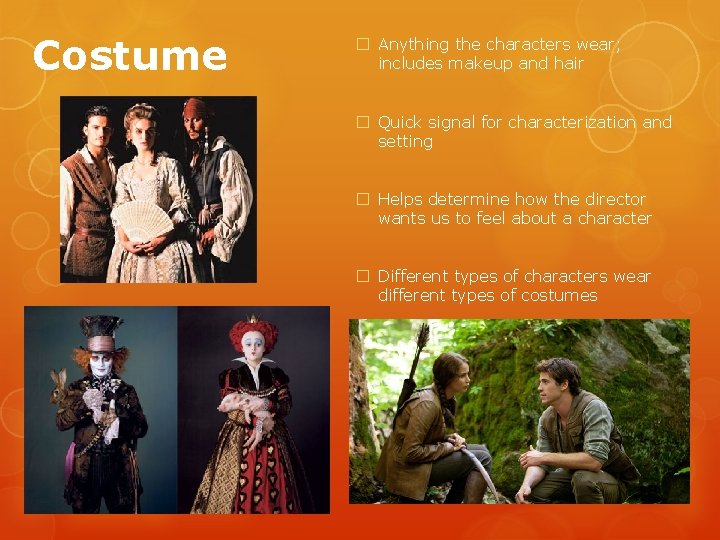
Costume � Anything the characters wear; includes makeup and hair � Quick signal for characterization and setting � Helps determine how the director wants us to feel about a character � Different types of characters wear different types of costumes
htt scr p: //w ee np ww. lay im /vi db. 33 c � More than just “good” or “bad” 34 om/ 27 v acting 53 ideo 53 / / Acting Choices � The choices that actors make to better portray the characters � Physicality � Facial expressions � Voice � Reaction/emotion m/vid o o r a i d om/me c. dem y c H t. r w M w http: //w /Dr-Jekyll-and il-. html 58 Ev eo/2368 -Can-This-Belip Movie-C � When considering acting, ask yourself: � Why did the actor decide to play the character a certain way? � Do you believe the character could be real? Why or why not?
The Design Team � Production designer – � responsible for the set of a film (artistic director) � Oversees the staff that creates costumes and makeup (costume designer, makeup artists) � In charge of the people who make or find props for a film � Storyboard artist – � Storyboard – series of pictures/sketches to plan out what each shot will look like � Draws up a storyboard for the film � Photography Unit – � Determines camera movements, focus, framing, and lighting � Cinematographer – in charge of photography unit
The Design Team (continued) � Sound Unit - Responsible for on-set recording of dialogue and sound effects � Composer – responsible for putting all of the sounds together on a film in the editing process � Editor– � Takes the raw footage and assembles it, keeping with the director’s vision � Work starts after the movie is filmed
Cinematic Technique How a movie is filmed.
Basic film terms � A SHOT: A shot is a segment of film that is an uninterrupted image � A TAKE: A specific version of a shot � A CUT: when the film changes from one image to the other and there is a tiny, split-second of black; kind of like the blink of an eye
Framing � Director determines how to frame, or focus on, each shot � This is based off of what the director is trying to communicate about the film � Main methods of framing � Close-up � objects shot in close-up will take up most of the scene � with actors, will only see their head from the neck up � can reveal a lot of detail and evoke emotions such as claustrophobia � Long shot � objects appear to be seen from a distance � we would see the actor’s entire body � can show setting � Medium shot � Between a long and a close-up � If an actor were in the shot, we’d view them from the waist up � Most shots are medium shots
Angles � The position of the camera in relation to the subject (what’s being filmed) � Types of angles � Low-angle, or superior, shot – subject is filmed from below, making the subject seem larger and more powerful � High angle, or inferior shot – subject is filmed from above, making the subject seem smaller and weaker � Eye level shot – camera is even with the subject, as most scenes are shot
Camera Movement � The Way that the camera moves during a particular shot � Pan: moving left to right horizontally; kind of like scanning scenery by turning your head from left to right � Tilt: camera stays stationary, but moves up and down on a fixed point � Zoom: focus of a stationary camera changes within a shot; making the object appear closer or farther away � Dolly shot: when the camera moves on a dolly, in a person’s hands, in a helicopter or in whatever way so that it is no longer stationary
Editing � Editor: the film’s storyteller; tells the story invisioned by the dirctor � Cut: joining to images together � Fade: (out) when the image on a screen shifts to black, white, or some other color or (in) when a color shifts to an image � Dissolve: when an image slowly fades away while the next image fades in � Parallel editing (or cross-cutting): cutting between scenes that are happening simultaneously
Editing (continued) � Point-of-view editing: � when an editor tries to show from a character’s point of view � tries to show what a character is thinking � Allows us to feel what the character feels � Duration � The length of time passed within a single shot � Long take: slower; gives more time for the audience to take in the image � Short take: fast-paced; creates rapid, energetic feel; can be used to create suspense