
Film Unit Formal Analysis How a film put


- Slides: 42
Film Unit Formal Analysis How a film put together Film Content What the film is about We will be studying Formal Analysis
Elements of Formal Analysis Story Mise-en-scene Cinematography Sound-Audio Editing
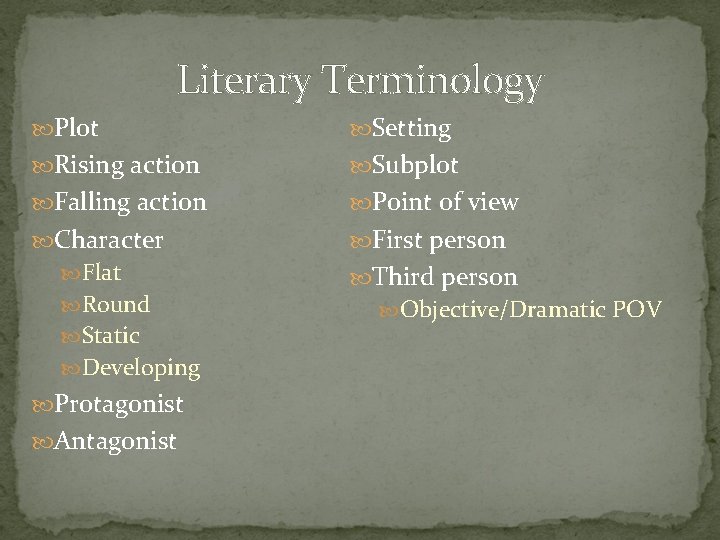
Literary Terminology Plot Setting Rising action Subplot Falling action Point of view Character First person Flat Round Static Developing Protagonist Antagonist Third person Objective/Dramatic POV
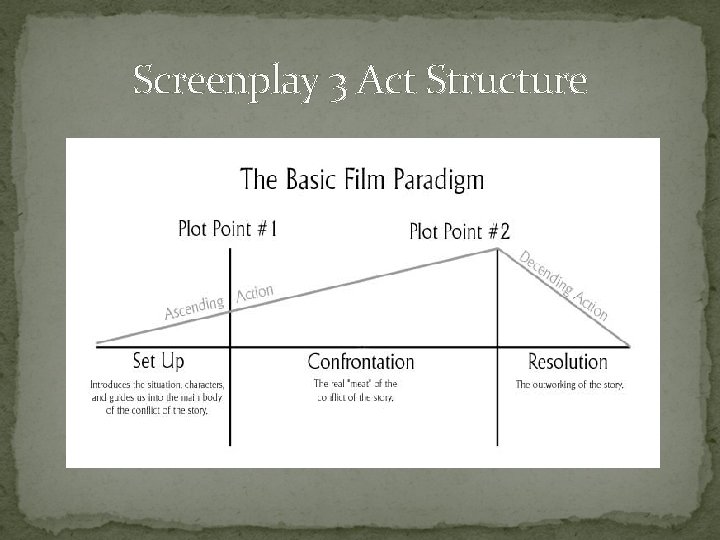
Screenplay 3 Act Structure
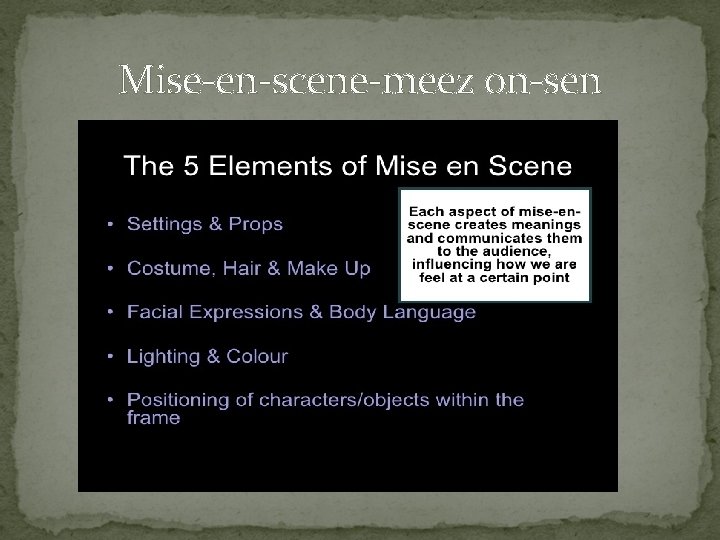
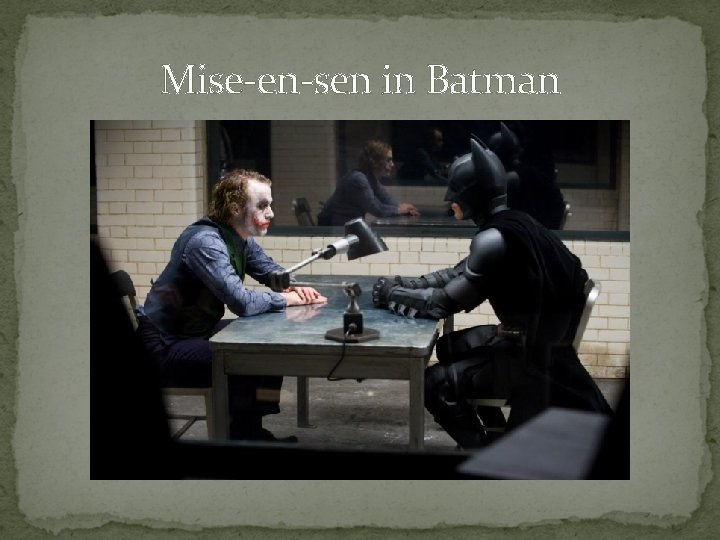
Mise-en-scene-meez on-sen
Mise-en-sen in Batman
Cinematography
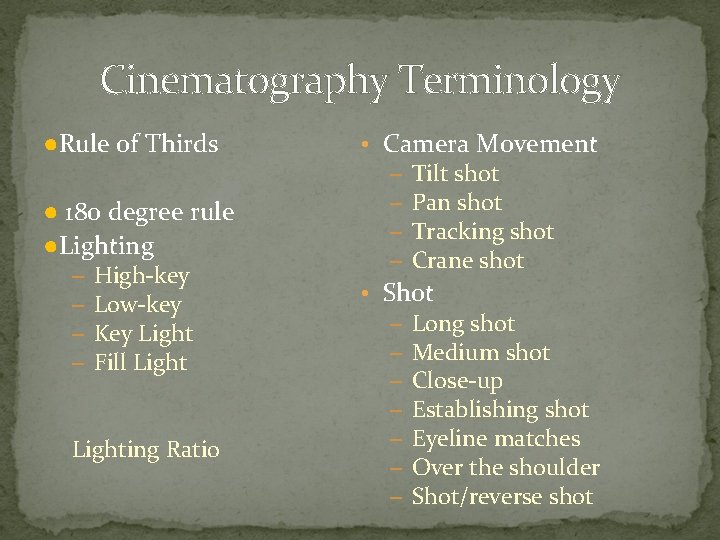
Cinematography Terminology ●Rule of Thirds ● 180 degree rule ●Lighting – – High-key Low-key Key Light Fill Lighting Ratio • Camera Movement – – Tilt shot Pan shot Tracking shot Crane shot • Shot – – – – Long shot Medium shot Close-up Establishing shot Eyeline matches Over the shoulder Shot/reverse shot
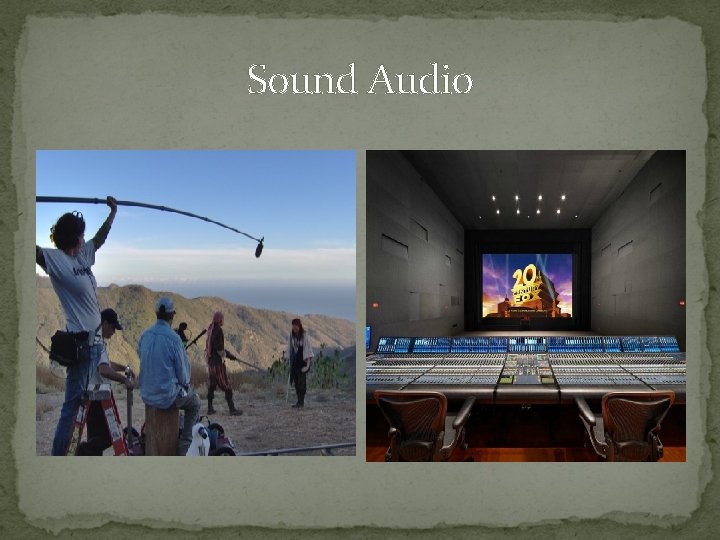
Sound Audio
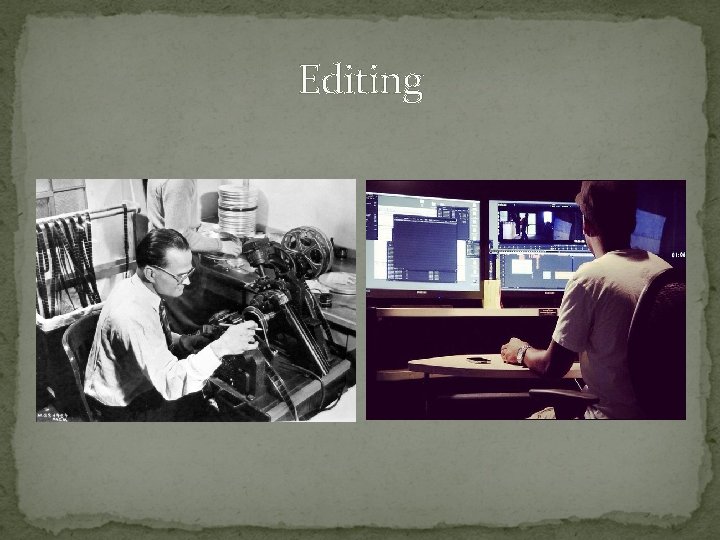
Editing
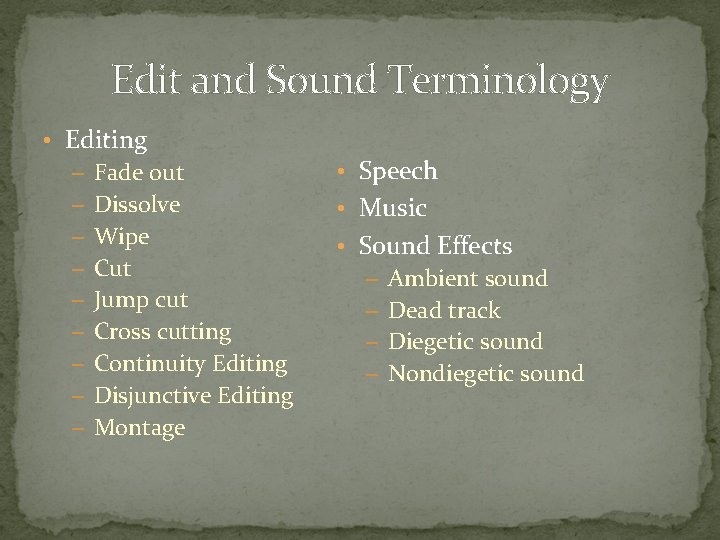
Edit and Sound Terminology • Editing – Fade out • Speech – Dissolve • Music – Wipe – Cut – Jump cut – Cross cutting – Continuity Editing – Disjunctive Editing – Montage • Sound Effects – Ambient sound – Dead track – Diegetic sound – Nondiegetic sound
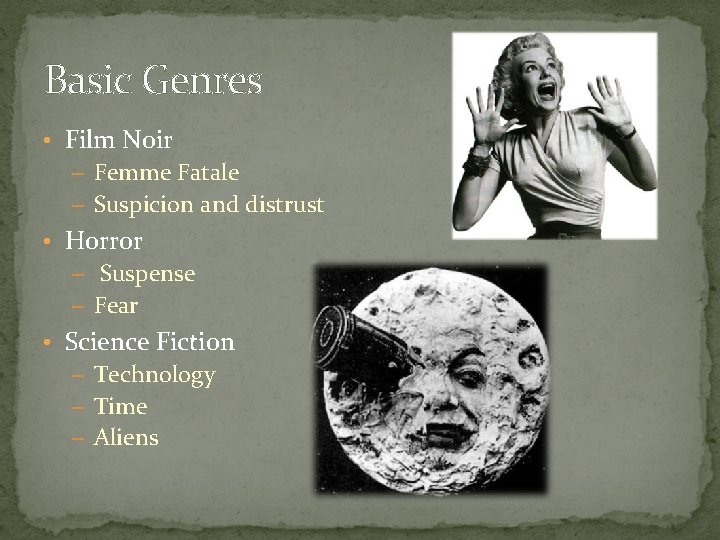
Basic Genres • Film Noir – Femme Fatale – Suspicion and distrust • Horror – Suspense – Fear • Science Fiction – Technology – Time – Aliens
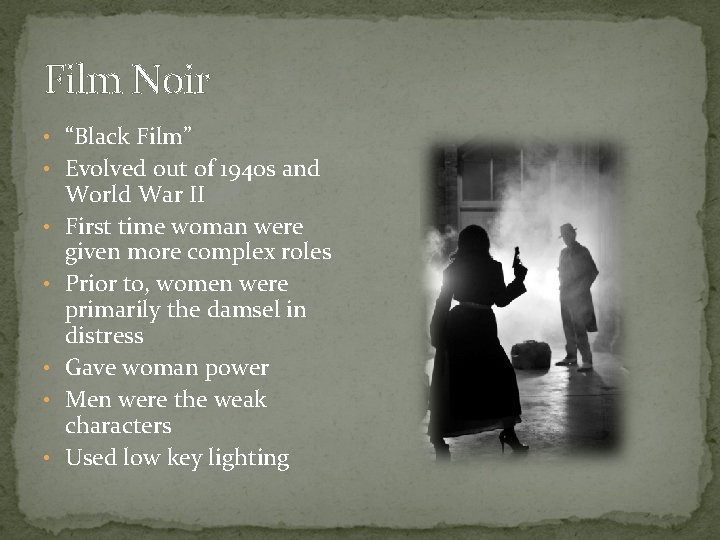
Film Noir • “Black Film” • Evolved out of 1940 s and • • • World War II First time woman were given more complex roles Prior to, women were primarily the damsel in distress Gave woman power Men were the weak characters Used low key lighting
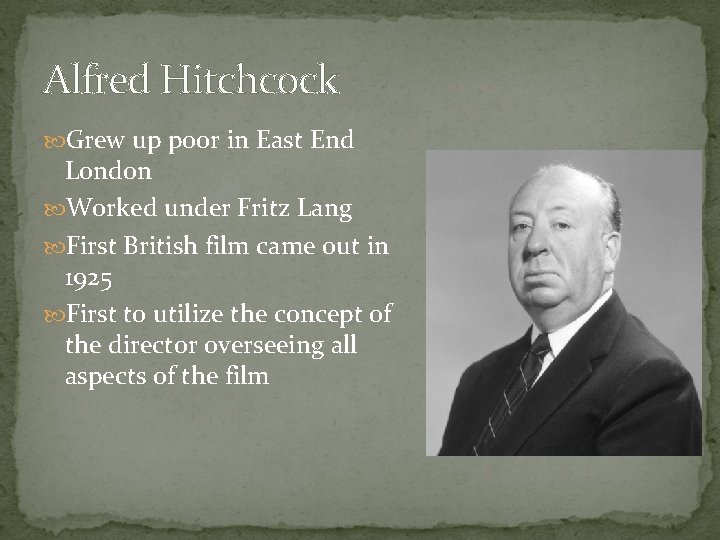
Alfred Hitchcock Grew up poor in East End London Worked under Fritz Lang First British film came out in 1925 First to utilize the concept of the director overseeing all aspects of the film
Hitchcock’s Elements • • • • “absurdist geography” “banality of evil” Betrayal Birds Blank stare Blondes Catholic Iconography Decorum, social order Disguise Doubling/twins Evil in normal surroundings Exchange of guilt Eyes Falling/dangling • Fantasy vs. reality, illusion • Family • Film and reality, film as a • • • metaphor Food, eating The “gaze” Guilt Handcuffs Imagination Logic vs. intuition Love Loyalty Passion Police, authority figures
Hitchcock’s Elements • Religious notions, guilt, • • • redemption Secrets Sex and death Shadows Suffering and its value Suspicion Travel, movement through space Trust Windows, curtains Women, femininity • Voyeurism • Smart woman/woman with • • • glasses Masculinity Maturity Mirrors Mothers obsession
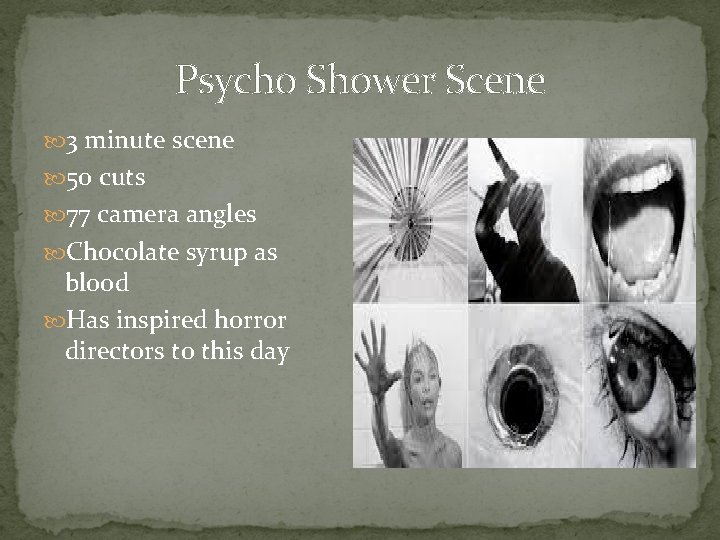
Psycho Shower Scene 3 minute scene 50 cuts 77 camera angles Chocolate syrup as blood Has inspired horror directors to this day
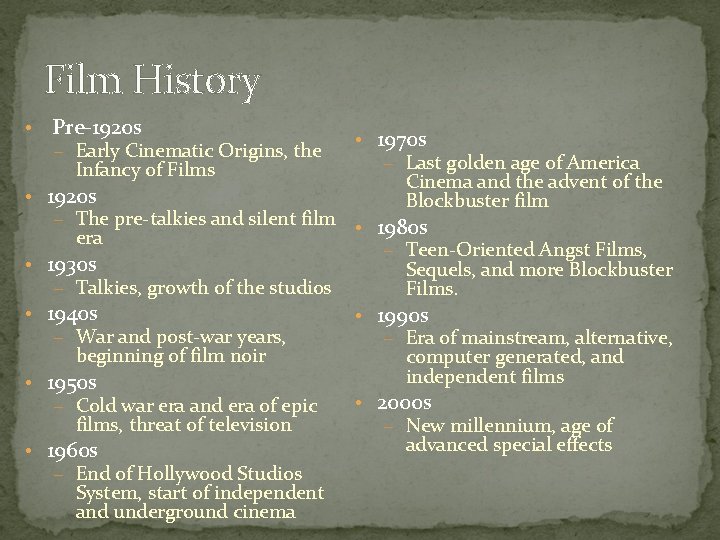
Film History • Pre-1920 s – Early Cinematic Origins, the Infancy of Films • 1920 s – The pre-talkies and silent film era • 1930 s – Talkies, growth of the studios • 1940 s – War and post-war years, beginning of film noir • 1950 s – Cold war era and era of epic films, threat of television • 1960 s – End of Hollywood Studios System, start of independent and underground cinema • 1970 s – Last golden age of America Cinema and the advent of the Blockbuster film • 1980 s – Teen-Oriented Angst Films, Sequels, and more Blockbuster Films. • 1990 s – Era of mainstream, alternative, computer generated, and independent films • 2000 s – New millennium, age of advanced special effects
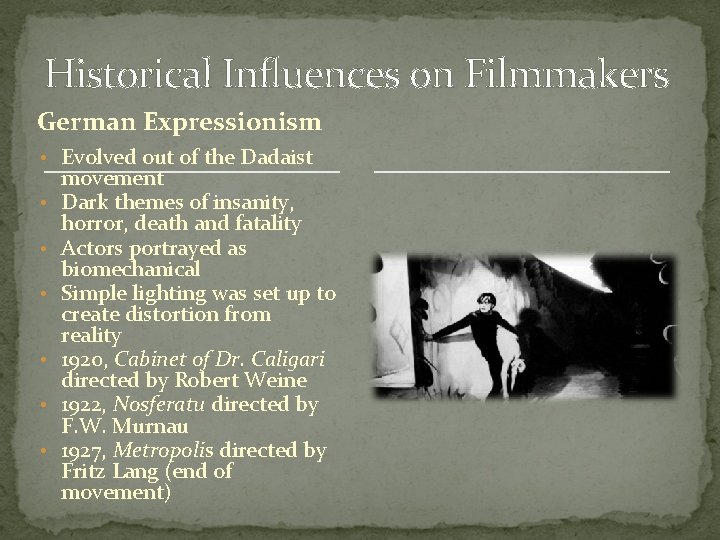
Historical Influences on Filmmakers German Expressionism • Evolved out of the Dadaist • • • movement Dark themes of insanity, horror, death and fatality Actors portrayed as biomechanical Simple lighting was set up to create distortion from reality 1920, Cabinet of Dr. Caligari directed by Robert Weine 1922, Nosferatu directed by F. W. Murnau 1927, Metropolis directed by Fritz Lang (end of movement)
German Expressionism https: //www. youtube. com/watch? v=EHGla_N 7 LDE
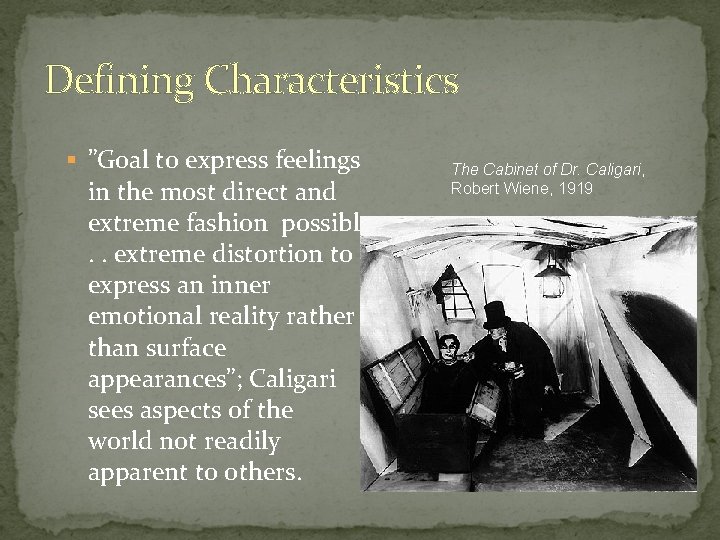
Defining Characteristics ”Goal to express feelings in the most direct and extreme fashion possible. . . extreme distortion to express an inner emotional reality rather than surface appearances”; Caligari sees aspects of the world not readily apparent to others. The Cabinet of Dr. Caligari, Robert Wiene, 1919
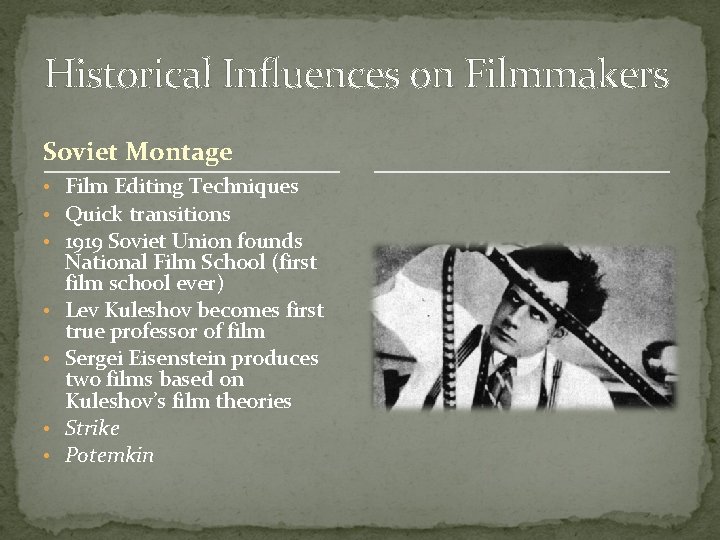
Historical Influences on Filmmakers Soviet Montage • Film Editing Techniques • Quick transitions • 1919 Soviet Union founds • • National Film School (first film school ever) Lev Kuleshov becomes first true professor of film Sergei Eisenstein produces two films based on Kuleshov’s film theories Strike Potemkin
Soviet Montage https: //www. youtube. com/watch? v=JYedfen. Q_Mw 2: 27 -6: 44
A MOTIF is a recurring image, idea, or pattern throughout a film that helps reveal theme of the text. How to recognize motif Identify Track Decipher Common Motifs Visual Motifs Colors Items Auditory Motifs phrases
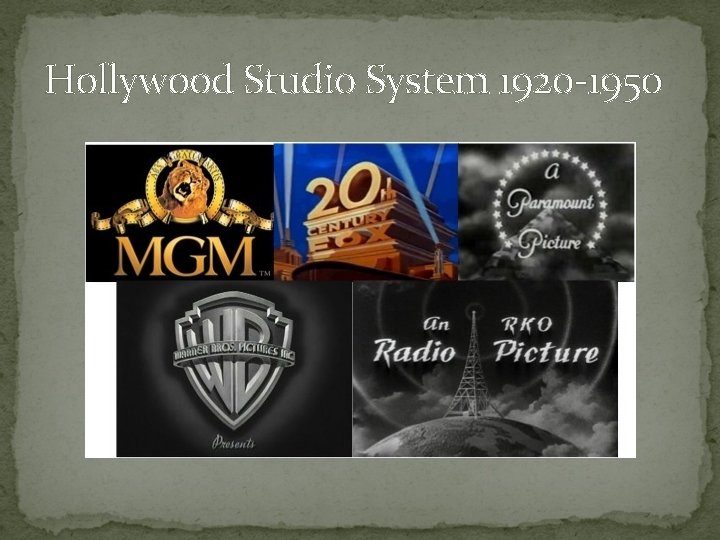
Hollywood Studio System 1920 -1950
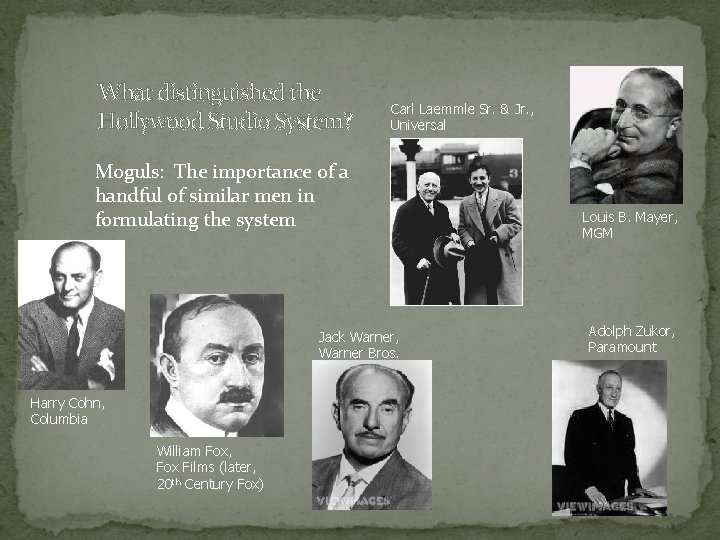
What distinguished the Hollywood Studio System? Carl Laemmle Sr. & Jr. , Universal Moguls: The importance of a handful of similar men in formulating the system Jack Warner, Warner Bros. Harry Cohn, Columbia William Fox, Fox Films (later, 20 th Century Fox) Louis B. Mayer, MGM Adolph Zukor, Paramount
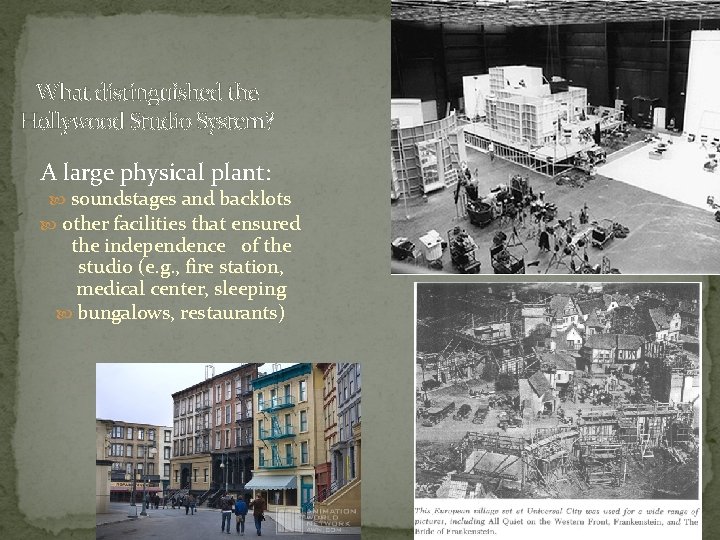
What distinguished the Hollywood Studio System? A large physical plant: soundstages and backlots other facilities that ensured the independence of the studio (e. g. , fire station, medical center, sleeping bungalows, restaurants)
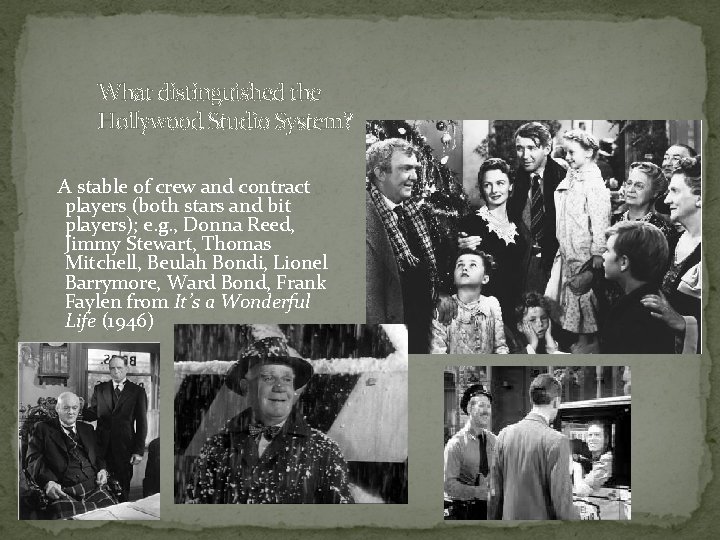
What distinguished the Hollywood Studio System? A stable of crew and contract players (both stars and bit players); e. g. , Donna Reed, Jimmy Stewart, Thomas Mitchell, Beulah Bondi, Lionel Barrymore, Ward Bond, Frank Faylen from It’s a Wonderful Life (1946)
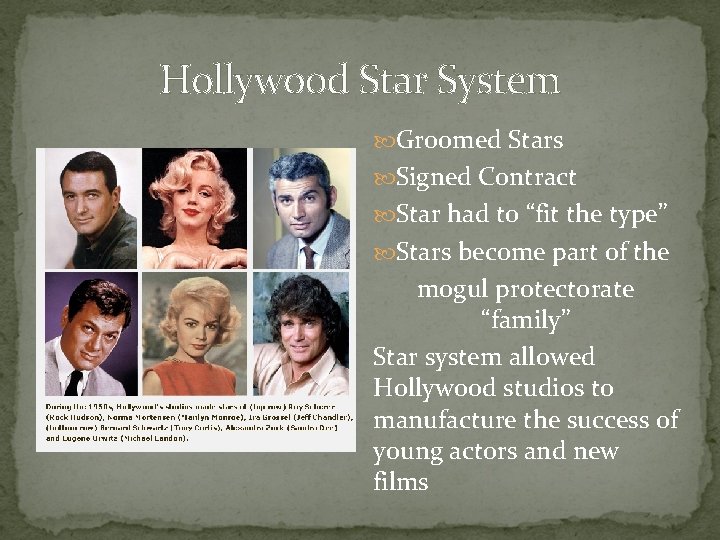
Hollywood Star System Groomed Stars Signed Contract Star had to “fit the type” Stars become part of the mogul protectorate “family” Star system allowed Hollywood studios to manufacture the success of young actors and new films
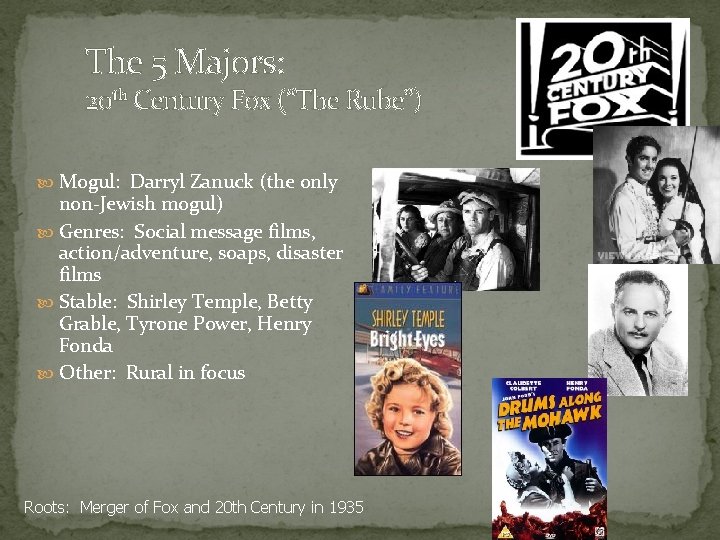
The 5 Majors: 20 th Century Fox (“The Rube”) Mogul: Darryl Zanuck (the only non-Jewish mogul) Genres: Social message films, action/adventure, soaps, disaster films Stable: Shirley Temple, Betty Grable, Tyrone Power, Henry Fonda Other: Rural in focus Roots: Merger of Fox and 20 th Century in 1935
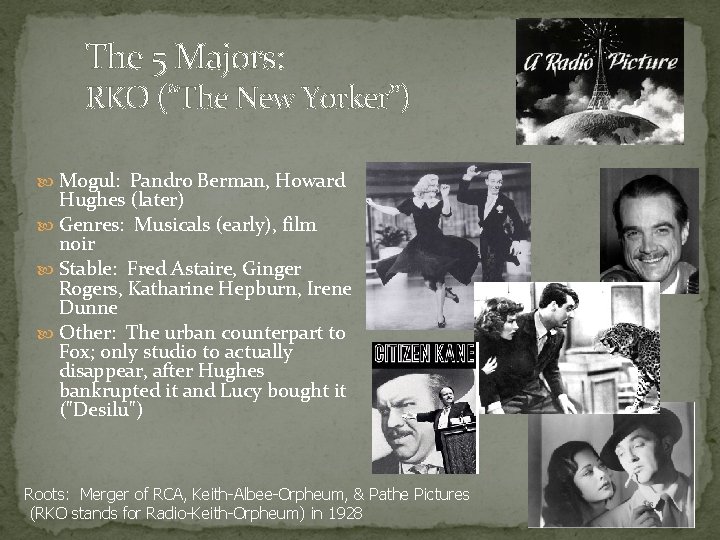
The 5 Majors: RKO (“The New Yorker”) Mogul: Pandro Berman, Howard Hughes (later) Genres: Musicals (early), film noir Stable: Fred Astaire, Ginger Rogers, Katharine Hepburn, Irene Dunne Other: The urban counterpart to Fox; only studio to actually disappear, after Hughes bankrupted it and Lucy bought it ("Desilu") Roots: Merger of RCA, Keith-Albee-Orpheum, & Pathe Pictures (RKO stands for Radio-Keith-Orpheum) in 1928
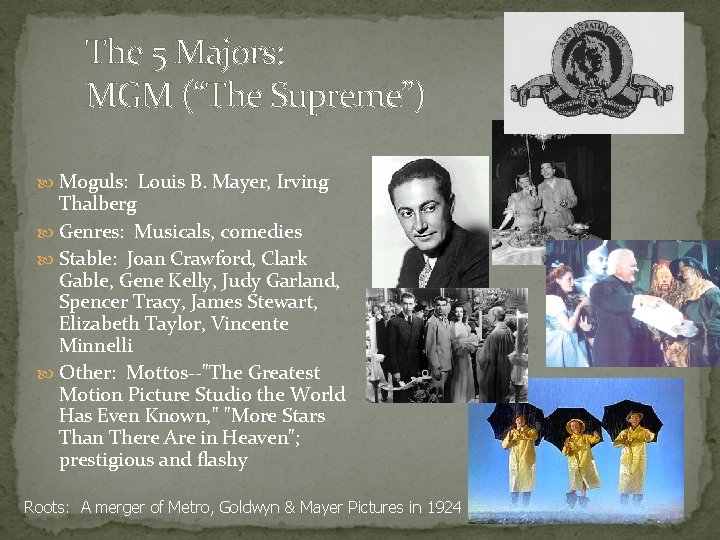
The 5 Majors: MGM (“The Supreme”) Moguls: Louis B. Mayer, Irving Thalberg Genres: Musicals, comedies Stable: Joan Crawford, Clark Gable, Gene Kelly, Judy Garland, Spencer Tracy, James Stewart, Elizabeth Taylor, Vincente Minnelli Other: Mottos--"The Greatest Motion Picture Studio the World Has Even Known, " "More Stars Than There Are in Heaven"; prestigious and flashy Roots: A merger of Metro, Goldwyn & Mayer Pictures in 1924
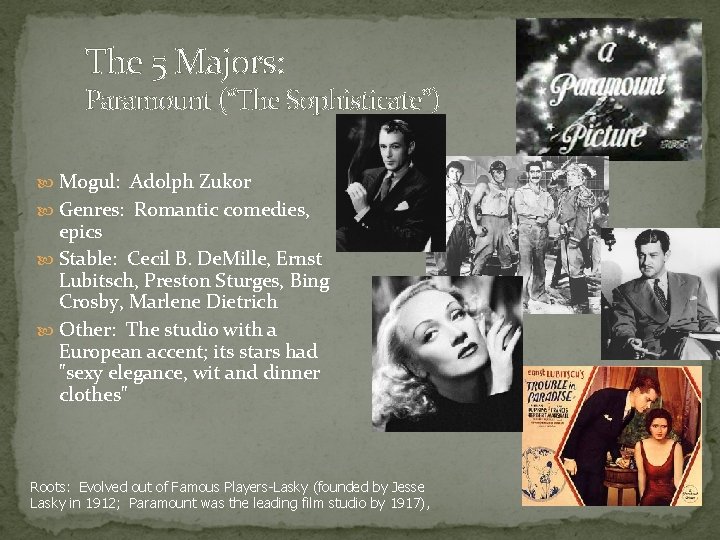
The 5 Majors: Paramount (“The Sophisticate”) Mogul: Adolph Zukor Genres: Romantic comedies, epics Stable: Cecil B. De. Mille, Ernst Lubitsch, Preston Sturges, Bing Crosby, Marlene Dietrich Other: The studio with a European accent; its stars had "sexy elegance, wit and dinner clothes" Roots: Evolved out of Famous Players-Lasky (founded by Jesse Lasky in 1912; Paramount was the leading film studio by 1917),
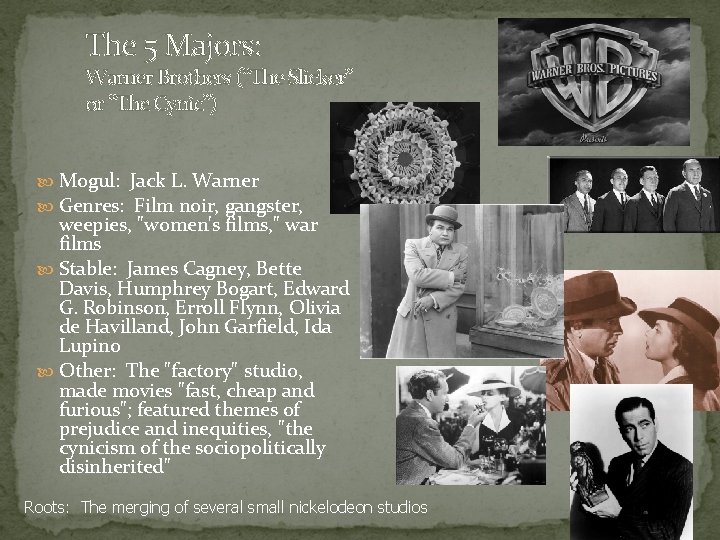
The 5 Majors: Warner Brothers (“The Slicker” or “The Cynic”) Mogul: Jack L. Warner Genres: Film noir, gangster, weepies, "women's films, " war films Stable: James Cagney, Bette Davis, Humphrey Bogart, Edward G. Robinson, Erroll Flynn, Olivia de Havilland, John Garfield, Ida Lupino Other: The "factory" studio, made movies "fast, cheap and furious"; featured themes of prejudice and inequities, "the cynicism of the sociopolitically disinherited" Roots: The merging of several small nickelodeon studios
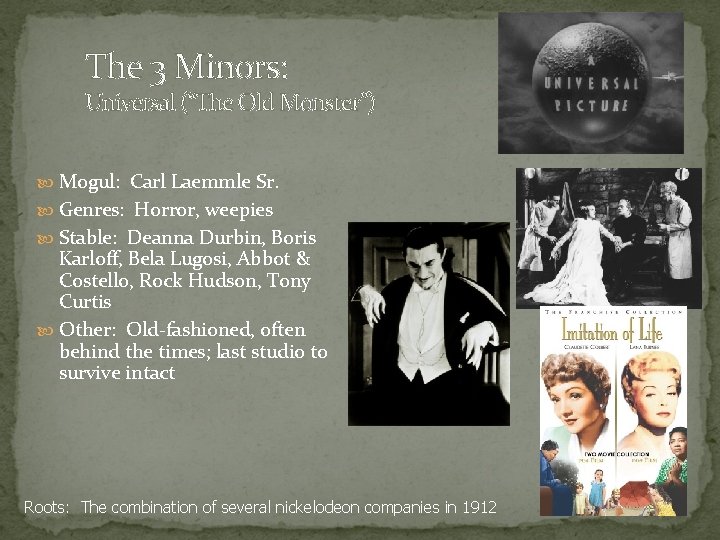
The 3 Minors: Universal (“The Old Monster”) Mogul: Carl Laemmle Sr. Genres: Horror, weepies Stable: Deanna Durbin, Boris Karloff, Bela Lugosi, Abbot & Costello, Rock Hudson, Tony Curtis Other: Old-fashioned, often behind the times; last studio to survive intact Roots: The combination of several nickelodeon companies in 1912
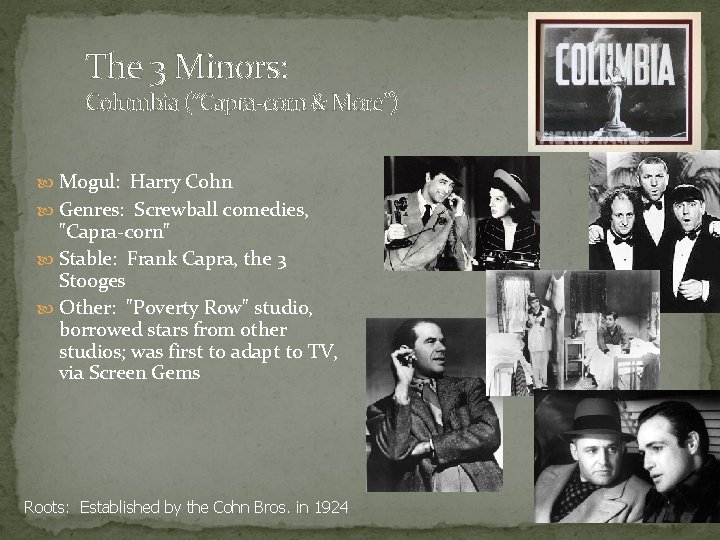
The 3 Minors: Columbia (“Capra-corn & More”) Mogul: Harry Cohn Genres: Screwball comedies, "Capra-corn" Stable: Frank Capra, the 3 Stooges Other: "Poverty Row" studio, borrowed stars from other studios; was first to adapt to TV, via Screen Gems Roots: Established by the Cohn Bros. in 1924
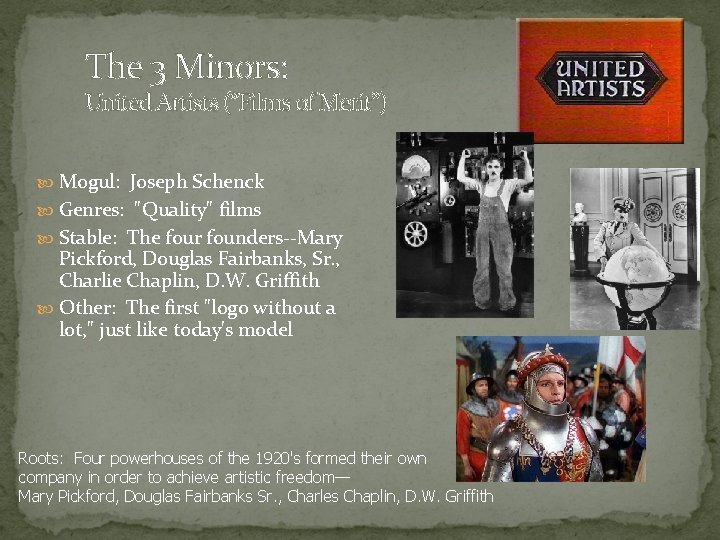
The 3 Minors: United Artists (“Films of Merit”) Mogul: Joseph Schenck Genres: "Quality" films Stable: The four founders--Mary Pickford, Douglas Fairbanks, Sr. , Charlie Chaplin, D. W. Griffith Other: The first "logo without a lot, " just like today's model Roots: Four powerhouses of the 1920's formed their own company in order to achieve artistic freedom— Mary Pickford, Douglas Fairbanks Sr. , Charles Chaplin, D. W. Griffith
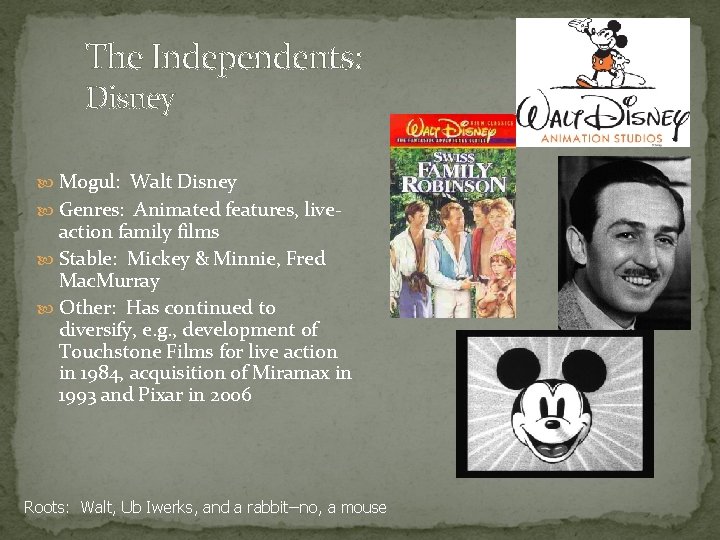
The Independents: Disney Mogul: Walt Disney Genres: Animated features, live- action family films Stable: Mickey & Minnie, Fred Mac. Murray Other: Has continued to diversify, e. g. , development of Touchstone Films for live action in 1984, acquisition of Miramax in 1993 and Pixar in 2006 Roots: Walt, Ub Iwerks, and a rabbit--no, a mouse
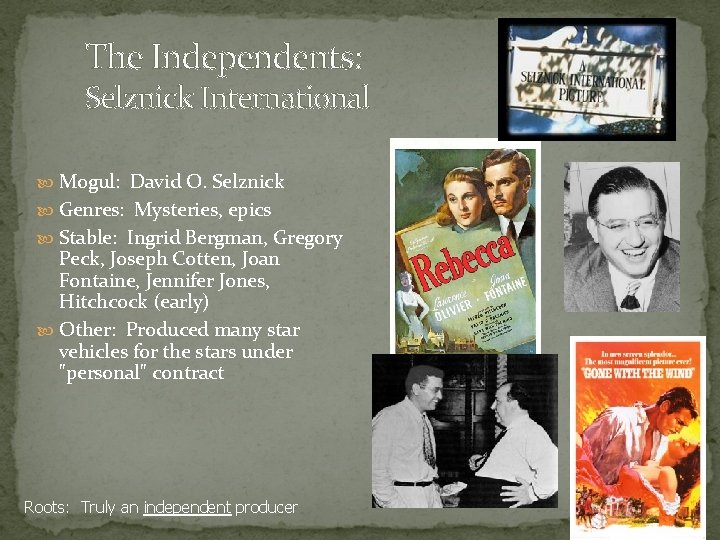
The Independents: Selznick International Mogul: David O. Selznick Genres: Mysteries, epics Stable: Ingrid Bergman, Gregory Peck, Joseph Cotten, Joan Fontaine, Jennifer Jones, Hitchcock (early) Other: Produced many star vehicles for the stars under "personal" contract Roots: Truly an independent producer
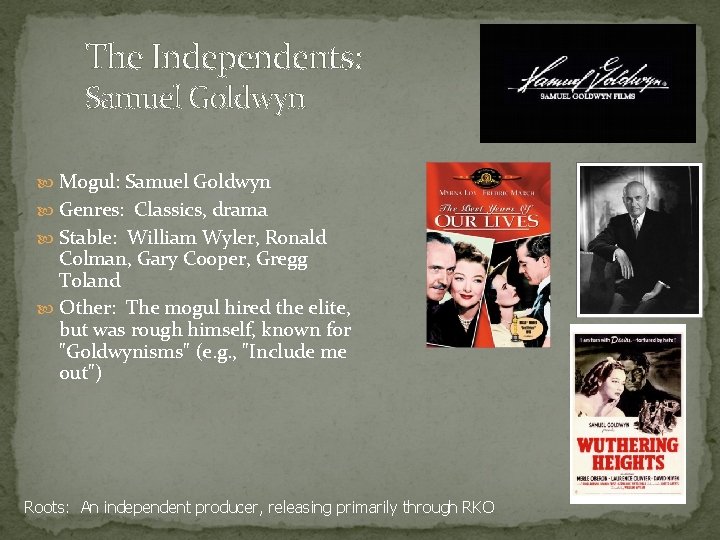
The Independents: Samuel Goldwyn Mogul: Samuel Goldwyn Genres: Classics, drama Stable: William Wyler, Ronald Colman, Gary Cooper, Gregg Toland Other: The mogul hired the elite, but was rough himself, known for "Goldwynisms" (e. g. , "Include me out") Roots: An independent producer, releasing primarily through RKO
Hollywood Walk of Fame