II Film Sound Theories 3 Feminist Film Theory
- Slides: 8
II. Film Sound Theories 3. Feminist Film Theory
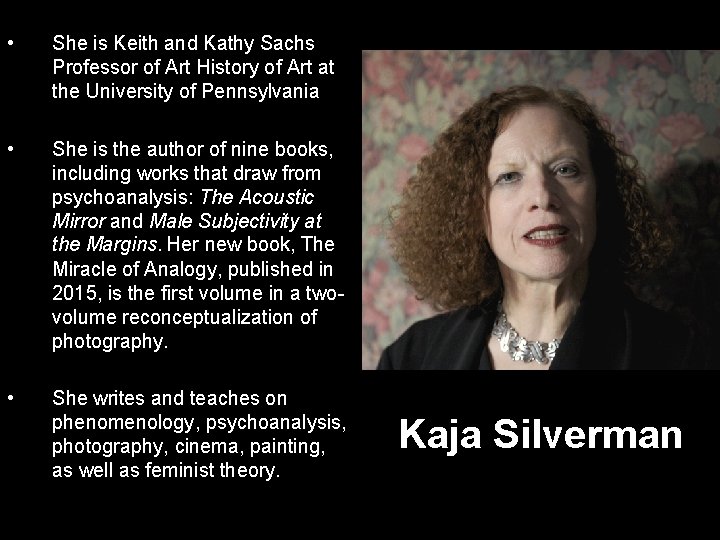
• She is Keith and Kathy Sachs Professor of Art History of Art at the University of Pennsylvania • She is the author of nine books, including works that draw from psychoanalysis: The Acoustic Mirror and Male Subjectivity at the Margins. Her new book, The Miracle of Analogy, published in 2015, is the first volume in a twovolume reconceptualization of photography. • She writes and teaches on phenomenology, psychoanalysis, photography, cinema, painting, as well as feminist theory. Kaja Silverman
The Acoustic Mirror • This book is concerned with the female voice in psychoanalysis and cinema • Published in 1988 • The influence of post-structuralist theory, deconstruction, and Freudian and Lacanian psychoanalysis on feminist film theory in the late 1970 s and 1980 s
• Why psychoanalysis? • How does Silverman use psychoanalysis to discuss the particular position of women’s voices in narrative cinema?
SINGIN’ IN THE RAIN: • Sonic vraisemblable • Dubbing and synchronization • Male and female subjectivity: exteriority and interiority • Invagination
Fantasies of The Mother’s Voice: • Subject formation: the mother’s voice as acoustic mirror, sonorous envelope • Dystopic fantasy / abject: web-like, entrapment, engulfment; Chion • Utopic fantasy / objet (a): plenitude and bliss, idyllic unity of mother and child; Rosolato and Kristeva
• Chora: signifier for the moment prior to the Mirror Stage and the Symbolic, an image of unity between mother and child, associated with music and poetry • The mother speaks: Laura Mulvey’s “voiceoff” in RIDDLES OF THE SPHINX
The Screaming / Crying Point: • The Screaming Point (Chion, pp. 76 -77) • The Point of the Cry (Silverman, p. 77) • Is the screaming / crying point always beyond meaning and subjectivity?