Chinese Word Segmentation Method for DomainSpecial Machine Translation


- Slides: 23
Chinese Word Segmentation Method for Domain-Special Machine Translation Su Chen; Zhang Yujie; Guo Zhen; Xu Jin’an Beijing Jiaotong University
Outline Motivation Method of combining multiple segmentation results Experiment & Evaluation Conclusion
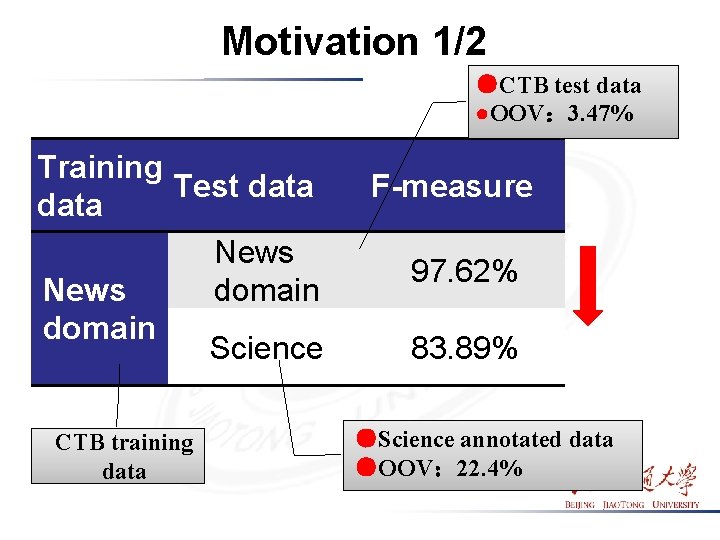
Motivation 1/2 ●CTB test data ●OOV: 3. 47% Training Test data News domain Science CTB training data F-measure 97. 62% 83. 89% ●Science annotated data ●OOV: 22. 4%
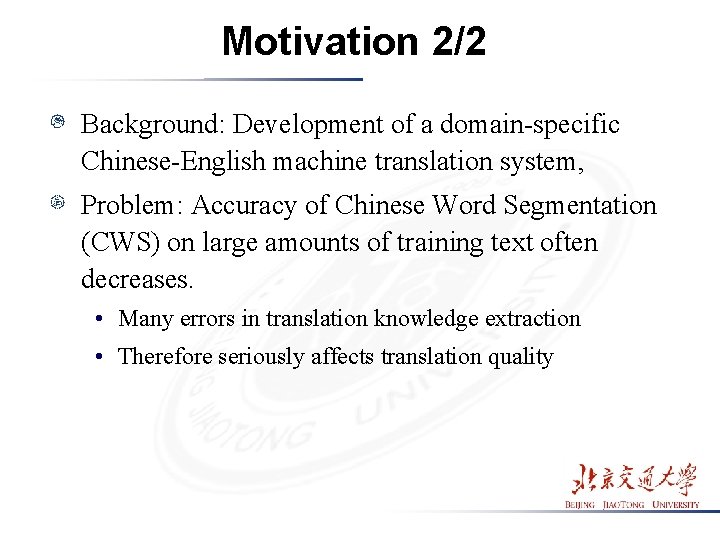
Motivation 2/2 Background: Development of a domain-specific Chinese-English machine translation system, Problem: Accuracy of Chinese Word Segmentation (CWS) on large amounts of training text often decreases. • Many errors in translation knowledge extraction • Therefore seriously affects translation quality
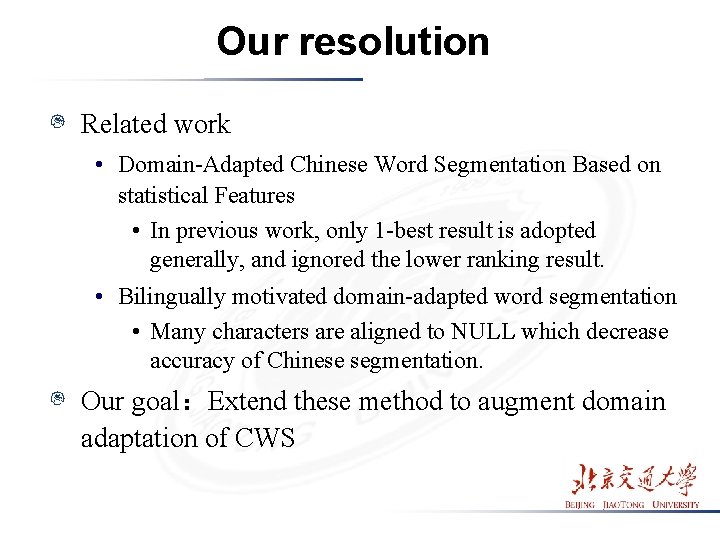
Our resolution Related work • Domain-Adapted Chinese Word Segmentation Based on statistical Features • In previous work, only 1 -best result is adopted generally, and ignored the lower ranking result. • Bilingually motivated domain-adapted word segmentation • Many characters are aligned to NULL which decrease accuracy of Chinese segmentation. Our goal:Extend these method to augment domain adaptation of CWS
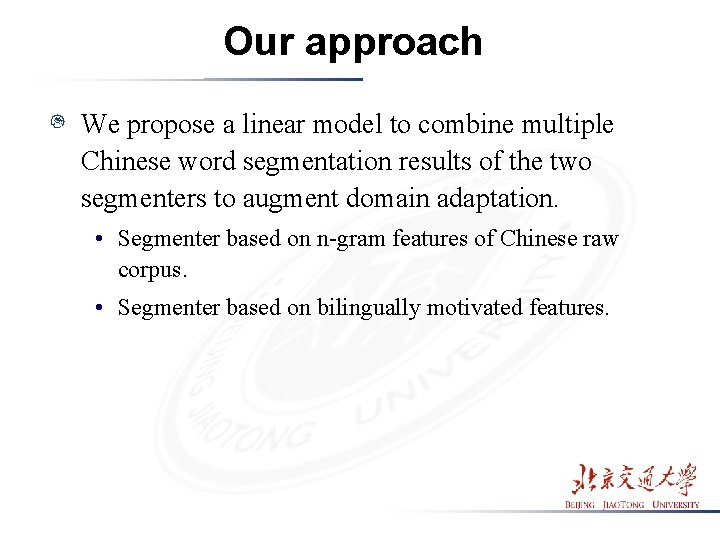
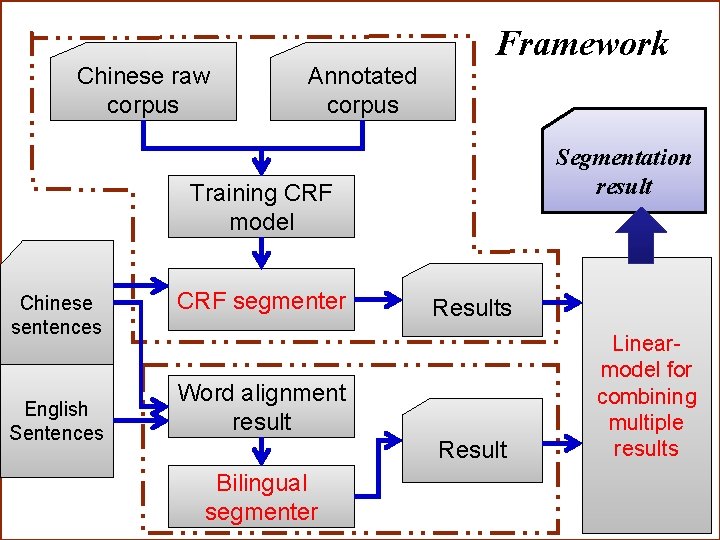
Our approach We propose a linear model to combine multiple Chinese word segmentation results of the two segmenters to augment domain adaptation. • Segmenter based on n-gram features of Chinese raw corpus. • Segmenter based on bilingually motivated features.
Chinese raw corpus Annotated corpus Framework Segmentation result Training CRF model Chinese sentences English Sentences CRF segmenter Results Word alignment result Result Bilingual segmenter Linearmodel for combining multiple results
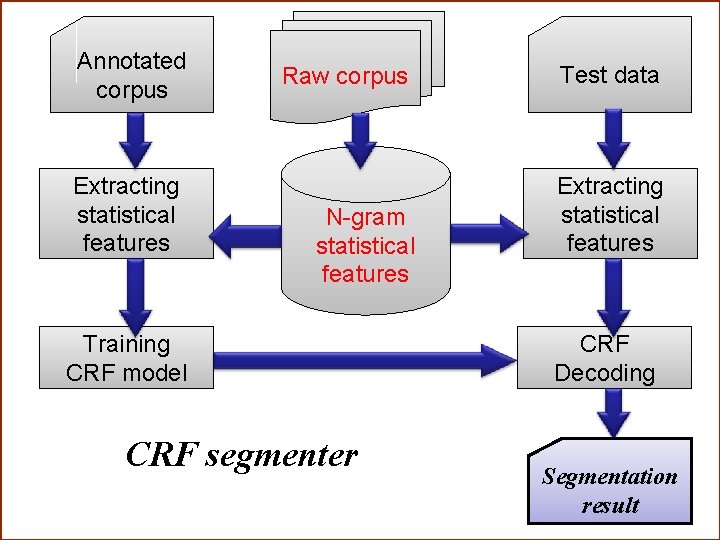
Annotated corpus Extracting statistical features Raw corpus N-gram statistical features Training CRF model CRF segmenter Test data Extracting statistical features CRF Decoding Segmentation result
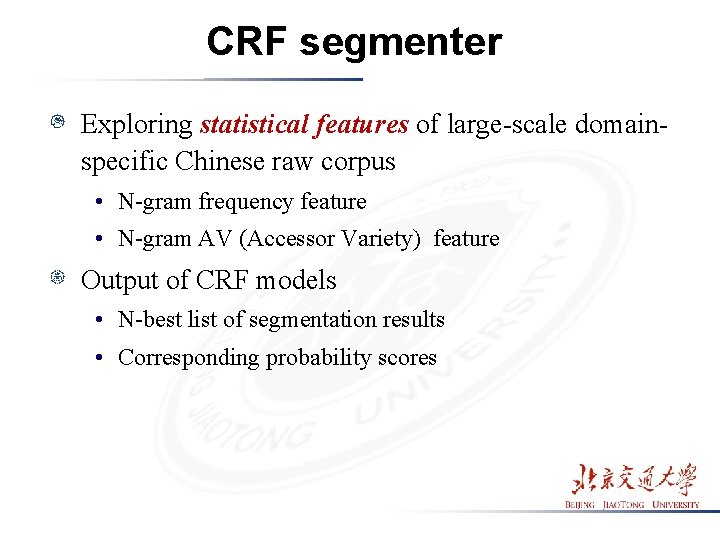
CRF segmenter Exploring statistical features of large-scale domainspecific Chinese raw corpus • N-gram frequency feature • N-gram AV (Accessor Variety) feature Output of CRF models • N-best list of segmentation results • Corresponding probability scores
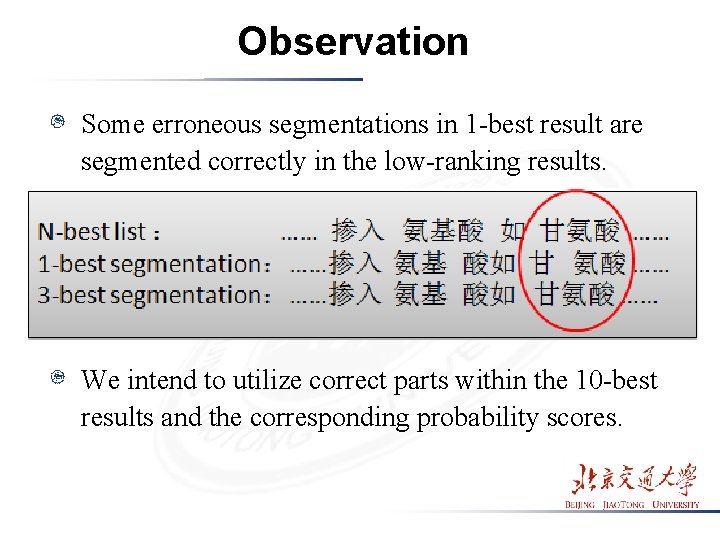
Observation Some erroneous segmentations in 1 -best result are segmented correctly in the low-ranking results. We intend to utilize correct parts within the 10 -best results and the corresponding probability scores.
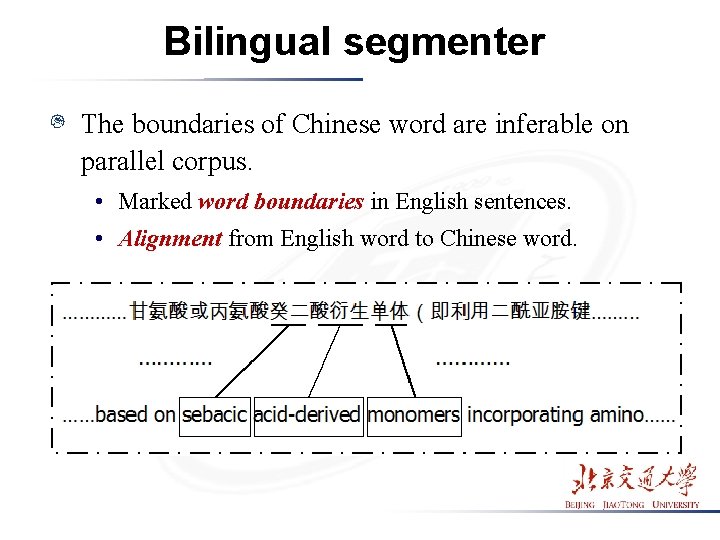
Bilingual segmenter The boundaries of Chinese word are inferable on parallel corpus. • Marked word boundaries in English sentences. • Alignment from English word to Chinese word.
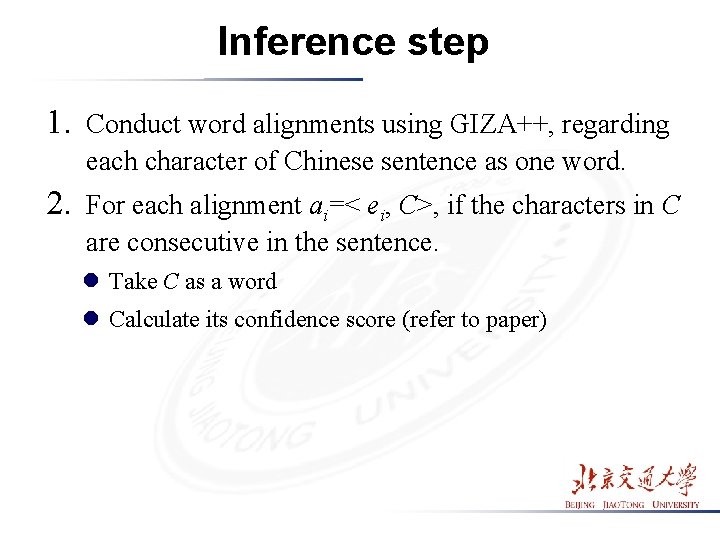
Inference step 1. Conduct word alignments using GIZA++, regarding each character of Chinese sentence as one word. 2. For each alignment ai=< ei, C>, if the characters in C are consecutive in the sentence. l Take C as a word l Calculate its confidence score (refer to paper)
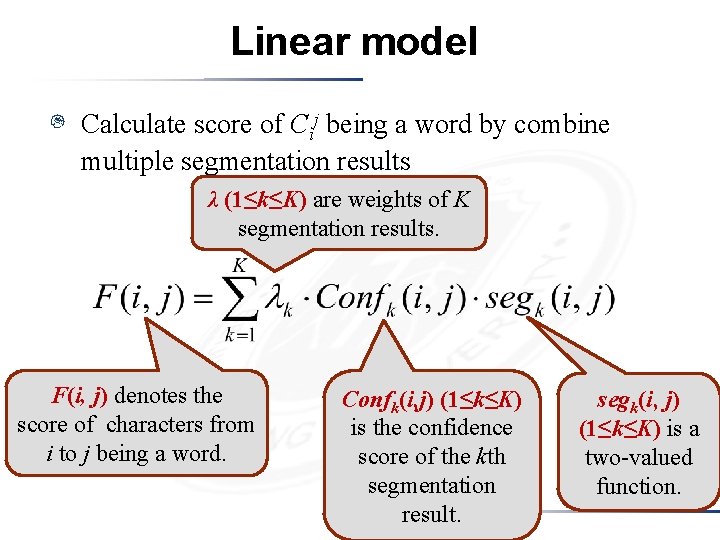
Linear model Calculate score of Cij being a word by combine multiple segmentation results λ (1≤k≤K) are weights of K segmentation results. F(i, j) denotes the score of characters from i to j being a word. Confk(i, j) (1≤k≤K) is the confidence score of the kth segmentation result. segk(i, j) (1≤k≤K) is a two-valued function.
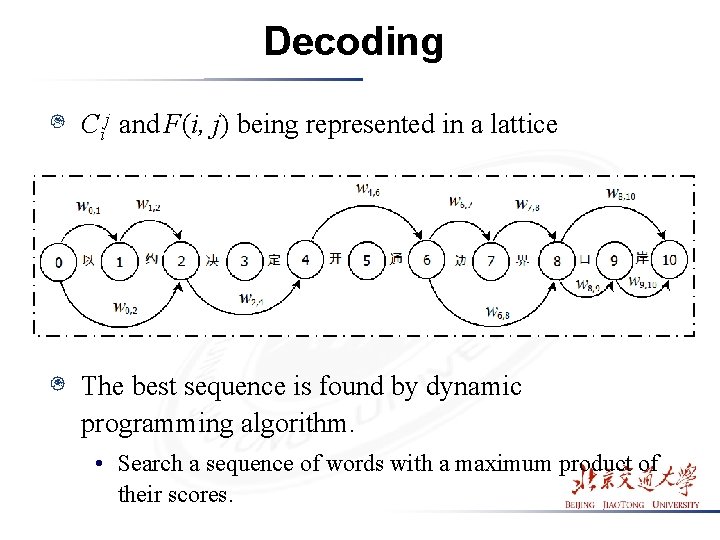
Decoding Cij and F(i, j) being represented in a lattice The best sequence is found by dynamic programming algorithm. • Search a sequence of words with a maximum product of their scores.
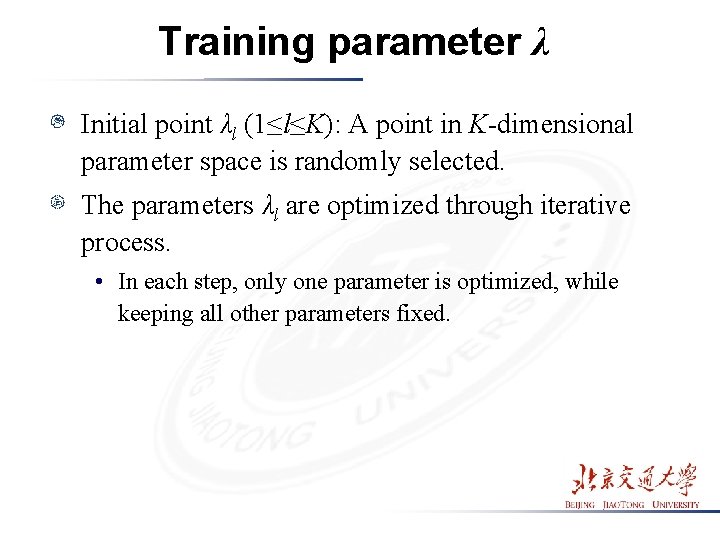
Training parameter λ Initial point λl (1≤l≤K): A point in K-dimensional parameter space is randomly selected. The parameters λl are optimized through iterative process. • In each step, only one parameter is optimized, while keeping all other parameters fixed.
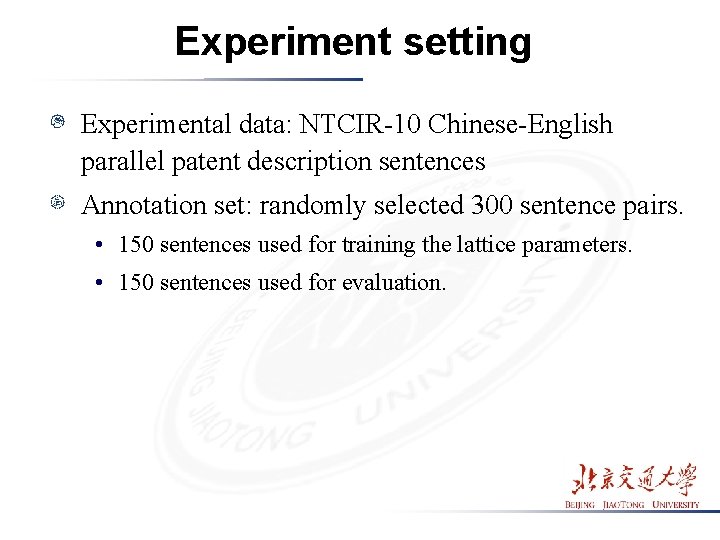
Experiment setting Experimental data: NTCIR-10 Chinese-English parallel patent description sentences Annotation set: randomly selected 300 sentence pairs. • 150 sentences used for training the lattice parameters. • 150 sentences used for evaluation.
Evaluation We conduct evaluations from two aspects: • Evaluation (1): accuracy of Chinese word segmentation (F -measure) • Evaluation (2): translation quality of MT system (BLEU)
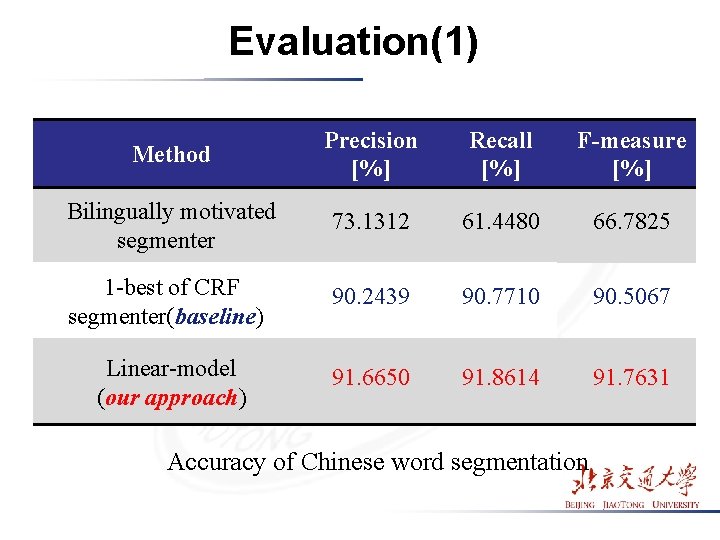
Evaluation(1) Method Precision [%] Recall [%] F-measure [%] Bilingually motivated segmenter 73. 1312 61. 4480 66. 7825 1 -best of CRF segmenter(baseline) 90. 2439 90. 7710 90. 5067 Linear-model (our approach) 91. 6650 91. 8614 91. 7631 Accuracy of Chinese word segmentation
Evaluation(2) We develop a phrase-based SMT with Moses, using different Chinese segmenters • 1 -best of CRF segmenter (baseline) • Linear model (our approach) • Stanford Chinese segmenter • NLPIR Chinese segmenter
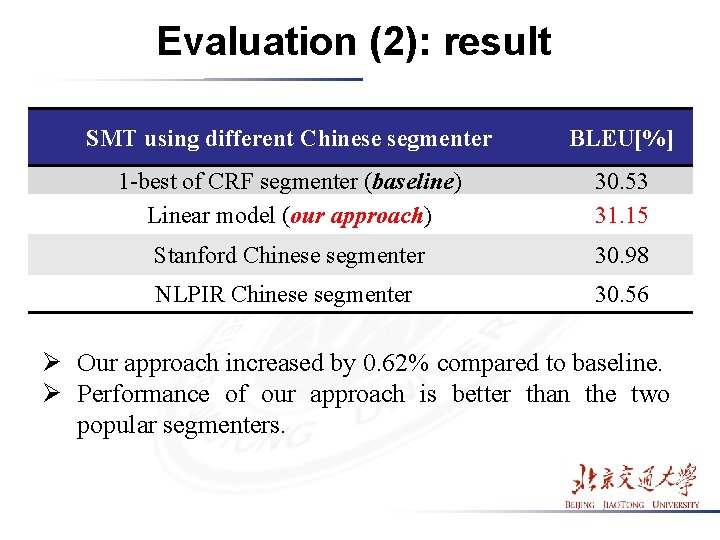
Evaluation (2): result SMT using different Chinese segmenter BLEU[%] 1 -best of CRF segmenter (baseline) Linear model (our approach) 30. 53 31. 15 Stanford Chinese segmenter 30. 98 NLPIR Chinese segmenter 30. 56 Ø Our approach increased by 0. 62% compared to baseline. Ø Performance of our approach is better than the two popular segmenters.
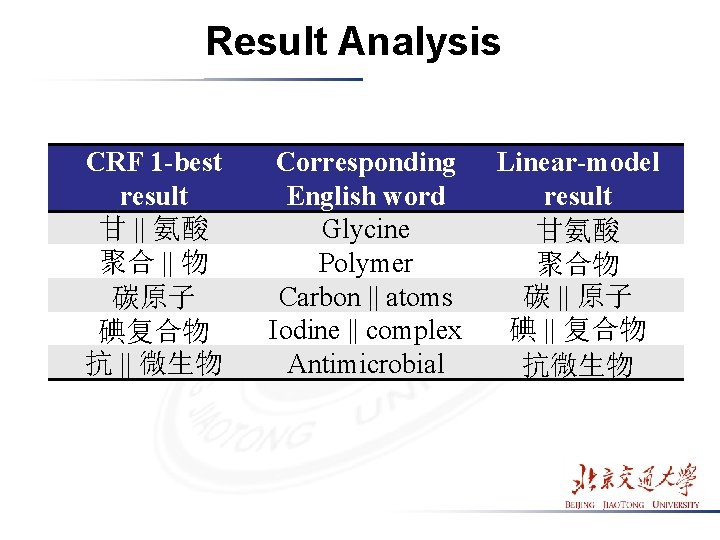
Result Analysis CRF 1 -best result 甘 || 氨酸 聚合 || 物 碳原子 碘复合物 抗 || 微生物 Corresponding English word Glycine Polymer Carbon || atoms Iodine || complex Antimicrobial Linear-model result 甘氨酸 聚合物 碳 || 原子 碘 || 复合物 抗微生物
Conclusion We propose a linear model to combine multiple segmentation results from two segmenters to augment domain-adaptation. • one based on n-gram statistical feature of large Chinese raw corpus. • the other one based on bilingually motivated features of parallel corpus. The experimental results show that both F-measure of CWS result and the BLEU score of SMT are improved.
Thanks! Q&A