
Introduction to translation prepared by Dr Adel Abdulkhaliq
Introduction to translation prepared by Dr Adel Abdulkhaliq 1 Dr. Adel Abdulkhaliq ﻡ 10: 52
Introduction • The Latin "translation" derives from "translatum, " of "transferre" ("to transfer" — from "trans, " "across" + "ferre, " "to carry" or "to bring") • Additionally, the Greek term for "translation, " "METAPHRASIS" ("a speaking across"), has supplied English with "metaphrase" — a "literal translation, " or "word-for-word" translation — as contrasted with "paraphrase" ("a saying in other words, " from the Greek "PARAPHRASIS") 2 Dr. Adel Abdulkhaliq ﻡ 10: 53
What is translation? • Translation is the replacement of textual material in one language (SL) by equivalent textual material in another language (TL). (Catford, 1965) • Translation is rendering the meaning of a text into another language in the way that the author intended the text. (Newmark, 1988: 5) 3 Dr. Adel Abdulkhaliq ﻡ 10: 53
What is translation? • Translation generally refers to all processes methods used to render and/or transfer meaning of the source language text into target language as closely, completely accurately as possible using: • and the and 1. word/phrases which already have a direct equivalent in Arabic language. 4 Dr. Adel Abdulkhaliq ﻡ 10: 53
What is translation? • 2. New words or terms for which no ready- made equivalent s are available • 3. foreign words or terms written in Arabic letteres as pronounced in their native origin • 4. foreign words or terms made to fit Arabic pronunciation spelling and grammar 5 Dr. Adel Abdulkhaliq ﻡ 10: 53
What is translation? • Translation consists of changing from one form – of language in this regard - to another. Talking about form, reference is made to the actual words, phrases, sentences, clauses, paragraphs etc which are spoken or written. They (i. e. the forms) are the surface structure of a language. 6 Dr. Adel Abdulkhaliq ﻡ 10: 53
What is translation? • Technically, the form from which the translation is made will be called the source language and the form into which it is to be changed will be called the receptor language/ target language. 7 Dr. Adel Abdulkhaliq ﻡ 10: 53
What is translation? • Translation, then, consists of studying the lexis, grammatical structure, communication situation, and cultural context of the source language text; all these are analyzed in order to determine its meaning. This same meaning is then reconstructed using the lexicon and grammatical structure which are appropriate in the receptor language and its cultural context. 8 Dr. Adel Abdulkhaliq ﻡ 10: 53
What is translation? • For example, if we use Arabic as a source language and English as the receptor, Ana Muslim becomes the text whose lexicon, grammatical structure, communication situation and cultural context are analyzed in order to 9 determine Dr. Adel Abdulkhaliq its meaning. ﻡ 10: 53
What is translation? • The meaning is then reconstructed using the lexicon and grammatical structure which are appropriate in the receptor language. To that extent, Ana Muslimis restructured thus: ‘I am a Muslim’. 10 Dr. Adel Abdulkhaliq ﻡ 10: 53
What is translation? • Ray (1973) defines translation as the rendering of a source language text into a target language with a view to preserving as much as possible the message and style of the source language. You will observe that receptor language has been given another name by Ray which is target language. 11 Dr. Adel Abdulkhaliq ﻡ 10: 53
What do we translate? • We translate neither grammar, words, style nor sounds. What do we translate then? • We always translate meaning. • What is meaning? It is a big question that difficult to answer easily, directly, exnhustively and decisively. 12 Dr. Adel Abdulkhaliq ﻡ 10: 53
What do we translate? • However, a general satisfactory and simple answer can b given here. Meaning is a complicated network of language components comprised of grammar, vocabulary, style and phonology. 13 Dr. Adel Abdulkhaliq ﻡ 10: 53
What do we translate? • All source elements must be produced in the target version as far as possible. • Denotative meaning • Contextual meaning 14 Dr. Adel Abdulkhaliq ﻡ 10: 53
What do we translate? • Denotation • A word's denotation is the strict dictionary definition of that word and refers to the actual thing or idea it represents. In other words, a denotation is the actual meaning of the word without reference to the emotional associations it can arouse in a reader. • 15 Dr. Adel Abdulkhaliq ﻡ 10: 53
What do we translate? • Connotation refers to the emotional or psychological associations a word carries with it. The connotation of a word goes beyond its strict meaning to express the feelings, thoughts, and images the word suggests or evokes. 16 Dr. Adel Abdulkhaliq ﻡ 10: 53
What do we translate? • Denotation is the dictionary meaning of a word. Connotation is the emotional overtones or a subtle difference in meaning that the word is understood to have, but which does not necessarily show up in the dictionary. 17 Dr. Adel Abdulkhaliq ﻡ 10: 53
What do we translate? • Another example is the difference in connotation between the words "house" and "home. " They can both mean the same thing, but "home" has a much warmer connotation than house. • 18 Dr. Adel Abdulkhaliq ﻡ 10: 53
What do we translate? • Contextual meaning • Context refers to the parts of something written or spoken that immediately precede and follow a word or passage and clarify its meaning: skilled readers use context to construct meaning from words as they are read • 19 Dr. Adel Abdulkhaliq ﻡ 10: 53
What do we translate? . • Words and sentences that occur before or after a word or sentence and imbue it with a particular meaning. • Circumstances under which a document was created, including its function, purpose, use, time, the creator, and the recipient. • 20 Dr. Adel Abdulkhaliq ﻡ 10: 53
Literal translation method is understood and applied in three different ways. We will highlight two types of literal translation Identical literal translation one to one translation, and Word for word translation textbook in translation 21 Dr. Adel Abdulkhaliq ﻡ 10: 53
Literal translation: • The SL grammatical constructions are converted to their nearest TL equivalents but the lexical items are translated out of context. The denotative meaning of words is taken as if straight from the dictionary BUT the target grammar is respected. • 22 Dr. Adel Abdulkhaliq ﻡ 10: 53
Word For Word translation: • The SL word order is preserved and the words translated by their most common meanings. Cultural words are translated literally. The main use of this method is either to understand the mechanics of the source language or to construe a difficult text as pre-translation process. 23 Dr. Adel Abdulkhaliq ﻡ 10: 53
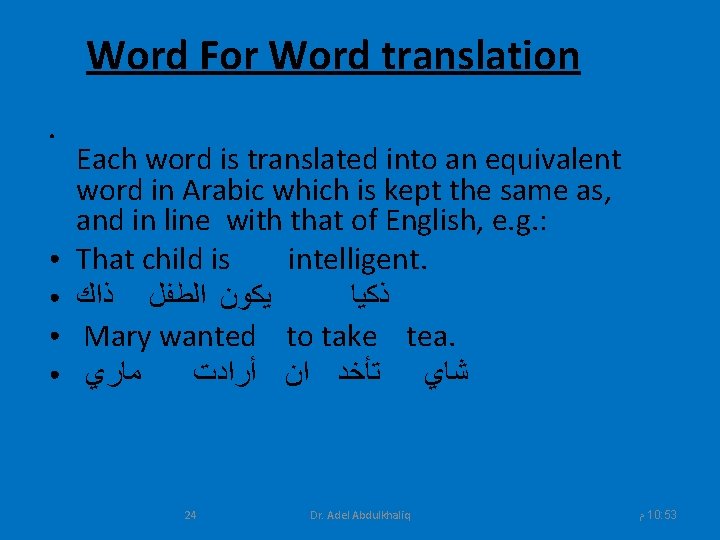
Word For Word translation ● ● ● Each word is translated into an equivalent word in Arabic which is kept the same as, and in line with that of English, e. g. : That child is intelligent. ﺫﺍﻙ ﺍﻟﻄﻔﻞ ﻳﻜﻮﻥ ﺫﻛﻴﺎ Mary wanted to take tea. ﻣﺎﺭﻱ ﺃﺮﺍﺩﺕ ﺍﻥ ﺗﺄﺨﺪ ﺷﺎﻱ 24 Dr. Adel Abdulkhaliq ﻡ 10: 53
Word For Word translation • This method regards translation to be a translation of individual words. All we have to do is find the equivalent word in Arabic for the English word, regardless of differences in grammar, word order, context, or special use. • 25 Dr. Adel Abdulkhaliq ﻡ 10: 53
One to one translation • Identical literal translation or one to one translation IS “a broader form of translation, each SL word has a corresponding TL word”. • It respects collocations meanings in their powerful context. • This method of translation means to translate each SL word or phrase into identical word or phrase in the TL, with the same number, grammatical class, and type of language. 26 Dr. Adel Abdulkhaliq ﻡ 10: 53
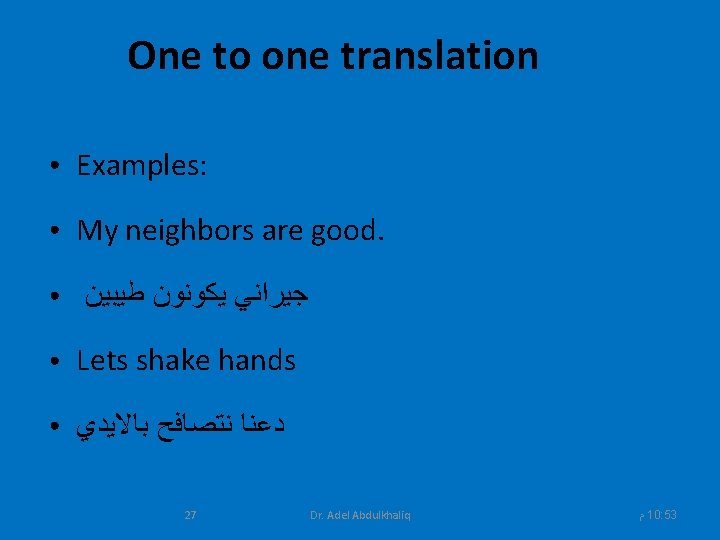
One to one translation ● Examples: ● My neighbors are good. ● ﻃﻴﺒﻴﻦ ﻳﻜﻮﻧﻮﻥ ﺟﻴﺮﺍﻧﻲ ● Lets shake hands ● ﺑﺎﻻﻳﺪﻱ ﻧﺘﺼﺎﻓﺢ ﺩﻋﻨﺎ 27 Dr. Adel Abdulkhaliq ﻡ 10: 53
One to one translation • This method of literal translation is similar to the first one in two respects: • 1. it retains the SL word order in the TL. • 2. It insists in having the same type and number of words. 28 Dr. Adel Abdulkhaliq ﻡ 10: 53
One to one translation • Yet, it is different in two respects too: • 1. it takes context into consideration. • 2. it translate collocations meanings, special and metaphorical SL words and phrases into their TL equivalents, if and when available. • 29 Dr. Adel Abdulkhaliq ﻡ 10: 53
Free translation: • It reproduces the matter without the manner, or the content without the form of the original. Usually it is a paraphrase much longer than the original. 30 Dr. Adel Abdulkhaliq ﻡ 10: 53
Discussion • 31 Dr. Adel Abdulkhaliq ﻡ 10: 53
Accuracy • True reproduction of “exact” meaning from source language form to equivalent receptor language form. • Completeness • The translation must reflect a complete description and meaning of the original language. It may be necessary to omit words and make grammatical changes in order to ensure an accurate, complete translation. 32 Dr. Adel Abdulkhaliq ﻡ 10: 53
Style • Style is the writer’s unique mode of expressing thought. • The translator should integrate and reproduce the style of the source language writer into the receptor language translation. • The translator should suppress his/her own stylistic effects upon the receptor translation. 33 Dr. Adel Abdulkhaliq ﻡ 10: 53
Second Lecture Translation versus Interpretation Prepared by Dr Adel Abdulkhaliq 34 Dr. Adel Abdulkhaliq ﻡ 10: 53
Translation versus Interpretation • People often confuse translation with interpretation. While both services involve adapting from one language to another, there a number of important differences. 35 Dr. Adel Abdulkhaliq ﻡ 10: 53
FIVE KEY DIFFERENCES 1. Spoken versus written: • Interpretation is the transference of meaning between spoken languages, while translation is the transference of meaning between written languages. 36 Dr. Adel Abdulkhaliq ﻡ 10: 53
2. Real time versus delayed: Interpreting occurs in real time. It happens in person, on the phone, or through a television/ video service. Because translation involves the written word, it typically takes place long after a text is created, which gives the translator time to access resources. 37 Dr. Adel Abdulkhaliq ﻡ 10: 53
3. Level of accuracy: • Interpretation and translation demand different levels of accuracy. While interpreters aim to be completely accurate, it’s difficult to achieve in a live conversation. They may omit some details of the original speech as they interpret into the target language. • Conversely, translators have time to evaluate and revise each word and sentence before delivering their product, so they can achieve a greater level of accuracy and greater fidelity to the original. 38 Dr. Adel Abdulkhaliq ﻡ 10: 53
4. Direction and fluency: • An interpreter must be fluent enough in both the original language and the target language to be able to translate in both directions, on the spot, without any reference material. Interpreters are highly qualified people, and the work is quite demanding! It’s so demanding that interpreters work in pairs and must switch off every 20 minutes or so to prevent mental fatigue. 39 Dr. Adel Abdulkhaliq ﻡ 10: 53
5 Intangibles • Both translators and interpreters are faced with the challenge of making metaphors, analogies, and idioms understandable to the audience in the target language. However, interpreters must also capture tone, inflection, voice quality, and the other intangible elements of the spoken word and convey those meaningfully to the audience 40 Dr. Adel Abdulkhaliq ﻡ 10: 53
• Despite the differences in the skills of translators and interpreters, both are bilingual professionals who share a passion for conveying meaning to people who would otherwise be unable to understand the information at hand. 41 Dr. Adel Abdulkhaliq ﻡ 10: 53
WHAT YOU SHOULD KNOW 1. Translators and interpreters are not interchangeable. 2. The skills and tasks required are different for the two jobs. 3. Interpretation is used at live, in-person events, such as in courtrooms, police stations, hospitals, and government forums. 42 Dr. Adel Abdulkhaliq ﻡ 10: 53
TYPES OF INTERPRETATION • 1. Simultaneous interpretation • The interpreter sits in a booth, , listens to the spoken content through headphones, and speaks the translated words into a microphone. As soon as the interpreter understands the general meaning of the sentence, he or she begins the interpretation. 43 Dr. Adel Abdulkhaliq ﻡ 10: 53
TYPES OF INTERPRETATION • 2. Consecutive interpretation: • The speaker stops frequently, typically every one to five minutes, to allow the interpreter to render what was said into the target language. The speaker’s pauses come at the end of a paragraph or topic. While waiting, the interpreter sits or stands beside the speaker, listening and taking notes as the speaker progresses through the message 44 Dr. Adel Abdulkhaliq ﻡ 10: 53
TYPES OF INTERPRETATION 3. Sight Translation • when an interpreter is given a written document in one language and asked to read it aloud in another language, the interpreter is being asked to do sight translation. Because this is a combination of text and speech, it has elements of both translating and interpreting. 45 Dr. Adel Abdulkhaliq ﻡ 10: 53
Sight translation: • Sight translation: Sight translation is the oral rendition of text written in one language into another language and is usually done in the moment. Central to sight translation are the following skills: the ability to comprehend written text in one language (reading skills) and the ability to produce an oral or rendition in another language (speaking). 46 Dr. Adel Abdulkhaliq ﻡ 10: 53
Prerequisites and Qualification of Translators • Competence in both SL & TL • fluent in at least two languages (one of which is always their native tongue). But the word fluent isn’t quite strong enough – you must really, really know your languages. You can’t rely on native comfort – you have to treat your native tongue almost as rigorously as your second language and know all the ins and outs and nuts and bolts of it. 47 Dr. Adel Abdulkhaliq ﻡ 10: 53
Subject Matter • Understanding the content and intention of the text’s author. • you must have a good working knowledge of whatever field you’re going to be concentrating in. - See more at: 48 Dr. Adel Abdulkhaliq ﻡ 10: 53
• Abroad understanding of both SL & TL the cultures • Reasonable background of all major subjects • Good reading and writing skills • Training • Being updated about the latest terminologies • Ability to access online resources 49 Dr. Adel Abdulkhaliq ﻡ 10: 53
Characteristics of a good translation • • • A. faithfulness to SL meaning Accurate rendition of the SL Understandability in TL Clarity Being natural like the SL text as far as possible 50 Dr. Adel Abdulkhaliq ﻡ 10: 53
Characteristics of a good translation • Producing the same effect of the SL • The TL must be an exact representative or alternative of the SL text • Maintaining the same aesthetic and artistic features of the SL 51 Dr. Adel Abdulkhaliq ﻡ 10: 53
Freedom and Limitation of Translators • Translators are not as free as the SL text writer • Translator may be free to manipulate and disregard the SL for and rewrite the SL meaning in accordance with the TL form. • Freedom of translators depends on the purpose of translation. However, if the purpose of translation is religious and legal text , so the translators in this case are restricted to respect the literal meaning and the form of the SL. 52 Dr. Adel Abdulkhaliq ﻡ 10: 53
Ethics of Translation • It stands to reason that translators should be responsible for and faithful to source texts. Sometimes they face badly written texts containing grammatical mistakes such as wrong choice words, misspelled words and the like. Similarly, some other poor texts are crammed with swearwords, misstated facts or misleading overgeneralizations. 53 Dr. Adel Abdulkhaliq ﻡ 10: 53
• In such situations, the translator should interfere to improve these texts by setting right what is wrong because it is his/her ethical and professional duty to convey correct information. However, as translators must be faithful and impartial, they are not permitted, under any circumstances, to alter the content of source texts. 54 Dr. Adel Abdulkhaliq ﻡ 10: 53
• Professional translators should be expert linguists who know quite well the correct grammar of both the source language and the target language. Consequently, when they spot any grammatical mistakes in the source written text which they are about to translate, it becomes their ethical and professional duty to correct these mistakes. If they do not do that, they not only distort the meaning of the source text, but they also jeopardize their career in the long run. 55 Dr. Adel Abdulkhaliq ﻡ 10: 53
• Just as there are specific situations where the translator has to amend a badly written text, there also limits to the translator's intervention as he/she must be faithful and impartial to the original text. In this respect, translators should not aspire to improve the content of any text, omit or add anything when especially they do legal translation. 56 Dr. Adel Abdulkhaliq ﻡ 10: 53
• To conclude, it can be said that translators should correct grammatical mistakes, wrong word choices and other linguistic defects in a badly written source text. They should also polish the translation of texts which include swearwords and take note of any omission of dates or distortion of facts because it is their moral and professional duty to translate correct information. Yet, translators should not change the content of source texts no matter how they feel about it. 57 Dr. Adel Abdulkhaliq ﻡ 10: 53
Translation between Profession and Practice • • • Translation is an art which requires: Skills and knowledge Mastering two languages Training Knowing about theories and strategies of translation 58 Dr. Adel Abdulkhaliq ﻡ 10: 53
Third Lecture Major Translation Approaches 59 Dr. Adel Abdulkhaliq ﻡ 10: 53
OBJECTIVS OF THE LECTURE • • What ‘translation approach’ refers to Major translation approaches : Literal translation, Formal translation, Semantic translation, Communicative translation, Dynamic or functional translation 60 Dr. Adel Abdulkhaliq ﻡ 10: 53
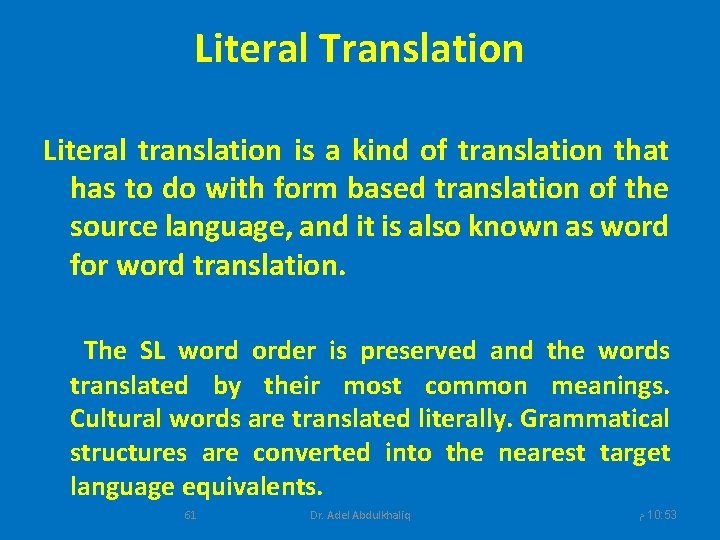
Literal Translation Literal translation is a kind of translation that has to do with form based translation of the source language, and it is also known as word for word translation. The SL word order is preserved and the words translated by their most common meanings. Cultural words are translated literally. Grammatical structures are converted into the nearest target language equivalents. 61 Dr. Adel Abdulkhaliq ﻡ 10: 53
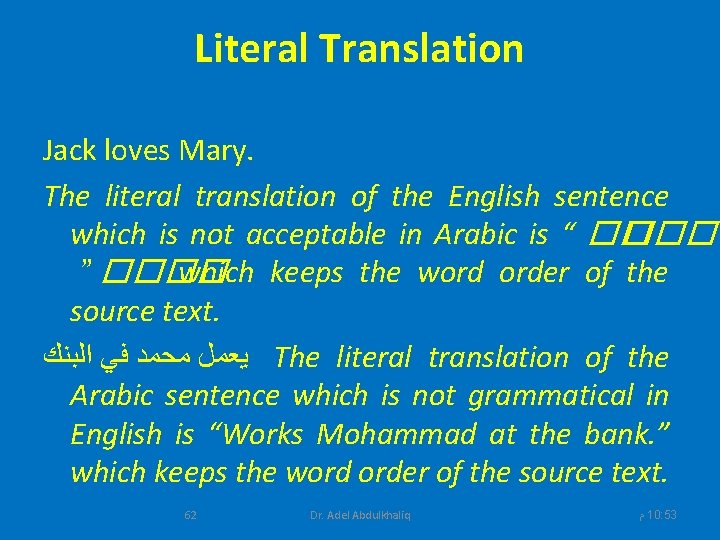
Literal Translation Jack loves Mary. The literal translation of the English sentence which is not acceptable in Arabic is “ �� ��� ” ���� which keeps the word order of the source text. ﺍﻟﺒﻨﻚ ﻓﻲ ﻣﺤﻤﺪ ﻳﻌﻤﻞ The literal translation of the Arabic sentence which is not grammatical in English is “Works Mohammad at the bank. ” which keeps the word order of the source text. 62 Dr. Adel Abdulkhaliq ﻡ 10: 53
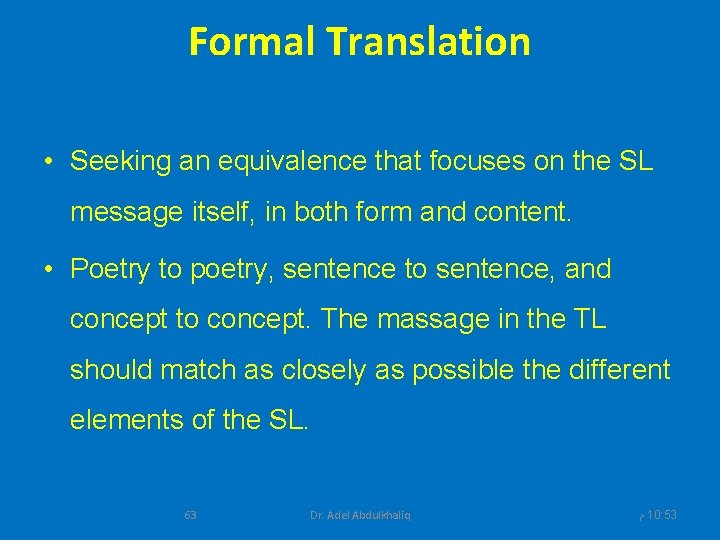
Formal Translation • Seeking an equivalence that focuses on the SL message itself, in both form and content. • Poetry to poetry, sentence to sentence, and concept to concept. The massage in the TL should match as closely as possible the different elements of the SL. 63 Dr. Adel Abdulkhaliq ﻡ 10: 53
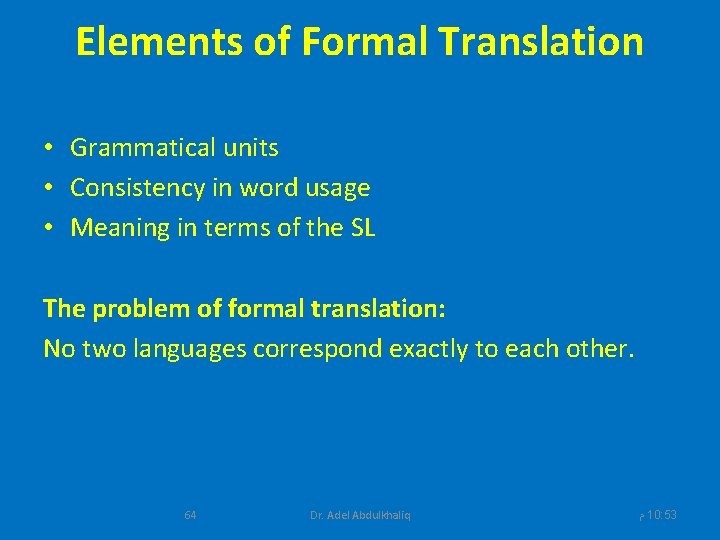
Elements of Formal Translation • Grammatical units • Consistency in word usage • Meaning in terms of the SL The problem of formal translation: No two languages correspond exactly to each other. 64 Dr. Adel Abdulkhaliq ﻡ 10: 53
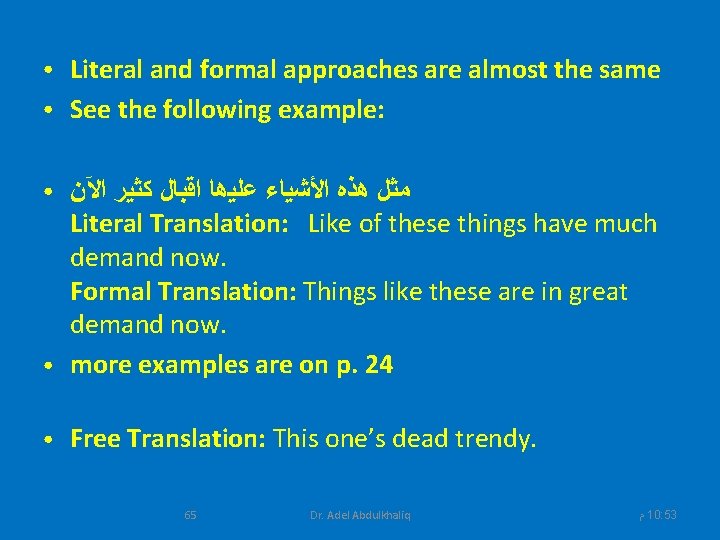
● ● Literal and formal approaches are almost the same See the following example: ● ﻣﺜﻞ ھﺬﻩ ﺍﻷﺸﻴﺎﺀ ﻋﻠﻴھﺎ ﺍﻗﺒﺎﻝ ﻛﺜﻴﺮ ﺍﻵﻦ Literal Translation: Like of these things have much demand now. Formal Translation: Things like these are in great demand now. more examples are on p. 24 ● Free Translation: This one’s dead trendy. ● 65 Dr. Adel Abdulkhaliq ﻡ 10: 53
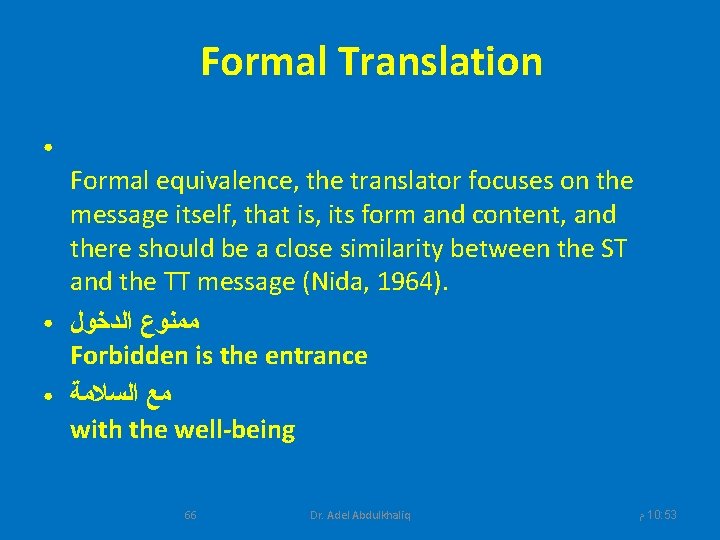
Formal Translation ● ● ● Formal equivalence, the translator focuses on the message itself, that is, its form and content, and there should be a close similarity between the ST and the TT message (Nida, 1964). ﻣﻤﻨﻮﻉ ﺍﻟﺪﺧﻮﻝ Forbidden is the entrance ﻣﻊ ﺍﻟﺴﻼﻣﺔ with the well-being 66 Dr. Adel Abdulkhaliq ﻡ 10: 53
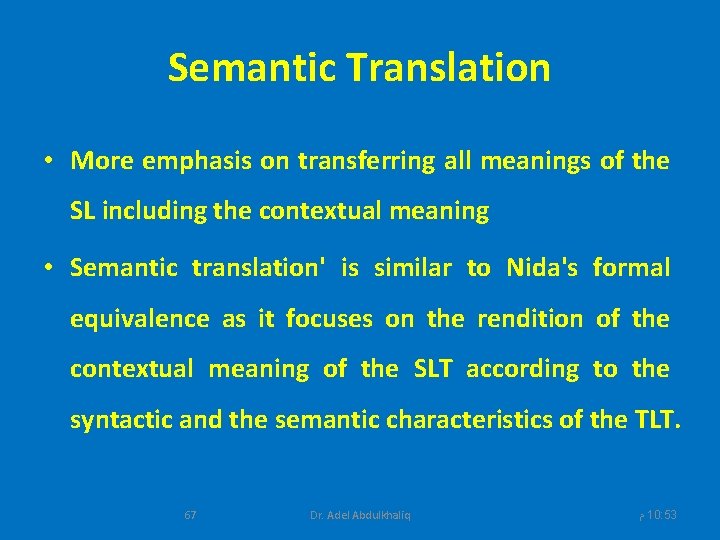
Semantic Translation • More emphasis on transferring all meanings of the SL including the contextual meaning • Semantic translation' is similar to Nida's formal equivalence as it focuses on the rendition of the contextual meaning of the SLT according to the syntactic and the semantic characteristics of the TLT. 67 Dr. Adel Abdulkhaliq ﻡ 10: 53
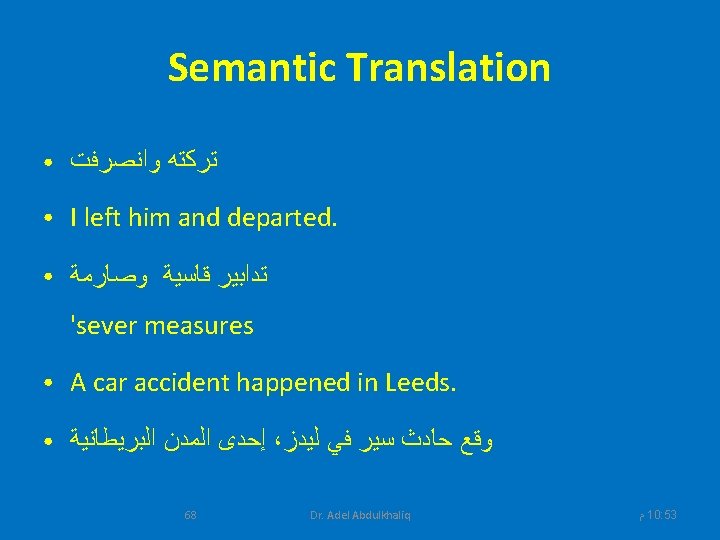
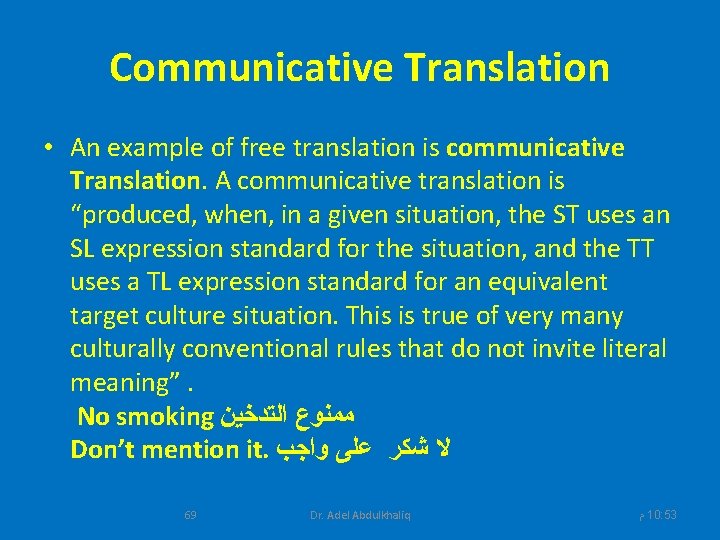
Communicative Translation • An example of free translation is communicative Translation. A communicative translation is “produced, when, in a given situation, the ST uses an SL expression standard for the situation, and the TT uses a TL expression standard for an equivalent target culture situation. This is true of very many culturally conventional rules that do not invite literal meaning”. No smoking ﻣﻤﻨﻮﻉ ﺍﻟﺘﺪﺧﻴﻦ Don’t mention it. ﻻ ﺷﻜﺮ ﻋﻠﻰ ﻭﺍﺟﺐ 69 Dr. Adel Abdulkhaliq ﻡ 10: 53
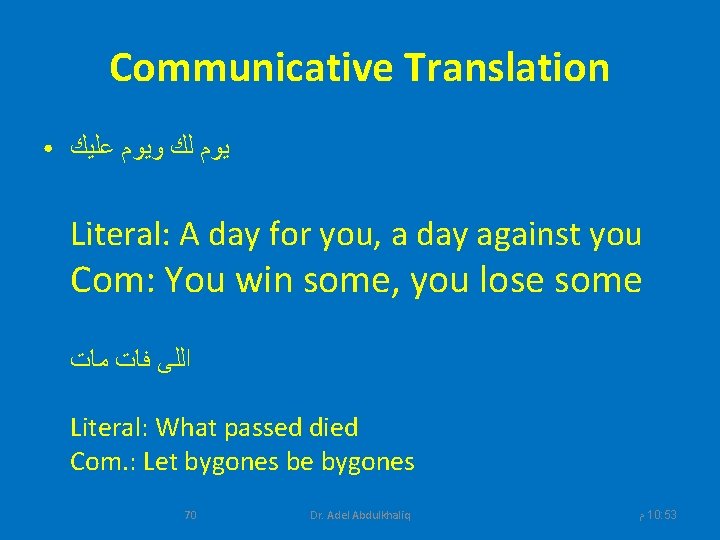
Communicative Translation ● ﻋﻠﻴﻚ ﻭﻳﻮﻡ ﻟﻚ ﻳﻮﻡ Literal: A day for you, a day against you Com: You win some, you lose some ﻣﺎﺕ ﻓﺎﺕ ﺍﻟﻠﻰ Literal: What passed died Com. : Let bygones be bygones 70 Dr. Adel Abdulkhaliq ﻡ 10: 53
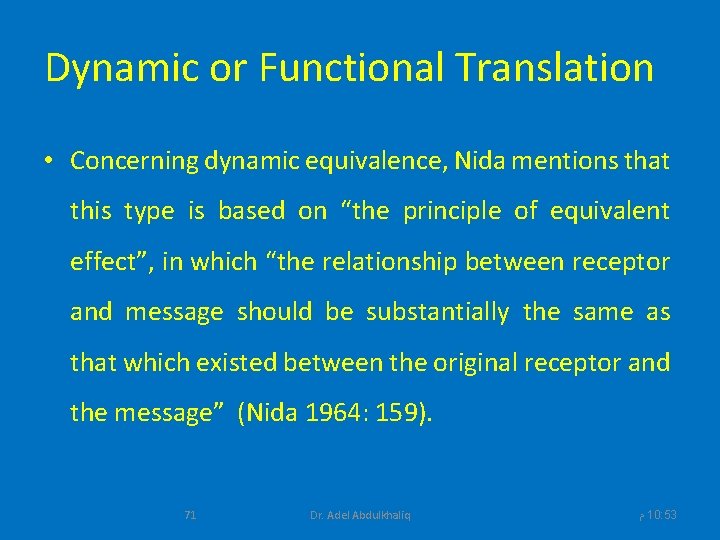
Dynamic or Functional Translation • Concerning dynamic equivalence, Nida mentions that this type is based on “the principle of equivalent effect”, in which “the relationship between receptor and message should be substantially the same as that which existed between the original receptor and the message” (Nida 1964: 159). 71 Dr. Adel Abdulkhaliq ﻡ 10: 53
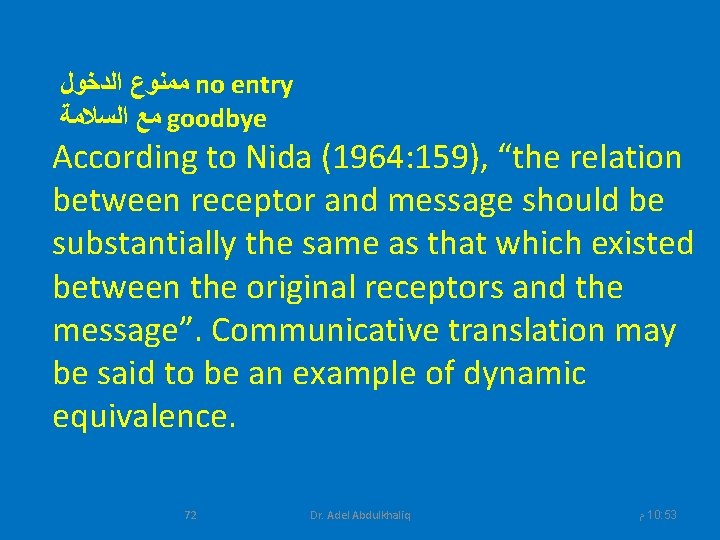
ﻣﻤﻨﻮﻉ ﺍﻟﺪﺧﻮﻝ no entry ﻣﻊ ﺍﻟﺴﻼﻣﺔ goodbye According to Nida (1964: 159), “the relation between receptor and message should be substantially the same as that which existed between the original receptors and the message”. Communicative translation may be said to be an example of dynamic equivalence. 72 Dr. Adel Abdulkhaliq ﻡ 10: 53
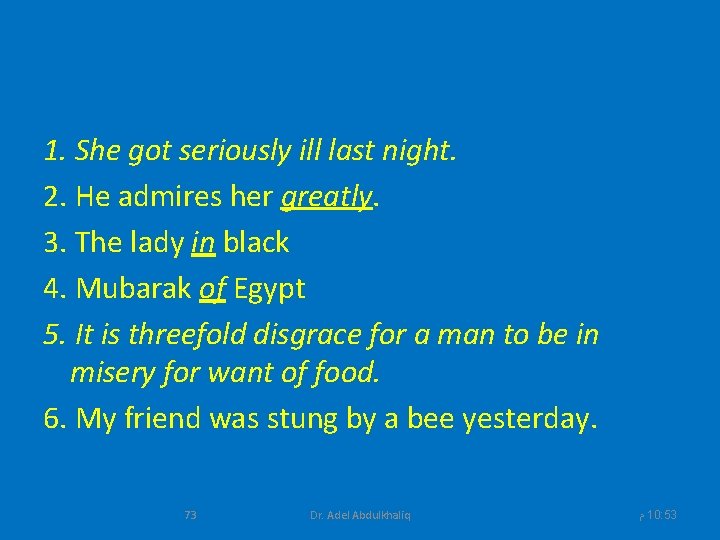
1. She got seriously ill last night. 2. He admires her greatly. 3. The lady in black 4. Mubarak of Egypt 5. It is threefold disgrace for a man to be in misery for want of food. 6. My friend was stung by a bee yesterday. 73 Dr. Adel Abdulkhaliq ﻡ 10: 53
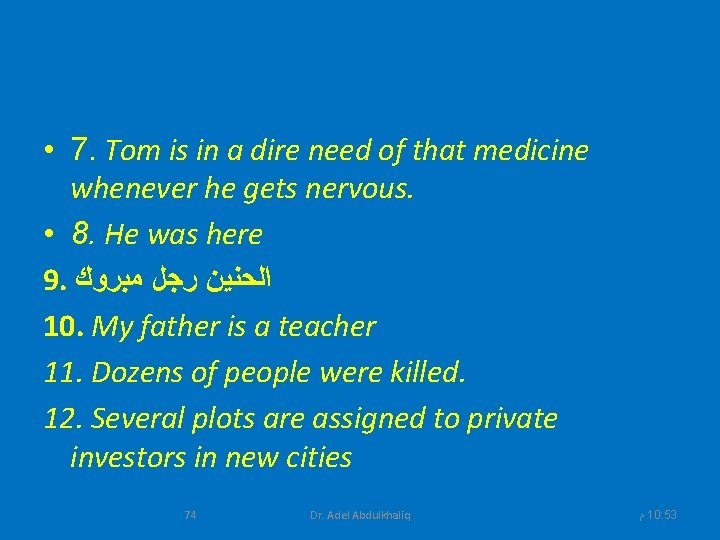
• 7. Tom is in a dire need of that medicine whenever he gets nervous. • 8. He was here 9. ﺍﻟﺤﻨﻴﻦ ﺭﺟﻞ ﻣﺒﺮﻭﻙ 10. My father is a teacher 11. Dozens of people were killed. 12. Several plots are assigned to private investors in new cities 74 Dr. Adel Abdulkhaliq ﻡ 10: 53
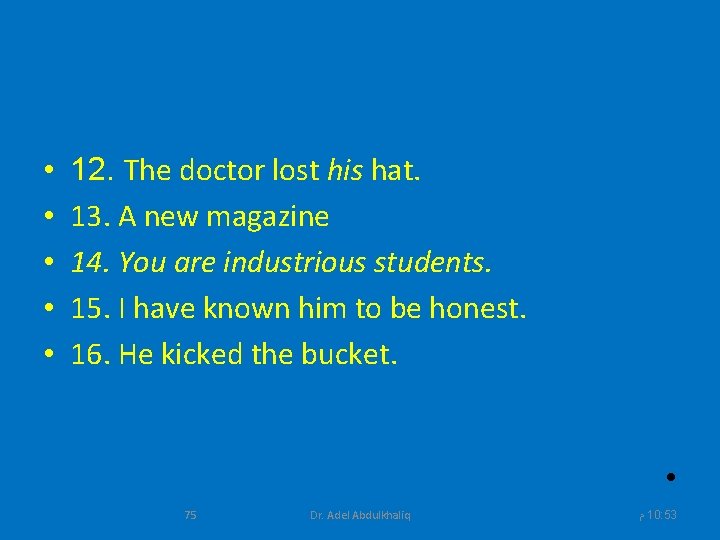
• • • 12. The doctor lost his hat. 13. A new magazine 14. You are industrious students. 15. I have known him to be honest. 16. He kicked the bucket. • 75 Dr. Adel Abdulkhaliq ﻡ 10: 53
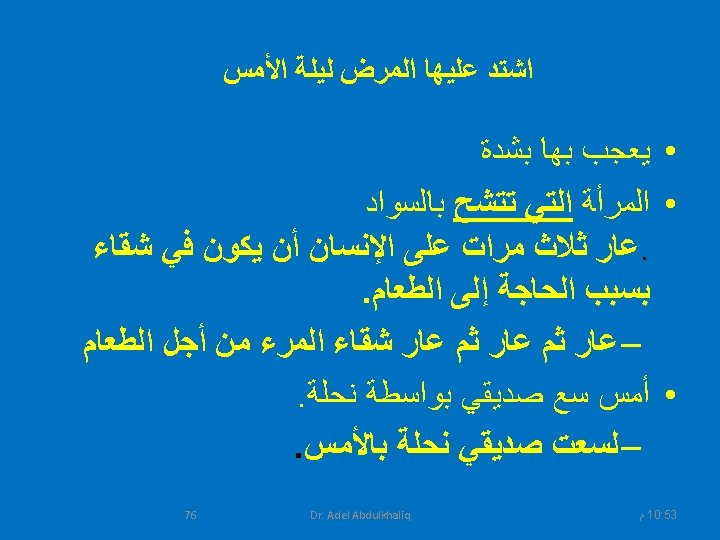


Chapter Four METHODS AND TECHNIQUES OF TRANSLATION 79 Dr. Adel Abdulkhaliq ﻡ 10: 53
The purpose of translation is to reproduce various kinds of texts —including religious, literary, scientific, and philosophical texts —in another language and thus making them available to wider readers. 80 Dr. Adel Abdulkhaliq ﻡ 10: 53
There are certain methods translators followed when translating any text. Due to the differences bet the SL & TL, the translators compel to use different techniques and methods in order to minimize any meaning loss. Here are some of the major translation methods. 81 Dr. Adel Abdulkhaliq ﻡ 10: 53
Rephrasing and paraphrasing In this common method of translation, translators make the necessary restructuring and rearrangement of the SL word order in TL translated version. Rephrasing is conducted due to the grammatical differences between SL & TL. THE PURPOSE of this method is to suit the TL grammar rule and produce an accepted TL text. 82 Dr. Adel Abdulkhaliq ﻡ 10: 53
2. INSERTION and DELETION are two translation techniques used by translators due to the lack of precise and accurate equivalence between SL and TL. 83 Dr. Adel Abdulkhaliq ﻡ 10: 53
Insertion is used to compensate for any loss of meaning or minumize the meaning loss. Deletion is used to avoid any misunderstanding, miscommunication, any unnecessary or unacceptable forms meaning in the TL 84 Dr. Adel Abdulkhaliq ﻡ 10: 53
3. Arabization One of the main aims of Arabization was to adopt and adapt western sciences through the coining of new Arabic terminologies. 85 Dr. Adel Abdulkhaliq ﻡ 10: 53
To Arabize a foreign term is to convey it in Arabic. Then such a term is regarded as original Arabic. Two major methods of Arabization a. Transliteration refers to the process of borrowing foreign words and introducing their pronunciation and spelling into another language. It is completely borrowing of meaning, spelling and pronunciation of a foreign word without any change. Translitrated words remain foreign do not obey or regard the TL system. 86 Dr. Adel Abdulkhaliq ﻡ 10: 53
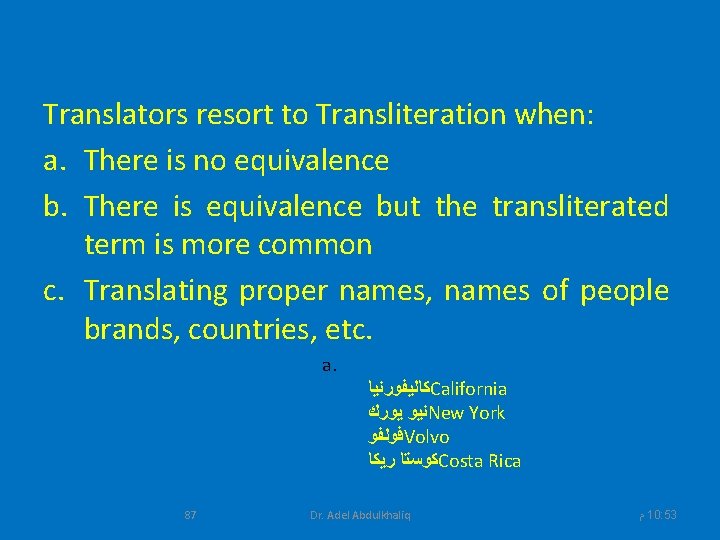
Translators resort to Transliteration when: a. There is no equivalence b. There is equivalence but the transliterated term is more common c. Translating proper names, names of people brands, countries, etc. a. ﻛﺎﻟﻴﻔﻮﺭﻧﻴﺎ California ﻧﻴﻮ ﻳﻮﺭﻙ New York ﻓﻮﻟﻔﻮ Volvo ﻛﻮﺳﺘﺎ ﺭﻳﻜﺎ Costa Rica 87 Dr. Adel Abdulkhaliq ﻡ 10: 53
b. Naturalization it formally to a process of naturalization: phonologically, morphologically and syntactically. Semantically, however, the Arabic meaning of an Arabized term is based on what it is meant to be in the foreign context in which it originally occurs. The borrowed words are subjected to partial change in their pronunciation so that they can be acceptable as familiar, normal and domestic words. 88 Dr. Adel Abdulkhaliq ﻡ 10: 53
4. Cultural substitution and approximation this method is necessary when there is ZERO equivalence bet the SL & TL due to different cultural backgrounds. It is defined as a translation strategy whereby a culture-specific expression in the SL is translated into a cultural substitute in the TL. 89 Dr. Adel Abdulkhaliq ﻡ 10: 53
5. Compensation of Meaning Loss The purpose of any translation is to produce a TL version that wholly matches the original text in meaning, format and style. However, languages differ and the cultures they represent differ too, and it is likely to experience some sort of meaning loss during the translating process. 90 Dr. Adel Abdulkhaliq ﻡ 10: 53
Therefore it is the translators’ responsibility to compensate for any loss in meaning. Translators may use certain compensatory methods such as parenthetical notes, symbols , brief explanation, appendices, and footnotes. Due to the lack of precise word for word equivalence, there is a need to explain the SL intended meaning by giving some details bet brackets to compensate for any possible meaning. 91 Dr. Adel Abdulkhaliq ﻡ 10: 53

92 Dr. Adel Abdulkhaliq ﻡ 10: 53

93 Dr. Adel Abdulkhaliq ﻡ 10: 53
- Slides: 93