ChapterIII Duality in LPP Dr T VENKATESAN Assistant

- Slides: 29
Chapter-III Duality in LPP Dr. T. VENKATESAN Assistant Professor Department of Statistics St. Joseph’s College, Trichy-2.
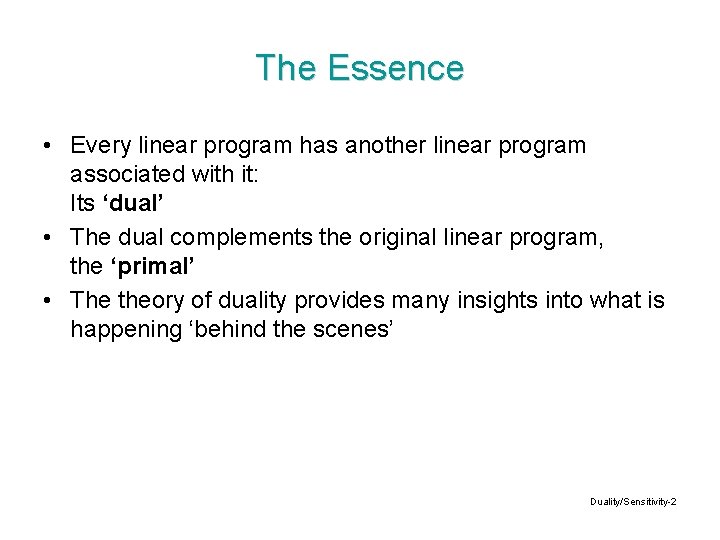
The Essence • Every linear program has another linear program associated with it: Its ‘dual’ • The dual complements the original linear program, the ‘primal’ • The theory of duality provides many insights into what is happening ‘behind the scenes’ Duality/Sensitivity-2
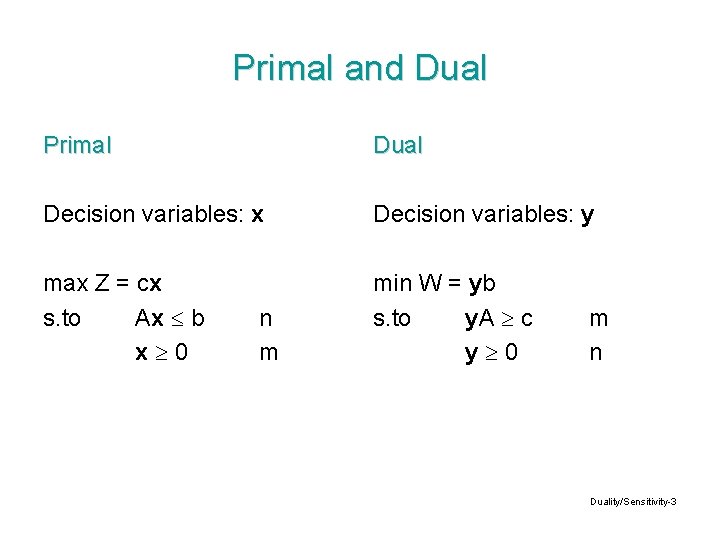
Primal and Dual Primal Dual Decision variables: x Decision variables: y max Z = cx s. to Ax b x 0 min W = yb s. to y. A c y 0 n m m n Duality/Sensitivity-3
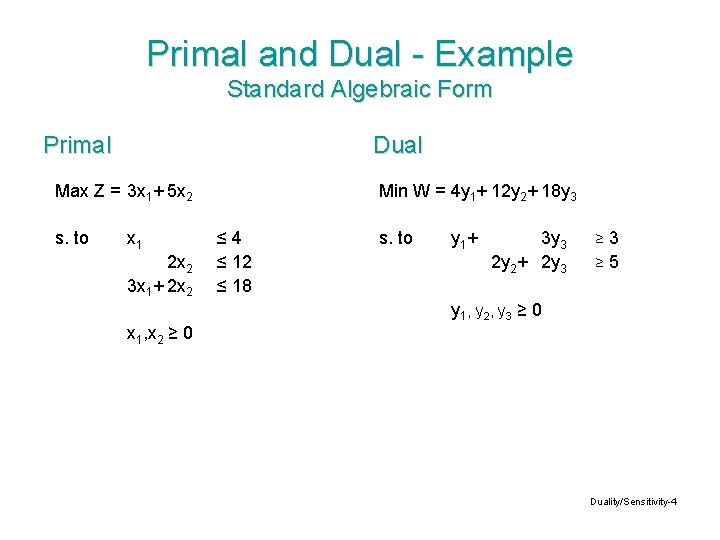
Primal and Dual - Example Standard Algebraic Form Primal Dual Max Z = 3 x 1+ 5 x 2 s. to x 1 2 x 2 3 x 1+ 2 x 2 Min W = 4 y 1+ 12 y 2+ 18 y 3 ≤ 4 ≤ 12 ≤ 18 s. to y 1+ 3 y 3 2 y 2+ 2 y 3 ≥ 5 y 1, y 2, y 3 ≥ 0 x 1, x 2 ≥ 0 Duality/Sensitivity-4
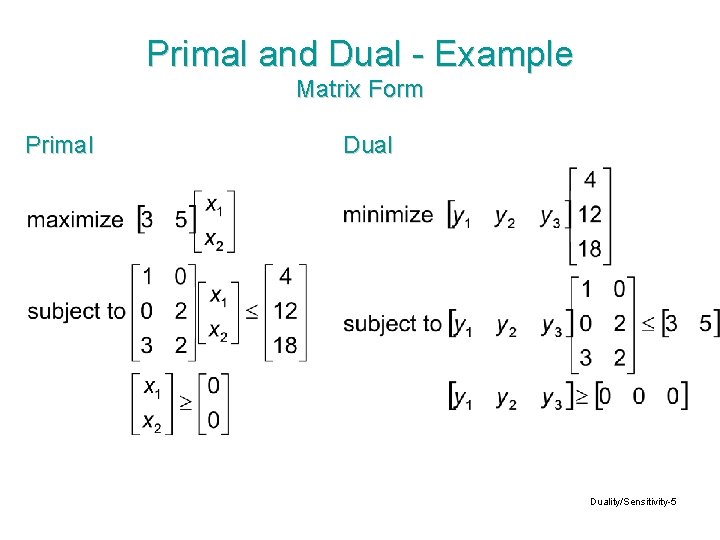
Primal and Dual - Example Matrix Form Primal Duality/Sensitivity-5
Symmetry Property • For any primal problem and its dual problem, all relationships between them must be symmetric because… Duality/Sensitivity-6
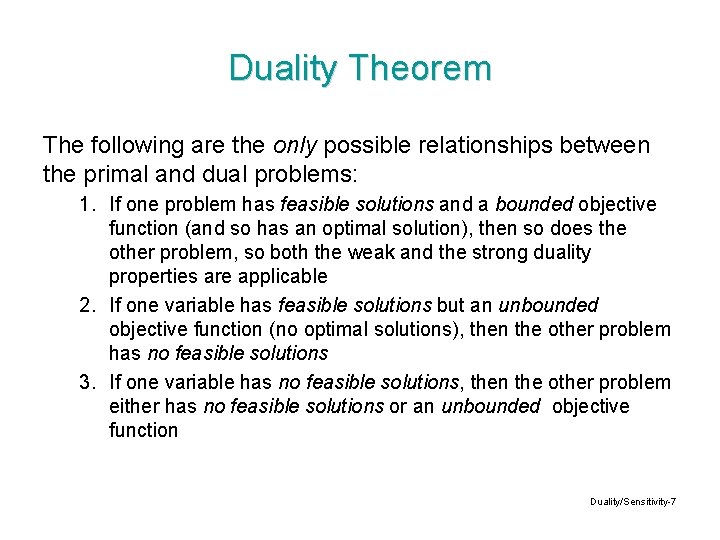
Duality Theorem The following are the only possible relationships between the primal and dual problems: 1. If one problem has feasible solutions and a bounded objective function (and so has an optimal solution), then so does the other problem, so both the weak and the strong duality properties are applicable 2. If one variable has feasible solutions but an unbounded objective function (no optimal solutions), then the other problem has no feasible solutions 3. If one variable has no feasible solutions, then the other problem either has no feasible solutions or an unbounded objective function Duality/Sensitivity-7
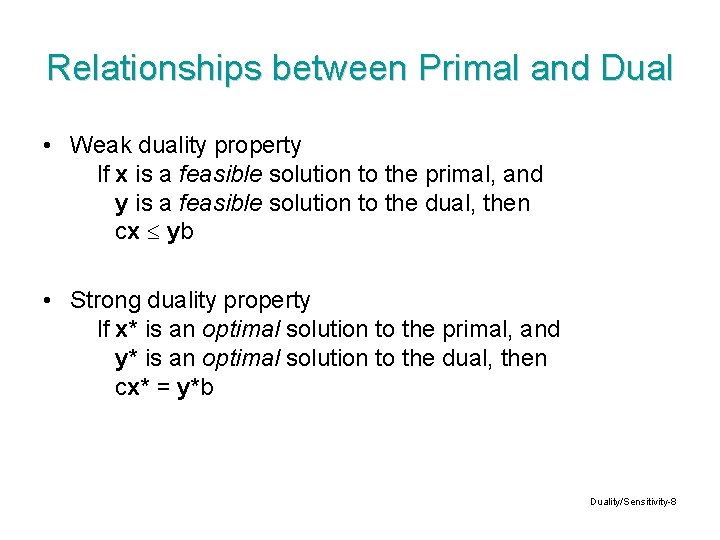
Relationships between Primal and Dual • Weak duality property If x is a feasible solution to the primal, and y is a feasible solution to the dual, then cx yb • Strong duality property If x* is an optimal solution to the primal, and y* is an optimal solution to the dual, then cx* = y*b Duality/Sensitivity-8
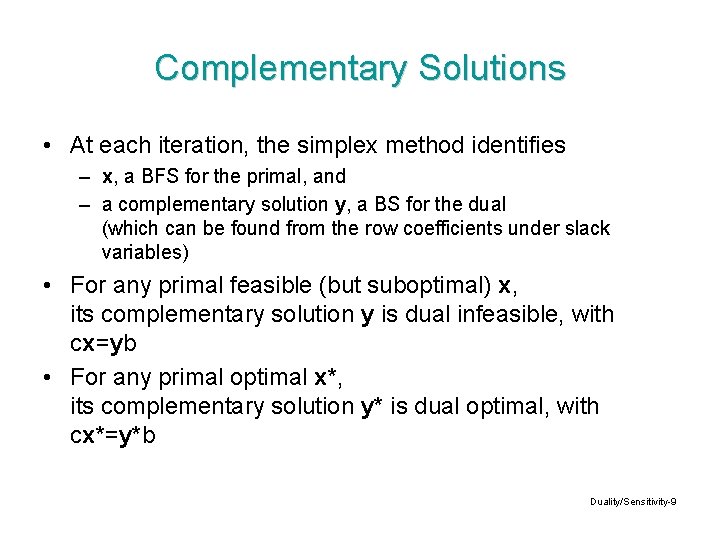
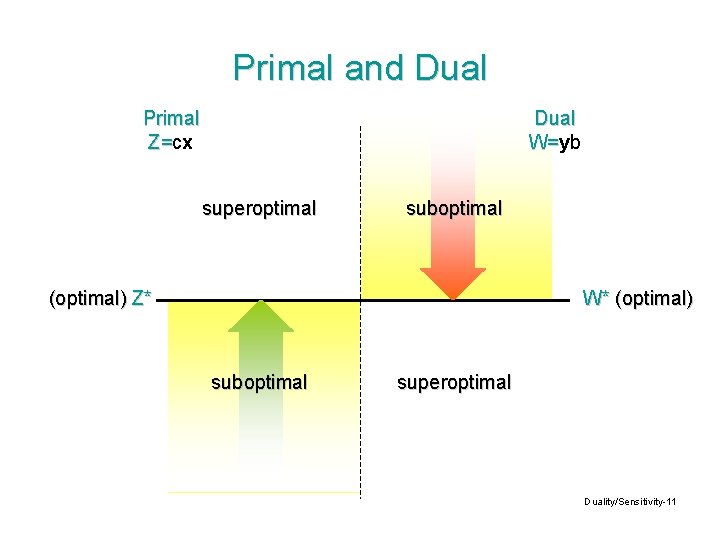
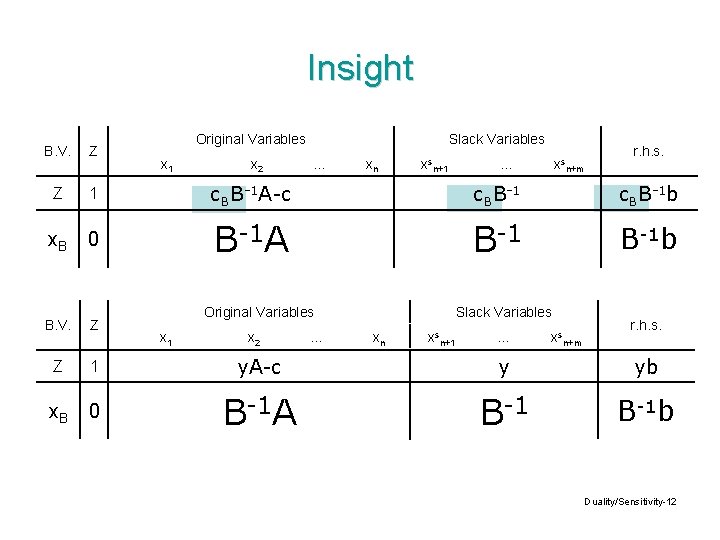
Complementary Solutions • At each iteration, the simplex method identifies – x, a BFS for the primal, and – a complementary solution y, a BS for the dual (which can be found from the row coefficients under slack variables) • For any primal feasible (but suboptimal) x, its complementary solution y is dual infeasible, with cx=yb • For any primal optimal x*, its complementary solution y* is dual optimal, with cx*=y*b Duality/Sensitivity-9
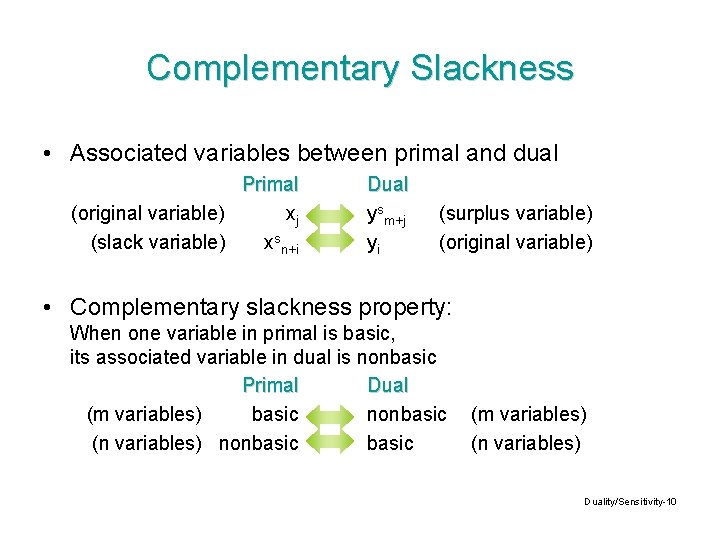
Complementary Slackness • Associated variables between primal and dual Primal (original variable) xj (slack variable) xsn+i Dual ysm+j yi (surplus variable) (original variable) • Complementary slackness property: When one variable in primal is basic, its associated variable in dual is nonbasic Primal Dual (m variables) basic nonbasic (n variables) nonbasic (m variables) (n variables) Duality/Sensitivity-10
Primal and Dual Primal Z=cx Z= Dual W=yb W= superoptimal suboptimal (optimal) Z* W* (optimal) suboptimal superoptimal Duality/Sensitivity-11
Insight Original Variables Slack Variables B. V. Z Z 1 c. BB-1 A-c c. BB-1 b x. B 0 B-1 A B-1 b B. V. Z Z 1 y. A-c y yb x. B 0 B-1 A B-1 b x 1 x 2 … xn xsn+1 Original Variables x 1 x 2 … … xsn+m Slack Variables xn xsn+1 … xsn+m r. h. s. Duality/Sensitivity-12
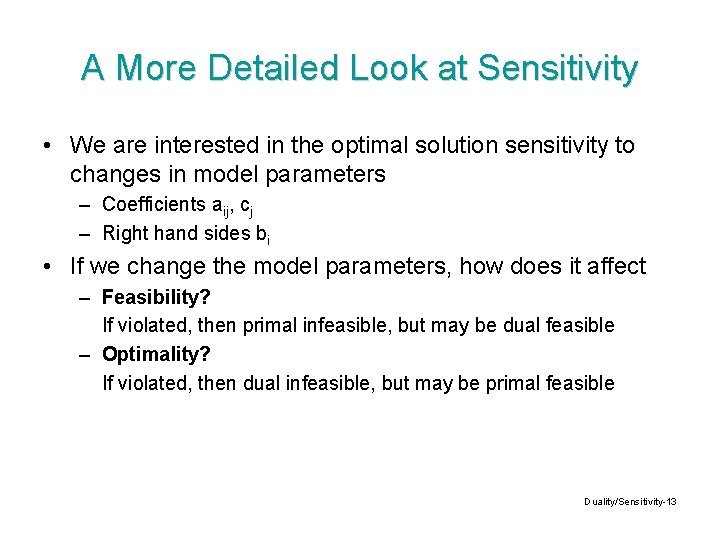
A More Detailed Look at Sensitivity • We are interested in the optimal solution sensitivity to changes in model parameters – Coefficients aij, cj – Right hand sides bi • If we change the model parameters, how does it affect – Feasibility? If violated, then primal infeasible, but may be dual feasible – Optimality? If violated, then dual infeasible, but may be primal feasible Duality/Sensitivity-13
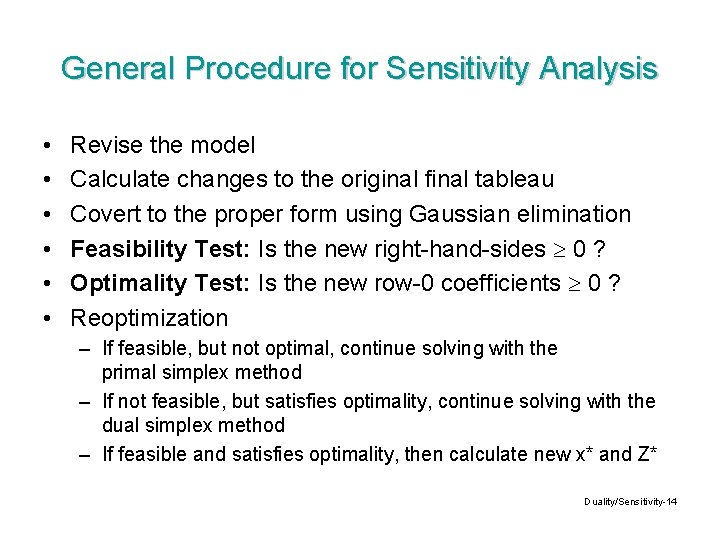
General Procedure for Sensitivity Analysis • • • Revise the model Calculate changes to the original final tableau Covert to the proper form using Gaussian elimination Feasibility Test: Is the new right-hand-sides 0 ? Optimality Test: Is the new row-0 coefficients 0 ? Reoptimization – If feasible, but not optimal, continue solving with the primal simplex method – If not feasible, but satisfies optimality, continue solving with the dual simplex method – If feasible and satisfies optimality, then calculate new x* and Z* Duality/Sensitivity-14
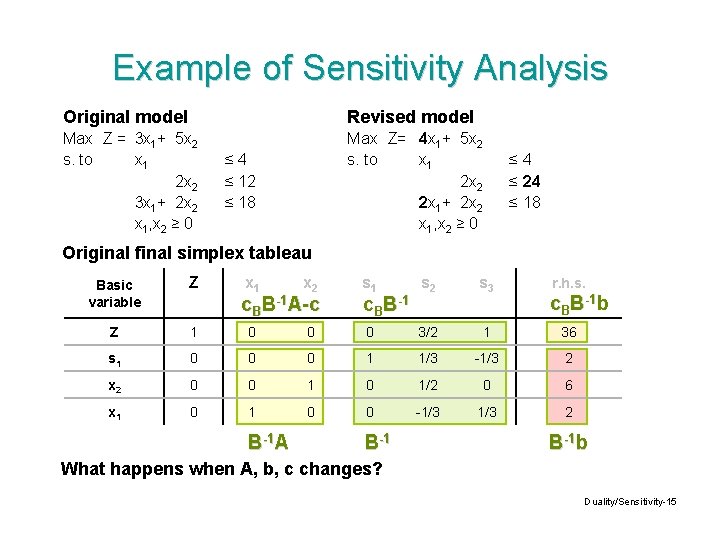
Example of Sensitivity Analysis Original model Revised model Max Z = 3 x 1+ 5 x 2 s. to x 1 2 x 2 3 x 1+ 2 x 2 x 1, x 2 ≥ 0 Max Z= 4 x 1+ 5 x 2 s. to x 1 2 x 2 2 x 1+ 2 x 2 x 1, x 2 ≥ 0 ≤ 4 ≤ 12 ≤ 18 ≤ 4 ≤ 24 ≤ 18 Original final simplex tableau Basic variable Z x 1 x 2 s 1 s 2 s 3 Z 1 0 0 0 3/2 1 36 s 1 0 0 0 1 1/3 -1/3 2 x 2 0 0 1/2 0 6 x 1 0 0 -1/3 2 c. BB-1 A-c B-1 A c. BB-1 r. h. s. c. BB-1 b What happens when A, b, c changes? Duality/Sensitivity-15
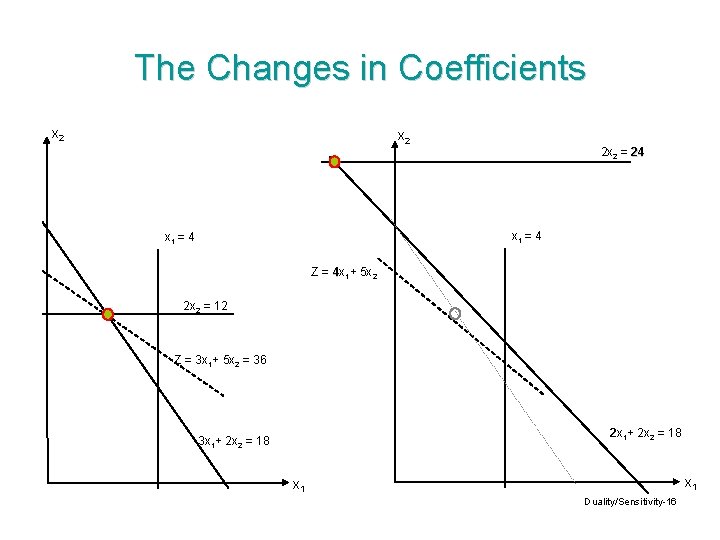
The Changes in Coefficients x 2 2 x 2 = 24 x 1 = 4 Z = 4 x 1+ 5 x 2 2 x 2 = 12 Z = 3 x 1+ 5 x 2 = 36 2 x 1+ 2 x 2 = 18 3 x 1+ 2 x 2 = 18 x 1 Duality/Sensitivity-16
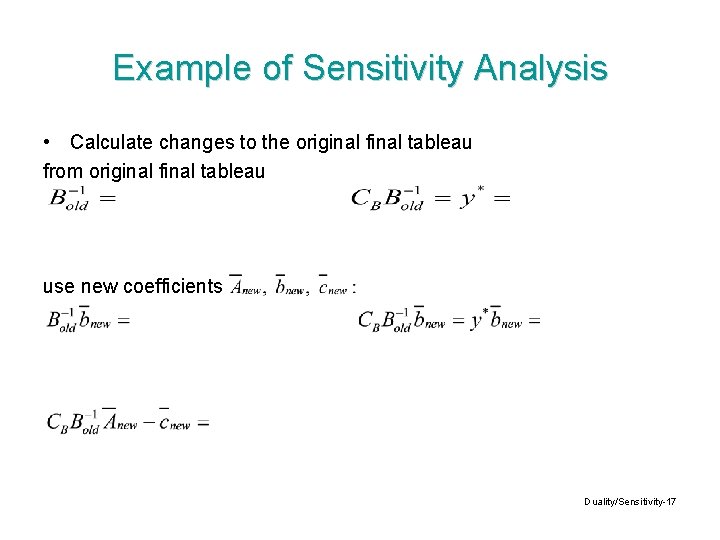
Example of Sensitivity Analysis • Calculate changes to the original final tableau from original final tableau use new coefficients Duality/Sensitivity-17
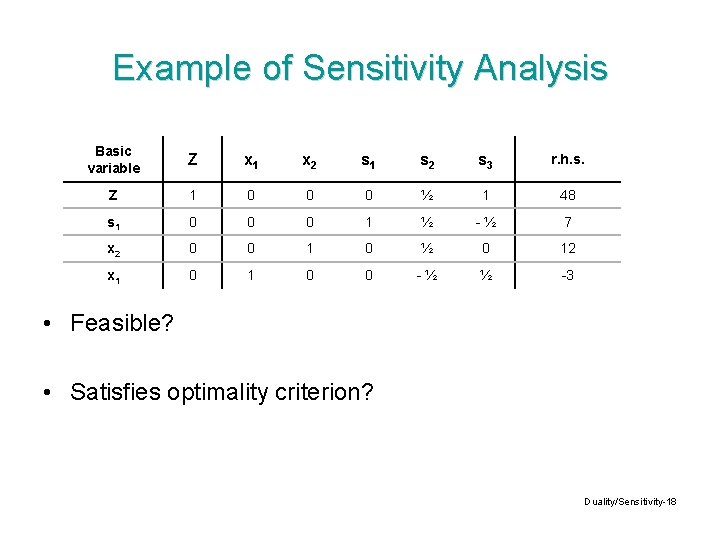
Example of Sensitivity Analysis Basic variable Z x 1 x 2 s 1 s 2 s 3 r. h. s. Z 1 0 0 0 ½ 1 48 s 1 0 0 0 1 ½ -½ 7 x 2 0 0 1 0 ½ 0 12 x 1 0 0 -½ ½ -3 • Feasible? • Satisfies optimality criterion? Duality/Sensitivity-18
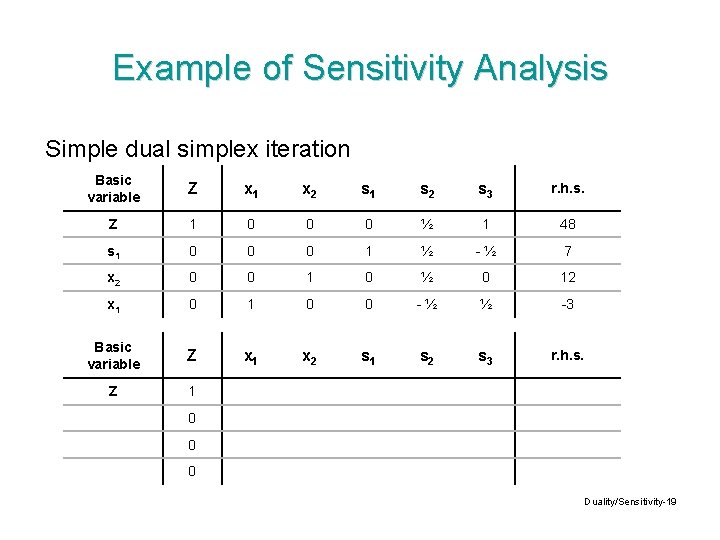
Example of Sensitivity Analysis Simple dual simplex iteration Basic variable Z x 1 x 2 s 1 s 2 s 3 r. h. s. Z 1 0 0 0 ½ 1 48 s 1 0 0 0 1 ½ -½ 7 x 2 0 0 1 0 ½ 0 12 x 1 0 0 -½ ½ -3 Basic variable Z x 1 x 2 s 1 s 2 s 3 r. h. s. Z 1 0 0 0 Duality/Sensitivity-19
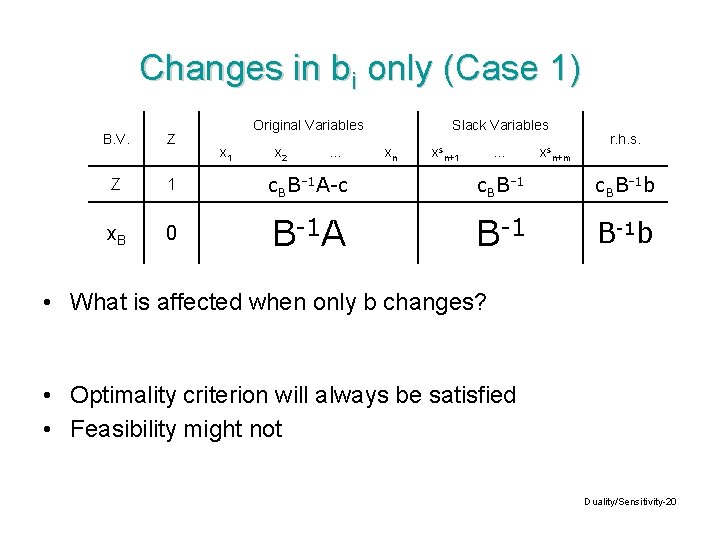
Changes in bi only (Case 1) B. V. Z Original Variables x 1 x 2 … Slack Variables xn xs … n+1 xs r. h. s. n+m Z 1 c. BB-1 A-c c. BB-1 b x. B 0 B-1 A B-1 b • What is affected when only b changes? • Optimality criterion will always be satisfied • Feasibility might not Duality/Sensitivity-20
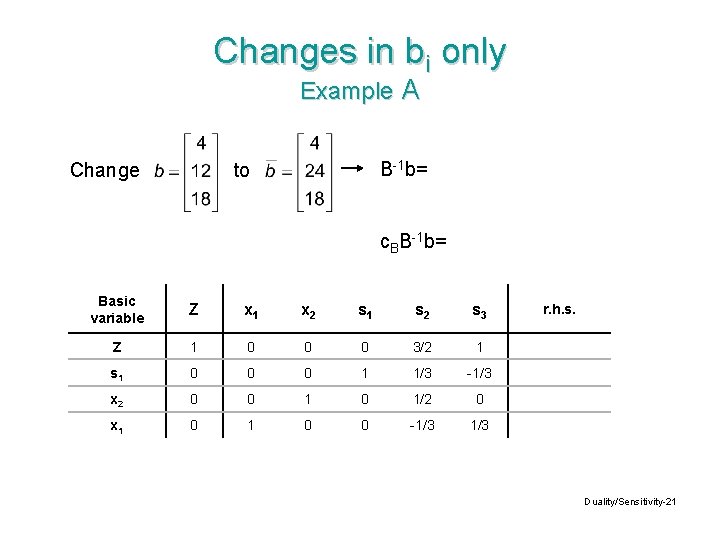
Changes in bi only Example A Change B-1 b= to c. BB-1 b= Basic variable Z x 1 x 2 s 1 s 2 s 3 Z 1 0 0 0 3/2 1 s 1 0 0 0 1 1/3 -1/3 x 2 0 0 1/2 0 x 1 0 0 -1/3 r. h. s. Duality/Sensitivity-21
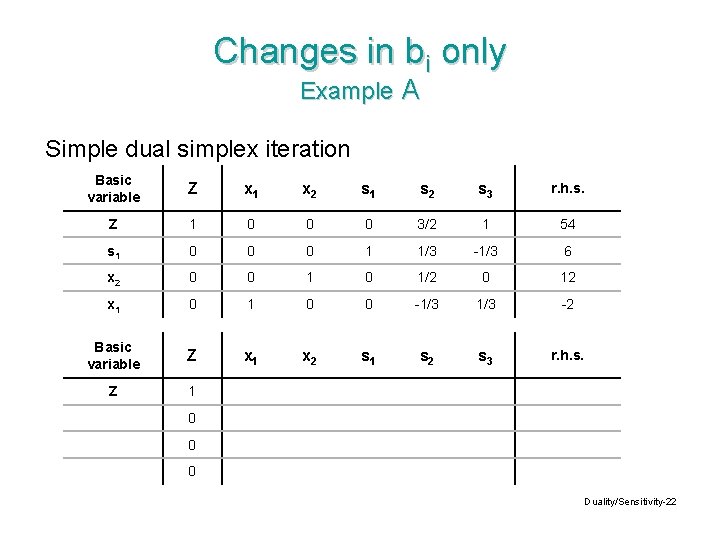
Changes in bi only Example A Simple dual simplex iteration Basic variable Z x 1 x 2 s 1 s 2 s 3 r. h. s. Z 1 0 0 0 3/2 1 54 s 1 0 0 0 1 1/3 -1/3 6 x 2 0 0 1/2 0 12 x 1 0 0 -1/3 -2 Basic variable Z x 1 x 2 s 1 s 2 s 3 r. h. s. Z 1 0 0 0 Duality/Sensitivity-22
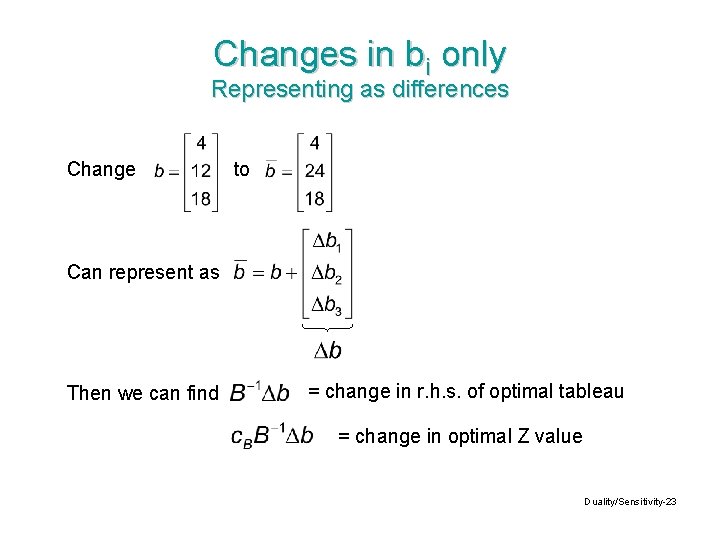
Changes in bi only Representing as differences Change to Can represent as Then we can find = change in r. h. s. of optimal tableau = change in optimal Z value Duality/Sensitivity-23
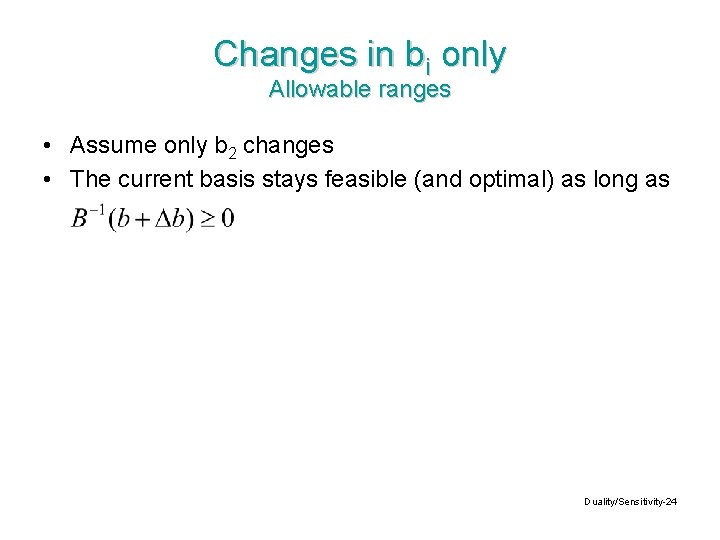
Changes in bi only Allowable ranges • Assume only b 2 changes • The current basis stays feasible (and optimal) as long as Duality/Sensitivity-24
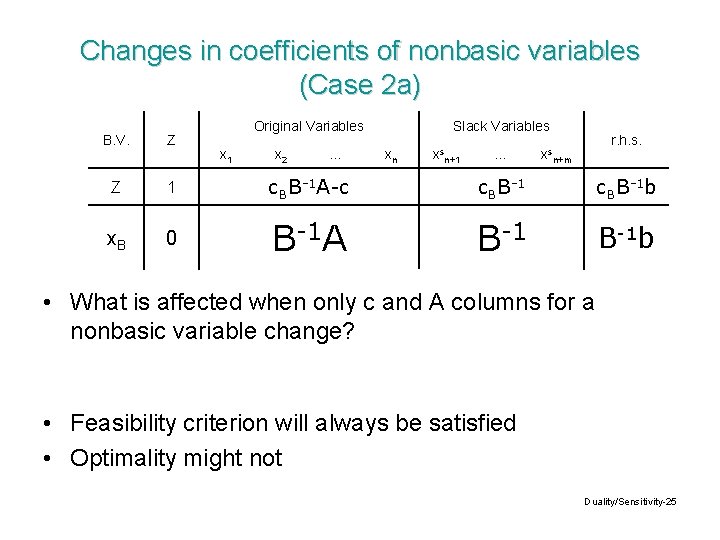
Changes in coefficients of nonbasic variables (Case 2 a) Original Variables Slack Variables B. V. Z Z 1 c. BB-1 A-c c. BB-1 b x. B 0 B-1 A B-1 b x 1 x 2 … xn xsn+1 … r. h. s. xsn+m • What is affected when only c and A columns for a nonbasic variable change? • Feasibility criterion will always be satisfied • Optimality might not Duality/Sensitivity-25
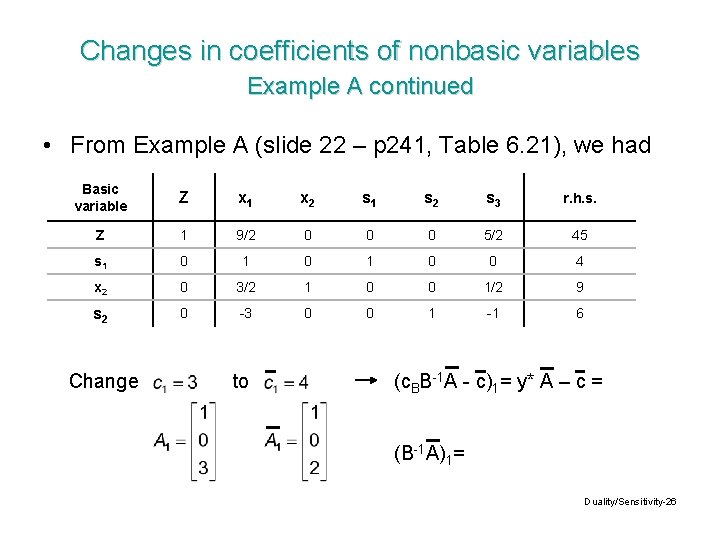
Changes in coefficients of nonbasic variables Example A continued • From Example A (slide 22 – p 241, Table 6. 21), we had Basic variable Z x 1 x 2 s 1 s 2 s 3 r. h. s. Z 1 9/2 0 0 0 5/2 45 s 1 0 1 0 0 4 x 2 0 3/2 1 0 0 1/2 9 s 2 0 -3 0 0 1 -1 6 Change to (c. BB-1 A - c)1= y* A – c = (B-1 A)1= Duality/Sensitivity-26
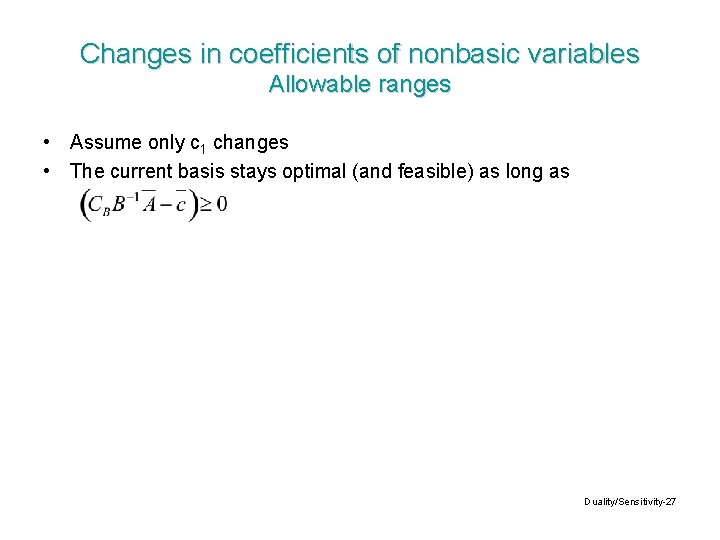
Changes in coefficients of nonbasic variables Allowable ranges • Assume only c 1 changes • The current basis stays optimal (and feasible) as long as Duality/Sensitivity-27
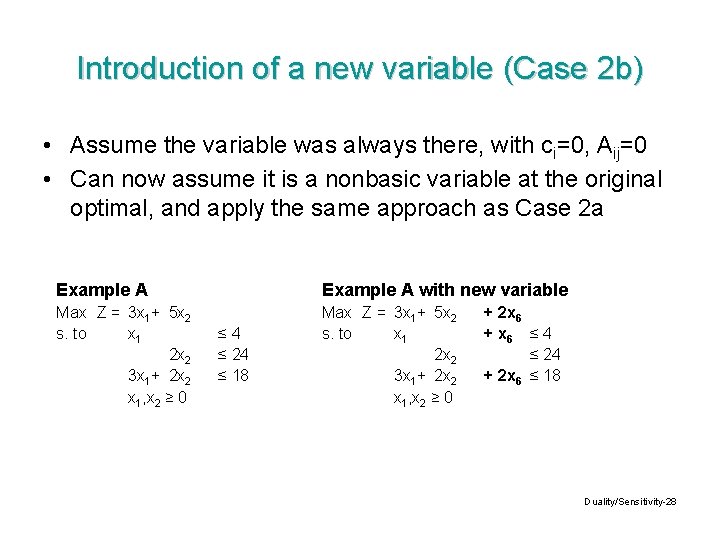
Introduction of a new variable (Case 2 b) • Assume the variable was always there, with ci=0, Aij=0 • Can now assume it is a nonbasic variable at the original optimal, and apply the same approach as Case 2 a Example A with new variable Max Z = 3 x 1+ 5 x 2 s. to x 1 2 x 2 3 x 1+ 2 x 2 x 1, x 2 ≥ 0 ≤ 4 ≤ 24 ≤ 18 + 2 x 6 + x 6 ≤ 4 ≤ 24 + 2 x 6 ≤ 18 Duality/Sensitivity-28
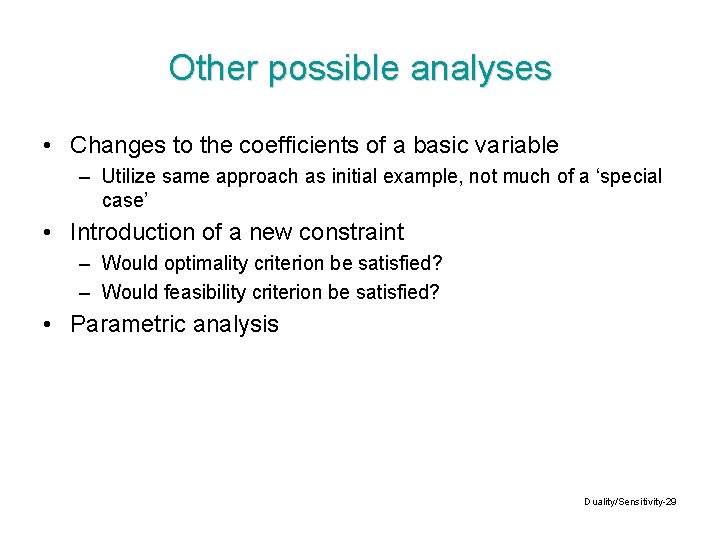
Other possible analyses • Changes to the coefficients of a basic variable – Utilize same approach as initial example, not much of a ‘special case’ • Introduction of a new constraint – Would optimality criterion be satisfied? – Would feasibility criterion be satisfied? • Parametric analysis Duality/Sensitivity-29