
PSY 369 Psycholinguistics Language and Communication What do


- Slides: 25
PSY 369: Psycholinguistics Language and Communication
What do you think? n What is language?
What is communication? n Any means by which two (or more) individuals exchange information n Paralinguistic techniques - not involving vocalization n n Non-linguistic communication - that do involve vocalization n n Hand signals, facial expressions, body language, nods, smiles, winks, etc. Grunts, groans, snorts, sighs, whimpers, etc. Not all produced sounds are intended to convey messages, so they aren’t communication n e. g. , snoring
Some examples n Animals - use a variety of methods to communicate n n Dogs bark Birds sing Bees dance People talk - we use language (as well as other methods) for communication
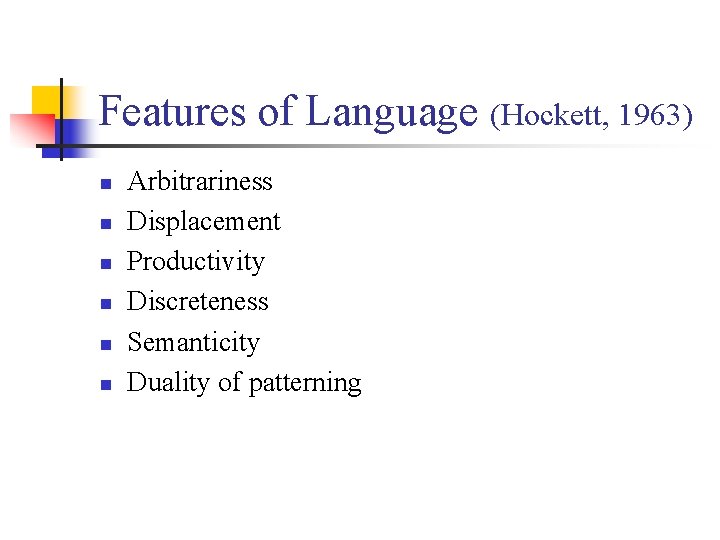
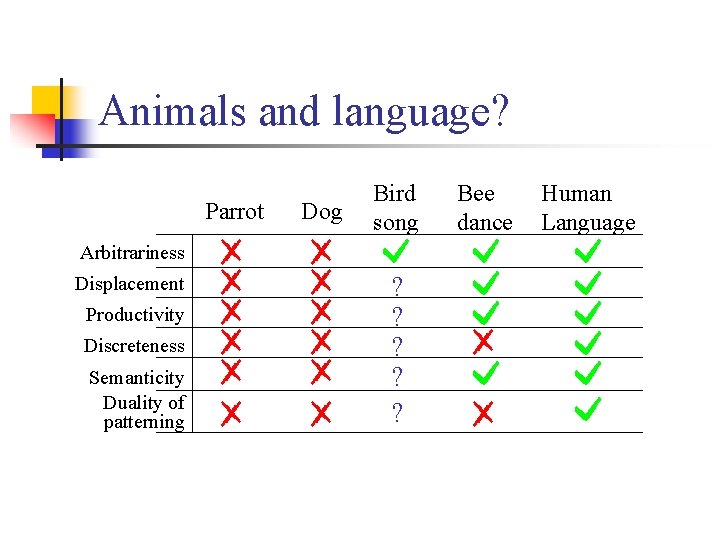
Features of Language (Hockett, 1963) n n n Arbitrariness Displacement Productivity Discreteness Semanticity Duality of patterning
Arbitrariness n No resemblance between the language signal and the thing that it represents “dog” “chien” “hund” “perro”
Features of Language n n n Arbitrariness Displacement Productivity Discreteness Semanticity Duality of patterning
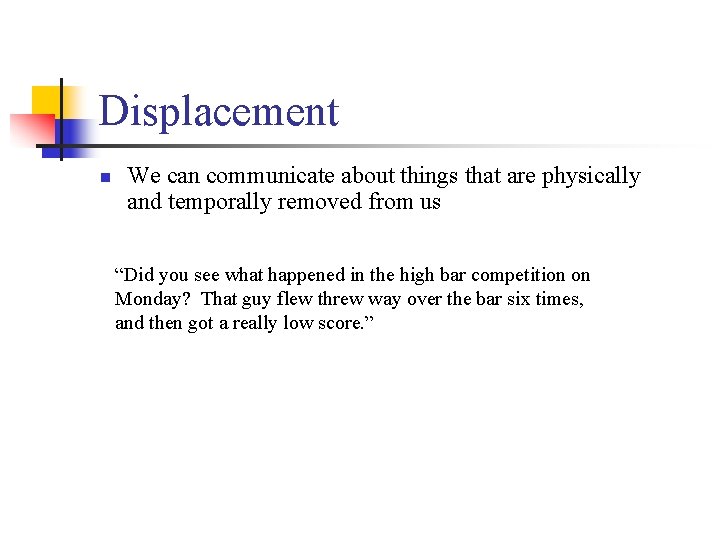
Displacement n We can communicate about things that are physically and temporally removed from us “Did you see what happened in the high bar competition on Monday? That guy flew threw way over the bar six times, and then got a really low score. ”
Features of Language n n n Arbitrariness Displacement Productivity Discreteness Semanticity Duality of patterning
Productivity n Our use of language is extremely creative. n We have a limited amount of linguistic elements (e. g. , sounds and words), but can combine those elements in novel ways. “I was tired of cleaning up after my dog in my backyard so I taught him to pole vault. ” n Even though you’ve never heard this sentence before you can understand it effortlessly
Features of Language n n n Arbitrariness Displacement Productivity Discreteness Semanticity Duality of patterning
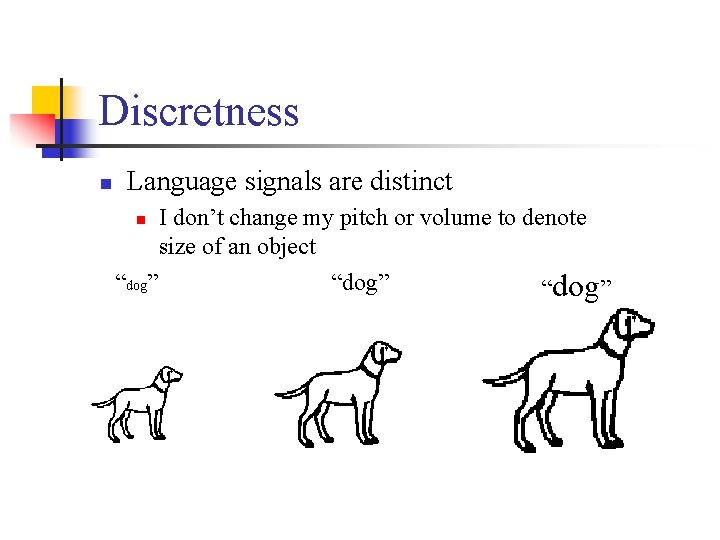
Discretness n Language signals are distinct I don’t change my pitch or volume to denote size of an object “dog” n
Features of Language n n n Arbitrariness Displacement Productivity Discreteness Semanticity Duality of patterning
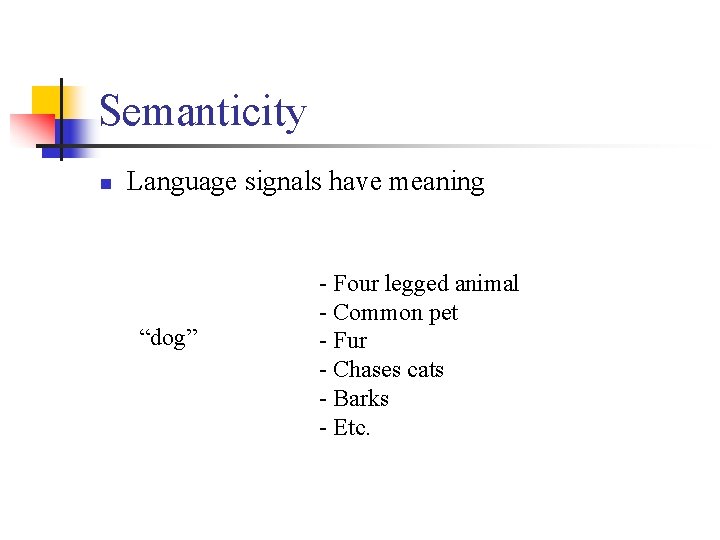
Semanticity n Language signals have meaning “dog” - Four legged animal - Common pet - Fur - Chases cats - Barks - Etc.
Features of Language n n n Arbitrariness Displacement Productivity Discreteness Semanticity Duality of patterning
Duality of Patterning n Language signals occur on two levels Symbols are meaningful, discrete, and arbitrary Smaller units that make up the meaningful units don’t have meaning Words and morphemes “dog” Phonomes /d/ /o/ /g/
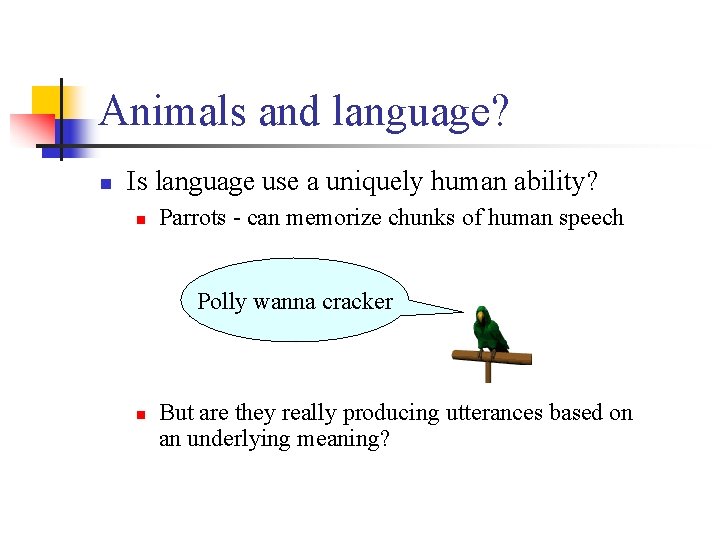
Animals and language? n Is language use a uniquely human ability? n Parrots - can memorize chunks of human speech Polly wanna cracker n But are they really producing utterances based on an underlying meaning?
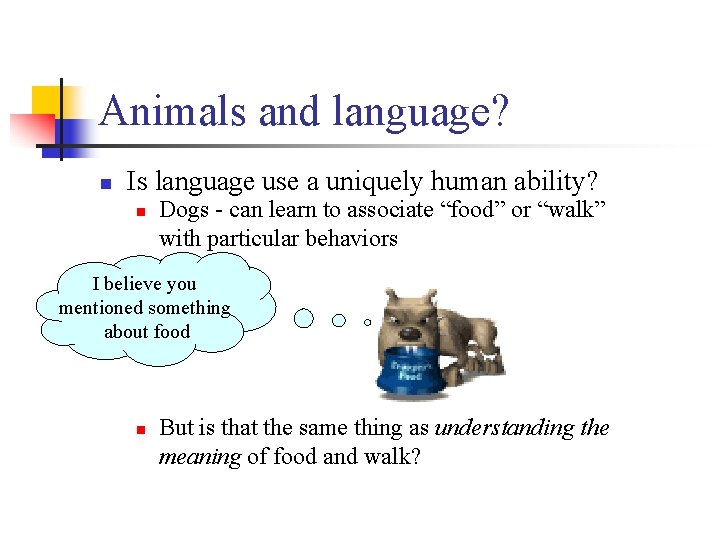
Animals and language? n Is language use a uniquely human ability? n Dogs - can learn to associate “food” or “walk” with particular behaviors I believe you mentioned something about food n But is that the same thing as understanding the meaning of food and walk?
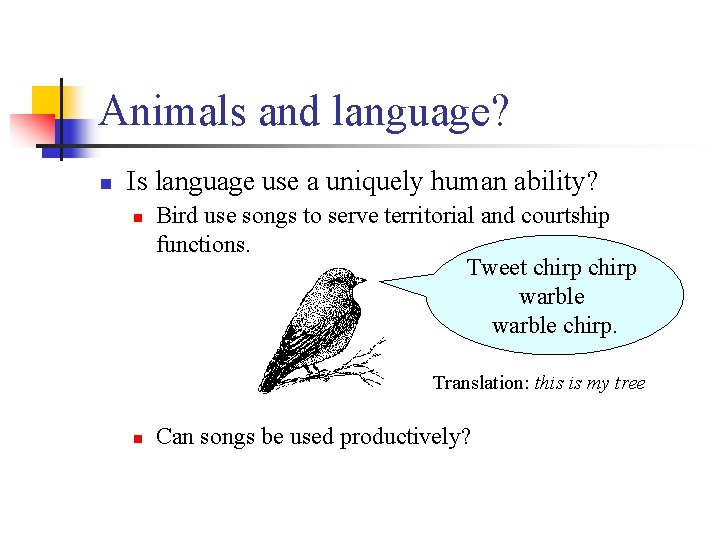
Animals and language? n Is language use a uniquely human ability? n Bird use songs to serve territorial and courtship functions. Tweet chirp warble chirp. Translation: this is my tree n Can songs be used productively?
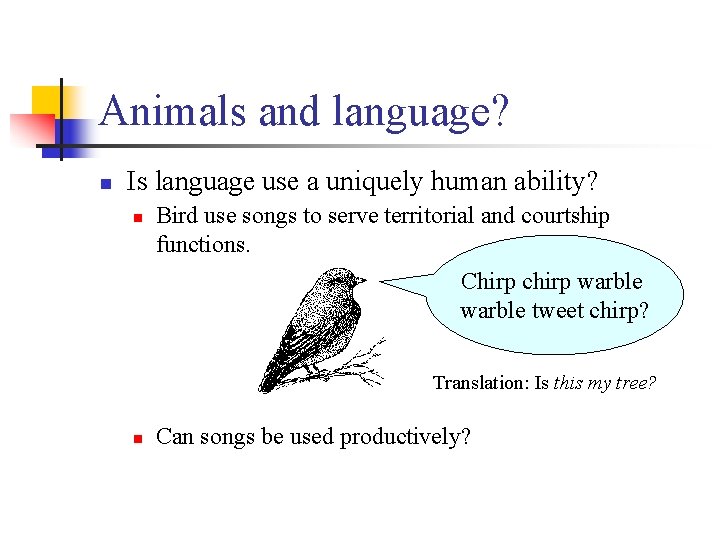
Animals and language? n Is language use a uniquely human ability? n Bird use songs to serve territorial and courtship functions. Chirp chirp warble tweet chirp? Translation: Is this my tree? n Can songs be used productively?
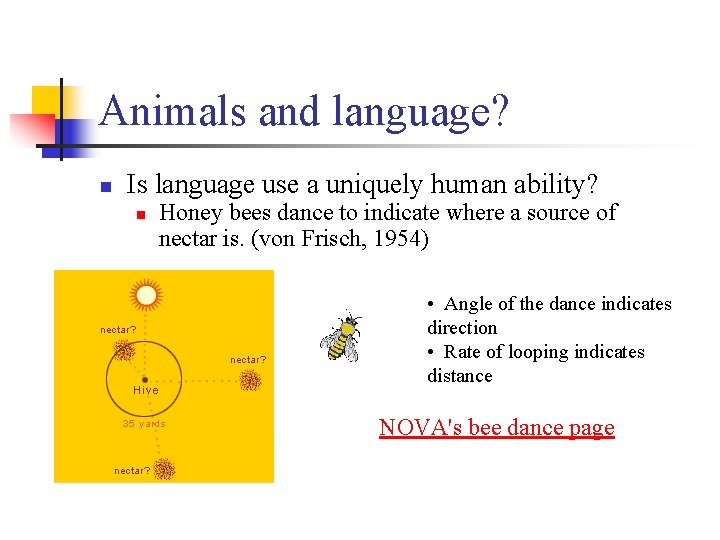
Animals and language? n Is language use a uniquely human ability? n Honey bees dance to indicate where a source of nectar is. (von Frisch, 1954) • Angle of the dance indicates direction • Rate of looping indicates distance NOVA's bee dance page
Animals and language? Parrot Dog Bird song Arbitrariness Displacement Productivity Discreteness Semanticity Duality of patterning ? ? ? Bee dance Human Language
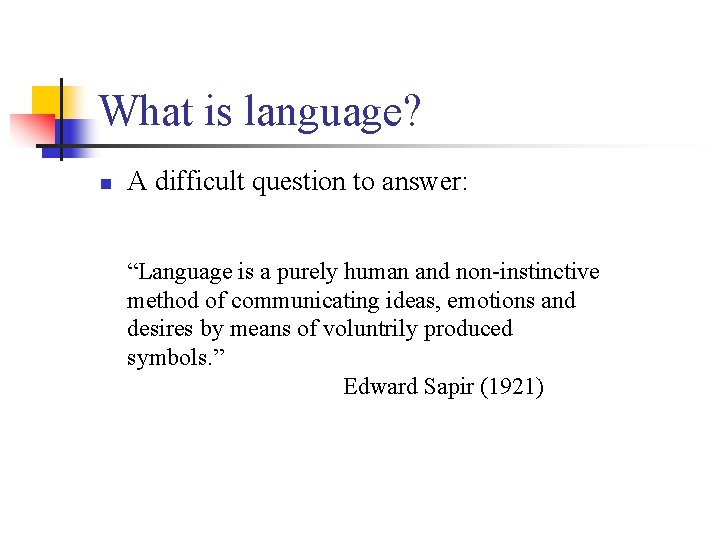
What is language? n A difficult question to answer: “Language is a purely human and non-instinctive method of communicating ideas, emotions and desires by means of voluntrily produced symbols. ” Edward Sapir (1921)
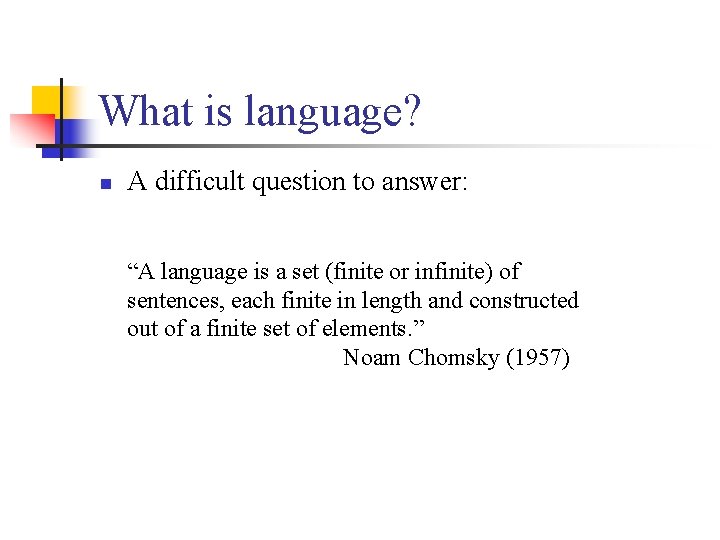
What is language? n A difficult question to answer: “A language is a set (finite or infinite) of sentences, each finite in length and constructed out of a finite set of elements. ” Noam Chomsky (1957)
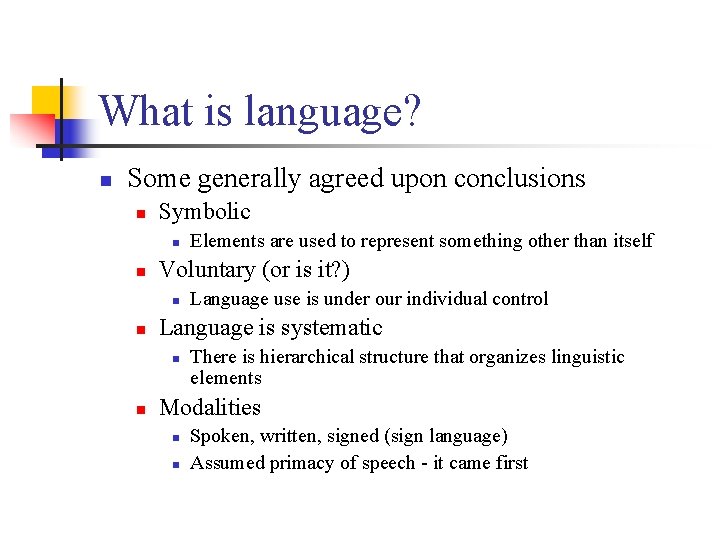
What is language? n Some generally agreed upon conclusions n Symbolic n n Voluntary (or is it? ) n n Language use is under our individual control Language is systematic n n Elements are used to represent something other than itself There is hierarchical structure that organizes linguistic elements Modalities n n Spoken, written, signed (sign language) Assumed primacy of speech - it came first