Chapter 9 Weathering and Soils 1 2 3


- Slides: 52
Chapter 9: Weathering and Soils 1. 2. 3. 4. The Dirt on Weathering Physical Weathering Chemical Weathering Biological Weathering and Decay 5. Weathering Rates 6. Soils: An Introduction 7. Soil Erosion and Conservation Copyright © The Mc. Graw-Hill Companies, Inc. Permission required for reproduction or display.
Learning Objectives • • • Students will explain concepts related to weathering and soils. Students will distinguish among physical, chemical, and biological weathering. Students will analyze the environmental factors that contribute to physical weathering. Students will describe the processes and products of hydrolysis, dissolution, and oxidation. Students will compare biological weathering processes to those of physical and chemical weathering. Students will describe the factors responsible for different weathering rates. Students will identify the key factors that contribute to the formation of different soil orders. Students will compare and contrast soil erosion due to water and wind. Students will list methods to combat soil erosion.
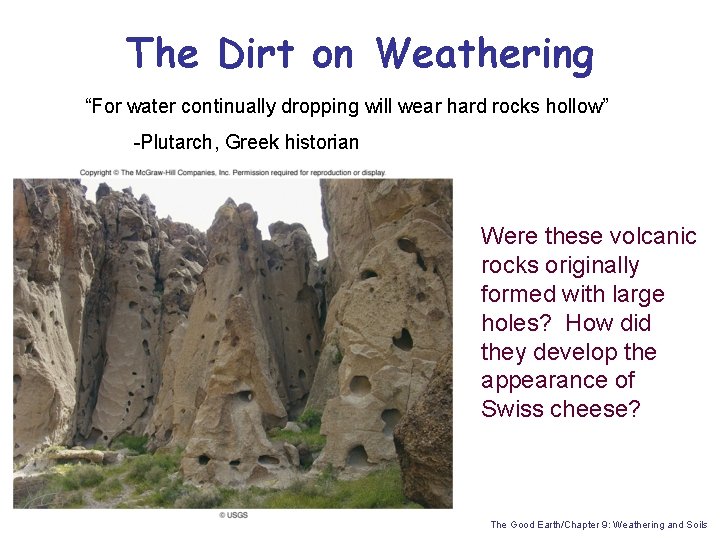
The Dirt on Weathering “For water continually dropping will wear hard rocks hollow” -Plutarch, Greek historian Were these volcanic rocks originally formed with large holes? How did they develop the appearance of Swiss cheese? The Good Earth/Chapter 9: Weathering and Soils
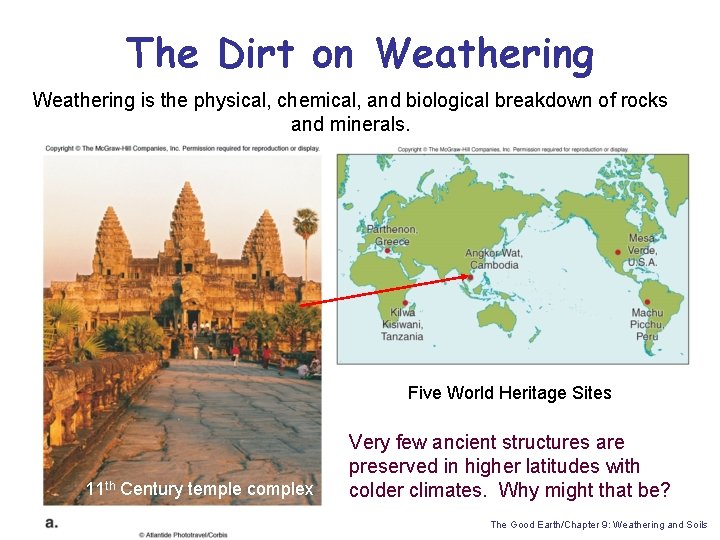
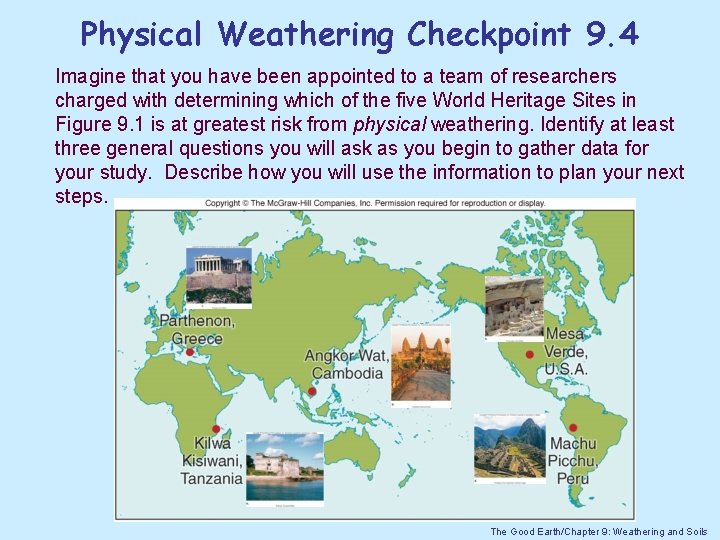
The Dirt on Weathering is the physical, chemical, and biological breakdown of rocks and minerals. Five World Heritage Sites 11 th Century temple complex Very few ancient structures are preserved in higher latitudes with colder climates. Why might that be? The Good Earth/Chapter 9: Weathering and Soils
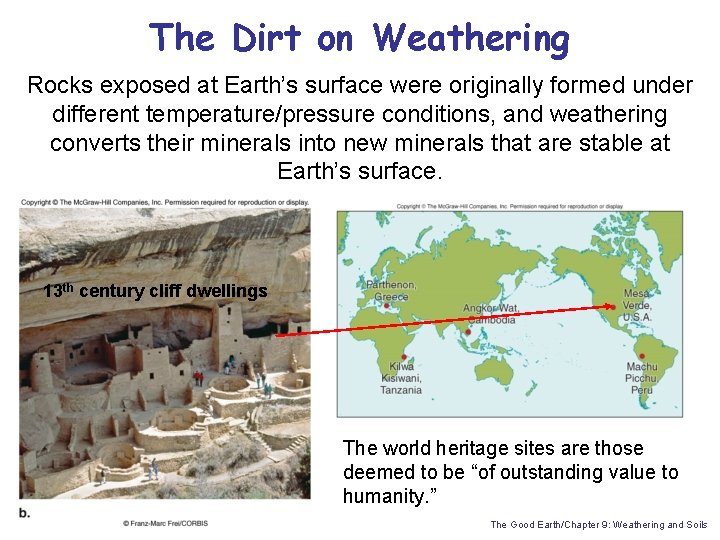
The Dirt on Weathering Rocks exposed at Earth’s surface were originally formed under different temperature/pressure conditions, and weathering converts their minerals into new minerals that are stable at Earth’s surface. 13 th century cliff dwellings The world heritage sites are those deemed to be “of outstanding value to humanity. ” The Good Earth/Chapter 9: Weathering and Soils
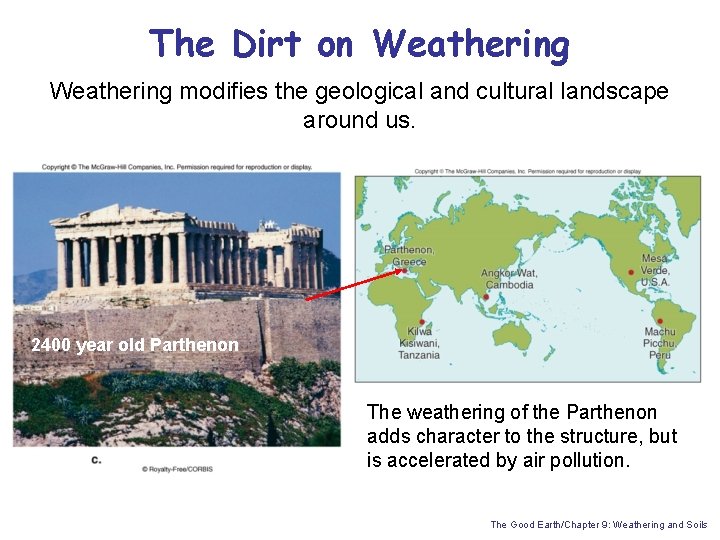
The Dirt on Weathering modifies the geological and cultural landscape around us. 2400 year old Parthenon The weathering of the Parthenon adds character to the structure, but is accelerated by air pollution. The Good Earth/Chapter 9: Weathering and Soils
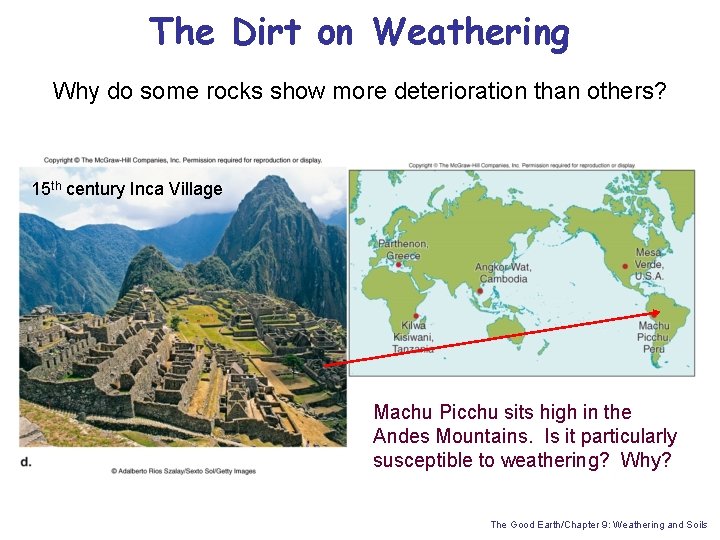
The Dirt on Weathering Why do some rocks show more deterioration than others? 15 th century Inca Village Machu Picchu sits high in the Andes Mountains. Is it particularly susceptible to weathering? Why? The Good Earth/Chapter 9: Weathering and Soils
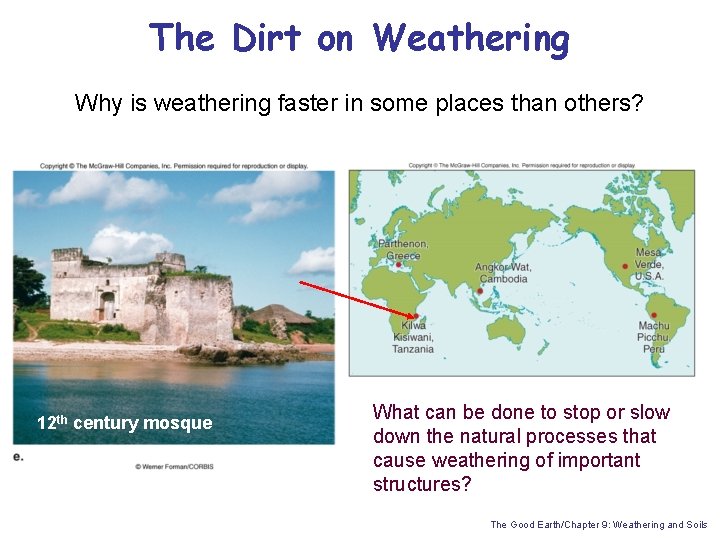
The Dirt on Weathering Why is weathering faster in some places than others? 12 th century mosque What can be done to stop or slow down the natural processes that cause weathering of important structures? The Good Earth/Chapter 9: Weathering and Soils
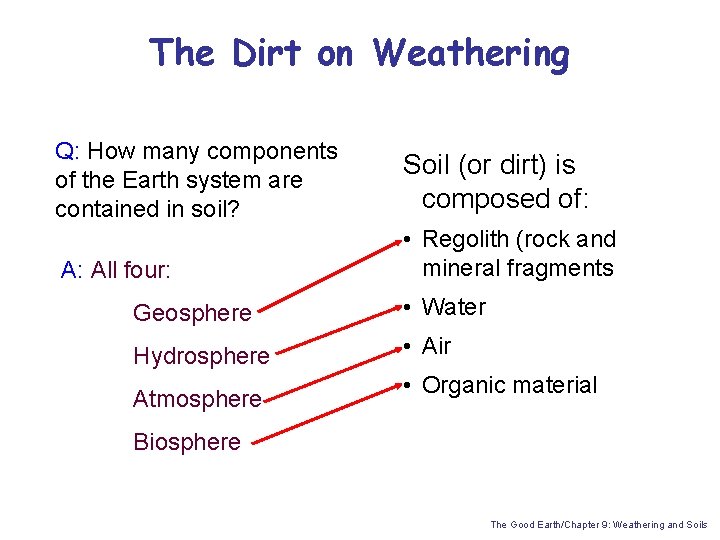
The Dirt on Weathering Q: How many components of the Earth system are contained in soil? Soil (or dirt) is composed of: A: All four: • Regolith (rock and mineral fragments Geosphere • Water Hydrosphere • Air Atmosphere • Organic material Biosphere The Good Earth/Chapter 9: Weathering and Soils
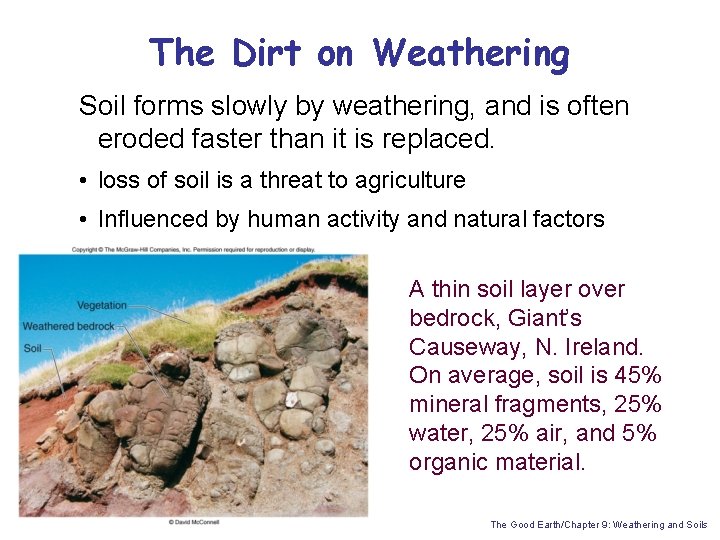
The Dirt on Weathering Soil forms slowly by weathering, and is often eroded faster than it is replaced. • loss of soil is a threat to agriculture • Influenced by human activity and natural factors A thin soil layer over bedrock, Giant’s Causeway, N. Ireland. On average, soil is 45% mineral fragments, 25% water, 25% air, and 5% organic material. The Good Earth/Chapter 9: Weathering and Soils
Go back to the Table of Contents Go to the next section: Physical Weathering The Good Earth/Chapter 9: Weathering and Soils
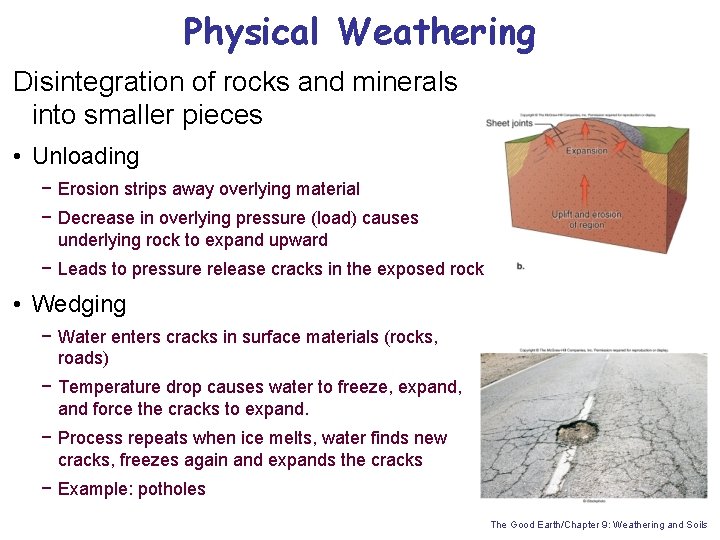
Physical Weathering Disintegration of rocks and minerals into smaller pieces • Unloading − Erosion strips away overlying material − Decrease in overlying pressure (load) causes underlying rock to expand upward − Leads to pressure release cracks in the exposed rock • Wedging − Water enters cracks in surface materials (rocks, roads) − Temperature drop causes water to freeze, expand, and force the cracks to expand. − Process repeats when ice melts, water finds new cracks, freezes again and expands the cracks − Example: potholes The Good Earth/Chapter 9: Weathering and Soils
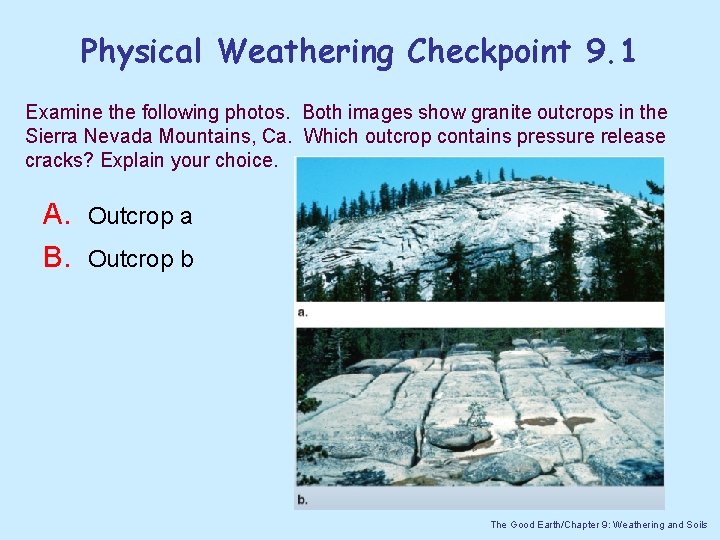
Physical Weathering Checkpoint 9. 1 Examine the following photos. Both images show granite outcrops in the Sierra Nevada Mountains, Ca. Which outcrop contains pressure release cracks? Explain your choice. A. Outcrop a B. Outcrop b The Good Earth/Chapter 9: Weathering and Soils
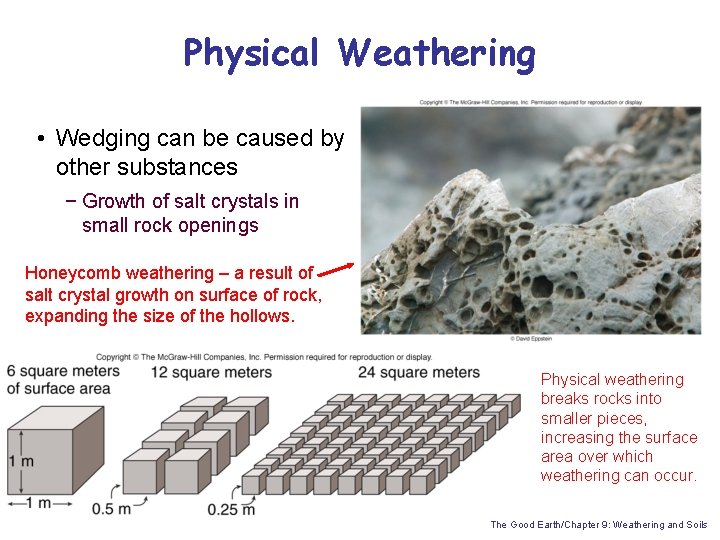
Physical Weathering • Wedging can be caused by other substances − Growth of salt crystals in small rock openings Honeycomb weathering – a result of salt crystal growth on surface of rock, expanding the size of the hollows. Physical weathering breaks rocks into smaller pieces, increasing the surface area over which weathering can occur. The Good Earth/Chapter 9: Weathering and Soils
Physical Weathering Conceptest Outcrops of granite are examined in California at similar elevations in the interior of the state more than 100 km (63 miles) from the Pacific Ocean, and in outcrops along the coast. The granites have identical compositions and textures. On the basis of the following information, which granite outcrop would weather most rapidly? a) Outcrop A; located at a coast, contains fractures spaced 1 meter apart b) Outcrop B; located at a coast, does not have fractures c) Outcrop C; located in an interior, contains fractures spaced 1 meter apart d) Outcrop D; located in an interior, does not have fractures The Good Earth, Chapter 9: Weathering and Soils
Physical Weathering Checkpoint 9. 4 Imagine that you have been appointed to a team of researchers charged with determining which of the five World Heritage Sites in Figure 9. 1 is at greatest risk from physical weathering. Identify at least three general questions you will ask as you begin to gather data for your study. Describe how you will use the information to plan your next steps. The Good Earth/Chapter 9: Weathering and Soils
Go back to the Table of Contents Go to the next section: Chemical Weathering The Good Earth/Chapter 9: Weathering and Soils
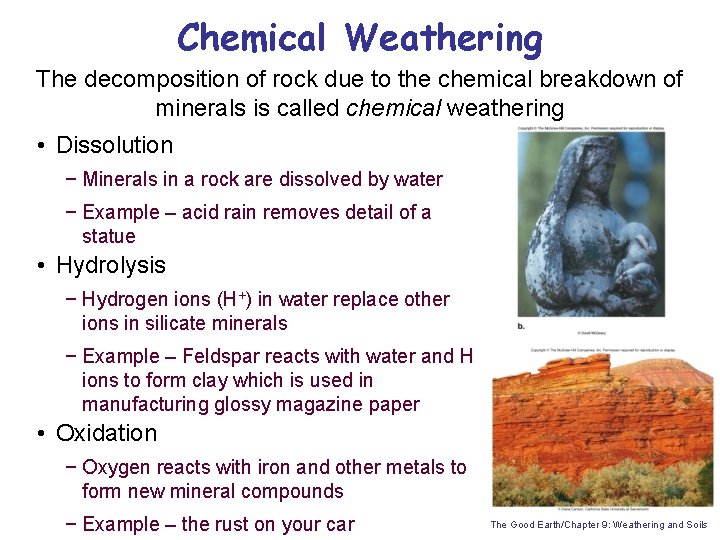
Chemical Weathering The decomposition of rock due to the chemical breakdown of minerals is called chemical weathering • Dissolution − Minerals in a rock are dissolved by water − Example – acid rain removes detail of a statue • Hydrolysis − Hydrogen ions (H+) in water replace other ions in silicate minerals − Example – Feldspar reacts with water and H ions to form clay which is used in 1, 200 meters manufacturing glossy magazine paper • Oxidation − Oxygen reacts with iron and other metals to form new mineral compounds − Example – the rust on your car The Good Earth/Chapter 9: Weathering and Soils
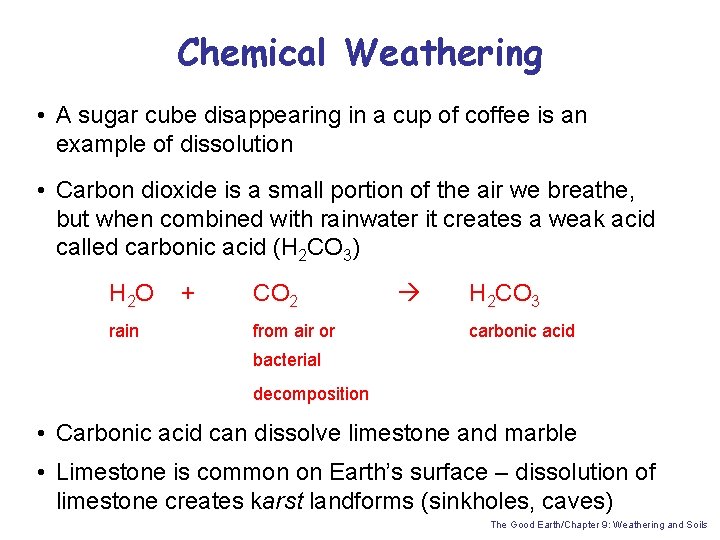
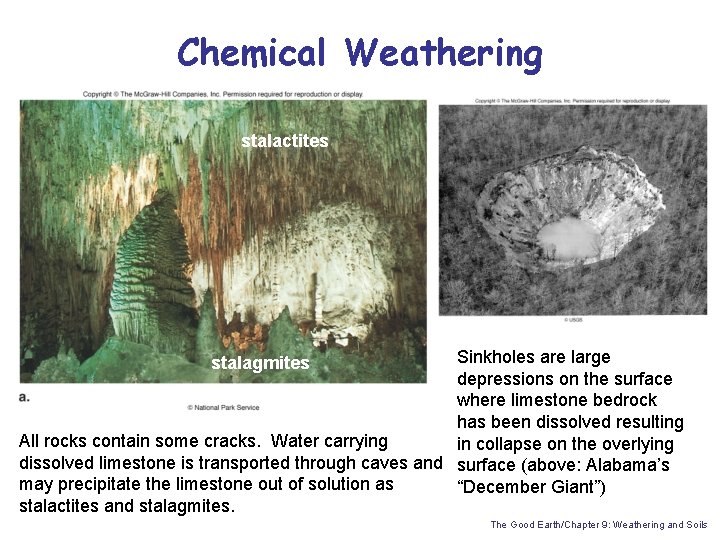
Chemical Weathering • A sugar cube disappearing in a cup of coffee is an example of dissolution • Carbon dioxide is a small portion of the air we breathe, but when combined with rainwater it creates a weak acid called carbonic acid (H 2 CO 3) H 2 O rain + CO 2 from air or H 2 CO 3 carbonic acid bacterial decomposition • Carbonic acid can dissolve limestone and marble • Limestone is common on Earth’s surface – dissolution of limestone creates karst landforms (sinkholes, caves) The Good Earth/Chapter 9: Weathering and Soils
Chemical Weathering stalactites Sinkholes are large depressions on the surface where limestone bedrock has been dissolved resulting All rocks contain some cracks. Water carrying in collapse on the overlying dissolved limestone is transported through caves and surface (above: Alabama’s may precipitate the limestone out of solution as “December Giant”) stalactites and stalagmites The Good Earth/Chapter 9: Weathering and Soils
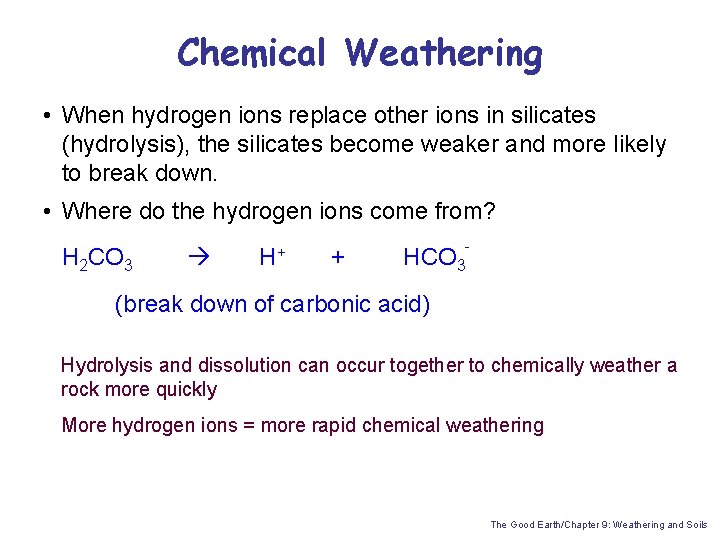
Chemical Weathering • When hydrogen ions replace other ions in silicates (hydrolysis), the silicates become weaker and more likely to break down. • Where do the hydrogen ions come from? H 2 CO 3 H+ + HCO 3 - (break down of carbonic acid) Hydrolysis and dissolution can occur together to chemically weather a rock more quickly More hydrogen ions = more rapid chemical weathering The Good Earth/Chapter 9: Weathering and Soils
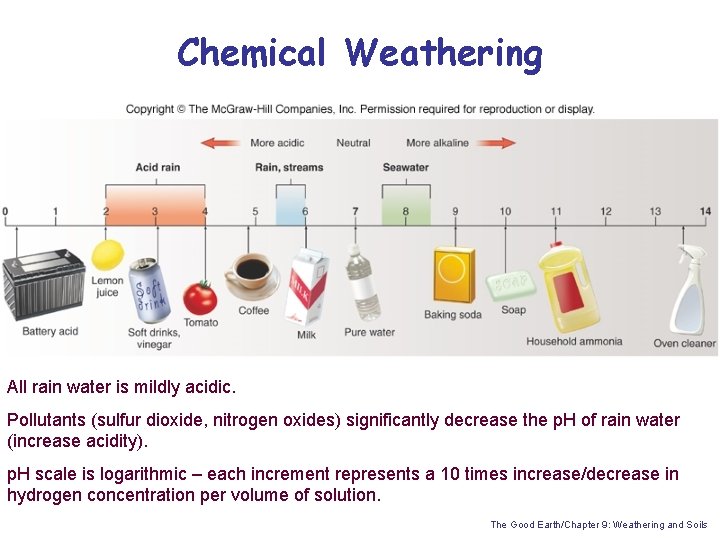
Chemical Weathering All rain water is mildly acidic. Pollutants (sulfur dioxide, nitrogen oxides) significantly decrease the p. H of rain water (increase acidity). p. H scale is logarithmic – each increment represents a 10 times increase/decrease in hydrogen concentration per volume of solution. The Good Earth/Chapter 9: Weathering and Soils
Weathering Concept Survey Venn Diagram: Physical vs. Chemical Weathering Complete the following Venn diagram to compare and contrast the similarities and differences between physical and chemical weathering. Identify 8 characteristics that are either shared by both physical and chemical weathering or are unique to one of the two. Then place the number corresponding to each characteristic in the diagram. Characteristics 1 and 2 have been plotted for you as examples. 1. Causes the breakdown of rocks and minerals 2 2. Causes iron bearing rocks to turn red/orange 3. 4. 1 5. 6. 7. 8. Physical weathering Chemical weathering The Good Earth, Chapter 9: Weathering and Soils
Go back to the Table of Contents Go to the next section: Biological Weathering and Decay The Good Earth/Chapter 9: Weathering and Soils
Biological Weathering and Decay • Believe it or not, critters (plants and animals) can remove and/or break down rocks and minerals. − Macroscopic (by organisms we can see) − Includes the actions of: plant roots, animal burrows, termites, and other boring organisms − Microscopic (by organisms we cannot see with the naked eye) − Primarily caused by decomposition of material that converts solid material to gases with or without water − Works mostly on organic material such as dead plant or animal matter sugars in organic material + oxygen carbon dioxide + water Sugars in organic material carbon dioxide + methane gas The Good Earth/Chapter 9: Weathering and Soils
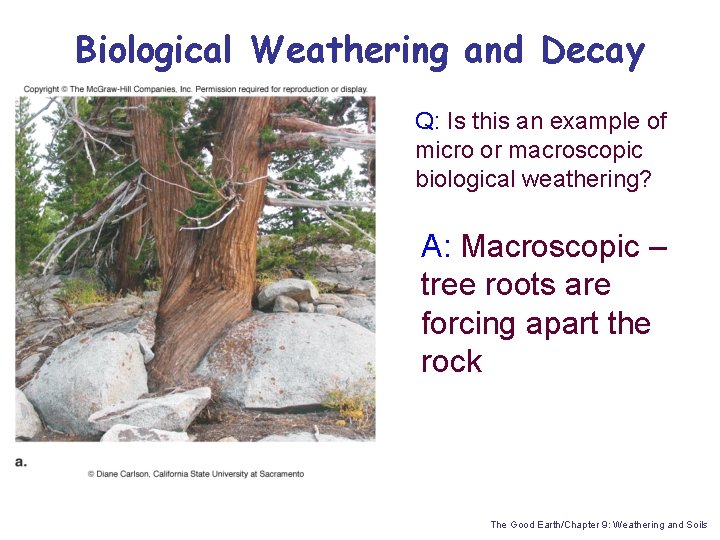
Biological Weathering and Decay Q: Is this an example of micro or macroscopic biological weathering? A: Macroscopic – tree roots are forcing apart the rock The Good Earth/Chapter 9: Weathering and Soils
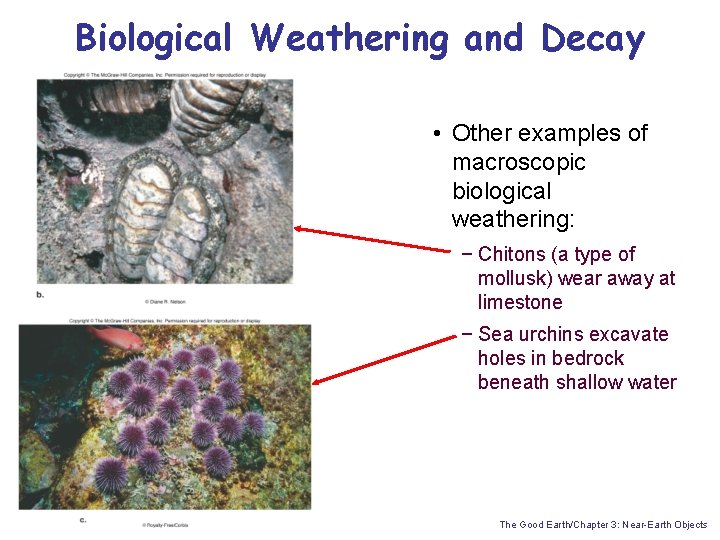
Biological Weathering and Decay • Other examples of macroscopic biological weathering: − Chitons (a type of mollusk) wear away at limestone − Sea urchins excavate holes in bedrock beneath shallow water The Good Earth/Chapter 3: Near-Earth Objects
Biological Weathering and Decay Checkpoint 9. 9 Give an every day example of microscopic or macroscopic biological weathering. Explain your example – how does it work, where might it occur. The Good Earth/Chapter 9: Weathering and Soils
Biological Weathering and Decay Checkpoint 9. 11 Write a paragraph that argues for OR against the following statement: Biological weathering processes could be considered examples of physical or chemical weathering. The Good Earth/Chapter 9: Weathering and Soils
Go back to the Table of Contents Go to the next section: Weathering Rates The Good Earth/Chapter 9: Weathering and Soils
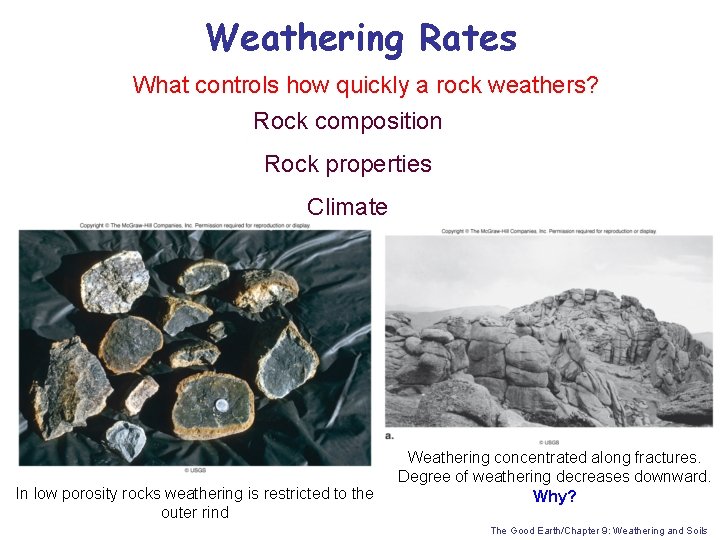
Weathering Rates What controls how quickly a rock weathers? Rock composition Rock properties Climate In low porosity rocks weathering is restricted to the outer rind Weathering concentrated along fractures. Degree of weathering decreases downward. Why? The Good Earth/Chapter 9: Weathering and Soils
Rates of Weathering Concept Survey Say whether each of the following statements relates to the influence on weathering by rock composition, rock properties, or climate. 1. Exposed rock in the mountains of Alaska 2. A lack of fractures in an outcrop 3. Quartz is rarely affected by dissolution, hydrolysis, or oxidation 4. High porosity (a large amount of space between grains in a rock) 5. Rocks on the coast of a tropical island 6. Minerals that dissolve in the presence of water The Good Earth/Chapter 9: Weathering and Soils
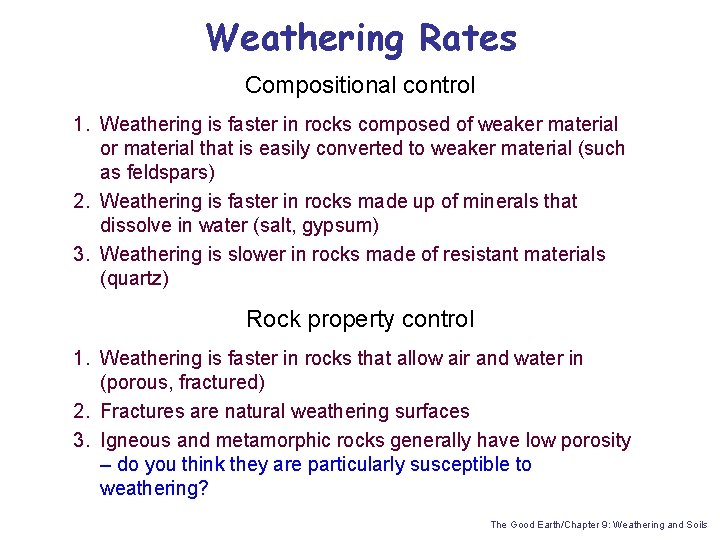
Weathering Rates Compositional control 1. Weathering is faster in rocks composed of weaker material or material that is easily converted to weaker material (such as feldspars) 2. Weathering is faster in rocks made up of minerals that dissolve in water (salt, gypsum) 3. Weathering is slower in rocks made of resistant materials (quartz) Rock property control 1. Weathering is faster in rocks that allow air and water in (porous, fractured) 2. Fractures are natural weathering surfaces 3. Igneous and metamorphic rocks generally have low porosity – do you think they are particularly susceptible to weathering? The Good Earth/Chapter 9: Weathering and Soils
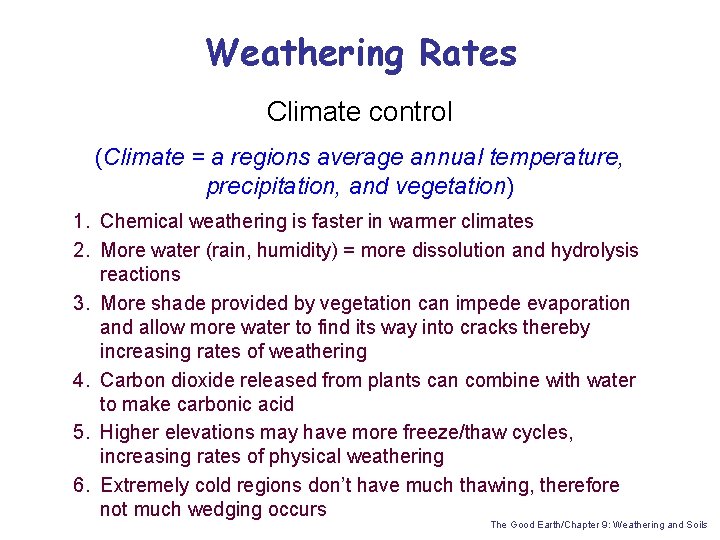
Weathering Rates Climate control (Climate = a regions average annual temperature, precipitation, and vegetation) 1. Chemical weathering is faster in warmer climates 2. More water (rain, humidity) = more dissolution and hydrolysis reactions 3. More shade provided by vegetation can impede evaporation and allow more water to find its way into cracks thereby increasing rates of weathering 4. Carbon dioxide released from plants can combine with water to make carbonic acid 5. Higher elevations may have more freeze/thaw cycles, increasing rates of physical weathering 6. Extremely cold regions don’t have much thawing, therefore not much wedging occurs The Good Earth/Chapter 9: Weathering and Soils
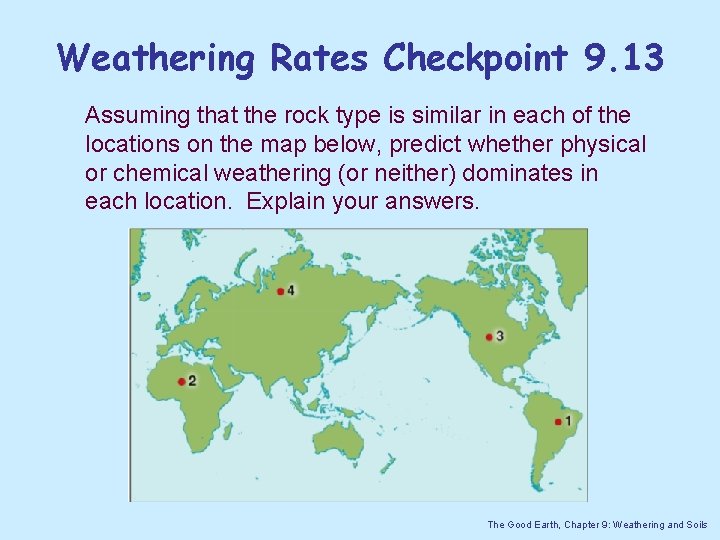
Weathering Rates Checkpoint 9. 13 Assuming that the rock type is similar in each of the locations on the map below, predict whether physical or chemical weathering (or neither) dominates in each location. Explain your answers. The Good Earth, Chapter 9: Weathering and Soils
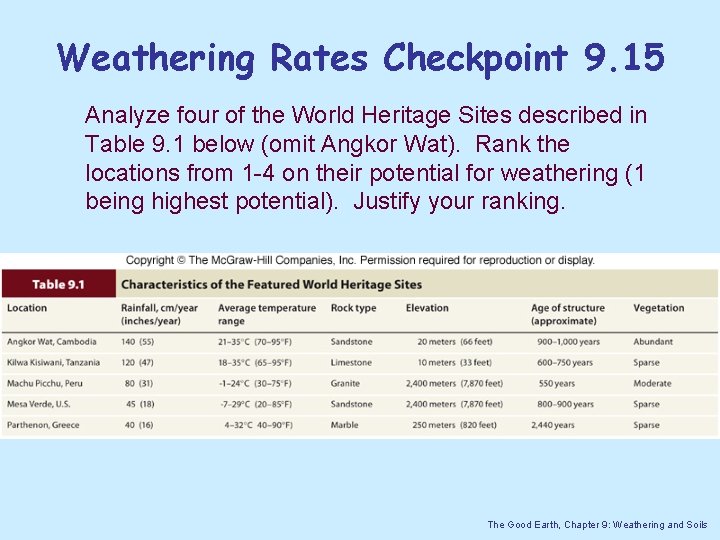
Weathering Rates Checkpoint 9. 15 Analyze four of the World Heritage Sites described in Table 9. 1 below (omit Angkor Wat). Rank the locations from 1 -4 on their potential for weathering (1 being highest potential). Justify your ranking. The Good Earth, Chapter 9: Weathering and Soils
Go back to the Table of Contents Go to the next section: Soils: An Introduction The Good Earth/Chapter 9: Weathering and Soils
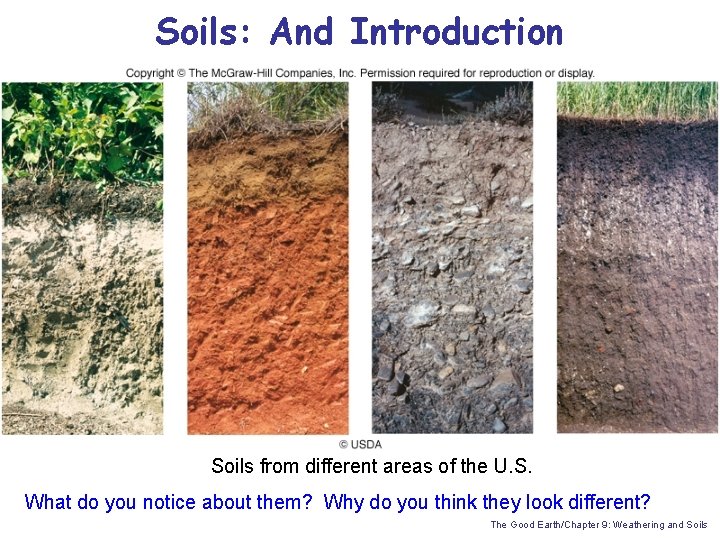
Soils: And Introduction Soils from different areas of the U. S. What do you notice about them? Why do you think they look different? The Good Earth/Chapter 9: Weathering and Soils
Soils: An Introduction • Soil = a stratified mixture of regolith that includes enough organic material, water, and air to support plant life − Organic material is supplied by decaying plants and animals − Organics get mixed with soil by burrowing animals, worms, and insects − Water moves through the soil and leaches it (dissolves iron) − Water can transport fine clay particles to lower layers Soil Profile: A series of distinct soil horizons (horizontal layers) created by 1. Organic Activity 2. Leaching and Precipitation 3. Transport of Clays The Good Earth/Chapter 9: Weathering and Soils
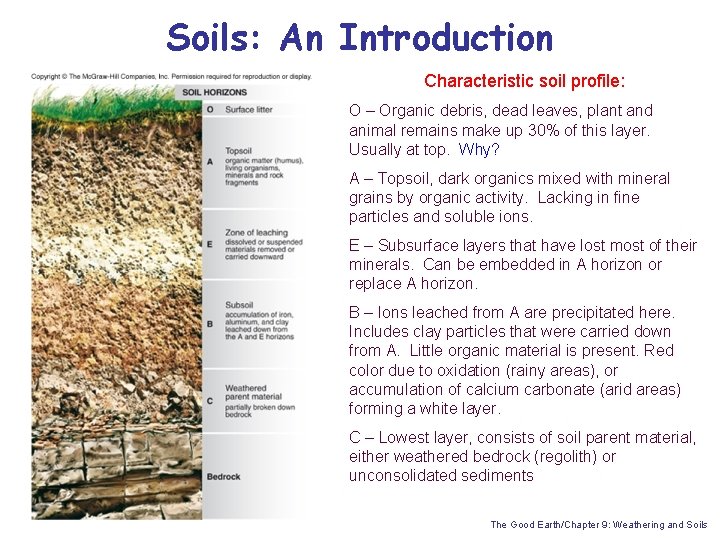
Soils: An Introduction Characteristic soil profile: O – Organic debris, dead leaves, plant and animal remains make up 30% of this layer. Usually at top. Why? A – Topsoil, dark organics mixed with mineral grains by organic activity. Lacking in fine particles and soluble ions. E – Subsurface layers that have lost most of their minerals. Can be embedded in A horizon or replace A horizon. B – Ions leached from A are precipitated here. Includes clay particles that were carried down from A. Little organic material is present. Red color due to oxidation (rainy areas), or accumulation of calcium carbonate (arid areas) forming a white layer. C – Lowest layer, consists of soil parent material, either weathered bedrock (regolith) or unconsolidated sediments The Good Earth/Chapter 9: Weathering and Soils
Soils: An Introduction • Soil formation is controlled by − The rock in the source area − Temperature and amount of rain in a region (climate factors) − Biological activity occurring in an area Q: How might soil formation differ on bare rock surfaces exposed in cold climates (e. g. Alaska) vs. warm, wet climates? A: In cold climates soil may take thousands of years to develop due to slow rates of chemical weathering. In warm, wet climates soils may develop in a few hundred years owing to rapid chemical weathering. The thickest soils exist in tropical regions that have year-round warm temperatures and rainfall. The Good Earth/Chapter 9: Weathering and Soils
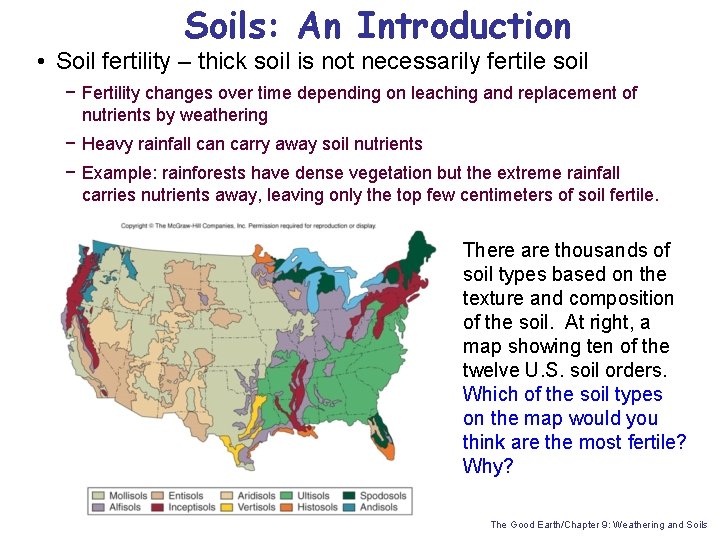
Soils: An Introduction • Soil fertility – thick soil is not necessarily fertile soil − Fertility changes over time depending on leaching and replacement of nutrients by weathering − Heavy rainfall can carry away soil nutrients − Example: rainforests have dense vegetation but the extreme rainfall carries nutrients away, leaving only the top few centimeters of soil fertile. There are thousands of soil types based on the texture and composition of the soil. At right, a map showing ten of the twelve U. S. soil orders. Which of the soil types on the map would you think are the most fertile? Why? The Good Earth/Chapter 9: Weathering and Soils
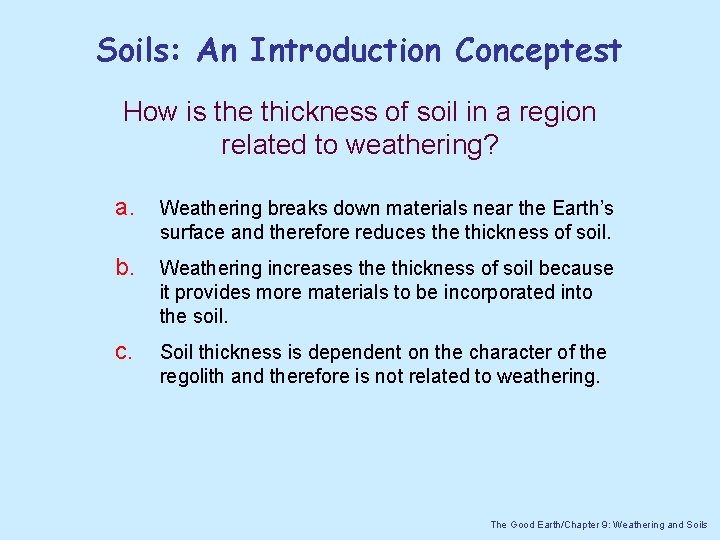
Soils: An Introduction Conceptest How is the thickness of soil in a region related to weathering? a. Weathering breaks down materials near the Earth’s surface and therefore reduces the thickness of soil. b. Weathering increases the thickness of soil because it provides more materials to be incorporated into the soil. c. Soil thickness is dependent on the character of the regolith and therefore is not related to weathering. The Good Earth/Chapter 9: Weathering and Soils
Soils: An Introduction Checkpoint 9. 18 From what you learned about geologic time in chapter 8, approximately when did the first regolith form on Earth? When did the first soils form? The Good Earth/Chapter 9: Weathering and Soils
Go back to the Table of Contents Go to the next section: Soil Erosion and Conservation The Good Earth/Chapter 9: Weathering and Soils
Soil Erosion and Conservation • Soil forms very slowly and is often depleted faster than it can be formed − Soil erosion rates are affected by climate factors (water and wind) and land use practices • Erosion of soil by wind and water occurs when soil particles are detached from soil column and transported away. This is controlled by: − the amount and frequency of rainfall − wind velocity − character of the soil − vegetation cover − slope of the land surface The Good Earth/Chapter 9: Weathering and Soils
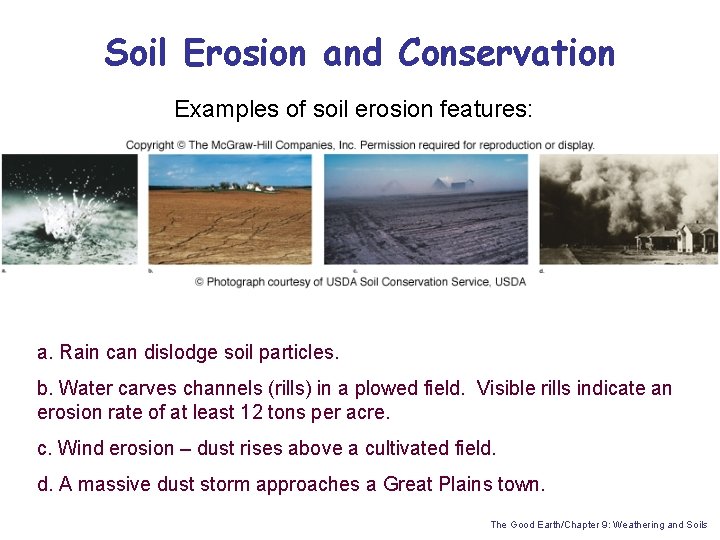
Soil Erosion and Conservation Examples of soil erosion features: a. Rain can dislodge soil particles. b. Water carves channels (rills) in a plowed field. Visible rills indicate an erosion rate of at least 12 tons per acre. c. Wind erosion – dust rises above a cultivated field. d. A massive dust storm approaches a Great Plains town. The Good Earth/Chapter 9: Weathering and Soils
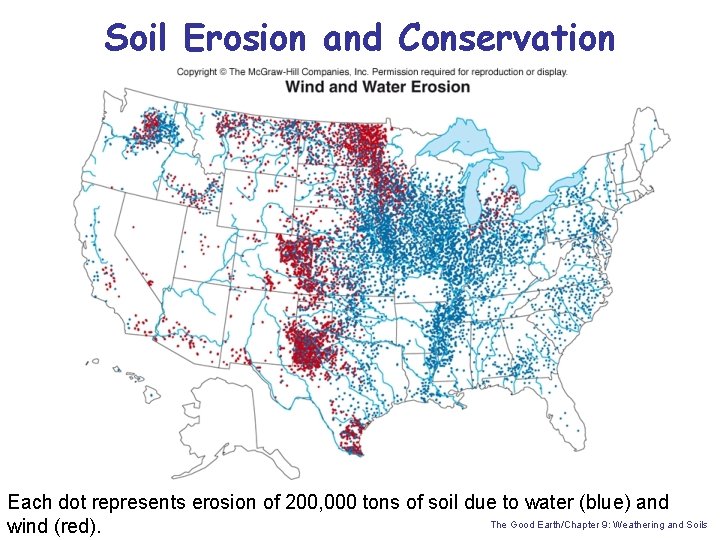
Soil Erosion and Conservation Each dot represents erosion of 200, 000 tons of soil due to water (blue) and The Good Earth/Chapter 9: Weathering and Soils wind (red).
Soil Erosion and Conservation Humans are now more important as agents in moving soils and sediments than all other natural processes operating on Earth combined. Agriculture can accelerate soil loss: -Poor soil management causes widespread soil erosion -Highest erosion rates are in parts of Africa, South America, and Asia where farming practices aren’t well regulated and rainfall is abundant -Lowest erosion rates are generally in Europe and N. America where governments encourage preservation of soils by good agricultural practices The economic cost of soil erosion in U. S. alone is estimated to be tens of billions of dollars a year! The Good Earth/Chapter 9: Weathering and Soils
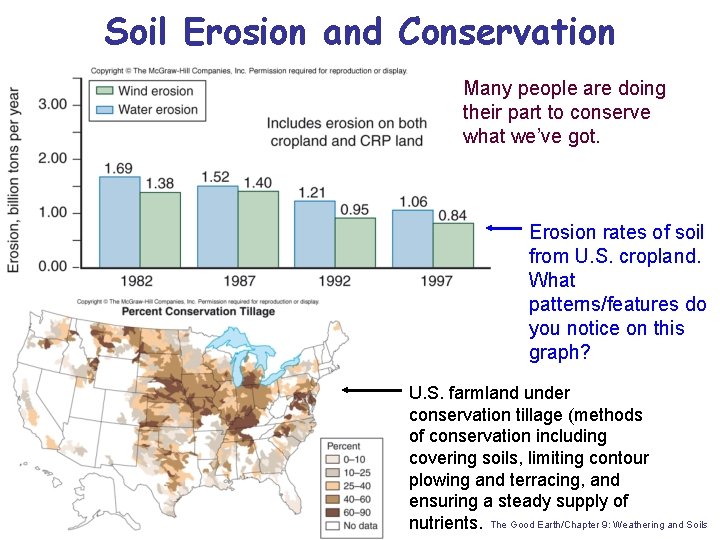
Soil Erosion and Conservation Many people are doing their part to conserve what we’ve got. Erosion rates of soil from U. S. cropland. What patterns/features do you notice on this graph? U. S. farmland under conservation tillage (methods of conservation including covering soils, limiting contour plowing and terracing, and ensuring a steady supply of nutrients. The Good Earth/Chapter 9: Weathering and Soils
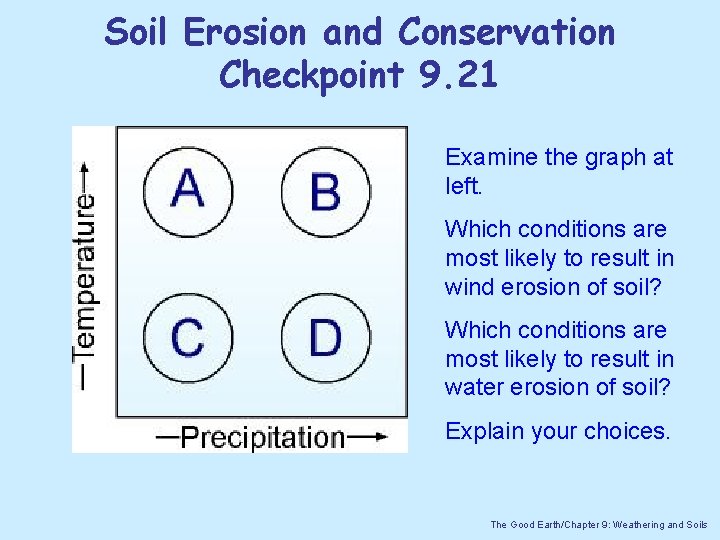
Soil Erosion and Conservation Checkpoint 9. 21 Examine the graph at left. Which conditions are most likely to result in wind erosion of soil? Which conditions are most likely to result in water erosion of soil? Explain your choices. The Good Earth/Chapter 9: Weathering and Soils
The End Go back to the Table of Contents The Good Earth/Chapter 9: Weathering and Soils