Soil Classification NR 200 Chapter 3 652021 1
- Slides: 49
Soil Classification NR 200 Chapter 3 6/5/2021 1
Why classify? n Soils are classified on the basis of their profile characteristics: Moisture, temperature, color, texture, structure, organic matter, clay, iron, salts, p. H, percentage of base saturation and soil depth. 6/5/2021 2
Individual soils: Pedon – and individual soil profile 1 - 10 m 2 n Polypedon – a group of pedons n When a polypedon has related characteristics of the profile then we can call it a : n ¨soil 6/5/2021 series. 3
Many terms are used to describe soils: n n Epipedons – top portion Ochric – light colored, low organic matter and may be massive structure when dry. Histic – High organic matter Subsurface Duripan – hardpan cemented by silica Fragipan – brittle pan, loamy to silty in texture Salic – Accumulation of salts 6/5/2021 4
Many terms are used to describe soils: continued n Soil moisture Ustic – soil moisture available during the growing season but dry drought periods will occur. Xeric – moist cool winters and dry summers 6/5/2021 5
Taxonomy of Soil Science: The systematic evaluation of the properties of the soil. Just like all living organisms. 6/5/2021 6
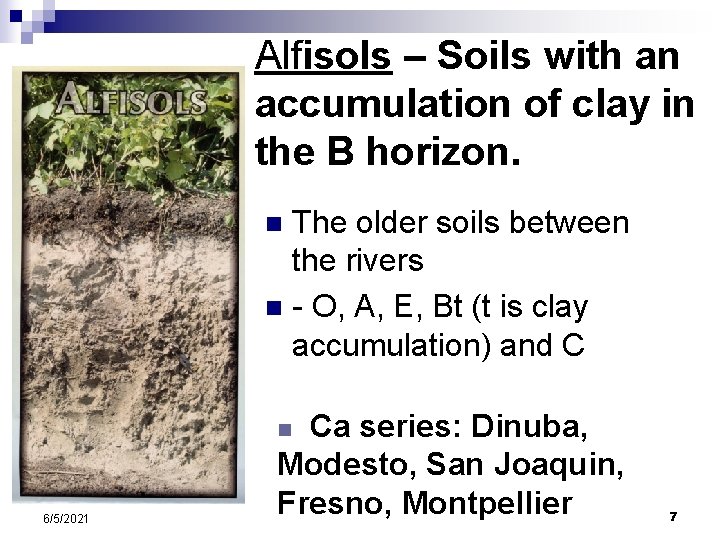
Alfisols – Soils with an accumulation of clay in the B horizon. The older soils between the rivers n - O, A, E, Bt (t is clay accumulation) and C n Ca series: Dinuba, Modesto, San Joaquin, Fresno, Montpellier n 6/5/2021 7
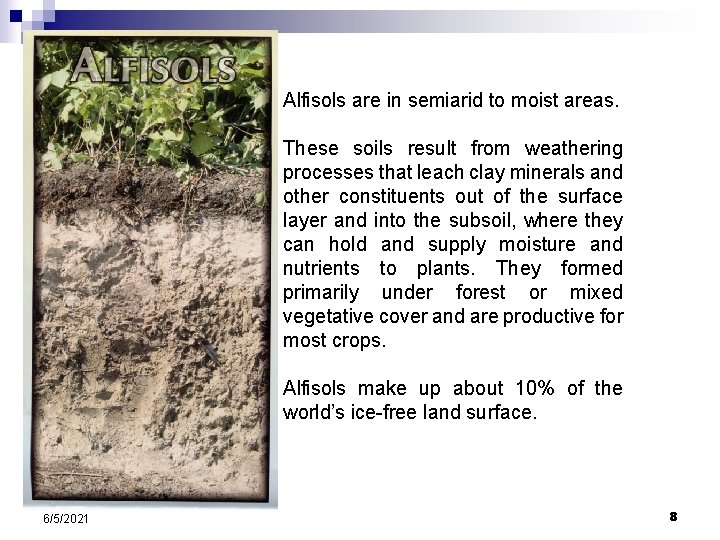
Alfisols are in semiarid to moist areas. These soils result from weathering processes that leach clay minerals and other constituents out of the surface layer and into the subsoil, where they can hold and supply moisture and nutrients to plants. They formed primarily under forest or mixed vegetative cover and are productive for most crops. Alfisols make up about 10% of the world’s ice-free land surface. 6/5/2021 8
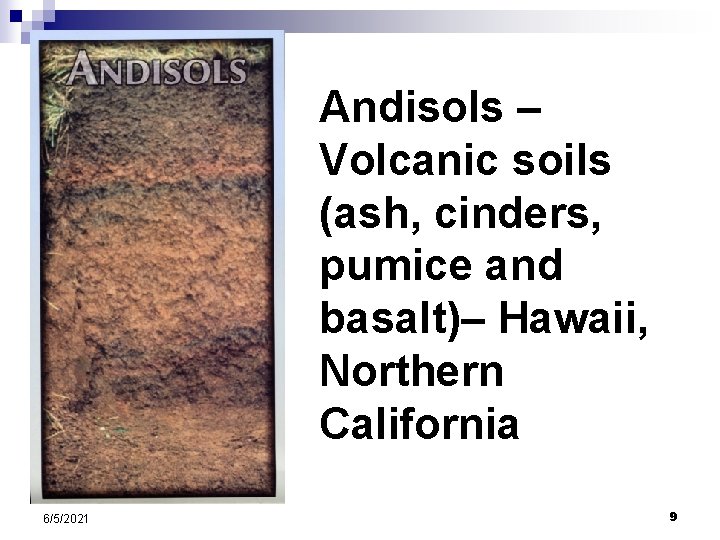
Andisols – Volcanic soils (ash, cinders, pumice and basalt)– Hawaii, Northern California 6/5/2021 9
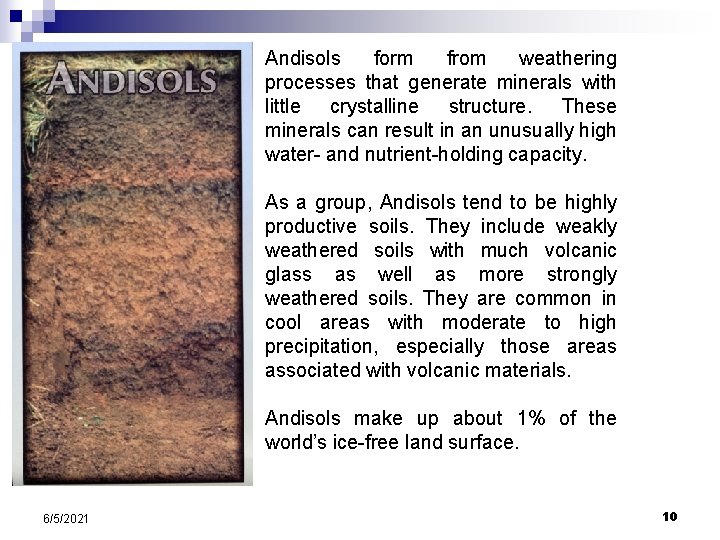
Andisols form from weathering processes that generate minerals with little crystalline structure. These minerals can result in an unusually high water- and nutrient-holding capacity. As a group, Andisols tend to be highly productive soils. They include weakly weathered soils with much volcanic glass as well as more strongly weathered soils. They are common in cool areas with moderate to high precipitation, especially those areas associated with volcanic materials. Andisols make up about 1% of the world’s ice-free land surface. 6/5/2021 10
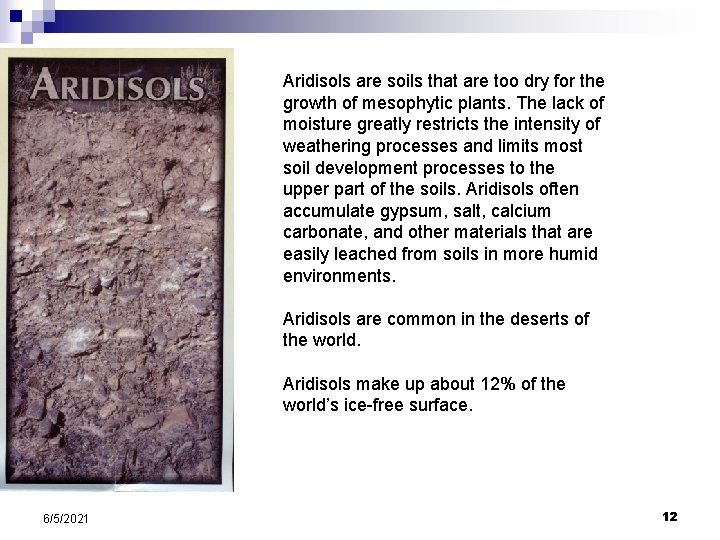
Aridisols – 6/5/2021 Arid Western soils low organic soils. Moisture is inadequate to mature a crop without irrigation in most years. 11
Aridisols are soils that are too dry for the growth of mesophytic plants. The lack of moisture greatly restricts the intensity of weathering processes and limits most soil development processes to the upper part of the soils. Aridisols often accumulate gypsum, salt, calcium carbonate, and other materials that are easily leached from soils in more humid environments. Aridisols are common in the deserts of the world. Aridisols make up about 12% of the world’s ice-free surface. 6/5/2021 12
Entisols – Very young soils, with C horizon and maybe a slight developed A horizon The Entisol soils that are formed from alluvial fans are some of the most productive soils in the world. Irrigated farming on the good young Valley soils produces crops in great abundance. California Series: Hanford, Delhi, Tujunga, Zacharis, White Rock 6/5/2021 13
Entisols are soils that show little or no evidence of pedogenic horizon development. Entisols occur in areas of recently deposited parent materials or in areas where erosion or depositions rates are faster than the rate of soil development; such as dunes, steep slopes, and flood planes. They occur in many environments. 6/5/2021 Entisols make up about 16% of the world’s ice-free land surface. 14
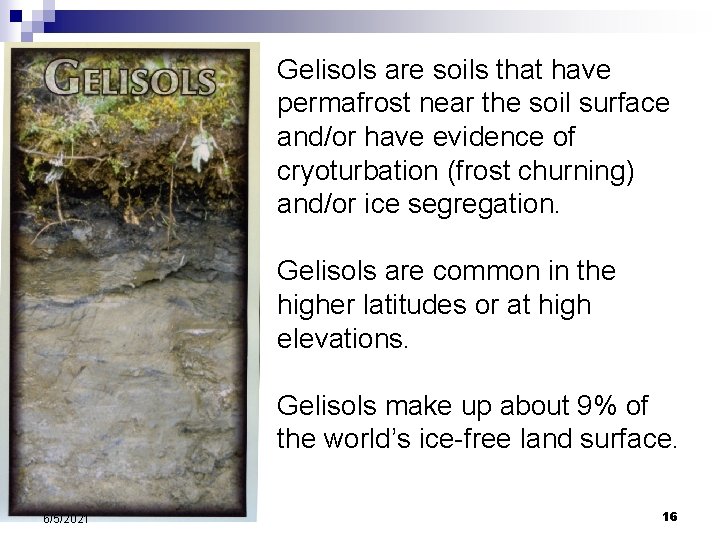
Gelisols – permafrost soils, tundra slowly aging. 6/5/2021 15
Gelisols are soils that have permafrost near the soil surface and/or have evidence of cryoturbation (frost churning) and/or ice segregation. Gelisols are common in the higher latitudes or at high elevations. Gelisols make up about 9% of the world’s ice-free land surface. 6/5/2021 16
Histosols – Organic soils over 20% OM –Delta area 6/5/2021 17
Histosols have a high content of organic matter and no permafrost. Most are saturated year round, but a few are freely drained. Histosols are commonly called bogs, moors, peats, or mucks. Histosols form in decomposed plant remains that accumulate in water, forest litter, or moss faster than they decay. If these soils are drained and exposed to air, microbial decomposition is accelerated and the soils may subside dramatically. 6/5/2021 Histosols make up about 1% of the world’s ice-free surface. 18
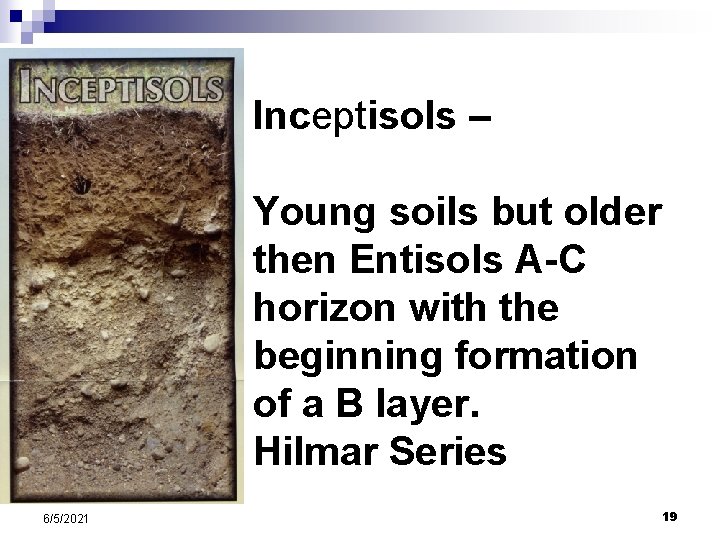
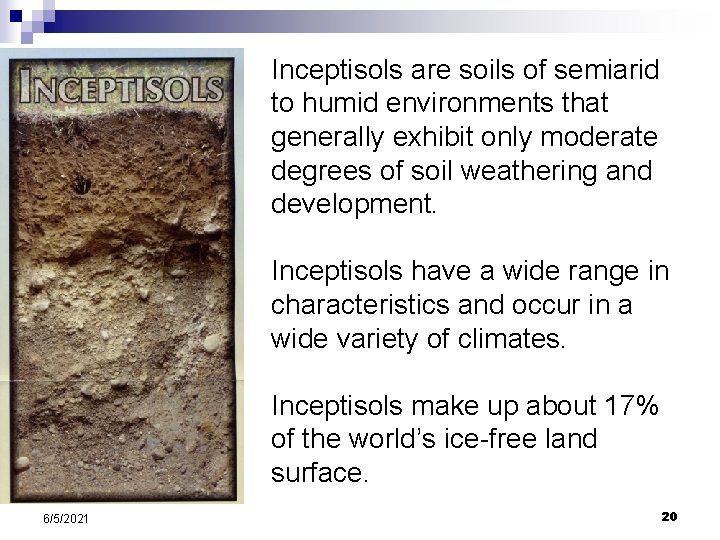
Inceptisols – Young soils but older then Entisols A-C horizon with the beginning formation of a B layer. Hilmar Series 6/5/2021 19
Inceptisols are soils of semiarid to humid environments that generally exhibit only moderate degrees of soil weathering and development. Inceptisols have a wide range in characteristics and occur in a wide variety of climates. Inceptisols make up about 17% of the world’s ice-free land surface. 6/5/2021 20
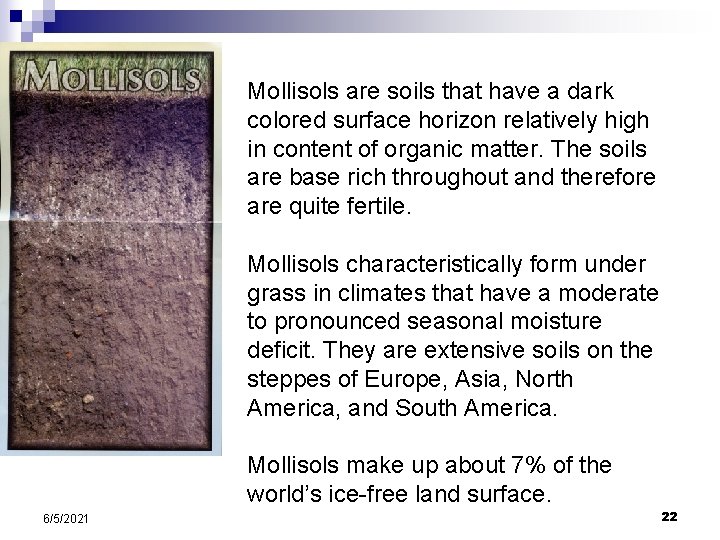
Mollisols – Most soils have developed under grass vegetation, Prairie soils Mineral soils with thick, dark surface horizons relatively high in organic matter and with high base saturation. The great Mid-West grain belt is predominately this order. Ca series: Grangeville, Sorrento 6/5/2021 21
Mollisols are soils that have a dark colored surface horizon relatively high in content of organic matter. The soils are base rich throughout and therefore are quite fertile. Mollisols characteristically form under grass in climates that have a moderate to pronounced seasonal moisture deficit. They are extensive soils on the steppes of Europe, Asia, North America, and South America. Mollisols make up about 7% of the world’s ice-free land surface. 6/5/2021 22
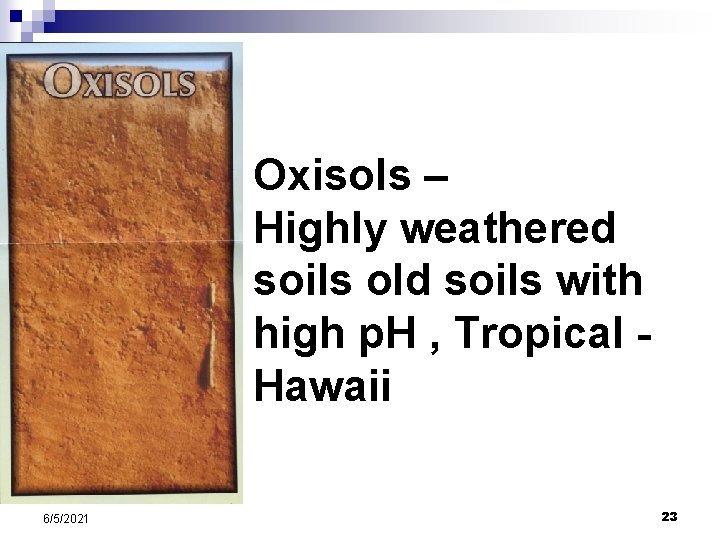
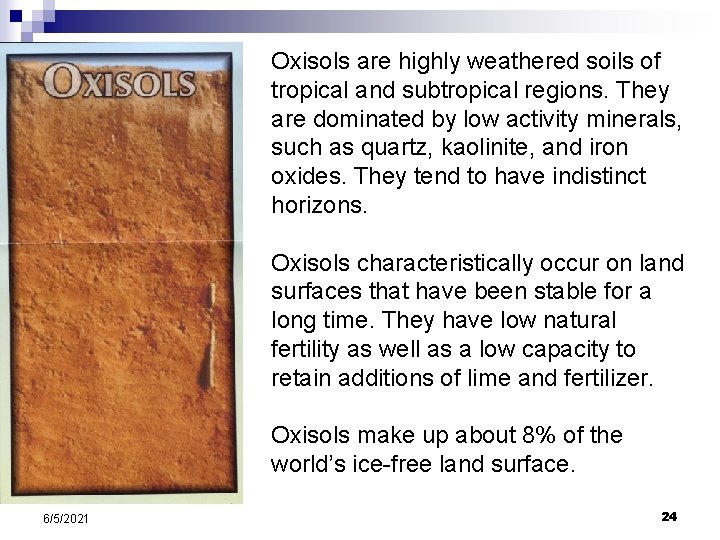
Oxisols – Highly weathered soils old soils with high p. H , Tropical Hawaii 6/5/2021 23
Oxisols are highly weathered soils of tropical and subtropical regions. They are dominated by low activity minerals, such as quartz, kaolinite, and iron oxides. They tend to have indistinct horizons. Oxisols characteristically occur on land surfaces that have been stable for a long time. They have low natural fertility as well as a low capacity to retain additions of lime and fertilizer. Oxisols make up about 8% of the world’s ice-free land surface. 6/5/2021 24
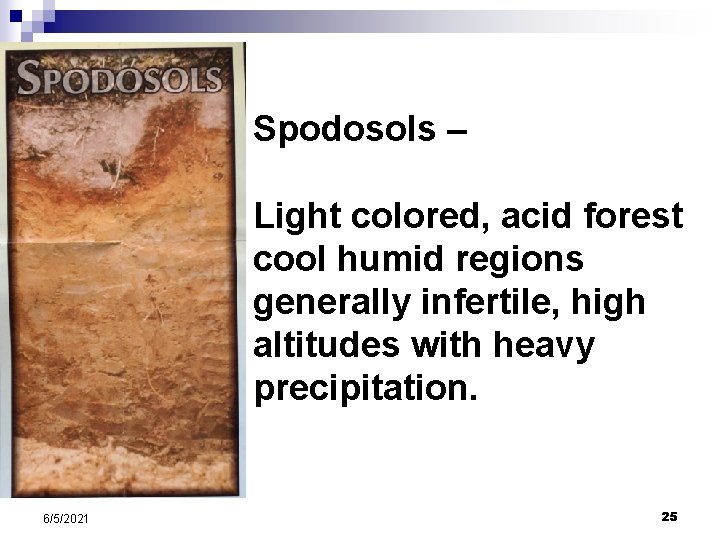
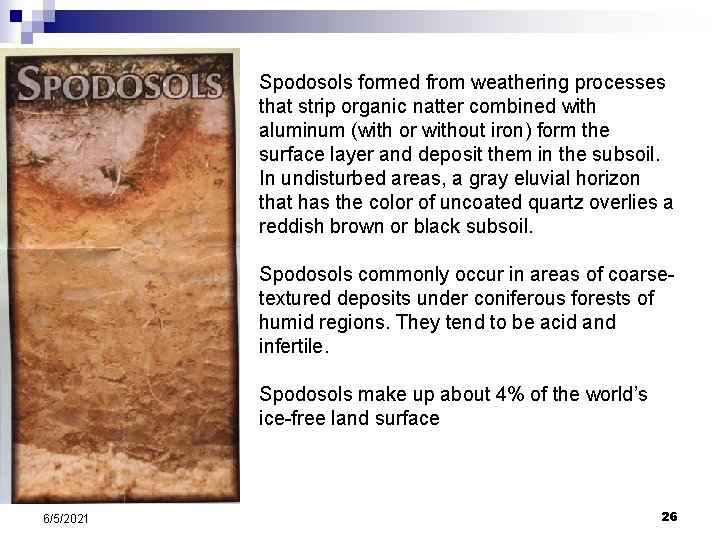
Spodosols – Light colored, acid forest cool humid regions generally infertile, high altitudes with heavy precipitation. 6/5/2021 25
Spodosols formed from weathering processes that strip organic natter combined with aluminum (with or without iron) form the surface layer and deposit them in the subsoil. In undisturbed areas, a gray eluvial horizon that has the color of uncoated quartz overlies a reddish brown or black subsoil. Spodosols commonly occur in areas of coarsetextured deposits under coniferous forests of humid regions. They tend to be acid and infertile. Spodosols make up about 4% of the world’s ice-free land surface 6/5/2021 26
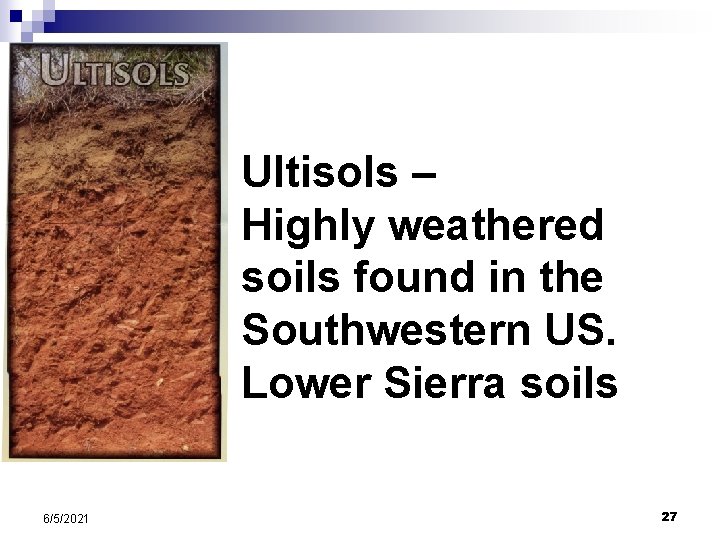
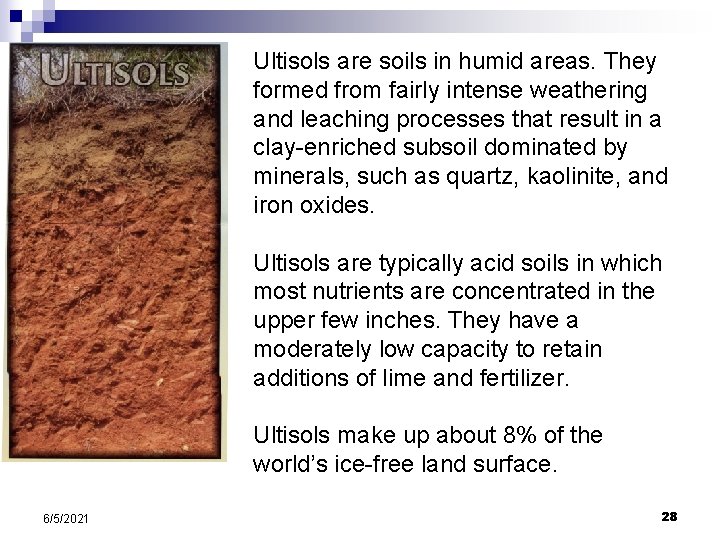
Ultisols – Highly weathered soils found in the Southwestern US. Lower Sierra soils 6/5/2021 27
Ultisols are soils in humid areas. They formed from fairly intense weathering and leaching processes that result in a clay-enriched subsoil dominated by minerals, such as quartz, kaolinite, and iron oxides. Ultisols are typically acid soils in which most nutrients are concentrated in the upper few inches. They have a moderately low capacity to retain additions of lime and fertilizer. Ultisols make up about 8% of the world’s ice-free land surface. 6/5/2021 28
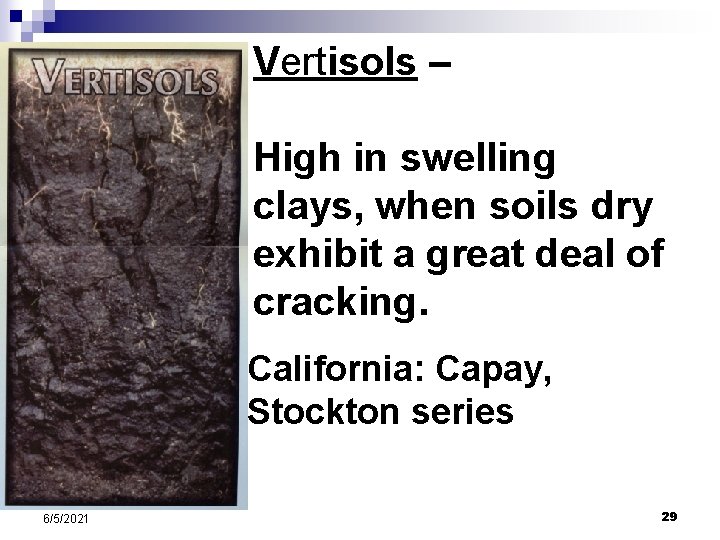
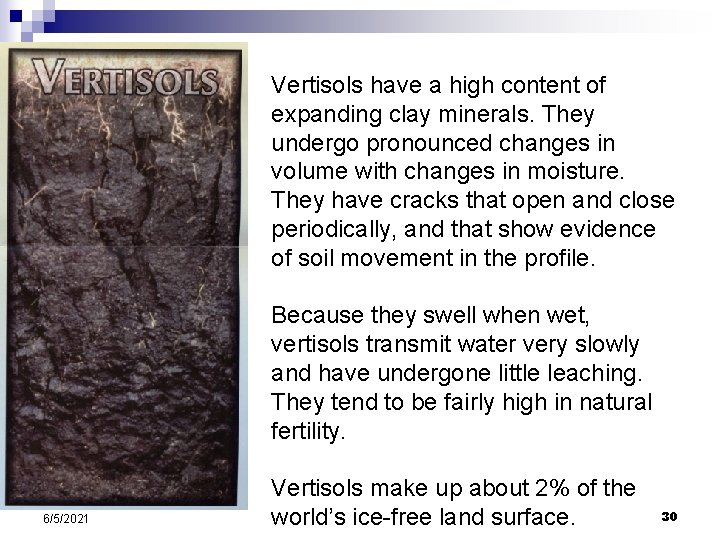
Vertisols – High in swelling clays, when soils dry exhibit a great deal of cracking. California: Capay, Stockton series 6/5/2021 29
Vertisols have a high content of expanding clay minerals. They undergo pronounced changes in volume with changes in moisture. They have cracks that open and close periodically, and that show evidence of soil movement in the profile. Because they swell when wet, vertisols transmit water very slowly and have undergone little leaching. They tend to be fairly high in natural fertility. 6/5/2021 Vertisols make up about 2% of the world’s ice-free land surface. 30
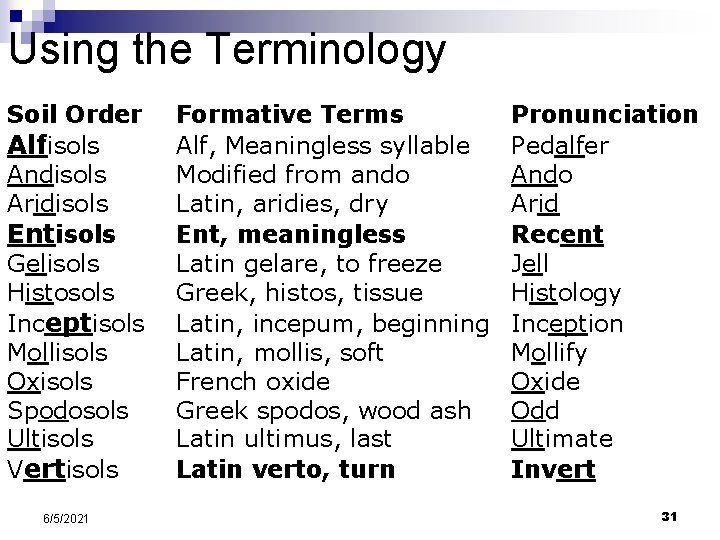
Using the Terminology Soil Order Alfisols Andisols Aridisols Entisols Gelisols Histosols Inceptisols Mollisols Oxisols Spodosols Ultisols Vertisols 6/5/2021 Formative Terms Alf, Meaningless syllable Modified from ando Latin, aridies, dry Ent, meaningless Latin gelare, to freeze Greek, histos, tissue Latin, incepum, beginning Latin, mollis, soft French oxide Greek spodos, wood ash Latin ultimus, last Latin verto, turn Pronunciation Pedalfer Ando Arid Recent Jell Histology Inception Mollify Oxide Odd Ultimate Invert 31
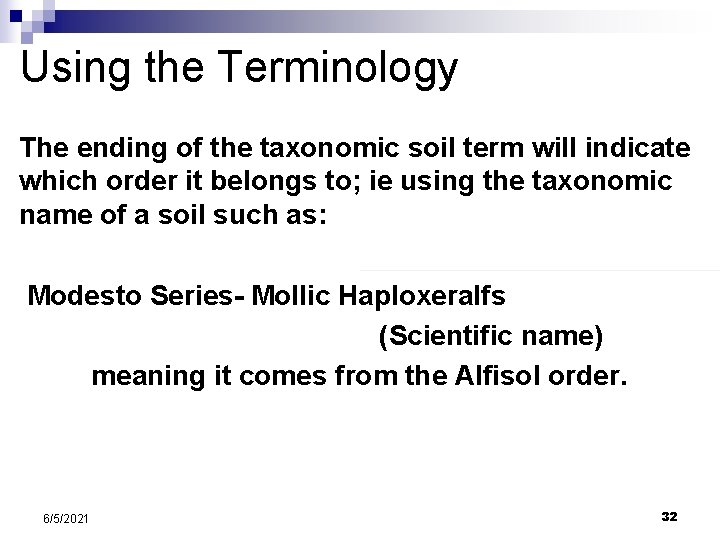
Using the Terminology The ending of the taxonomic soil term will indicate which order it belongs to; ie using the taxonomic name of a soil such as: Modesto Series- Mollic Haploxeralfs (Scientific name) meaning it comes from the Alfisol order. 6/5/2021 32
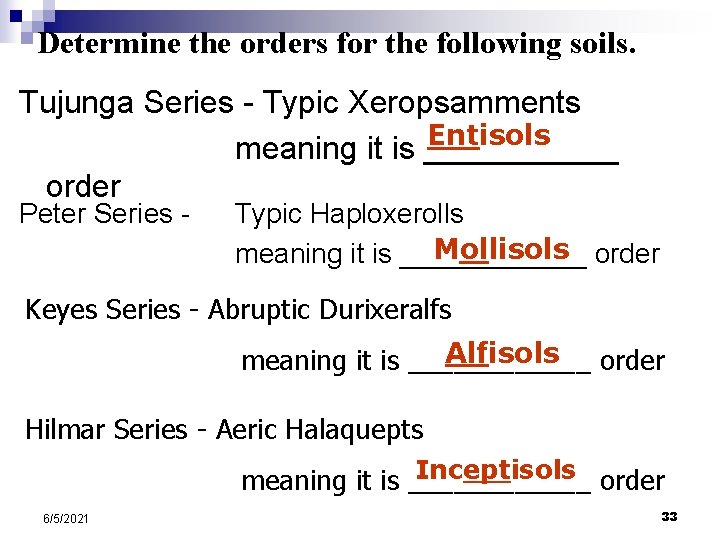
Determine the orders for the following soils. Tujunga Series - Typic Xeropsamments Entisols meaning it is ______ order Peter Series - Typic Haploxerolls Mollisols order meaning it is ______ Keyes Series - Abruptic Durixeralfs Alfisols order meaning it is ______ Hilmar Series - Aeric Halaquepts Inceptisols order meaning it is ______ 6/5/2021 33
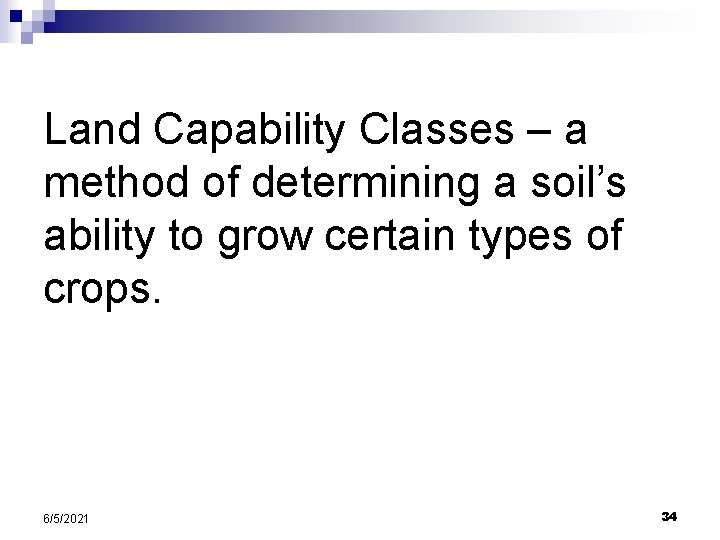
Land Capability Classes – a method of determining a soil’s ability to grow certain types of crops. 6/5/2021 34
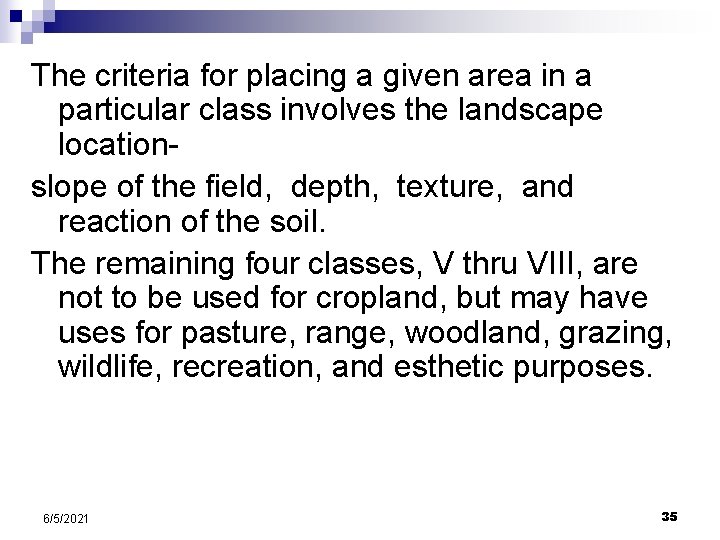
The criteria for placing a given area in a particular class involves the landscape locationslope of the field, depth, texture, and reaction of the soil. The remaining four classes, V thru VIII, are not to be used for cropland, but may have uses for pasture, range, woodland, grazing, wildlife, recreation, and esthetic purposes. 6/5/2021 35
Exerpt from A. A. Klingebiel and P. H. Montgomery, Land Capability Classification, Agriculture Handbook No. 210 (Washington, DC: Soil Conservation Service, U. S. Department of Agriculture, 1961), pp. 1 -3. 6/5/2021 36
I: Can grow anything 6/5/2021 37
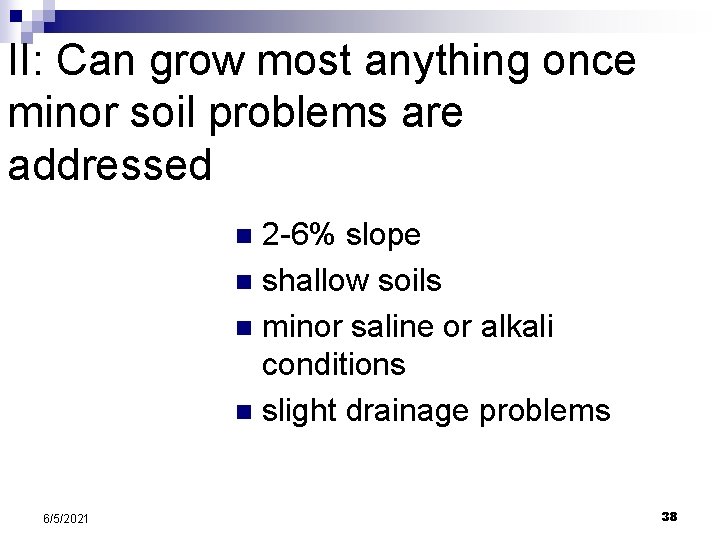
II: Can grow most anything once minor soil problems are addressed 2 -6% slope n shallow soils n minor saline or alkali conditions n slight drainage problems n 6/5/2021 38
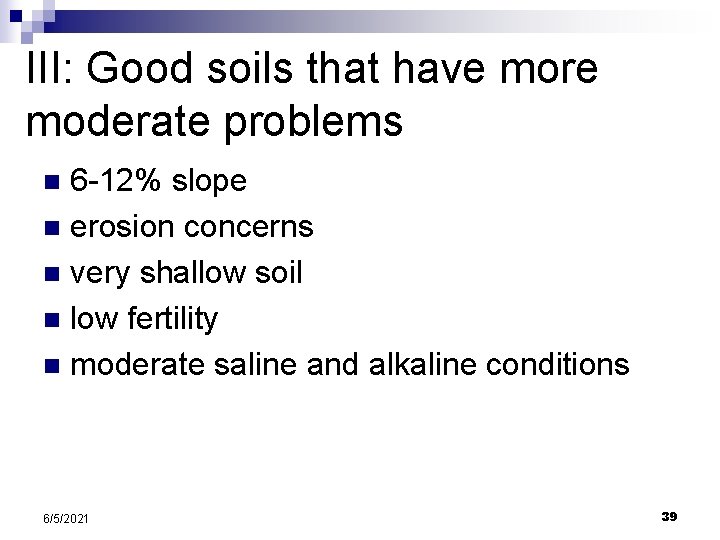
III: Good soils that have more moderate problems 6 -12% slope n erosion concerns n very shallow soil n low fertility n moderate saline and alkaline conditions n 6/5/2021 39
IV: Pasture to grass hays 6/5/2021 40
V-VIII: Little agriculture value except for pasture for grazing 6/5/2021 41
Letters for further understanding e - erosion factor n w – wetness n s – stony, tillage difficulties, shallow or saline n 6/5/2021 42
Storie Index Rating 6/5/2021 43
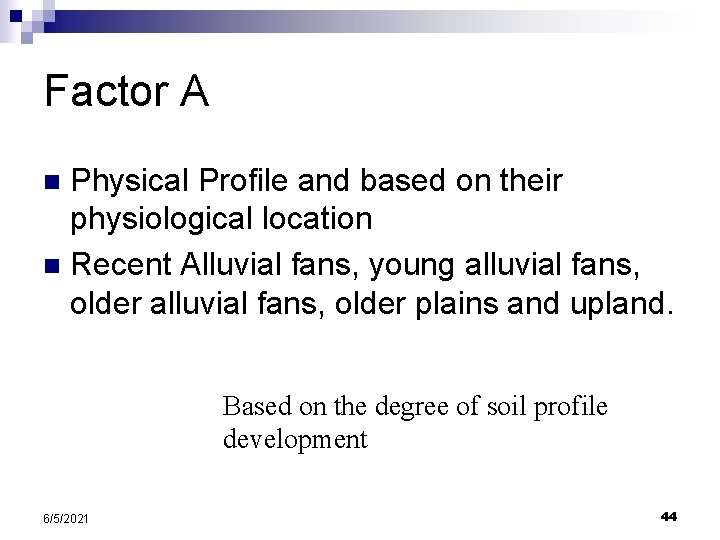
Factor A Physical Profile and based on their physiological location n Recent Alluvial fans, young alluvial fans, older plains and upland. n Based on the degree of soil profile development 6/5/2021 44
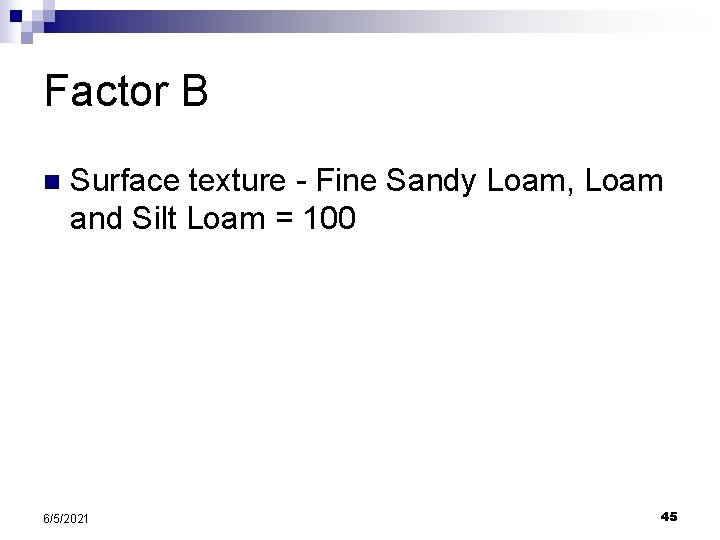
Factor B n Surface texture - Fine Sandy Loam, Loam and Silt Loam = 100 6/5/2021 45
Factor C n Slope 0 -2% = 100 6/5/2021 46
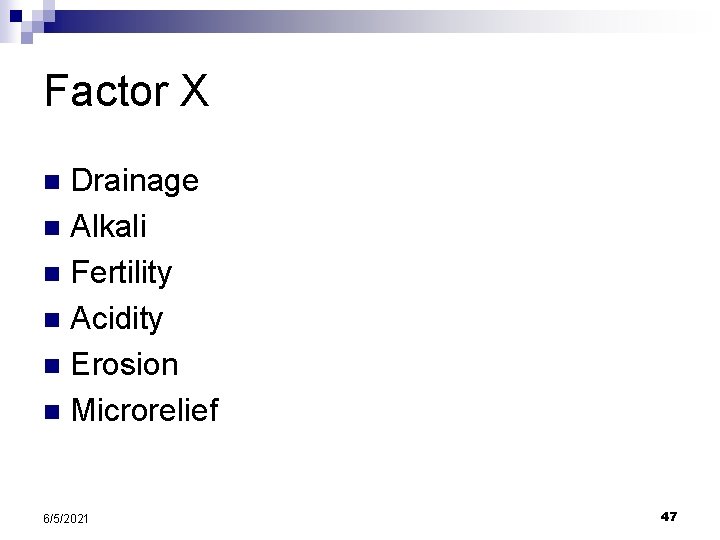
Factor X Drainage n Alkali n Fertility n Acidity n Erosion n Microrelief n 6/5/2021 47
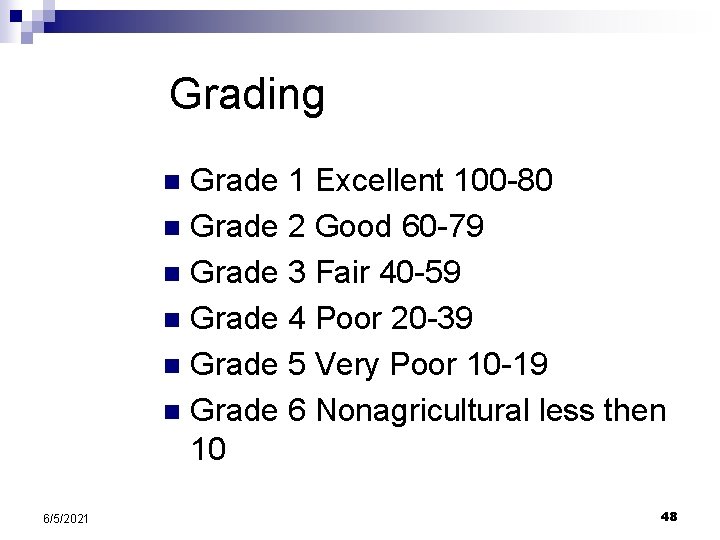
Grading Grade 1 Excellent 100 -80 n Grade 2 Good 60 -79 n Grade 3 Fair 40 -59 n Grade 4 Poor 20 -39 n Grade 5 Very Poor 10 -19 n Grade 6 Nonagricultural less then 10 n 6/5/2021 48
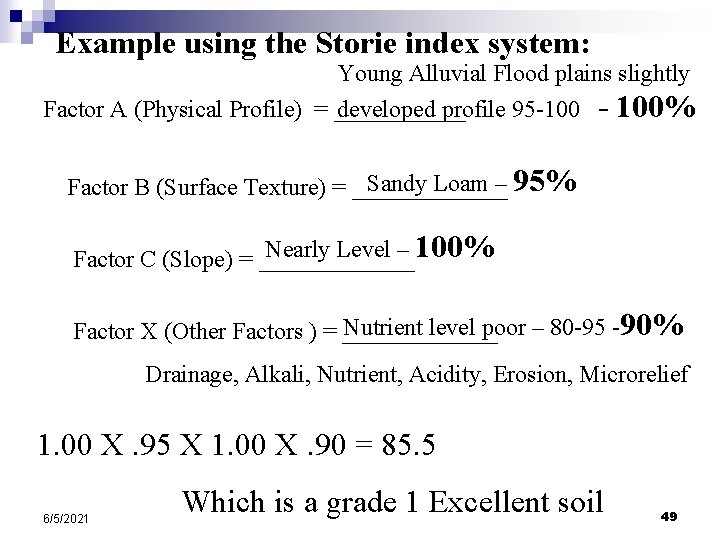
Example using the Storie index system: Young Alluvial Flood plains slightly Factor A (Physical Profile) = ______ developed profile 95 -100 - 100% Sandy Loam – 95% Factor B (Surface Texture) = _______ Nearly Level – 100% Factor C (Slope) = _______ Nutrient level poor – 80 -95 -90% Factor X (Other Factors ) = _______ Drainage, Alkali, Nutrient, Acidity, Erosion, Microrelief 1. 00 X. 95 X 1. 00 X. 90 = 85. 5 6/5/2021 Which is a grade 1 Excellent soil 49