Chapter 9 Net Present Value and Other Investment


- Slides: 26
Chapter 9 • Net Present Value and Other Investment Criteria Mc. Graw-Hill/Irwin Copyright © 2006 by The Mc. Graw-Hill Companies, Inc. All rights reserved.
Chapter 9 – Index of Sample Problems • • • Slide # 02 - 04 Slide # 05 - 06 Slide # 07 - 08 Slide # 09 - 10 Slide # 11 - 12 Slide # 13 - 16 Slide # 17 - 19 Slide # 20 - 22 Slide # 23 - 24 Net present value Payback Discounted payback Average accounting return Internal rate of return Crossover point Profitability index Mutually exclusive projects Multiple independent projects
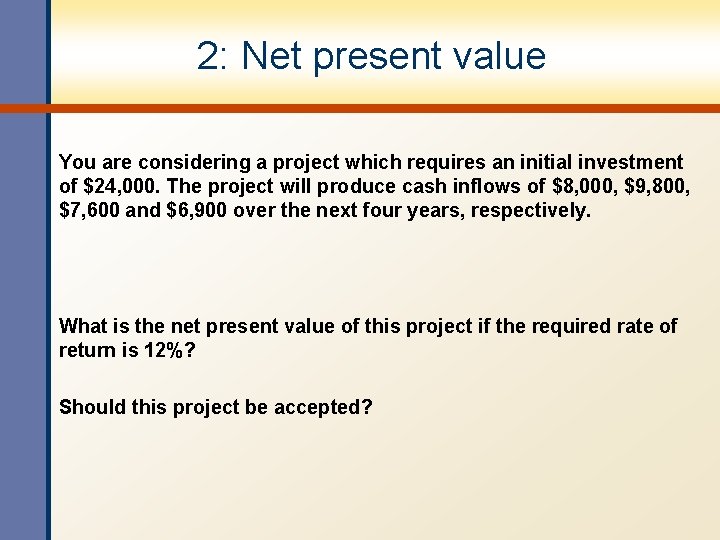
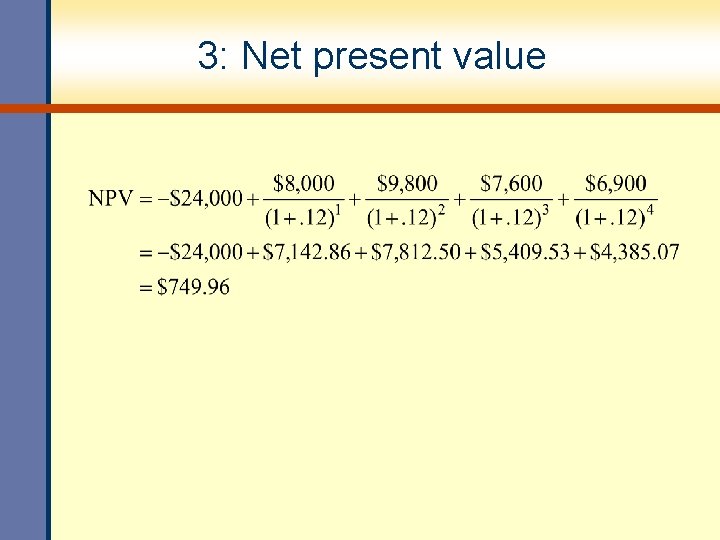
2: Net present value You are considering a project which requires an initial investment of $24, 000. The project will produce cash inflows of $8, 000, $9, 800, $7, 600 and $6, 900 over the next four years, respectively. What is the net present value of this project if the required rate of return is 12%? Should this project be accepted?
3: Net present value
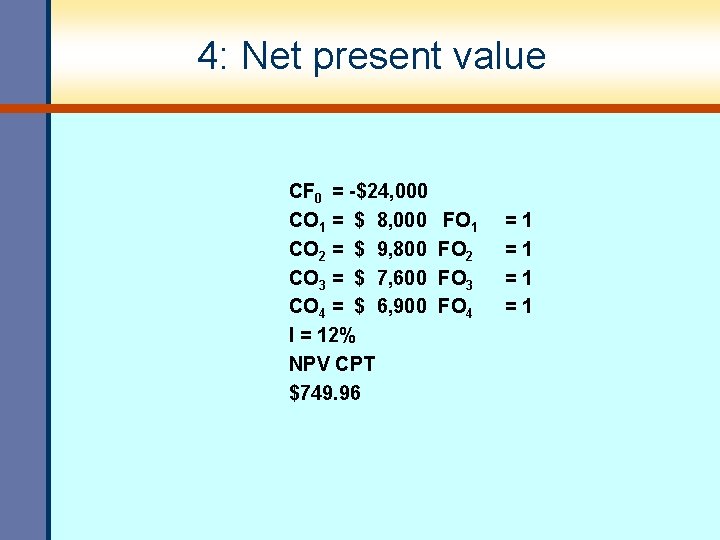
4: Net present value CF 0 = -$24, 000 CO 1 = $ 8, 000 CO 2 = $ 9, 800 CO 3 = $ 7, 600 CO 4 = $ 6, 900 I = 12% NPV CPT $749. 96 FO 1 FO 2 FO 3 FO 4 =1 =1
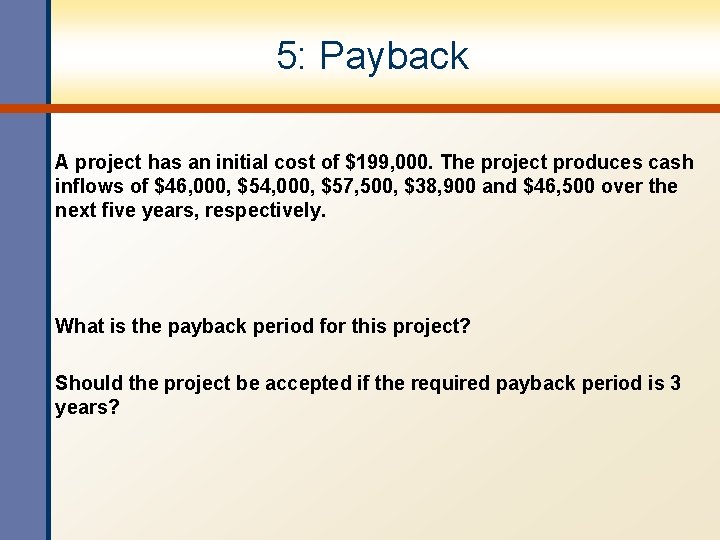
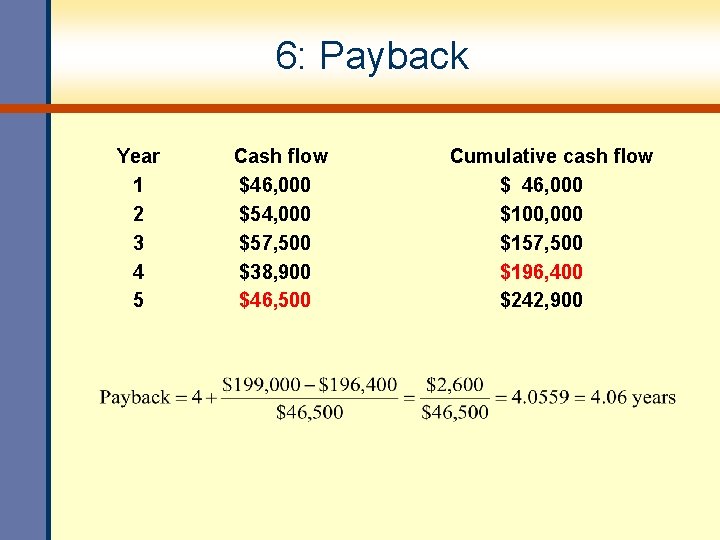
5: Payback A project has an initial cost of $199, 000. The project produces cash inflows of $46, 000, $54, 000, $57, 500, $38, 900 and $46, 500 over the next five years, respectively. What is the payback period for this project? Should the project be accepted if the required payback period is 3 years?
6: Payback Year 1 2 3 4 5 Cash flow $46, 000 $54, 000 $57, 500 $38, 900 $46, 500 Cumulative cash flow $ 46, 000 $100, 000 $157, 500 $196, 400 $242, 900
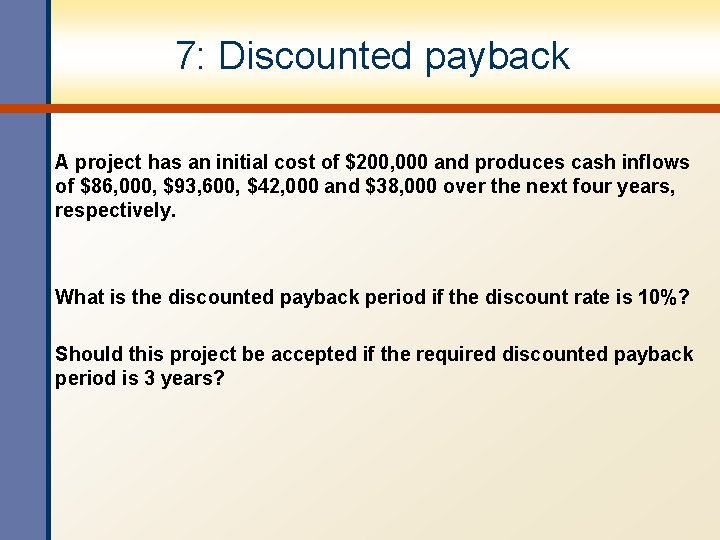
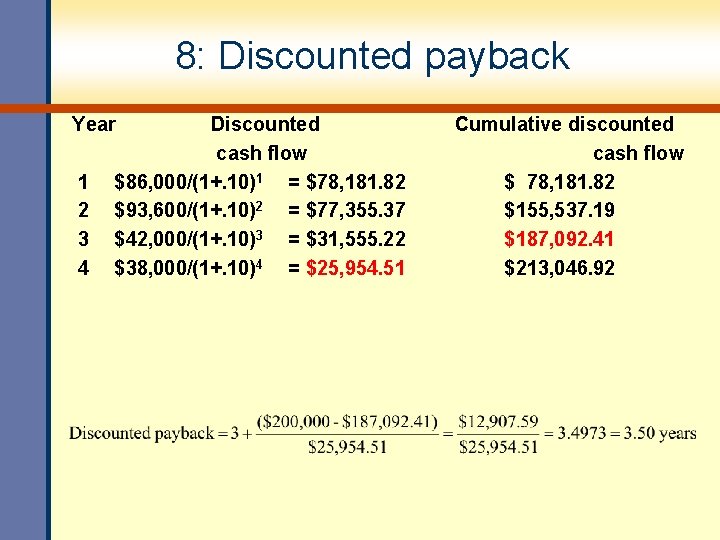
7: Discounted payback A project has an initial cost of $200, 000 and produces cash inflows of $86, 000, $93, 600, $42, 000 and $38, 000 over the next four years, respectively. What is the discounted payback period if the discount rate is 10%? Should this project be accepted if the required discounted payback period is 3 years?
8: Discounted payback Year 1 2 3 4 Discounted cash flow $86, 000/(1+. 10)1 = $78, 181. 82 $93, 600/(1+. 10)2 = $77, 355. 37 $42, 000/(1+. 10)3 = $31, 555. 22 $38, 000/(1+. 10)4 = $25, 954. 51 Cumulative discounted cash flow $ 78, 181. 82 $155, 537. 19 $187, 092. 41 $213, 046. 92
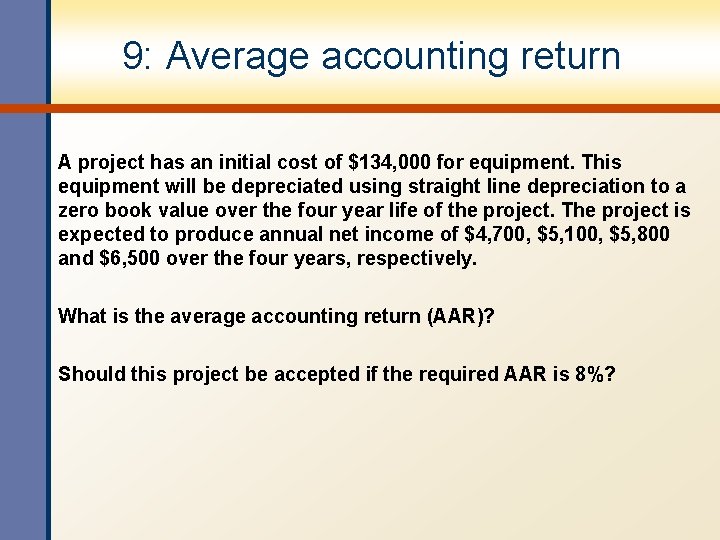
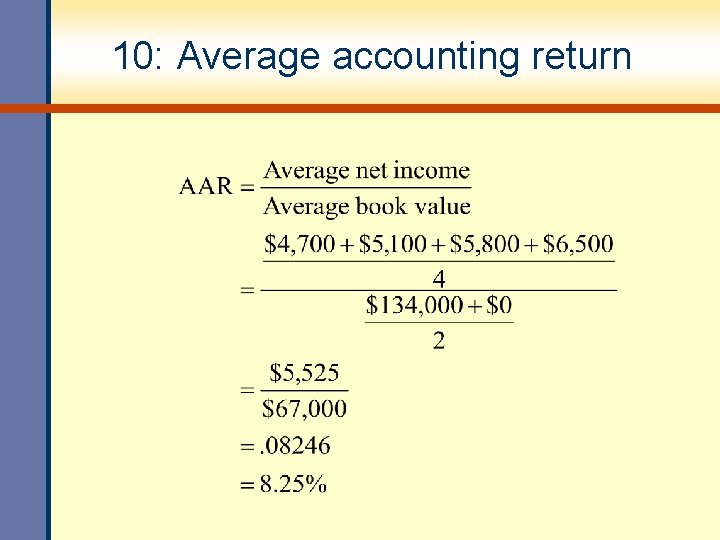
9: Average accounting return A project has an initial cost of $134, 000 for equipment. This equipment will be depreciated using straight line depreciation to a zero book value over the four year life of the project. The project is expected to produce annual net income of $4, 700, $5, 100, $5, 800 and $6, 500 over the four years, respectively. What is the average accounting return (AAR)? Should this project be accepted if the required AAR is 8%?
10: Average accounting return
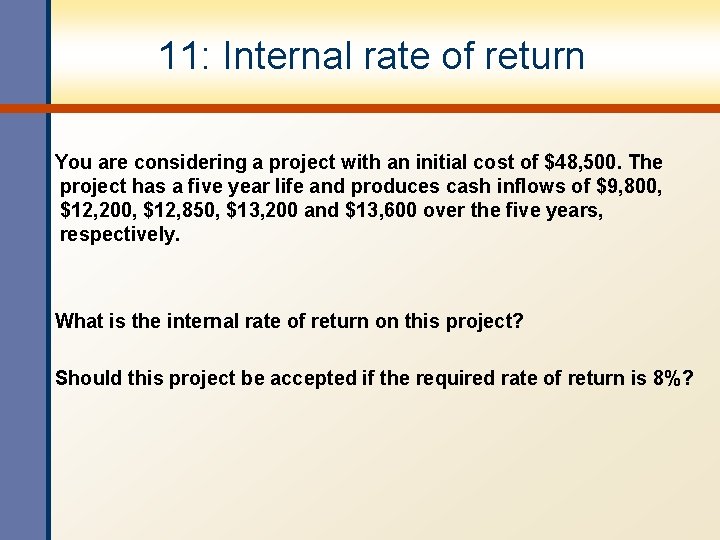
11: Internal rate of return You are considering a project with an initial cost of $48, 500. The project has a five year life and produces cash inflows of $9, 800, $12, 200, $12, 850, $13, 200 and $13, 600 over the five years, respectively. What is the internal rate of return on this project? Should this project be accepted if the required rate of return is 8%?
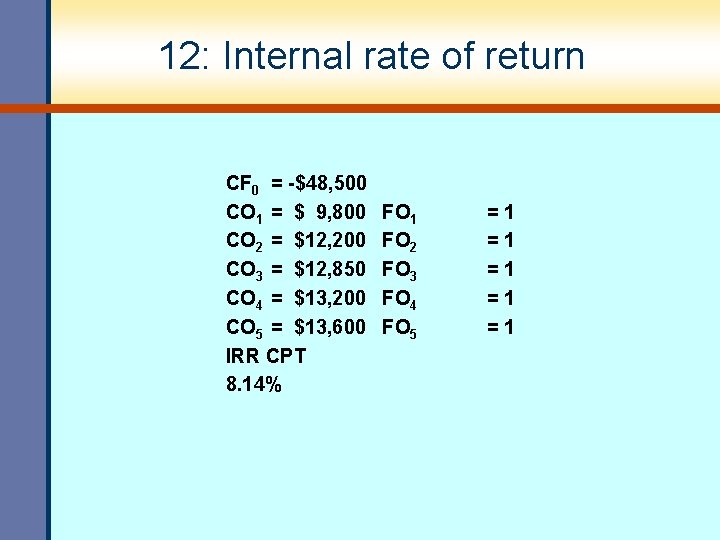
12: Internal rate of return CF 0 = -$48, 500 CO 1 = $ 9, 800 CO 2 = $12, 200 CO 3 = $12, 850 CO 4 = $13, 200 CO 5 = $13, 600 IRR CPT 8. 14% FO 1 FO 2 FO 3 FO 4 FO 5 =1 =1 =1
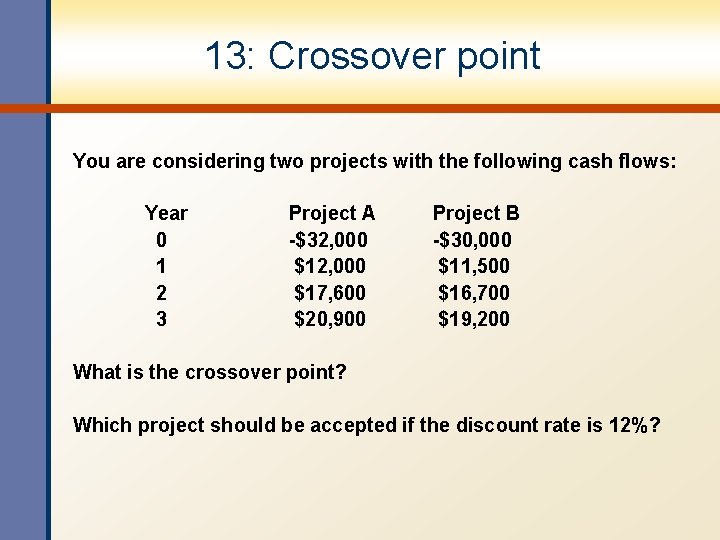
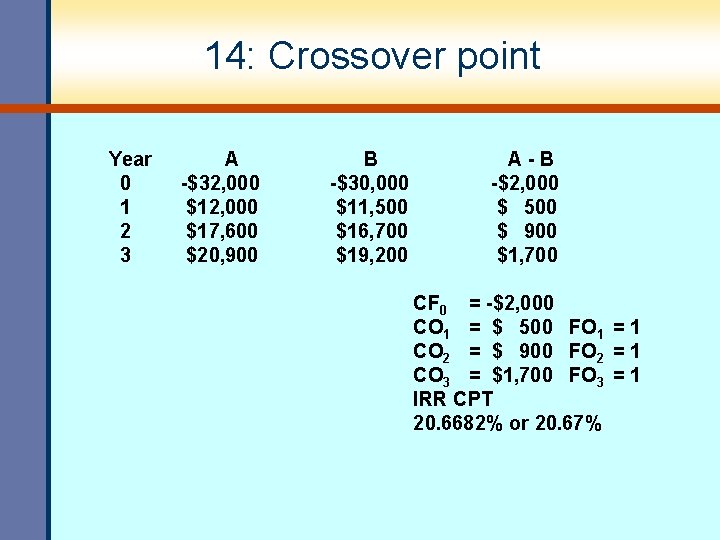
13: Crossover point You are considering two projects with the following cash flows: Year 0 1 2 3 Project A -$32, 000 $17, 600 $20, 900 Project B -$30, 000 $11, 500 $16, 700 $19, 200 What is the crossover point? Which project should be accepted if the discount rate is 12%?
14: Crossover point Year 0 1 2 3 A -$32, 000 $17, 600 $20, 900 B -$30, 000 $11, 500 $16, 700 $19, 200 A-B -$2, 000 $ 500 $ 900 $1, 700 CF 0 = -$2, 000 CO 1 = $ 500 FO 1 = 1 CO 2 = $ 900 FO 2 = 1 CO 3 = $1, 700 FO 3 = 1 IRR CPT 20. 6682% or 20. 67%
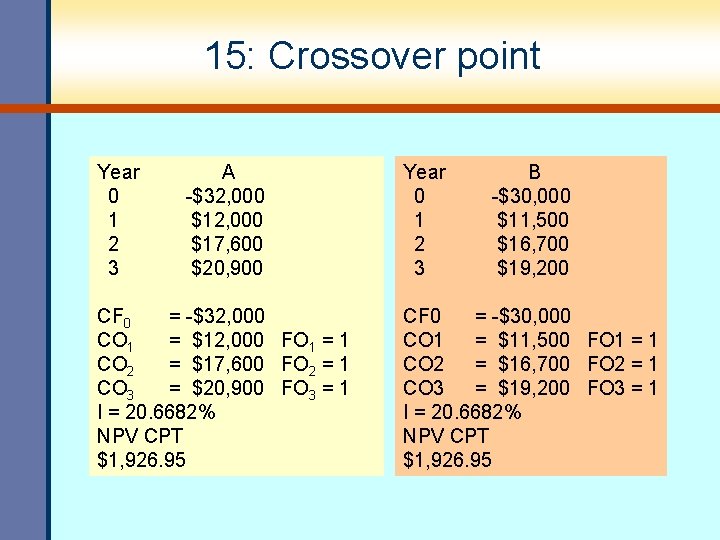
15: Crossover point Year 0 1 2 3 A -$32, 000 $17, 600 $20, 900 CF 0 = -$32, 000 CO 1 = $12, 000 FO 1 = 1 CO 2 = $17, 600 FO 2 = 1 CO 3 = $20, 900 FO 3 = 1 I = 20. 6682% NPV CPT $1, 926. 95 Year 0 1 2 3 B -$30, 000 $11, 500 $16, 700 $19, 200 CF 0 = -$30, 000 CO 1 = $11, 500 FO 1 = 1 CO 2 = $16, 700 FO 2 = 1 CO 3 = $19, 200 FO 3 = 1 I = 20. 6682% NPV CPT $1, 926. 95
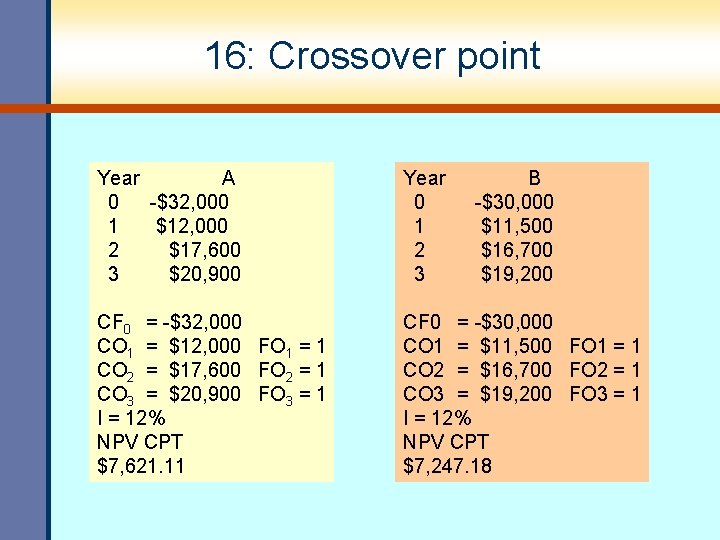
16: Crossover point Year A 0 -$32, 000 1 $12, 000 2 $17, 600 3 $20, 900 Year 0 1 2 3 B -$30, 000 $11, 500 $16, 700 $19, 200 CF 0 = -$32, 000 CO 1 = $12, 000 FO 1 = 1 CO 2 = $17, 600 FO 2 = 1 CO 3 = $20, 900 FO 3 = 1 I = 12% NPV CPT $7, 621. 11 CF 0 = -$30, 000 CO 1 = $11, 500 FO 1 = 1 CO 2 = $16, 700 FO 2 = 1 CO 3 = $19, 200 FO 3 = 1 I = 12% NPV CPT $7, 247. 18
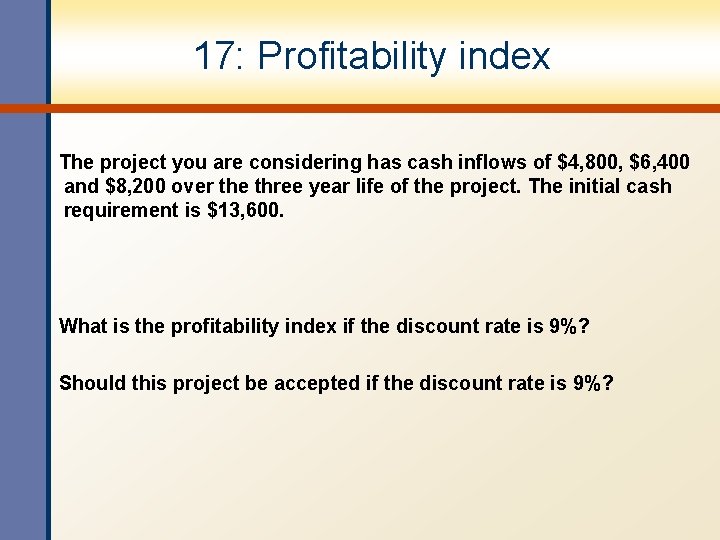
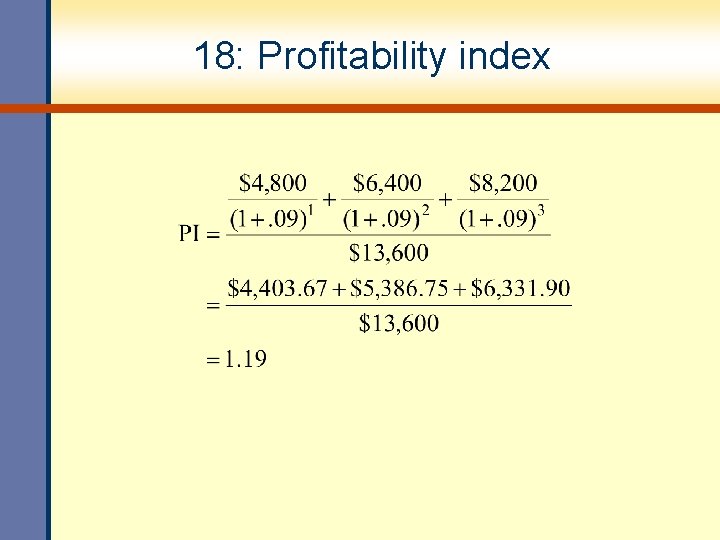
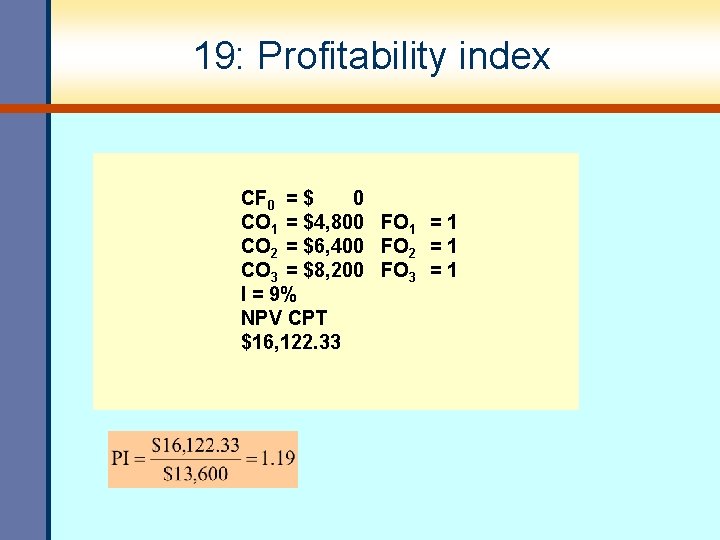
17: Profitability index The project you are considering has cash inflows of $4, 800, $6, 400 and $8, 200 over the three year life of the project. The initial cash requirement is $13, 600. What is the profitability index if the discount rate is 9%? Should this project be accepted if the discount rate is 9%?
18: Profitability index
19: Profitability index CF 0 = $ 0 CO 1 = $4, 800 FO 1 = 1 CO 2 = $6, 400 FO 2 = 1 CO 3 = $8, 200 FO 3 = 1 I = 9% NPV CPT $16, 122. 33
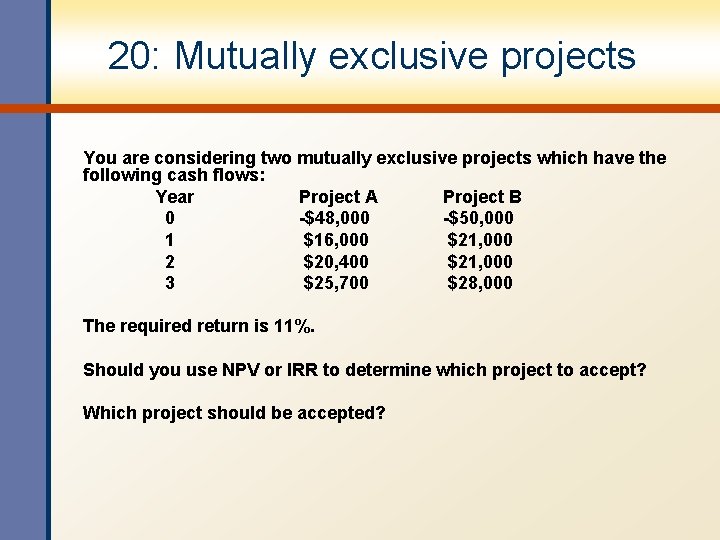
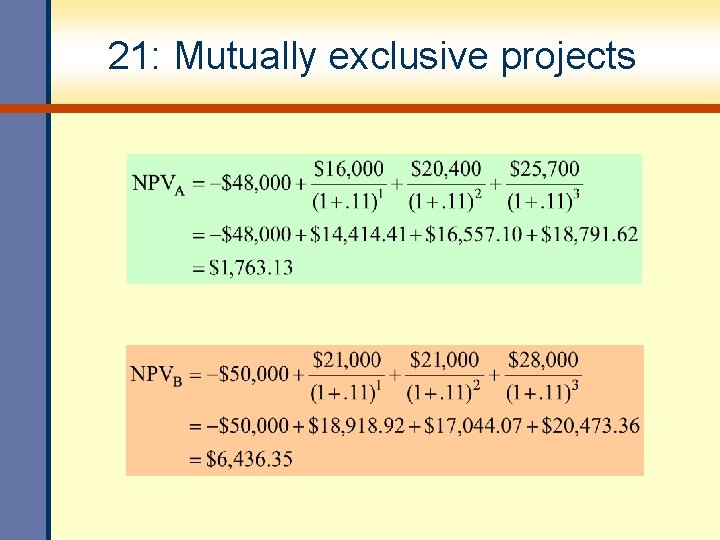
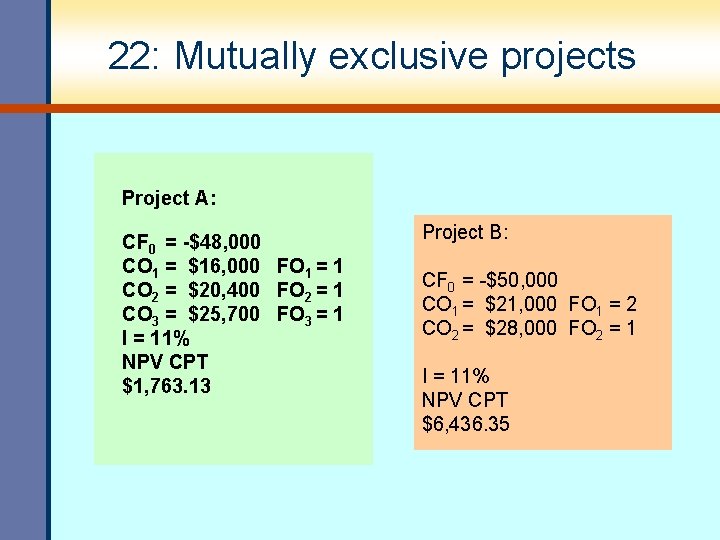
20: Mutually exclusive projects You are considering two mutually exclusive projects which have the following cash flows: Year Project A Project B 0 -$48, 000 -$50, 000 1 $16, 000 $21, 000 2 $20, 400 $21, 000 3 $25, 700 $28, 000 The required return is 11%. Should you use NPV or IRR to determine which project to accept? Which project should be accepted?
21: Mutually exclusive projects
22: Mutually exclusive projects Project A: CF 0 = -$48, 000 CO 1 = $16, 000 FO 1 = 1 CO 2 = $20, 400 FO 2 = 1 CO 3 = $25, 700 FO 3 = 1 I = 11% NPV CPT $1, 763. 13 Project B: CF 0 = -$50, 000 CO 1 = $21, 000 FO 1 = 2 CO 2 = $28, 000 FO 2 = 1 I = 11% NPV CPT $6, 436. 35
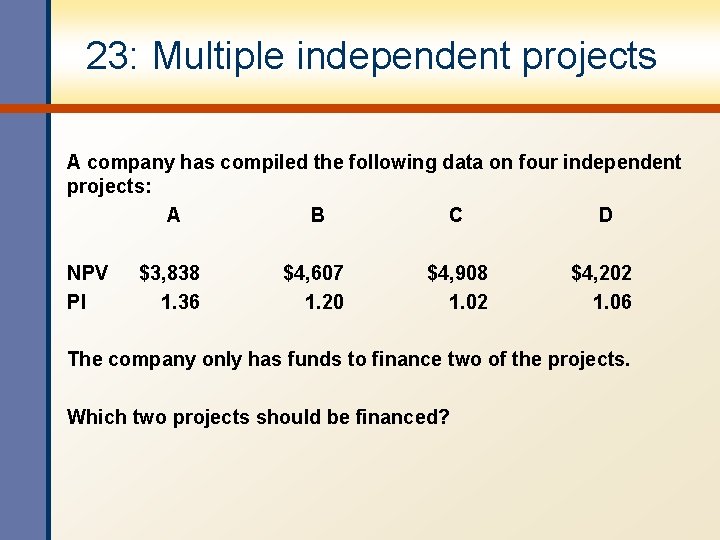
23: Multiple independent projects A company has compiled the following data on four independent projects: A B C D NPV PI $3, 838 1. 36 $4, 607 1. 20 $4, 908 1. 02 $4, 202 1. 06 The company only has funds to finance two of the projects. Which two projects should be financed?
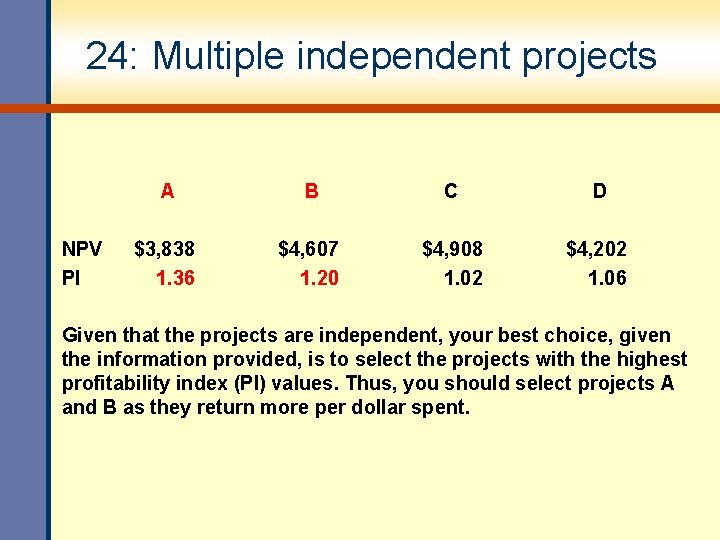
24: Multiple independent projects NPV PI A B C D $3, 838 1. 36 $4, 607 1. 20 $4, 908 1. 02 $4, 202 1. 06 Given that the projects are independent, your best choice, given the information provided, is to select the projects with the highest profitability index (PI) values. Thus, you should select projects A and B as they return more per dollar spent.
Chapter 9 • End of Chapter 9 Mc. Graw-Hill/Irwin Copyright © 2006 by The Mc. Graw-Hill Companies, Inc. All rights reserved.