CHAPTER 7 IDENTIFYING ADVANCED ATTACKS Mc Kinley Technology
- Slides: 25
CHAPTER 7: IDENTIFYING ADVANCED ATTACKS Mc. Kinley Technology HS - Cybersecurity
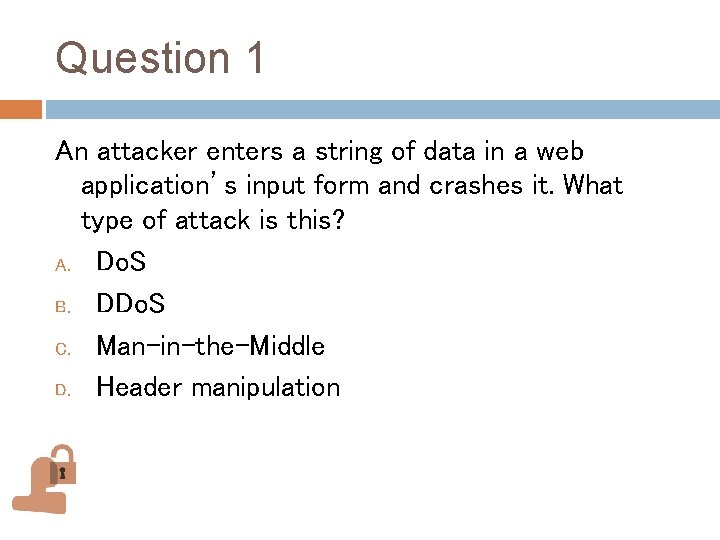
Question 1 An attacker enters a string of data in a web application’s input form and crashes it. What type of attack is this? A. Do. S B. DDo. S C. Man-in-the-Middle D. Header manipulation
Question 2 What will protect against a SYN attack? A. Input validation B. Error handling C. Flood guard D. Cross-site scripting
Question 3 What can an administrator use to detect a DDo. S attack? A. Privilege escalation B. Performance baseline C. Web form sanitization D. Antivirus software
Question 4 A user browsing the Internet notices erratic behavior right before the user’s system crashes. After rebooting, the system is slow and the user detects hundreds of outbound connections. What likely occurred? A. The system has become a botnet B. The system is hosting a botnet C. The system is spamming other users D. The system has joined a botnet
Question 5 A computer is regularly communicating with an unknown IRC server and sending traffic without user interaction. What is likely causing this? A. Buffer overflow B. Cross-site scripting C. Botnet D. Rootkit
Question 6 Of the following choices, what uses a command control server? A. Do. S attacks B. Trojans C. Man-in-the-Middle D. Botnet
Question 7 Of the following choices, what type of attack can intercept traffic and insert malicious code into a network conversation? A. Spim B. Xmas attack C. LDAP attack D. Man-in-the-middle
Question 8 What can a header manipulation attack modify? A. Flags B. Buffers C. Databases D. Signature definitions
Question 9 An attacker is sending false hardware address updates to a system, causing the system to redirect traffic to an attacker. What type of attack is this? A. IRC B. ARP poisoning C. Xmas attack D. DNS poisoning
Question 10 What can mitigate ARP poisoning attacks in a network? A. Disable unused ports on a switch B. Man-in-the-middle C. DMZ D. VLAN segregation
Question 11 You manage a server hosting a third-party database application. You want to ensure that the application is secure and all unnecessary services are disabled. What should you perform? A. Secure code review B. Application hardening C. White box testing D. Black box testing
Question 12 Of the following choices, what is a step used to harden a database application? A. Enabling all services B. Disabling default accounts and changing default passwords C. Disabling SQL D. Disabling stored procedures
Question 13 An organization develops its own software. Of the following choices, what is a security practice that should be included in the process? A. Check vendor documentation B. SDLC Waterfall model C. Code review D. Enabling command injection
Question 14 An attacker in entering incorrect data into a form on a web page. The result shows the attacker the type of database used by the website and provides hints on what SQL statements the database accepts. What can prevent this? A. Error handling B. Antivirus software C. Anti-spam software D. Flood guards
Question 15 Your organization hosts several websites accessible on the Internet and is conducting a security review of these sites. Of the following choices, that is the most common security issue for web-based applications? A. Input validation B. Phishing C. Whaling D. Social engineering
Question 16 An IDS detected a NOOP sled. What kind of attack does this indicate? A. Input validation B. SQL injection C. Cross-site scripting D. Buffer overflow
Question 17 A web-based application expects a user to enter eight characters into the text box. What is a potential vulnerability for this application? A. Input validation B. Buffer overflow C. SYN flood D. Flood guard
Question 18 Of the following choices, what can help prevent SQL injection attacks? A. Output validation B. NOOP sleds C. Stored procedures D. Antivirus software
Question 19 A web developer wants to prevent cross-site scripting. What should the developer do? A. Use input validation to remove hypertext B. Use input validation to remove cookies C. Use input validation to SQL statements D. Use input validation to overflow buffers
Question 20 A website prevents users from using the lessthan character (<) when entering data into forms. What is it trying to prevent? A. Logic bomb B. Cross-site scripting C. Fuzzing D. SQL injection
Question 21 While analyzing an application log, you discover several entries where a user has entered the following command into a web-based form: …/etc/passwd. What does this indicate? A. Fuzzing B. Kiting C. Command injection attack D. Do. S
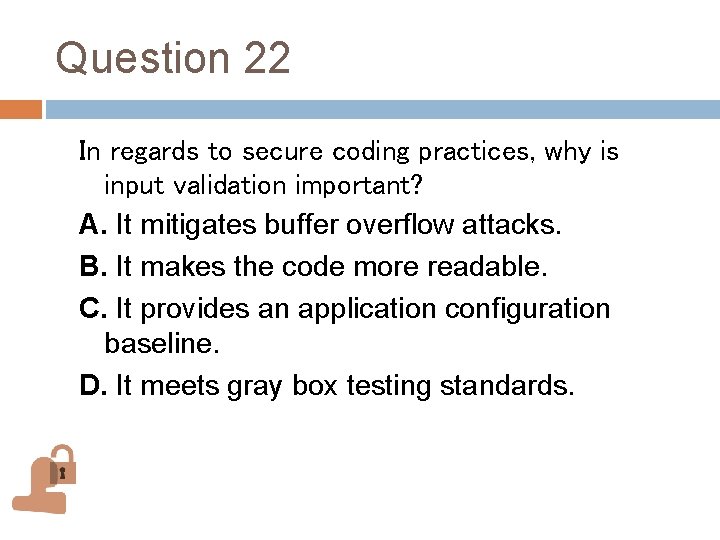
Question 22 In regards to secure coding practices, why is input validation important? A. It mitigates buffer overflow attacks. B. It makes the code more readable. C. It provides an application configuration baseline. D. It meets gray box testing standards.
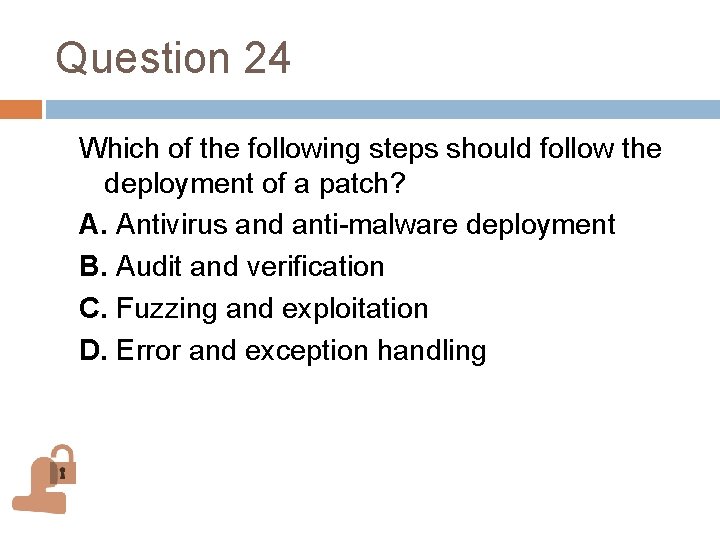
Question 24 Which of the following steps should follow the deployment of a patch? A. Antivirus and anti-malware deployment B. Audit and verification C. Fuzzing and exploitation D. Error and exception handling
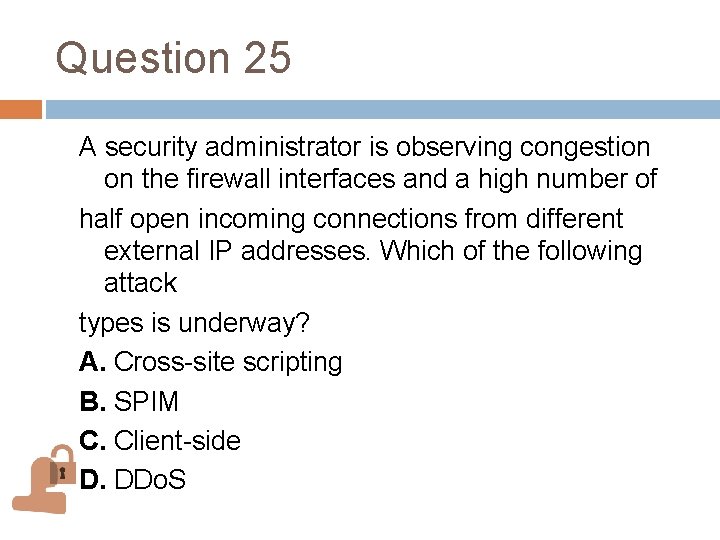
Question 25 A security administrator is observing congestion on the firewall interfaces and a high number of half open incoming connections from different external IP addresses. Which of the following attack types is underway? A. Cross-site scripting B. SPIM C. Client-side D. DDo. S