
Joint Polar Satellite System JPSS Instrument Calibration and

Joint Polar Satellite System (JPSS) Instrument Calibration and Validation Fuzhong Weng, JPSS SDR Science Chair National Environmental Satellites, Data and Information Service National Oceanic and Atmospheric Administration (NOAA) Contributed by STAR JPSS SDR Leads: Yong Han, Changyong Cao, Larry Flynn, Ninghai Sun SDR Principal Investigators: Hu Yang, Vince Leslie, Xiaolei Zou, Hank Rivercomb, Dave Tobin, Larrabee Strow, Dan Mooney, Deron Scott , Degui Gu, Jack Xiong, Frank Deluccia, Robert Wolfe, Glen Jaross , Chunhui Pan and many others
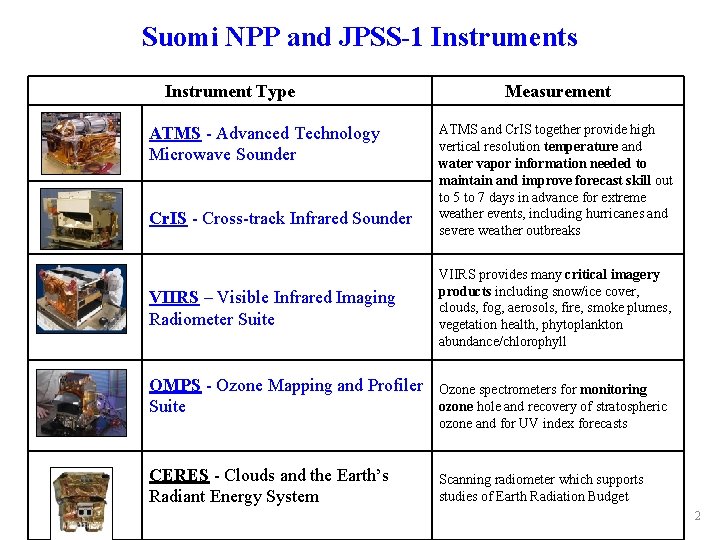
Suomi NPP and JPSS-1 Instruments Instrument Type ATMS - Advanced Technology Microwave Sounder Cr. IS - Cross-track Infrared Sounder VIIRS – Visible Infrared Imaging Radiometer Suite Measurement ATMS and Cr. IS together provide high vertical resolution temperature and water vapor information needed to maintain and improve forecast skill out to 5 to 7 days in advance for extreme weather events, including hurricanes and severe weather outbreaks VIIRS provides many critical imagery products including snow/ice cover, clouds, fog, aerosols, fire, smoke plumes, vegetation health, phytoplankton abundance/chlorophyll OMPS - Ozone Mapping and Profiler Suite Ozone spectrometers for monitoring ozone hole and recovery of stratospheric ozone and for UV index forecasts CERES - Clouds and the Earth’s Radiant Energy System Scanning radiometer which supports studies of Earth Radiation Budget 2
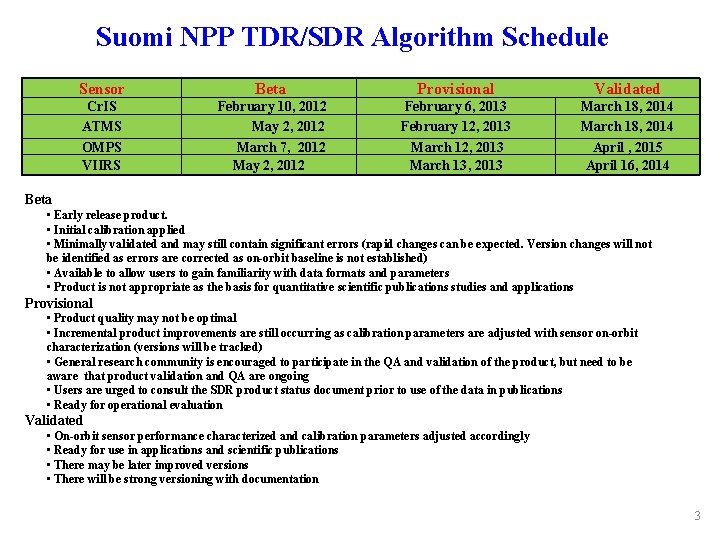
Suomi NPP TDR/SDR Algorithm Schedule Sensor Beta Provisional Validated Cr. IS ATMS OMPS VIIRS February 10, 2012 May 2, 2012 March 7, 2012 May 2, 2012 February 6, 2013 February 12, 2013 C March 12, 2013 March 13, 2013 March 18, 2014 April , 2015 April 16, 2014 Beta C C • Early release product. • Initial calibration applied • Minimally validated and may still contain significant errors (rapid changes can be expected. Version changes will not be identified as errors are corrected as on-orbit baseline is not established) • Available to allow users to gain familiarity with data formats and parameters • Product is not appropriate as the basis for quantitative scientific publications studies and applications Provisional • Product quality may not be optimal • Incremental product improvements are still occurring as calibration parameters are adjusted with sensor on-orbit characterization (versions will be tracked) • General research community is encouraged to participate in the QA and validation of the product, but need to be aware that product validation and QA are ongoing • Users are urged to consult the SDR product status document prior to use of the data in publications • Ready for operational evaluation Validated • On-orbit sensor performance characterized and calibration parameters adjusted accordingly • Ready for use in applications and scientific publications • There may be later improved versions • There will be strong versioning with documentation 3
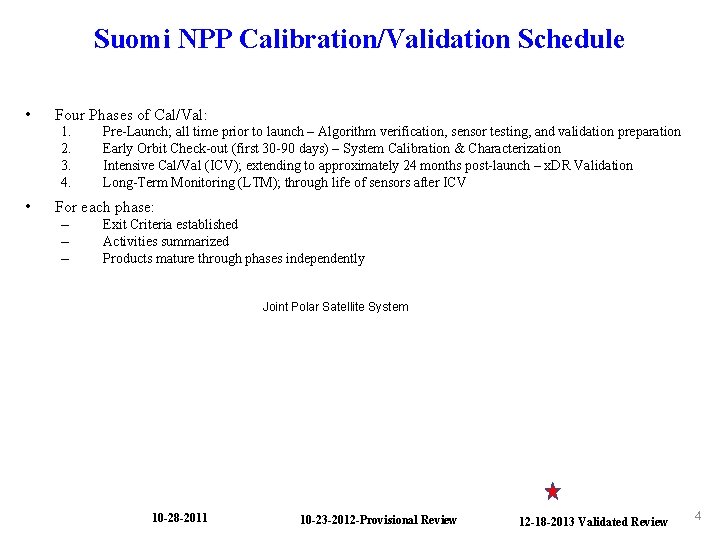
Suomi NPP Calibration/Validation Schedule • Four Phases of Cal/Val: 1. 2. 3. 4. • Pre-Launch; all time prior to launch – Algorithm verification, sensor testing, and validation preparation Early Orbit Check-out (first 30 -90 days) – System Calibration & Characterization Intensive Cal/Val (ICV); extending to approximately 24 months post-launch – x. DR Validation Long-Term Monitoring (LTM); through life of sensors after ICV For each phase: – – – Exit Criteria established Activities summarized Products mature through phases independently Joint Polar Satellite System 10 -28 -2011 10 -23 -2012 -Provisional Review 12 -18 -2013 Validated Review 4
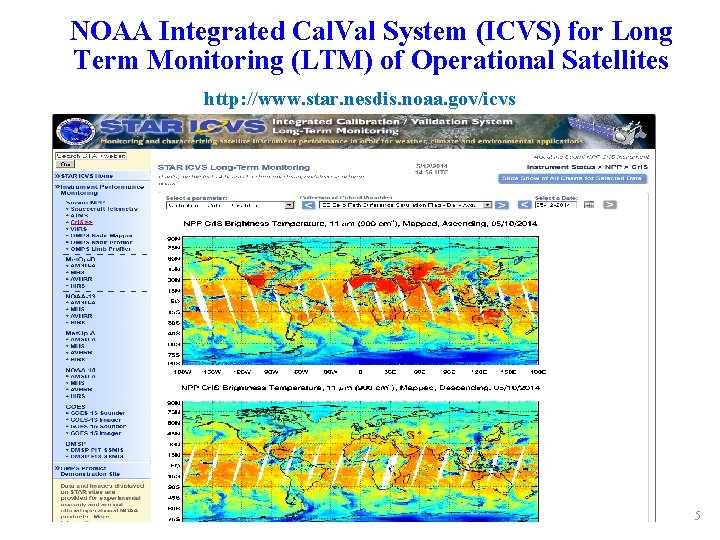
NOAA Integrated Cal. Val System (ICVS) for Long Term Monitoring (LTM) of Operational Satellites http: //www. star. nesdis. noaa. gov/icvs 5

SNPP Advanced Technology Microwave Sounder (ATMS) TDR/SDR Status • • • TDR/SDR data have reached a full validated maturity level ATMS has a stable instrument performance and calibration ATMS instrument noises (NEDT) are characterized and all channels meet or exceed the requirements All the ATMS channels have noises much lower than specification ATMS processing coefficients table (PCT) are updated with nominal values Quality flags (e. g. spacecraft maneuver and scanline, calibration) are updated and monitored Geolocation errors for all the channels are quantified and meet specification Instrument performance and SDR uncertainties are well characterized and documented (e. g. ATBD, peer-reviewed publications, user’s guide, error budget analysis) Both TDR and SDR products are used in NOAA operations Innovated sciences have been made for instrument calibration 6
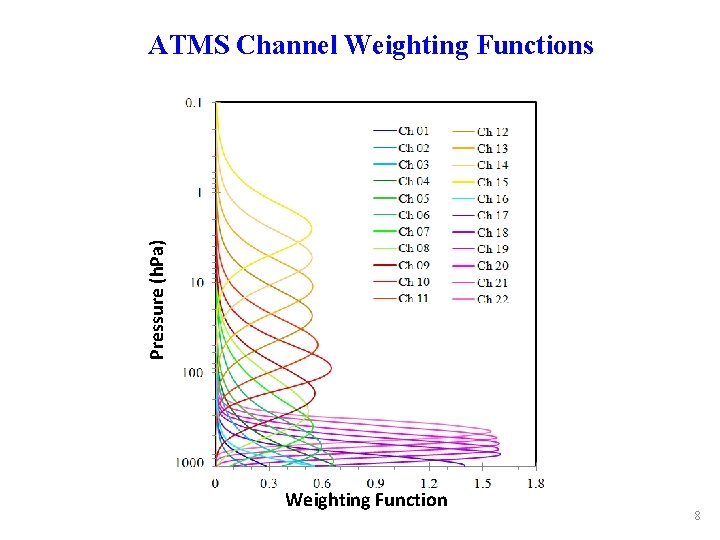
Pressure (h. Pa) ATMS Channel Weighting Functions Weighting Function 8
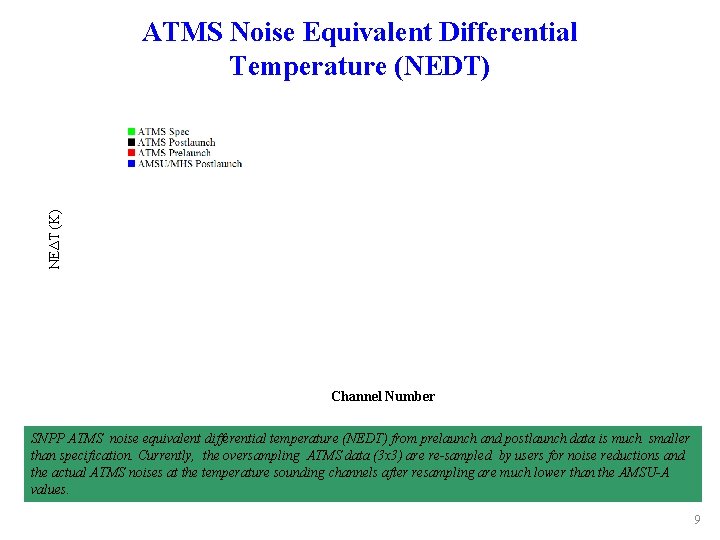
NEΔT (K) ATMS Noise Equivalent Differential Temperature (NEDT) Channel Number SNPP ATMS noise equivalent differential temperature (NEDT) from prelaunch and postlaunch data is much smaller than specification. Currently, the oversampling ATMS data (3 x 3) are re-sampled by users for noise reductions and the actual ATMS noises at the temperature sounding channels after resampling are much lower than the AMSU-A values. 9
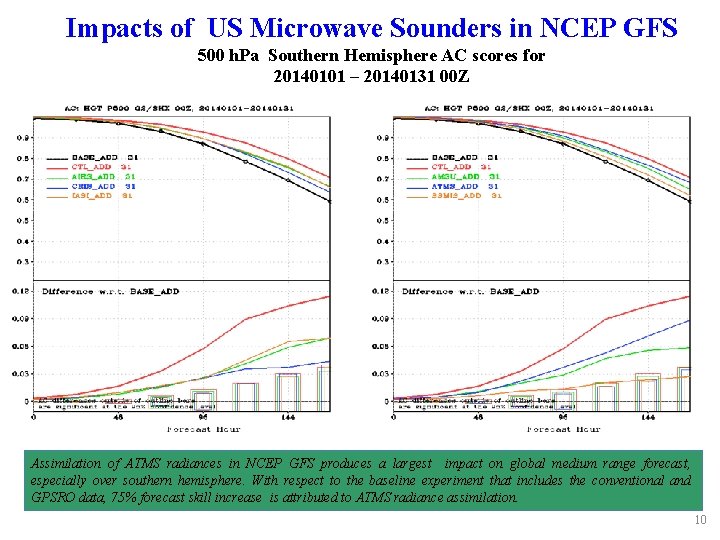
Impacts of US Microwave Sounders in NCEP GFS 500 h. Pa Southern Hemisphere AC scores for 20140101 – 20140131 00 Z Assimilation of ATMS radiances in NCEP GFS produces a largest impact on global medium range forecast, especially over southern hemisphere. With respect to the baseline experiment that includes the conventional and GPSRO data, 75% forecast skill increase is attributed to ATMS radiance assimilation. 10
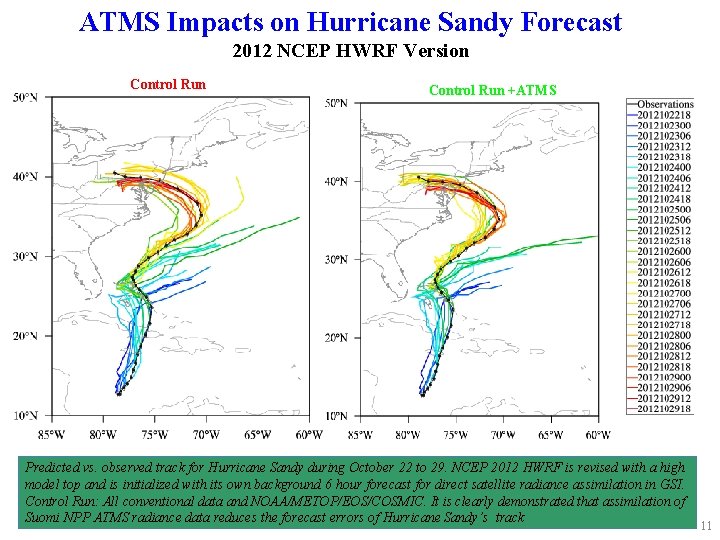
ATMS Impacts on Hurricane Sandy Forecast 2012 NCEP HWRF Version Control Run +ATMS Predicted vs. observed track for Hurricane Sandy during October 22 to 29. NCEP 2012 HWRF is revised with a high model top and is initialized with its own background 6 hour forecast for direct satellite radiance assimilation in GSI. Control Run: All conventional data and NOAA/METOP/EOS/COSMIC. It is clearly demonstrated that assimilation of Suomi NPP ATMS radiance data reduces the forecast errors of Hurricane Sandy’s track 11
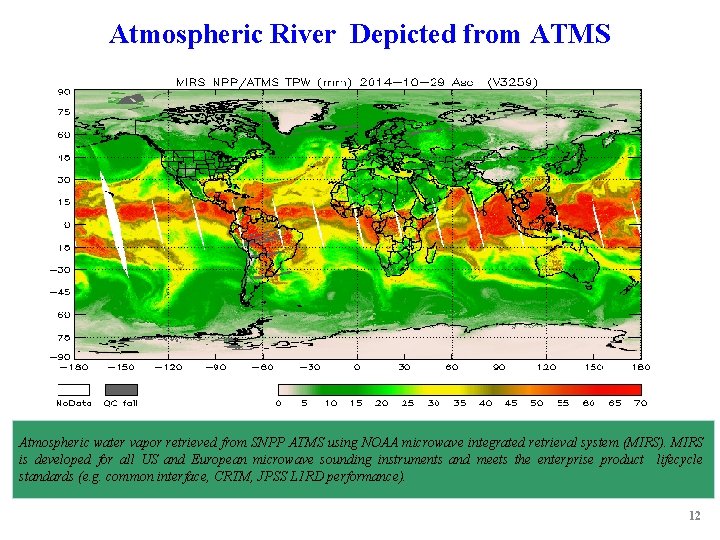
Atmospheric River Depicted from ATMS Atmospheric water vapor retrieved from SNPP ATMS using NOAA microwave integrated retrieval system (MIRS). MIRS is developed for all US and European microwave sounding instruments and meets the enterprise product lifecycle standards (e. g. common interface, CRTM, JPSS L 1 RD performance). 12
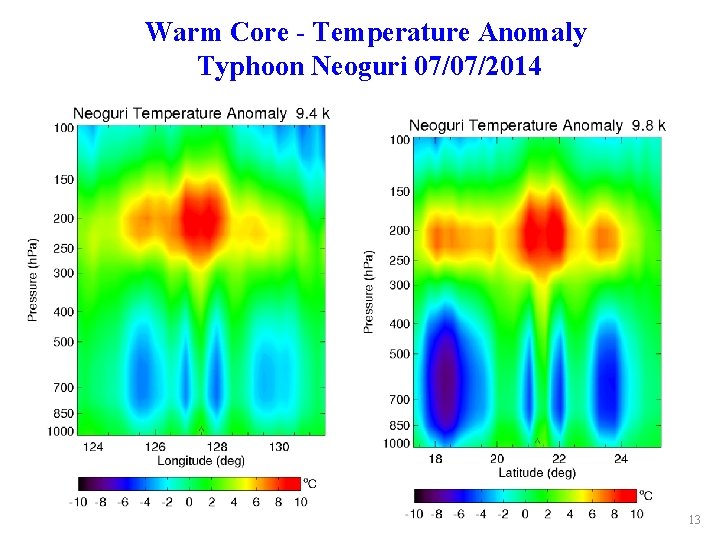
Warm Core - Temperature Anomaly Typhoon Neoguri 07/07/2014 13
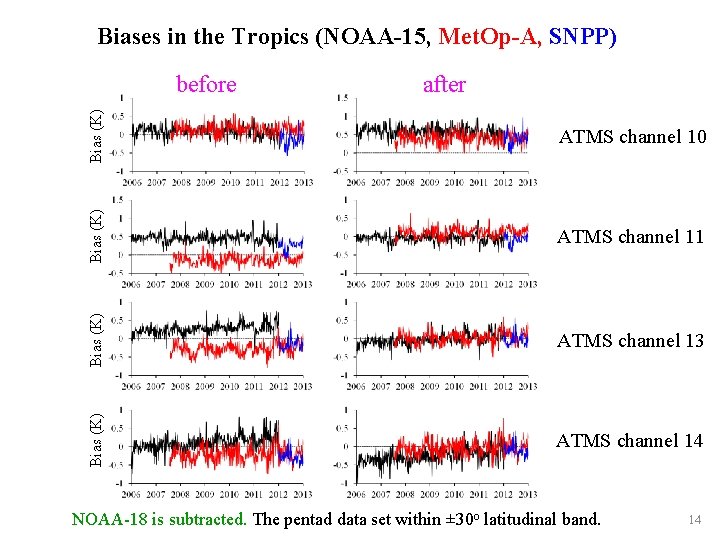
Biases in the Tropics (NOAA-15, Met. Op-A, SNPP) Bias (K) ATMS channel 10 Bias (K) ATMS channel 11 Bias (K) after ATMS channel 13 Bias (K) before ATMS channel 14 NOAA-18 is subtracted. The pentad data set within ± 30 o latitudinal band. 14
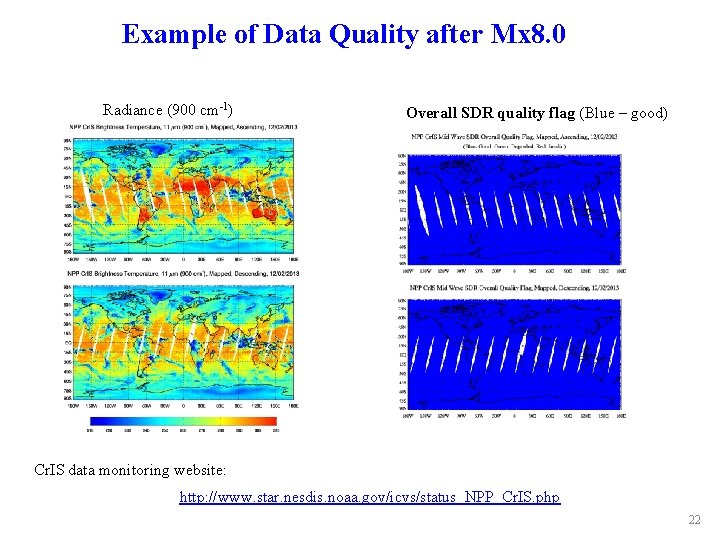
SNPP Cross-Track Infrared Sounder (CRIS) SDR Status • • • CRIS SDR data have reached a full validated maturity level On-orbit instrument performance is stable and well within specification SDR uncertainties meet requirements, with NEd. N and uncertainties of radiometric and spectral calibration well below specifications Spectral uncertainty: < 3 ppm, well below specification Radiometric uncertainty: ~0. 1 K, well below specification Geolocation error: < 1. 2 km below specification ILS and NL correction algorithms/code and coefficients are improved and adjusted All the important SDR quality flags are functioning as expected 99. 98% of the SDR data are in good quality IDPS capability to process full resolution RDRs is implemented and tested Instrument performance and SDR uncertainties are well characterized and documented (e. g. ATBD, peer-reviewed publications, user’s guide, error budget analysis) Cr. IS SDR team developed lots of innovative algorithms for full resolution SDR processing 21
Example of Data Quality after Mx 8. 0 Radiance (900 cm-1) Overall SDR quality flag (Blue – good) Cr. IS data monitoring website: http: //www. star. nesdis. noaa. gov/icvs/status_NPP_Cr. IS. php 22
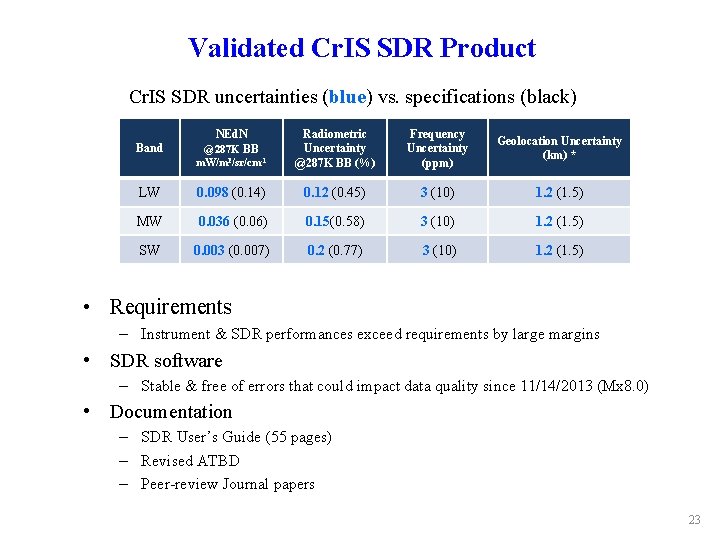
Validated Cr. IS SDR Product Cr. IS SDR uncertainties (blue) vs. specifications (black) m. W/m 2/sr/cm-1 Radiometric Uncertainty @287 K BB (%) Frequency Uncertainty (ppm) Geolocation Uncertainty (km) * LW 0. 098 (0. 14) 0. 12 (0. 45) 3 (10) 1. 2 (1. 5) MW 0. 036 (0. 06) 0. 15(0. 58) 3 (10) 1. 2 (1. 5) SW 0. 003 (0. 007) 0. 2 (0. 77) 3 (10) 1. 2 (1. 5) Band NEd. N @287 K BB • Requirements – Instrument & SDR performances exceed requirements by large margins • SDR software – Stable & free of errors that could impact data quality since 11/14/2013 (Mx 8. 0) • Documentation – SDR User’s Guide (55 pages) – Revised ATBD – Peer-review Journal papers 23
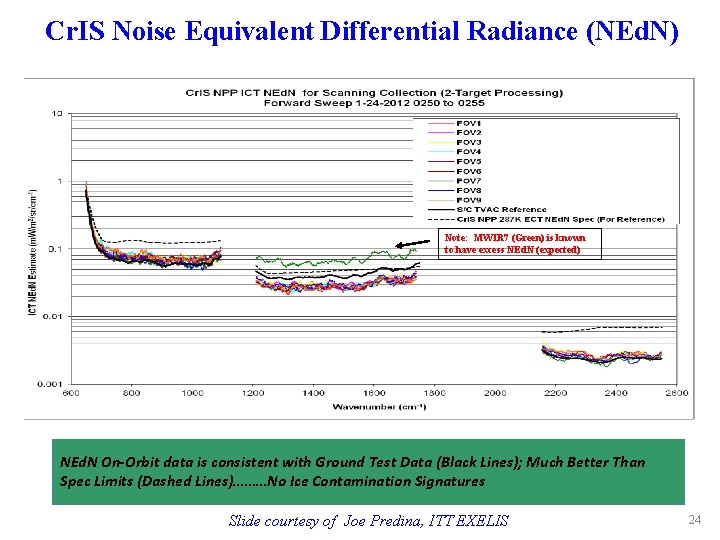
Cr. IS Noise Equivalent Differential Radiance (NEd. N) Note: MWIR 7 (Green) is known to have excess NEd. N (expected) NEd. N On-Orbit data is consistent with Ground Test Data (Black Lines); Much Better Than Spec Limits (Dashed Lines)………No Ice Contamination Signatures Slide courtesy of Joe Predina, ITT EXELIS 24
SNPP Visible Infrared Imaging Radiometer Suite (VIIRS) SDR Status • • • VIIRS SDR products have reached a validated maturity level Multiple code/LUT updates have been implemented or are being implemented into the SDR processing, including the scan-by-scan calibration, and have led to higher quality SDRs and EDRs. VIIRS on-orbit performance is well characterized and meets specifications Noise is small and stable, meet specification Bias (accuracy) is well characterized for both reflective solar and thermal emissive bands. with the exception of M 11 due to low signal (known prelaunch with waiver) Calibration coefficients are automatically updated RSB Autocal is implemented and reduce calibration latency and improve performance. DNB straylight correction works well. Geo-location uncertainties for I-/M-bands are ~ 70 m at nadir, meeting specifications at nadir and edge-of-scan (DNB terrain corrected geo-location product is expected in Mx 8. 3 in March 2014) Instrument performance and SDR uncertainties are well characterized and documented (e. g. ATBD, peer-reviewed publications, user’s guide, error budget analysis) 27
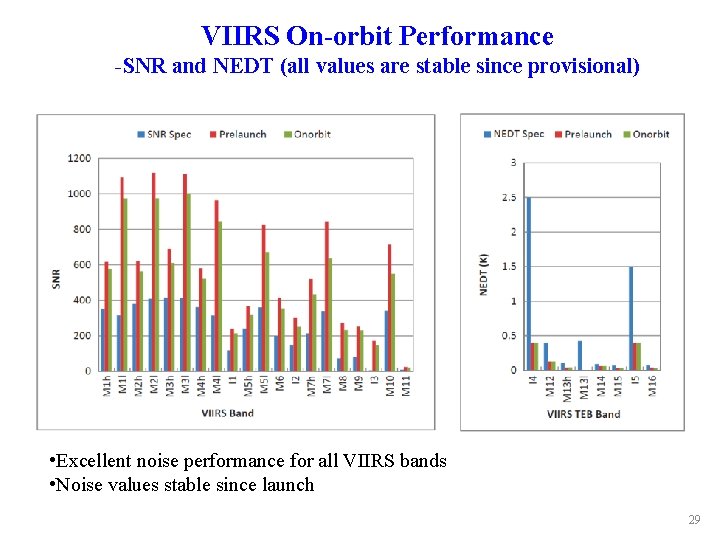
VIIRS On-orbit Performance -SNR and NEDT (all values are stable since provisional) • Excellent noise performance for all VIIRS bands • Noise values stable since launch 29
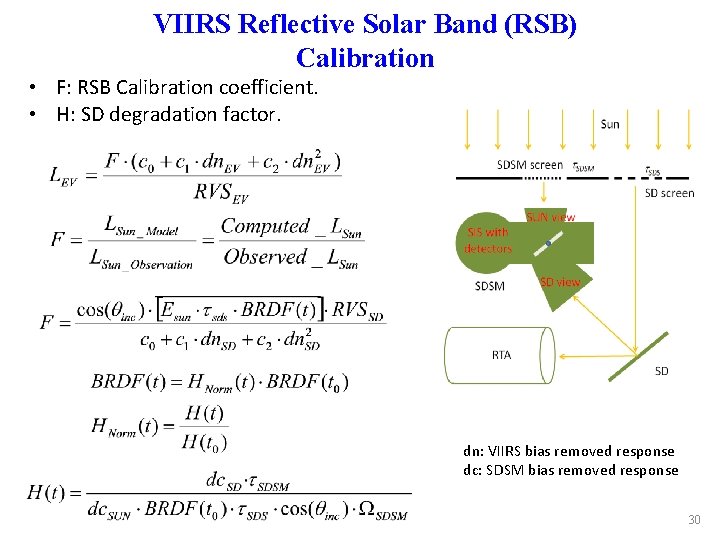
VIIRS Reflective Solar Band (RSB) Calibration • F: RSB Calibration coefficient. • H: SD degradation factor. dn: VIIRS bias removed response dc: SDSM bias removed response 30
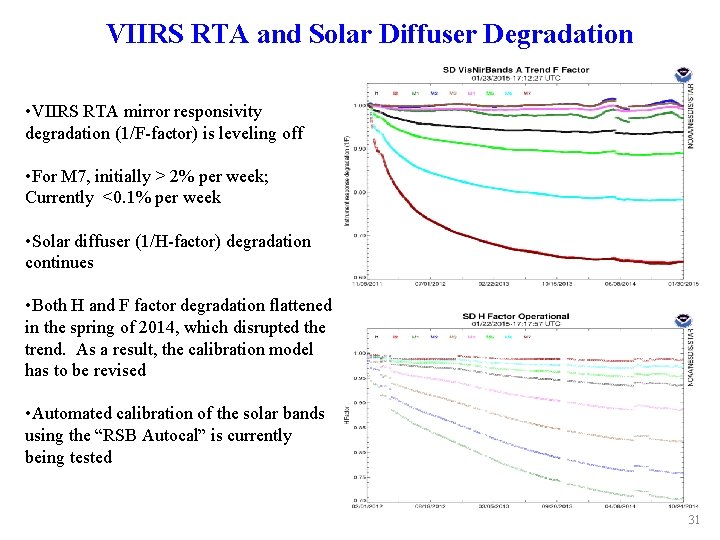
VIIRS RTA and Solar Diffuser Degradation • VIIRS RTA mirror responsivity degradation (1/F-factor) is leveling off • For M 7, initially > 2% per week; Currently <0. 1% per week • Solar diffuser (1/H-factor) degradation continues • Both H and F factor degradation flattened in the spring of 2014, which disrupted the trend. As a result, the calibration model has to be revised • Automated calibration of the solar bands using the “RSB Autocal” is currently being tested 31
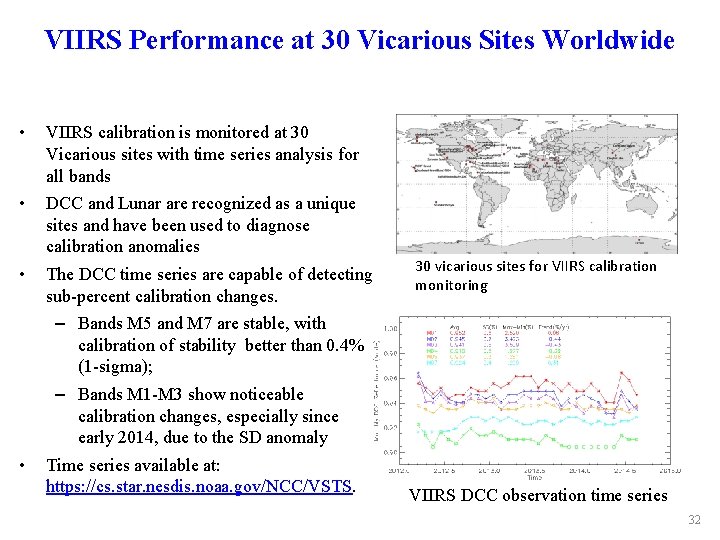
VIIRS Performance at 30 Vicarious Sites Worldwide • VIIRS calibration is monitored at 30 Vicarious sites with time series analysis for all bands • DCC and Lunar are recognized as a unique sites and have been used to diagnose calibration anomalies • The DCC time series are capable of detecting sub-percent calibration changes. • – Bands M 5 and M 7 are stable, with calibration of stability better than 0. 4% (1 -sigma); – Bands M 1 -M 3 show noticeable calibration changes, especially since early 2014, due to the SD anomaly Time series available at: https: //cs. star. nesdis. noaa. gov/NCC/VSTS. Feb 2014 30 vicarious sites for VIIRS calibration monitoring Nadir VIIRS DCC observation time series 32
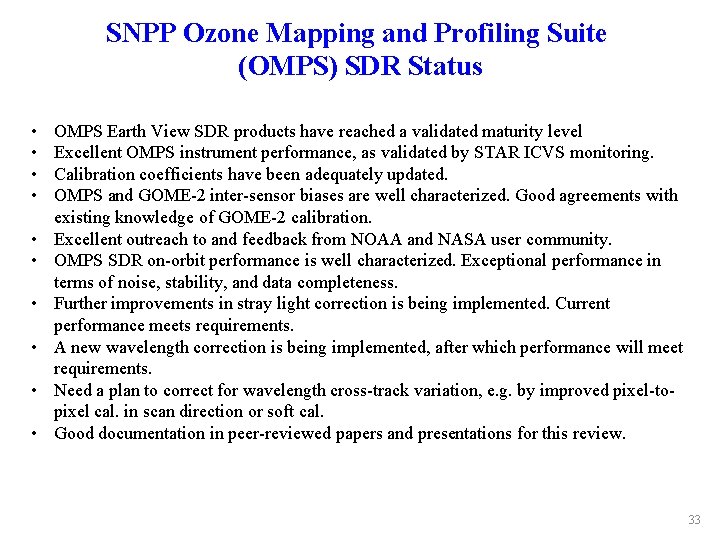
SNPP Ozone Mapping and Profiling Suite (OMPS) SDR Status • • • OMPS Earth View SDR products have reached a validated maturity level Excellent OMPS instrument performance, as validated by STAR ICVS monitoring. Calibration coefficients have been adequately updated. OMPS and GOME-2 inter-sensor biases are well characterized. Good agreements with existing knowledge of GOME-2 calibration. Excellent outreach to and feedback from NOAA and NASA user community. OMPS SDR on-orbit performance is well characterized. Exceptional performance in terms of noise, stability, and data completeness. Further improvements in stray light correction is being implemented. Current performance meets requirements. A new wavelength correction is being implemented, after which performance will meet requirements. Need a plan to correct for wavelength cross-track variation, e. g. by improved pixel-topixel cal. in scan direction or soft cal. Good documentation in peer-reviewed papers and presentations for this review. 33
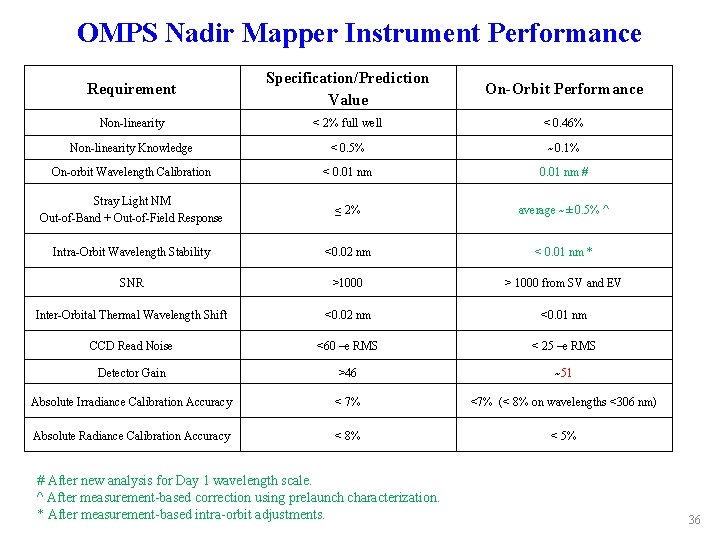
OMPS Nadir Mapper Instrument Performance Requirement Specification/Prediction Value On-Orbit Performance Non-linearity < 2% full well < 0. 46% Non-linearity Knowledge < 0. 5% ~0. 1% On-orbit Wavelength Calibration < 0. 01 nm # Stray Light NM Out-of-Band + Out-of-Field Response ≤ 2% average ~± 0. 5% ^ Intra-Orbit Wavelength Stability <0. 02 nm < 0. 01 nm * SNR >1000 > 1000 from SV and EV Inter-Orbital Thermal Wavelength Shift <0. 02 nm <0. 01 nm CCD Read Noise <60 –e RMS < 25 –e RMS Detector Gain >46 ~51 Absolute Irradiance Calibration Accuracy < 7% <7% (< 8% on wavelengths <306 nm) Absolute Radiance Calibration Accuracy < 8% < 5% # After new analysis for Day 1 wavelength scale. ^ After measurement-based correction using prelaunch characterization. * After measurement-based intra-orbit adjustments. 36
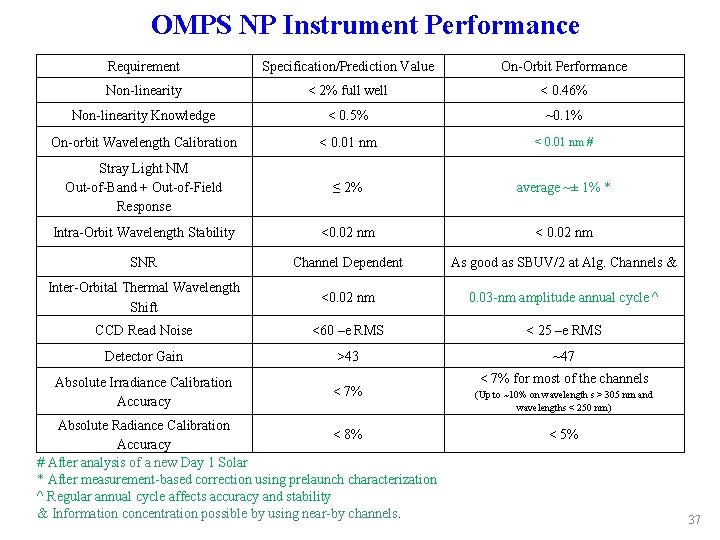
OMPS NP Instrument Performance Requirement Specification/Prediction Value On-Orbit Performance Non-linearity < 2% full well < 0. 46% Non-linearity Knowledge < 0. 5% ~0. 1% On-orbit Wavelength Calibration < 0. 01 nm # Stray Light NM Out-of-Band + Out-of-Field Response ≤ 2% average ~± 1% * Intra-Orbit Wavelength Stability <0. 02 nm < 0. 02 nm SNR Channel Dependent As good as SBUV/2 at Alg. Channels & Inter-Orbital Thermal Wavelength Shift <0. 02 nm 0. 03 -nm amplitude annual cycle ^ CCD Read Noise <60 –e RMS < 25 –e RMS Detector Gain >43 ~47 Absolute Irradiance Calibration Accuracy < 7% Absolute Radiance Calibration < 8% Accuracy # After analysis of a new Day 1 Solar * After measurement-based correction using prelaunch characterization ^ Regular annual cycle affects accuracy and stability & Information concentration possible by using near-by channels. < 7% for most of the channels (Up to ~10% on wavelength s > 305 nm and wavelengths < 250 nm) < 5% 37
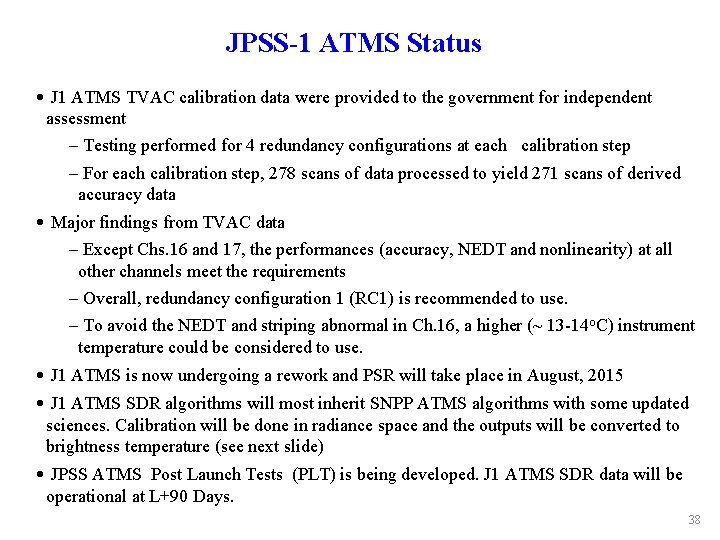
JPSS-1 ATMS Status • J 1 ATMS TVAC calibration data were provided to the government for independent assessment – Testing performed for 4 redundancy configurations at each calibration step – For each calibration step, 278 scans of data processed to yield 271 scans of derived accuracy data • Major findings from TVAC data – Except Chs. 16 and 17, the performances (accuracy, NEDT and nonlinearity) at all other channels meet the requirements – Overall, redundancy configuration 1 (RC 1) is recommended to use. – To avoid the NEDT and striping abnormal in Ch. 16, a higher (~ 13 -14 o. C) instrument temperature could be considered to use. • J 1 ATMS is now undergoing a rework and PSR will take place in August, 2015 • J 1 ATMS SDR algorithms will most inherit SNPP ATMS algorithms with some updated sciences. Calibration will be done in radiance space and the outputs will be converted to brightness temperature (see next slide) • JPSS ATMS Post Launch Tests (PLT) is being developed. J 1 ATMS SDR data will be operational at L+90 Days. 38
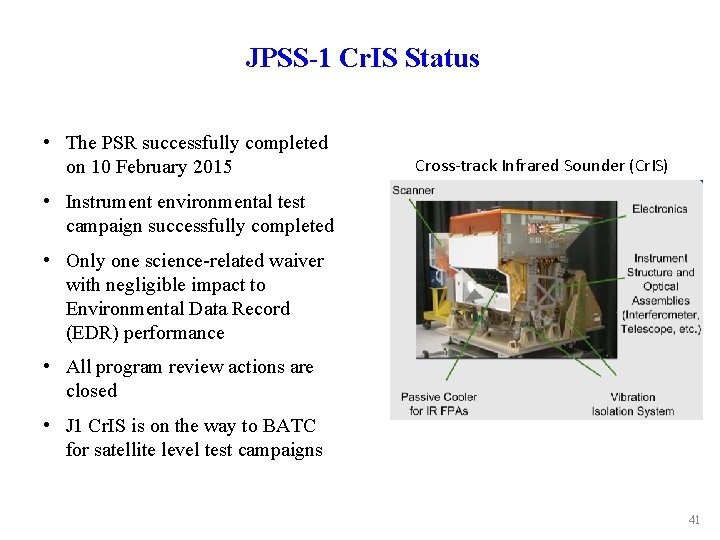
JPSS-1 Cr. IS Status • The PSR successfully completed on 10 February 2015 Cross-track Infrared Sounder (Cr. IS) • Instrument environmental test campaign successfully completed • Only one science-related waiver with negligible impact to Environmental Data Record (EDR) performance • All program review actions are closed • J 1 Cr. IS is on the way to BATC for satellite level test campaigns 41
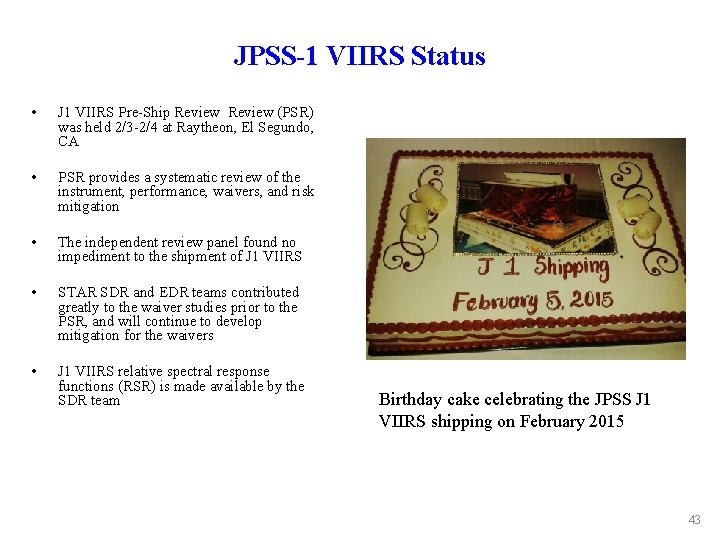
JPSS-1 VIIRS Status • J 1 VIIRS Pre-Ship Review (PSR) was held 2/3 -2/4 at Raytheon, El Segundo, CA • PSR provides a systematic review of the instrument, performance, waivers, and risk mitigation • The independent review panel found no impediment to the shipment of J 1 VIIRS • STAR SDR and EDR teams contributed greatly to the waiver studies prior to the PSR, and will continue to develop mitigation for the waivers • J 1 VIIRS relative spectral response functions (RSR) is made available by the SDR team Birthday cake celebrating the JPSS J 1 VIIRS shipping on February 2015 43
Summary and Conclusions • Suomi NPP instrument calibration and validation tasks have been completed successfully and all the SDR products have been used in NOAA operations • NOAA has developed an Integrated Cal. Val System (ICVS) for long-term monitoring (LTM) of all SNPP/JPSS/GOES-R/METOP instruments • Cr. IS, ATMS, VIIRS and OMPS have stable performance with the key instrument parameters (e. g. noise, bias) meeting or exceeding the requirements • SDR teams developed innovative sciences and algorithms for improving and refining the products processing system, e. g. , Cr. IS full spectral resolution processing and ATMS full radiance processing, VIIRS DNB straylight corrections. • SDR teams are being participated with the members from NOAA, NASA and universities and government labs. Transitions of new calval sciences from research to operations are going well • SDR teams start working on J 1 prelaunch characterizations of all the instruments, preparing for J 1 SDR algorithm upgrades. • Documentation of all the SNPP SDR sciences and operational codes have been completed, including ATBD and user manuals, error budgets. Peer-review papers have been published in JGR special issue and other high quality journals 47
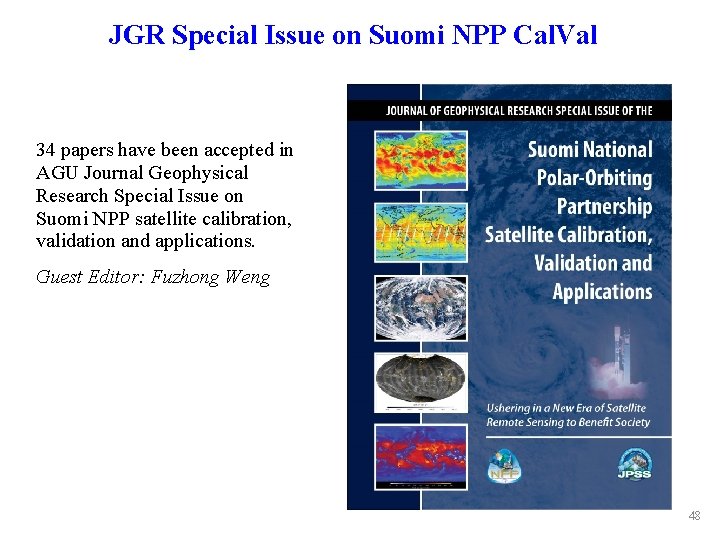
JGR Special Issue on Suomi NPP Cal. Val 34 papers have been accepted in AGU Journal Geophysical Research Special Issue on Suomi NPP satellite calibration, validation and applications. Guest Editor: Fuzhong Weng 48
- Slides: 30