Chapter 7 Developing a Core Knowledge Framework Learning
- Slides: 31
Chapter 7 Developing a Core Knowledge Framework
Learning Objectives 1. Define core knowledge 2. List the three phases of developing a core knowledge framework 3. Describe core business of an organisation and its knowledge requirements 4. Analyse a business to identify the knowledge domain
Learning Objectives (cont'd) 5. Outline why knowledge capabilities can influence core knowledge 6. Construct a definition of core knowledge for an organisation 7. Explain issues that need to be considered when designing a core knowledge policy
Learning Objectives (cont'd) Examine potential challenges associated with mapping core knowledge in an organisation 9. Identify issues that may need to be resolved when developing a knowledge repository 10. Outline issues likely to arise over content authorship 8.
Today’s focus: What is core knowledge? Why is it important to clarify the scope and nature of core knowledge? What are some of the likely issues which may arise when building a content management system?
Introduction Most organisations face a knowledge glut Many apply a ‘kitchen sink’ approach to providing access to knowledge This can prevent useful application of knowledge The goal of knowledge management is to facilitate ready access to critical knowledge when people need it
Introduction (cont'd) Content management Vital to effective knowledge management Identifies and categorises valued knowledge (today’s session) Manages and maintains the currency and accessibility of that knowledge (Session 8)
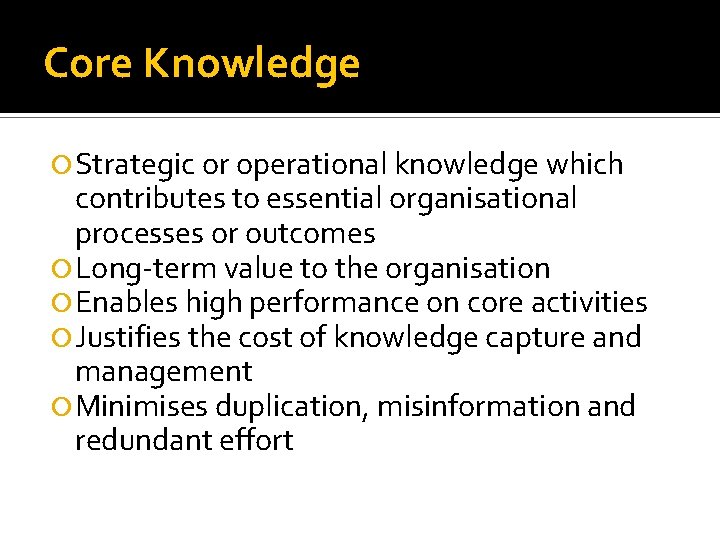
Core Knowledge Strategic or operational knowledge which contributes to essential organisational processes or outcomes Long-term value to the organisation Enables high performance on core activities Justifies the cost of knowledge capture and management Minimises duplication, misinformation and redundant effort
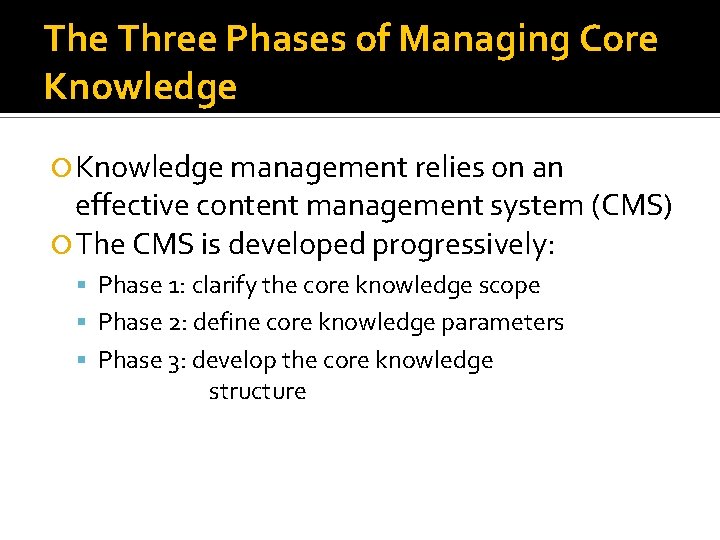
The Three Phases of Managing Core Knowledge management relies on an effective content management system (CMS) The CMS is developed progressively: Phase 1: clarify the core knowledge scope Phase 2: define core knowledge parameters Phase 3: develop the core knowledge structure
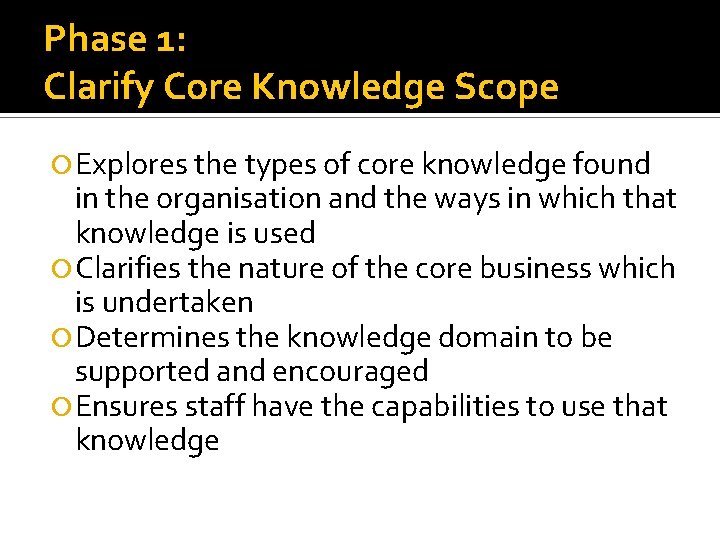
Phase 1: Clarify Core Knowledge Scope Explores the types of core knowledge found in the organisation and the ways in which that knowledge is used Clarifies the nature of the core business which is undertaken Determines the knowledge domain to be supported and encouraged Ensures staff have the capabilities to use that knowledge
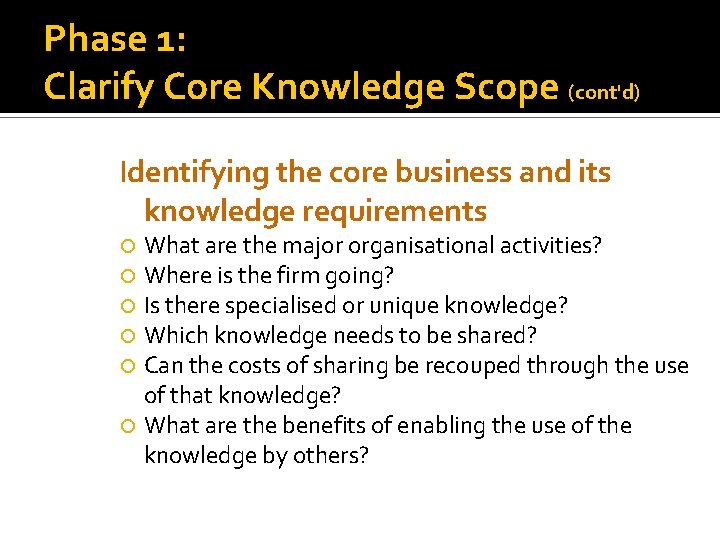
Phase 1: Clarify Core Knowledge Scope (cont'd) Identifying the core business and its knowledge requirements What are the major organisational activities? Where is the firm going? Is there specialised or unique knowledge? Which knowledge needs to be shared? Can the costs of sharing be recouped through the use of that knowledge? What are the benefits of enabling the use of the knowledge by others?
Phase 1: Clarify Core Knowledge Scope (cont'd) Define the knowledge domain Areas of knowledge that support the core business strategy of the organisation Each organisation develops a different knowledge domain Knowledge which members need to share and use as common resources Knowledge which is strategic and needs to be developed and cultivated over time
Phase 1: Clarify Core Knowledge Scope (cont'd) Review knowledge capabilities Identification of desired capabilities, valuable sources of knowledge, demonstrable capabilities and knowledge practices What do our employees really know? What should they know? How can they gain this knowledge?
Phase 2: Define Core Knowledge Parameters Defines and builds policies relating to the core knowledge domain identified in phase 1 Provides boundaries for the core knowledge to be supported in the KMS Ensures relevant contributions to the system, and appropriate use of the system Still accommodates evolving requirements
Phase 2: Define Core Knowledge Parameters (cont'd) Defining core knowledge Clear definition of what is important Directs employee attention and resources to that knowledge Should reflect the capacity to manage, contribute to and resource the resultant domain May commence with a very tight focus and then expand as time progresses
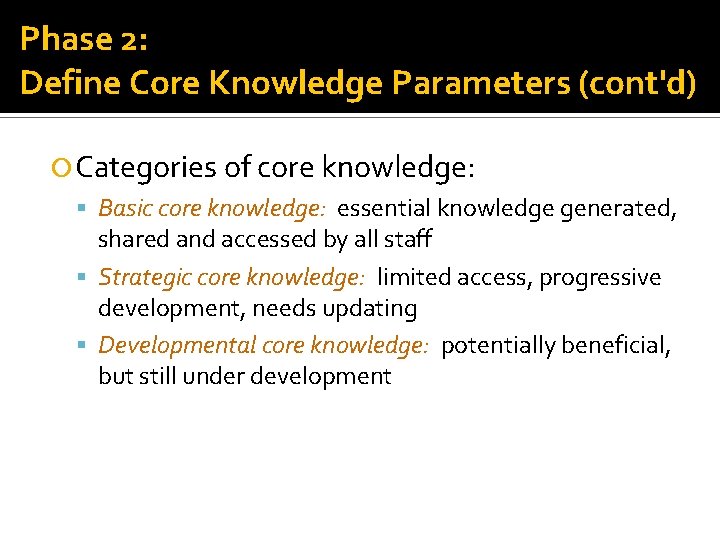
Phase 2: Define Core Knowledge Parameters (cont'd) Categories of core knowledge: Basic core knowledge: essential knowledge generated, shared and accessed by all staff Strategic core knowledge: limited access, progressive development, needs updating Developmental core knowledge: potentially beneficial, but still under development
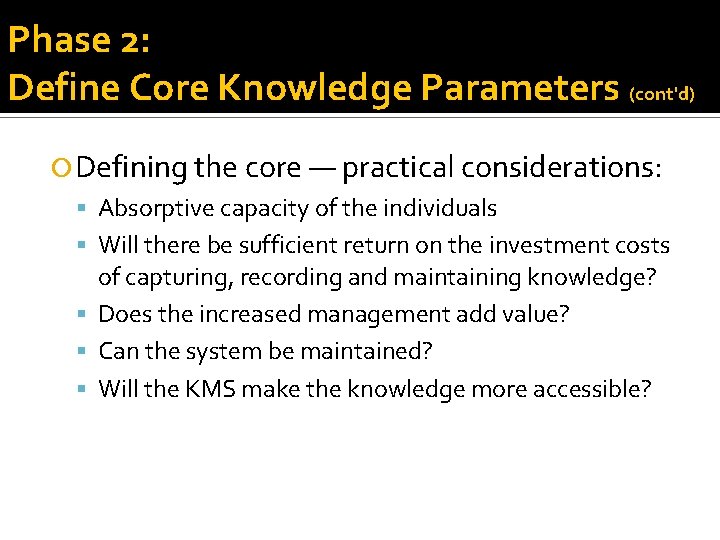
Phase 2: Define Core Knowledge Parameters (cont'd) Defining the core — practical considerations: Absorptive capacity of the individuals Will there be sufficient return on the investment costs of capturing, recording and maintaining knowledge? Does the increased management add value? Can the system be maintained? Will the KMS make the knowledge more accessible?
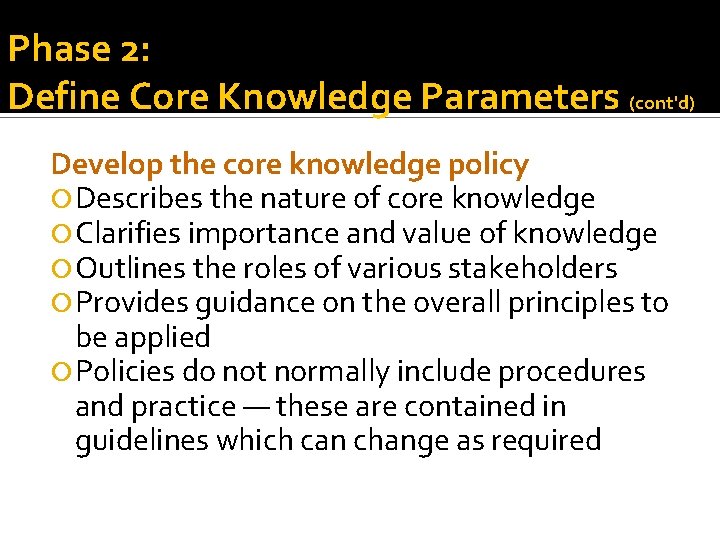
Phase 2: Define Core Knowledge Parameters (cont'd) Develop the core knowledge policy Describes the nature of core knowledge Clarifies importance and value of knowledge Outlines the roles of various stakeholders Provides guidance on the overall principles to be applied Policies do not normally include procedures and practice — these are contained in guidelines which can change as required
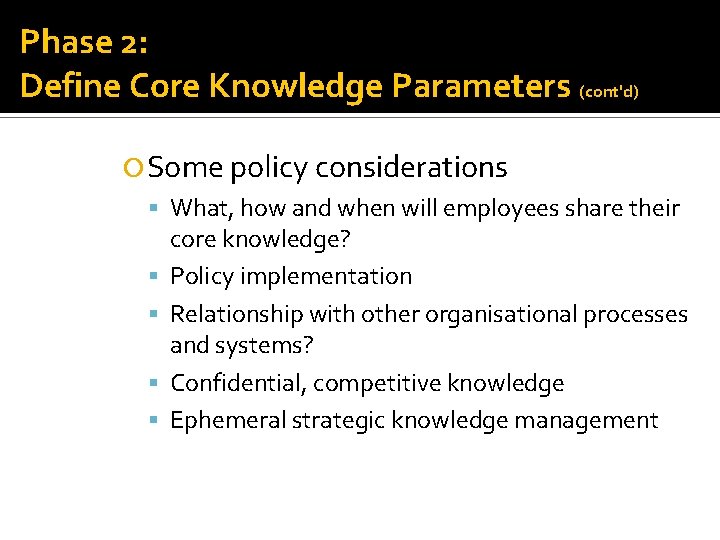
Phase 2: Define Core Knowledge Parameters (cont'd) Some policy considerations What, how and when will employees share their core knowledge? Policy implementation Relationship with other organisational processes and systems? Confidential, competitive knowledge Ephemeral strategic knowledge management
Phase 3: Developing the Core Knowledge Structure Systems and processes which assist with mapping and organising the organisation’s core knowledge Encompasses mapping, categorising, indexing and otherwise labelling core knowledge to facilitate its management Enables the ready retrieval of core knowledge through effective search processes
Phase 3: Developing the Core Knowledge Structure User-driven core knowledge versus Systematic core knowledge definition
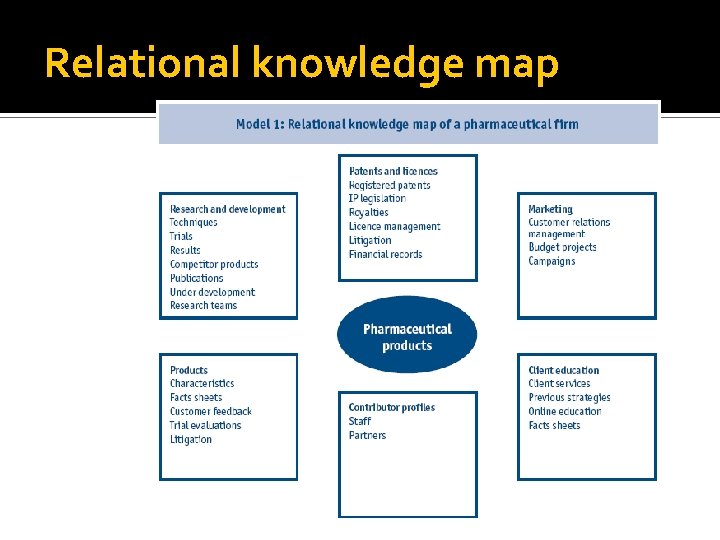
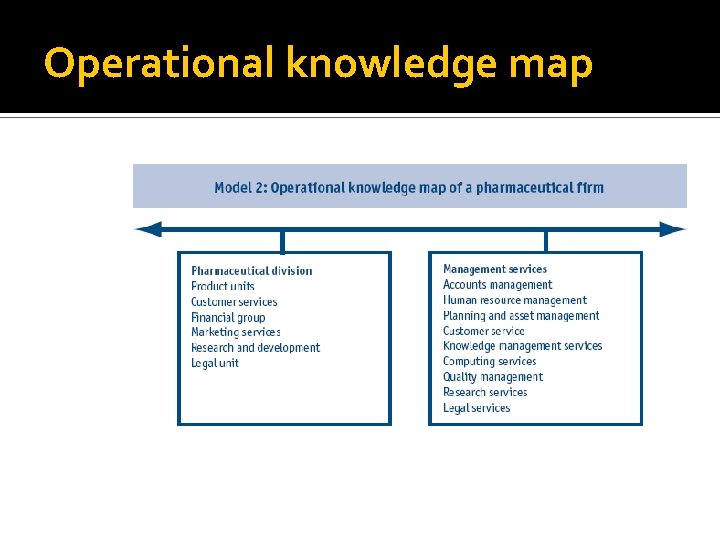
Phase 3: Developing the Core Knowledge Structure Mapping core knowledge Knowledge maps describe the core knowledge categories and focal areas Define the structural breakdown of the different core knowledge areas Two types of maps can be developed: relational knowledge maps or operational knowledge maps
Relational knowledge map
Operational knowledge map
Phase 3: Developing the Core Knowledge Structure (cont'd) Establishing and promoting the knowledge repository Repositories link the different sources by integrating them into a single united system which can be searched in many different ways Structured or unstructured repository management strategies?
Phase 3: Developing the Core Knowledge Structure (cont'd) Structured repository management Integrate the use of common structures, formally constituted headings and content descriptors to describe the content Keyword headings facilitate subsequent retrieval by providing predictable and reliable terms which are used by both contributors and knowledge seekers Descriptors guide the user as to the defined content to be found under a keyword
Phase 3: Developing the Core Knowledge Structure (cont'd) Unstructured knowledge repositories Knowledge is not structured in terms of content, but is found using free-text searching Usage is flexible, and sources can be accessed in many creative ways Successful identification of sources relies on the use of common language and ideas
Phase 3: Developing the Core Knowledge Structure (cont'd) Repository design principles Ensure only core knowledge is included Clarify the level of control over content Browser design should match the user needs and capabilities There should be easy access to the system and user guidance Search agents may assist the user
Content Authorship Knowledge in repositories will be reused, adapted and generally changed over time Should people be recognised for their contributions? The source documentation can recognise each individual’s contribution and the date of the contribution Recognition and reward systems may also integrate this information
Concluding Points Content management is a critical factor in building an effective KMS Core knowledge should be clearly defined and agreed before the KMS is implemented Structured and well controlled systems provide better overall support to the user Knowledge repositories rely on effective knowledge maps to guide their structure and management
Today’s focus questions: What is core knowledge? Why is it important to clarify the scope and nature of core knowledge? What are some of the likely issues which may arise when building a content management system?