
Overview Design Principles Core Knowledge Language Arts 2014

- Slides: 46
Overview & Design Principles Core Knowledge Language Arts © 2014 Core Knowledge Foundation. This work is licensed under a Creative Commons Attribution-Non. Commercial -Share. Alike 3. 0 Unported License. www. creativecommons. org/licenses/by-nc-sa/3. 0
Objectives We will be able to: • explain the significance of starting instruction with the most frequent or least ambiguous sounds; • describe how the Skills strand provides students with intensive practice that enables them to build reliability and automaticity; • describe how the domain structure of the Listening and Learning strand supports children’s comprehension and background knowledge; • identify at least two ways the Listening and Learning materials support vocabulary learning. © 2014 Core Knowledge Foundation. This work is licensed under a Creative Commons Attribution-Non. Commercial -Share. Alike 3. 0 Unported License. www. creativecommons. org/licenses/by-nc-sa/3. 0 3
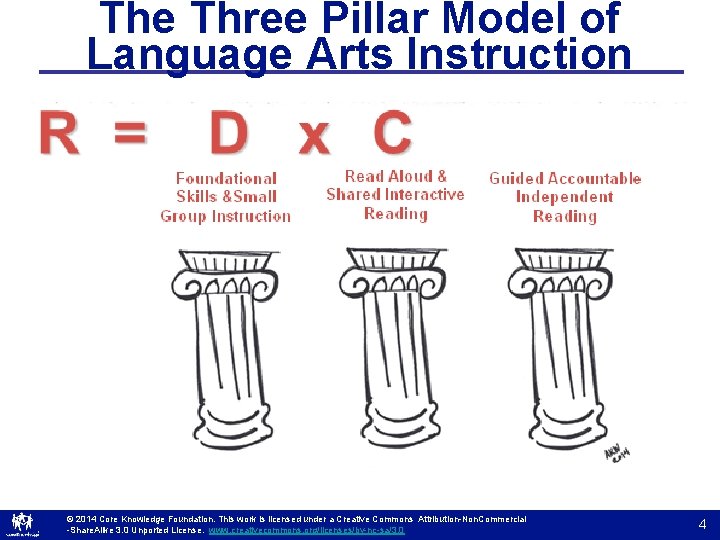
The Three Pillar Model of Language Arts Instruction © 2014 Core Knowledge Foundation. This work is licensed under a Creative Commons Attribution-Non. Commercial -Share. Alike 3. 0 Unported License. www. creativecommons. org/licenses/by-nc-sa/3. 0 4
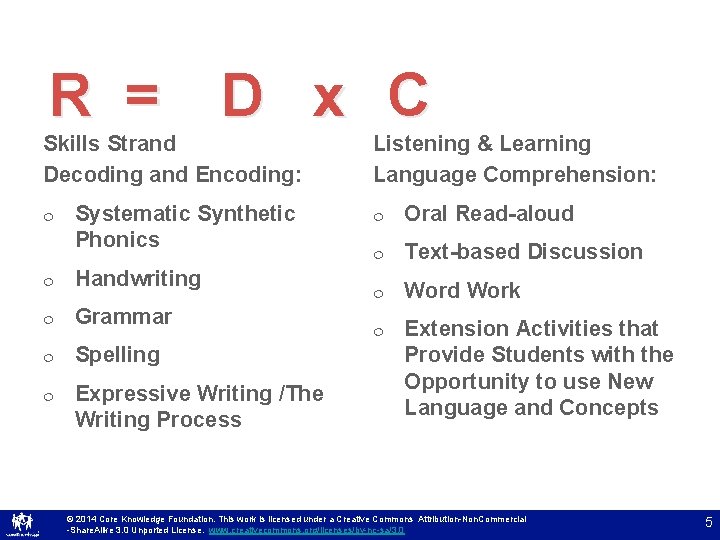
R = D x C Skills Strand Decoding and Encoding: ¦ Systematic Synthetic Phonics ¦ Handwriting ¦ Grammar ¦ Spelling ¦ Expressive Writing /The Writing Process Listening & Learning Language Comprehension: ¦ Oral Read-aloud ¦ Text-based Discussion ¦ Word Work ¦ Extension Activities that Provide Students with the Opportunity to use New Language and Concepts © 2014 Core Knowledge Foundation. This work is licensed under a Creative Commons Attribution-Non. Commercial -Share. Alike 3. 0 Unported License. www. creativecommons. org/licenses/by-nc-sa/3. 0 5
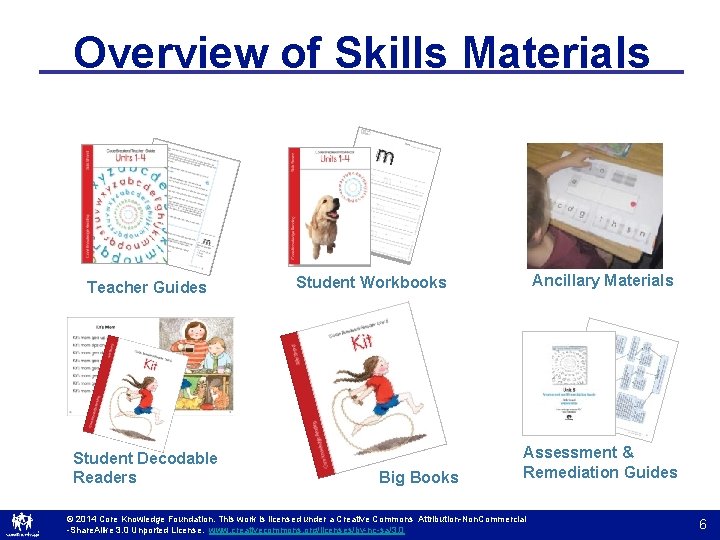
Overview of Skills Materials Teacher Guides Student Decodable Readers Ancillary Materials Student Workbooks Big Books Assessment & Remediation Guides © 2014 Core Knowledge Foundation. This work is licensed under a Creative Commons Attribution-Non. Commercial -Share. Alike 3. 0 Unported License. www. creativecommons. org/licenses/by-nc-sa/3. 0 6
Skills Strand Instruction • 10 – 12 Lesson Types Per Grade ¦ Phonics & Reading ¦ Grammar ¦ Spelling ¦ Writing • Gradual Release Modeled Through Lessons ¦ Warm-up ¦ Explicit Instruction ¦ Model ¦ Group Practice ¦ Independent Application © 2014 Core Knowledge Foundation. This work is licensed under a Creative Commons Attribution-Non. Commercial -Share. Alike 3. 0 Unported License. www. creativecommons. org/licenses/by-nc-sa/3. 0 7
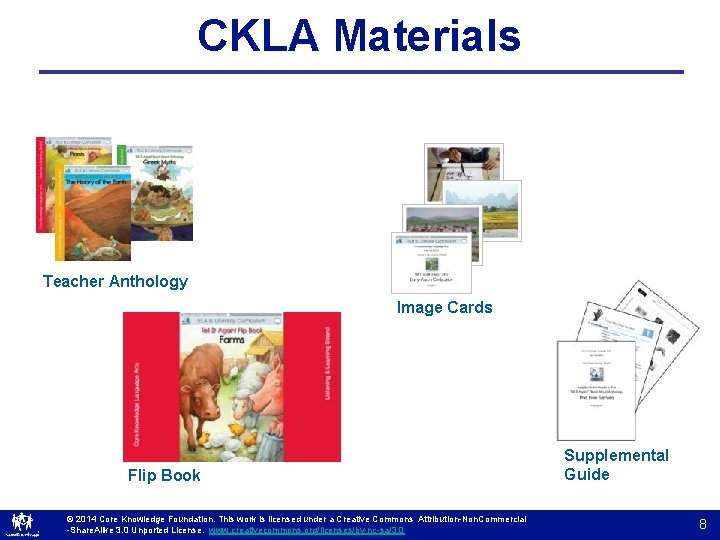
CKLA Materials Teacher Anthology Image Cards Flip Book © 2014 Core Knowledge Foundation. This work is licensed under a Creative Commons Attribution-Non. Commercial -Share. Alike 3. 0 Unported License. www. creativecommons. org/licenses/by-nc-sa/3. 0 Supplemental Guide 8
Listening & Learning Instruction • Stays on topic for 2 – 3 weeks • Single Lesson Type Across Grades • Each Lesson Includes: ¦ Read-aloud • Introduction to the Read Aloud • Presenting the Read Aloud ¦ Discussion • Comprehension Questions • Word Work ¦ Extension Activity © 2014 Core Knowledge Foundation. This work is licensed under a Creative Commons Attribution-Non. Commercial -Share. Alike 3. 0 Unported License. www. creativecommons. org/licenses/by-nc-sa/3. 0 9
Key Design Principles of the Skills Strand A Systematic Approach
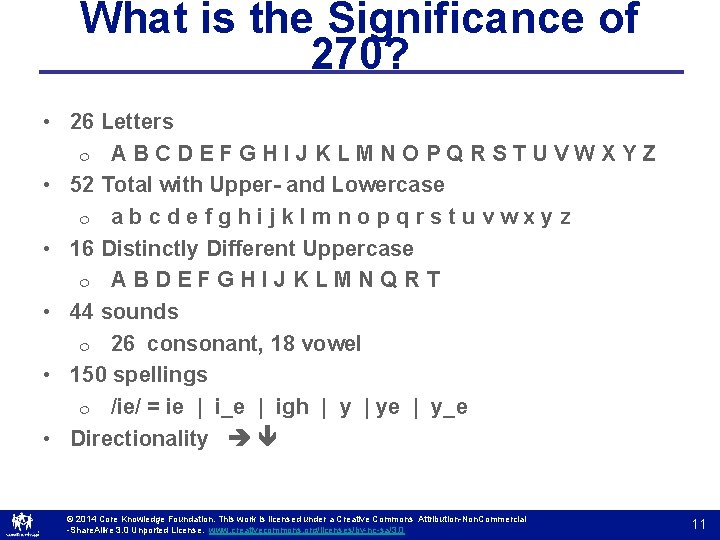
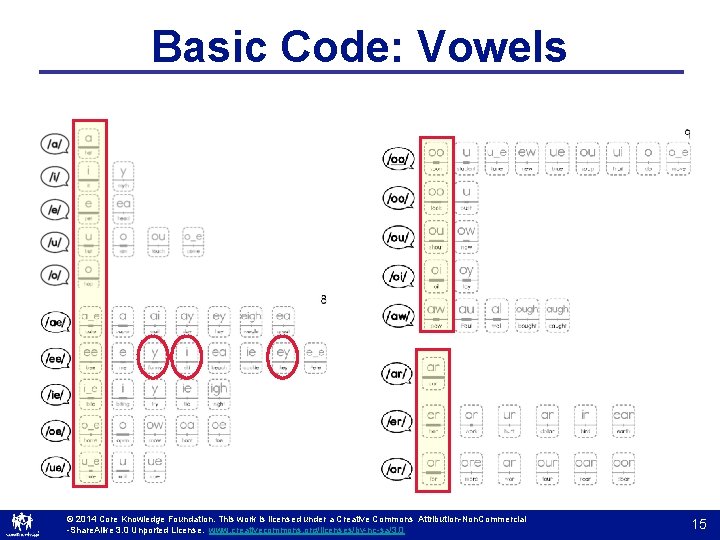
What is the Significance of 270? • 26 Letters ¦ ABCDEFGHIJKLMNOPQRSTUVWXYZ • 52 Total with Upper- and Lowercase ¦ abcdefghijklmnopqrstuvwxyz • 16 Distinctly Different Uppercase ¦ ABDEFGHIJKLMNQRT • 44 sounds ¦ 26 consonant, 18 vowel • 150 spellings ¦ /ie/ = ie | i_e | igh | ye | y_e • Directionality © 2014 Core Knowledge Foundation. This work is licensed under a Creative Commons Attribution-Non. Commercial -Share. Alike 3. 0 Unported License. www. creativecommons. org/licenses/by-nc-sa/3. 0 11
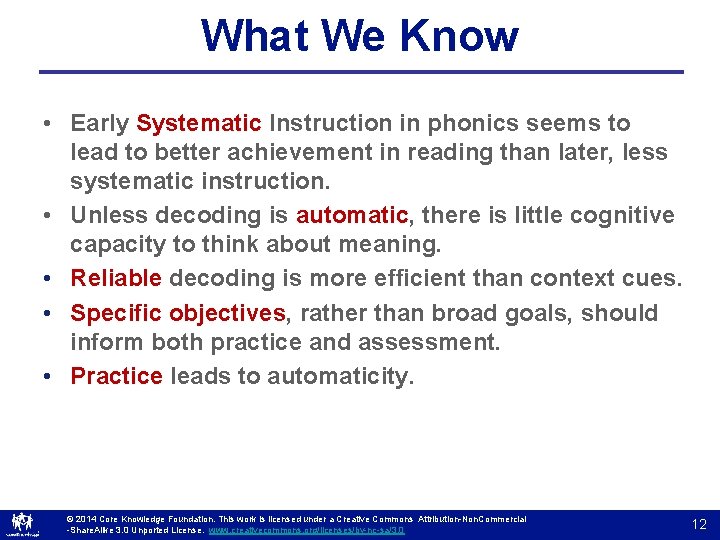
What We Know • Early Systematic Instruction in phonics seems to lead to better achievement in reading than later, less systematic instruction. • Unless decoding is automatic, there is little cognitive capacity to think about meaning. • Reliable decoding is more efficient than context cues. • Specific objectives, rather than broad goals, should inform both practice and assessment. • Practice leads to automaticity. © 2014 Core Knowledge Foundation. This work is licensed under a Creative Commons Attribution-Non. Commercial -Share. Alike 3. 0 Unported License. www. creativecommons. org/licenses/by-nc-sa/3. 0 12
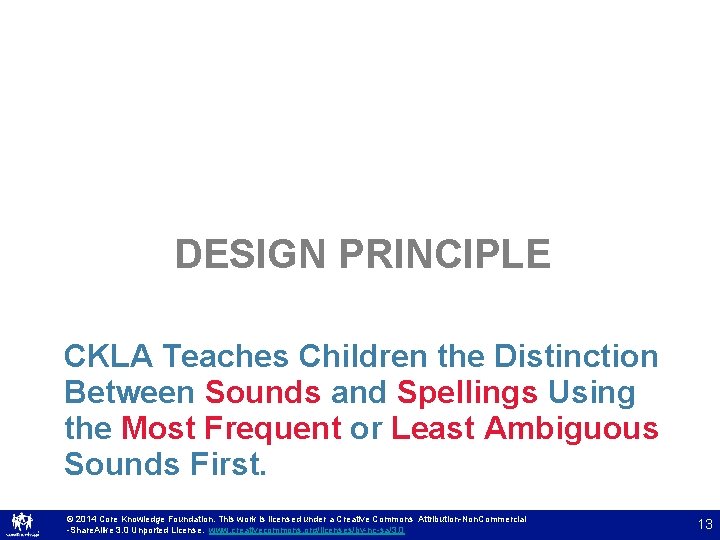
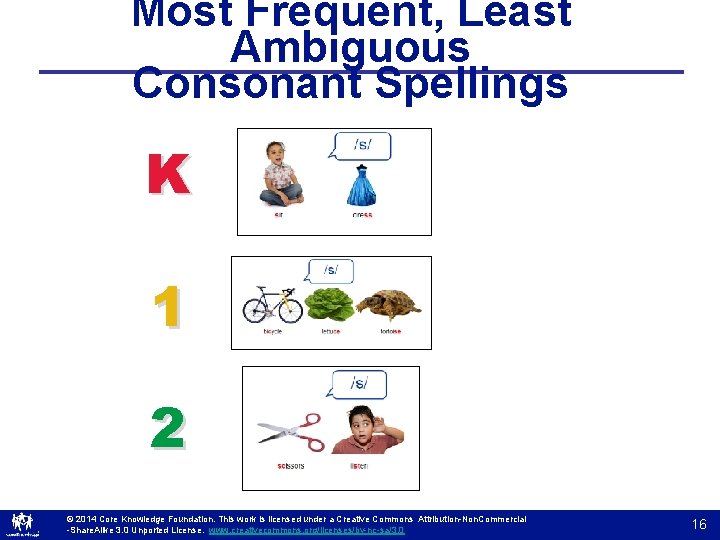
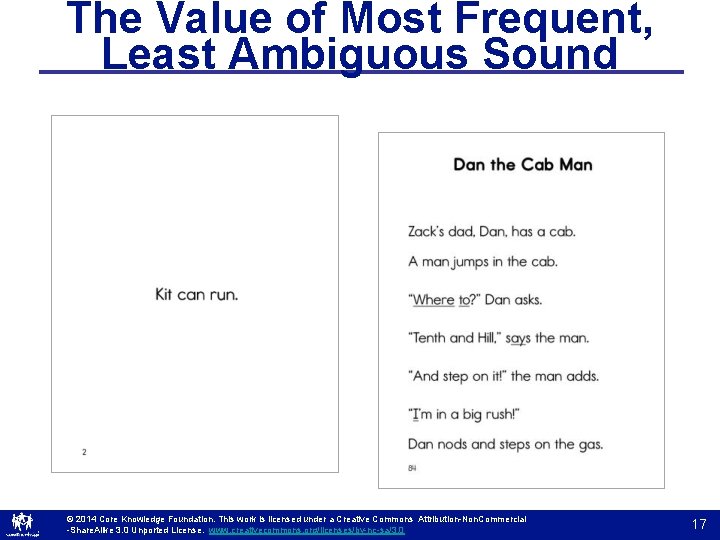
DESIGN PRINCIPLE CKLA Teaches Children the Distinction Between Sounds and Spellings Using the Most Frequent or Least Ambiguous Sounds First. © 2014 Core Knowledge Foundation. This work is licensed under a Creative Commons Attribution-Non. Commercial -Share. Alike 3. 0 Unported License. www. creativecommons. org/licenses/by-nc-sa/3. 0 13
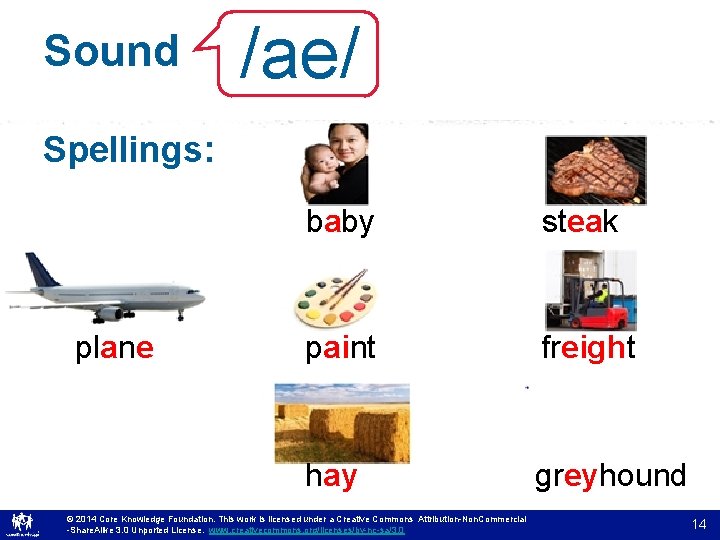
Sound: /ae/ Spellings: plane baby steak paint freight hay greyhound © 2014 Core Knowledge Foundation. This work is licensed under a Creative Commons Attribution-Non. Commercial -Share. Alike 3. 0 Unported License. www. creativecommons. org/licenses/by-nc-sa/3. 0 14
Basic Code: Vowels © 2014 Core Knowledge Foundation. This work is licensed under a Creative Commons Attribution-Non. Commercial -Share. Alike 3. 0 Unported License. www. creativecommons. org/licenses/by-nc-sa/3. 0 15
Most Frequent, Least Ambiguous Consonant Spellings K 1 2 © 2014 Core Knowledge Foundation. This work is licensed under a Creative Commons Attribution-Non. Commercial -Share. Alike 3. 0 Unported License. www. creativecommons. org/licenses/by-nc-sa/3. 0 16
The Value of Most Frequent, Least Ambiguous Sound © 2014 Core Knowledge Foundation. This work is licensed under a Creative Commons Attribution-Non. Commercial -Share. Alike 3. 0 Unported License. www. creativecommons. org/licenses/by-nc-sa/3. 0 17
DESIGN PRINCIPLE CKLA Gives Intensive Practice to Build Reliability and Automaticity. © 2014 Core Knowledge Foundation. This work is licensed under a Creative Commons Attribution-Non. Commercial -Share. Alike 3. 0 Unported License. www. creativecommons. org/licenses/by-nc-sa/3. 0 18
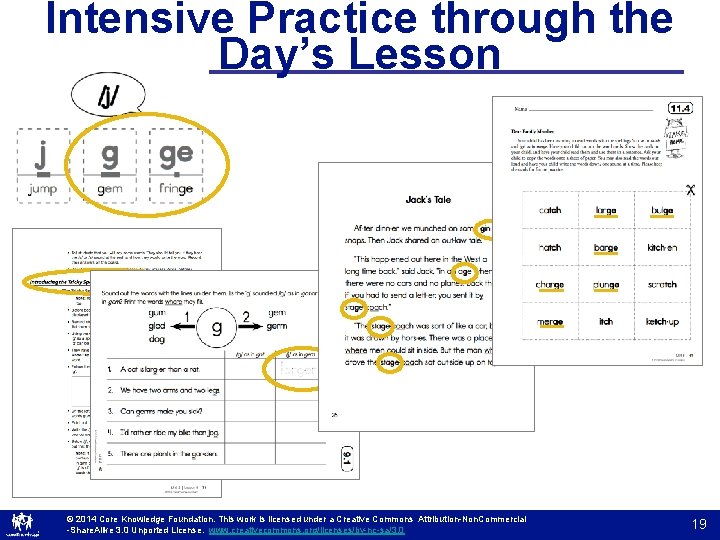
Intensive Practice through the Day’s Lesson © 2014 Core Knowledge Foundation. This work is licensed under a Creative Commons Attribution-Non. Commercial -Share. Alike 3. 0 Unported License. www. creativecommons. org/licenses/by-nc-sa/3. 0 19
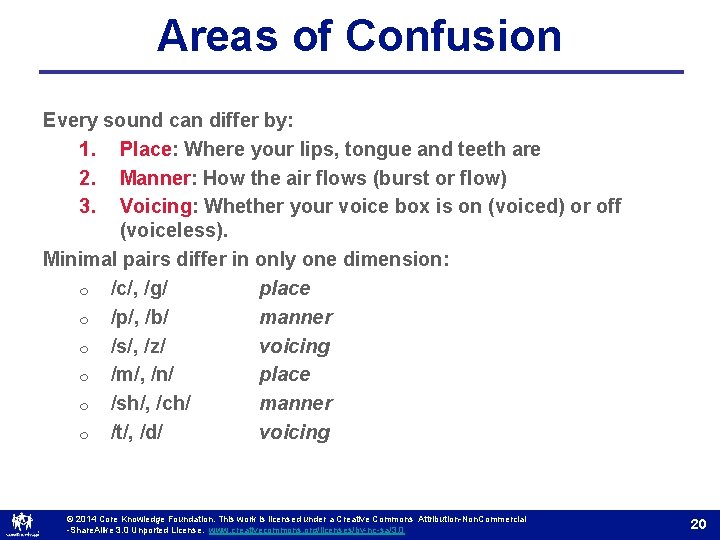
Areas of Confusion Every sound can differ by: 1. Place: Where your lips, tongue and teeth are 2. Manner: How the air flows (burst or flow) 3. Voicing: Whether your voice box is on (voiced) or off (voiceless). Minimal pairs differ in only one dimension: ¦ /c/, /g/ place ¦ /p/, /b/ manner ¦ /s/, /z/ voicing ¦ /m/, /n/ place ¦ /sh/, /ch/ manner ¦ /t/, /d/ voicing © 2014 Core Knowledge Foundation. This work is licensed under a Creative Commons Attribution-Non. Commercial -Share. Alike 3. 0 Unported License. www. creativecommons. org/licenses/by-nc-sa/3. 0 20
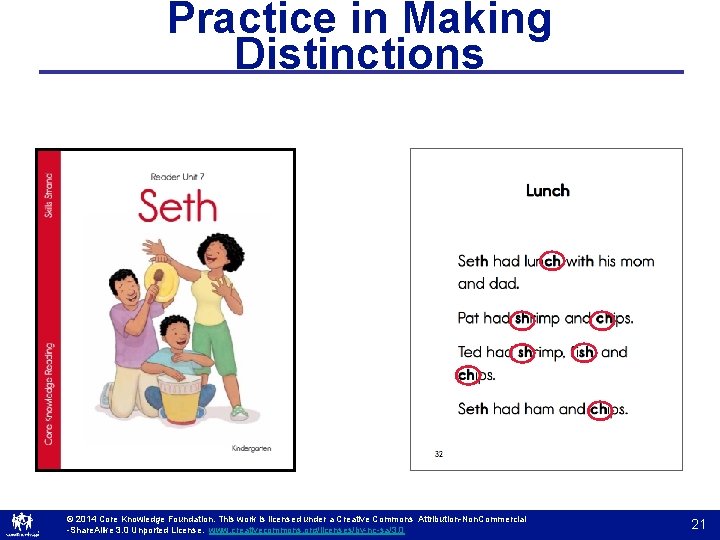
Practice in Making Distinctions © 2014 Core Knowledge Foundation. This work is licensed under a Creative Commons Attribution-Non. Commercial -Share. Alike 3. 0 Unported License. www. creativecommons. org/licenses/by-nc-sa/3. 0 21
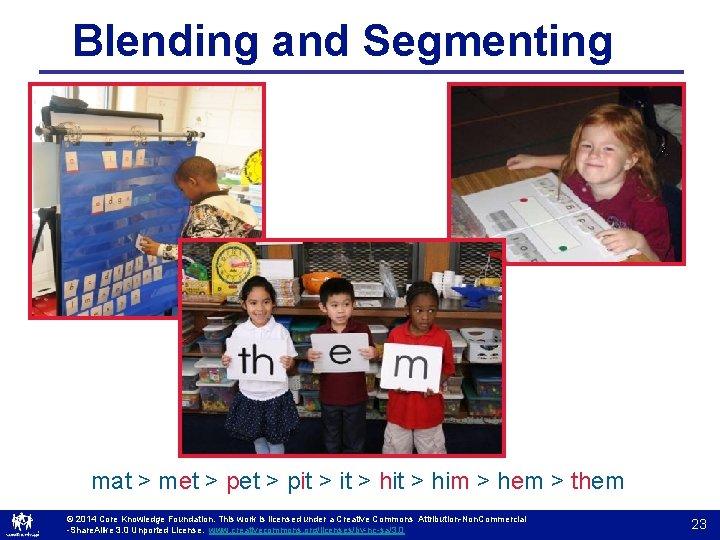
DESIGN PRINCIPLE CKLA Directly Instructs in those Oral Language Skills (Blending & Segmenting) that Underlie And Parallel Reading And Writing Skills. © 2014 Core Knowledge Foundation. This work is licensed under a Creative Commons Attribution-Non. Commercial -Share. Alike 3. 0 Unported License. www. creativecommons. org/licenses/by-nc-sa/3. 0 22
Blending and Segmenting mat > met > pit > hit > him > hem > them © 2014 Core Knowledge Foundation. This work is licensed under a Creative Commons Attribution-Non. Commercial -Share. Alike 3. 0 Unported License. www. creativecommons. org/licenses/by-nc-sa/3. 0 23
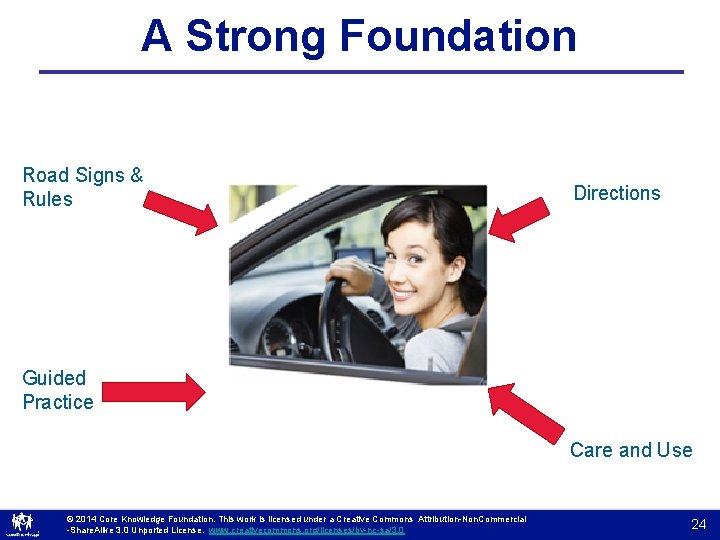
A Strong Foundation Road Signs & Rules Directions Guided Practice Care and Use © 2014 Core Knowledge Foundation. This work is licensed under a Creative Commons Attribution-Non. Commercial -Share. Alike 3. 0 Unported License. www. creativecommons. org/licenses/by-nc-sa/3. 0 24
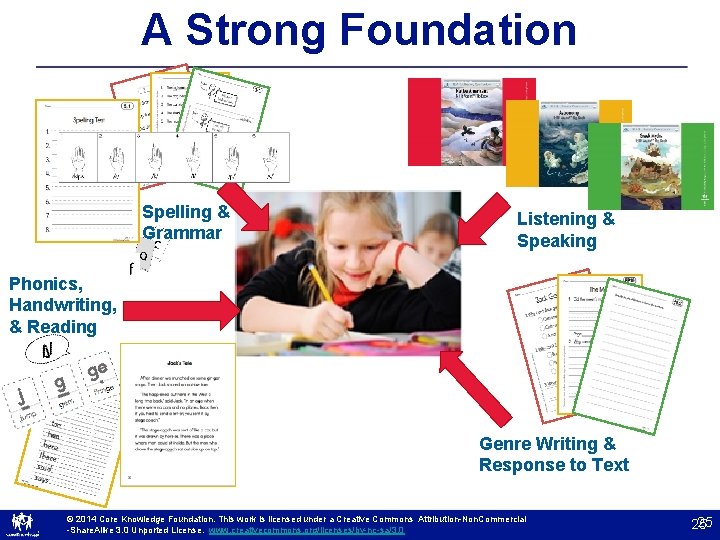
A Strong Foundation Spelling & Grammar Listening & Speaking Phonics, Handwriting, & Reading Genre Writing & Response to Text © 2014 Core Knowledge Foundation. This work is licensed under a Creative Commons Attribution-Non. Commercial -Share. Alike 3. 0 Unported License. www. creativecommons. org/licenses/by-nc-sa/3. 0 25 25
Key Design Principles of Listening and Learning Building Knowledge and Language Systematically © 2014 Core Knowledge Foundation. This work is licensed under a Creative Commons Attribution-Non. Commercial -Share. Alike 3. 0 Unported License. www. creativecommons. org/licenses/by-nc-sa/3. 0
DESIGN PRINCIPLE CKLA uses Read-alouds to Support Oral Language Skills that Underlie and Parallel Reading and Writing Skills. © 2014 Core Knowledge Foundation. This work is licensed under a Creative Commons Attribution-Non. Commercial -Share. Alike 3. 0 Unported License. www. creativecommons. org/licenses/by-nc-sa/3. 0 27
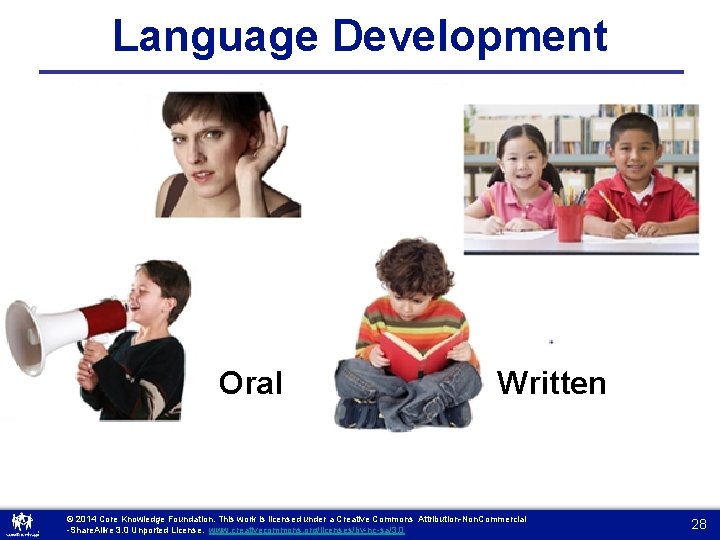
Language Development Oral Written © 2014 Core Knowledge Foundation. This work is licensed under a Creative Commons Attribution-Non. Commercial -Share. Alike 3. 0 Unported License. www. creativecommons. org/licenses/by-nc-sa/3. 0 28
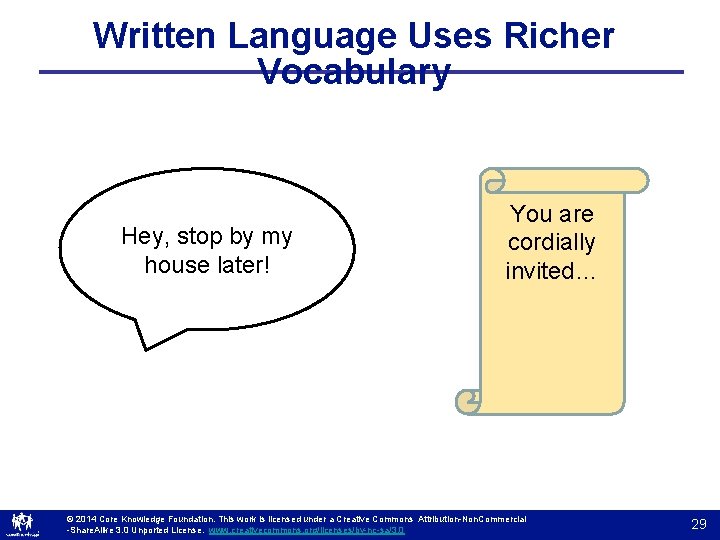
Written Language Uses Richer Vocabulary Hey, stop by my house later! You are cordially invited… © 2014 Core Knowledge Foundation. This work is licensed under a Creative Commons Attribution-Non. Commercial -Share. Alike 3. 0 Unported License. www. creativecommons. org/licenses/by-nc-sa/3. 0 29
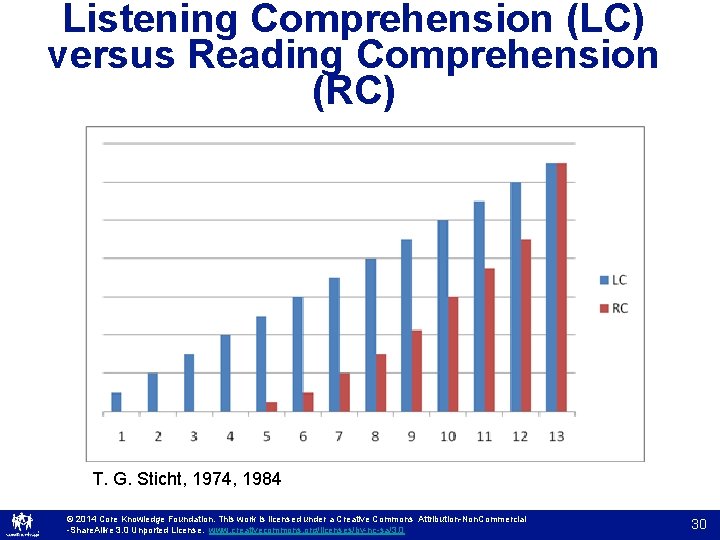
Listening Comprehension (LC) versus Reading Comprehension (RC) T. G. Sticht, 1974, 1984 © 2014 Core Knowledge Foundation. This work is licensed under a Creative Commons Attribution-Non. Commercial -Share. Alike 3. 0 Unported License. www. creativecommons. org/licenses/by-nc-sa/3. 0 30
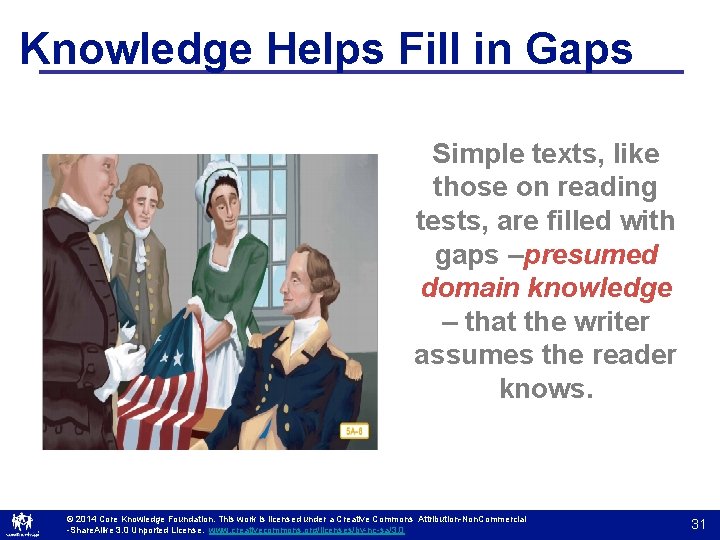
Knowledge Helps Fill in Gaps Simple texts, like those on reading tests, are filled with gaps –presumed domain knowledge – that the writer assumes the reader knows. © 2014 Core Knowledge Foundation. This work is licensed under a Creative Commons Attribution-Non. Commercial -Share. Alike 3. 0 Unported License. www. creativecommons. org/licenses/by-nc-sa/3. 0 31
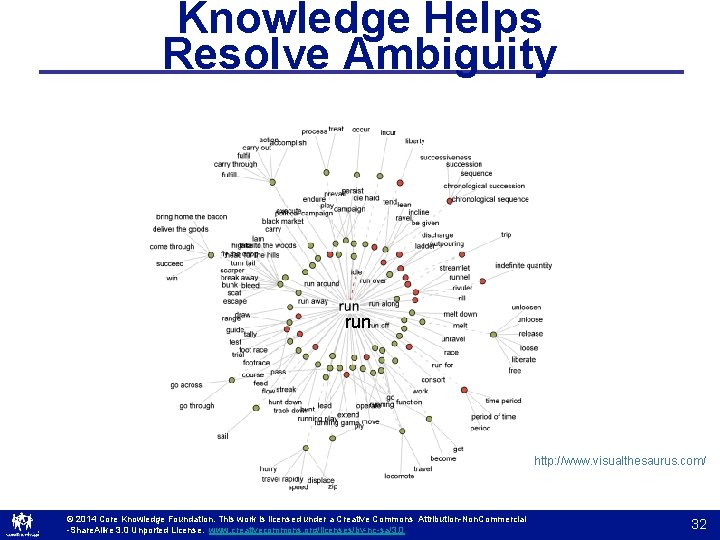
Knowledge Helps Resolve Ambiguity run http: //www. visualthesaurus. com/ © 2014 Core Knowledge Foundation. This work is licensed under a Creative Commons Attribution-Non. Commercial -Share. Alike 3. 0 Unported License. www. creativecommons. org/licenses/by-nc-sa/3. 0 32
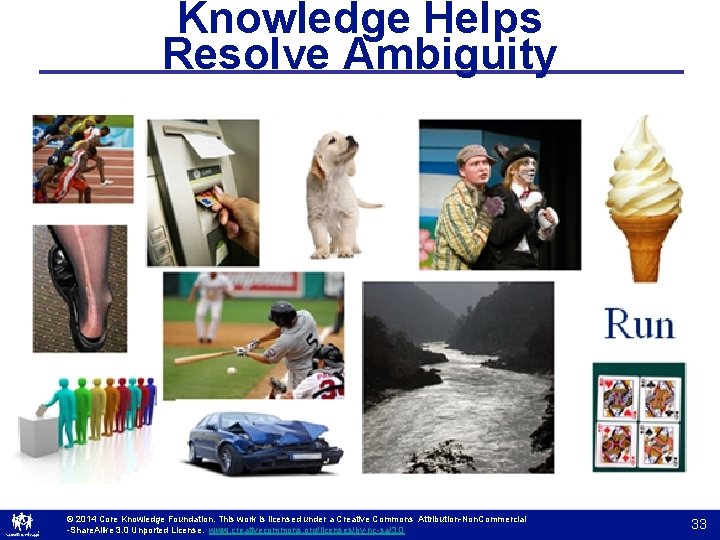
Knowledge Helps Resolve Ambiguity © 2014 Core Knowledge Foundation. This work is licensed under a Creative Commons Attribution-Non. Commercial -Share. Alike 3. 0 Unported License. www. creativecommons. org/licenses/by-nc-sa/3. 0 33
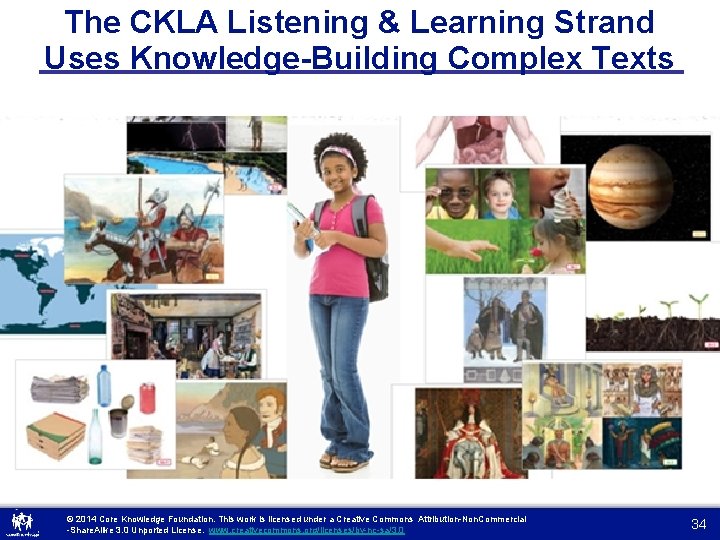
The CKLA Listening & Learning Strand Uses Knowledge-Building Complex Texts © 2014 Core Knowledge Foundation. This work is licensed under a Creative Commons Attribution-Non. Commercial -Share. Alike 3. 0 Unported License. www. creativecommons. org/licenses/by-nc-sa/3. 0 34
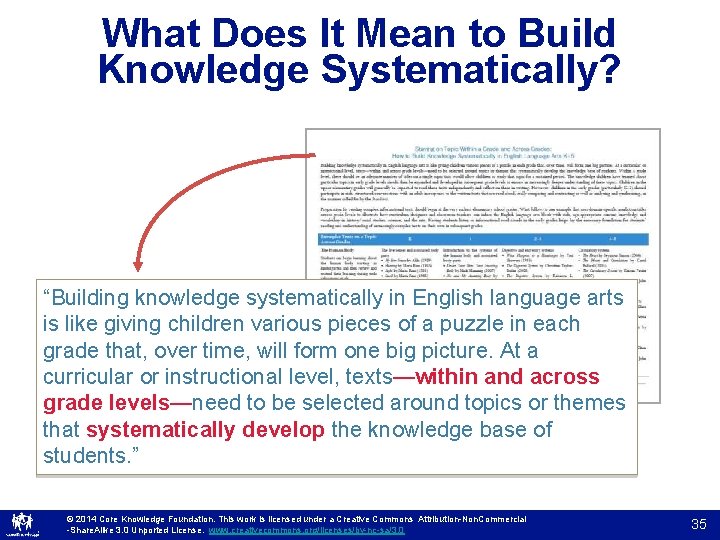
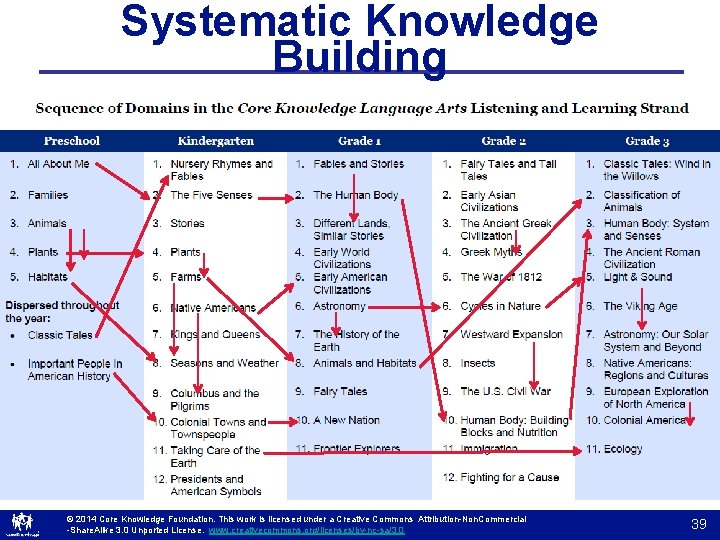
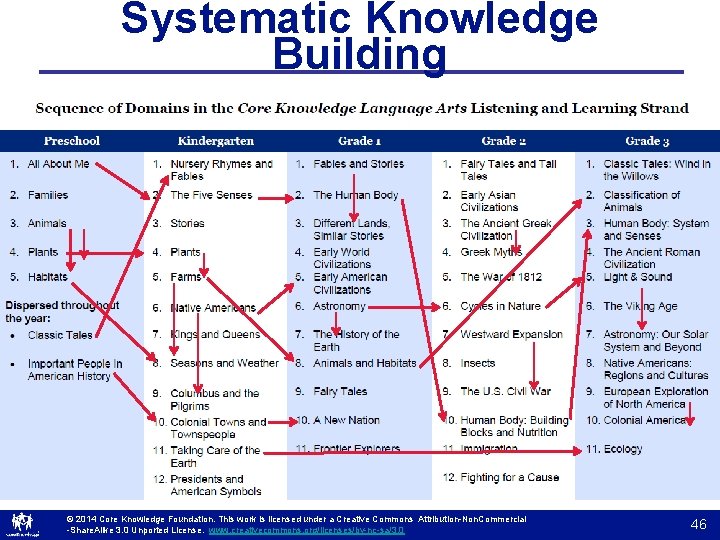
What Does It Mean to Build Knowledge Systematically? “Building knowledge systematically in English language arts is like giving children various pieces of a puzzle in each grade that, over time, will form one big picture. At a curricular or instructional level, texts—within and across grade levels—need to be selected around topics or themes that systematically develop the knowledge base of students. ” © 2014 Core Knowledge Foundation. This work is licensed under a Creative Commons Attribution-Non. Commercial -Share. Alike 3. 0 Unported License. www. creativecommons. org/licenses/by-nc-sa/3. 0 35
DESIGN PRINCIPLE CKLA Systematically Builds Knowledge © 2014 Core Knowledge Foundation. This work is licensed under a Creative Commons Attribution-Non. Commercial -Share. Alike 3. 0 Unported License. www. creativecommons. org/licenses/by-nc-sa/3. 0 36
What We Know • Knowledge builds on knowledge • All of our most desirable goals for education are all knowledge dependent: ¦ ¦ Creativity Problem solving Reading comprehension General achievement • Knowing things allows us to expend the smallest amount of cognitive capacity on processing lowerorder aspects of a problem so that more cognitive capacity is available for higher levels © 2014 Core Knowledge Foundation. This work is licensed under a Creative Commons Attribution-Non. Commercial -Share. Alike 3. 0 Unported License. www. creativecommons. org/licenses/by-nc-sa/3. 0 37
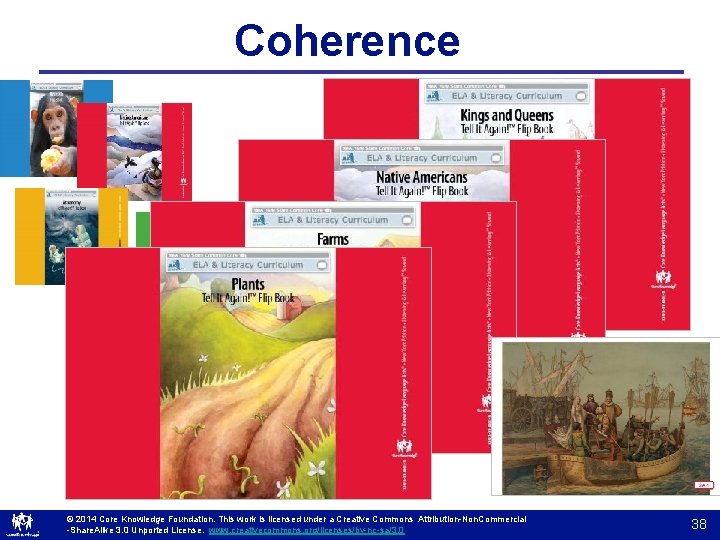
Coherence © 2014 Core Knowledge Foundation. This work is licensed under a Creative Commons Attribution-Non. Commercial -Share. Alike 3. 0 Unported License. www. creativecommons. org/licenses/by-nc-sa/3. 0 38
Systematic Knowledge Building © 2014 Core Knowledge Foundation. This work is licensed under a Creative Commons Attribution-Non. Commercial -Share. Alike 3. 0 Unported License. www. creativecommons. org/licenses/by-nc-sa/3. 0 39
DESIGN PRINCIPLE CKLA Stays On Topic To Foster The Most Efficient Word Learning © 2014 Core Knowledge Foundation. This work is licensed under a Creative Commons Attribution-Non. Commercial -Share. Alike 3. 0 Unported License. www. creativecommons. org/licenses/by-nc-sa/3. 0 40
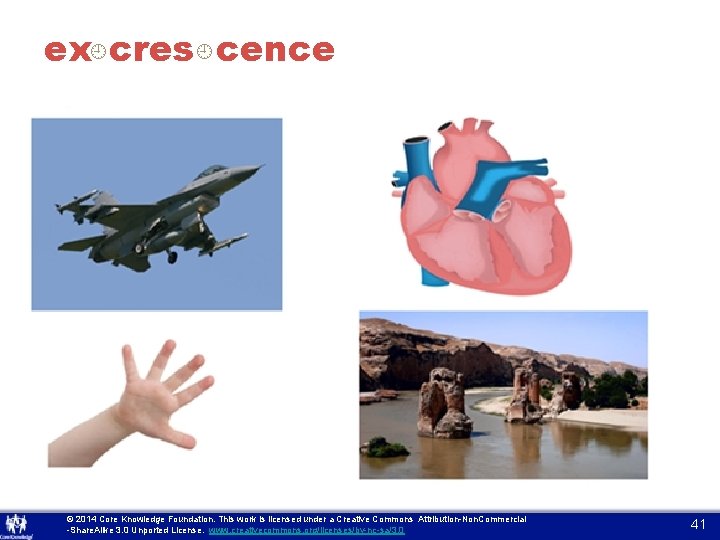
ex cres cence © 2014 Core Knowledge Foundation. This work is licensed under a Creative Commons Attribution-Non. Commercial -Share. Alike 3. 0 Unported License. www. creativecommons. org/licenses/by-nc-sa/3. 0 41
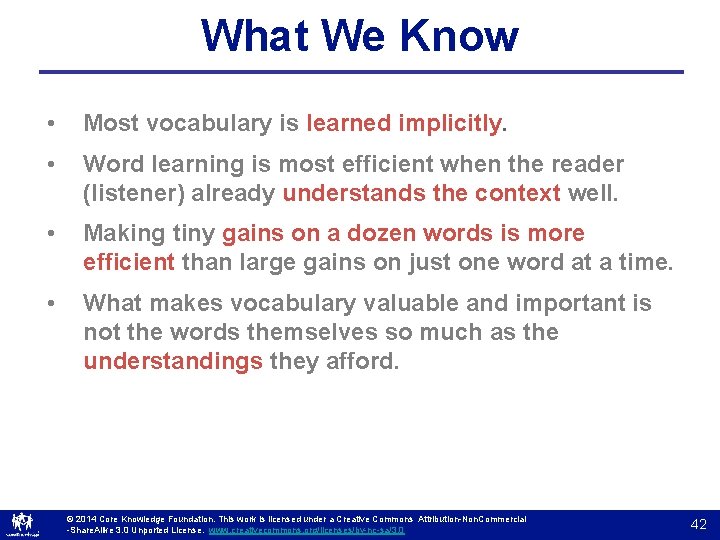
What We Know • Most vocabulary is learned implicitly. • Word learning is most efficient when the reader (listener) already understands the context well. • Making tiny gains on a dozen words is more efficient than large gains on just one word at a time. • What makes vocabulary valuable and important is not the words themselves so much as the understandings they afford. © 2014 Core Knowledge Foundation. This work is licensed under a Creative Commons Attribution-Non. Commercial -Share. Alike 3. 0 Unported License. www. creativecommons. org/licenses/by-nc-sa/3. 0 42
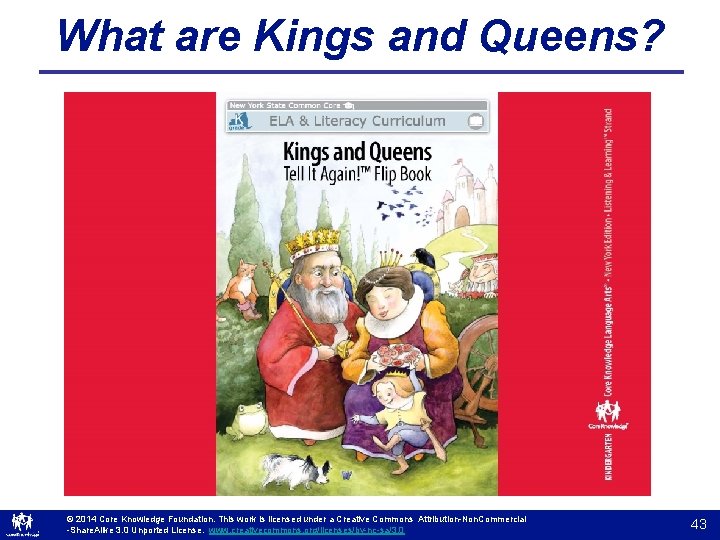
What are Kings and Queens? © 2014 Core Knowledge Foundation. This work is licensed under a Creative Commons Attribution-Non. Commercial -Share. Alike 3. 0 Unported License. www. creativecommons. org/licenses/by-nc-sa/3. 0 43
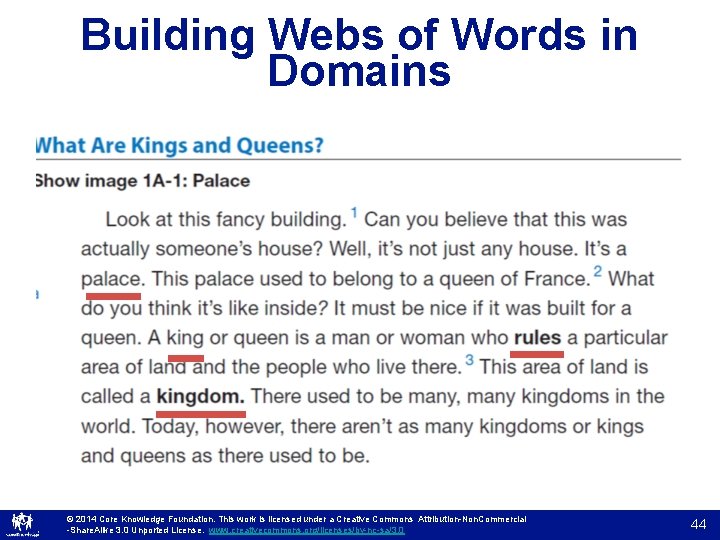
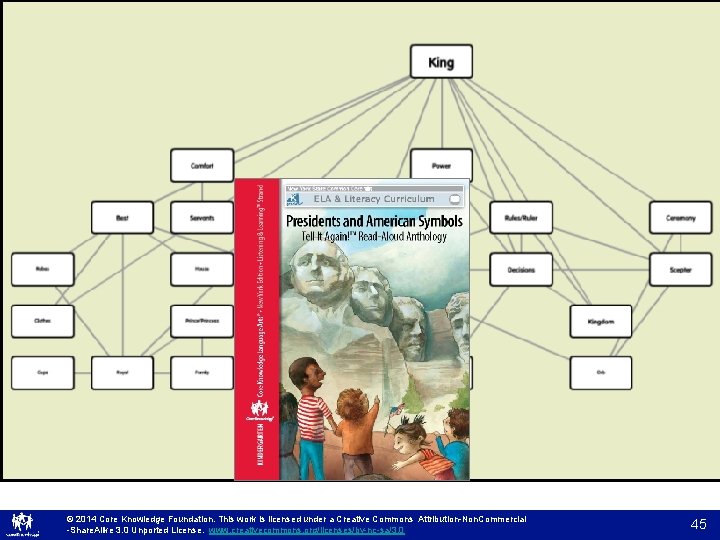
Building Webs of Words in Domains © 2014 Core Knowledge Foundation. This work is licensed under a Creative Commons Attribution-Non. Commercial -Share. Alike 3. 0 Unported License. www. creativecommons. org/licenses/by-nc-sa/3. 0 44
Sections 3 & 4 © 2014 Core Knowledge Foundation. This work is licensed under a Creative Commons Attribution-Non. Commercial -Share. Alike 3. 0 Unported License. www. creativecommons. org/licenses/by-nc-sa/3. 0 45
Systematic Knowledge Building © 2014 Core Knowledge Foundation. This work is licensed under a Creative Commons Attribution-Non. Commercial -Share. Alike 3. 0 Unported License. www. creativecommons. org/licenses/by-nc-sa/3. 0 46
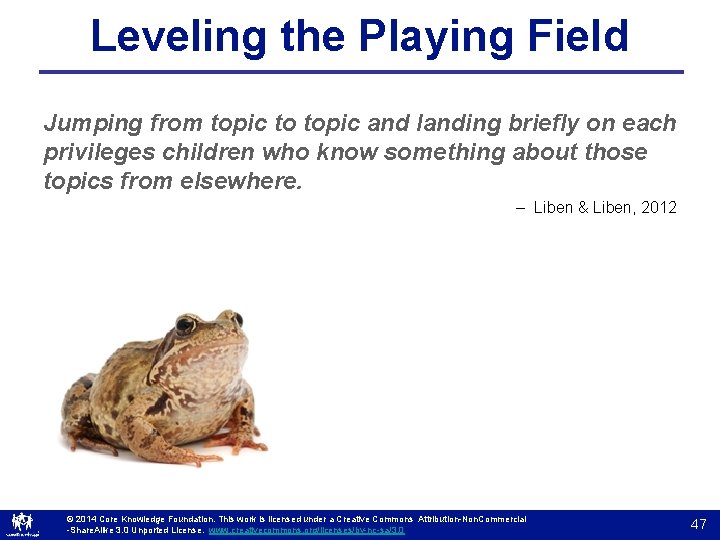
Leveling the Playing Field Jumping from topic to topic and landing briefly on each privileges children who know something about those topics from elsewhere. – Liben & Liben, 2012 © 2014 Core Knowledge Foundation. This work is licensed under a Creative Commons Attribution-Non. Commercial -Share. Alike 3. 0 Unported License. www. creativecommons. org/licenses/by-nc-sa/3. 0 47