Chapter 6 Lesson 3 Part I Names and
- Slides: 17
Chapter 6 Lesson 3 (Part I) “Names and Formulas for Ionic Compounds”
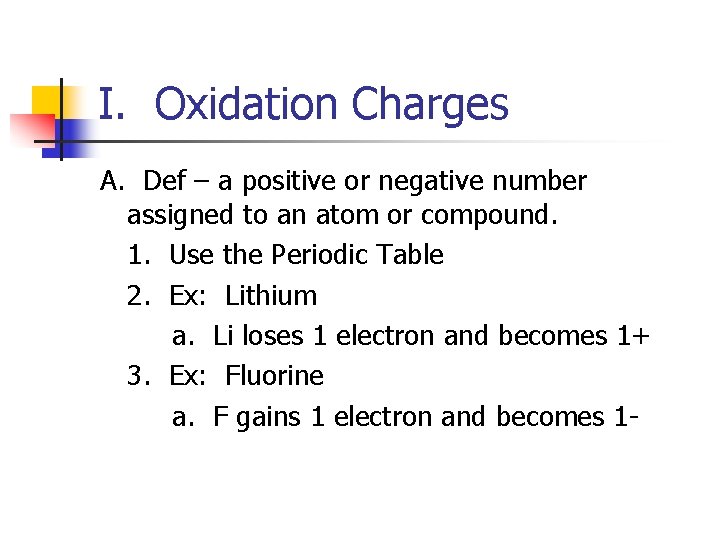
I. Oxidation Charges A. Def – a positive or negative number assigned to an atom or compound. 1. Use the Periodic Table 2. Ex: Lithium a. Li loses 1 electron and becomes 1+ 3. Ex: Fluorine a. F gains 1 electron and becomes 1 -
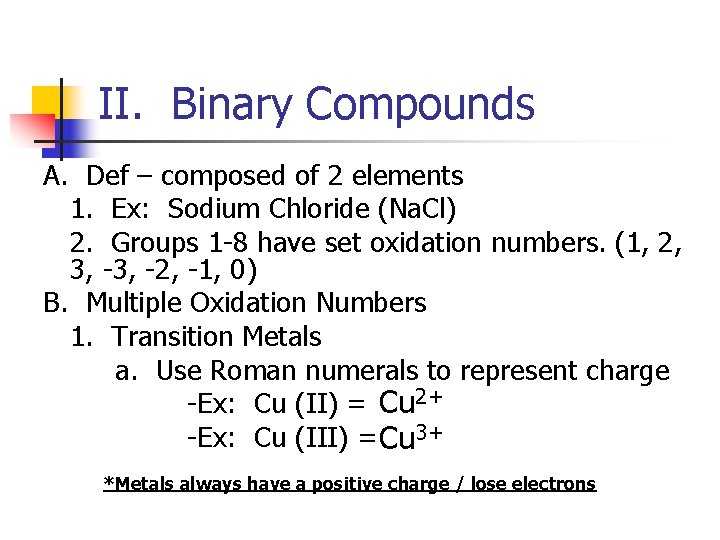
II. Binary Compounds A. Def – composed of 2 elements 1. Ex: Sodium Chloride (Na. Cl) 2. Groups 1 -8 have set oxidation numbers. (1, 2, 3, -2, -1, 0) B. Multiple Oxidation Numbers 1. Transition Metals a. Use Roman numerals to represent charge -Ex: Cu (II) = Cu 2+ -Ex: Cu (III) = Cu 3+ *Metals always have a positive charge / lose electrons
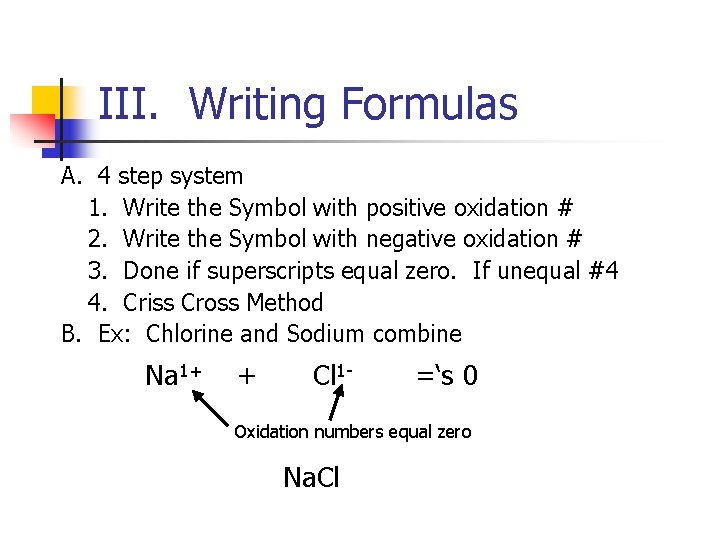
III. Writing Formulas A. 4 step system 1. Write the Symbol with positive oxidation # 2. Write the Symbol with negative oxidation # 3. Done if superscripts equal zero. If unequal #4 4. Criss Cross Method B. Ex: Chlorine and Sodium combine Na 1+ + Cl 1 - =‘s 0 Oxidation numbers equal zero Na. Cl
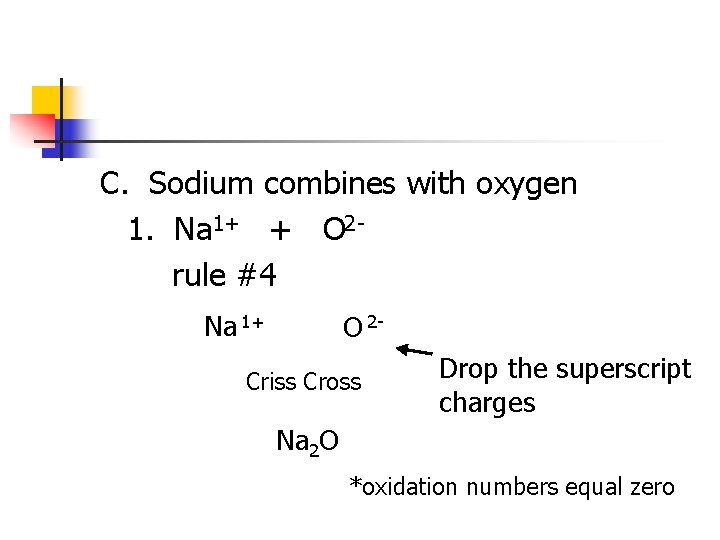
C. Sodium combines with oxygen 1. Na 1+ + O 2 rule #4 Na 1+ O 2 - Criss Cross Drop the superscript charges Na 2 O *oxidation numbers equal zero
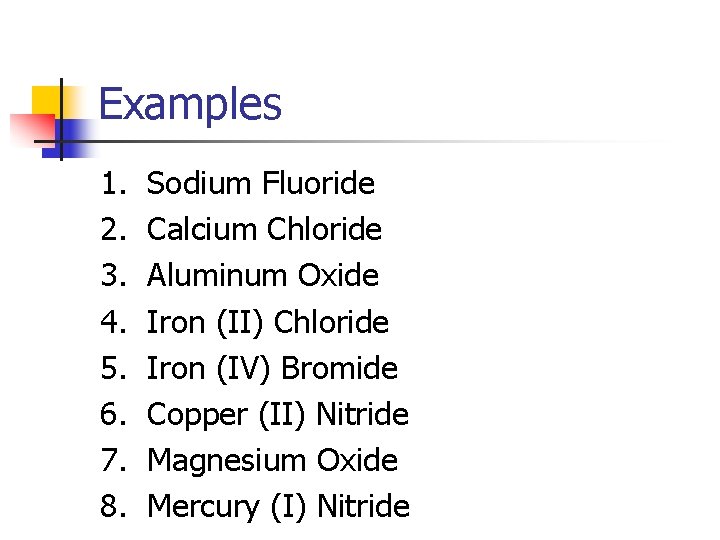
Examples 1. 2. 3. 4. 5. 6. 7. 8. Sodium Fluoride Calcium Chloride Aluminum Oxide Iron (II) Chloride Iron (IV) Bromide Copper (II) Nitride Magnesium Oxide Mercury (I) Nitride
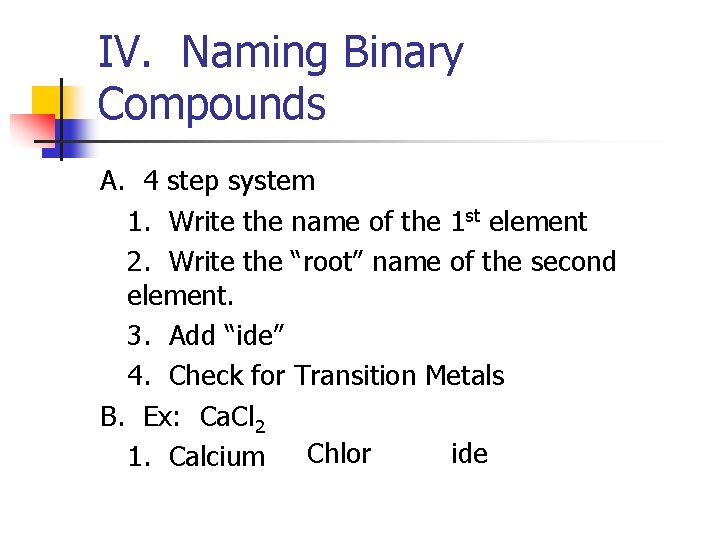
IV. Naming Binary Compounds A. 4 step system 1. Write the name of the 1 st element 2. Write the “root” name of the second element. 3. Add “ide” 4. Check for Transition Metals B. Ex: Ca. Cl 2 Chlor ide 1. Calcium
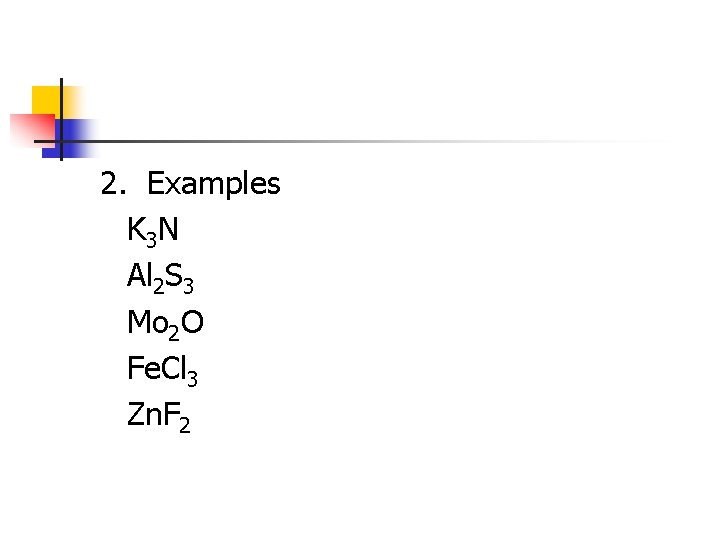
2. Examples K 3 N Al 2 S 3 Mo 2 O Fe. Cl 3 Zn. F 2
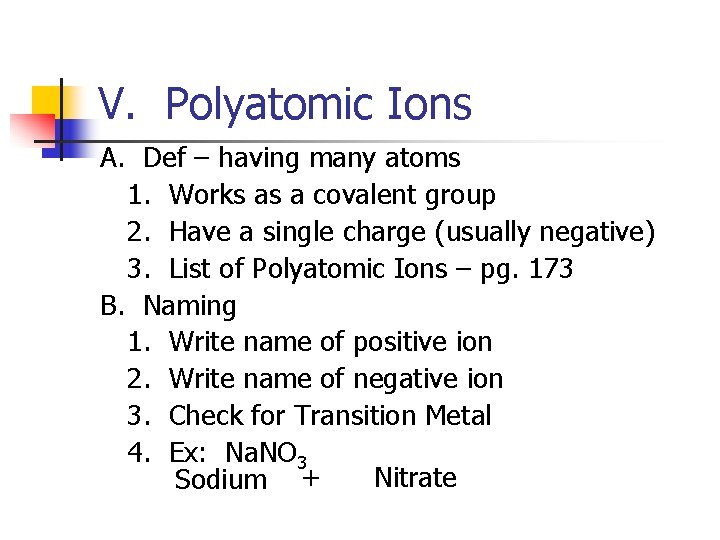
V. Polyatomic Ions A. Def – having many atoms 1. Works as a covalent group 2. Have a single charge (usually negative) 3. List of Polyatomic Ions – pg. 173 B. Naming 1. Write name of positive ion 2. Write name of negative ion 3. Check for Transition Metal 4. Ex: Na. NO 3 Nitrate Sodium +
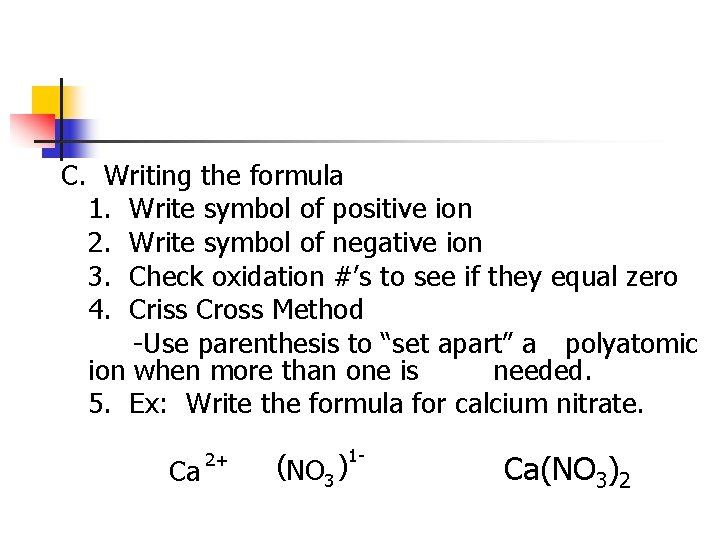
C. Writing the formula 1. Write symbol of positive ion 2. Write symbol of negative ion 3. Check oxidation #’s to see if they equal zero 4. Criss Cross Method -Use parenthesis to “set apart” a polyatomic ion when more than one is needed. 5. Ex: Write the formula for calcium nitrate. Ca 2+ (NO 3 )1 - Ca(NO 3)2
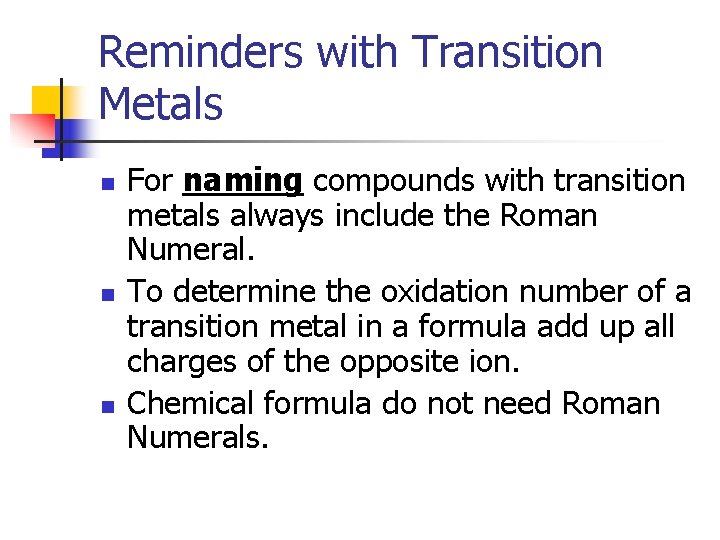
Reminders with Transition Metals n n n For naming compounds with transition metals always include the Roman Numeral. To determine the oxidation number of a transition metal in a formula add up all charges of the opposite ion. Chemical formula do not need Roman Numerals.
Chapter 6 Lesson 3 (Part II) “Names and Formulas for Molecular (Covalent) Compounds”
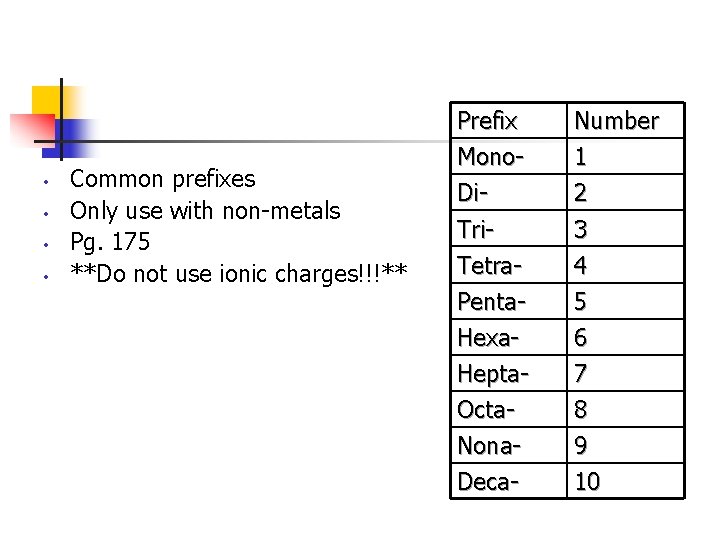
• • Common prefixes Only use with non-metals Pg. 175 **Do not use ionic charges!!!** Prefix Mono. Di- Number 1 2 Tri. Tetra- 3 4 Penta. Hexa. Hepta. Octa. Nona. Deca- 5 6 7 8 9 10
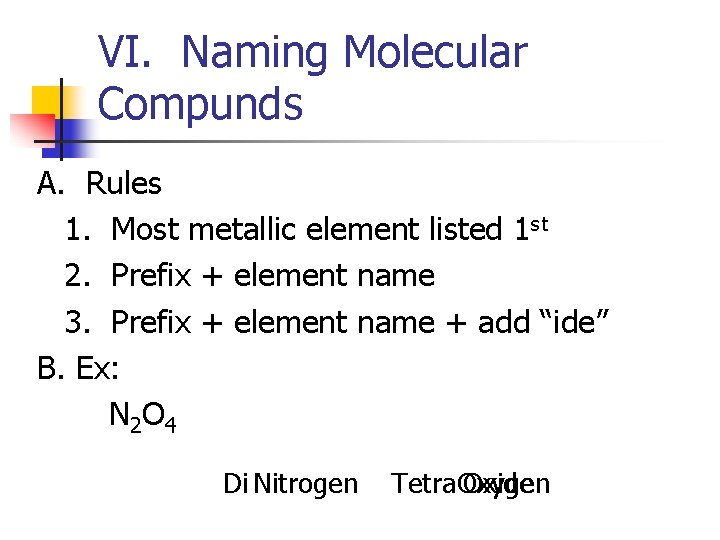
VI. Naming Molecular Compunds A. Rules 1. Most metallic element listed 1 st 2. Prefix + element name 3. Prefix + element name + add “ide” B. Ex: N 2 O 4 Di Nitrogen Tetra Oxygen Oxide
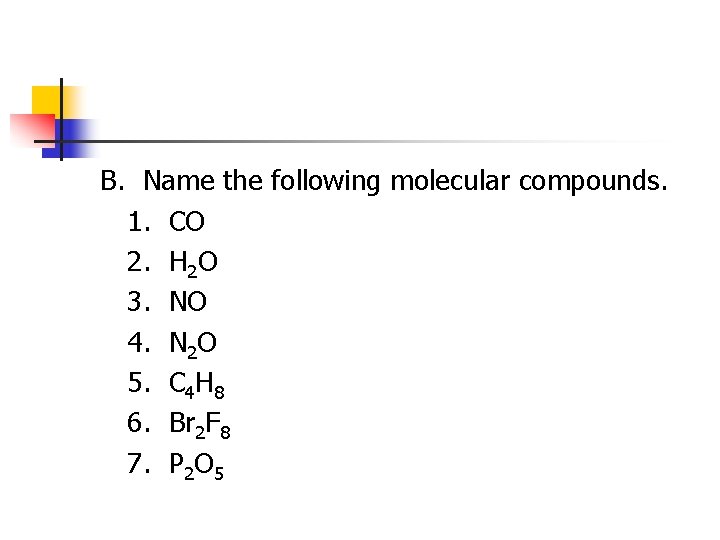
B. Name the following molecular compounds. 1. CO 2. H 2 O 3. NO 4. N 2 O 5. C 4 H 8 6. Br 2 F 8 7. P 2 O 5
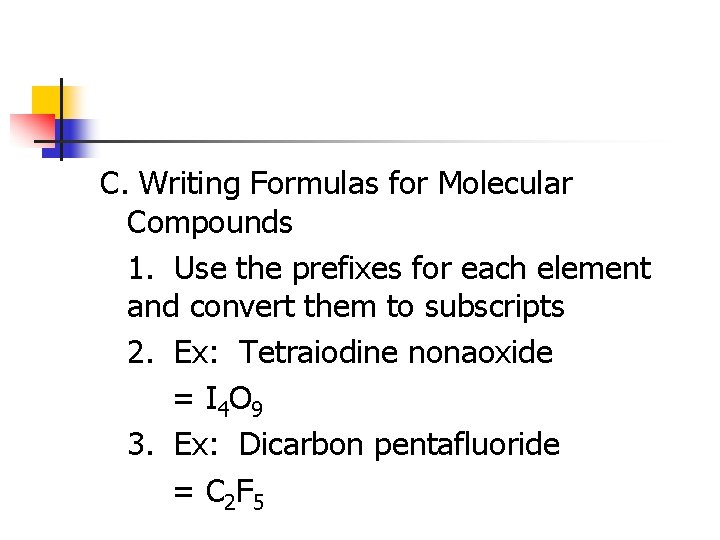
C. Writing Formulas for Molecular Compounds 1. Use the prefixes for each element and convert them to subscripts 2. Ex: Tetraiodine nonaoxide = I 4 O 9 3. Ex: Dicarbon pentafluoride = C 2 F 5
D. Write the formulas for the following molecular compounds 1. Carbon Dioxide 2. Sulfur Hexafluoride 3. Phosphorus Tribromide 4. Diphosphorus pentaoxide 5. Carbon Heptaoxide 6. Dicarbon decafluoride