CHAPTER 4 Completing the Accounting Cycle Principles of

- Slides: 13
CHAPTER 4 Completing the Accounting Cycle Principles of Financial Accounting 12 e Needles Powers © human/i. Stockphoto
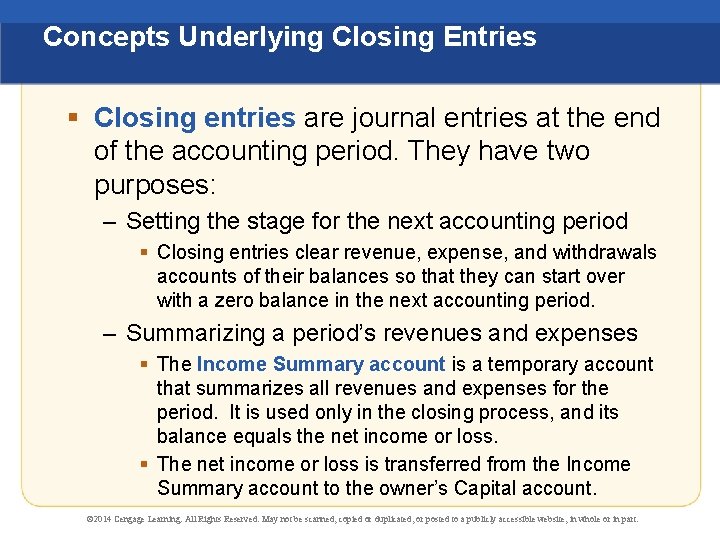
Concepts Underlying Closing Entries § Closing entries are journal entries at the end of the accounting period. They have two purposes: – Setting the stage for the next accounting period § Closing entries clear revenue, expense, and withdrawals accounts of their balances so that they can start over with a zero balance in the next accounting period. – Summarizing a period’s revenues and expenses § The Income Summary account is a temporary account that summarizes all revenues and expenses for the period. It is used only in the closing process, and its balance equals the net income or loss. § The net income or loss is transferred from the Income Summary account to the owner’s Capital account. © 2014 Cengage Learning. All Rights Reserved. May not be scanned, copied or duplicated, or posted to a publicly accessible website, in whole or in part.
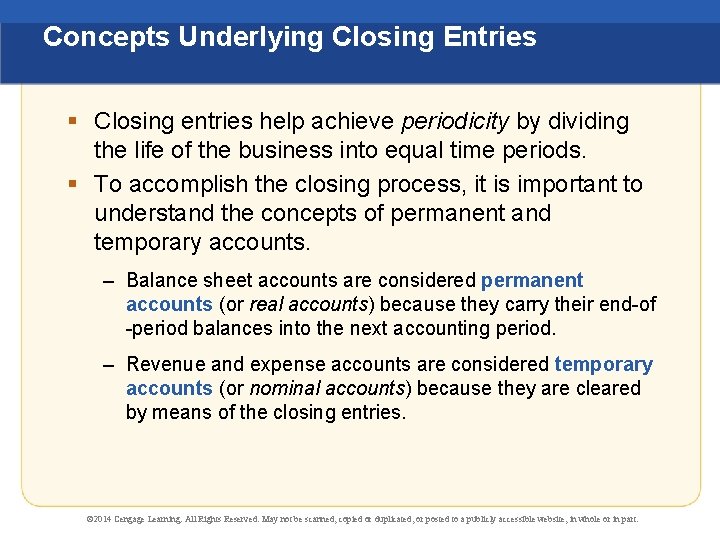
Concepts Underlying Closing Entries § Closing entries help achieve periodicity by dividing the life of the business into equal time periods. § To accomplish the closing process, it is important to understand the concepts of permanent and temporary accounts. – Balance sheet accounts are considered permanent accounts (or real accounts) because they carry their end-of -period balances into the next accounting period. – Revenue and expense accounts are considered temporary accounts (or nominal accounts) because they are cleared by means of the closing entries. © 2014 Cengage Learning. All Rights Reserved. May not be scanned, copied or duplicated, or posted to a publicly accessible website, in whole or in part.
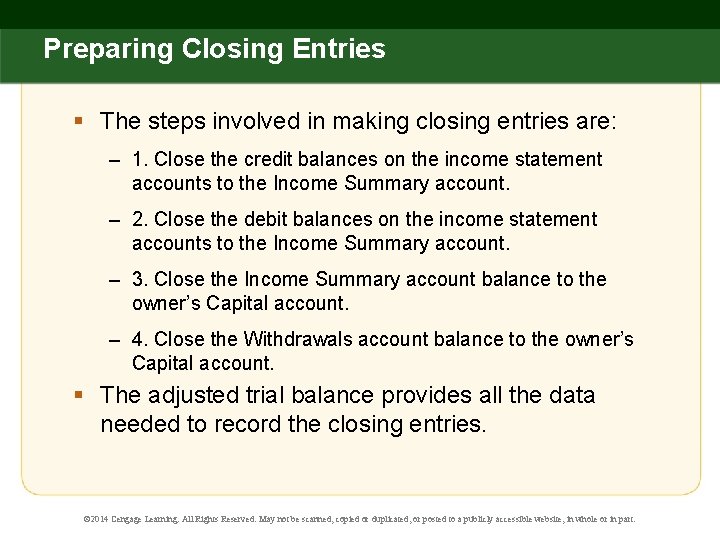
Preparing Closing Entries § The steps involved in making closing entries are: – 1. Close the credit balances on the income statement accounts to the Income Summary account. – 2. Close the debit balances on the income statement accounts to the Income Summary account. – 3. Close the Income Summary account balance to the owner’s Capital account. – 4. Close the Withdrawals account balance to the owner’s Capital account. § The adjusted trial balance provides all the data needed to record the closing entries. © 2014 Cengage Learning. All Rights Reserved. May not be scanned, copied or duplicated, or posted to a publicly accessible website, in whole or in part.
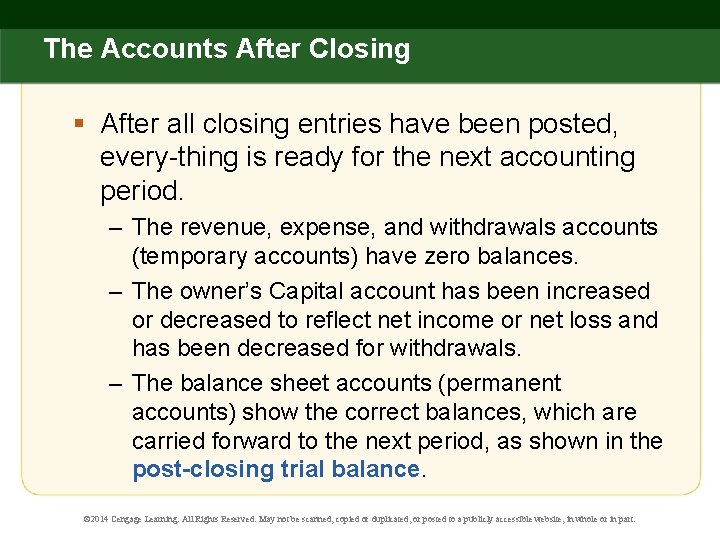
The Accounts After Closing § After all closing entries have been posted, every-thing is ready for the next accounting period. – The revenue, expense, and withdrawals accounts (temporary accounts) have zero balances. – The owner’s Capital account has been increased or decreased to reflect net income or net loss and has been decreased for withdrawals. – The balance sheet accounts (permanent accounts) show the correct balances, which are carried forward to the next period, as shown in the post-closing trial balance. © 2014 Cengage Learning. All Rights Reserved. May not be scanned, copied or duplicated, or posted to a publicly accessible website, in whole or in part.
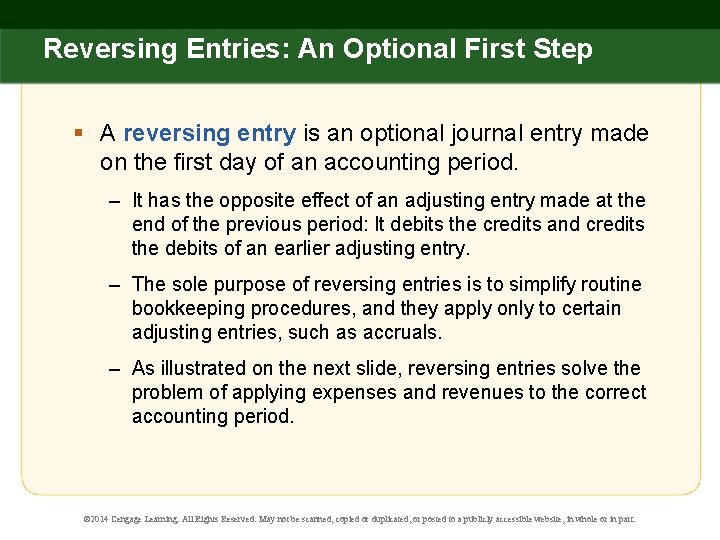
Reversing Entries: An Optional First Step § A reversing entry is an optional journal entry made on the first day of an accounting period. – It has the opposite effect of an adjusting entry made at the end of the previous period: It debits the credits and credits the debits of an earlier adjusting entry. – The sole purpose of reversing entries is to simplify routine bookkeeping procedures, and they apply only to certain adjusting entries, such as accruals. – As illustrated on the next slide, reversing entries solve the problem of applying expenses and revenues to the correct accounting period. © 2014 Cengage Learning. All Rights Reserved. May not be scanned, copied or duplicated, or posted to a publicly accessible website, in whole or in part.
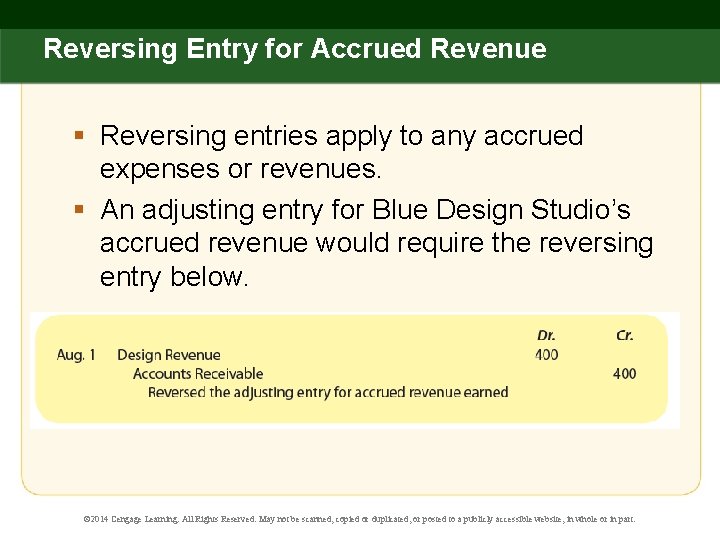
Reversing Entry for Accrued Revenue § Reversing entries apply to any accrued expenses or revenues. § An adjusting entry for Blue Design Studio’s accrued revenue would require the reversing entry below. © 2014 Cengage Learning. All Rights Reserved. May not be scanned, copied or duplicated, or posted to a publicly accessible website, in whole or in part.
The Work Sheet: An Accountant’s Tool § To organize data and important information, accountants use working papers. – They provide evidence of past work. – They enable accountants to retrace their steps when they need to verify information on the financial statements. § A work sheet is a special kind of working paper. – It serves as a preliminary step in preparing financial statements and lessens the possibility of errors. © 2014 Cengage Learning. All Rights Reserved. May not be scanned, copied or duplicated, or posted to a publicly accessible website, in whole or in part.
Preparing the Work Sheet (slide 1 of 2) § Step 1: Enter and total the account balances in the Trial Balance columns. § Step 2: Enter and total the adjustments in the Adjustments columns. § Step 3: Enter and total the adjusted account balances in the Adjusted Trial Balance columns. – The work sheet uses crossfooting, or adding or subtracting a group of numbers horizontally. – The Adjusted Trial Balance columns are then footed (totaled) to check the accuracy of the crossfooting. © 2014 Cengage Learning. All Rights Reserved. May not be scanned, copied or duplicated, or posted to a publicly accessible website, in whole or in part.
Preparing the Work Sheet (slide 2 of 2) § Step 4: Extend the account balances from the Adjusted Trial Balance columns to the Income Statement or Balance Sheet columns. § Step 5: Total the Income Statement columns and the Balance Sheet columns. Enter the net income or loss in both pairs of columns as a balancing figure, and recompute the column totals. © 2014 Cengage Learning. All Rights Reserved. May not be scanned, copied or duplicated, or posted to a publicly accessible website, in whole or in part.
Closing Entries and the Financial Statements § Closing entries set the accounts on the income statement to zero and transfer the resulting balance of net income or loss to the owner’s Capital account on the balance sheet. § Closing entries do not affect cash flows. © 2014 Cengage Learning. All Rights Reserved. May not be scanned, copied or duplicated, or posted to a publicly accessible website, in whole or in part.
The Importance of the Work Sheet and Closing Entries for Managers § Accountants use the completed work sheet in performing three principal tasks: – Recording the adjusting entries in the general journal. § The information needed to record the adjusting entries can be copied from the work sheet. – Recording the closing entries in the general journal. § The Income Statement columns of the work sheet show all the accounts that need to be closed, except for the Withdrawals account. – Preparing the financial statements. § Once the work sheet has been completed, preparing the financial statements is easy because the account balances have been sorted into Income Statement and Balance Sheet columns. © 2014 Cengage Learning. All Rights Reserved. May not be scanned, copied or duplicated, or posted to a publicly accessible website, in whole or in part.
The Importance of the Work Sheet and Closing Entries for Managers § Closing entries are important to managing a business for the following reasons: – The owners of the business expect periodic reports of the progress of the business. – In planning a business’s future operations, management needs to prepare budgets for future time periods. – For management to evaluate a company’s progress in achieving its profitability goals, it is necessary to divide the life of the business into relatively short time periods. © 2014 Cengage Learning. All Rights Reserved. May not be scanned, copied or duplicated, or posted to a publicly accessible website, in whole or in part.