
Completing the Accounting Cycle Chapter 4 The Accounting




- Slides: 72
Completing the Accounting Cycle Chapter 4
The Accounting Cycle Process by which companies produce their financial statements Use of a work sheet summarizes needed data in one place Copyright © 2009 Prentice Hall. All rights reserved 2
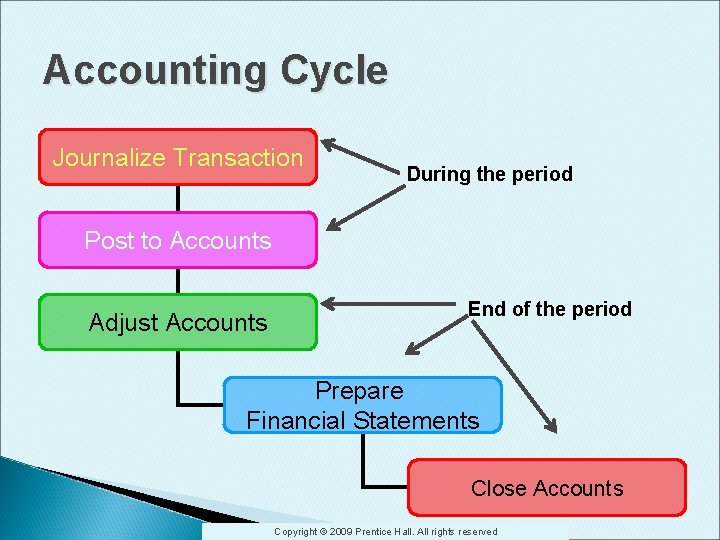
Accounting Cycle Journalize Transaction During the period Post to Accounts Adjust Accounts End of the period Prepare Financial Statements Close Accounts Copyright © 2009 Prentice Hall. All rights reserved
Learning Objective 1 Prepare an accounting work sheet Copyright (c) 2009. Prentice Hall. All rights reserved. 4
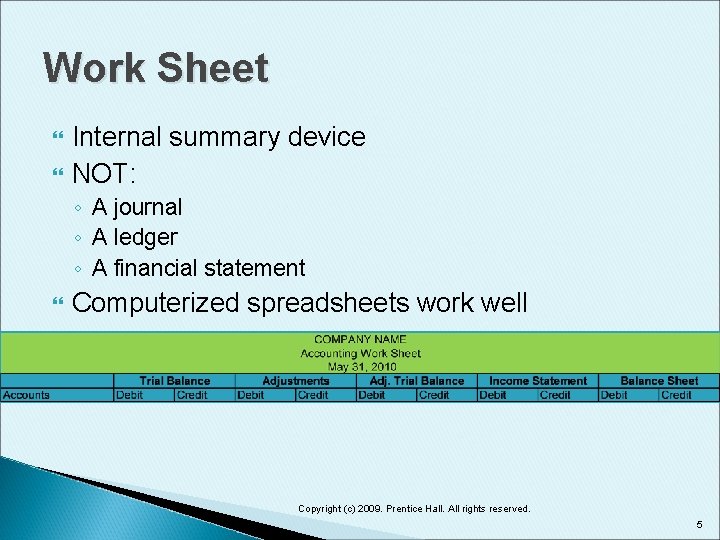
Work Sheet Internal summary device NOT: ◦ A journal ◦ A ledger ◦ A financial statement Computerized spreadsheets work well Copyright (c) 2009. Prentice Hall. All rights reserved. 5
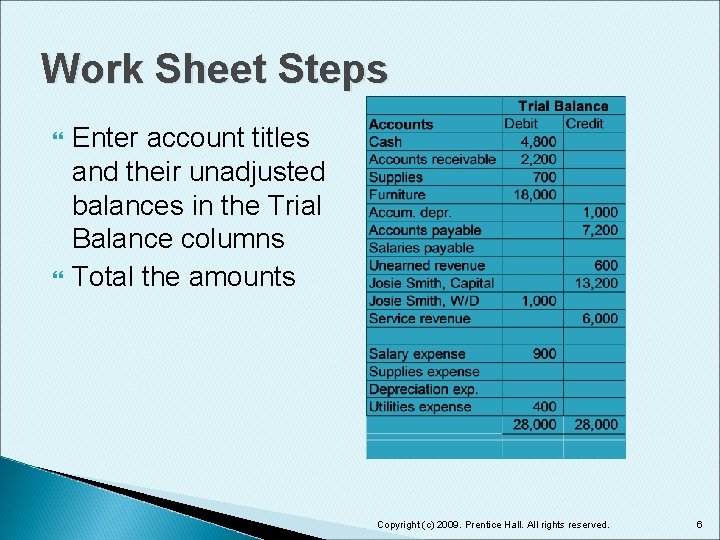
Work Sheet Steps Enter account titles and their unadjusted balances in the Trial Balance columns Total the amounts Copyright (c) 2009. Prentice Hall. All rights reserved. 6
Work Sheet Steps Enter the adjusting entries in the Adjustments columns Total the amounts Copyright (c) 2009. Prentice Hall. All rights reserved. 7
Work Sheet Steps Compute each account’s adjusted balance by combining the trial balance and adjustment figures Enter each account’s adjusted amount in the Adjusted trial balance columns See following slide Copyright (c) 2009. Prentice Hall. All rights reserved. 8
Work Sheet Steps Copyright (c) 2009. Prentice Hall. All rights reserved. 9
Work Sheet Steps Draw an imaginary line above the first revenue account Every account above goes to the Balance sheet columns Every account below goes to the Income Statement columns Copyright (c) 2009. Prentice Hall. All rights reserved. 10
Copyright (c) 2009. Prentice Hall. All rights reserved. 11
Work Sheet Steps On the income statement, compute net income ◦ Revenues minus expenses Enter net income as the balancing amount Net Income Copyright (c) 2009. Prentice Hall. All rights reserved. 12
Work Sheet Steps Also enter net income as a balancing amount on the balance sheet Net Income Copyright (c) 2009. Prentice Hall. All rights reserved. 13
Copyright (c) 2009. Prentice Hall. All rights reserved. 14
Learning Objective 2 Use the work sheet to prepare financial statements Copyright (c) 2009. Prentice Hall. All rights reserved. 15
Preparing Financial Statements from a Work Sheet Both work sheet and financial statements have the same account balances and the same net income(or loss) Work sheet is an internal document Financial statements are for external users Adjusting entries from work sheet need to be recorded in journal and posted Copyright (c) 2009. Prentice Hall. All rights reserved. 16
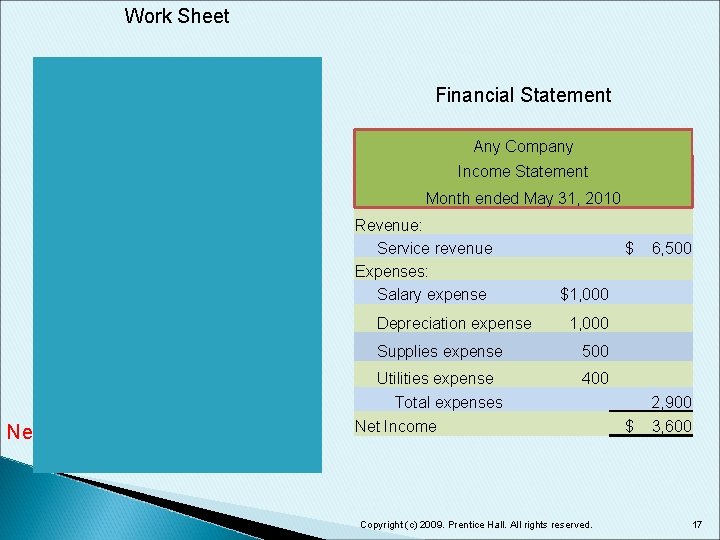
Work Sheet Financial Statement Any Company Income Statement Month ended May 31, 2010 Revenue: Service revenue Expenses: Salary expense Net Income $ 6, 500 $1, 000 Depreciation expense 1, 000 Supplies expense Utilities expense Total expenses Net Income 500 400 2, 900 $ 3, 600 Copyright (c) 2009. Prentice Hall. All rights reserved. 17
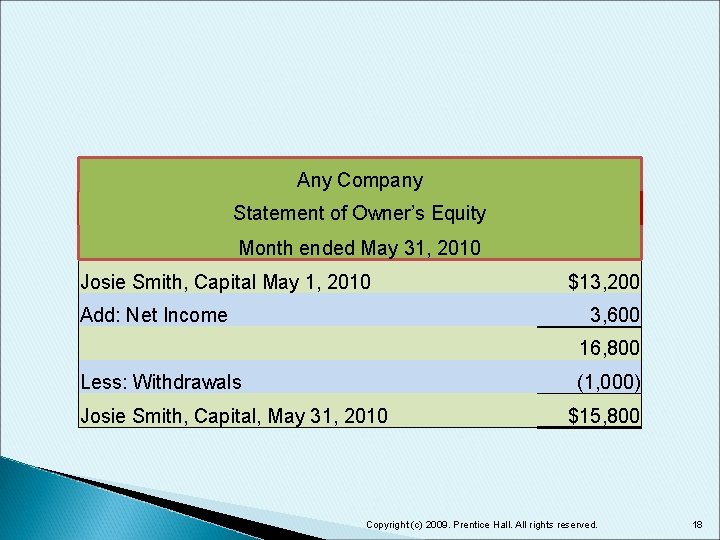
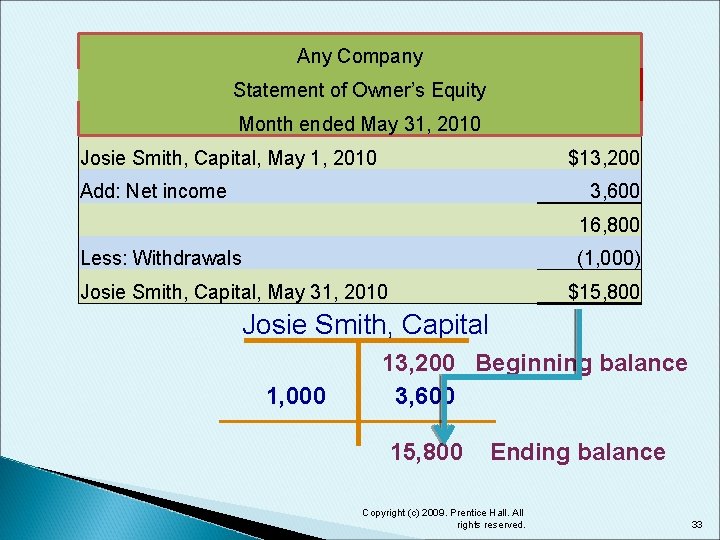
Any Company Statement of Owner’s Equity Month ended May 31, 2010 Josie Smith, Capital May 1, 2010 Add: Net Income $13, 200 3, 600 16, 800 Less: Withdrawals (1, 000) Josie Smith, Capital, May 31, 2010 $15, 800 Copyright (c) 2009. Prentice Hall. All rights reserved. 18
Copyright (c) 2009. Prentice Hall. All rights reserved. 19
? Review Question? ?
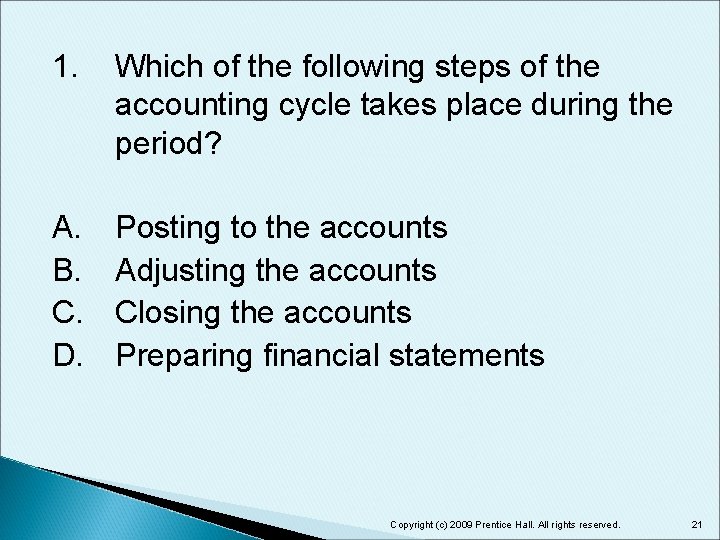
1. Which of the following steps of the accounting cycle takes place during the period? A. B. C. D. Posting to the accounts Adjusting the accounts Closing the accounts Preparing financial statements Copyright (c) 2009 Prentice Hall. All rights reserved. 21
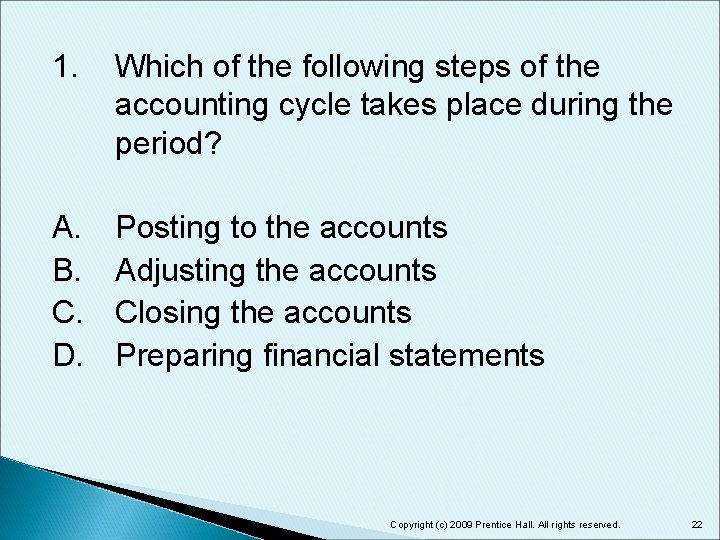
1. Which of the following steps of the accounting cycle takes place during the period? A. B. C. D. Posting to the accounts Adjusting the accounts Closing the accounts Preparing financial statements Copyright (c) 2009 Prentice Hall. All rights reserved. 22
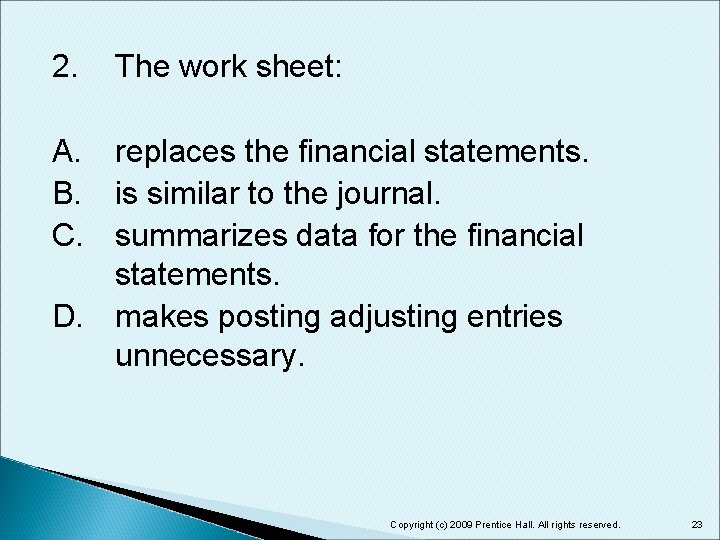
2. The work sheet: A. replaces the financial statements. B. is similar to the journal. C. summarizes data for the financial statements. D. makes posting adjusting entries unnecessary. Copyright (c) 2009 Prentice Hall. All rights reserved. 23
2. The work sheet: A. replaces the financial statements. B. is similar to the journal. C. summarizes data for the financial statements. D. makes posting adjusting entries unnecessary. Copyright (c) 2009 Prentice Hall. All rights reserved. 24
Learning Objective 3 Close the revenue, expense, and dividend accounts Copyright (c) 2009. Prentice Hall. All rights reserved. 25
Closing the Accounts Occurs at the end of the period ◦ Gets accounts ready for next period Zeroes out revenue and expense accounts Copyright (c) 2009. Prentice Hall. All rights reserved. 26
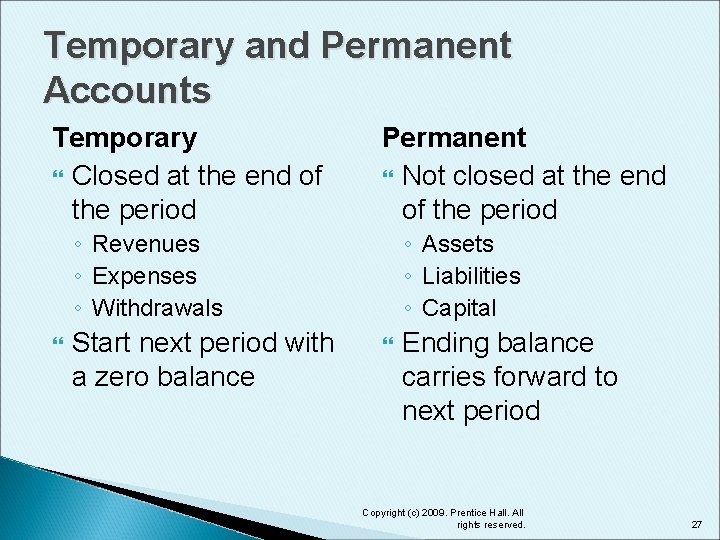
Temporary and Permanent Accounts Temporary Closed at the end of the period Permanent Not closed at the end of the period ◦ Revenues ◦ Expenses ◦ Withdrawals Start next period with a zero balance ◦ Assets ◦ Liabilities ◦ Capital Ending balance carries forward to next period Copyright (c) 2009. Prentice Hall. All rights reserved. 27
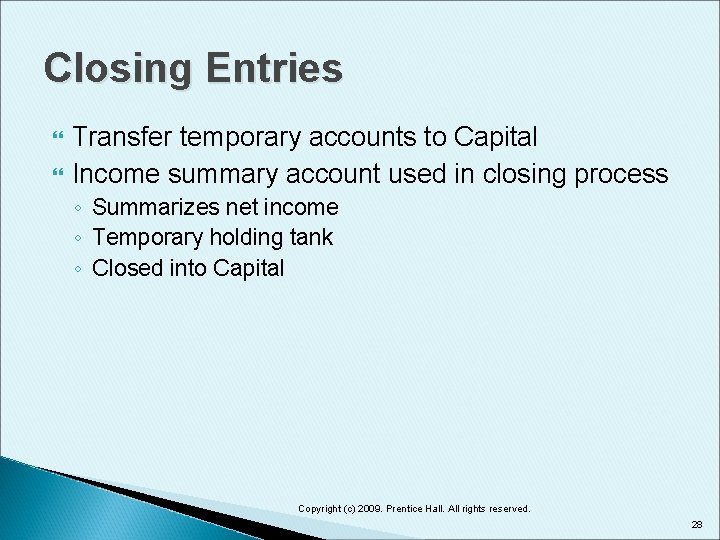
Closing Entries Transfer temporary accounts to Capital Income summary account used in closing process ◦ Summarizes net income ◦ Temporary holding tank ◦ Closed into Capital Copyright (c) 2009. Prentice Hall. All rights reserved. 28
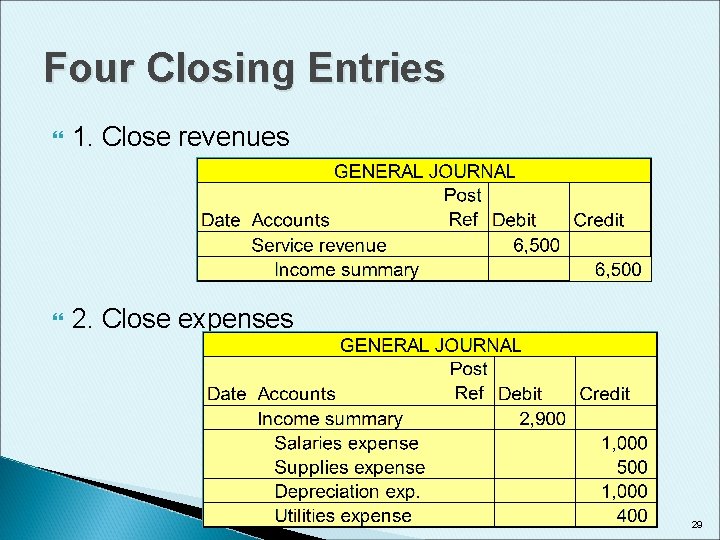
Four Closing Entries 1. Close revenues 2. Close expenses 29
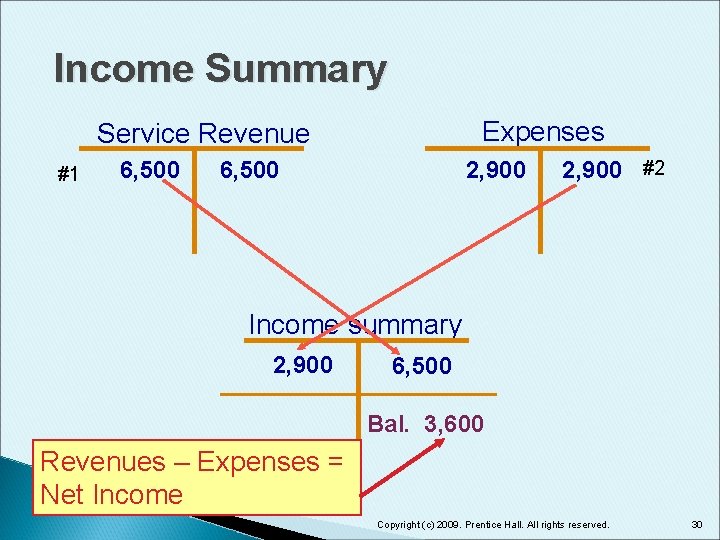
Income Summary Expenses Service Revenue #1 6, 500 2, 900 #2 Income summary 2, 900 6, 500 Bal. 3, 600 Revenues – Expenses = Net Income Copyright (c) 2009. Prentice Hall. All rights reserved. 30
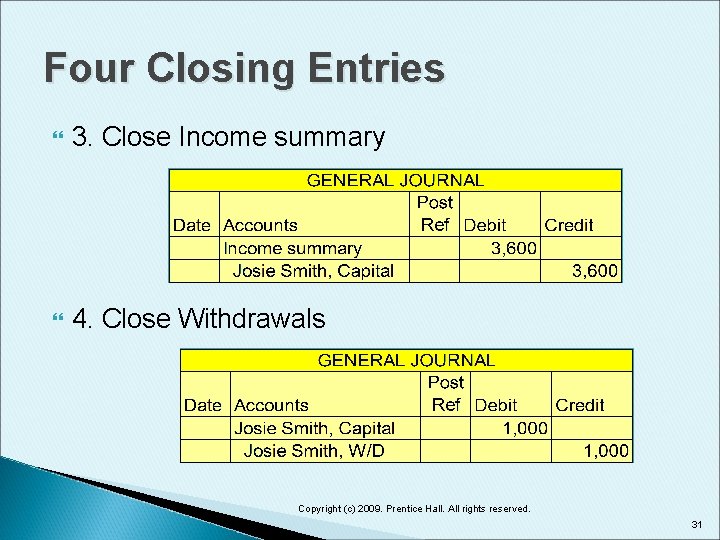
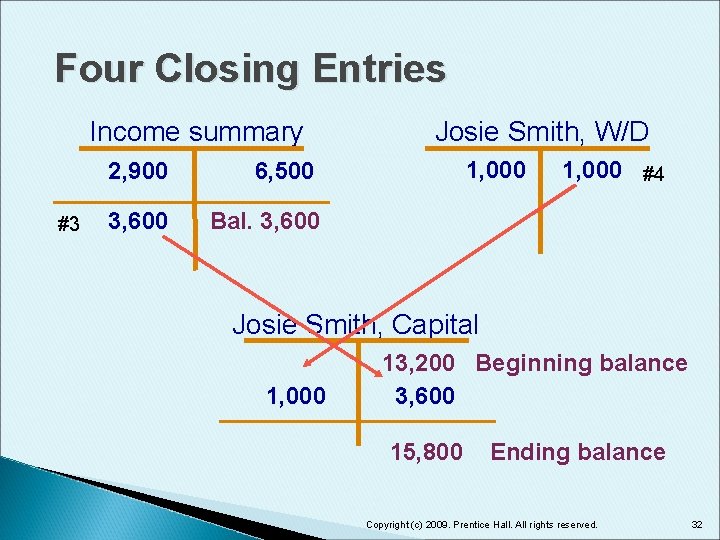
Four Closing Entries 3. Close Income summary 4. Close Withdrawals Copyright (c) 2009. Prentice Hall. All rights reserved. 31
Four Closing Entries Income summary #3 2, 900 6, 500 3, 600 Bal. 3, 600 Josie Smith, W/D 1, 000 #4 Josie Smith, Capital 1, 000 13, 200 Beginning balance 3, 600 15, 800 Ending balance Copyright (c) 2009. Prentice Hall. All rights reserved. 32
Any Company Statement of Owner’s Equity Month ended May 31, 2010 Josie Smith, Capital, May 1, 2010 $13, 200 Add: Net income 3, 600 16, 800 Less: Withdrawals (1, 000) Josie Smith, Capital, May 31, 2010 $15, 800 Josie Smith, Capital 1, 000 13, 200 Beginning balance 3, 600 15, 800 Ending balance Copyright (c) 2009. Prentice Hall. All rights reserved. 33
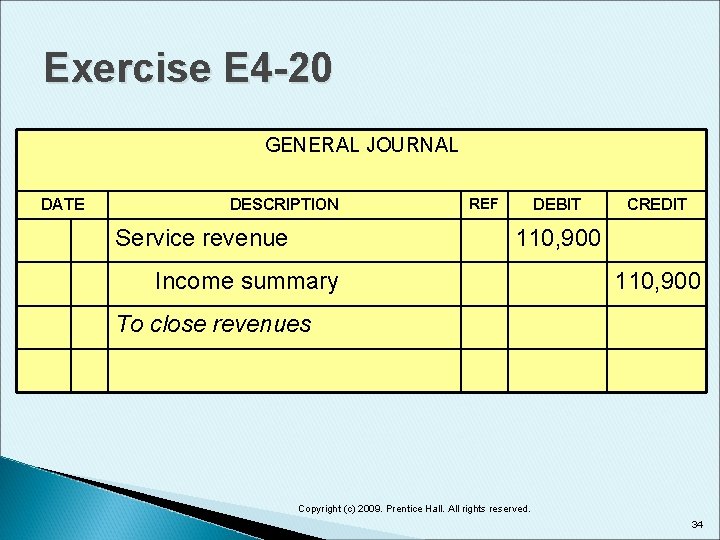
Exercise E 4 -20 GENERAL JOURNAL DATE DESCRIPTION Service revenue REF DEBIT CREDIT 110, 900 Income summary 110, 900 To close revenues Copyright (c) 2009. Prentice Hall. All rights reserved. 34
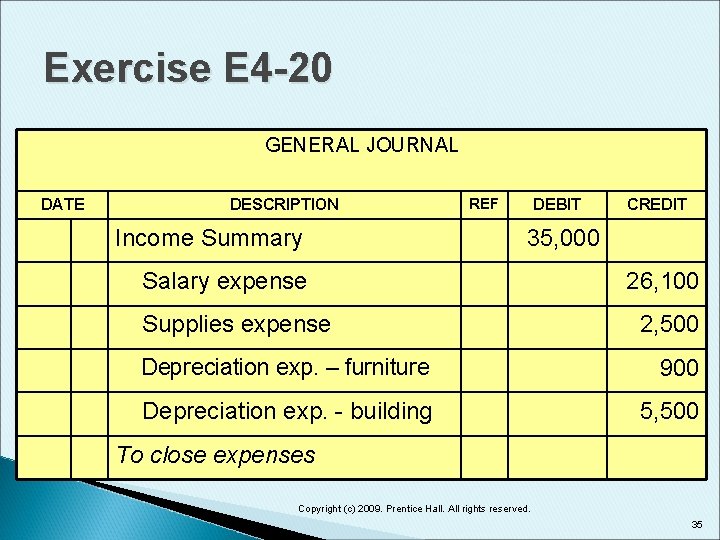
Exercise E 4 -20 GENERAL JOURNAL DATE DESCRIPTION Income Summary REF DEBIT CREDIT 35, 000 Salary expense Supplies expense 26, 100 2, 500 Depreciation exp. – furniture 900 Depreciation exp. - building 5, 500 To close expenses Copyright (c) 2009. Prentice Hall. All rights reserved. 35
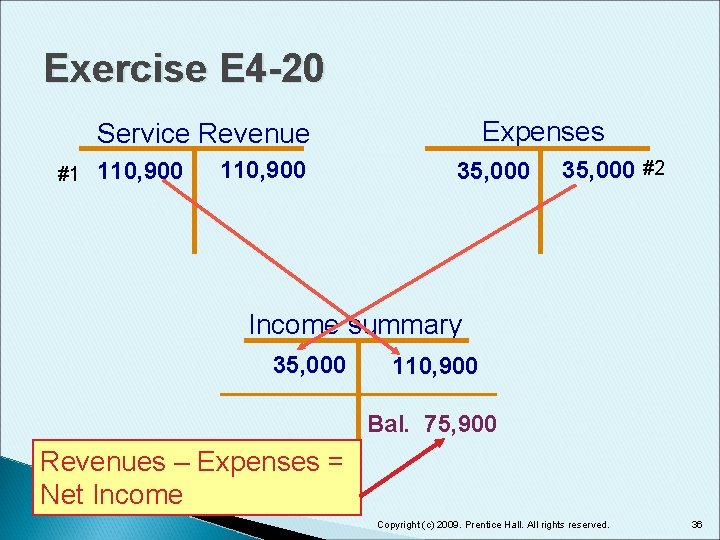
Exercise E 4 -20 Expenses Service Revenue #1 110, 900 35, 000 #2 Income summary 35, 000 110, 900 Bal. 75, 900 Revenues – Expenses = Net Income Copyright (c) 2009. Prentice Hall. All rights reserved. 36
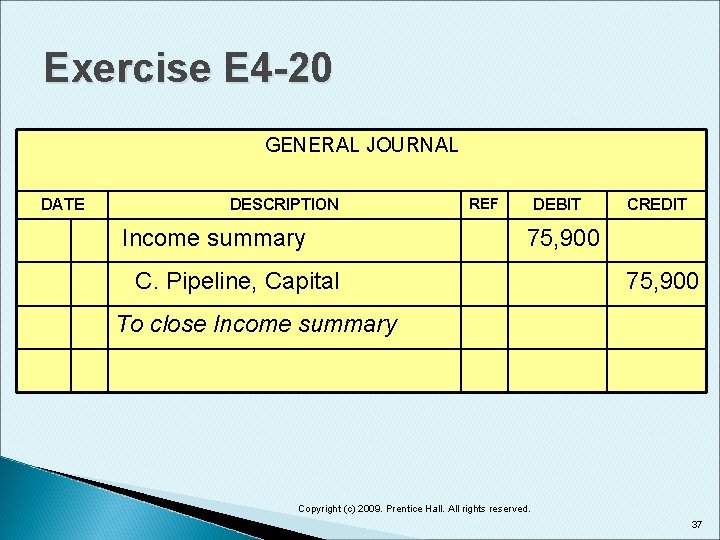
Exercise E 4 -20 GENERAL JOURNAL DATE DESCRIPTION Income summary REF DEBIT CREDIT 75, 900 C. Pipeline, Capital 75, 900 To close Income summary Copyright (c) 2009. Prentice Hall. All rights reserved. 37
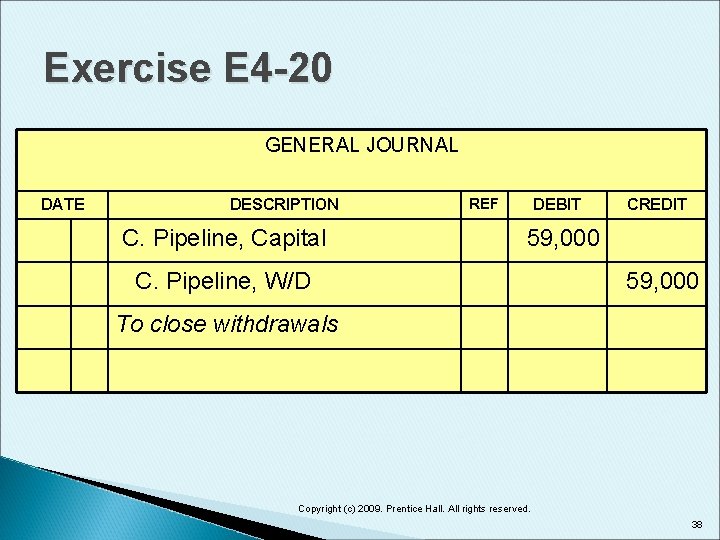
Exercise E 4 -20 GENERAL JOURNAL DATE DESCRIPTION C. Pipeline, Capital REF DEBIT CREDIT 59, 000 C. Pipeline, W/D 59, 000 To close withdrawals Copyright (c) 2009. Prentice Hall. All rights reserved. 38
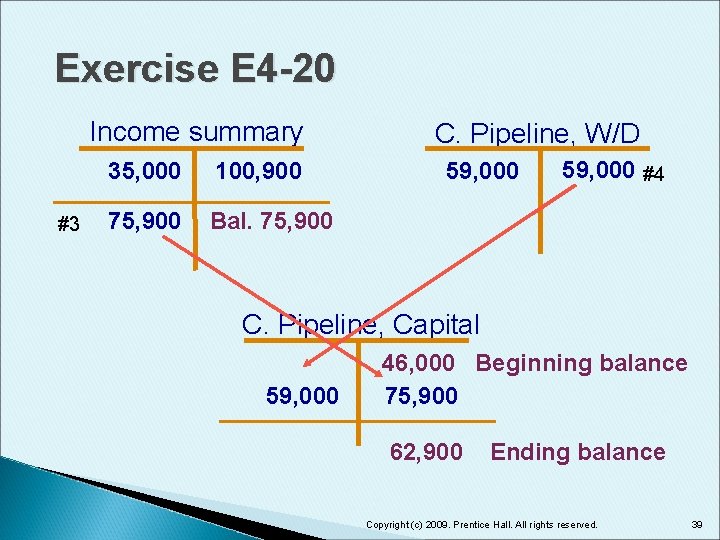
Exercise E 4 -20 Income summary #3 35, 000 100, 900 75, 900 Bal. 75, 900 C. Pipeline, W/D 59, 000 #4 C. Pipeline, Capital 59, 000 46, 000 Beginning balance 75, 900 62, 900 Ending balance Copyright (c) 2009. Prentice Hall. All rights reserved. 39
Review ? Questions?
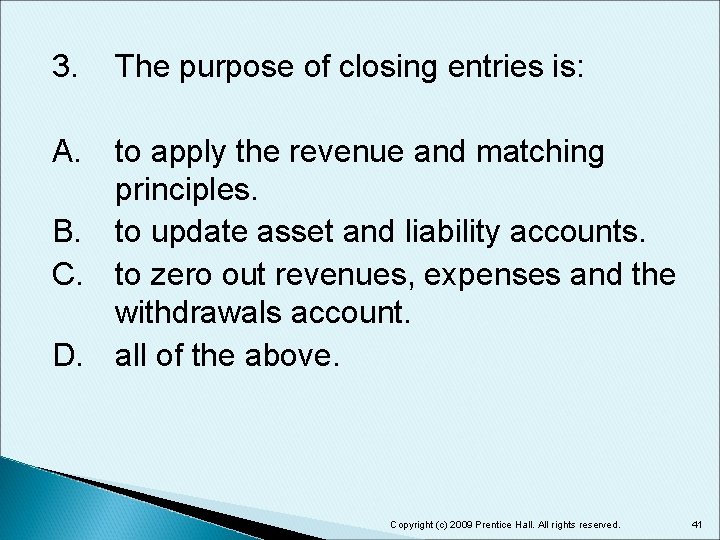
3. The purpose of closing entries is: A. to apply the revenue and matching principles. B. to update asset and liability accounts. C. to zero out revenues, expenses and the withdrawals account. D. all of the above. Copyright (c) 2009 Prentice Hall. All rights reserved. 41
3. The purpose of closing entries is: A. to apply the revenue and matching principles. B. to update asset and liability accounts. C. to zero out revenues, expenses and the withdrawals account. D. all of the above. Copyright (c) 2009 Prentice Hall. All rights reserved. 42
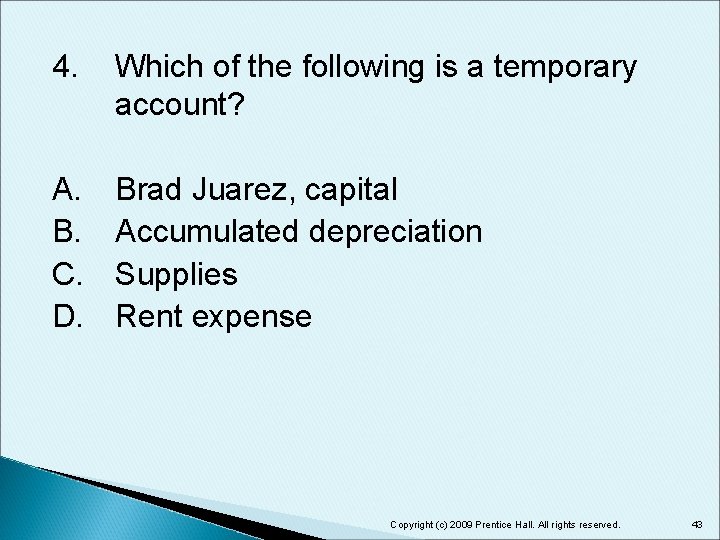
4. Which of the following is a temporary account? A. B. C. D. Brad Juarez, capital Accumulated depreciation Supplies Rent expense Copyright (c) 2009 Prentice Hall. All rights reserved. 43
4. Which of the following is a temporary account? A. B. C. D. Brad Juarez, capital Accumulated depreciation Supplies Rent expense Copyright (c) 2009 Prentice Hall. All rights reserved. 44
4. Which of the following is a temporary account? A. B. C. D. Brad Juarez, capital Accumulated depreciation Supplies Rent expense Copyright (c) 2009 Prentice Hall. All rights reserved. 45
5. Which of the following is a permanent account? A. B. C. D. Unearned revenue Service revenue Withdrawals Depreciation expense Copyright (c) 2009 Prentice Hall. All rights reserved. 46
5. Which of the following is a permanent account? A. B. C. D. Unearned revenue Service revenue Withdrawals Depreciation expense Copyright (c) 2009 Prentice Hall. All rights reserved. 47
6. The Income summary: A. is an account used only in the closing process. B. temporarily holds the amount of net income for the period. C. is closed into owner’s capital. D. is all of the above. Copyright (c) 2009 Prentice Hall. All rights reserved. 48
Learning Objective 4 Prepare postclosing trial balance Copyright (c) 2009. Prentice Hall. All rights reserved. 49
Post-Closing Trial Balance List of permanent accounts and their balances after posting closing entries Total debits and credits must be equal Same accounts as on the Balance Sheet Copyright (c) 2009. Prentice Hall. All rights reserved. 50
Learning Objective 5 Classify assets and liabilities as current or long-term Copyright (c) 2009. Prentice Hall. All rights reserved. 51
Liquidity Measure of how quickly an item can be converted into cash A classified balance sheet lists assets in order of their liquidity Copyright (c) 2009. Prentice Hall. All rights reserved. 52
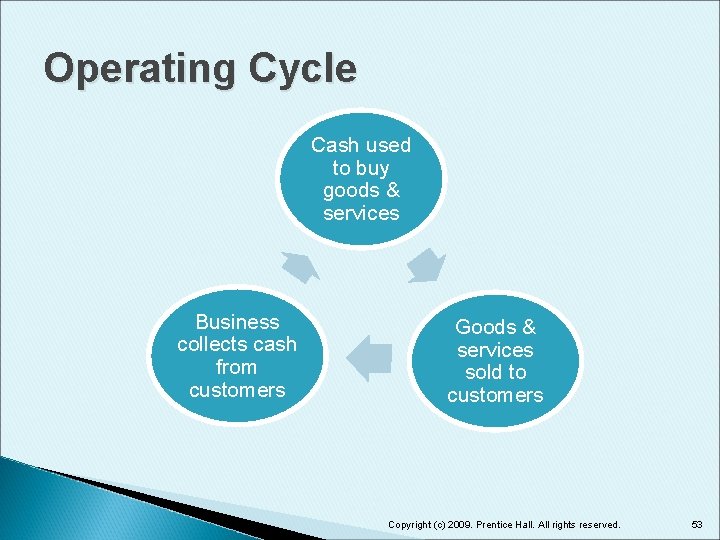
Operating Cycle Cash used to buy goods & services Business collects cash from customers Goods & services sold to customers Copyright (c) 2009. Prentice Hall. All rights reserved. 53
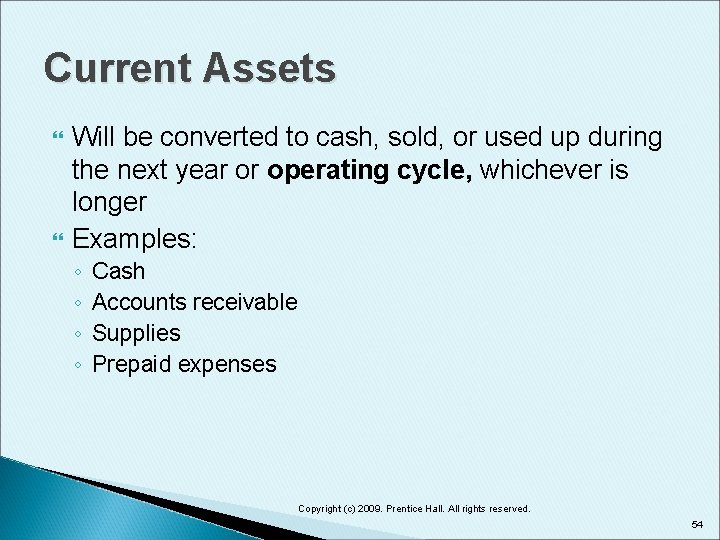
Current Assets Will be converted to cash, sold, or used up during the next year or operating cycle, whichever is longer Examples: ◦ ◦ Cash Accounts receivable Supplies Prepaid expenses Copyright (c) 2009. Prentice Hall. All rights reserved. 54
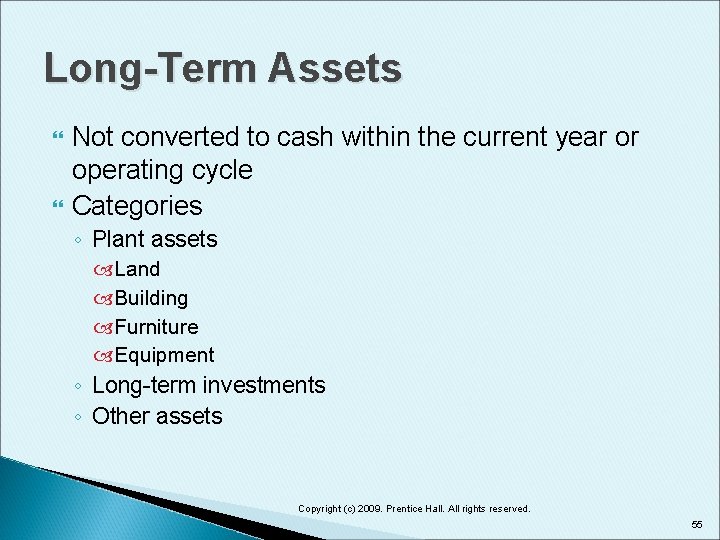
Long-Term Assets Not converted to cash within the current year or operating cycle Categories ◦ Plant assets Land Building Furniture Equipment ◦ Long-term investments ◦ Other assets Copyright (c) 2009. Prentice Hall. All rights reserved. 55
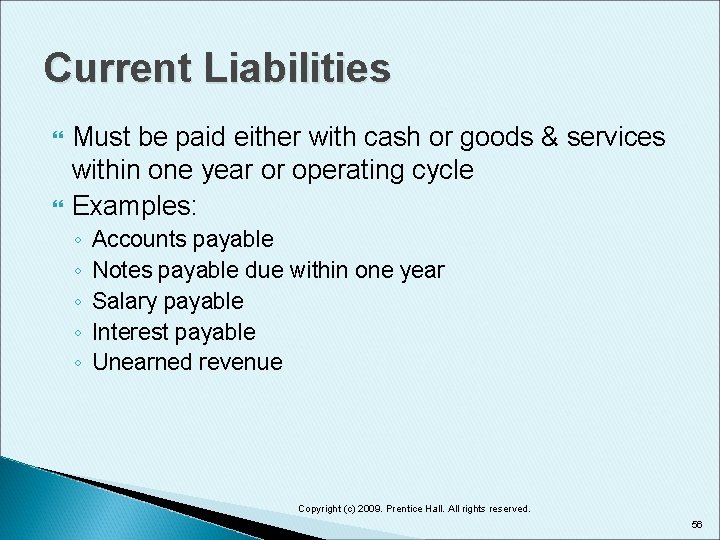
Current Liabilities Must be paid either with cash or goods & services within one year or operating cycle Examples: ◦ ◦ ◦ Accounts payable Notes payable due within one year Salary payable Interest payable Unearned revenue Copyright (c) 2009. Prentice Hall. All rights reserved. 56
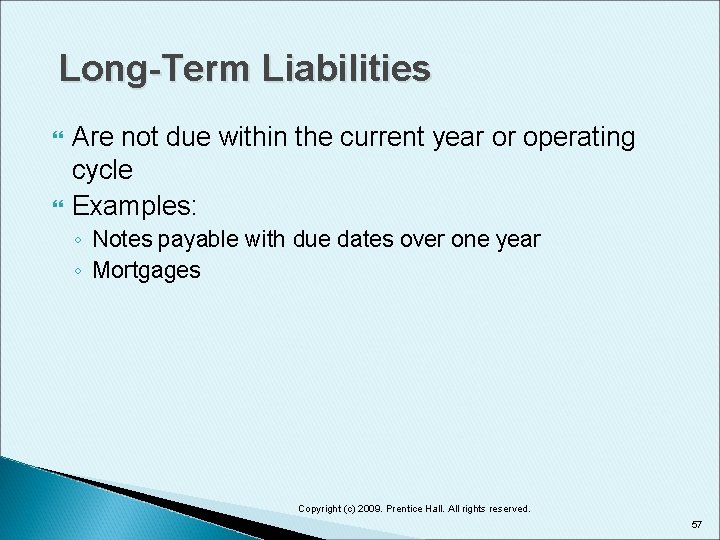
Long-Term Liabilities Are not due within the current year or operating cycle Examples: ◦ Notes payable with due dates over one year ◦ Mortgages Copyright (c) 2009. Prentice Hall. All rights reserved. 57
Copyright (c) 2009. Prentice Hall. All rights reserved. 58
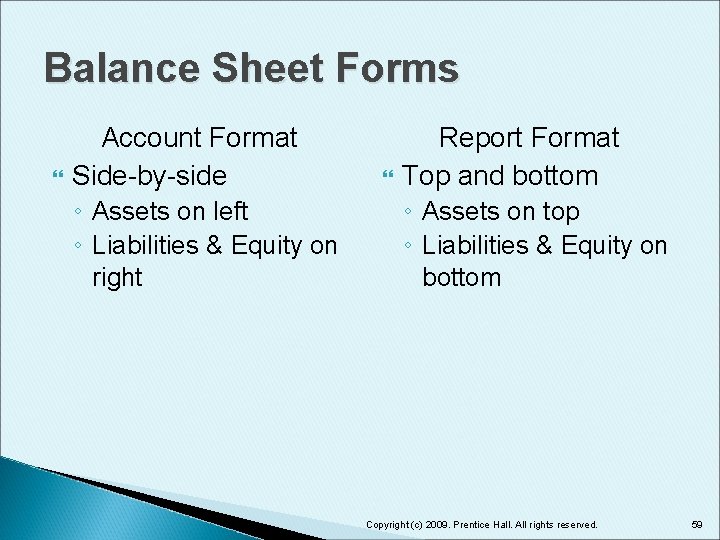
Balance Sheet Forms Account Format Side-by-side ◦ Assets on left ◦ Liabilities & Equity on right Report Format Top and bottom ◦ Assets on top ◦ Liabilities & Equity on bottom Copyright (c) 2009. Prentice Hall. All rights reserved. 59
Learning Objective 6 Use the current ratio and the debt ratio to evaluate a company Copyright (c) 2009. Prentice Hall. All rights reserved. 60
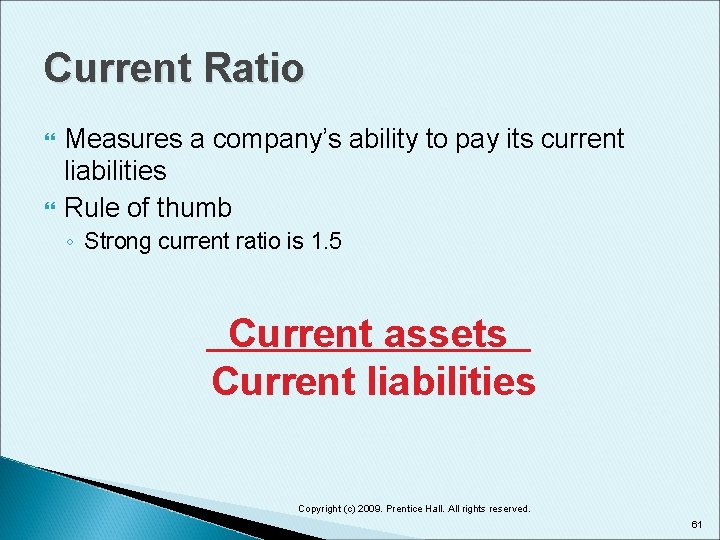
Current Ratio Measures a company’s ability to pay its current liabilities Rule of thumb ◦ Strong current ratio is 1. 5 Current assets Current liabilities Copyright (c) 2009. Prentice Hall. All rights reserved. 61
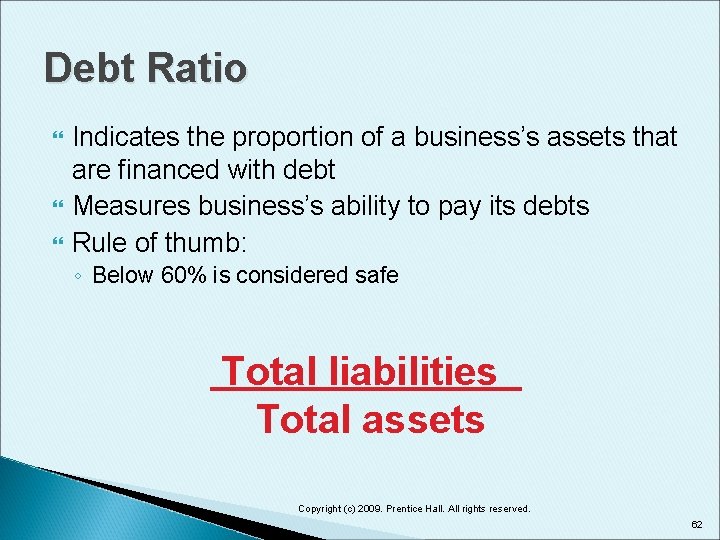
Debt Ratio Indicates the proportion of a business’s assets that are financed with debt Measures business’s ability to pay its debts Rule of thumb: ◦ Below 60% is considered safe Total liabilities Total assets Copyright (c) 2009. Prentice Hall. All rights reserved. 62
Review ? Questions?
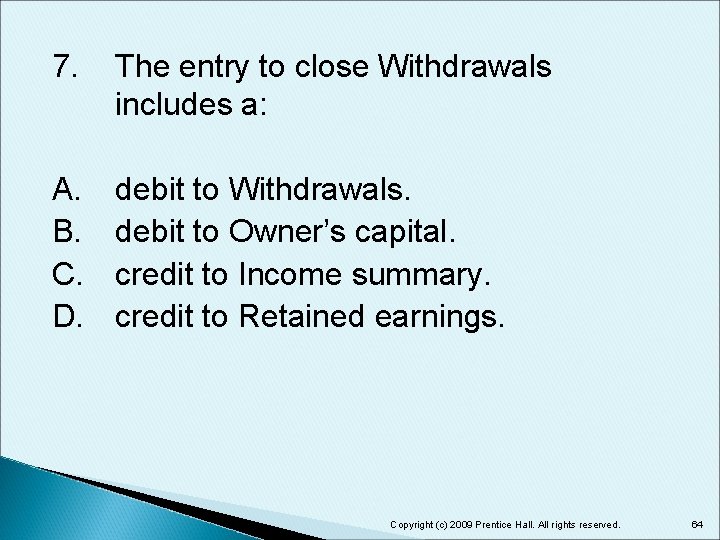
7. The entry to close Withdrawals includes a: A. B. C. D. debit to Withdrawals. debit to Owner’s capital. credit to Income summary. credit to Retained earnings. Copyright (c) 2009 Prentice Hall. All rights reserved. 64
7. The entry to close Withdrawals includes a: A. B. C. D. debit to Withdrawals. debit to Owner’s capital. credit to Income summary. credit to Retained earnings. Copyright (c) 2009 Prentice Hall. All rights reserved. 65
8. Which of the following accounts would NOT appear on a postclosing trial balance? A. B. C. D. Owner’s capital Accounts receivable Prepaid rent Rent expense Copyright (c) 2009 Prentice Hall. All rights reserved. 66
8. Which of the following accounts would NOT appear on a postclosing trial balance? A. B. C. D. Owner’s capital Accounts receivable Prepaid rent Rent expense Copyright (c) 2009 Prentice Hall. All rights reserved. 67
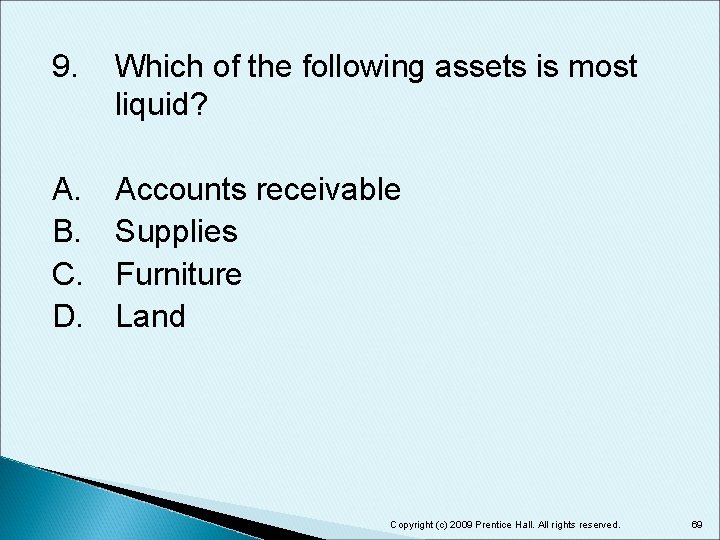
9. Which of the following assets is most liquid? A. B. C. D. Accounts receivable Supplies Furniture Land Copyright (c) 2009 Prentice Hall. All rights reserved. 68
9. Which of the following assets is most liquid? A. B. C. D. Accounts receivable Supplies Furniture Land Copyright (c) 2009 Prentice Hall. All rights reserved. 69
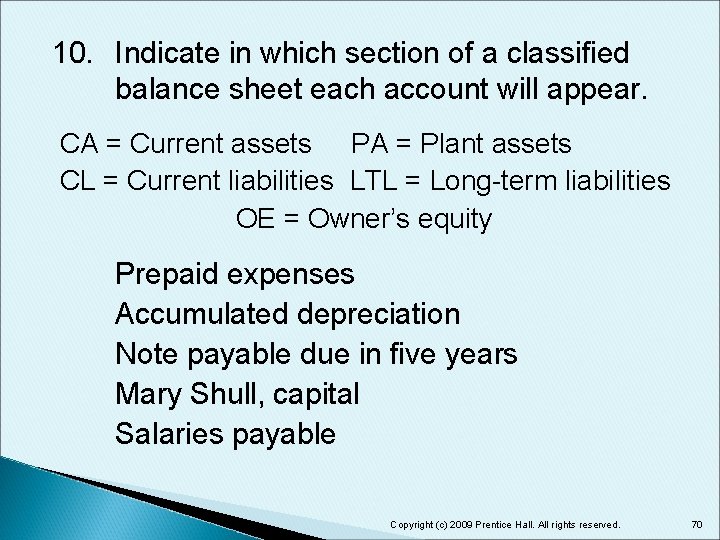
10. Indicate in which section of a classified balance sheet each account will appear. CA = Current assets PA = Plant assets CL = Current liabilities LTL = Long-term liabilities OE = Owner’s equity Prepaid expenses Accumulated depreciation Note payable due in five years Mary Shull, capital Salaries payable Copyright (c) 2009 Prentice Hall. All rights reserved. 70
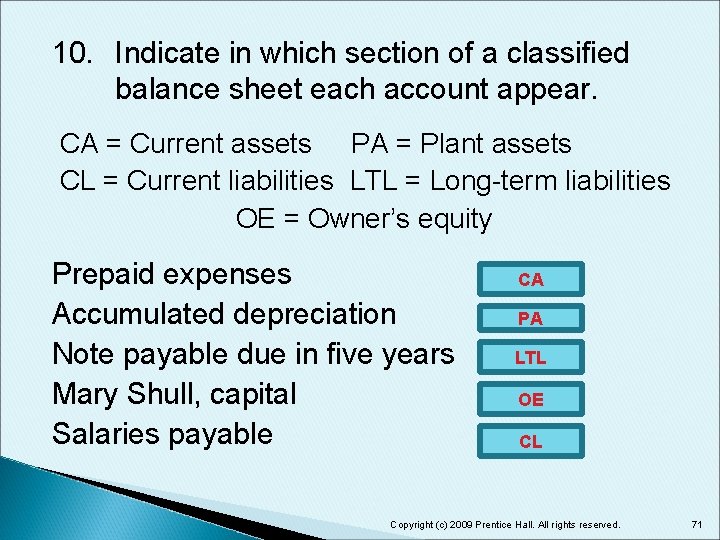
10. Indicate in which section of a classified balance sheet each account appear. CA = Current assets PA = Plant assets CL = Current liabilities LTL = Long-term liabilities OE = Owner’s equity Prepaid expenses Accumulated depreciation Note payable due in five years Mary Shull, capital Salaries payable CA PA LTL OE CL Copyright (c) 2009 Prentice Hall. All rights reserved. 71
End of Chapter 4