CHAPTER 3 1 PROPERTY AND FINANCIAL CLAIMS Property


- Slides: 20
CHAPTER 3. 1 PROPERTY AND FINANCIAL CLAIMS Property The right to own property is basic to a free enterprise system Property is anything of value that a person or business owns and therefore controls Financial Claim Is a legal right to an item In accounting property is measured in dollar amounts Dollar amounts measure both the cost of the property and the financial claims to the property
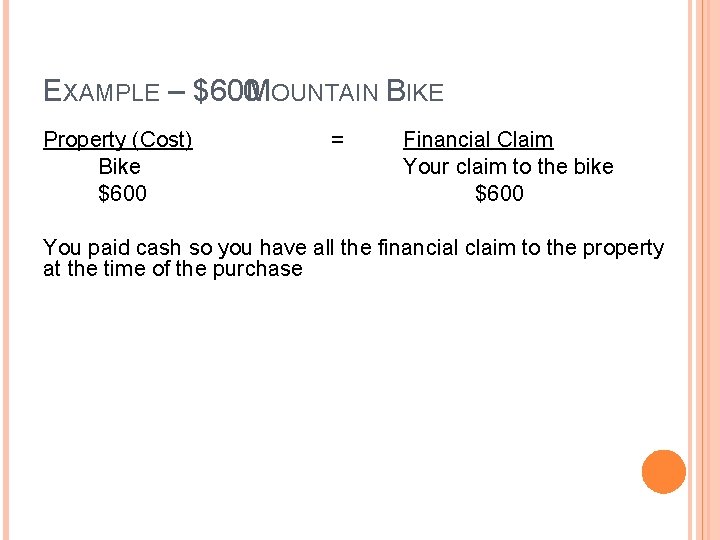
EXAMPLE – $600 MOUNTAIN BIKE Property (Cost) Bike $600 = Financial Claim Your claim to the bike $600 You paid cash so you have all the financial claim to the property at the time of the purchase
PROPERTY AND FINANCIAL CLAIMS Credit When you buy something and agree to pay for it later you are buying it on credit Creditor The business or person selling you the item on credit is called a creditor • A creditor can be any person or business to which you owe money • When you buy property on credit, you do not have the only claim to the property. • A creditor is also know as a note holder (IOU)
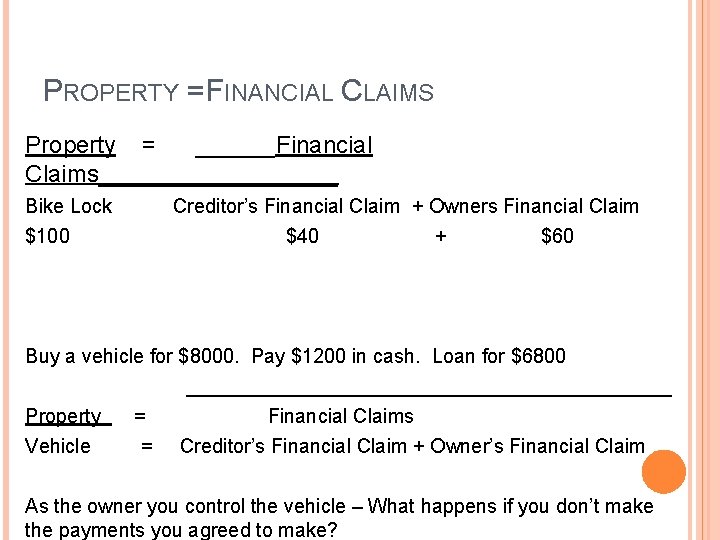
PROPERTY = FINANCIAL CLAIMS Property = ______Financial Claims_________ Bike Lock $100 Creditor’s Financial Claim + Owners Financial Claim $40 + $60 Buy a vehicle for $8000. Pay $1200 in cash. Loan for $6800 Property Vehicle = = Financial Claims Creditor’s Financial Claim + Owner’s Financial Claim As the owner you control the vehicle – What happens if you don’t make the payments you agreed to make?
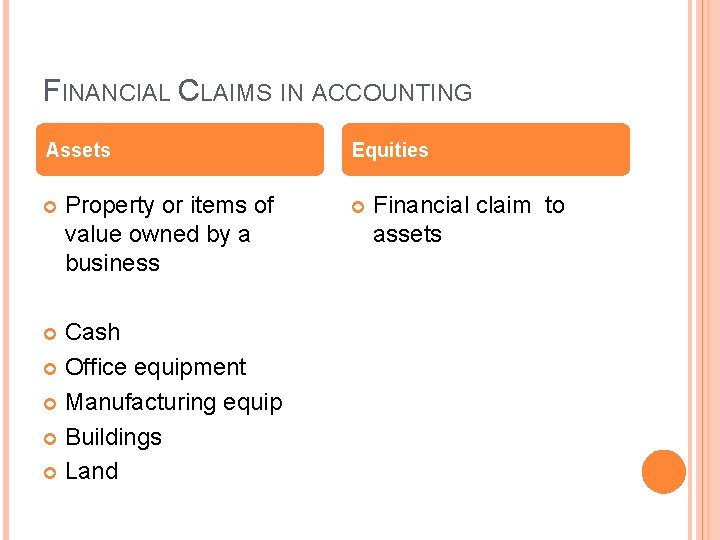
FINANCIAL CLAIMS IN ACCOUNTING Assets Property or items of value owned by a business Cash Office equipment Manufacturing equip Buildings Land Equities Financial claim to assets
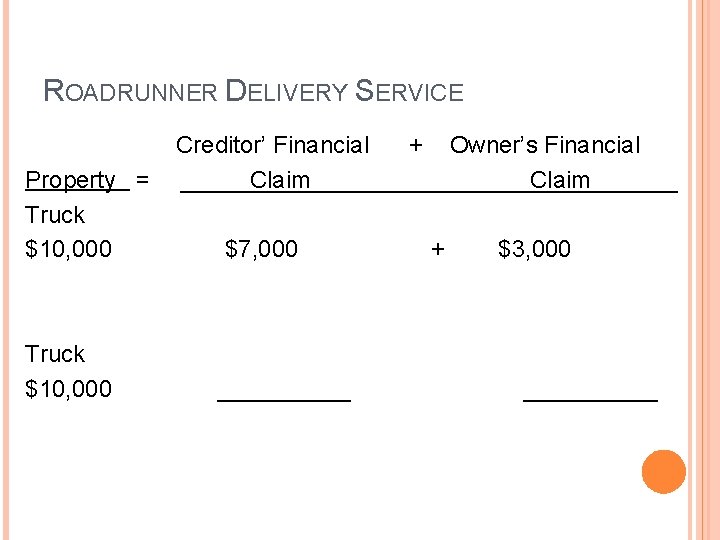
ROADRUNNER DELIVERY SERVICE Property = Truck $10, 000 Creditor’ Financial Claim $7, 000 _____ + Owner’s Financial Claim + $3, 000 _____
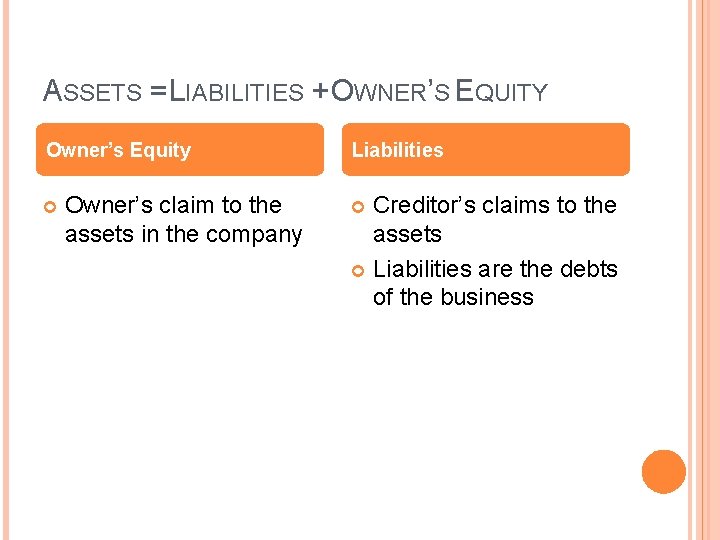
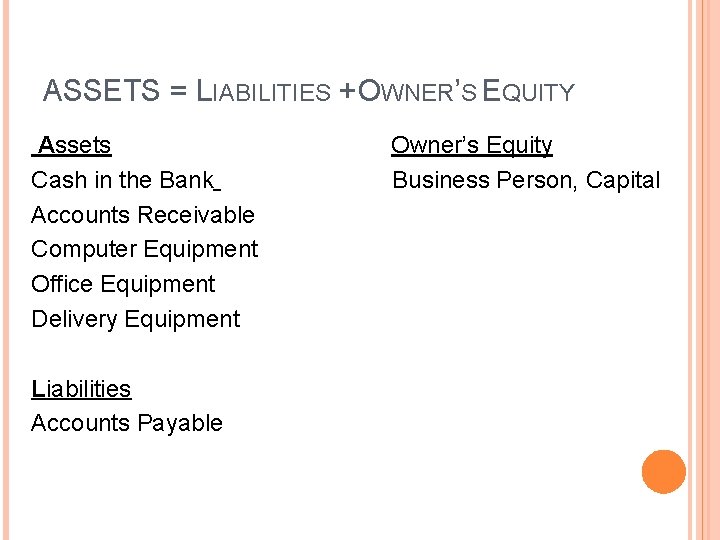
ASSETS = LIABILITIES + OWNER’S EQUITY Owner’s Equity Owner’s claim to the assets in the company Liabilities Creditor’s claims to the assets Liabilities are the debts of the business
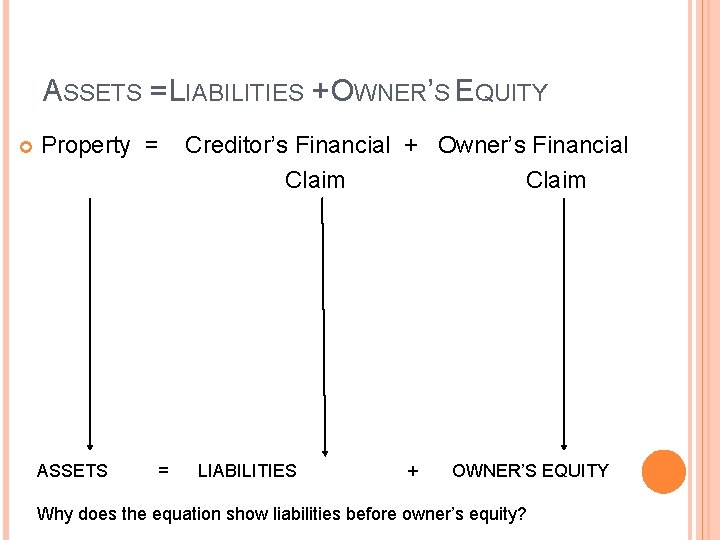
ASSETS = LIABILITIES + OWNER’S EQUITY Property = ASSETS = Creditor’s Financial + Owner’s Financial Claim LIABILITIES + OWNER’S EQUITY Why does the equation show liabilities before owner’s equity?
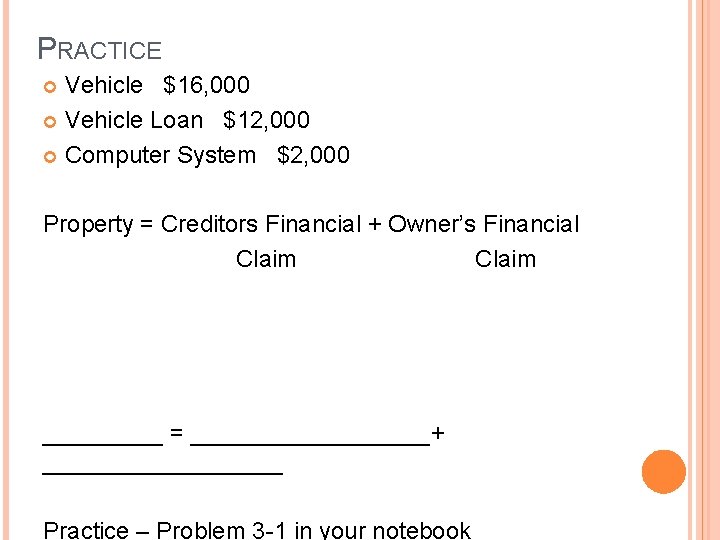
PRACTICE Vehicle $16, 000 Vehicle Loan $12, 000 Computer System $2, 000 Property = Creditors Financial + Owner’s Financial Claim _____ = _________+ _________ Practice – Problem 3 -1 in your notebook
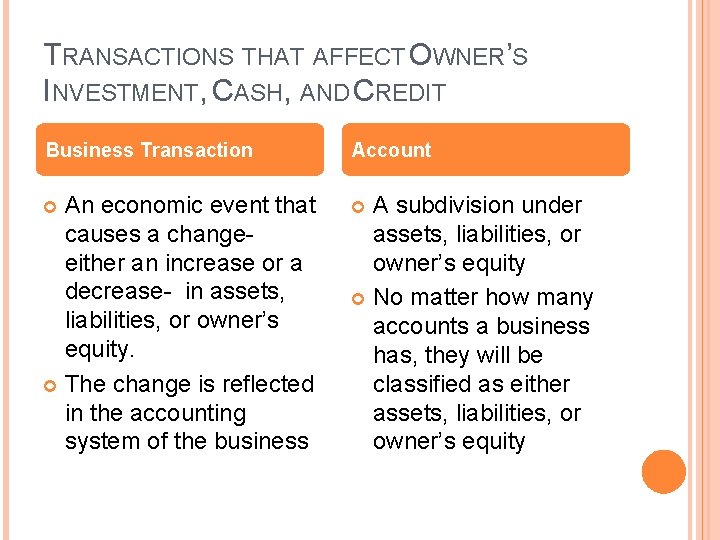
TRANSACTIONS THAT AFFECT OWNER’S INVESTMENT, CASH, AND CREDIT Business Transaction Account An economic event that causes a changeeither an increase or a decrease- in assets, liabilities, or owner’s equity. The change is reflected in the accounting system of the business A subdivision under assets, liabilities, or owner’s equity No matter how many accounts a business has, they will be classified as either assets, liabilities, or owner’s equity
ASSETS = LIABILITIES + OWNER’S EQUITY Assets Cash in the Bank Accounts Receivable Computer Equipment Office Equipment Delivery Equipment Liabilities Accounts Payable Owner’s Equity Business Person, Capital
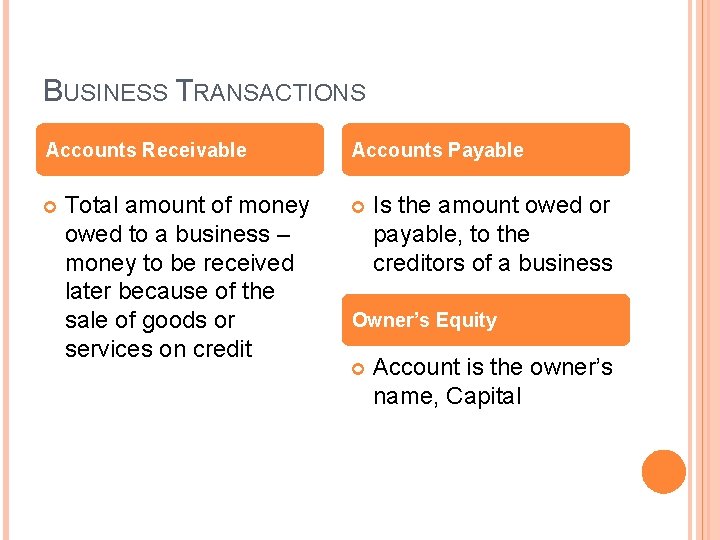
BUSINESS TRANSACTIONS Accounts Receivable Total amount of money owed to a business – money to be received later because of the sale of goods or services on credit Accounts Payable Is the amount owed or payable, to the creditors of a business Owner’s Equity Account is the owner’s name, Capital
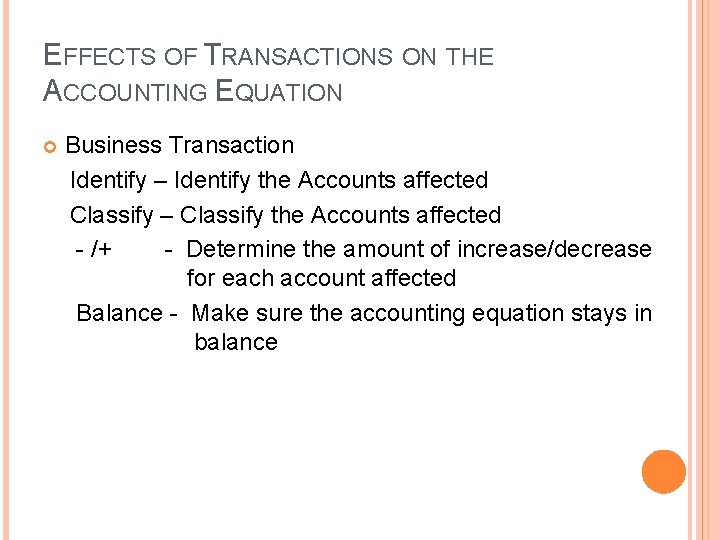
EFFECTS OF TRANSACTIONS ON THE ACCOUNTING EQUATION Business Transaction Identify – Identify the Accounts affected Classify – Classify the Accounts affected - /+ - Determine the amount of increase/decrease for each account affected Balance - Make sure the accounting equation stays in balance
COMMON TRANSACTIONS Investments by the owner Cash transactions Credit transactions Revenue and expense transactions Withdrawals by the owner
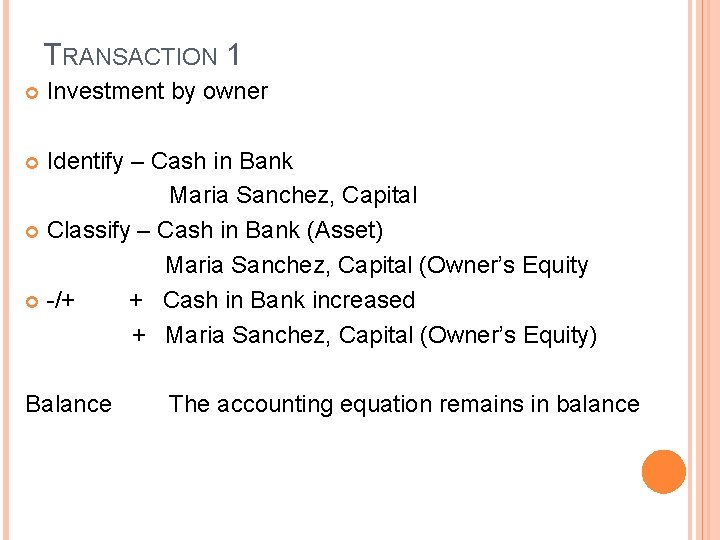
TRANSACTION 1 Investment by owner Identify – Cash in Bank Maria Sanchez, Capital Classify – Cash in Bank (Asset) Maria Sanchez, Capital (Owner’s Equity -/+ + Cash in Bank increased + Maria Sanchez, Capital (Owner’s Equity) Balance The accounting equation remains in balance
REVIEW TRANSACTIONS 1 -7 Complete “Do the Math Complete Problem 3 -2
TRANSACTIONS THAT AFFECT REVENUE, EXPENSE, AND WITHDRAWALS BY THE OWNER Revenue Transaction Income earned from the sale of goods or services Examples: Fees for services performed Cash received for from the sale of merchandise Both Revenue and Investments by owner increase Owner’s Equity They originate from two separate resources Revenue increases Assets and Owner’s Equity
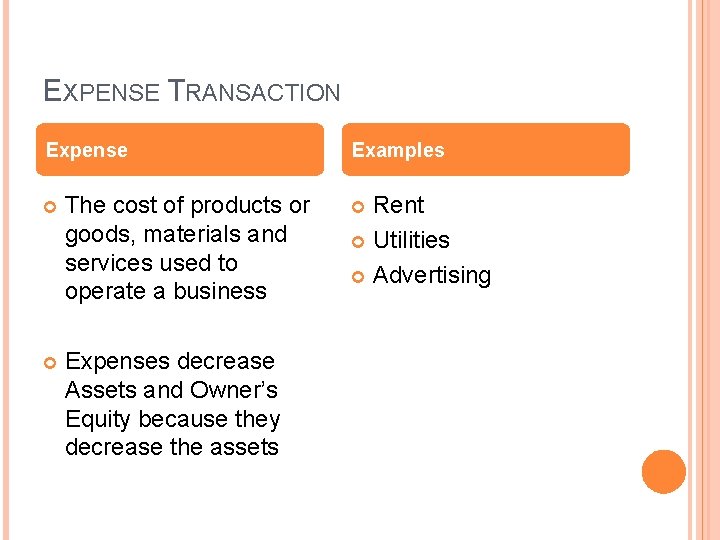
EXPENSE TRANSACTION Expense The cost of products or goods, materials and services used to operate a business Expenses decrease Assets and Owner’s Equity because they decrease the assets Examples Rent Utilities Advertising
BUSINESS TRANSACTIONS Transaction 8 Transaction 9
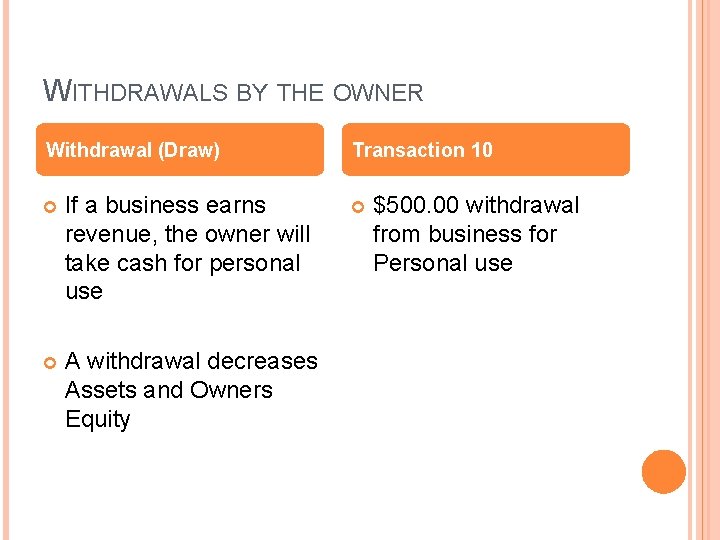
WITHDRAWALS BY THE OWNER Withdrawal (Draw) If a business earns revenue, the owner will take cash for personal use A withdrawal decreases Assets and Owners Equity Transaction 10 $500. 00 withdrawal from business for Personal use