
TF 5 10 15 20 25 30 35










- Slides: 44
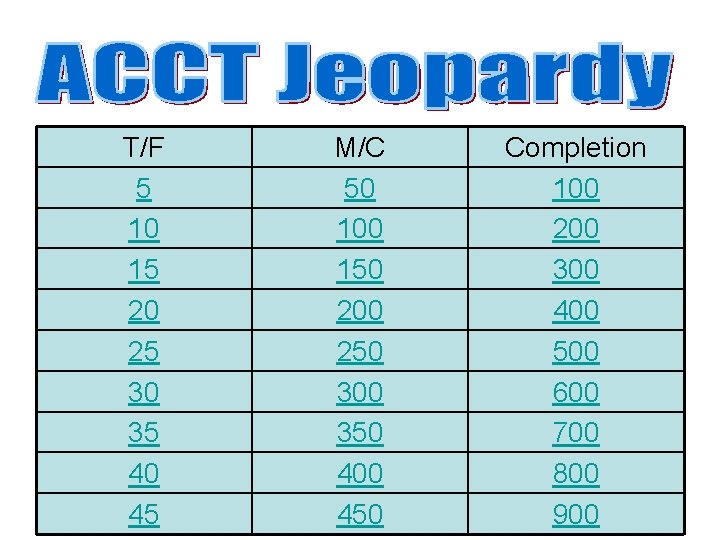
T/F 5 10 15 20 25 30 35 40 45 M/C 50 100 150 200 250 300 350 400 450 Completion 100 200 300 400 500 600 700 800 900
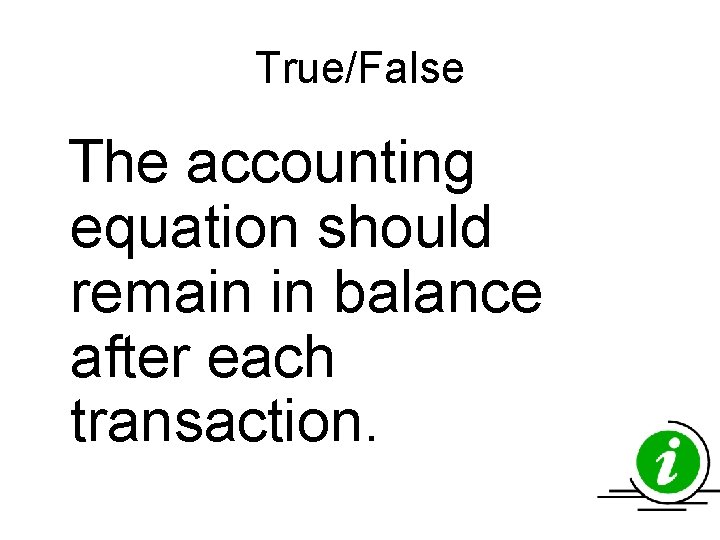
True/False The accounting equation should remain in balance after each transaction.
True
False
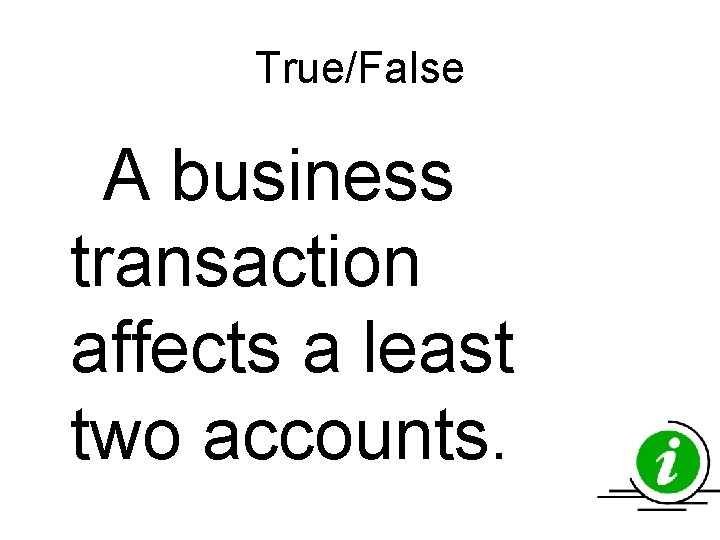
True/False A business transaction affects a least two accounts.
True/False “Assets + Liabilities = Owner’s Equity” is another way to express the accounting equation.
True/False The private enterprise system is based on the right to own property.
True/False The owner’s personal financial transactions are part of the business’s records.
True/False Full Screen view removes the toolbars, rulers, and scrollbars from the screen.
True/False Press the Down arrow key to move the insertion point to the next page.
True/False The owner’s claims to the assets of a business are liabilities.
True/False When a business transaction occurs, the financial position of the business changes.
True/False A creditor has a financial claim to the assets of a business.
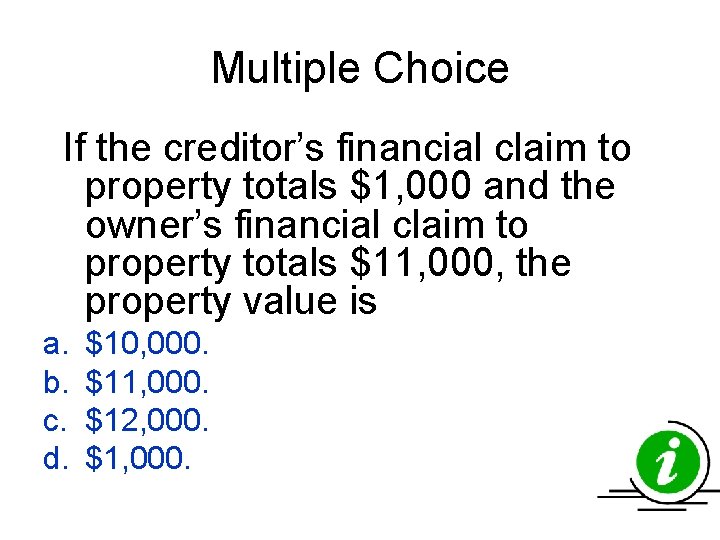
Multiple Choice If the creditor’s financial claim to property totals $1, 000 and the owner’s financial claim to property totals $11, 000, the property value is a. b. c. d. $10, 000. $11, 000. $12, 000. $1, 000.
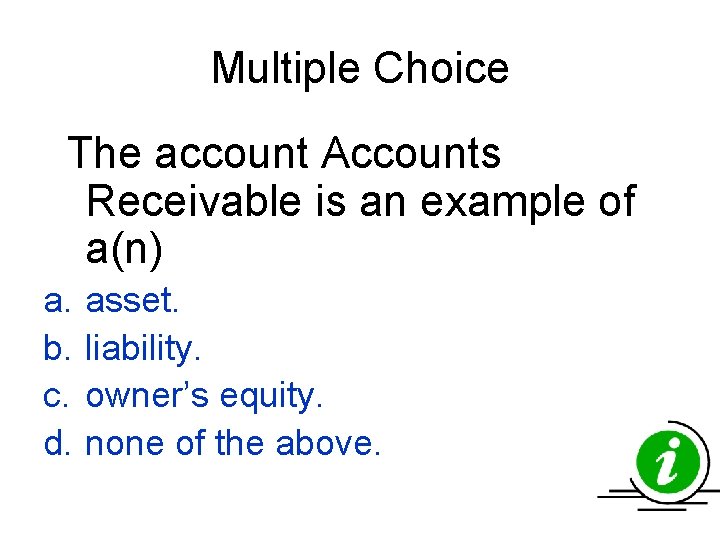
Multiple Choice The account Accounts Receivable is an example of a(n) a. b. c. d. asset. liability. owner’s equity. none of the above.
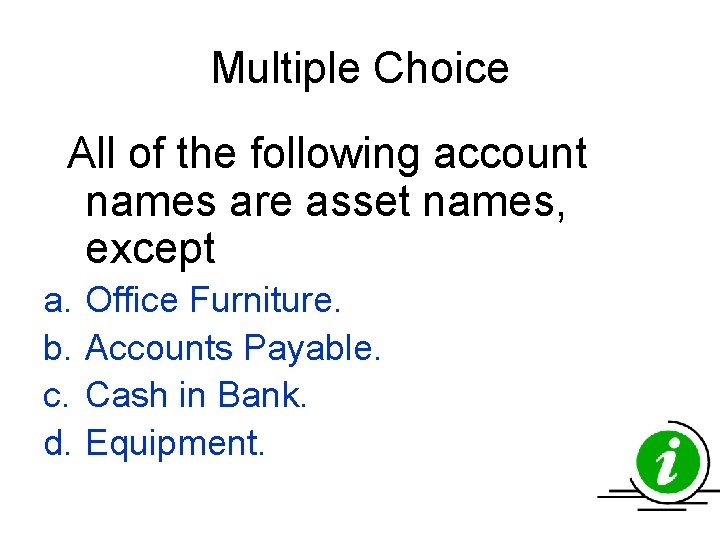
Multiple Choice All of the following account names are asset names, except a. b. c. d. Office Furniture. Accounts Payable. Cash in Bank. Equipment.
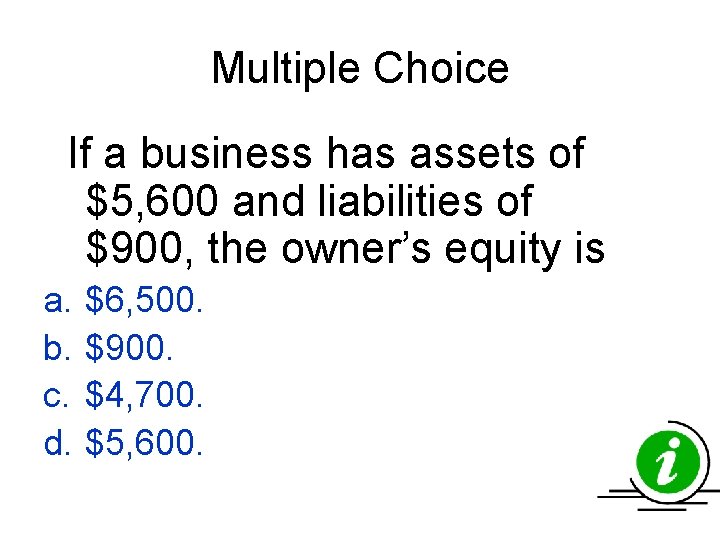
Multiple Choice If a business has assets of $5, 600 and liabilities of $900, the owner’s equity is a. b. c. d. $6, 500. $900. $4, 700. $5, 600.
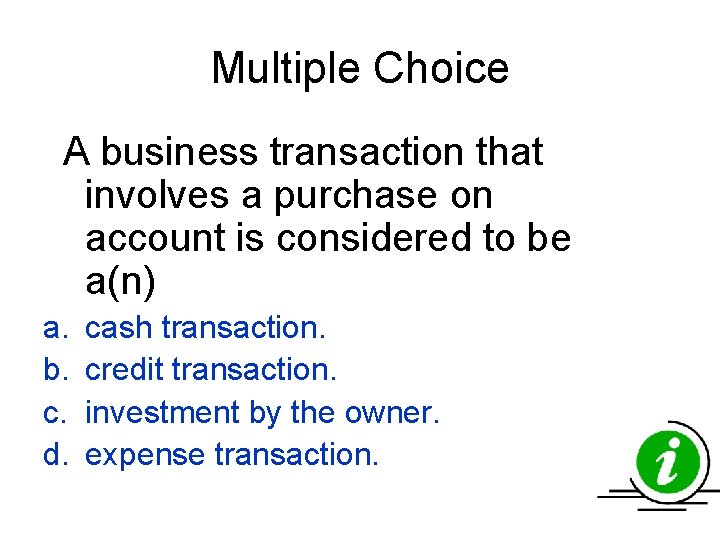
Multiple Choice A business transaction that involves a purchase on account is considered to be a(n) a. b. c. d. cash transaction. credit transaction. investment by the owner. expense transaction.
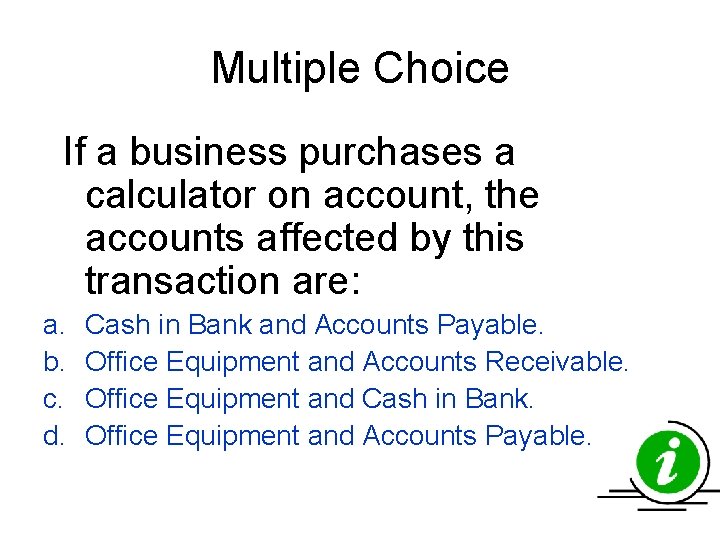
Multiple Choice If a business purchases a calculator on account, the accounts affected by this transaction are: a. b. c. d. Cash in Bank and Accounts Payable. Office Equipment and Accounts Receivable. Office Equipment and Cash in Bank. Office Equipment and Accounts Payable.
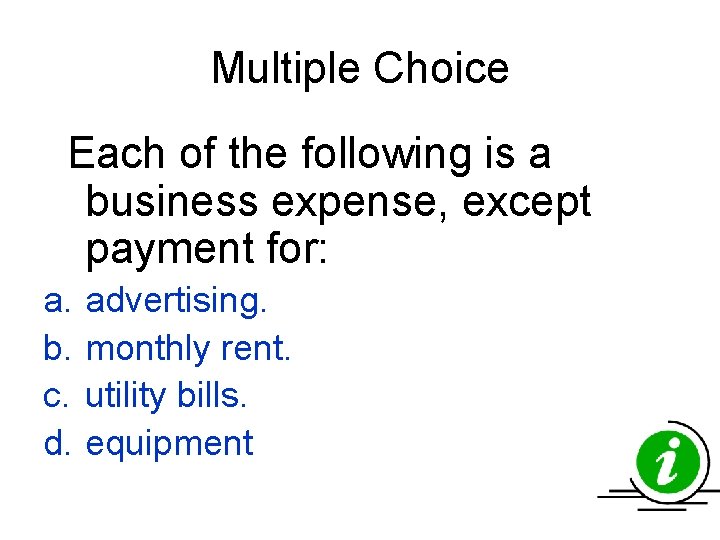
Multiple Choice Each of the following is a business expense, except payment for: a. b. c. d. advertising. monthly rent. utility bills. equipment
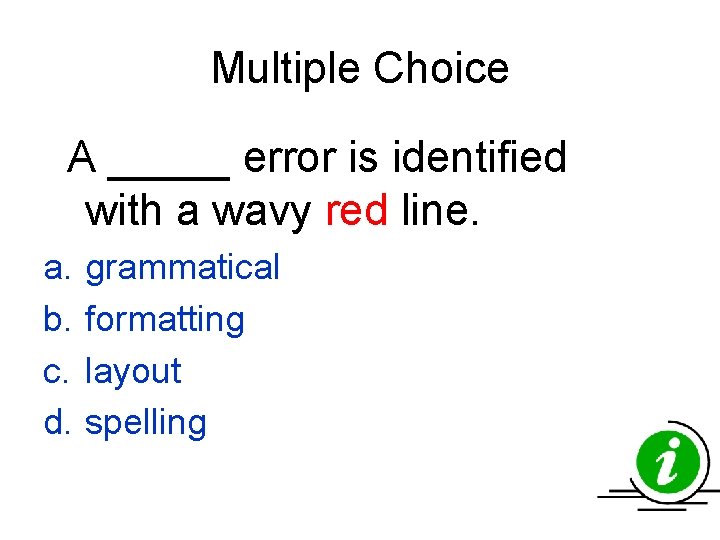
Multiple Choice A _____ error is identified with a wavy red line. a. b. c. d. grammatical formatting layout spelling
Multiple Choice The purchase of a desk on account will increase Office Furniture and will also increase a. b. c. d. Cash in Bank. Accounts Payable. Accounts Receivable. Jon Mc. Ivey, Capital.
Completion The ____ is Assets = Liabilities + Owner’s Equity.
Completion A(n) ____ is any property or item of value owned by a business.
Completion ______ are the creditor’s claims to the assets of the business.
Completion Buying ____ is the same as buying on credit.
Completion _____ is income earned from the sale of goods and services.
Completion A person or business that sells property on credit, or any person or business to which money is owed, is called a(n) ______.
Completion The amount of money owed to the creditors of a business is _______.
Completion _____ refers to the dollar amount of the owner’s equity in the business.
Completion The costs of goods and services used to operate a business are _____.
a
b
c
d
accounting equation
asset
liabilities
on account
revenue
creditor
accounts payable
capital
expenses