Chapter 23 Sorting Liang Introduction to Java Programming
- Slides: 42
Chapter 23 Sorting Liang, Introduction to Java Programming, Eleventh Edition, (c) 2018 Pearson Education, Ltd. All rights reserved. 1
Objectives F F F F F To study and analyze time complexity of various sorting algorithms (§§ 23. 2– 23. 7). To design, implement, and analyze insertion sort (§ 23. 2). To design, implement, and analyze bubble sort (§ 23. 3). To design, implement, and analyze merge sort (§ 23. 4). To design, implement, and analyze quick sort (§ 23. 5). To design and implement a binary heap (§ 23. 6). To design, implement, and analyze heap sort (§ 23. 7). To design, implement, and analyze bucket sort and radix sort (§ 23. 8). To design, implement, and analyze external sort for files that have a large amount of data (§ 23. 9). Liang, Introduction to Java Programming, Eleventh Edition, (c) 2018 Pearson Education, Ltd. All rights reserved. 2
Why study sorting? Sorting is a classic subject in computer science. There are three reasons for studying sorting algorithms. – First, sorting algorithms illustrate many creative approaches to problem solving and these approaches can be applied to solve other problems. – Second, sorting algorithms are good for practicing fundamental programming techniques using selection statements, loops, methods, and arrays. – Third, sorting algorithms are excellent examples to demonstrate algorithm performance. Liang, Introduction to Java Programming, Eleventh Edition, (c) 2018 Pearson Education, Ltd. All rights reserved. 3
What data to sort? The data to be sorted might be integers, doubles, characters, or objects. § 7. 8, “Sorting Arrays, ” presented selection sort and insertion sort for numeric values. The selection sort algorithm was extended to sort an array of objects in § 11. 5. 7, “Example: Sorting an Array of Objects. ” The Java API contains several overloaded sort methods for sorting primitive type values and objects in the java. util. Arrays and java. util. Collections class. For simplicity, this section assumes: F data to be sorted are integers, F data are sorted in ascending order, and F data are stored in an array. The programs can be easily modified to sort other types of data, to sort in descending order, or to sort data in an Array. List or a Linked. List. Liang, Introduction to Java Programming, Eleventh Edition, (c) 2018 Pearson Education, Ltd. All rights reserved. 4
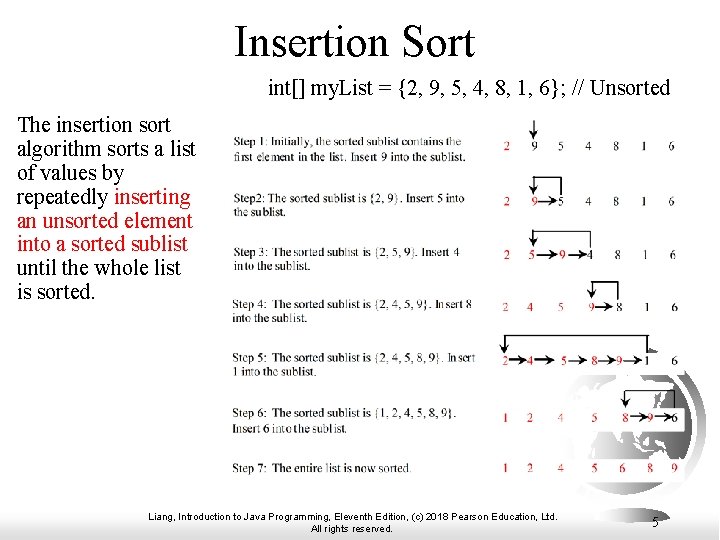
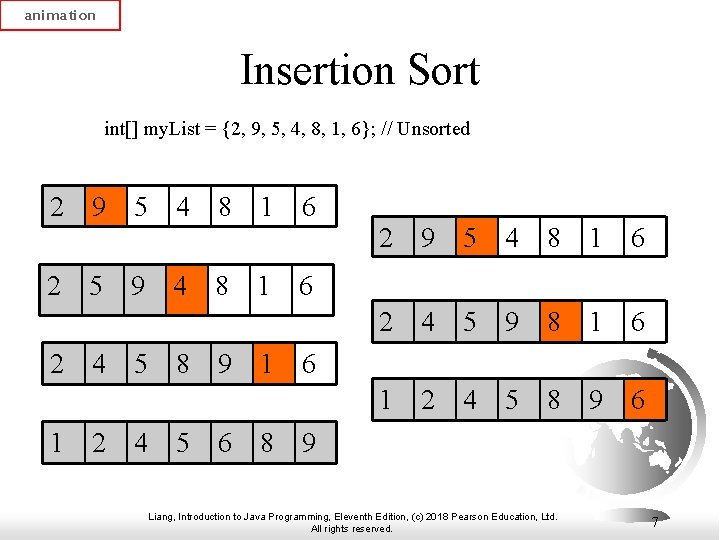
Insertion Sort int[] my. List = {2, 9, 5, 4, 8, 1, 6}; // Unsorted The insertion sort algorithm sorts a list of values by repeatedly inserting an unsorted element into a sorted sublist until the whole list is sorted. Liang, Introduction to Java Programming, Eleventh Edition, (c) 2018 Pearson Education, Ltd. All rights reserved. 5
animation Insertion Sort Animation https: //liveexample. pearsoncmg. com/dsanimation/Insertio n. Sort. Newe. Book. html Liang, Introduction to Java Programming, Eleventh Edition, (c) 2018 Pearson Education, Ltd. All rights reserved. 6
animation Insertion Sort int[] my. List = {2, 9, 5, 4, 8, 1, 6}; // Unsorted 2 9 5 4 8 1 6 2 5 9 4 8 1 6 2 4 1 2 5 4 8 5 9 1 6 8 2 9 5 4 8 1 6 2 4 5 9 8 1 6 1 2 4 5 8 9 6 6 9 Liang, Introduction to Java Programming, Eleventh Edition, (c) 2018 Pearson Education, Ltd. All rights reserved. 7
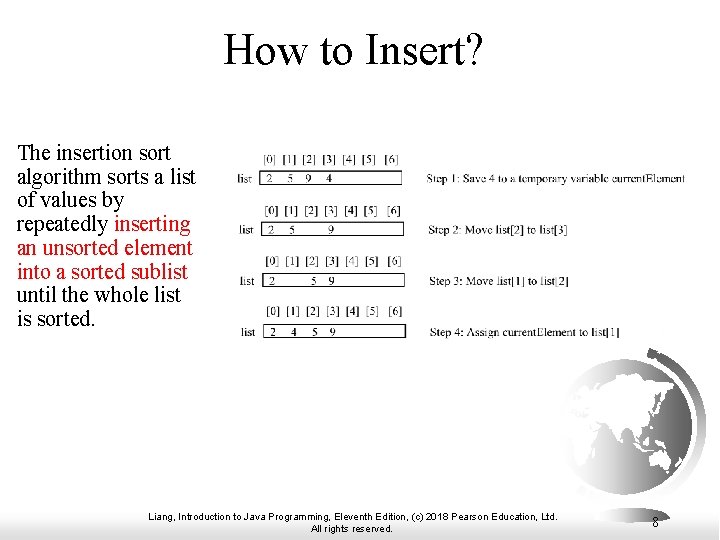
How to Insert? The insertion sort algorithm sorts a list of values by repeatedly inserting an unsorted element into a sorted sublist until the whole list is sorted. Liang, Introduction to Java Programming, Eleventh Edition, (c) 2018 Pearson Education, Ltd. All rights reserved. 8
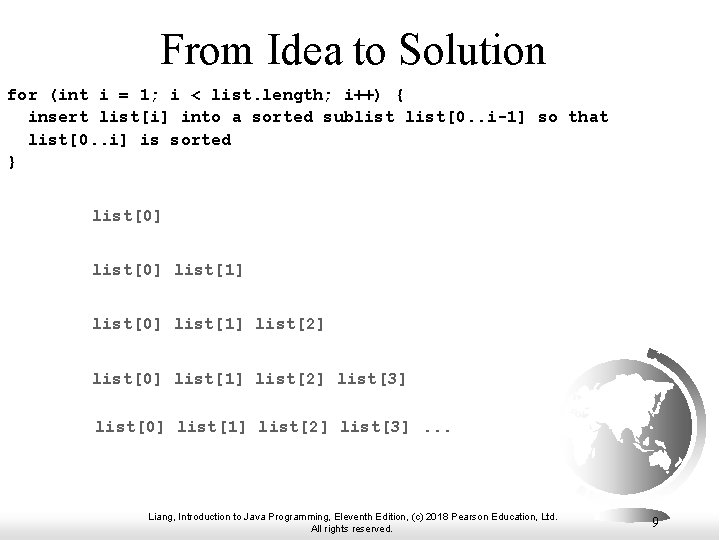
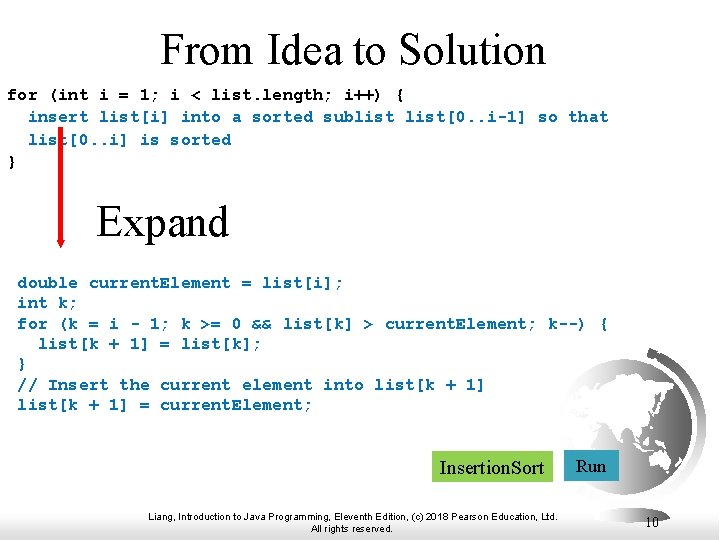
From Idea to Solution for (int i = 1; i < list. length; i++) { insert list[i] into a sorted sublist[0. . i-1] so that list[0. . i] is sorted } list[0] list[1] list[2] list[3] list[0] list[1] list[2] list[3]. . . Liang, Introduction to Java Programming, Eleventh Edition, (c) 2018 Pearson Education, Ltd. All rights reserved. 9
From Idea to Solution for (int i = 1; i < list. length; i++) { insert list[i] into a sorted sublist[0. . i-1] so that list[0. . i] is sorted } Expand double current. Element = list[i]; int k; for (k = i - 1; k >= 0 && list[k] > current. Element; k--) { list[k + 1] = list[k]; } // Insert the current element into list[k + 1] = current. Element; Insertion. Sort Liang, Introduction to Java Programming, Eleventh Edition, (c) 2018 Pearson Education, Ltd. All rights reserved. Run 10
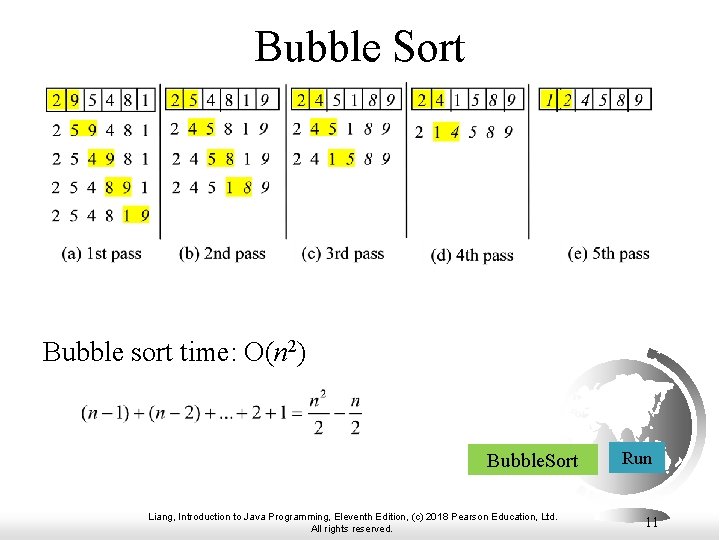
Bubble Sort Bubble sort time: O(n 2) Bubble. Sort Liang, Introduction to Java Programming, Eleventh Edition, (c) 2018 Pearson Education, Ltd. All rights reserved. Run 11
Bubble Sort Animation https: //liveexample. pearsoncmg. com/dsanimation/Bubble. Sort. Newe. Boo k. html Liang, Introduction to Java Programming, Eleventh Edition, (c) 2018 Pearson Education, Ltd. All rights reserved. 12
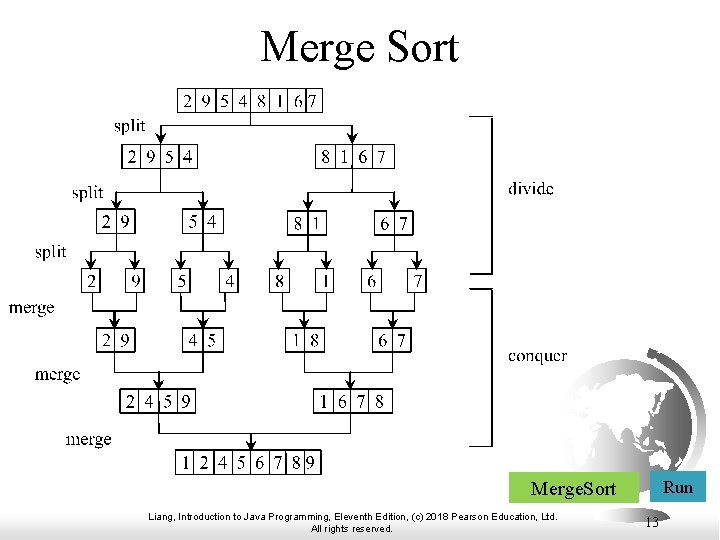
Merge Sort Run Merge. Sort Liang, Introduction to Java Programming, Eleventh Edition, (c) 2018 Pearson Education, Ltd. All rights reserved. 13
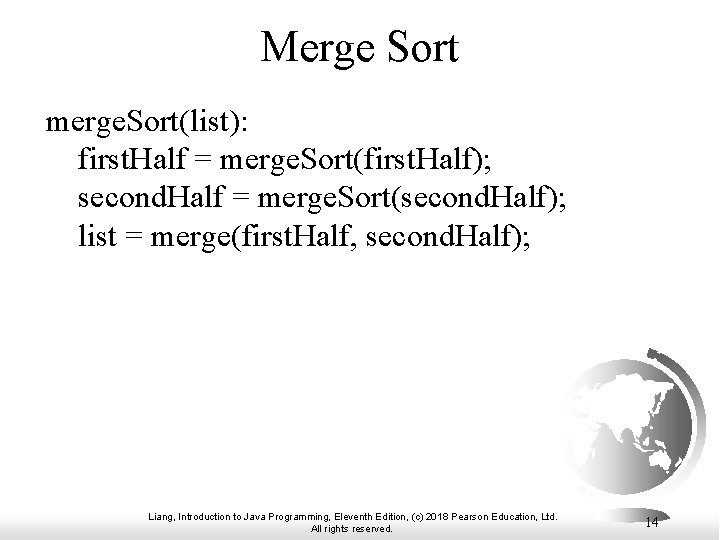
Merge Sort merge. Sort(list): first. Half = merge. Sort(first. Half); second. Half = merge. Sort(second. Half); list = merge(first. Half, second. Half); Liang, Introduction to Java Programming, Eleventh Edition, (c) 2018 Pearson Education, Ltd. All rights reserved. 14
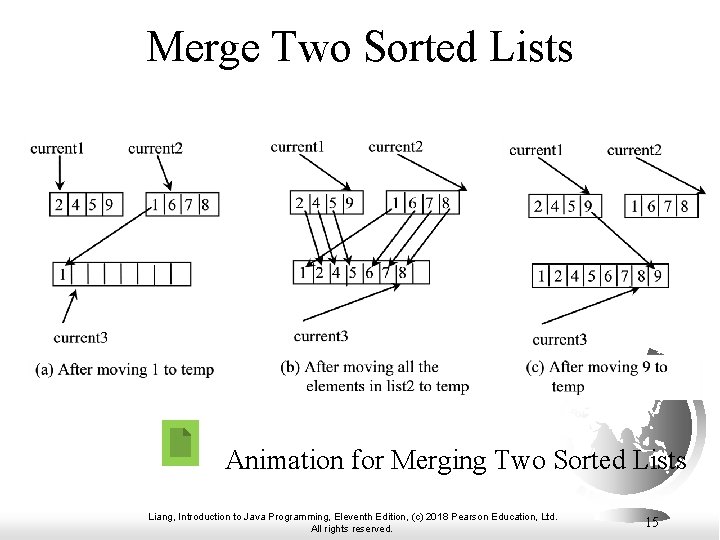
Merge Two Sorted Lists Animation for Merging Two Sorted Lists Liang, Introduction to Java Programming, Eleventh Edition, (c) 2018 Pearson Education, Ltd. All rights reserved. 15
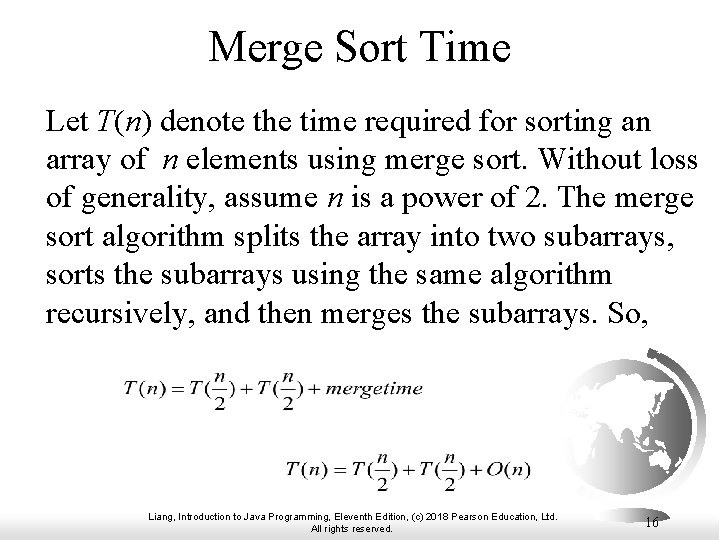
Merge Sort Time Let T(n) denote the time required for sorting an array of n elements using merge sort. Without loss of generality, assume n is a power of 2. The merge sort algorithm splits the array into two subarrays, sorts the subarrays using the same algorithm recursively, and then merges the subarrays. So, Liang, Introduction to Java Programming, Eleventh Edition, (c) 2018 Pearson Education, Ltd. All rights reserved. 16
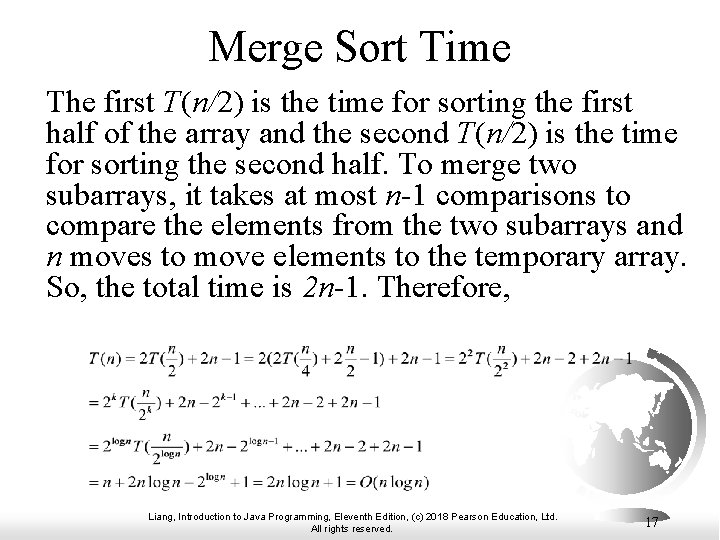
Merge Sort Time The first T(n/2) is the time for sorting the first half of the array and the second T(n/2) is the time for sorting the second half. To merge two subarrays, it takes at most n-1 comparisons to compare the elements from the two subarrays and n moves to move elements to the temporary array. So, the total time is 2 n-1. Therefore, Liang, Introduction to Java Programming, Eleventh Edition, (c) 2018 Pearson Education, Ltd. All rights reserved. 17
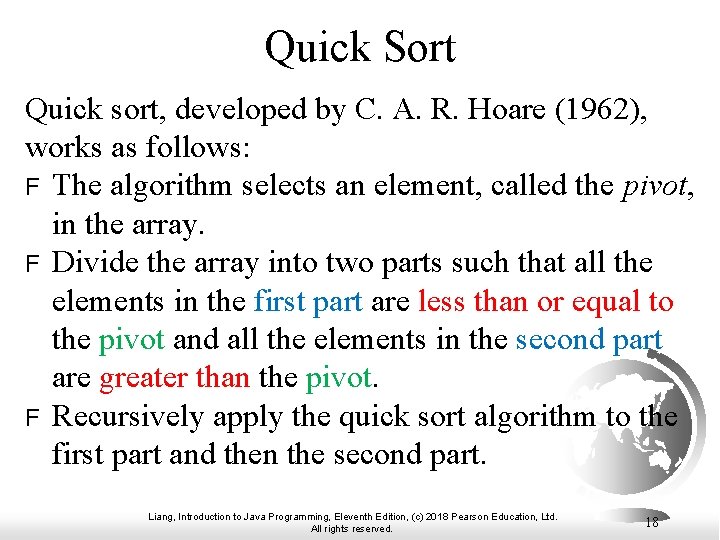
Quick Sort Quick sort, developed by C. A. R. Hoare (1962), works as follows: F The algorithm selects an element, called the pivot, in the array. F Divide the array into two parts such that all the elements in the first part are less than or equal to the pivot and all the elements in the second part are greater than the pivot. F Recursively apply the quick sort algorithm to the first part and then the second part. Liang, Introduction to Java Programming, Eleventh Edition, (c) 2018 Pearson Education, Ltd. All rights reserved. 18
Quick Sort Liang, Introduction to Java Programming, Eleventh Edition, (c) 2018 Pearson Education, Ltd. All rights reserved. 19
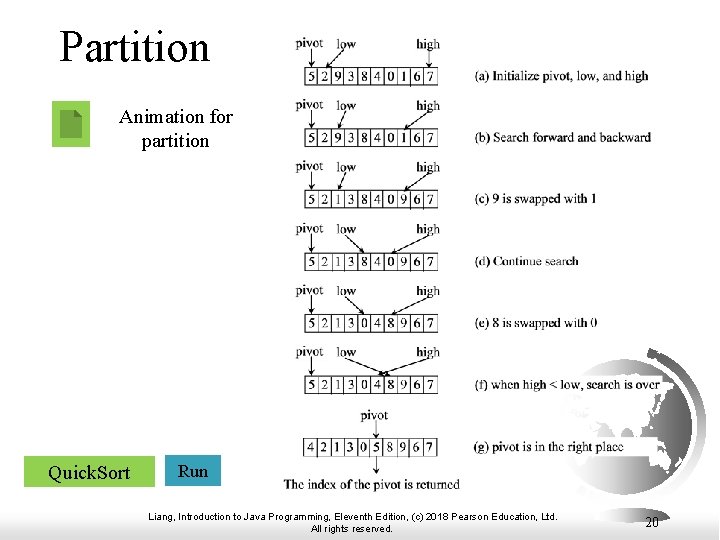
Partition Animation for partition Quick. Sort Run Liang, Introduction to Java Programming, Eleventh Edition, (c) 2018 Pearson Education, Ltd. All rights reserved. 20
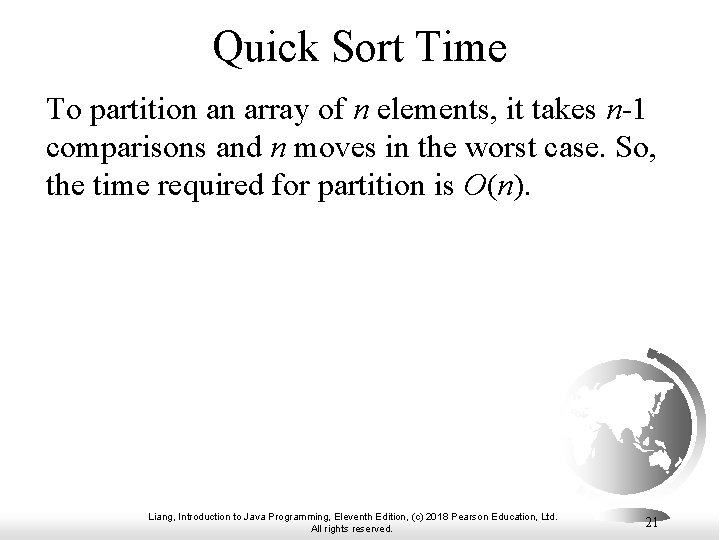
Quick Sort Time To partition an array of n elements, it takes n-1 comparisons and n moves in the worst case. So, the time required for partition is O(n). Liang, Introduction to Java Programming, Eleventh Edition, (c) 2018 Pearson Education, Ltd. All rights reserved. 21
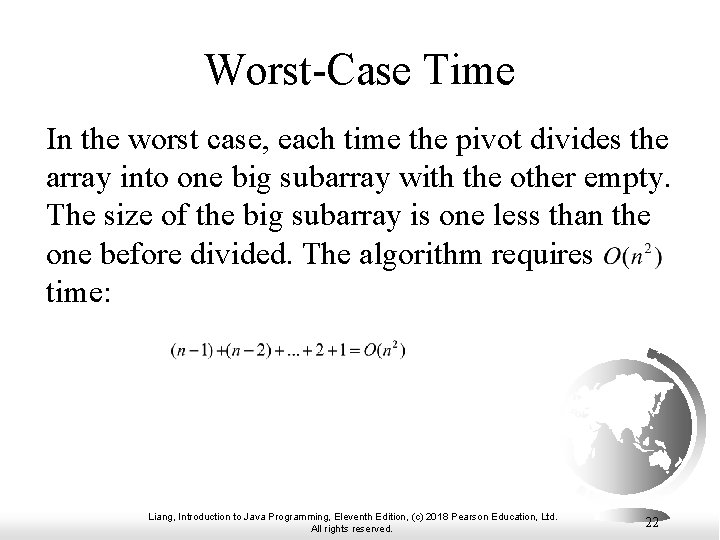
Worst-Case Time In the worst case, each time the pivot divides the array into one big subarray with the other empty. The size of the big subarray is one less than the one before divided. The algorithm requires time: Liang, Introduction to Java Programming, Eleventh Edition, (c) 2018 Pearson Education, Ltd. All rights reserved. 22
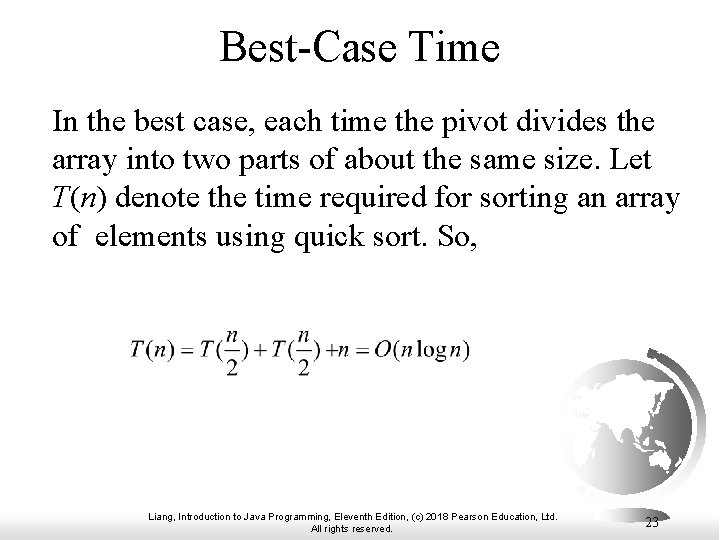
Best-Case Time In the best case, each time the pivot divides the array into two parts of about the same size. Let T(n) denote the time required for sorting an array of elements using quick sort. So, Liang, Introduction to Java Programming, Eleventh Edition, (c) 2018 Pearson Education, Ltd. All rights reserved. 23
Average-Case Time On the average, each time the pivot will not divide the array into two parts of the same size nor one empty part. Statistically, the sizes of the two parts are very close. So the average time is O(nlogn). The exact average-case analysis is beyond the scope of this book. Liang, Introduction to Java Programming, Eleventh Edition, (c) 2018 Pearson Education, Ltd. All rights reserved. 24
Heap is a useful data structure for designing efficient sorting algorithms and priority queues. A heap is a binary tree with the following properties: FIt is a complete binary tree. FEach node is greater than or equal to any of its children. Liang, Introduction to Java Programming, Eleventh Edition, (c) 2018 Pearson Education, Ltd. All rights reserved. 25
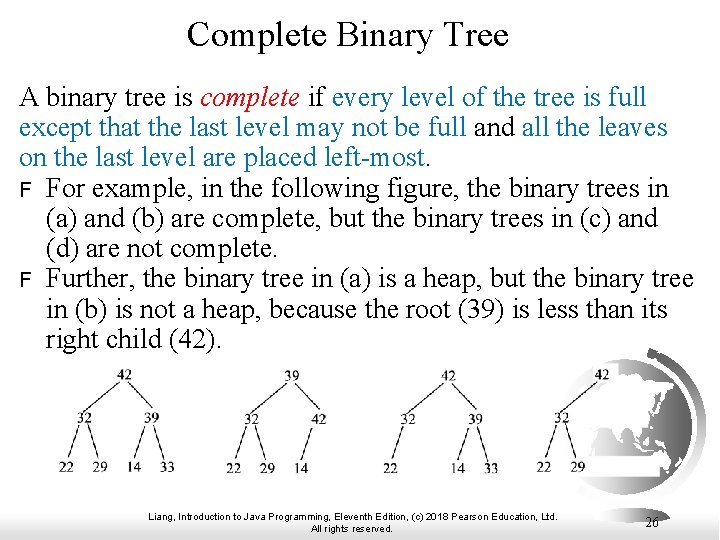
Complete Binary Tree A binary tree is complete if every level of the tree is full except that the last level may not be full and all the leaves on the last level are placed left-most. F For example, in the following figure, the binary trees in (a) and (b) are complete, but the binary trees in (c) and (d) are not complete. F Further, the binary tree in (a) is a heap, but the binary tree in (b) is not a heap, because the root (39) is less than its right child (42). Liang, Introduction to Java Programming, Eleventh Edition, (c) 2018 Pearson Education, Ltd. All rights reserved. 26
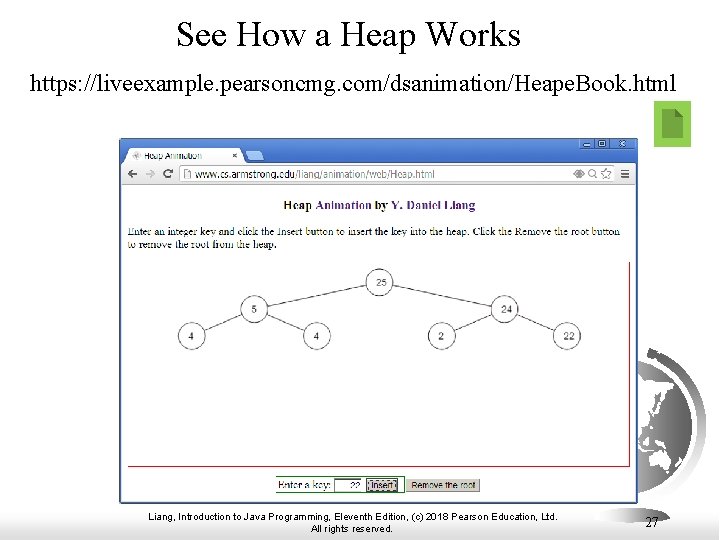
See How a Heap Works https: //liveexample. pearsoncmg. com/dsanimation/Heape. Book. html Liang, Introduction to Java Programming, Eleventh Edition, (c) 2018 Pearson Education, Ltd. All rights reserved. 27
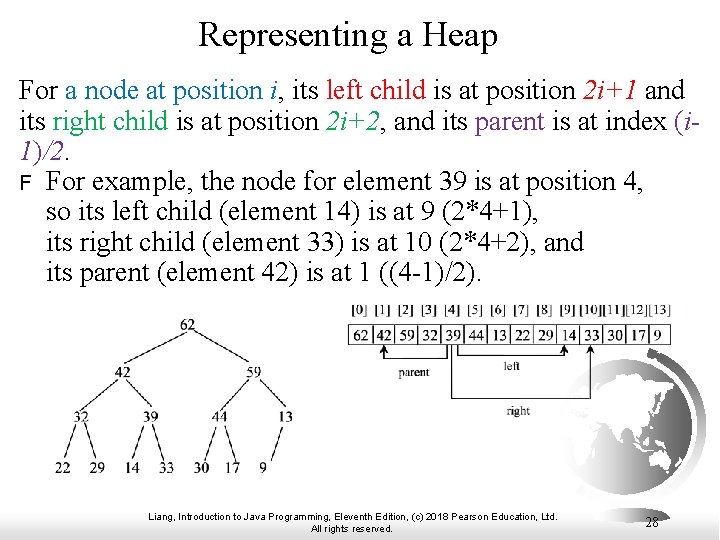
Representing a Heap For a node at position i, its left child is at position 2 i+1 and its right child is at position 2 i+2, and its parent is at index (i 1)/2. F For example, the node for element 39 is at position 4, so its left child (element 14) is at 9 (2*4+1), its right child (element 33) is at 10 (2*4+2), and its parent (element 42) is at 1 ((4 -1)/2). Liang, Introduction to Java Programming, Eleventh Edition, (c) 2018 Pearson Education, Ltd. All rights reserved. 28
1. Adding Elements to the Heap Adding 3, 5, 1, 19, 11, and 22 to a heap, initially empty Liang, Introduction to Java Programming, Eleventh Edition, (c) 2018 Pearson Education, Ltd. All rights reserved. 29
Rebuild the heap after adding a new node Adding 88 to the heap Liang, Introduction to Java Programming, Eleventh Edition, (c) 2018 Pearson Education, Ltd. All rights reserved. 30
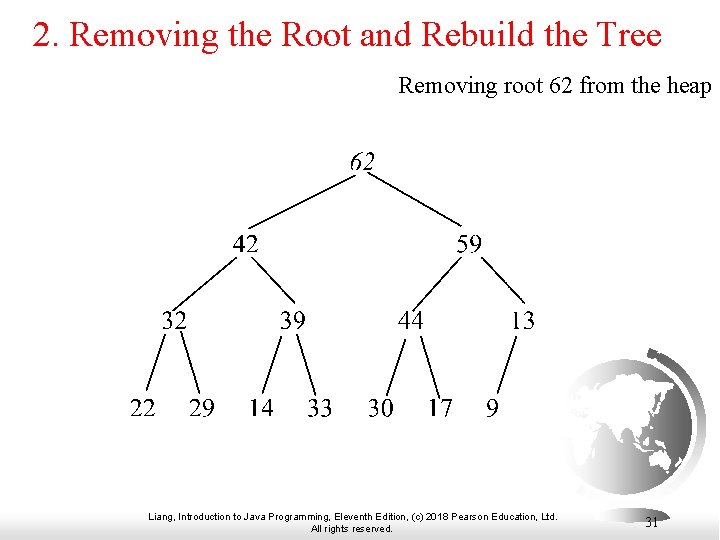
2. Removing the Root and Rebuild the Tree Removing root 62 from the heap Liang, Introduction to Java Programming, Eleventh Edition, (c) 2018 Pearson Education, Ltd. All rights reserved. 31
Removing the Root and Rebuild the Tree Move 9 to root Liang, Introduction to Java Programming, Eleventh Edition, (c) 2018 Pearson Education, Ltd. All rights reserved. 32
Removing the Root and Rebuild the Tree Swap 9 with 59 Liang, Introduction to Java Programming, Eleventh Edition, (c) 2018 Pearson Education, Ltd. All rights reserved. 33
Removing the Root and Rebuild the Tree Swap 9 with 44 Liang, Introduction to Java Programming, Eleventh Edition, (c) 2018 Pearson Education, Ltd. All rights reserved. 34
Removing the Root and Rebuild the Tree Swap 9 with 30 Liang, Introduction to Java Programming, Eleventh Edition, (c) 2018 Pearson Education, Ltd. All rights reserved. 35
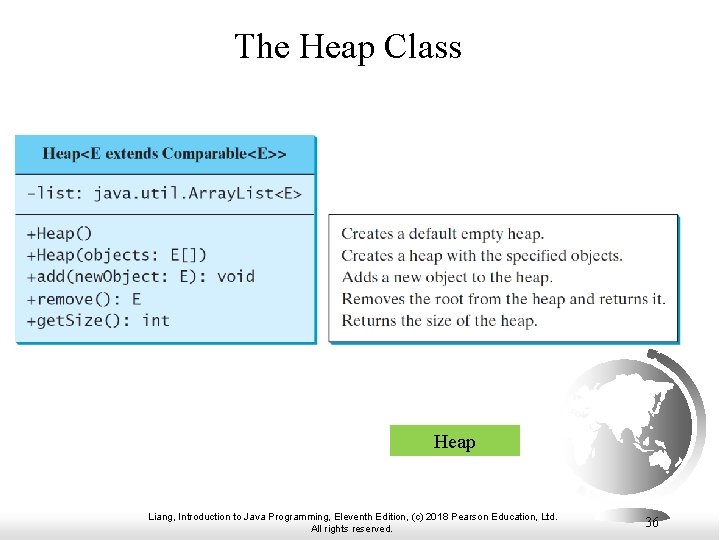
The Heap Class Heap Liang, Introduction to Java Programming, Eleventh Edition, (c) 2018 Pearson Education, Ltd. All rights reserved. 36
Heap Sort Heap. Sort Run Liang, Introduction to Java Programming, Eleventh Edition, (c) 2018 Pearson Education, Ltd. All rights reserved. 37
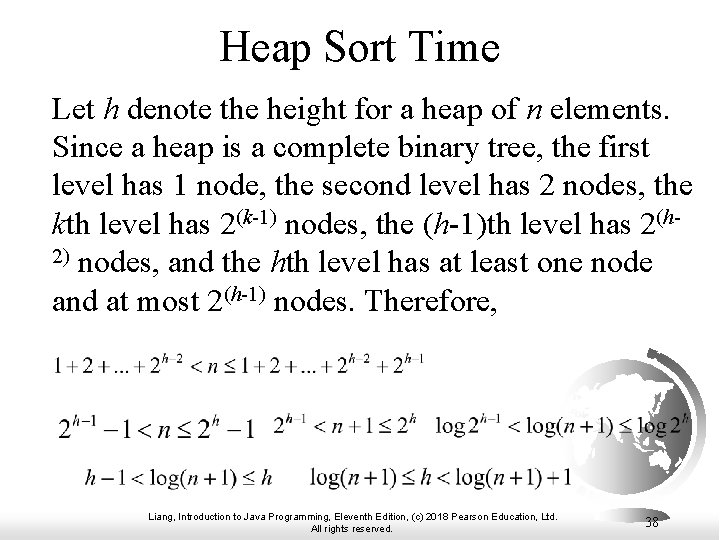
Heap Sort Time Let h denote the height for a heap of n elements. Since a heap is a complete binary tree, the first level has 1 node, the second level has 2 nodes, the kth level has 2(k-1) nodes, the (h-1)th level has 2(h 2) nodes, and the hth level has at least one node and at most 2(h-1) nodes. Therefore, Liang, Introduction to Java Programming, Eleventh Edition, (c) 2018 Pearson Education, Ltd. All rights reserved. 38
Bucket Sort and Radix Sort F All sort algorithms discussed so far are general sorting algorithms that work for any types of keys (e. g. , integers, strings, and any comparable objects). These algorithms sort the elements by comparing their keys. – The lower bound for general sorting algorithms is O(nlogn). So, no sorting algorithms based on comparisons can perform better than O(nlogn). F However, if the keys are small integers, you can use bucket sort without having to compare the keys. Liang, Introduction to Java Programming, Eleventh Edition, (c) 2018 Pearson Education, Ltd. All rights reserved. 39
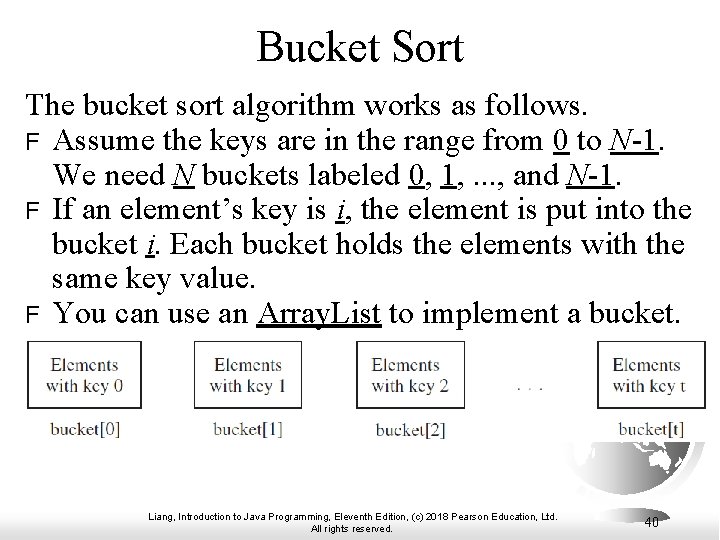
Bucket Sort The bucket sort algorithm works as follows. F Assume the keys are in the range from 0 to N-1. We need N buckets labeled 0, 1, . . . , and N-1. F If an element’s key is i, the element is put into the bucket i. Each bucket holds the elements with the same key value. F You can use an Array. List to implement a bucket. Liang, Introduction to Java Programming, Eleventh Edition, (c) 2018 Pearson Education, Ltd. All rights reserved. 40
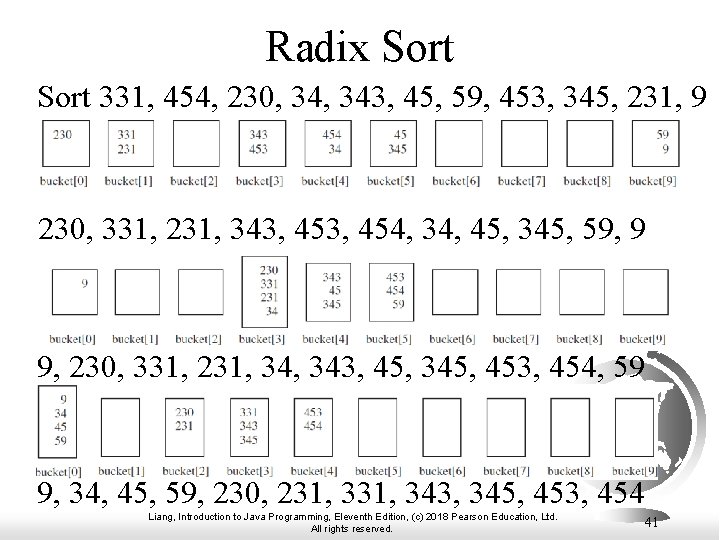
Radix Sort 331, 454, 230, 343, 45, 59, 453, 345, 231, 9 230, 331, 231, 343, 454, 34, 45, 345, 59, 9 9, 230, 331, 231, 343, 45, 345, 453, 454, 59 9, 34, 45, 59, 230, 231, 343, 345, 453, 454 Liang, Introduction to Java Programming, Eleventh Edition, (c) 2018 Pearson Education, Ltd. All rights reserved. 41
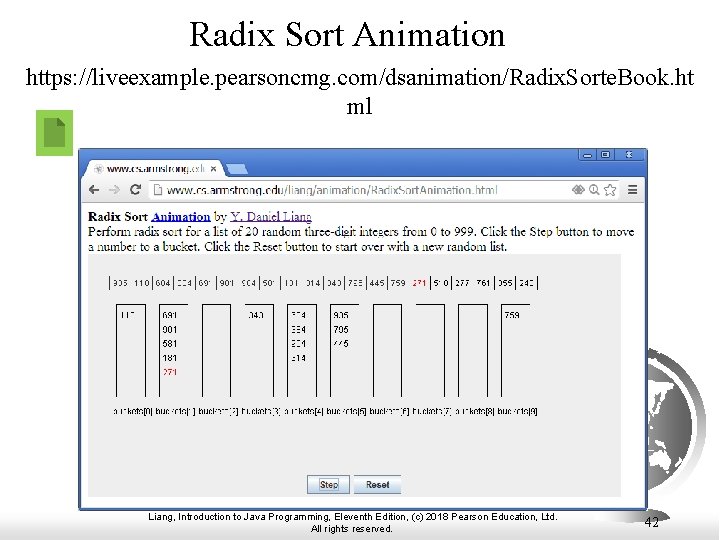
Radix Sort Animation https: //liveexample. pearsoncmg. com/dsanimation/Radix. Sorte. Book. ht ml Liang, Introduction to Java Programming, Eleventh Edition, (c) 2018 Pearson Education, Ltd. All rights reserved. 42