Chapter 19 Descent with Modification Part A Darwin


- Slides: 28
Chapter 19 Descent with Modification Part A: Darwin & Natural Selection
What you must know: Several examples of evidence for evolution from different scientific disciplines and how each supports change of populations over time. The difference between structures that are homologous and those that are analogous, and how this relates to evolution. The role of adaptations, variation, time, reproductive success, and heritability in evolution.
Descent with Modification Theme: Evolutionary change is based on the interactions between populations & their environment which results in adaptations (inherited characteristics) to increase fitness Define: Evolution 1. Descent with modification (Darwin) 2. Change over time in the genetic composition of a population from generation to generation
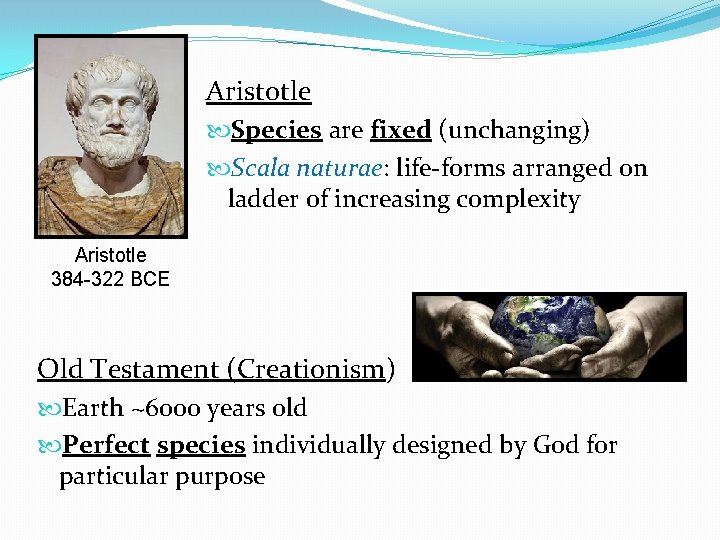
Aristotle Species are fixed (unchanging) Scala naturae: life-forms arranged on ladder of increasing complexity Aristotle 384 -322 BCE Old Testament (Creationism) Earth ~6000 years old Perfect species individually designed by God for particular purpose
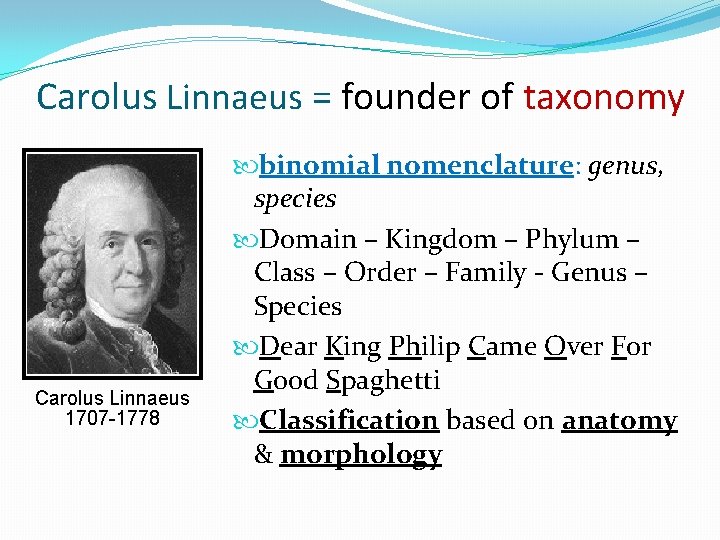
Carolus Linnaeus = founder of taxonomy Carolus Linnaeus 1707 -1778 binomial nomenclature: genus, species Domain – Kingdom – Phylum – Class – Order – Family - Genus – Species Dear King Philip Came Over For Good Spaghetti Classification based on anatomy & morphology
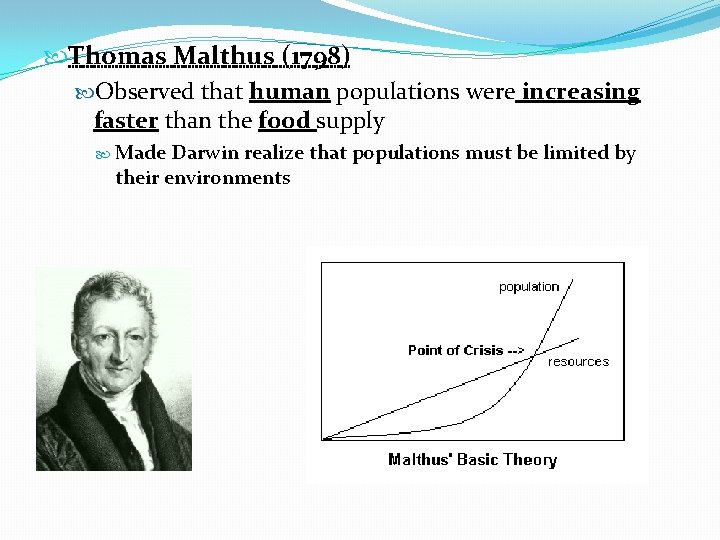
Thomas Malthus (1798) Observed that human populations were increasing faster than the food supply Made Darwin realize that populations must be limited by their environments
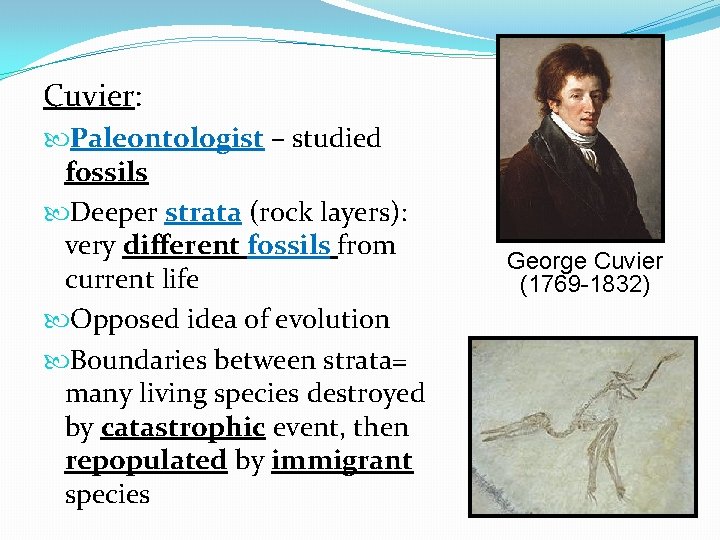
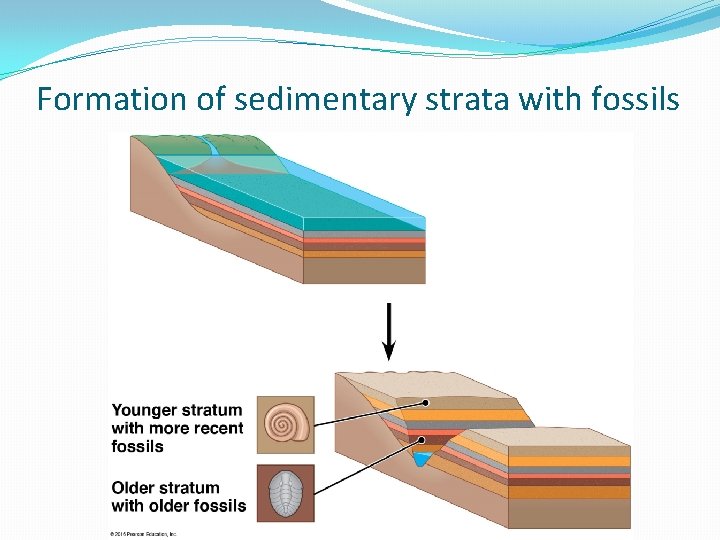
Cuvier: Paleontologist – studied fossils Deeper strata (rock layers): very different fossils from current life Opposed idea of evolution Boundaries between strata= many living species destroyed by catastrophic event, then repopulated by immigrant species George Cuvier (1769 -1832)
Formation of sedimentary strata with fossils
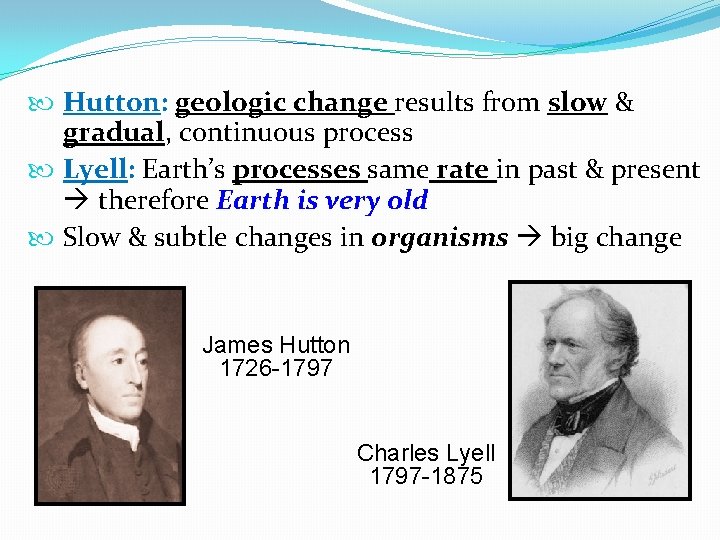
Hutton: geologic change results from slow & gradual, continuous process Lyell: Earth’s processes same rate in past & present therefore Earth is very old Slow & subtle changes in organisms big change James Hutton 1726 -1797 Charles Lyell 1797 -1875
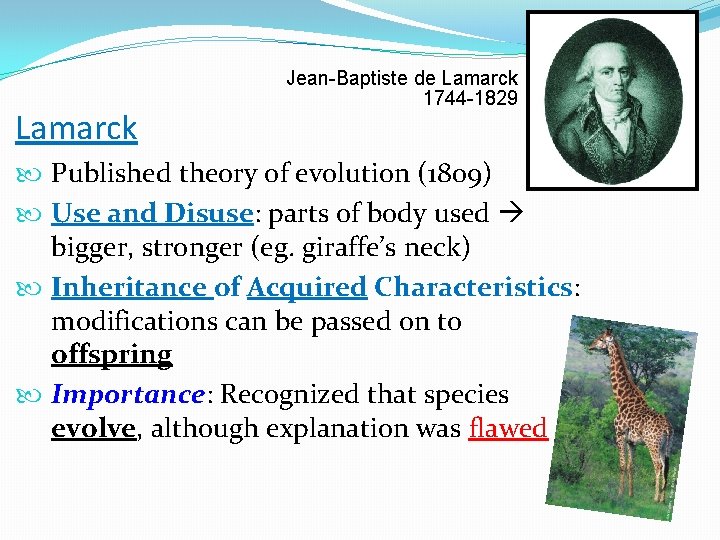
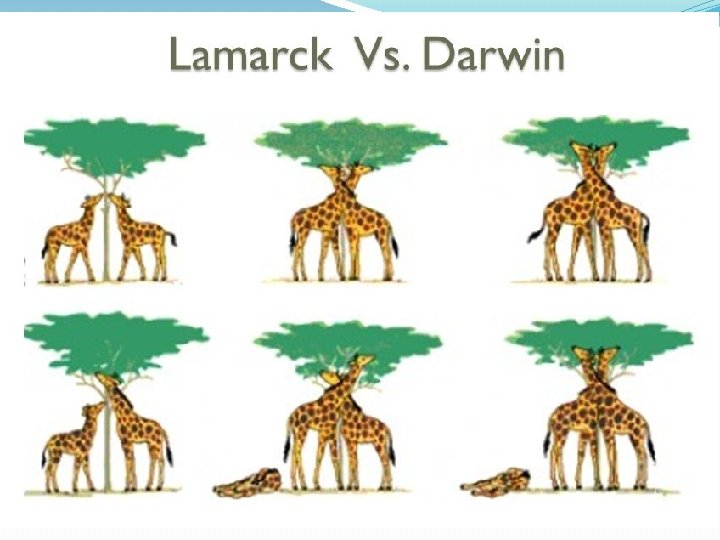
Lamarck Jean-Baptiste de Lamarck 1744 -1829 Published theory of evolution (1809) Use and Disuse: parts of body used bigger, stronger (eg. giraffe’s neck) Inheritance of Acquired Characteristics: modifications can be passed on to offspring Importance: Recognized that species evolve, although explanation was flawed
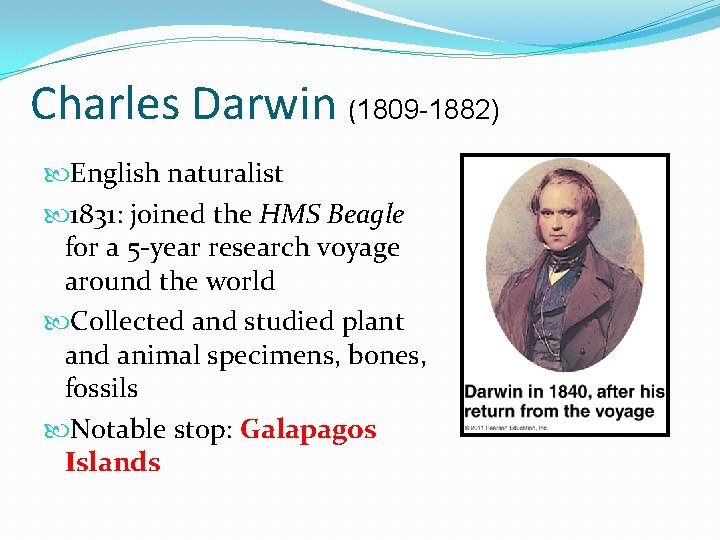
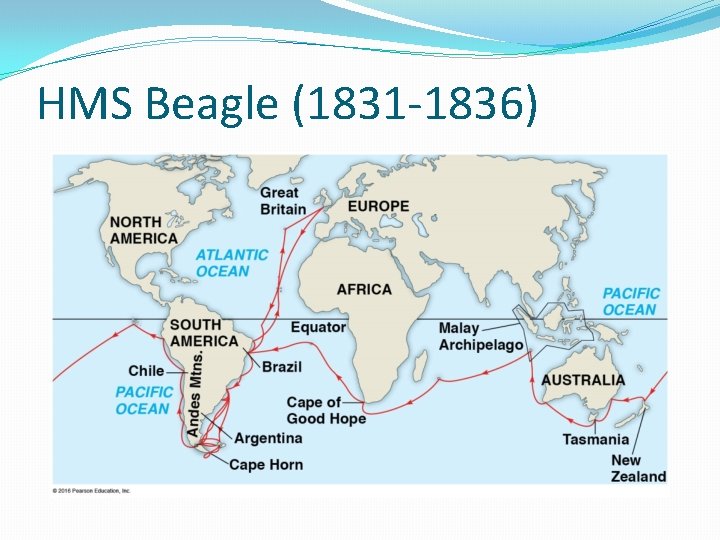
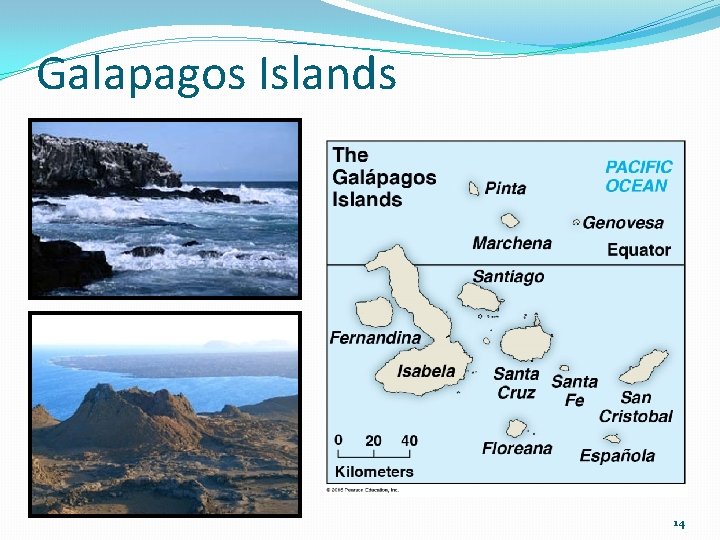
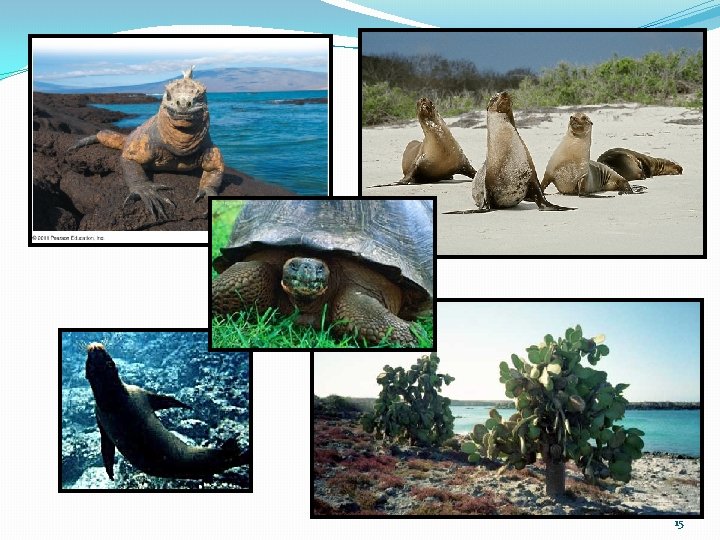
Charles Darwin (1809 -1882) English naturalist 1831: joined the HMS Beagle for a 5 -year research voyage around the world Collected and studied plant and animal specimens, bones, fossils Notable stop: Galapagos Islands
HMS Beagle (1831 -1836)
Galapagos Islands 14
15
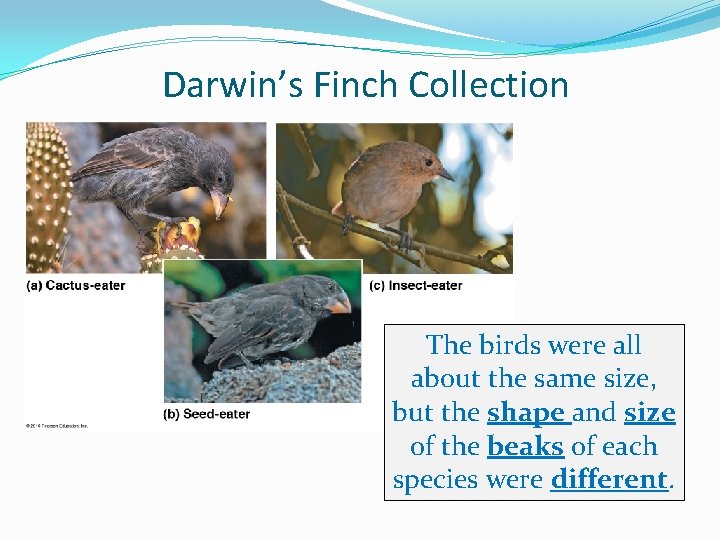
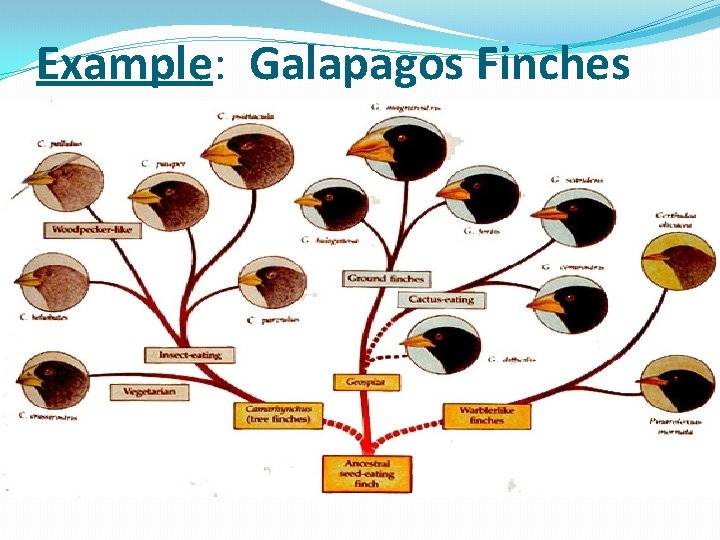
Darwin’s Finch Collection The birds were all about the same size, but the shape and size of the beaks of each species were different.
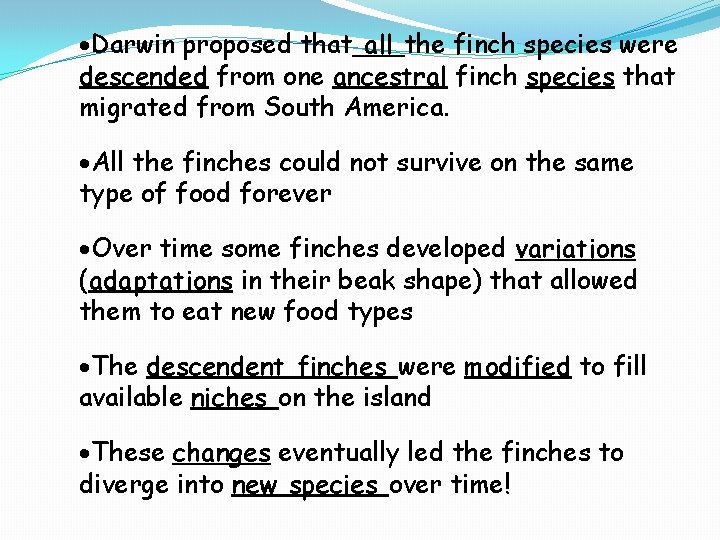
Darwin proposed that all the finch species were descended from one ancestral finch species that migrated from South America. All the finches could not survive on the same type of food forever Over time some finches developed variations (adaptations in their beak shape) that allowed them to eat new food types The descendent finches were modified to fill available niches on the island These changes eventually led the finches to diverge into new species over time!
Example: Galapagos Finches Darwin proposed that all the finch species were descended from one ancestral finch species that migrated from South America All the finches could not survive on the same type of food forever Over time some finches developed variations (adaptations in their beak shape) that allowed them to eat new food types The descendent finches were modified to fill available niches on the island These changes eventually led the finches to diverge into new species over time!
5 min https: //www. youtube. com/watch? v=MU 5 ze. BOq 8 k. M
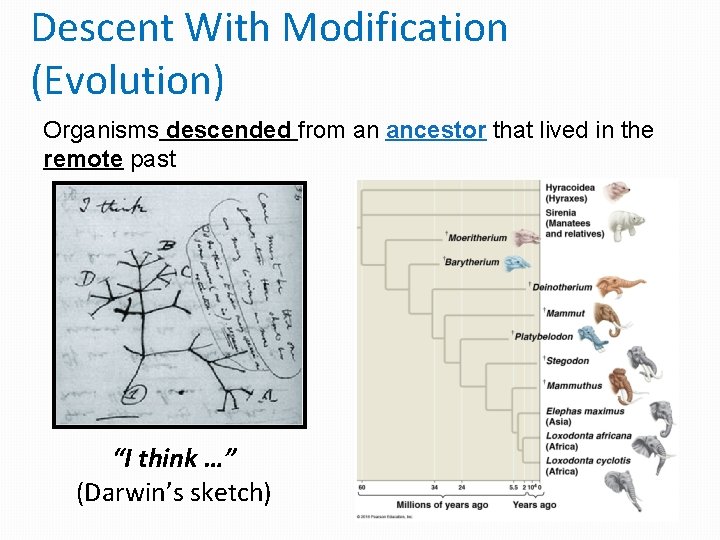
Descent With Modification (Evolution) Organisms descended from an ancestor that lived in the remote past “I think …” (Darwin’s sketch)
Darwin waited 30 years before publishing his ideas on evolution Alfred Russell Wallace – published paper on natural selection first (1858) Charles Darwin (1859): On the Origin of Species by Means of Natural Selection Mechanism for evolution is Natural Selection Darwin didn’t use “evolution”, but rather “descent with modification” 21
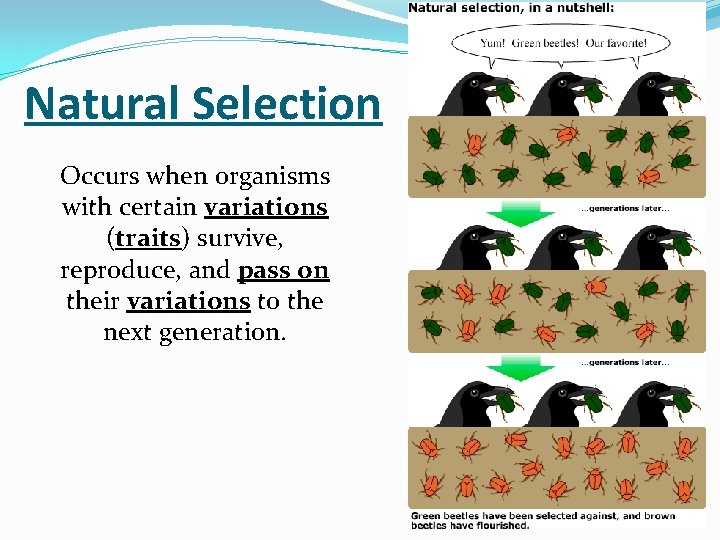
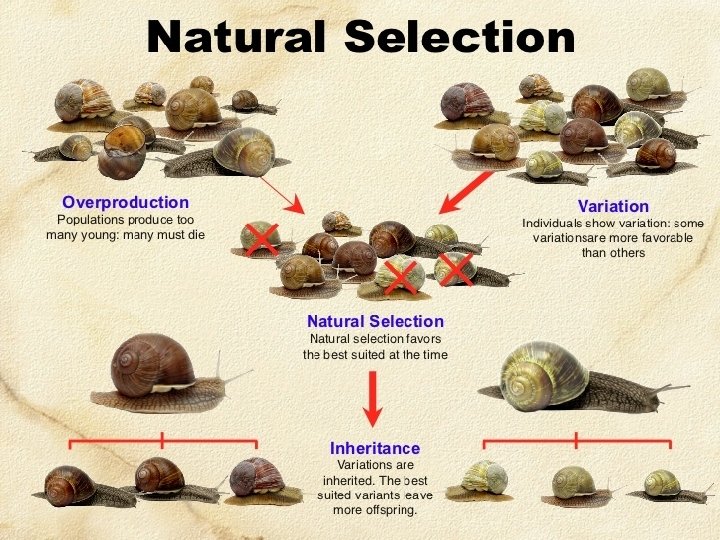
Natural Selection Occurs when organisms with certain variations (traits) survive, reproduce, and pass on their variations to the next generation.
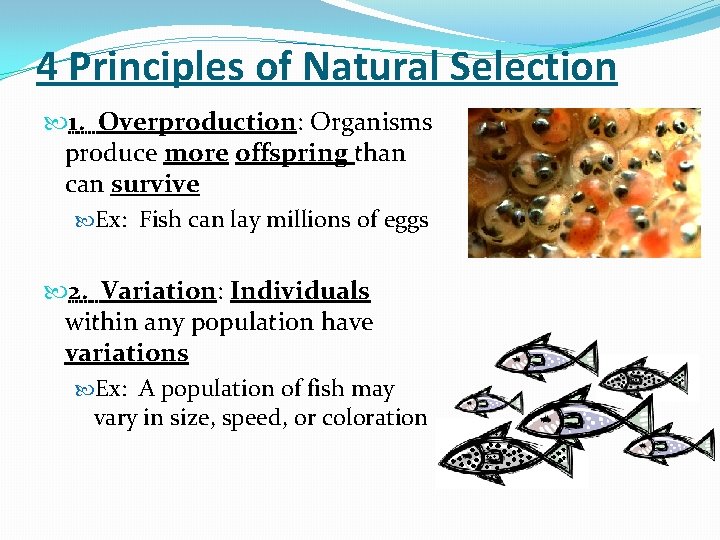
4 Principles of Natural Selection 1. Overproduction: Organisms produce more offspring than can survive Ex: Fish can lay millions of eggs 2. Variation: Individuals within any population have variations Ex: A population of fish may vary in size, speed, or coloration
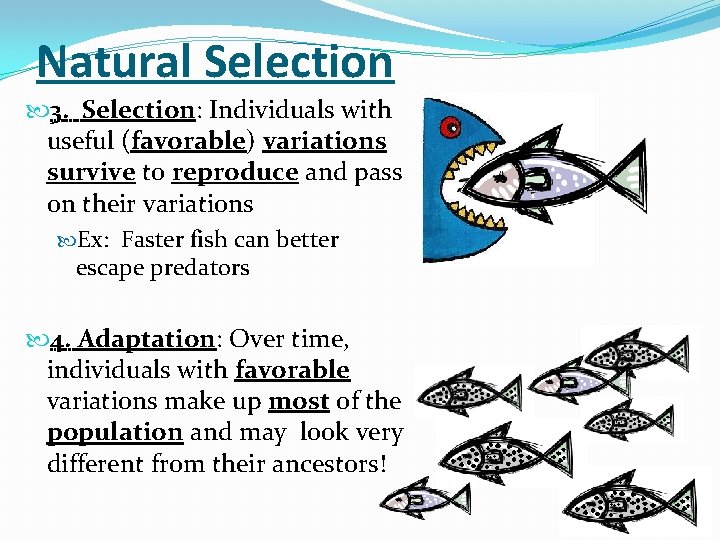
Natural Selection 3. Selection: Individuals with useful (favorable) variations survive to reproduce and pass on their variations Ex: Faster fish can better escape predators 4. Adaptation: Over time, individuals with favorable variations make up most of the population and may look very different from their ancestors!
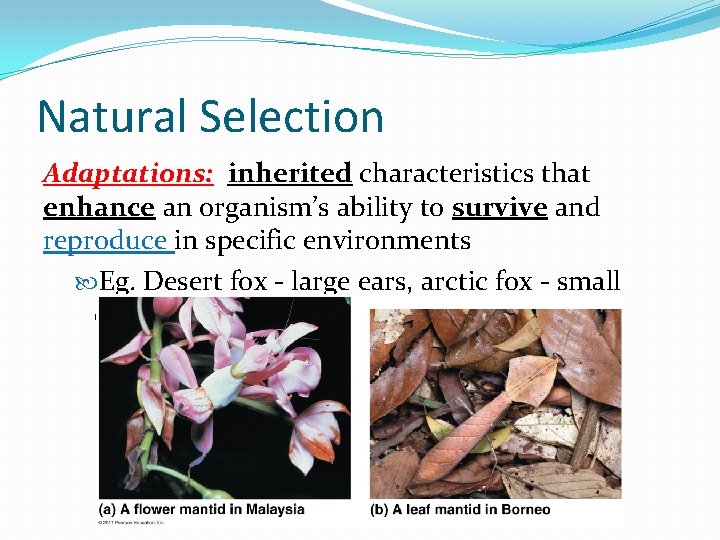
Natural Selection Adaptations: inherited characteristics that enhance an organism’s ability to survive and reproduce in specific environments Eg. Desert fox - large ears, arctic fox - small ears
Rock Pocket Mice with WS (10 min) https: //www. hhmi. org/biointeractive/making-fittestnatural-selection-and-adaptation
PBS: What Darwin Never Knew https: //www. youtube. com/watch ? v=Mwwska. Z 6 ql. M Video Clip: 20: 18 – 31: 27