Chapter 10 and 11 Notes Work Energy and


- Slides: 25
Chapter 10 and 11 Notes Work, Energy, and Simple Machines
10. 1 and 11. 1 Objectives • Recognize the relationship between work and energy. • Calculate work and power. • Calculate kinetic energy. • Recognize the relationship between position and potential energy. • Calculate gravitational and elastic potential energy.
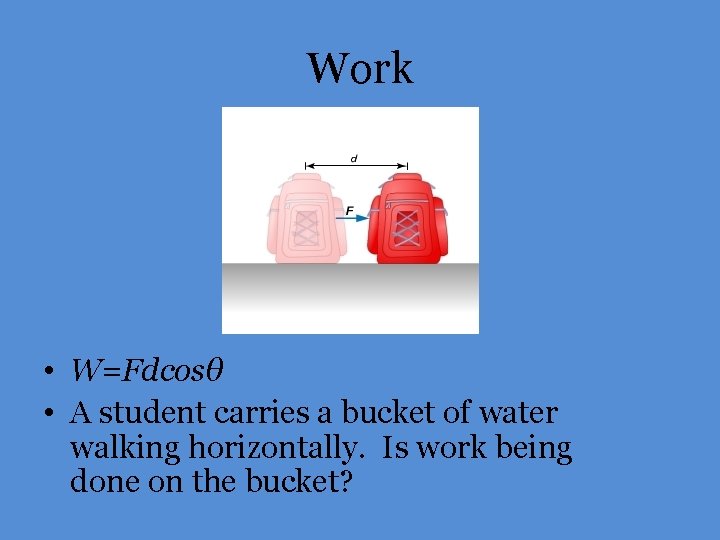
Work • W=Fdcosθ • A student carries a bucket of water walking horizontally. Is work being done on the bucket?
Example Problems • Will work have a positive or negative value for the following situations? – The road exerts a friction force on a speeding car skidding to a stop. – A rope exerts a force on a bucket as the bucket is raised up a well. – Air exerts a force on a parachute as the parachutist falls to Earth.
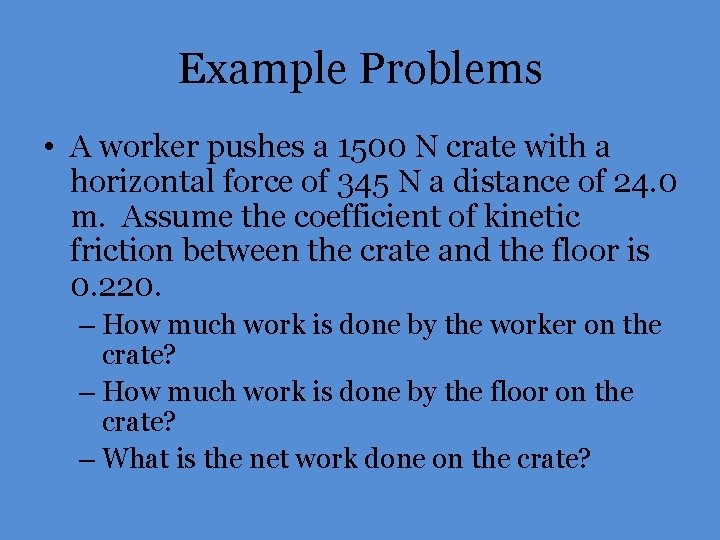
Example Problems • A worker pushes a 1500 N crate with a horizontal force of 345 N a distance of 24. 0 m. Assume the coefficient of kinetic friction between the crate and the floor is 0. 220. – How much work is done by the worker on the crate? – How much work is done by the floor on the crate? – What is the net work done on the crate?
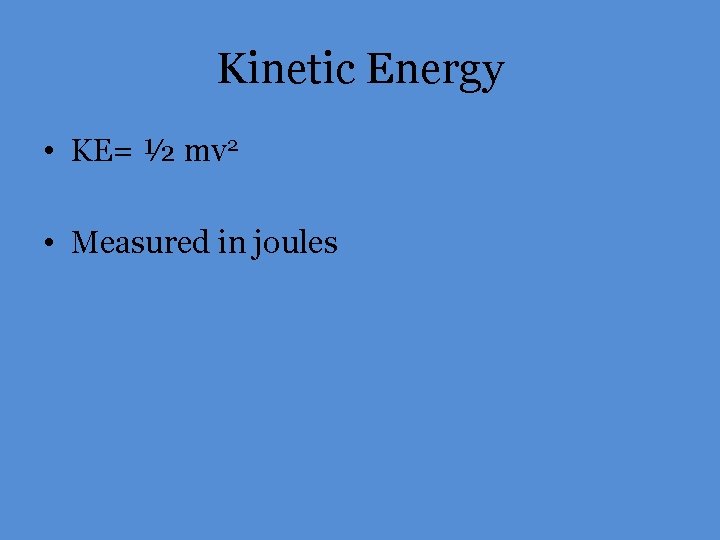
Kinetic Energy • KE= ½ mv 2 • Measured in joules
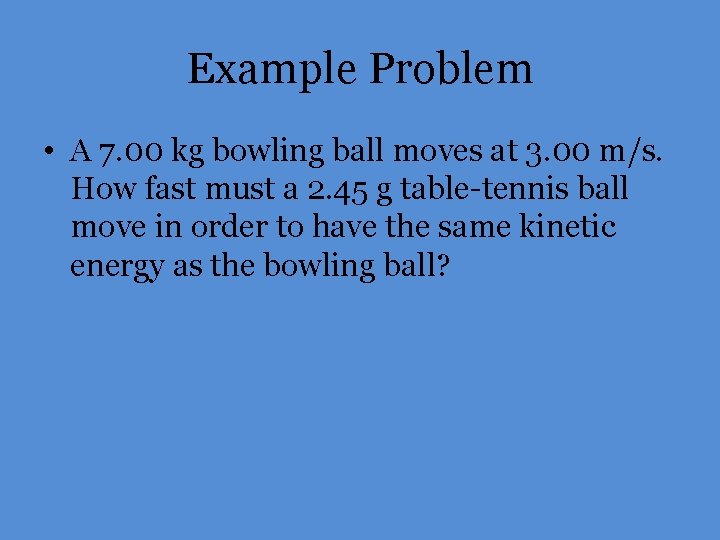
Example Problem • A 7. 00 kg bowling ball moves at 3. 00 m/s. How fast must a 2. 45 g table-tennis ball move in order to have the same kinetic energy as the bowling ball?
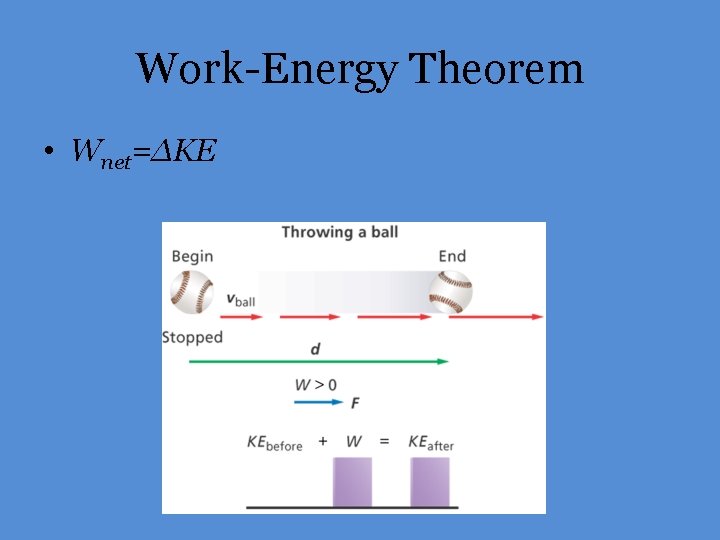
Work-Energy Theorem • Wnet=ΔKE
Practice Problems • A student wearing frictionless in-line skates on a horizontal surface is pushed by a friend with a constant force of 45 N. How far must the student be pushed, starting from rest, so that her final kinetic energy is 352 J? • On a frozen pond, a person kicks a 10. 0 kg sled, giving it an initial speed of 2. 2 m/s. How far does the sled move if the coefficient of kinetic friction between the sled and the ice is 0. 10?
Potential Energy • Gravitational Potential Energy – PEg = mgh
Practice Problem • A spoon is raised 21. 0 cm above a table. If the spoon and its contents have a mass of 30. 0 g, what is the gravitational potential energy associated with the spoon at that height relative to the surface of the table?
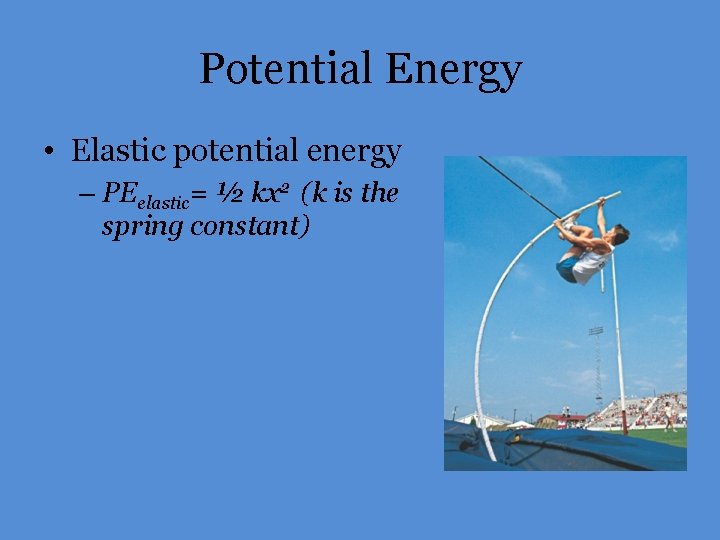
Potential Energy • Elastic potential energy – PEelastic= ½ kx 2 (k is the spring constant)
Practice Problem • A spring with a force constant of 5. 2 N/m has a relaxed length of 2. 45 m. When a mass is attached to the end of the spring and allowed to come to rest, the vertical length of the spring is 3. 57 m. Calculate the elastic potential energy stored in the spring.
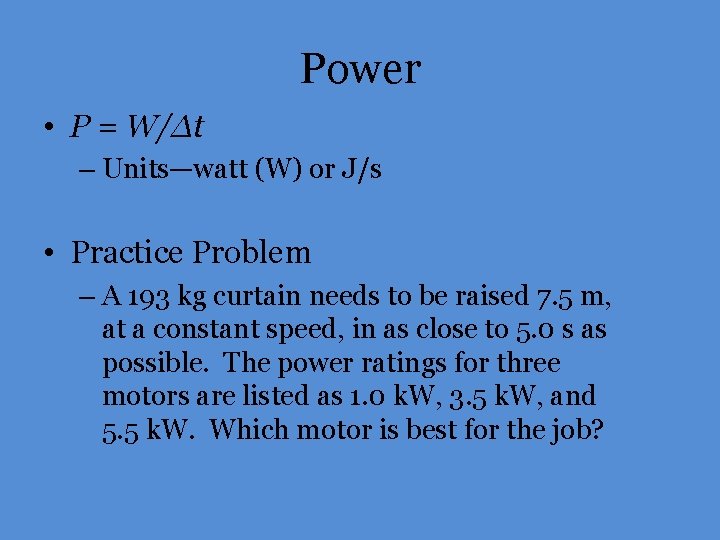
Power • P = W/Δt – Units—watt (W) or J/s • Practice Problem – A 193 kg curtain needs to be raised 7. 5 m, at a constant speed, in as close to 5. 0 s as possible. The power ratings for three motors are listed as 1. 0 k. W, 3. 5 k. W, and 5. 5 k. W. Which motor is best for the job?
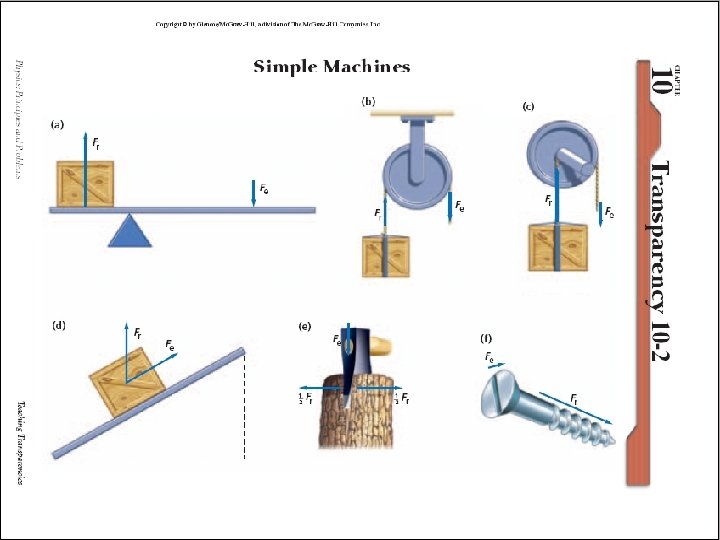
Benefits of Machines
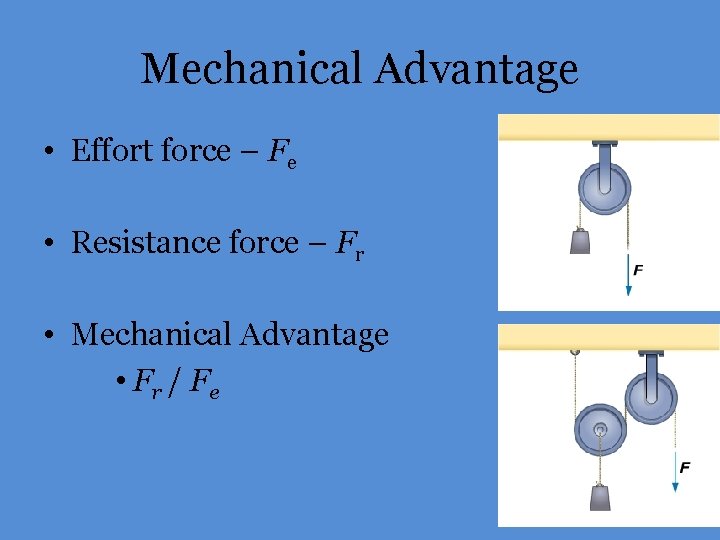
Mechanical Advantage • Effort force – Fe • Resistance force – Fr • Mechanical Advantage • Fr / Fe
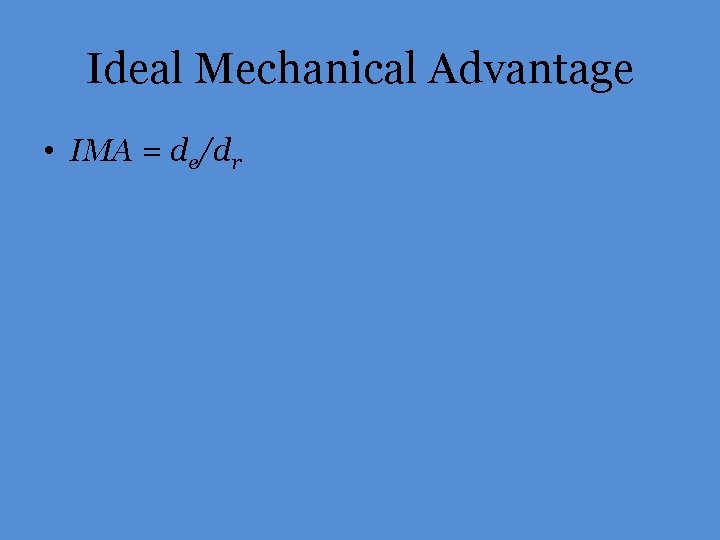
Ideal Mechanical Advantage • IMA = de/dr
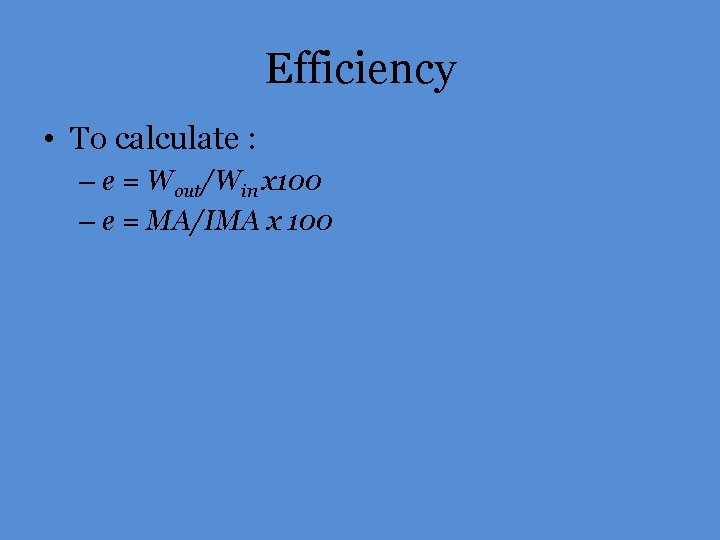
Efficiency • To calculate : – e = Wout/Win x 100 – e = MA/IMA x 100
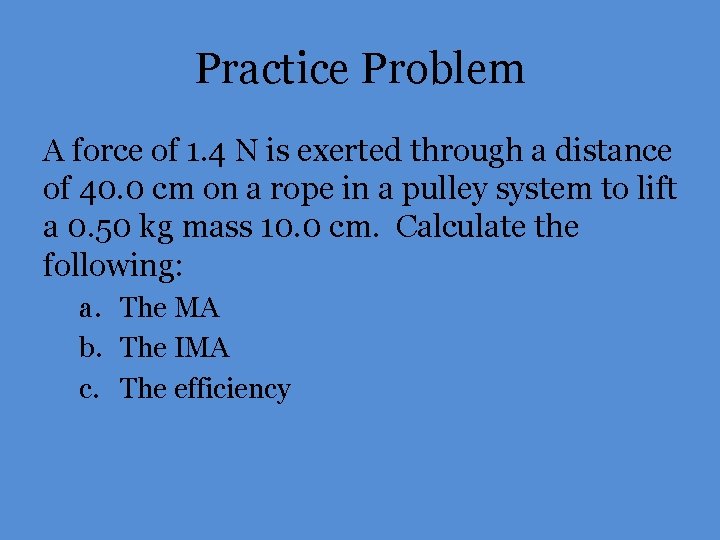
Practice Problem A force of 1. 4 N is exerted through a distance of 40. 0 cm on a rope in a pulley system to lift a 0. 50 kg mass 10. 0 cm. Calculate the following: a. The MA b. The IMA c. The efficiency
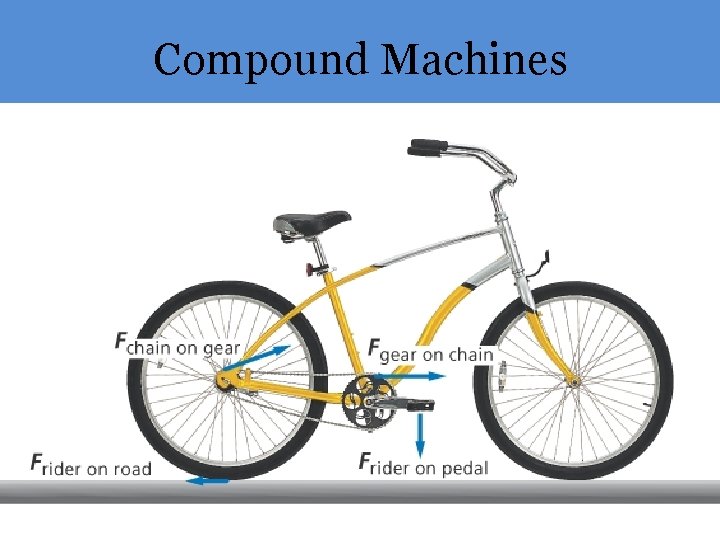
Compound Machines
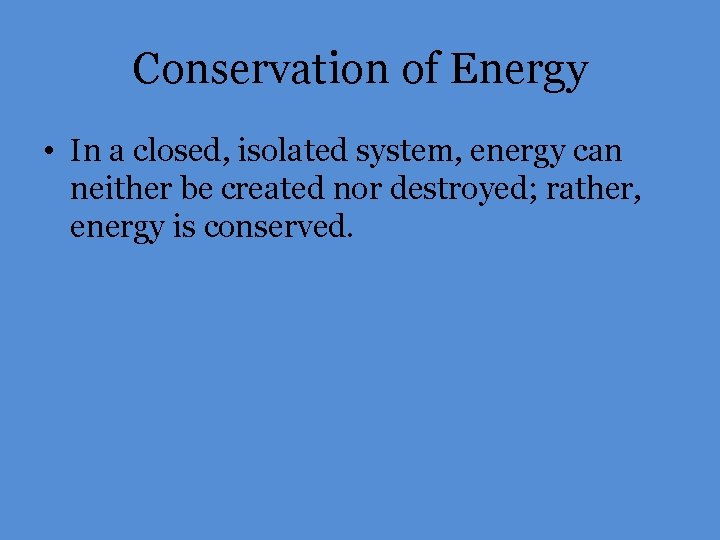
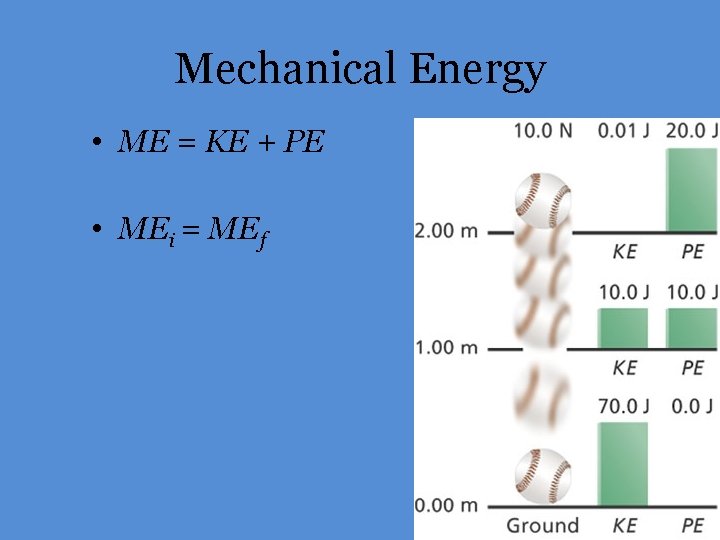
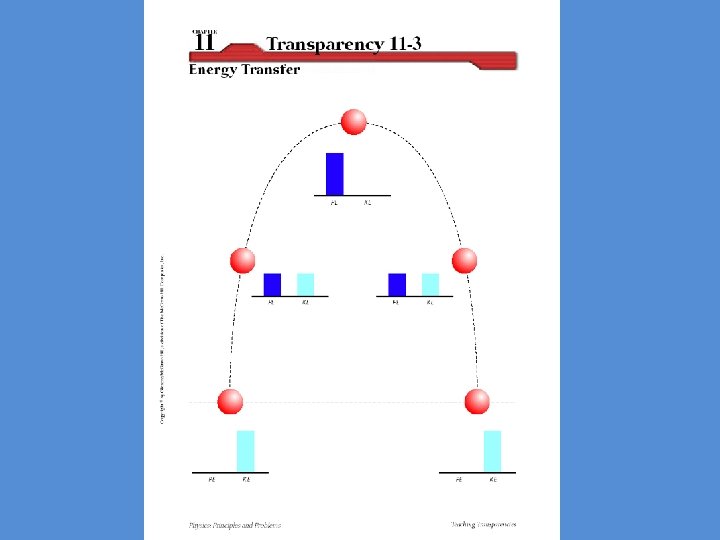
Conservation of Energy • In a closed, isolated system, energy can neither be created nor destroyed; rather, energy is conserved.
Mechanical Energy • ME = KE + PE • MEi = MEf
Practice Problem Starting from rest, a child zooms down a frictionless slide from an initial height of 3. 00 m. What is her speed at the bottom of the slide? Assume she has a mass of 25. 0 kg.