Chapter 1 The Relationship of Nutrition and Health













- Slides: 37
Chapter 1 The Relationship of Nutrition and Health Copyright © 2011 Delmar, Cengage Learning. ALL RIGHTS RESERVED.
Objectives • Name six classes of nutrients and their primary functions • Recognize common characteristics of wellnourished people • Recognize symptoms of malnutrition Copyright © 2011 Delmar, Cengage Learning. ALL RIGHTS RESERVED. (continues)
Objectives • Describe ways in which nutrition and health are related • List four basic steps in nutrition assessment Copyright © 2011 Delmar, Cengage Learning. ALL RIGHTS RESERVED.
Nutrients • Chemical substances necessary for life • Functions: – Provide energy – Build and repair tissue – Regulate body processes • Circulation, respiration, digestion, and elimination Copyright © 2011 Delmar, Cengage Learning. ALL RIGHTS RESERVED. (continues)
Nutrients • Six classes: 1. 2. 3. 4. 5. 6. Carbohydrates (CHO) Fats (lipids) Proteins Vitamins Minerals Water Copyright © 2011 Delmar, Cengage Learning. ALL RIGHTS RESERVED. (continues)
Nutrients • No nutrient can work alone • Essential nutrients – Found only in foods • Organic nutrients – Must be broken down to be used by body • Inorganic nutrients – Already in their smallest components Copyright © 2011 Delmar, Cengage Learning. ALL RIGHTS RESERVED.
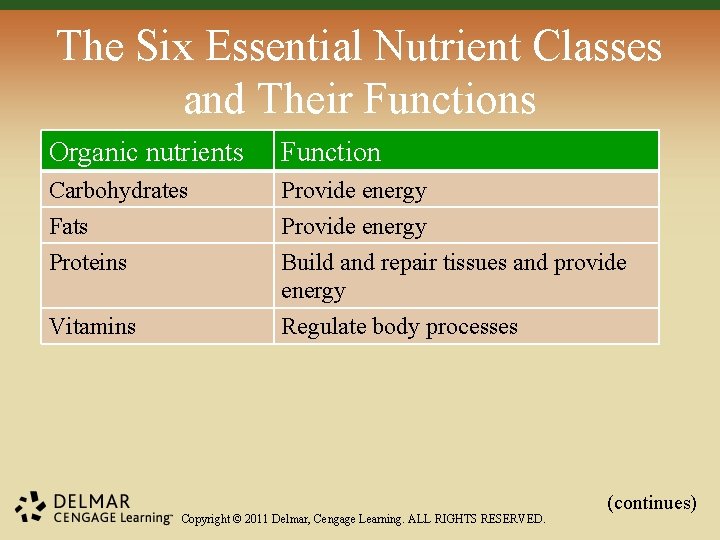
The Six Essential Nutrient Classes and Their Functions Organic nutrients Function Carbohydrates Fats Proteins Provide energy Build and repair tissues and provide energy Vitamins Regulate body processes Copyright © 2011 Delmar, Cengage Learning. ALL RIGHTS RESERVED. (continues)
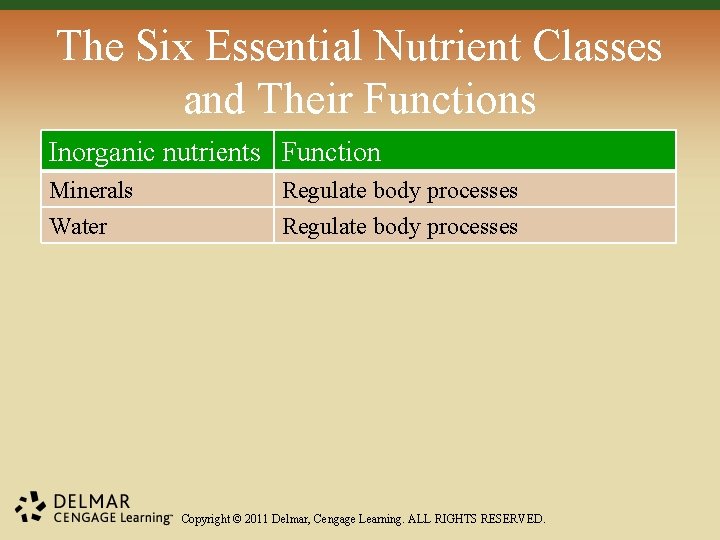
The Six Essential Nutrient Classes and Their Functions Inorganic nutrients Function Minerals Water Regulate body processes Copyright © 2011 Delmar, Cengage Learning. ALL RIGHTS RESERVED.
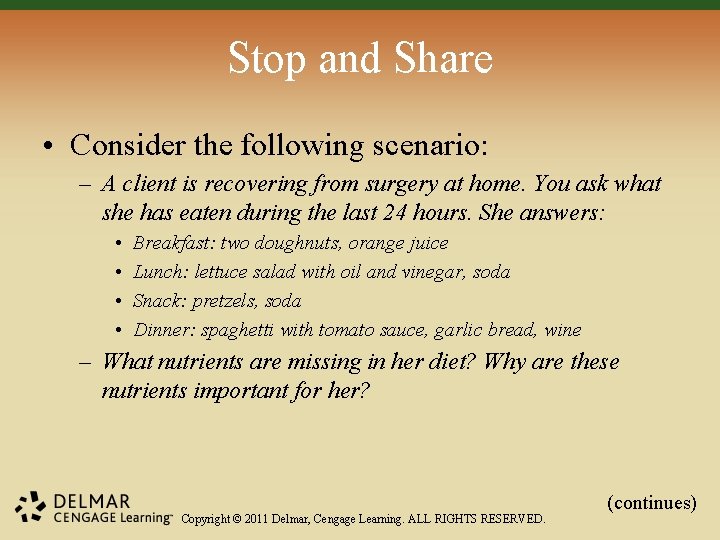
Stop and Share • Consider the following scenario: – A client is recovering from surgery at home. You ask what she has eaten during the last 24 hours. She answers: • • Breakfast: two doughnuts, orange juice Lunch: lettuce salad with oil and vinegar, soda Snack: pretzels, soda Dinner: spaghetti with tomato sauce, garlic bread, wine – What nutrients are missing in her diet? Why are these nutrients important for her? Copyright © 2011 Delmar, Cengage Learning. ALL RIGHTS RESERVED. (continues)
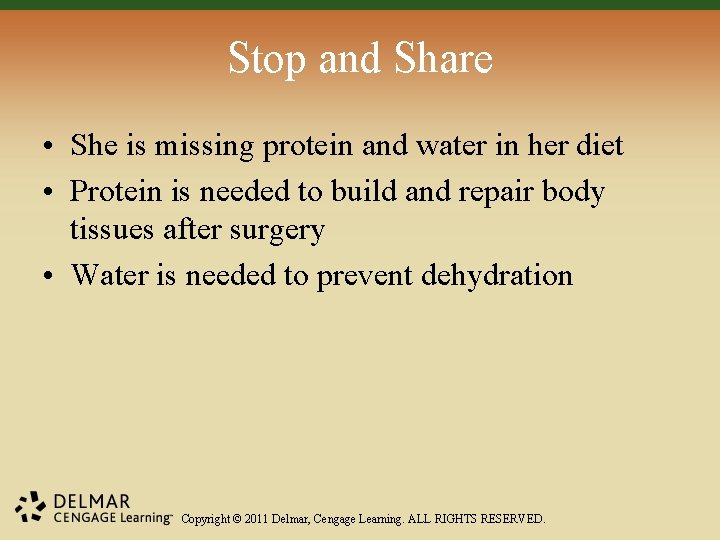
Stop and Share • She is missing protein and water in her diet • Protein is needed to build and repair body tissues after surgery • Water is needed to prevent dehydration Copyright © 2011 Delmar, Cengage Learning. ALL RIGHTS RESERVED.
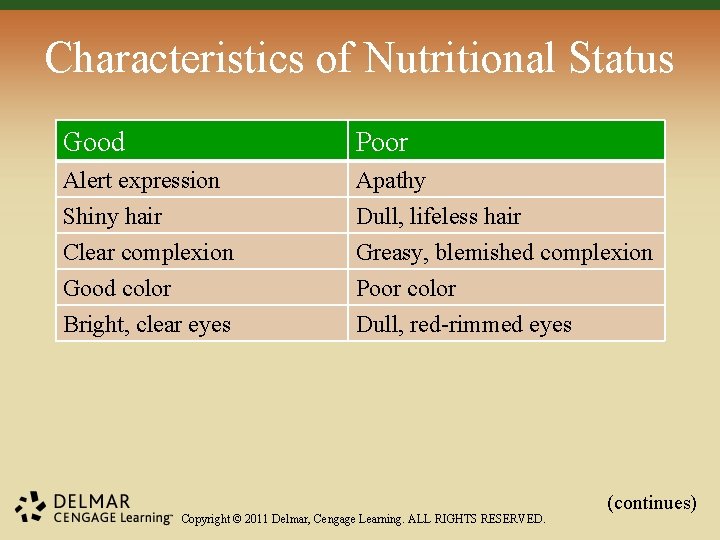
Characteristics of Nutritional Status Good Poor Alert expression Shiny hair Clear complexion Good color Bright, clear eyes Apathy Dull, lifeless hair Greasy, blemished complexion Poor color Dull, red-rimmed eyes Copyright © 2011 Delmar, Cengage Learning. ALL RIGHTS RESERVED. (continues)
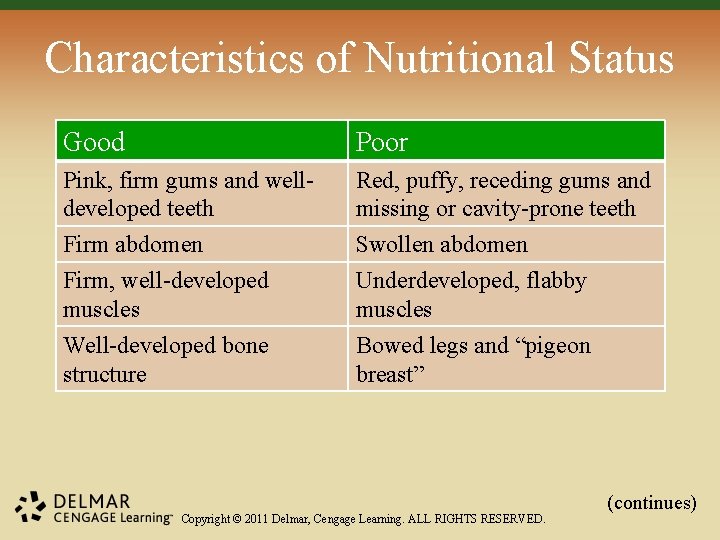
Characteristics of Nutritional Status Good Poor Pink, firm gums and welldeveloped teeth Red, puffy, receding gums and missing or cavity-prone teeth Firm abdomen Swollen abdomen Firm, well-developed muscles Well-developed bone structure Underdeveloped, flabby muscles Bowed legs and “pigeon breast” Copyright © 2011 Delmar, Cengage Learning. ALL RIGHTS RESERVED. (continues)
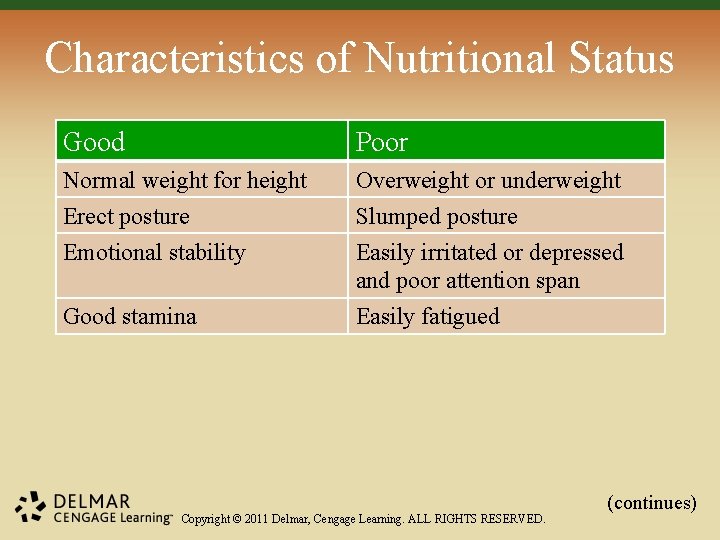
Characteristics of Nutritional Status Good Poor Normal weight for height Erect posture Emotional stability Overweight or underweight Slumped posture Easily irritated or depressed and poor attention span Good stamina Easily fatigued Copyright © 2011 Delmar, Cengage Learning. ALL RIGHTS RESERVED. (continues)
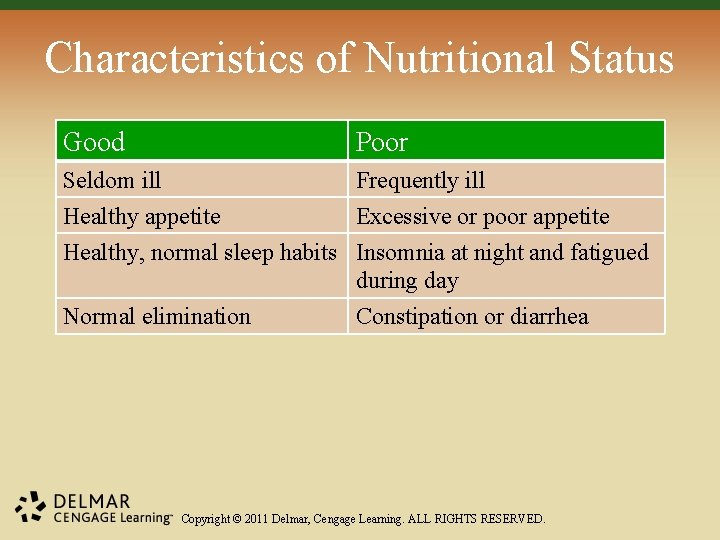
Characteristics of Nutritional Status Good Poor Seldom ill Frequently ill Healthy appetite Excessive or poor appetite Healthy, normal sleep habits Insomnia at night and fatigued during day Normal elimination Constipation or diarrhea Copyright © 2011 Delmar, Cengage Learning. ALL RIGHTS RESERVED.
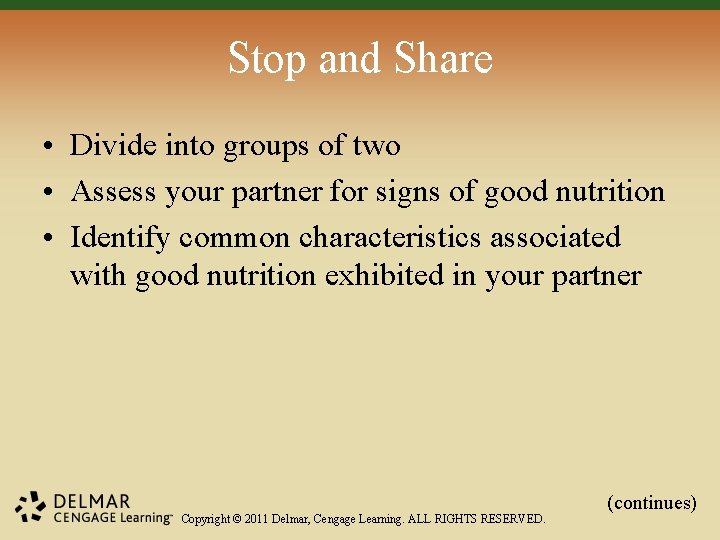
Stop and Share • Divide into groups of two • Assess your partner for signs of good nutrition • Identify common characteristics associated with good nutrition exhibited in your partner Copyright © 2011 Delmar, Cengage Learning. ALL RIGHTS RESERVED. (continues)
Stop and Share • • • Shiny hair Clear skin Clear eyes Erect posture Alertness • Firm flesh on welldeveloped bone structures • Pink gums and welldeveloped teeth • Normal weight for height Copyright © 2011 Delmar, Cengage Learning. ALL RIGHTS RESERVED.
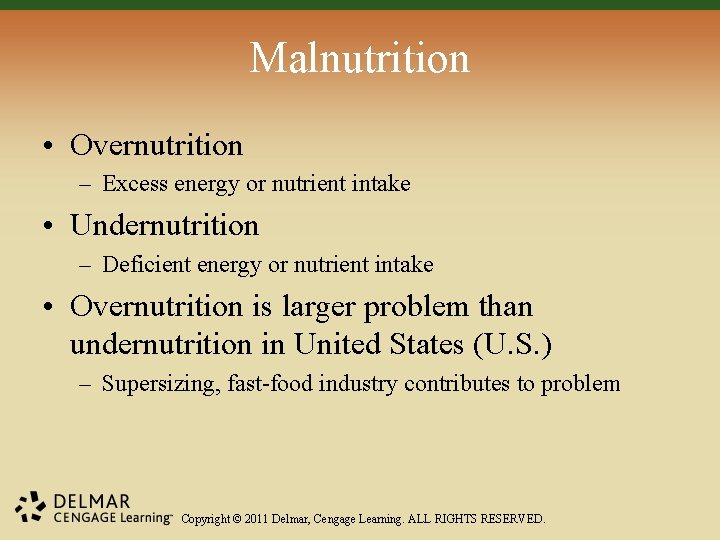
Malnutrition • Overnutrition – Excess energy or nutrient intake • Undernutrition – Deficient energy or nutrient intake • Overnutrition is larger problem than undernutrition in United States (U. S. ) – Supersizing, fast-food industry contributes to problem Copyright © 2011 Delmar, Cengage Learning. ALL RIGHTS RESERVED.
Supersize USA: The Fattest Cities in the U. S. 1. 2. 3. 4. 5. Miami, FL Oklahoma City, OK San Antonio, TX Las Vegas, NV New York, NY 6. Houston, TX 7. El Paso, TX 8. Jacksonville, FL 9. Charlotte, NC 10. Louisville-Jefferson, KY Copyright © 2011 Delmar, Cengage Learning. ALL RIGHTS RESERVED.
Cumulative Effects of Nutrition • Excesses – Excess nutrients over time – E. g. , atherosclerosis, obesity, hypertension, diabetes, gallbladder disease, some cancers • Deficiencies – Nutrients lacking for extended period – E. g. , iron deficiency, beri, scurvy, osteomalacia, osteoporosis, rickets, goiter Copyright © 2011 Delmar, Cengage Learning. ALL RIGHTS RESERVED.
Nutrient Deficiency • Primary – Inadequate dietary intake • Secondary – Due to causes other than dietary intake • Both can result in malnutrition Copyright © 2011 Delmar, Cengage Learning. ALL RIGHTS RESERVED.
Deficiency Diseases Deficiency disease Nutrients lacking Iron-deficiency anemia Beriberi Night blindness Goiter Kwashiorkor Iron Thiamin Vitamin A Iodine Protein Copyright © 2011 Delmar, Cengage Learning. ALL RIGHTS RESERVED. (continues)
Deficiency Diseases Deficiency disease Nutrients lacking Marasmus Osteomalacia All nutrients Calcium, vitamin D, phosphorus, magnesium, and fluoride Calcium and vitamin D Osteoporosis Copyright © 2011 Delmar, Cengage Learning. ALL RIGHTS RESERVED. (continues)
Deficiency Diseases Deficiency disease Nutrients lacking Pellagra Rickets Scurvy Xerophthalmia Niacin Calcium and vitamin D Vitamin C Vitamin A Copyright © 2011 Delmar, Cengage Learning. ALL RIGHTS RESERVED.
Nutritional Assessment • • Anthropometric measurements Clinical examination Biochemical tests Dietary and social history Copyright © 2011 Delmar, Cengage Learning. ALL RIGHTS RESERVED.
Anthropometric Measurements • Height • Weight • Head, chest, and abdominal circumference – For children • Upper arm measurement • Skinfold measurement with caliper Copyright © 2011 Delmar, Cengage Learning. ALL RIGHTS RESERVED.
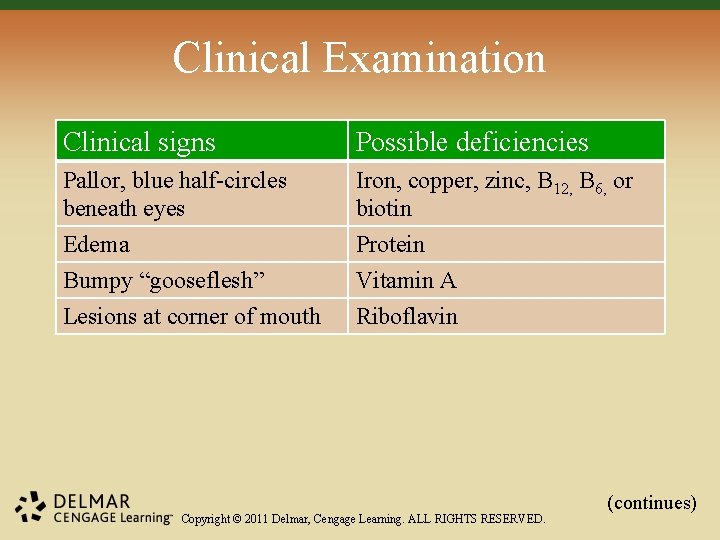
Clinical Examination Clinical signs Possible deficiencies Pallor, blue half-circles beneath eyes Iron, copper, zinc, B 12, B 6, or biotin Edema Protein Bumpy “gooseflesh” Lesions at corner of mouth Vitamin A Riboflavin Copyright © 2011 Delmar, Cengage Learning. ALL RIGHTS RESERVED. (continues)
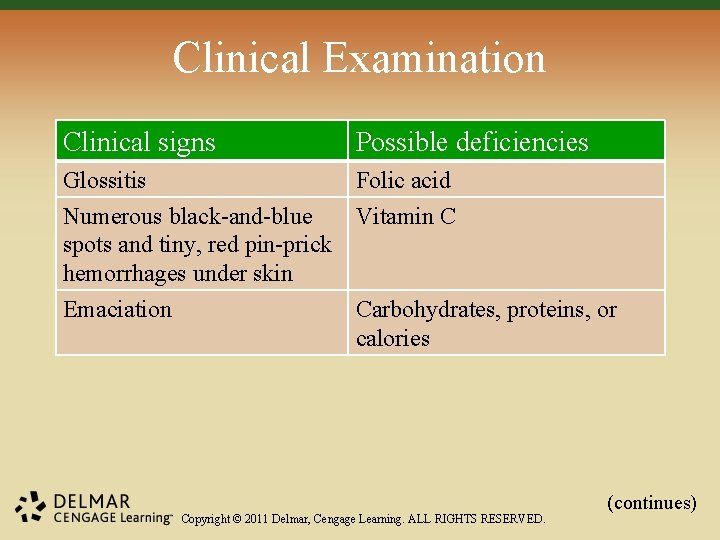
Clinical Examination Clinical signs Possible deficiencies Glossitis Folic acid Numerous black-and-blue Vitamin C spots and tiny, red pin-prick hemorrhages under skin Emaciation Carbohydrates, proteins, or calories Copyright © 2011 Delmar, Cengage Learning. ALL RIGHTS RESERVED. (continues)
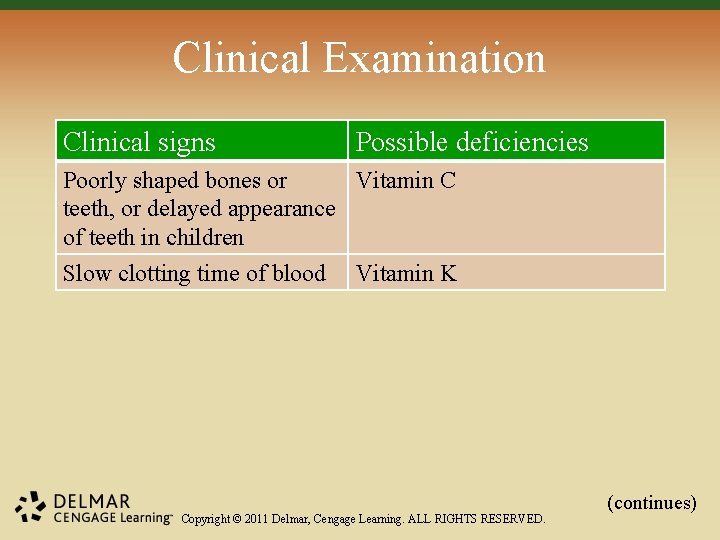
Clinical Examination Clinical signs Possible deficiencies Poorly shaped bones or Vitamin C teeth, or delayed appearance of teeth in children Slow clotting time of blood Vitamin K Copyright © 2011 Delmar, Cengage Learning. ALL RIGHTS RESERVED. (continues)
Clinical Examination Clinical signs Possible deficiencies Unusual nervousness, dermatitis, and diarrhea in same client Tetany Goiter Eczema Niacin Calcium, potassium, or sodium Iodine Fat Copyright © 2011 Delmar, Cengage Learning. ALL RIGHTS RESERVED.
Biochemical Tests • Serum albumin level – Measures main protein in blood – Determines protein status • Serum transferrin level – Indicates iron-carrying protein in blood – indicates iron stores low – indicates body lacks protein Copyright © 2011 Delmar, Cengage Learning. ALL RIGHTS RESERVED. (continues)
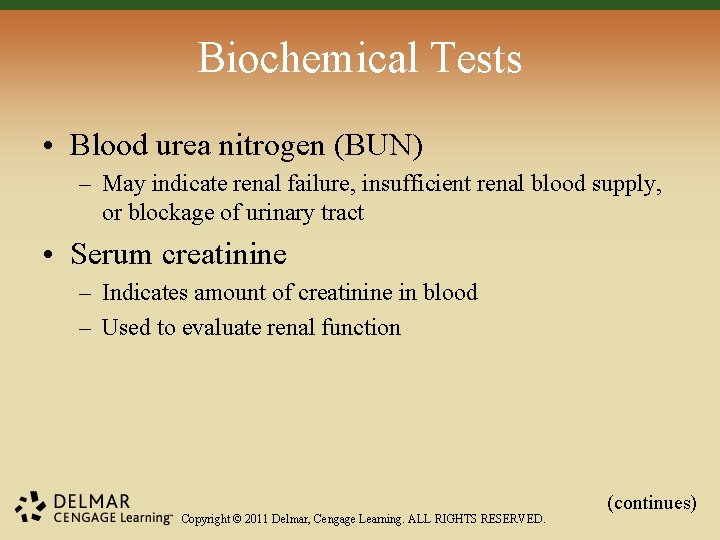
Biochemical Tests • Blood urea nitrogen (BUN) – May indicate renal failure, insufficient renal blood supply, or blockage of urinary tract • Serum creatinine – Indicates amount of creatinine in blood – Used to evaluate renal function Copyright © 2011 Delmar, Cengage Learning. ALL RIGHTS RESERVED. (continues)
Biochemical Tests • Creatinine excretion – Indicates amount of creatinine excreted in urine during 24 hour period – Used in estimating body muscle mass – Muscle mass depleted, as in malnutrition • Level will be low Copyright © 2011 Delmar, Cengage Learning. ALL RIGHTS RESERVED. (continues)
Biochemical Tests • Other tests – – Hemoglobin (Hgb) Hematocrit (Hct) Red blood cells (RBCs) White blood cells (WBCs) Copyright © 2011 Delmar, Cengage Learning. ALL RIGHTS RESERVED. (continues)
Biochemical Tests • Other tests – Lipid profile • High- and low-density lipoprotein • Serum triglycerides – Urinalysis Copyright © 2011 Delmar, Cengage Learning. ALL RIGHTS RESERVED.
Dietary and Social History • Evaluation of food habits – 24 -hour recall • Types, amounts, and preparation of all foods eaten in last 24 hours – Food diary • Written record of all food and drink ingested in specified period – Computer diet analysis • Determines nutrient deficiencies or toxicities Copyright © 2011 Delmar, Cengage Learning. ALL RIGHTS RESERVED. (continues)
Dietary and Social History • Social history – Consideration of financial resources to do the following: • Obtain needed food • Properly store and cook food – Food-drug interactions that can lead to malnutrition Copyright © 2011 Delmar, Cengage Learning. ALL RIGHTS RESERVED.
Conclusion • Nutrition and health directly related • Effects of poor nutrition cumulative • Six essential nutrient classes: – Carbohydrates, fats, proteins, minerals, vitamins, and water • Nutritional assessment – Best way to determine deficiencies that can result from lack of nutrients Copyright © 2011 Delmar, Cengage Learning. ALL RIGHTS RESERVED.