Carolyn Shread Mount Holyoke College NEH Summer Institute




- Slides: 28
Carolyn Shread (Mount Holyoke College) NEH Summer Institute “What is Gained in Translation? ” 25 June 2015
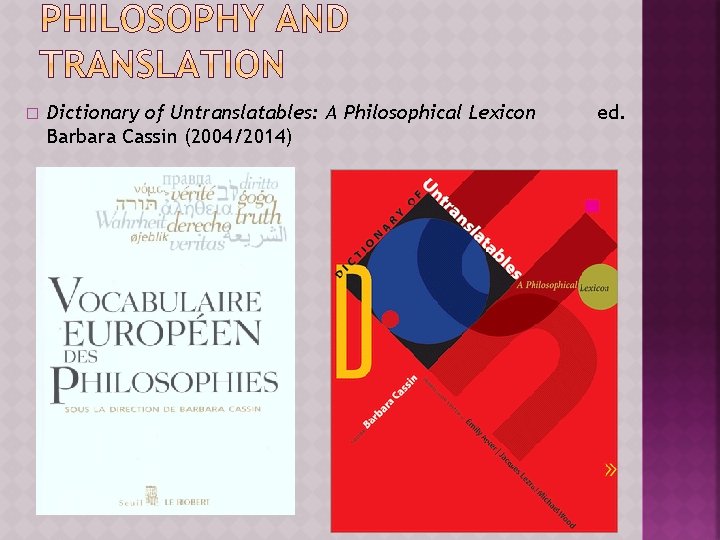
� Dictionary of Untranslatables: A Philosophical Lexicon Barbara Cassin (2004/2014) ed.
� The Routledge Handbook of Translation Studies and Philosophy, eds. Piers Rawling & Philip Wilson � “Translating � All Feminist Philosophers” suggestions/references most welcome! Email: cshread@mtholyoke. edu
� To take the case study of the translation of Catherine Malabou’s works into English � What do we learn about the circulation of philosophical ideas via translation?
� Contemporary French philosopher � Paris-Nanterre, France 2011 Kingston University, UK � Writes mainly in French, one co-authored book in English � Translated into at least 9 languages: English, Spanish, German, Italian, Dutch, Japanese, Portuguese, Dutch and Turkish.
� Key concept: “plasticity” (cf Hegel) to replace philosophies of difference (countering Derrida) � Draws from neuroscience (neuroplasticity) and biological sciences (beyond genetics to epigenetics) �I propose that the form of writing that is translation exemplifies plasticity.
� Who � 6 translates Catherine Malabou into English? translators for 9 books translated into English � First gain in translation: multiple voices !
� Serial versus simultaneous translators � 9 translations published 2004 -2015 of texts written 1996 -2014 � Translation � Not 2 -8 years after French publication so much “new, updated translation” as a team working in parallel to keep up with the prolific author!
� Academics in the US – varying nationalities/status � Various disciplines: Lisabeth During: Social Science & Cultural Studies Peter Skafish: Philosophical Anthropology Sebastian Rand: Philosophy Steven Miller: English David Wills & Carolyn Shread: French � Presses: Stanford Univ. ; Routledge; SUNY; Fordham; Columbia; Polity (3) � Funding: French Ministry of Culture – National Center for the Book (Stanford, Polity) & French publisher, Léo Schéer
� Cover acknowledgment � Translator’s preface � Footnotes & references – philosophy conventions & the labor of the translator � Secondary literature – surplus of academic labor beyond the “work for hire” translator contract
� Counterpath: (1999/2004) Traveling with Jacques Derrida
� Cover – Wills, translator of Derrida � One paragraph Translator’s Note explaining neologism of the title: Contre-allée/Counterpath “which refers to a sideroad, service or access road, or “alley” that runs alongside a main thoroughfare, such as one finds providing access to the buildings lining the boulevards of French cities…” � D. W. makes 9 interventions in footnotes: “Translations from the cited English versions of Derrida’s works have at times been modified, often to emphasize the sense of the French original developed in Malabou’s discussion […]” Often comments on “sentences missing in the English version”
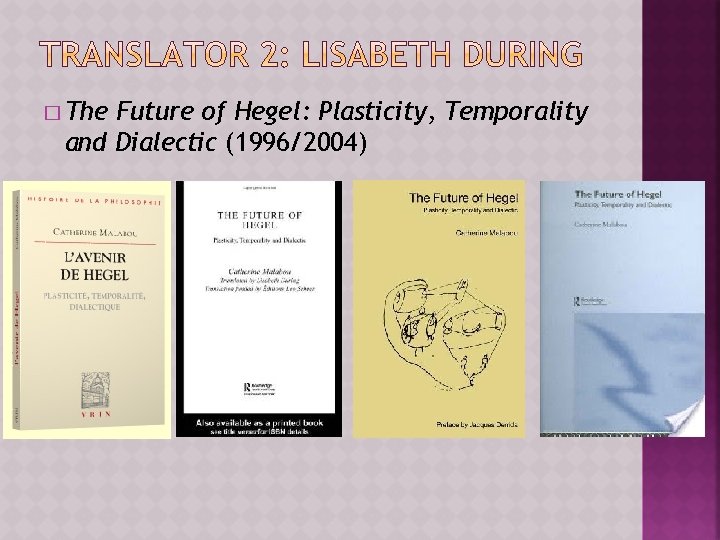
� The Future of Hegel: Plasticity, Temporality and Dialectic (1996/2004)
� Instability � Derrida’s of early publication preface but no Translator’s Note � Translator/explicator: “Catherine Malabou and the Currency of Hegelianism” Hypatia (2000)
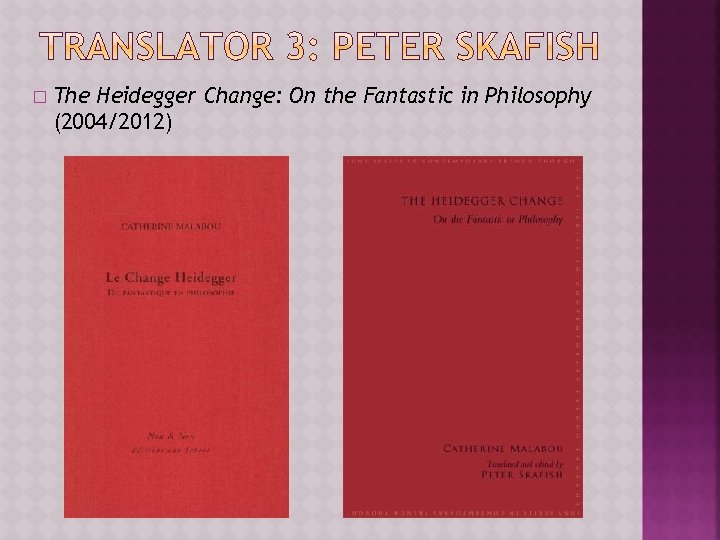
� The Heidegger Change: On the Fantastic in Philosophy (2004/2012)
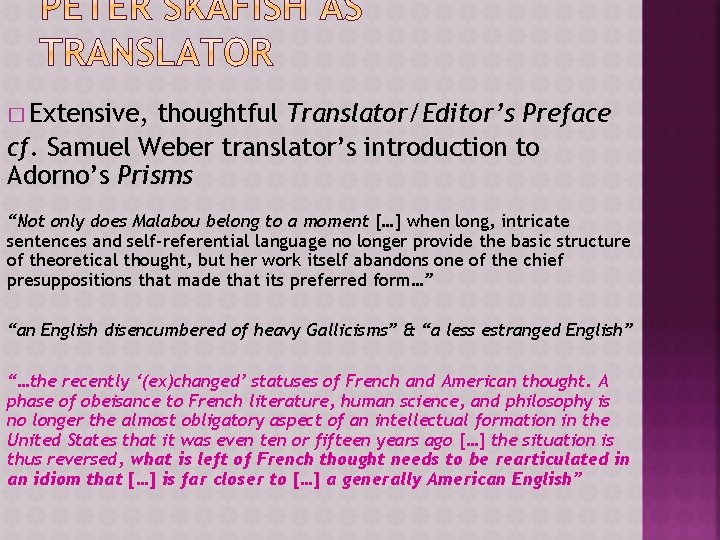
� Extensive, thoughtful Translator/Editor’s Preface cf. Samuel Weber translator’s introduction to Adorno’s Prisms “Not only does Malabou belong to a moment […] when long, intricate sentences and self-referential language no longer provide the basic structure of theoretical thought, but her work itself abandons one of the chief presuppositions that made that its preferred form…” “an English disencumbered of heavy Gallicisms” & “a less estranged English” “…the recently ‘(ex)changed’ statuses of French and American thought. A phase of obeisance to French literature, human science, and philosophy is no longer the almost obligatory aspect of an intellectual formation in the United States that it was even ten or fifteen years ago […] the situation is thus reversed, what is left of French thought needs to be rearticulated in an idiom that […] is far closer to […] a generally American English”
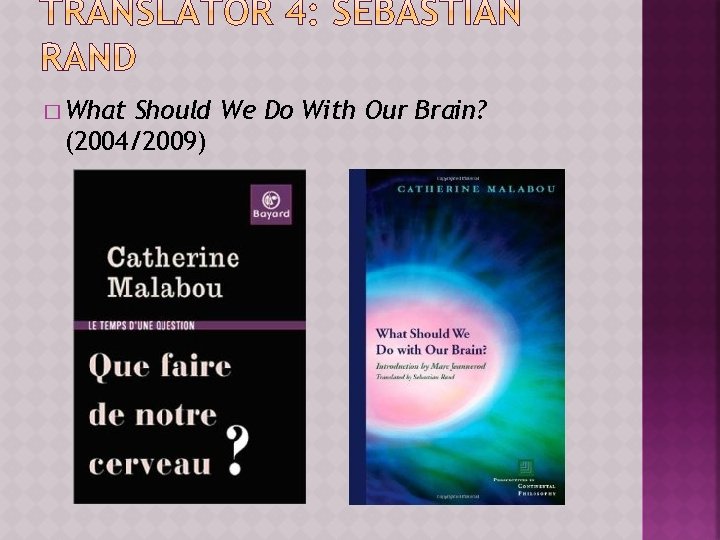
� What Should We Do With Our Brain? (2004/2009)
� Foreword by neuroscientist Marc Jeannerod � Brief Translator’s Note – thanks + circuit of prestige (Sam Weber) � 7 interventions in footnotes to clarify French e. g. connotations of “plastiquage” in French not evident in the English term “plastic explosive”
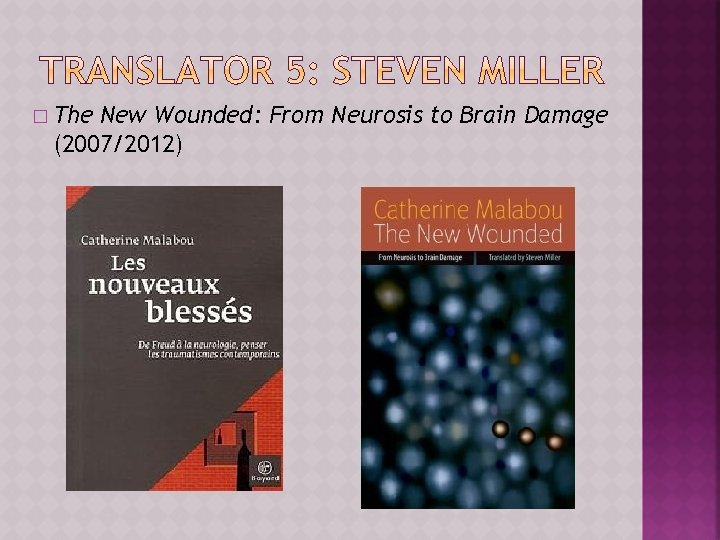
� The New Wounded: From Neurosis to Brain Damage (2007/2012)
� No Translator’s Note � 4 interventions in footnotes – philosophical necessity to clarify particular lexical items � Institutional networking
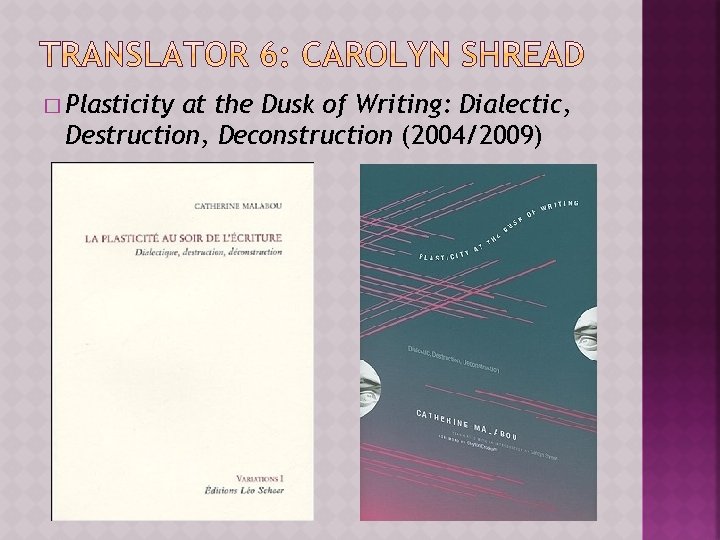
� Plasticity at the Dusk of Writing: Dialectic, Destruction, Deconstruction (2004/2009)
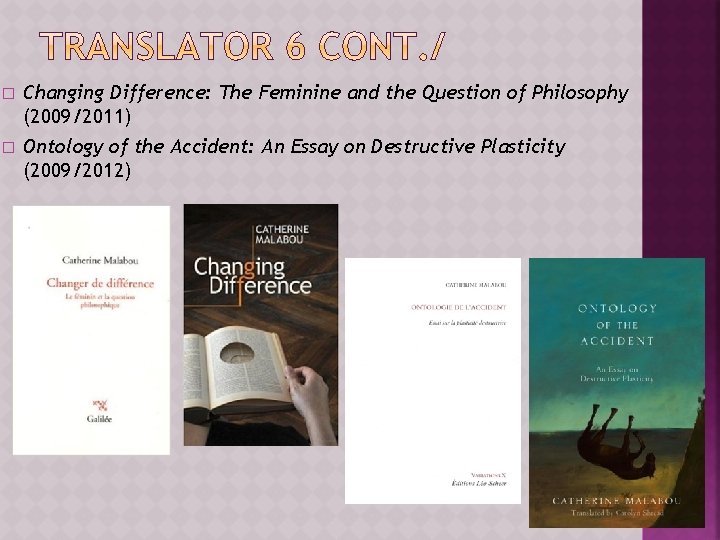
� � Changing Difference: The Feminine and the Question of Philosophy (2009/2011) Ontology of the Accident: An Essay on Destructive Plasticity (2009/2012)
� Before Tomorrow: Epigenesis and Rationality (2014/forthcoming)
� Shift in cover art as indicator of audience � Translator’s Preface : Translation manifestos – symbiosis of content/translation or hijacking? � 2 articles importing Malabou to translation studies “Catherine Malabou’s Plasticity in Translation” TTR (2011) “The Horror of Translation” theory@buffalo (2012)
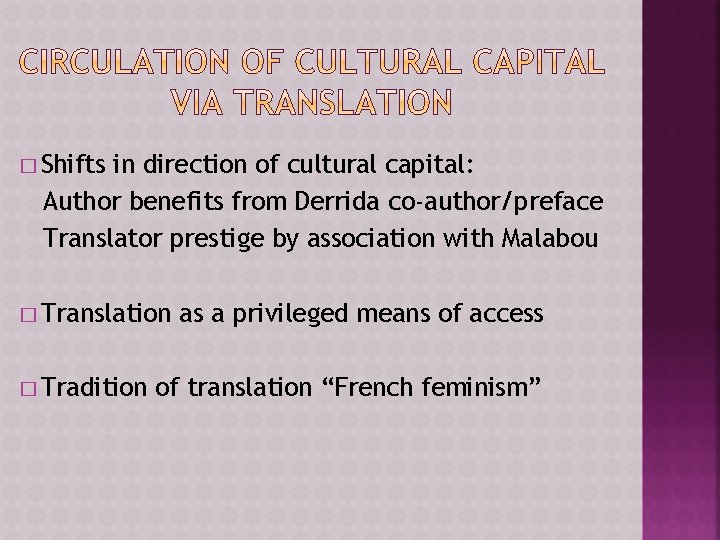
� Shifts in direction of cultural capital: Author benefits from Derrida co-author/preface Translator prestige by association with Malabou � Translation � Tradition as a privileged means of access of translation “French feminism”
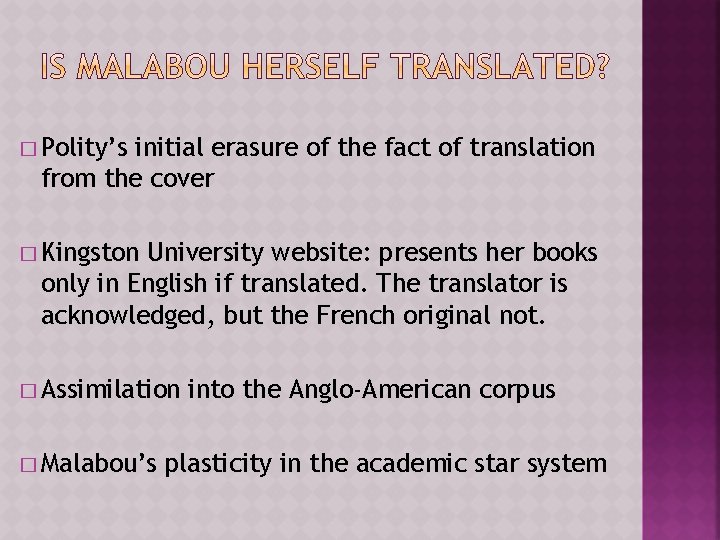
� Polity’s initial erasure of the fact of translation from the cover � Kingston University website: presents her books only in English if translated. The translator is acknowledged, but the French original not. � Assimilation � Malabou’s into the Anglo-American corpus plasticity in the academic star system
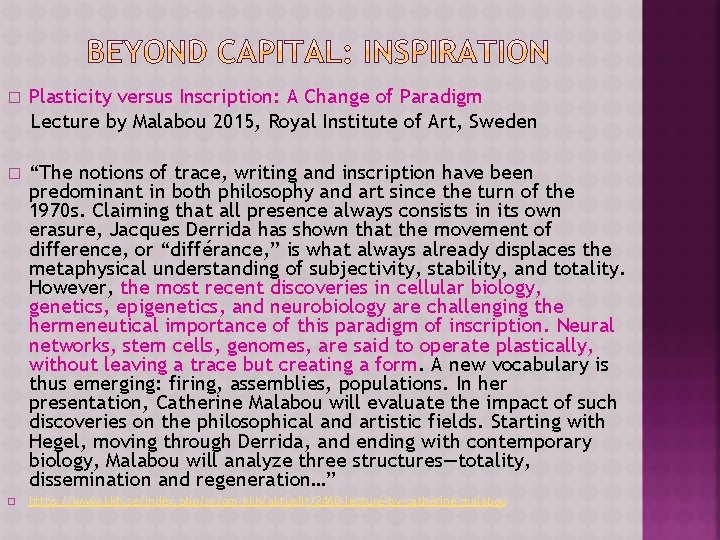
� Plasticity versus Inscription: A Change of Paradigm Lecture by Malabou 2015, Royal Institute of Art, Sweden � “The notions of trace, writing and inscription have been predominant in both philosophy and art since the turn of the 1970 s. Claiming that all presence always consists in its own erasure, Jacques Derrida has shown that the movement of difference, or “différance, ” is what always already displaces the metaphysical understanding of subjectivity, stability, and totality. However, the most recent discoveries in cellular biology, genetics, epigenetics, and neurobiology are challenging the hermeneutical importance of this paradigm of inscription. Neural networks, stem cells, genomes, are said to operate plastically, without leaving a trace but creating a form. A new vocabulary is thus emerging: firing, assemblies, populations. In her presentation, Catherine Malabou will evaluate the impact of such discoveries on the philosophical and artistic fields. Starting with Hegel, moving through Derrida, and ending with contemporary biology, Malabou will analyze three structures—totality, dissemination and regeneration…” � https: //www. kkh. se/index. php/sv/om-kkh/aktuellt/2460 -lecture-by-catherine-malabou