
Standard Model and Higgs Physics SLAC SUMMER INSTITUTE





- Slides: 66
Standard Model and Higgs Physics SLAC SUMMER INSTITUTE, 2009 Sally Dawson, BNL • Introduction to the Higgs Sector – Review of the SU(2) x U(1) Electroweak theory – Constraints from Precision Measurements • Searching for the Higgs Boson • Theoretical problems with the Standard Model
Lecture 1 • Introduction to the Standard Model – Just the SU(2) x U(1) part (See Petriello lecture) • My favorite references: – A. Djouadi, The Anatomy of Electroweak Symmetry Breaking, hep-ph/0503172 – Chris Quigg, Gauge Theories of the Strong, Weak, and Electromagnetic Interactions – Michael Peskin, An Introduction to Quantum Field Theory – Sally Dawson, Trieste lectures, hep-ph/9901280 – David Rainwater, TASI 2006, hep-ph/0702124
What we know • The photon and gluon are massless • The W and Z gauge bosons are heavy – MW=80. 399 0. 025 Ge. V – MZ =91. 1875 0. 0021 Ge. V • There are 6 quarks – Mt=173. 1 1. 3 Ge. V – Mt >> all the other quark masses • There are 3 distinct neutrinos with small but non -zero masses • The pattern of fermions appears to replicate itself 3 times
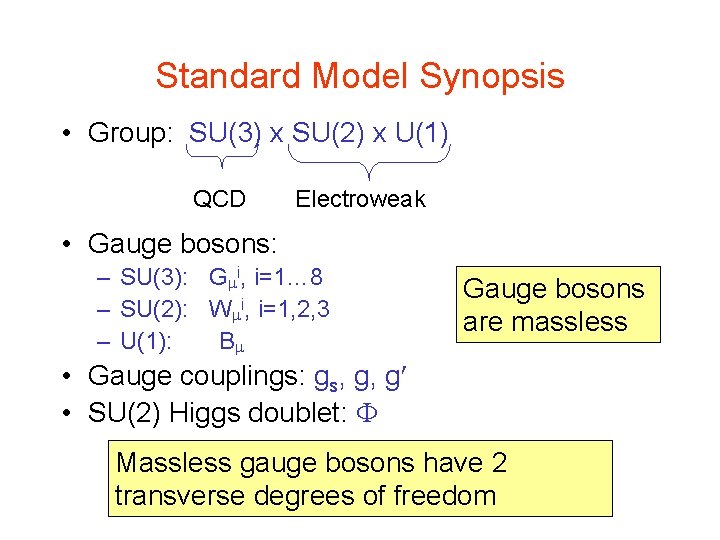
Standard Model Synopsis • Group: SU(3) x SU(2) x U(1) QCD Electroweak • Gauge bosons: – SU(3): G i, i=1… 8 – SU(2): W i, i=1, 2, 3 – U(1): B Gauge bosons are massless • Gauge couplings: gs, g, g • SU(2) Higgs doublet: Massless gauge bosons have 2 transverse degrees of freedom
Fermions come in generations Except for masses, the generations are identical
Masses for Gauge Bosons • Why are the W and Z boson masses non-zero? • U(1) gauge theory with single spin-1 gauge field, A • U(1) local gauge invariance: • Mass term for A would look like: • Mass term violates local gauge invariance • We understand why MA = 0 Gauge invariance is guiding principle
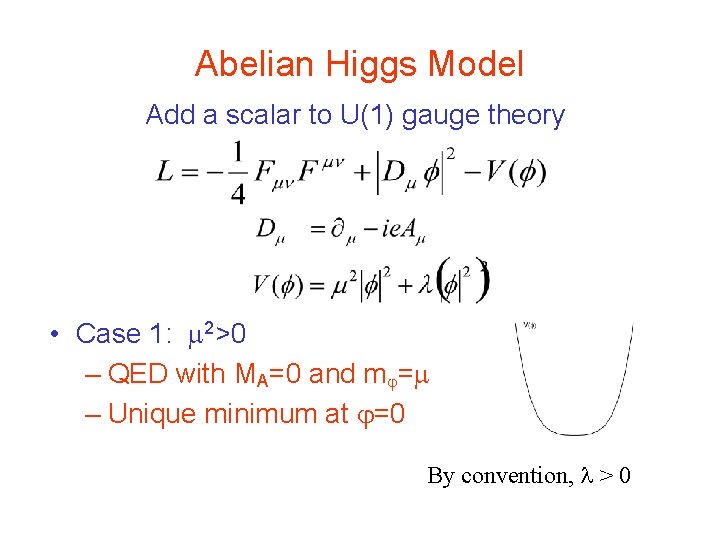
Abelian Higgs Model Add a scalar to U(1) gauge theory • Case 1: 2>0 – QED with MA=0 and m = – Unique minimum at =0 By convention, > 0
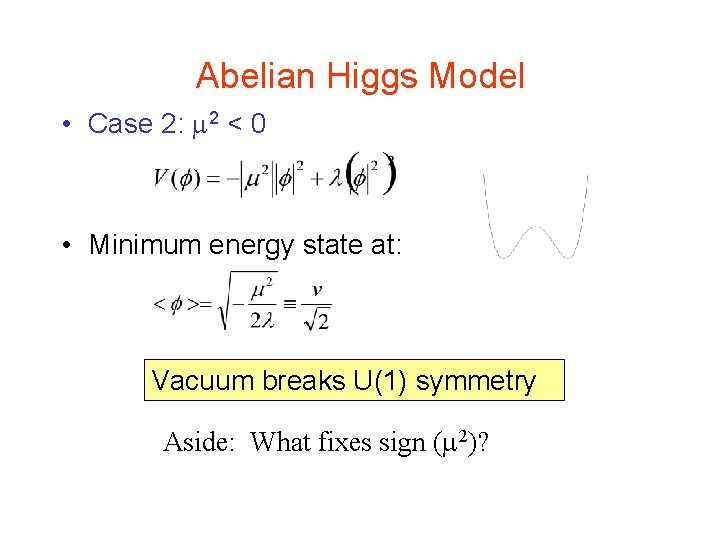
Abelian Higgs Model • Case 2: 2 < 0 • Minimum energy state at: Vacuum breaks U(1) symmetry Aside: What fixes sign ( 2)?
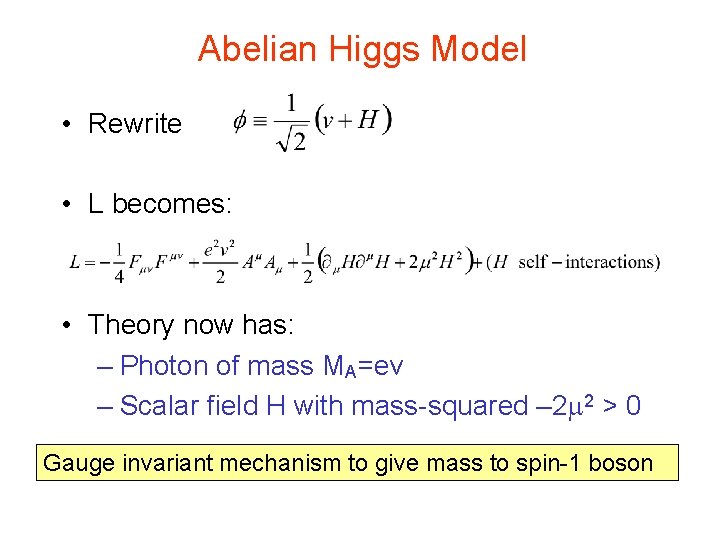
Abelian Higgs Model • Rewrite • L becomes: • Theory now has: – Photon of mass MA=ev – Scalar field H with mass-squared – 2 2 > 0 Gauge invariant mechanism to give mass to spin-1 boson
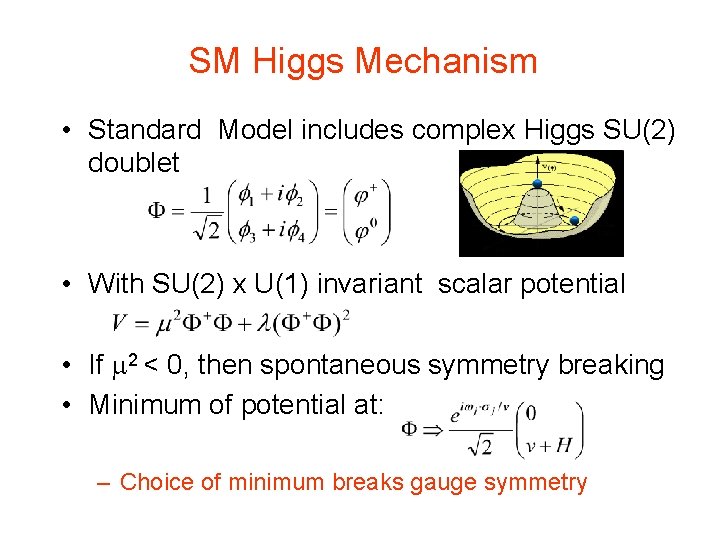
SM Higgs Mechanism • Standard Model includes complex Higgs SU(2) doublet • With SU(2) x U(1) invariant scalar potential • If 2 < 0, then spontaneous symmetry breaking • Minimum of potential at: – Choice of minimum breaks gauge symmetry
More on SM Higgs Mechanism • Couple to SU(2) x U(1) gauge bosons (Wi , i=1, 2, 3; B ) • Gauge boson mass terms from:
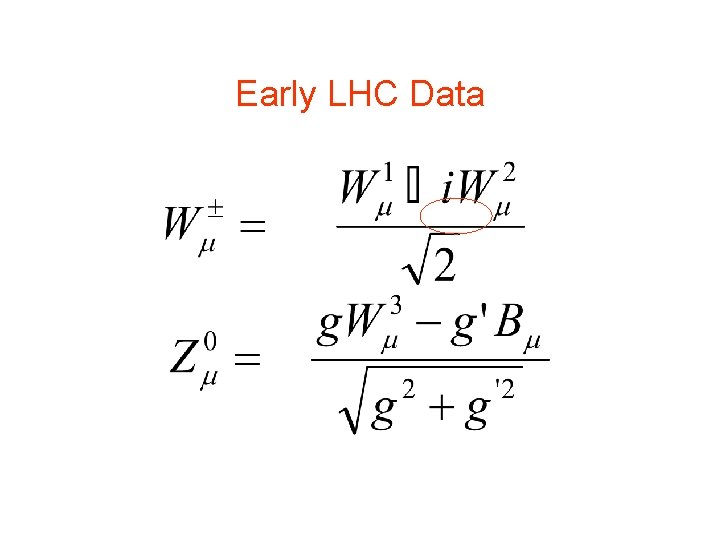
SM Higgs Mechanism • Massive gauge bosons: • Orthogonal combination to Z is massless photon:
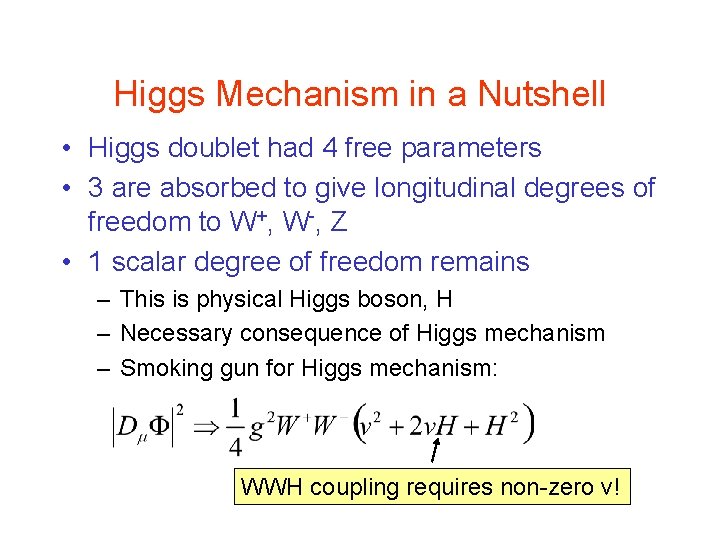
Higgs Mechanism in a Nutshell • Higgs doublet had 4 free parameters • 3 are absorbed to give longitudinal degrees of freedom to W+, W-, Z • 1 scalar degree of freedom remains – This is physical Higgs boson, H – Necessary consequence of Higgs mechanism – Smoking gun for Higgs mechanism: WWH coupling requires non-zero v!
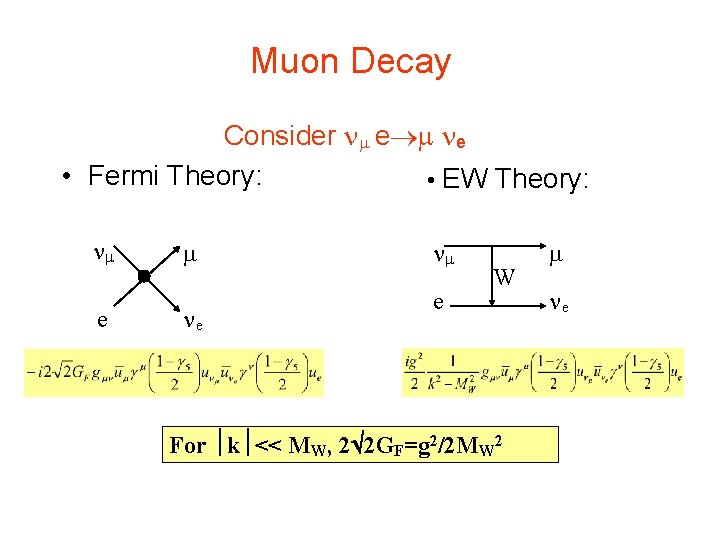
Muon Decay Consider e e • Fermi Theory: • EW Theory: e e e W For k << MW, 2 2 GF=g 2/2 MW 2 e
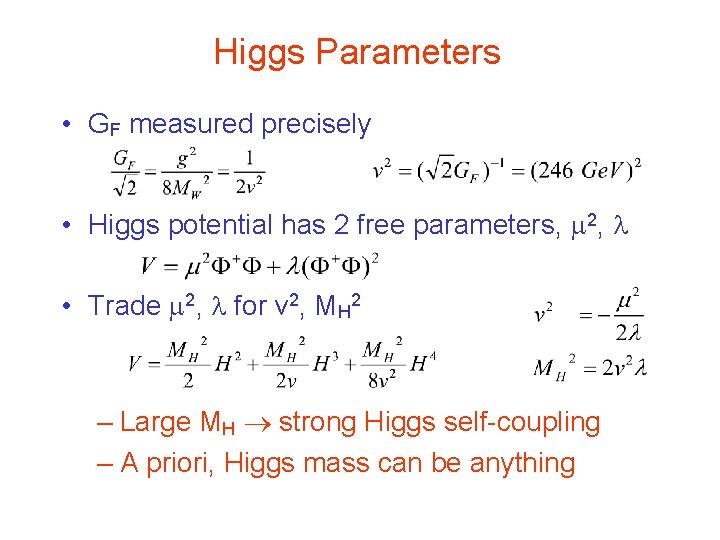
Higgs Parameters • GF measured precisely • Higgs potential has 2 free parameters, 2, • Trade 2, for v 2, MH 2 – Large MH strong Higgs self-coupling – A priori, Higgs mass can be anything
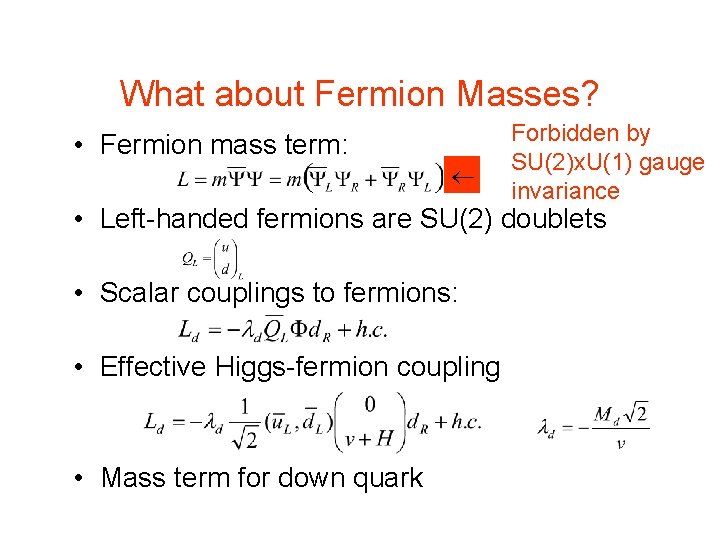
What about Fermion Masses? • Fermion mass term: Forbidden by SU(2)x. U(1) gauge invariance • Left-handed fermions are SU(2) doublets • Scalar couplings to fermions: • Effective Higgs-fermion coupling • Mass term for down quark
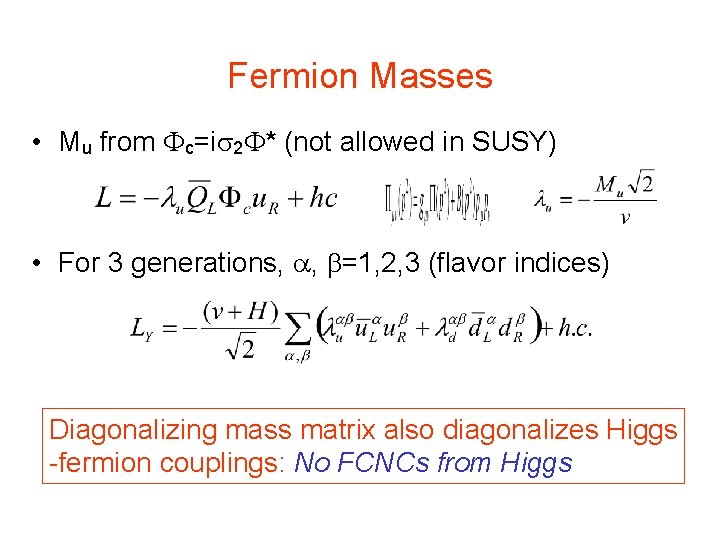
Fermion Masses • Mu from c=i 2 * (not allowed in SUSY) • For 3 generations, , =1, 2, 3 (flavor indices) Diagonalizing mass matrix also diagonalizes Higgs -fermion couplings: No FCNCs from Higgs
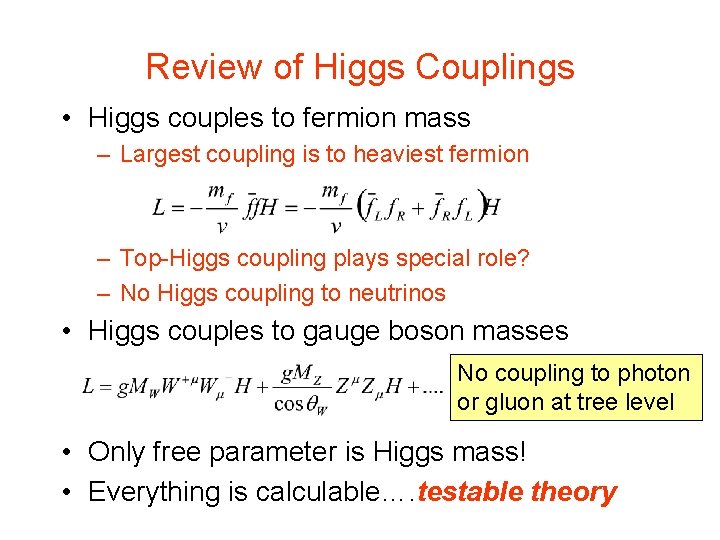
Review of Higgs Couplings • Higgs couples to fermion mass – Largest coupling is to heaviest fermion – Top-Higgs coupling plays special role? – No Higgs coupling to neutrinos • Higgs couples to gauge boson masses No coupling to photon or gluon at tree level • Only free parameter is Higgs mass! • Everything is calculable…. testable theory
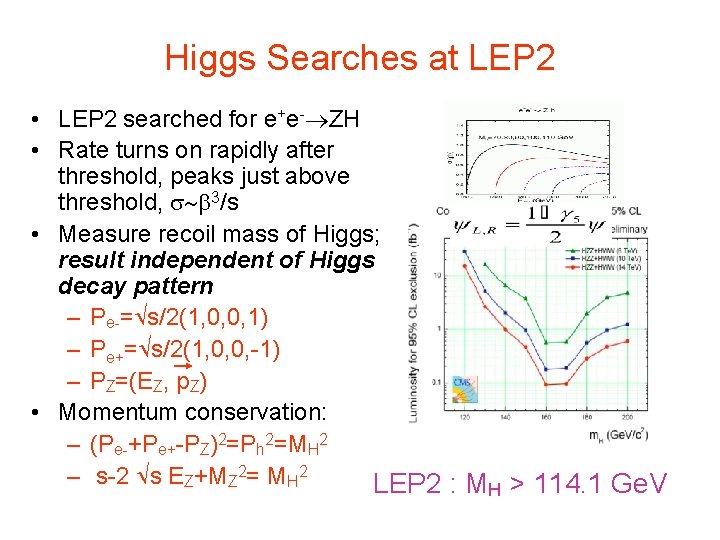
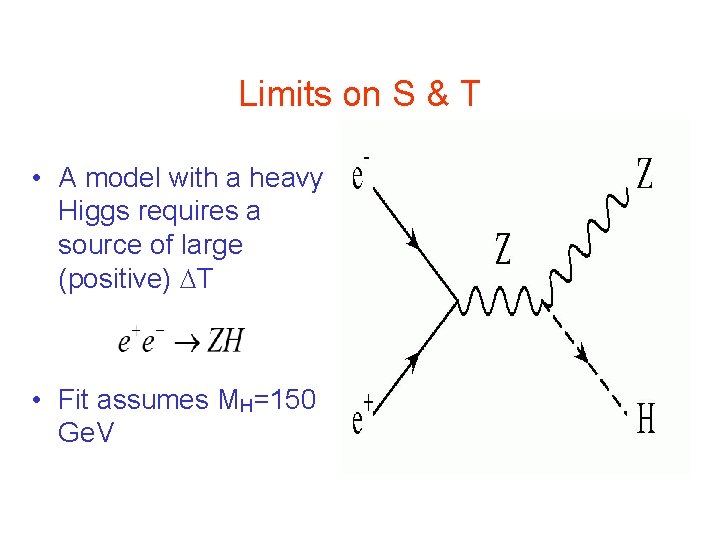
Higgs Searches at LEP 2 • LEP 2 searched for e+e- ZH • Rate turns on rapidly after threshold, peaks just above threshold, 3/s • Measure recoil mass of Higgs; result independent of Higgs decay pattern – Pe-= s/2(1, 0, 0, 1) – Pe+= s/2(1, 0, 0, -1) – PZ=(EZ, p. Z) • Momentum conservation: – (Pe-+Pe+-PZ)2=Ph 2=MH 2 – s-2 s EZ+MZ 2= MH 2 LEP 2 : MH > 114. 1 Ge. V
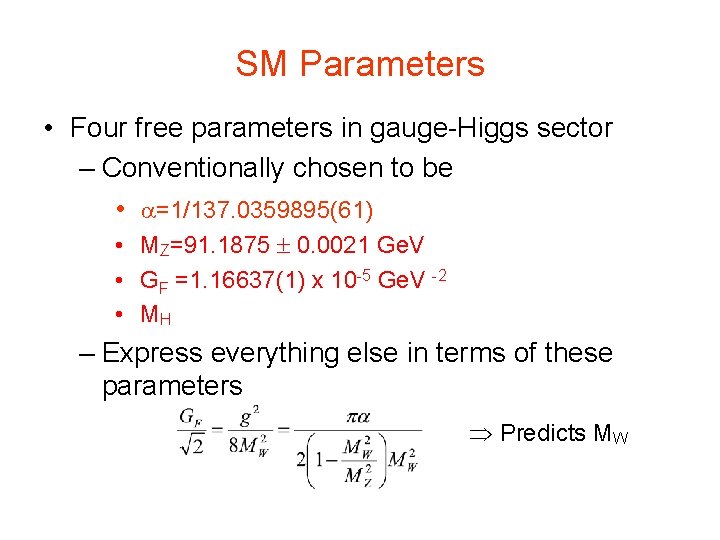
SM Parameters • Four free parameters in gauge-Higgs sector – Conventionally chosen to be • =1/137. 0359895(61) • MZ=91. 1875 0. 0021 Ge. V • GF =1. 16637(1) x 10 -5 Ge. V -2 • MH – Express everything else in terms of these parameters Predicts MW
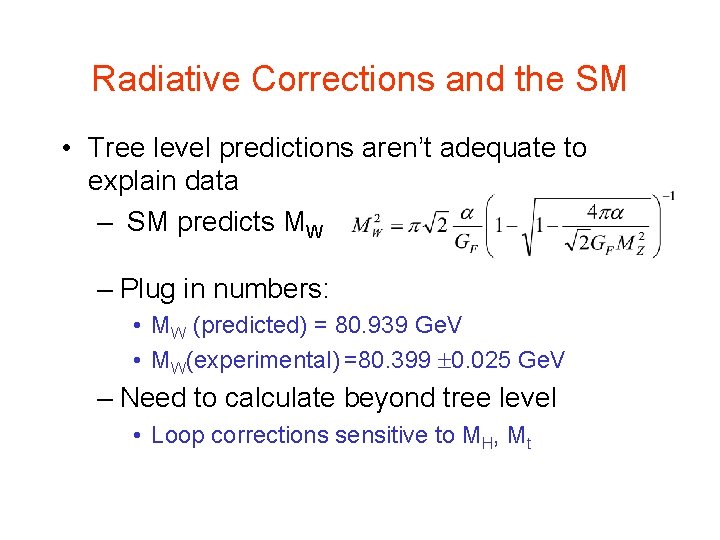
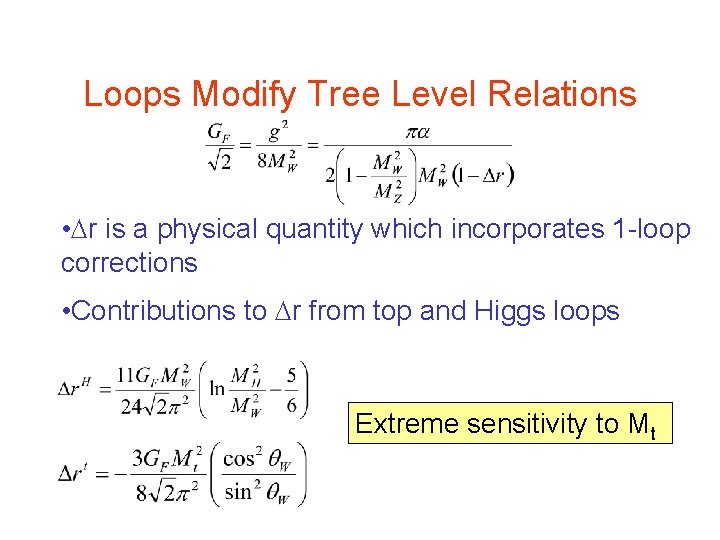
Radiative Corrections and the SM • Tree level predictions aren’t adequate to explain data – SM predicts MW – Plug in numbers: • MW (predicted) = 80. 939 Ge. V • MW(experimental) =80. 399 0. 025 Ge. V – Need to calculate beyond tree level • Loop corrections sensitive to MH, Mt
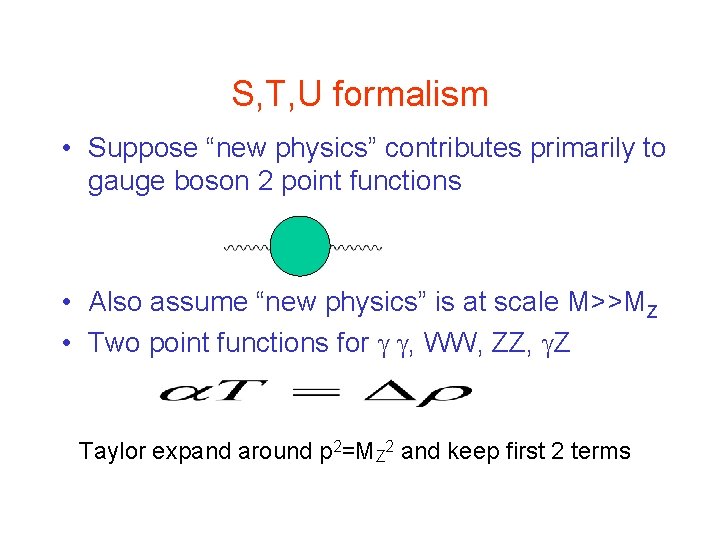
S, T, U formalism • Suppose “new physics” contributes primarily to gauge boson 2 point functions • Also assume “new physics” is at scale M>>MZ • Two point functions for , WW, ZZ, Z Taylor expand around p 2=MZ 2 and keep first 2 terms
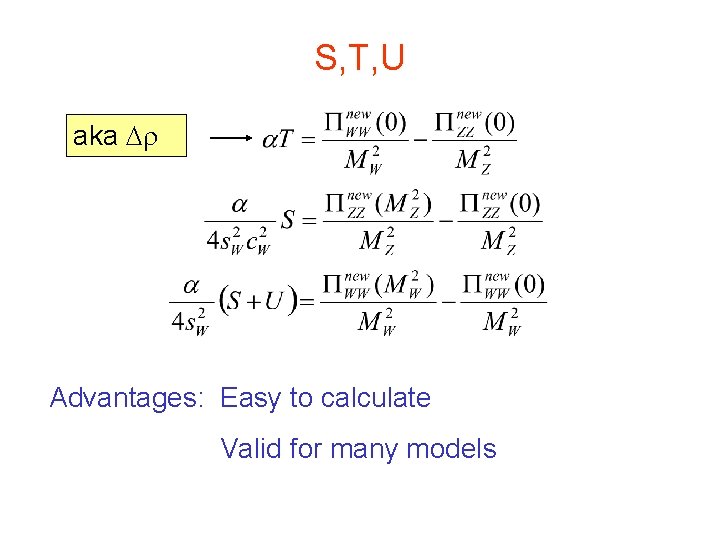
S, T, U aka Advantages: Easy to calculate Valid for many models
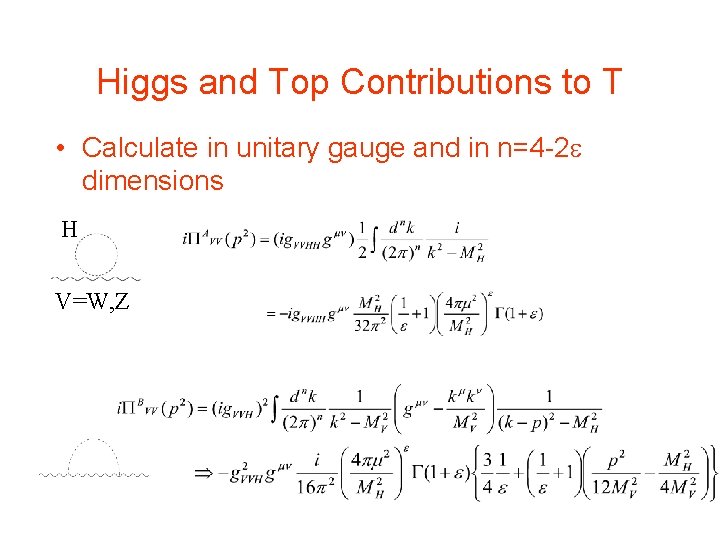
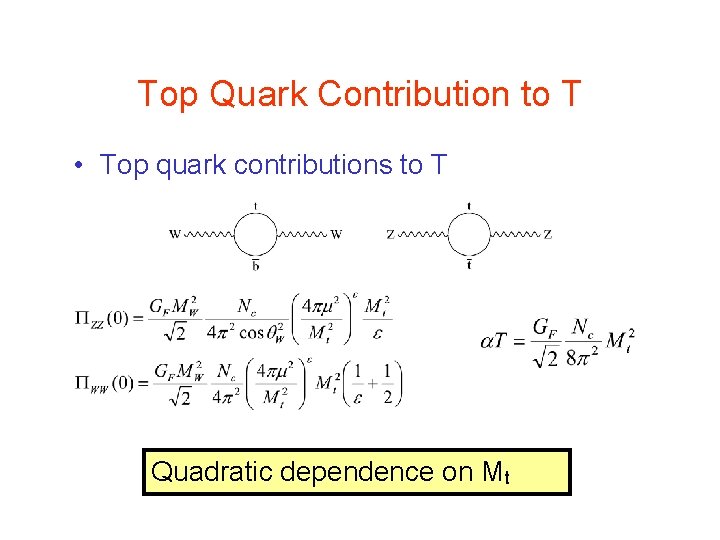
Higgs and Top Contributions to T • Calculate in unitary gauge and in n=4 -2 dimensions H V=W, Z
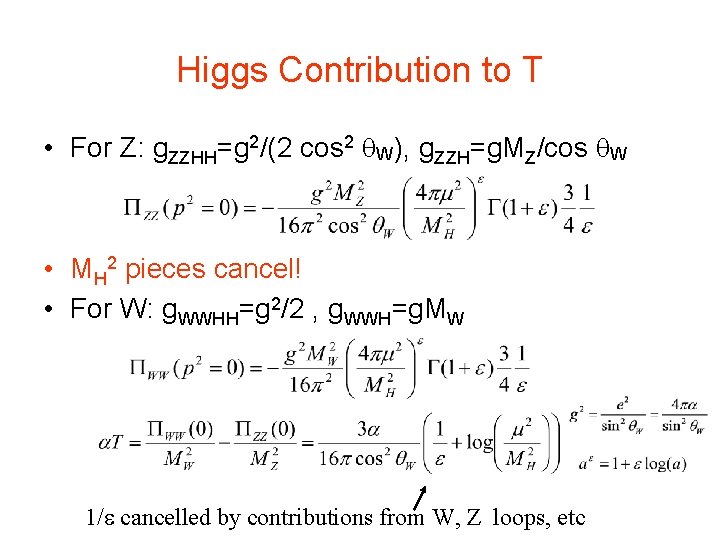
Higgs Contribution to T • For Z: g. ZZHH=g 2/(2 cos 2 W), g. ZZH=g. MZ/cos W • MH 2 pieces cancel! • For W: g. WWHH=g 2/2 , g. WWH=g. MW 1/ cancelled by contributions from W, Z loops, etc
Top Quark Contribution to T • Top quark contributions to T Quadratic dependence on Mt
Limits on S & T • A model with a heavy Higgs requires a source of large (positive) T • Fit assumes MH=150 Ge. V
Loops Modify Tree Level Relations • r is a physical quantity which incorporates 1 -loop corrections • Contributions to r from top and Higgs loops Extreme sensitivity to Mt
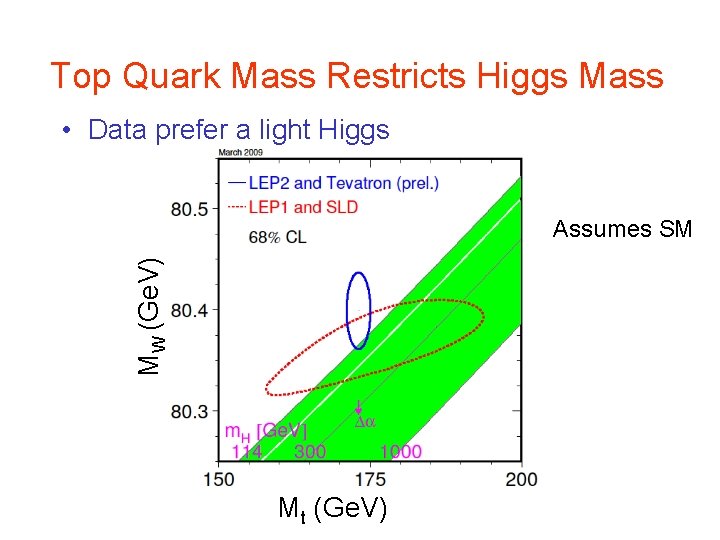
Top Quark Mass Restricts Higgs Mass • Data prefer a light Higgs MW (Ge. V) Assumes SM Mt (Ge. V)
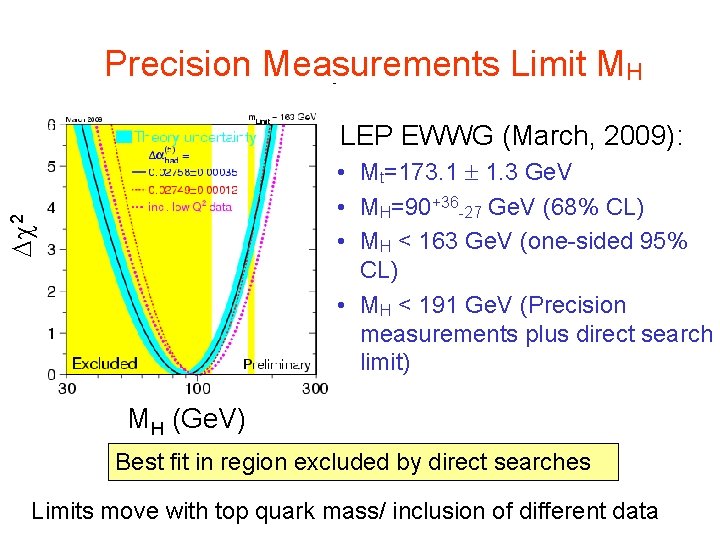
Precision Measurements Limit MH LEP EWWG (March, 2009): 2 • Mt=173. 1 1. 3 Ge. V • MH=90+36 -27 Ge. V (68% CL) • MH < 163 Ge. V (one-sided 95% CL) • MH < 191 Ge. V (Precision measurements plus direct search limit) MH (Ge. V) Best fit in region excluded by direct searches Limits move with top quark mass/ inclusion of different data
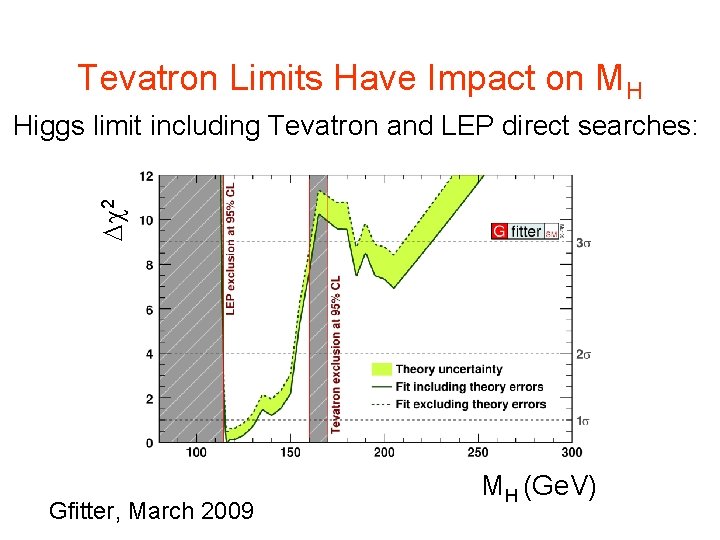
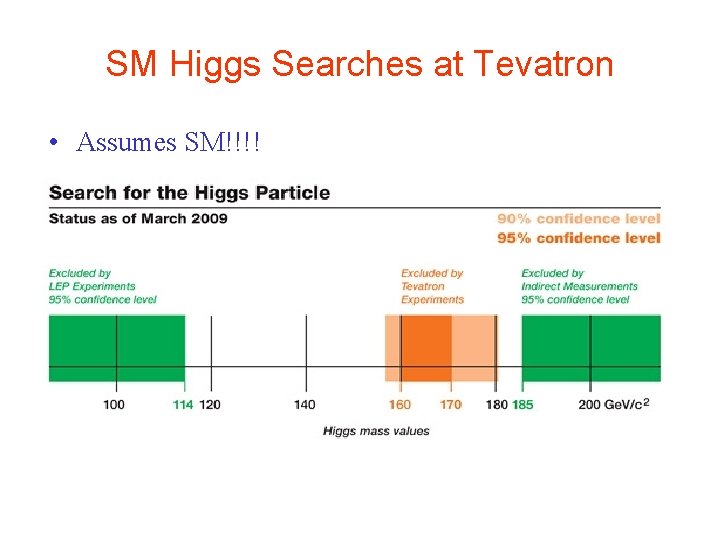
Tevatron Limits Have Impact on MH 2 Higgs limit including Tevatron and LEP direct searches: Gfitter, March 2009 MH (Ge. V)
Higgs production at Hadron Colliders • Many possible production mechanisms; Importance depends on: – Size of production cross section – Size of branching ratios to observable channels – Size of background • Importance varies with Higgs mass • Need to see more than one channel to establish Higgs properties and verify that it is a Higgs boson
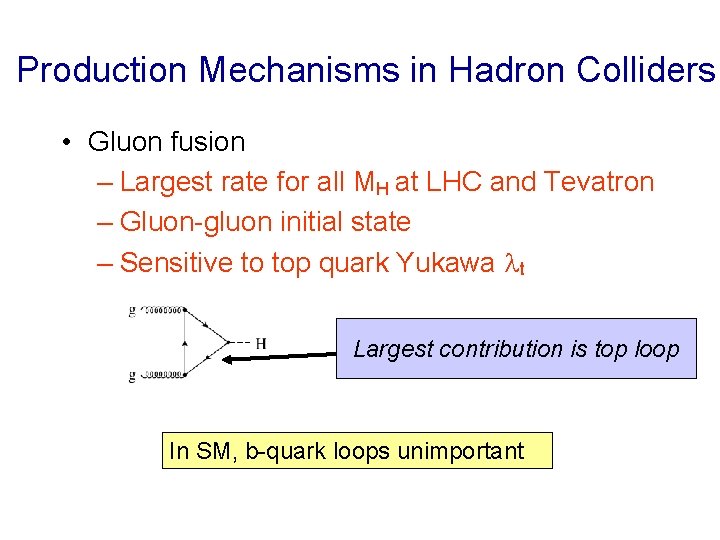
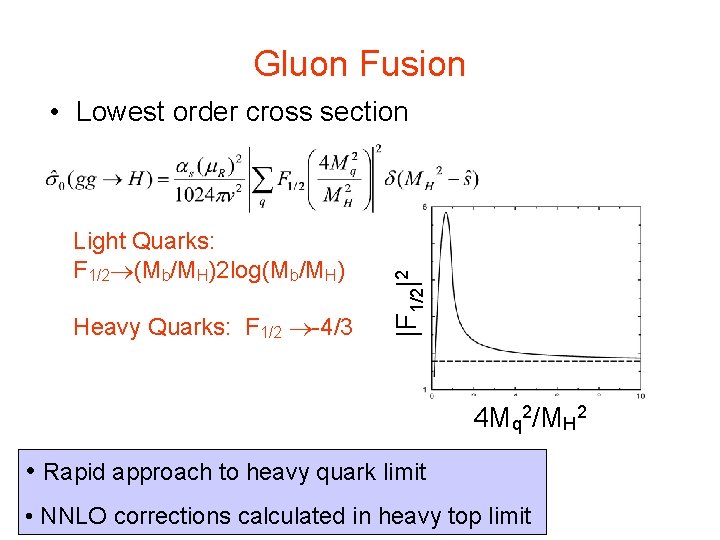
Production Mechanisms in Hadron Colliders • Gluon fusion – Largest rate for all MH at LHC and Tevatron – Gluon-gluon initial state – Sensitive to top quark Yukawa t Largest contribution is top loop In SM, b-quark loops unimportant
Gluon Fusion Light Quarks: F 1/2 (Mb/MH)2 log(Mb/MH) Heavy Quarks: F 1/2 -4/3 |F 1/2|2 • Lowest order cross section 4 Mq 2/MH 2 • Rapid approach to heavy quark limit • NNLO corrections calculated in heavy top limit
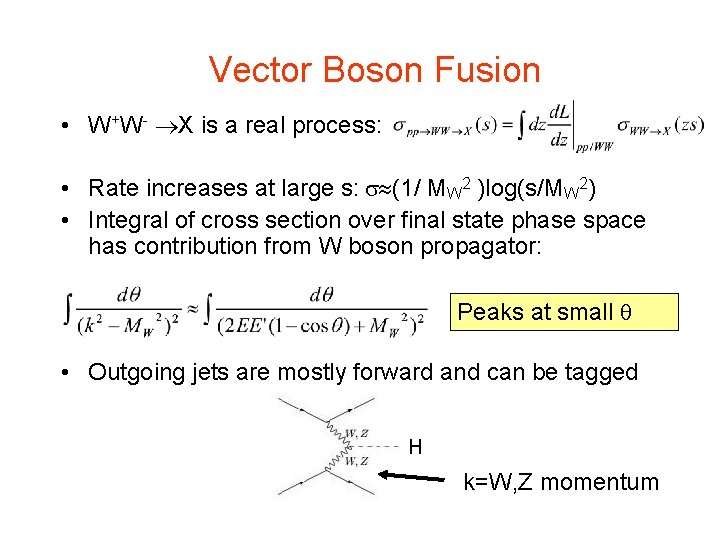
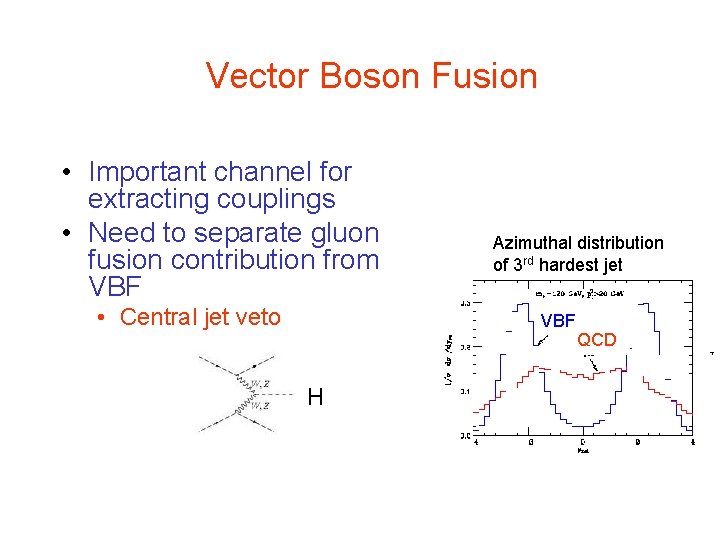
Vector Boson Fusion • W+W- X is a real process: • Rate increases at large s: (1/ MW 2 )log(s/MW 2) • Integral of cross section over final state phase space has contribution from W boson propagator: Peaks at small • Outgoing jets are mostly forward and can be tagged H k=W, Z momentum
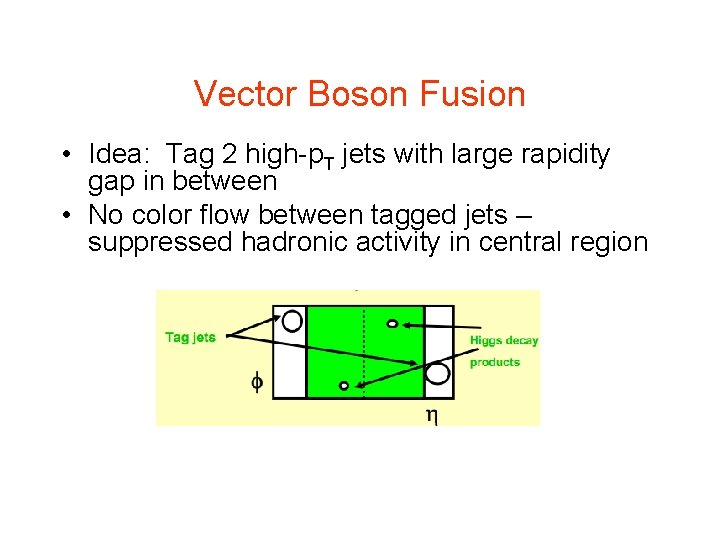
Vector Boson Fusion • Idea: Tag 2 high-p. T jets with large rapidity gap in between • No color flow between tagged jets – suppressed hadronic activity in central region
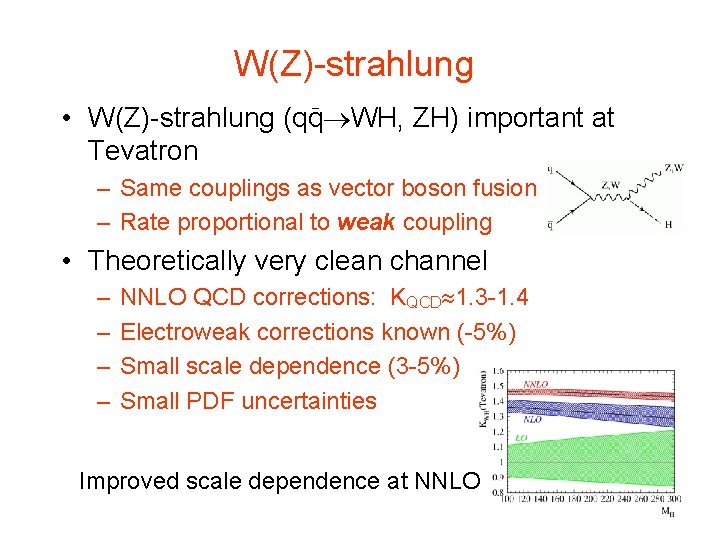
W(Z)-strahlung • W(Z)-strahlung (qq WH, ZH) important at Tevatron – Same couplings as vector boson fusion – Rate proportional to weak coupling • Theoretically very clean channel – – NNLO QCD corrections: KQCD 1. 3 -1. 4 Electroweak corrections known (-5%) Small scale dependence (3 -5%) Small PDF uncertainties Improved scale dependence at NNLO
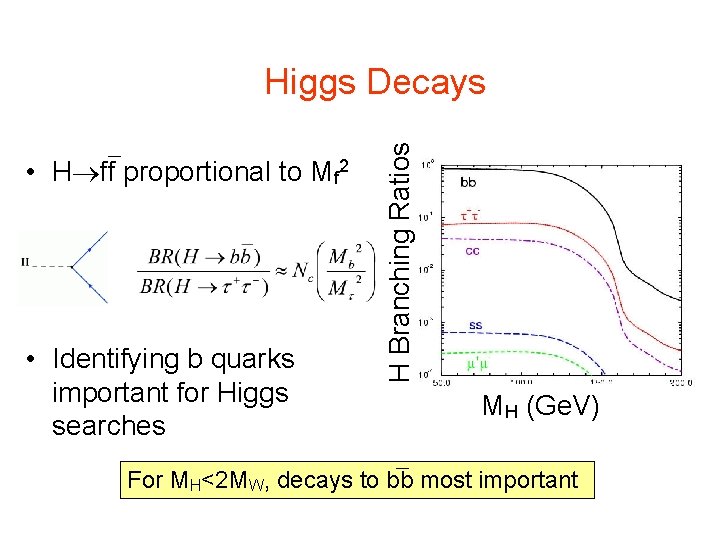
• H ff proportional to Mf 2 • Identifying b quarks important for Higgs searches H Branching Ratios Higgs Decays MH (Ge. V) For MH<2 MW, decays to bb most important
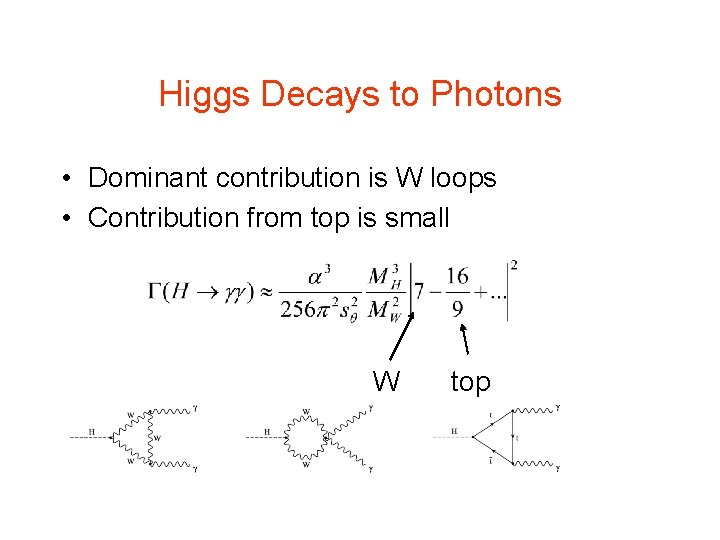
Higgs Decays to Photons • Dominant contribution is W loops • Contribution from top is small W top
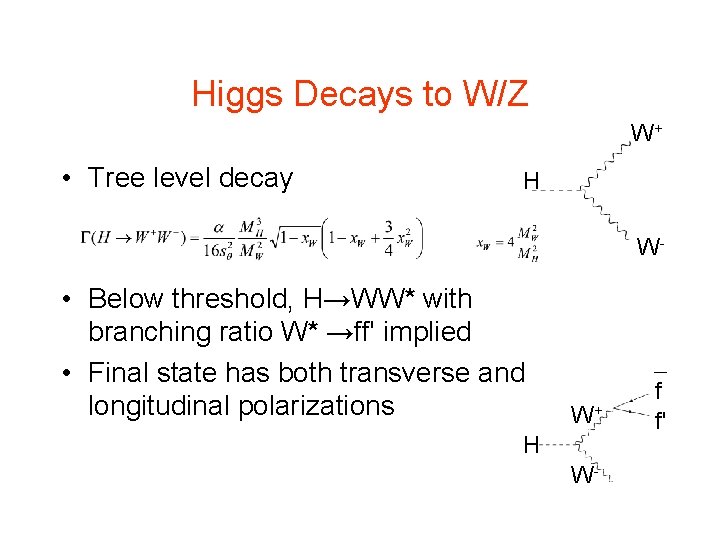
Higgs Decays to W/Z W+ • Tree level decay H W- • Below threshold, H→WW* with branching ratio W* →ff' implied • Final state has both transverse and longitudinal polarizations W+ H W- f f'
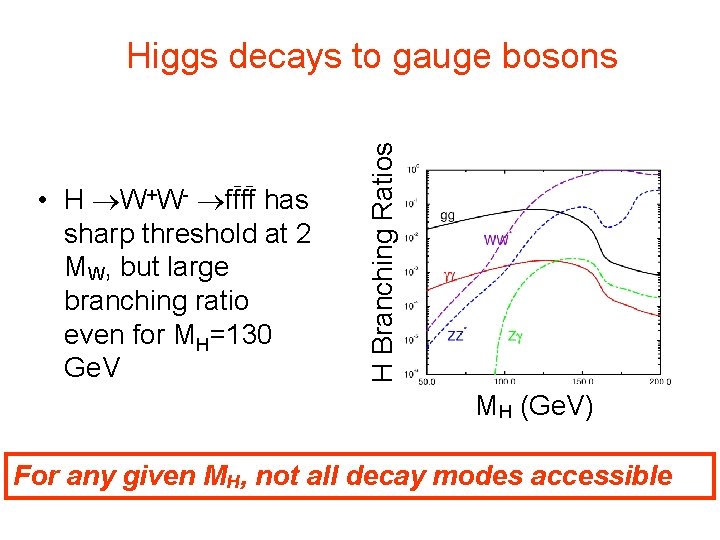
• H W+W- ffff has sharp threshold at 2 MW, but large branching ratio even for MH=130 Ge. V H Branching Ratios Higgs decays to gauge bosons MH (Ge. V) For any given MH, not all decay modes accessible
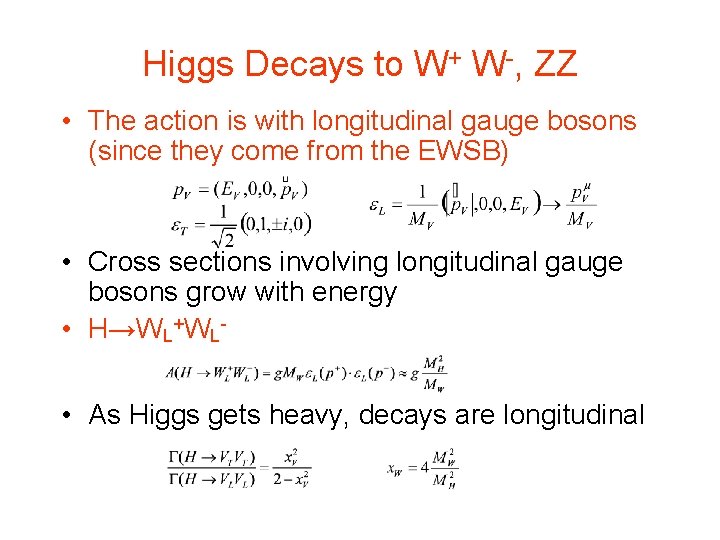
Higgs Decays to W+ W-, ZZ • The action is with longitudinal gauge bosons (since they come from the EWSB) • Cross sections involving longitudinal gauge bosons grow with energy • H→WL+WL • As Higgs gets heavy, decays are longitudinal
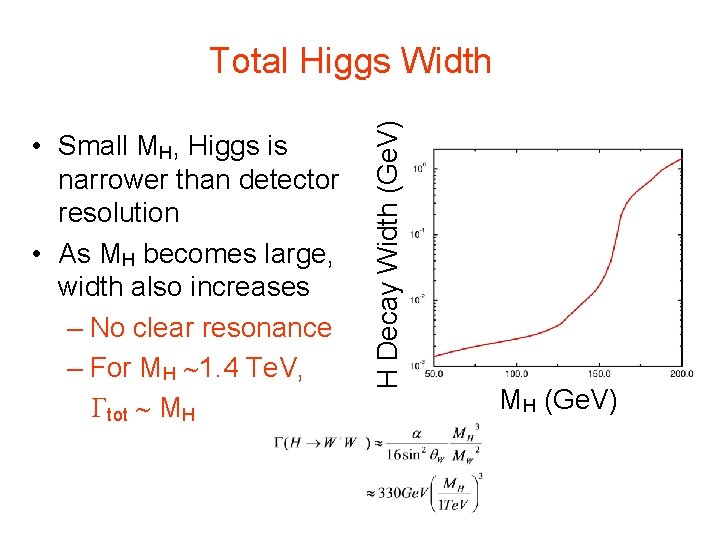
• Small MH, Higgs is narrower than detector resolution • As MH becomes large, width also increases – No clear resonance – For MH 1. 4 Te. V, tot MH H Decay Width (Ge. V) Total Higgs Width MH (Ge. V)
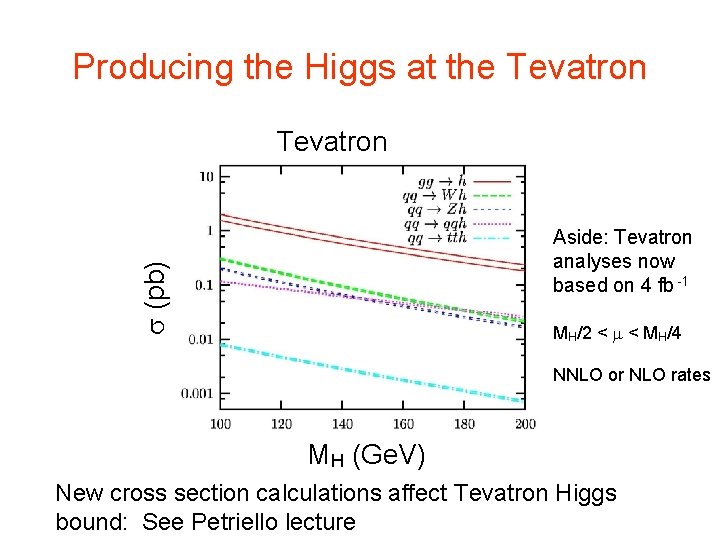
Producing the Higgs at the Tevatron (pb) Aside: Tevatron analyses now based on 4 fb -1 MH/2 < < MH/4 NNLO or NLO rates MH (Ge. V) New cross section calculations affect Tevatron Higgs bound: See Petriello lecture
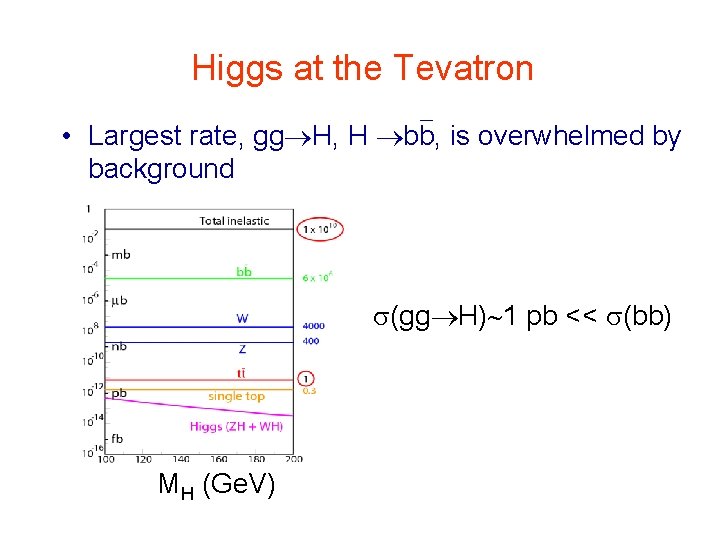
Higgs at the Tevatron • Largest rate, gg H, H bb, is overwhelmed by background (gg H) 1 pb << (bb) MH (Ge. V)
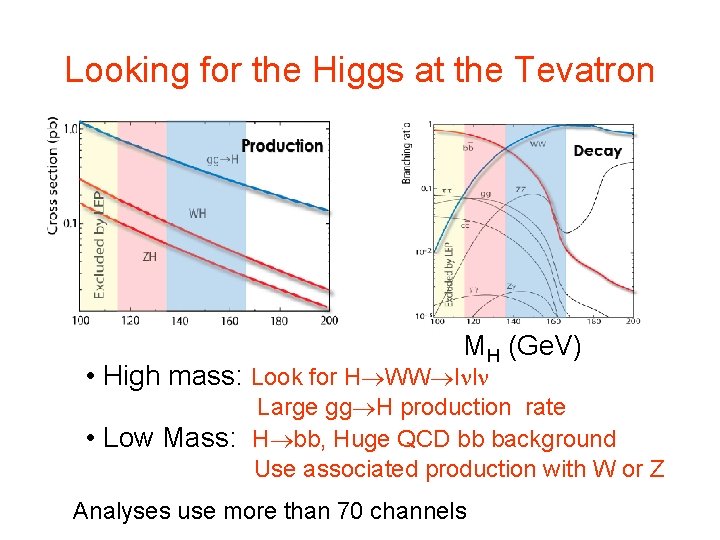
Looking for the Higgs at the Tevatron MH (Ge. V) • High mass: Look for H WW l l Large gg H production rate • Low Mass: H bb, Huge QCD bb background Use associated production with W or Z Analyses use more than 70 channels
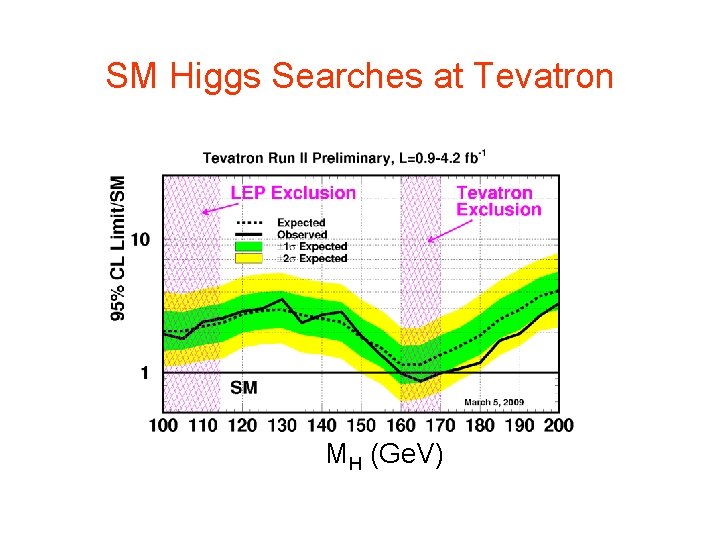
SM Higgs Searches at Tevatron MH (Ge. V)
SM Higgs Searches at Tevatron • Assumes SM!!!!
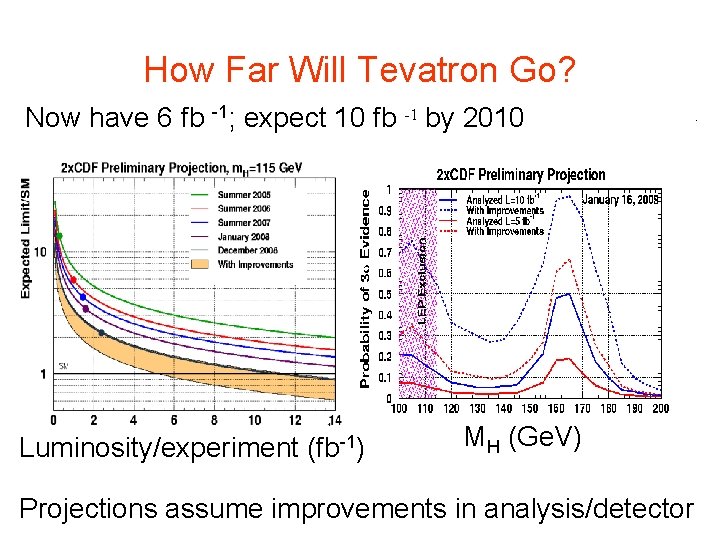
How Far Will Tevatron Go? Now have 6 fb -1; expect 10 fb -1 by 2010 Luminosity/experiment (fb-1) MH (Ge. V) Projections assume improvements in analysis/detector
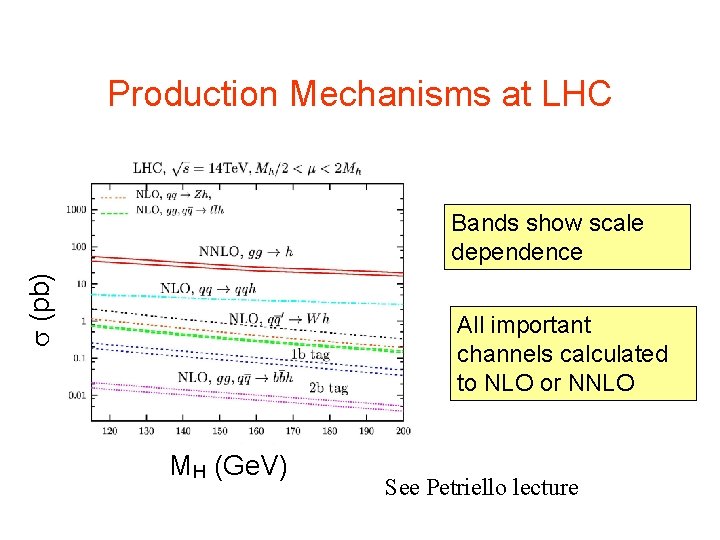
Production Mechanisms at LHC (pb) Bands show scale dependence All important channels calculated to NLO or NNLO MH (Ge. V) See Petriello lecture
Search Channels at the LHC gg H bb has huge QCD background: Must use rare decay modes of H • gg H – Small BR (10 -3 – 10 -4) – Only measurable for MH < 140 Ge. V • Largest Background: QCD continuum production of • Also from -jet production, with jet faking , or fragmenting to 0 • Fit background from data
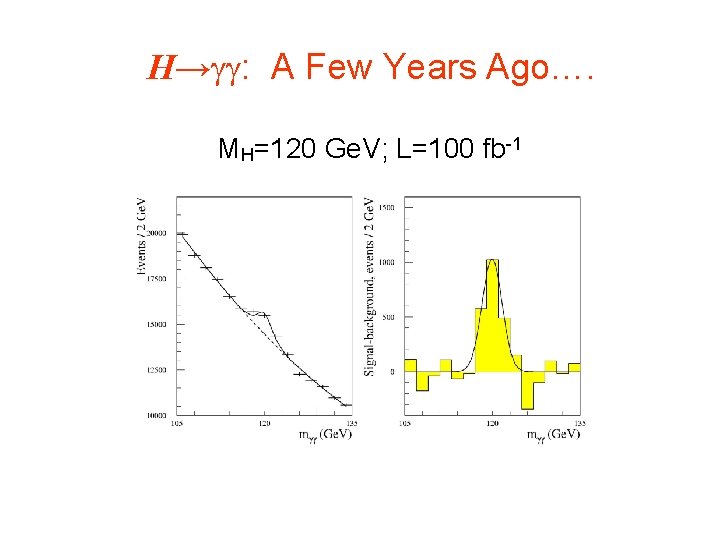
H→ : A Few Years Ago…. MH=120 Ge. V; L=100 fb-1
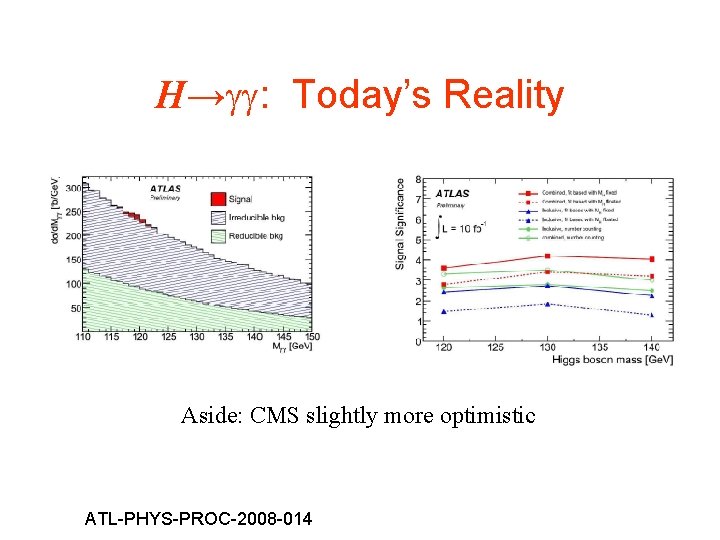
H→ : Today’s Reality Aside: CMS slightly more optimistic ATL-PHYS-PROC-2008 -014
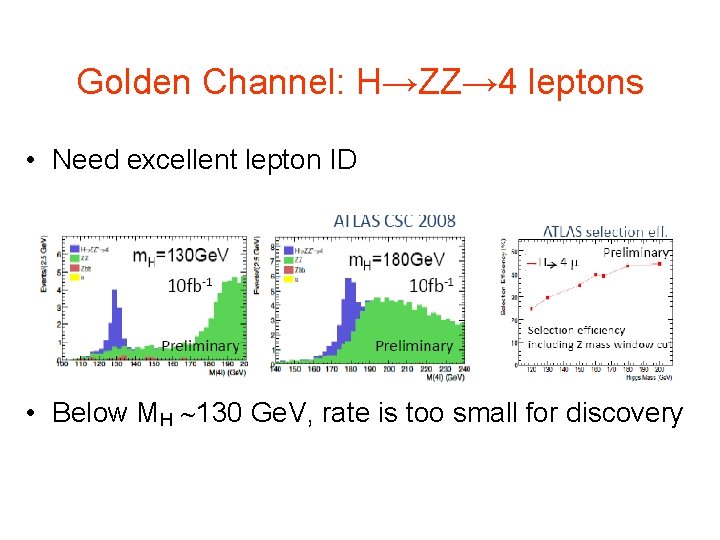
Golden Channel: H→ZZ→ 4 leptons • Need excellent lepton ID • Below MH 130 Ge. V, rate is too small for discovery
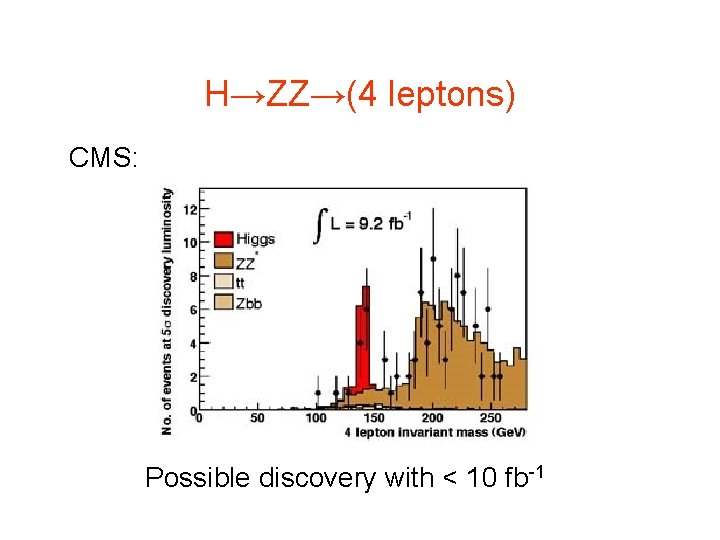
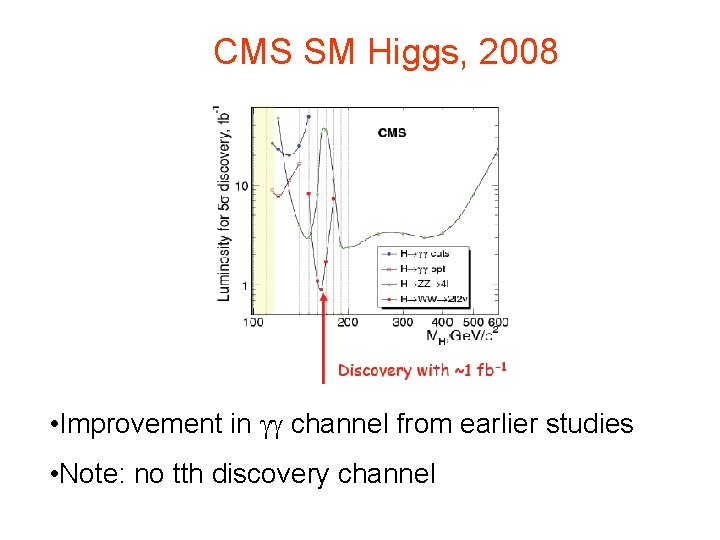
H→ZZ→(4 leptons) CMS: Possible discovery with < 10 fb-1
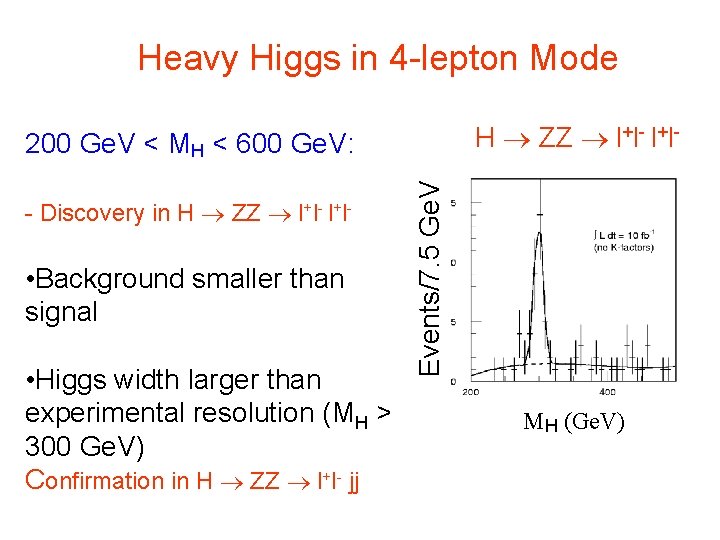
Heavy Higgs in 4 -lepton Mode H ZZ l+l- - Discovery in H ZZ l+l- • Background smaller than signal • Higgs width larger than experimental resolution (MH > 300 Ge. V) Confirmation in H ZZ l+l- jj Events/7. 5 Ge. V 200 Ge. V < MH < 600 Ge. V: MH (Ge. V)
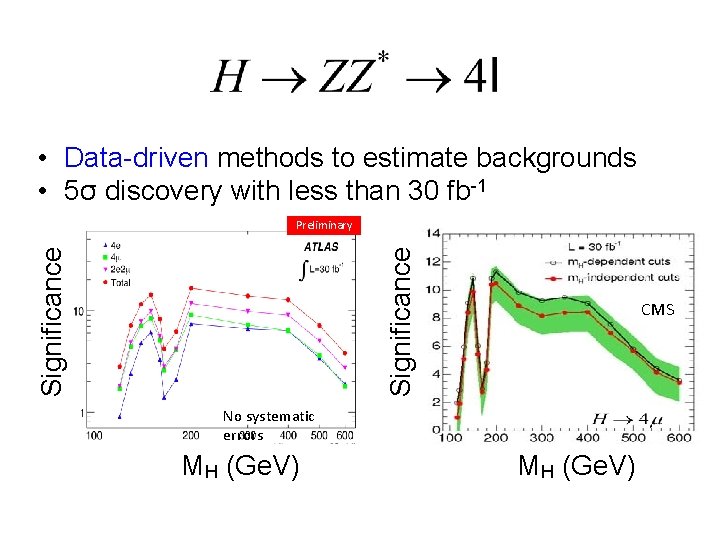
• Data-driven methods to estimate backgrounds • 5σ discovery with less than 30 fb-1 Significance Preliminary CMS No systematic errors MH (Ge. V)
Vector Boson Fusion • Important channel for extracting couplings • Need to separate gluon fusion contribution from VBF • Central jet veto Azimuthal distribution of 3 rd hardest jet VBF H QCD
CMS SM Higgs, 2008 • Improvement in channel from earlier studies • Note: no tth discovery channel
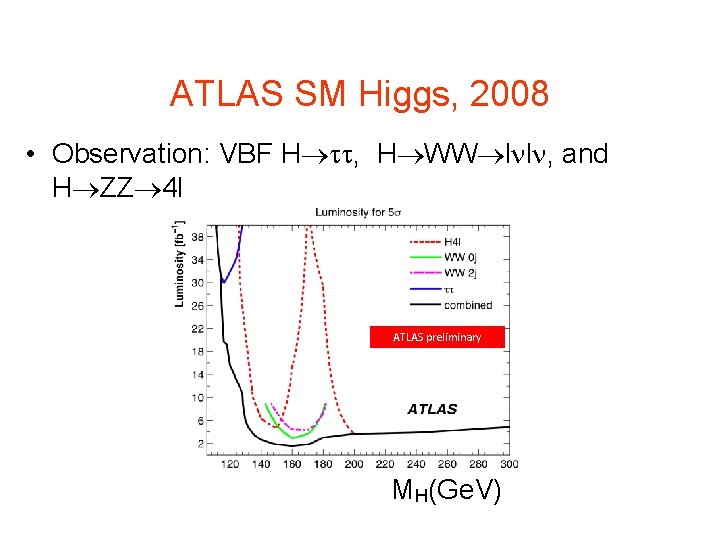
ATLAS SM Higgs, 2008 • Observation: VBF H , H WW l l , and H ZZ 4 l ATLAS preliminary MH(Ge. V)
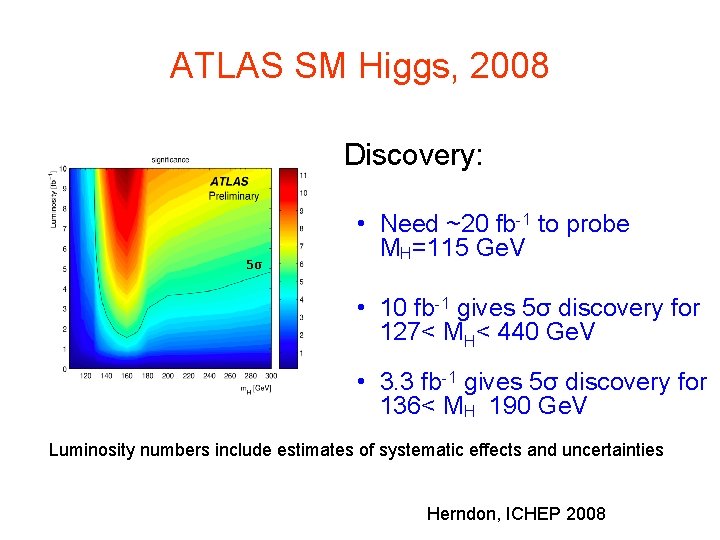
ATLAS SM Higgs, 2008 Discovery: 5σ • Need ~20 fb-1 to probe MH=115 Ge. V • 10 fb-1 gives 5σ discovery for 127< MH< 440 Ge. V • 3. 3 fb-1 gives 5σ discovery for 136< MH 190 Ge. V Luminosity numbers include estimates of systematic effects and uncertainties Herndon, ICHEP 2008
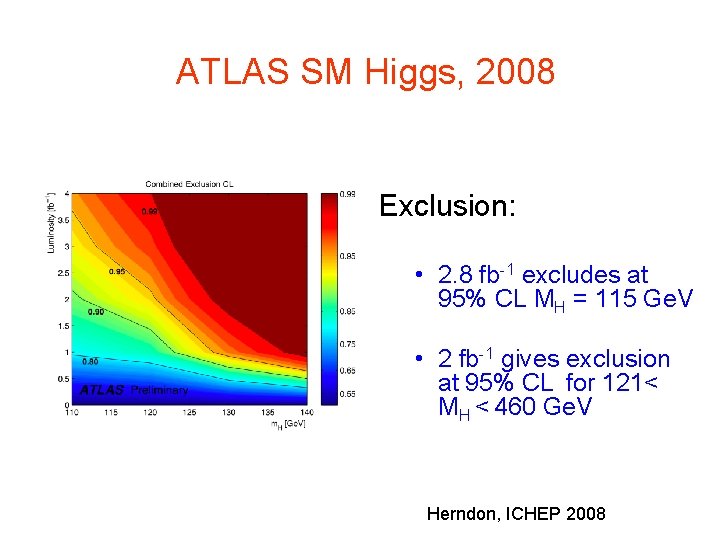
ATLAS SM Higgs, 2008 Exclusion: • 2. 8 fb-1 excludes at 95% CL MH = 115 Ge. V • 2 fb-1 gives exclusion at 95% CL for 121< MH < 460 Ge. V Herndon, ICHEP 2008
Early LHC Data
What if the LHC Energy is Lower?
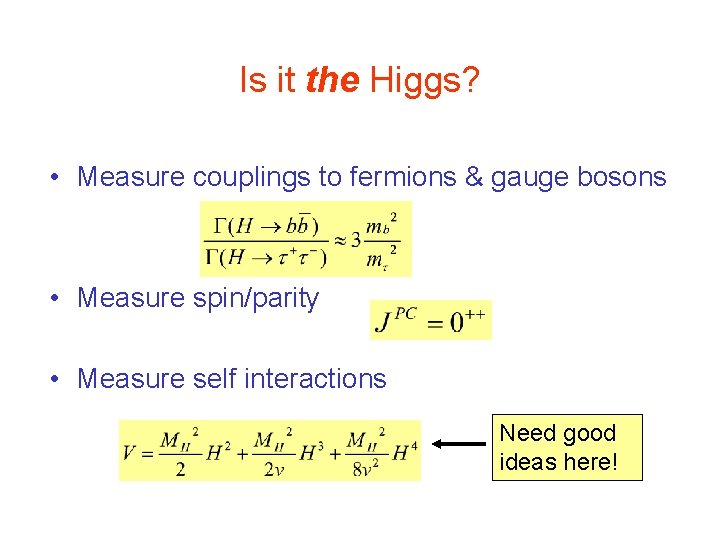
Is it the Higgs? • Measure couplings to fermions & gauge bosons • Measure spin/parity • Measure self interactions Need good ideas here!
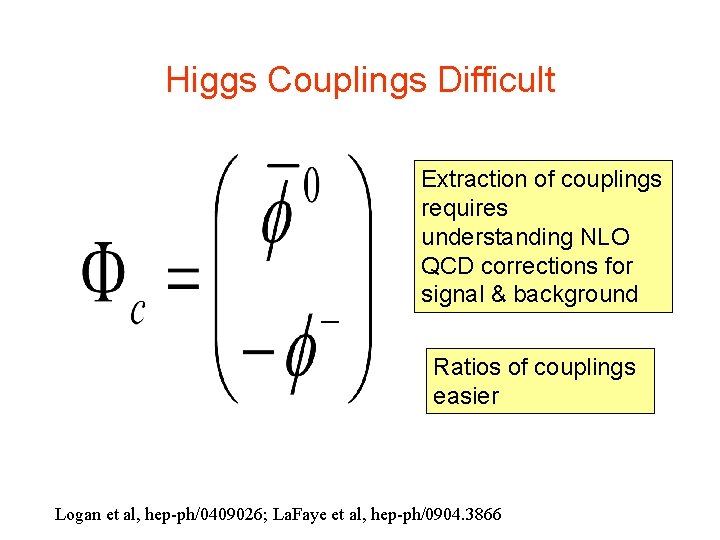
Higgs Couplings Difficult Extraction of couplings requires understanding NLO QCD corrections for signal & background Ratios of couplings easier Logan et al, hep-ph/0409026; La. Faye et al, hep-ph/0904. 3866