
Session 4 01 Physicians Physician Organizations Emerging Initiatives

- Slides: 36
Session 4. 01. Physicians & Physician Organizations Emerging Initiatives to Put Clinical Guidelines at the Point of Care
Panelists w Nick Beard, MD IDX Systems Corp. w Stan Huff, MD Intermountain Health Care w Bob Greenes, MD, Ph. D Brigham & Women’s Hospital, Harvard Medical School
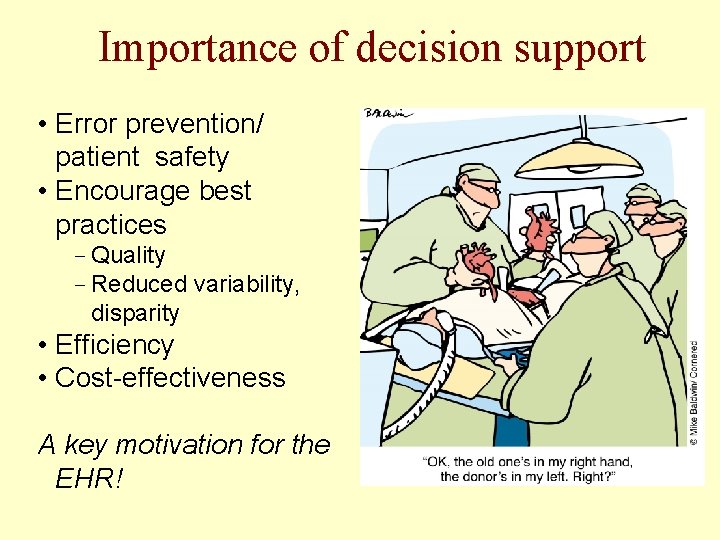
Importance of decision support • Error prevention/ patient safety • Encourage best practices Quality Reduced variability, disparity • Efficiency • Cost-effectiveness A key motivation for the EHR!
We know how to do this w Computerized alerts – Reduced errors – Faster response to problems w Reminders – Improved compliance with guidelines w CPOE – medication error & ADE reduction – cost savings w ADE detection and monitoring … etc. So, why is use not more widespread?
Goal of this presentation is to explore that question w Three case studies – Focus on lessons learned w Generalization of experience – Key challenges – Recommendations
Example: Partners Healthcare System w Integrated healthcare delivery network in Eastern Massachusetts w Founded in 1995 w Includes: – – – Mass. General Hospital Brigham & Women’s Hospital Dana Farber Cancer Institute several community hospitals many practice groups
Long tradition of computer-based decision support e. . g, Brigham system (BICS): w Order entry – – w w w Drug-drug, drug-lab interaction checks Redundancy/appropriateness checks Dose ranges, contraindications, allergies, age, renal function Order sets Alerts Reminders Lab result interpretation Adverse event detection Guideline recomendations
Cost-effective w 55% decrease in serious medication errors – Bates, JAMA 1998 w Decreased redundant labs – Bates, Am J Med, 1997 w More appropriate renal dosing w No reduction in inappropriate x-rays – Harpole, JAMIA, 1997 w Minimal effect of charge display – Bates, Archives of Internal Medicine, 1995 w More appropriate dosing, substitutions accepted – Teich, Archives of Internal Medicine, 2000 w Decreased vancomycin use – Sojania, JAMIA, 1998
CDM Modeling w Decision Systems Group R&D – – Data mining/predictive modeling Technology assessment Guideline modeling (GLIF) Expression language development (GELLO)
So what’s broken? w Gap between models and practice w Generic slowness of technology diffusion w Specific issues relating to our environment
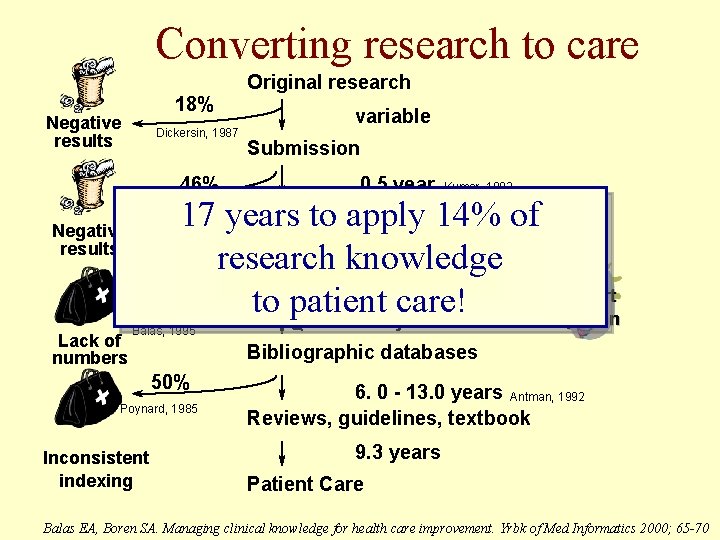
Converting research to care 18% Negative results Dickersin, 1987 46% Original research variable Submission 0. 5 year Kumar, 1992 Acceptance 17 years to apply 14% of 0. 6 year research knowledge Publication 17: 14 to patient care! 35% 0. 3 year Koren, 1989 Negative results Lack of numbers Kumar, 1992 Poyer, 1982 Balas, 1995 Bibliographic databases 50% Poynard, 1985 Inconsistent indexing Expert opinion 6. 0 - 13. 0 years Antman, 1992 Reviews, guidelines, textbook 9. 3 years Patient Care Balas EA, Boren SA. Managing clinical knowledge for health care improvement. Yrbk of Med Informatics 2000; 65 -70
Knowledge Inventory Study w Conducted spring/summer, 2002 w Findings: KI Report – Many PHSIS apps/subsystems use embedded knowledge for decision support • If…then rules IF labtest_result_type < value AND medication_class THEN send textpage • Tabular data (Drug_a, drug_b, interaction_type) – can be thought of as if…then rules • Knowledge-Element Groupings (“KEGs”) Order sets, structured documents, data entry forms, … • Other…
Major findings w Multiple systems/application w/ CDS – Multi-vendor environment – Many apps as result of academic projects • Main goal to demonstrate effectiveness • One-of-a-kind implementations – Not standards-based – Knowledge embedded in systems • Difficult to extract, generalize, replicate
Rules knowledge, as example: w Widely used: – Alerting • Drug-lab interactions • Panic lab alerts – CPOE • • • – – Order-entry rules Drug dictionary (incl. interactions, Gerios, Nephros) Order sets Relevant labs when ordering medications Redundant tests Use and impact Adverse event monitor LMR Outpatient reminders LMR Result manager P-CAPE (guideline implementation)
Varied authoring approaches w Direct encoding in host language – e. g. , MUMPS w Creation of tables w Application-specific authoring tools & DBs w Representation varied accordingly w Also apps have counterparts – e. g. , CPOE
Common rules engine feasibility study w Explore requirements for KM – Externalizing the knowledge from the application – Making it transparent w Particular focus on rules knowledge – Feasibility of a common representation – Implications for authoring/updating and execution
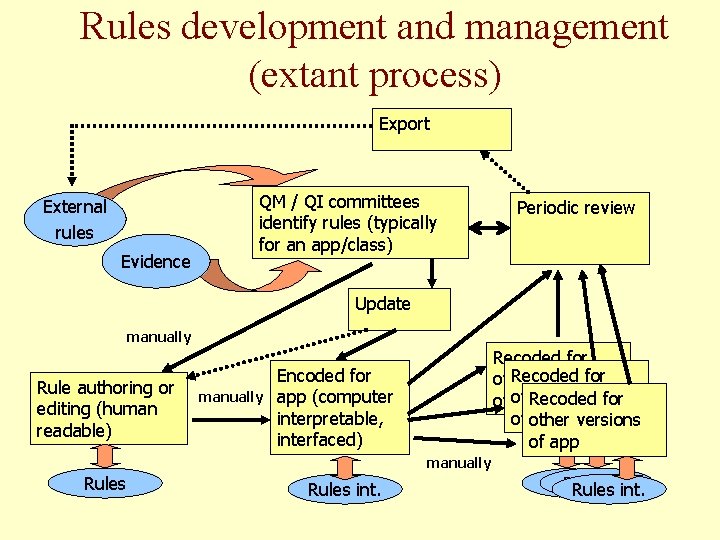
Rules development and management (extant process) Export External rules Evidence QM / QI committees identify rules (typically for an app/class) Periodic review Update manually Rule authoring or editing (human readable) manually Recoded for other versions Recoded for of other app versions of app Encoded for app (computer interpretable, interfaced) manually Rules intint Rules int.
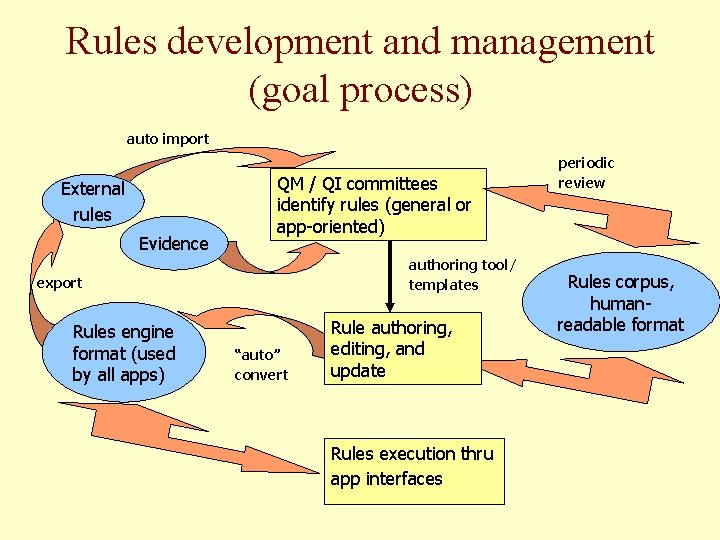
Rules development and management (goal process) auto import External rules Evidence QM / QI committees identify rules (general or app-oriented) authoring tool/ templates export Rules engine format (used by all apps) “auto” convert Rule authoring, editing, and update Rules execution thru app interfaces periodic review Rules corpus, humanreadable format
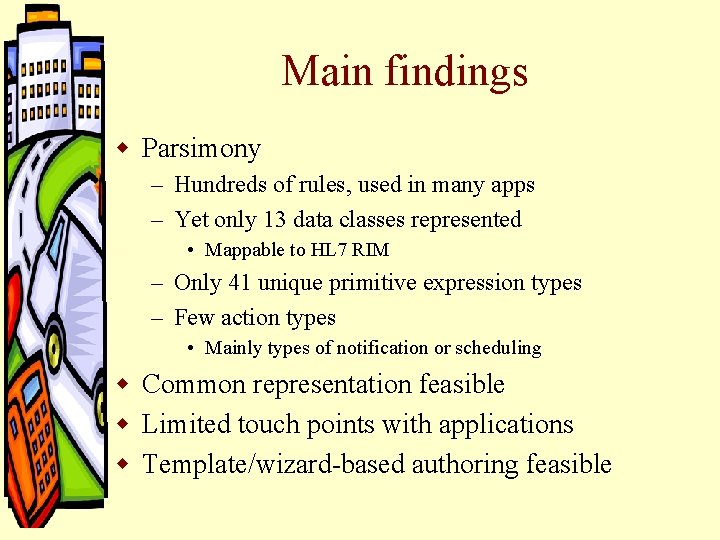
Main findings w Parsimony – Hundreds of rules, used in many apps – Yet only 13 data classes represented • Mappable to HL 7 RIM – Only 41 unique primitive expression types – Few action types • Mainly types of notification or scheduling w Common representation feasible w Limited touch points with applications w Template/wizard-based authoring feasible
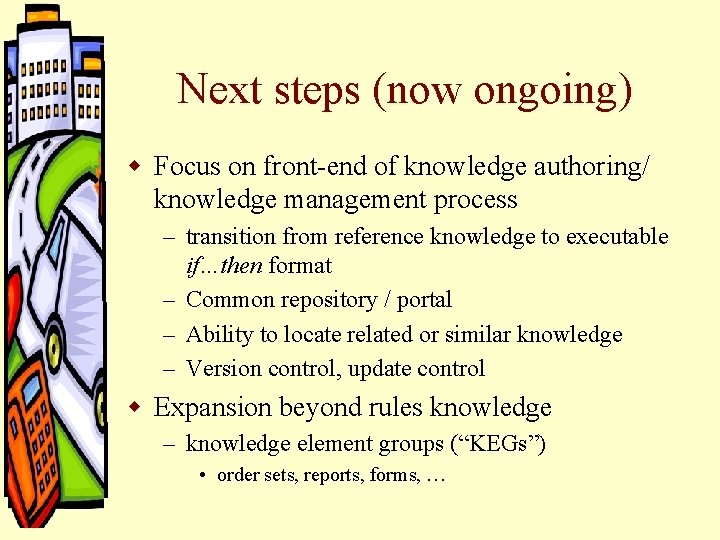
Next steps (now ongoing) w Focus on front-end of knowledge authoring/ knowledge management process – transition from reference knowledge to executable if…then format – Common repository / portal – Ability to locate related or similar knowledge – Version control, update control w Expansion beyond rules knowledge – knowledge element groups (“KEGs”) • order sets, reports, forms, …
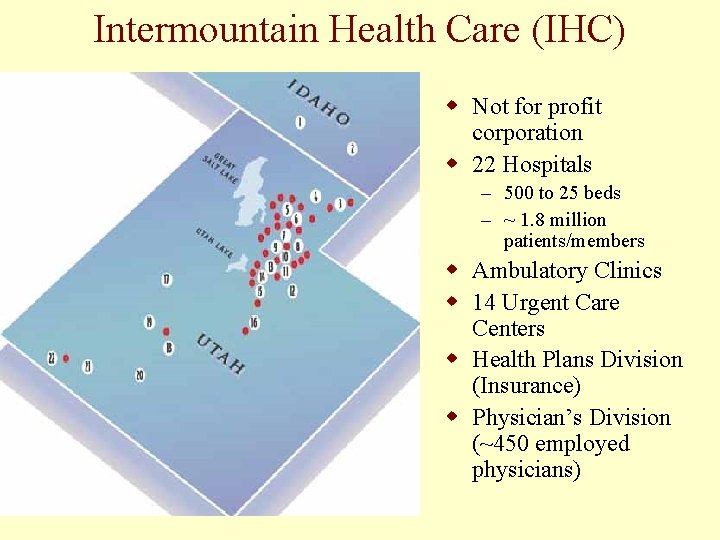
Intermountain Health Care (IHC) w Not for profit corporation w 22 Hospitals – 500 to 25 beds – ~ 1. 8 million patients/members w Ambulatory Clinics w 14 Urgent Care Centers w Health Plans Division (Insurance) w Physician’s Division (~450 employed physicians)
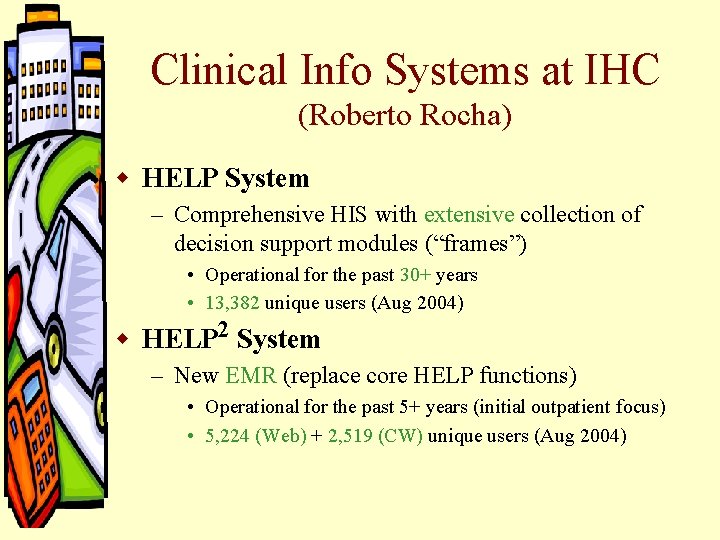
Clinical Info Systems at IHC (Roberto Rocha) w HELP System – Comprehensive HIS with extensive collection of decision support modules (“frames”) • Operational for the past 30+ years • 13, 382 unique users (Aug 2004) w HELP 2 System – New EMR (replace core HELP functions) • Operational for the past 5+ years (initial outpatient focus) • 5, 224 (Web) + 2, 519 (CW) unique users (Aug 2004)
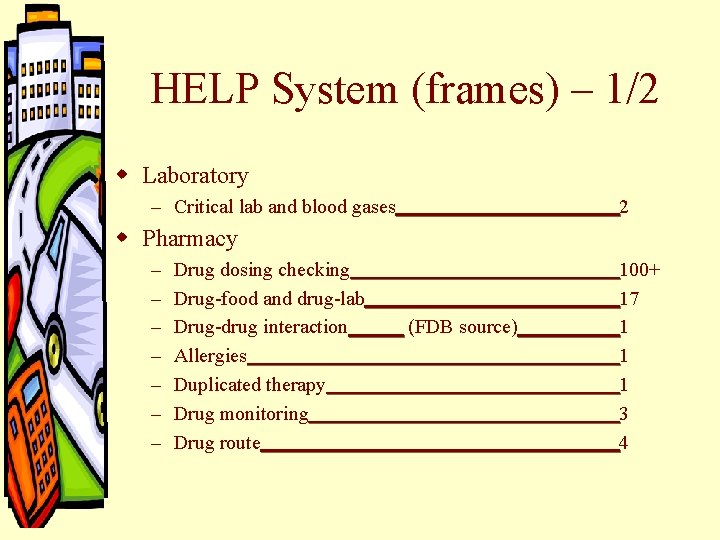
HELP System (frames) – 1/2 w Laboratory – Critical lab and blood gases 2 w Pharmacy – – – – Drug dosing checking Drug-food and drug-lab Drug-drug interaction Allergies Duplicated therapy Drug monitoring Drug route (FDB source) 100+ 17 1 1 1 3 4
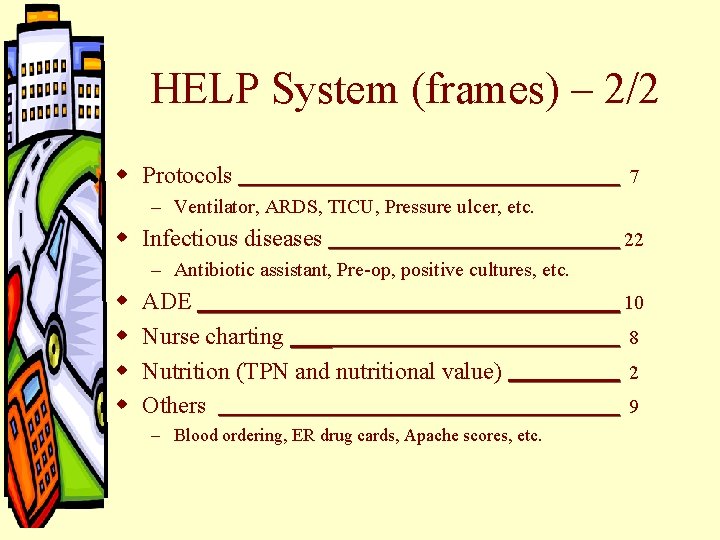
HELP System (frames) – 2/2 w Protocols 7 – Ventilator, ARDS, TICU, Pressure ulcer, etc. w Infectious diseases 22 – Antibiotic assistant, Pre-op, positive cultures, etc. w w ADE Nurse charting Nutrition (TPN and nutritional value) Others – Blood ordering, ER drug cards, Apache scores, etc. 10 8 2 9
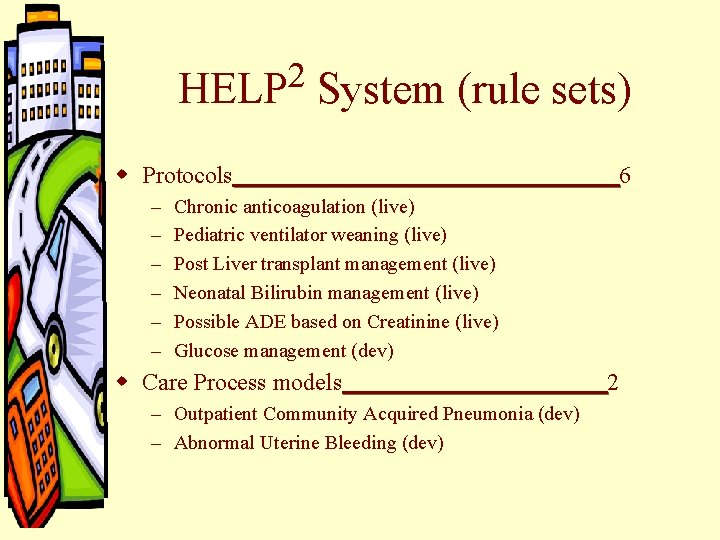
2 HELP System (rule sets) w Protocols – – – 6 Chronic anticoagulation (live) Pediatric ventilator weaning (live) Post Liver transplant management (live) Neonatal Bilirubin management (live) Possible ADE based on Creatinine (live) Glucose management (dev) w Care Process models – Outpatient Community Acquired Pneumonia (dev) – Abnormal Uterine Bleeding (dev) 2
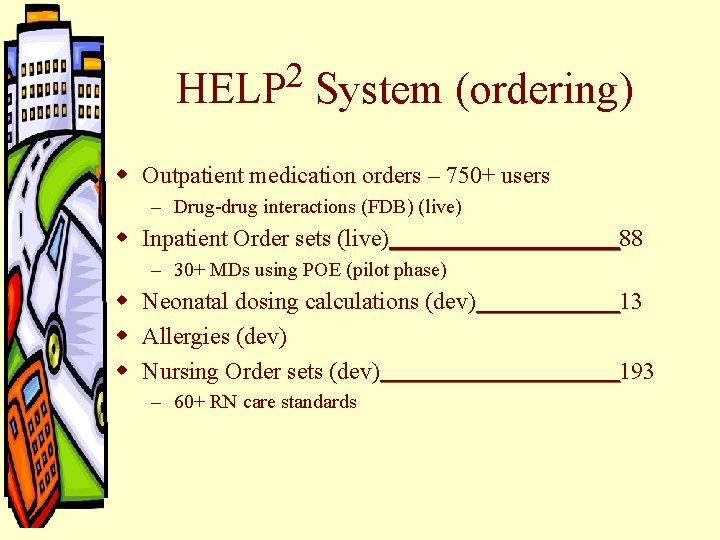
2 HELP System (ordering) w Outpatient medication orders – 750+ users – Drug-drug interactions (FDB) (live) w Inpatient Order sets (live) 88 – 30+ MDs using POE (pilot phase) w Neonatal dosing calculations (dev) w Allergies (dev) w Nursing Order sets (dev) – 60+ RN care standards 13 193
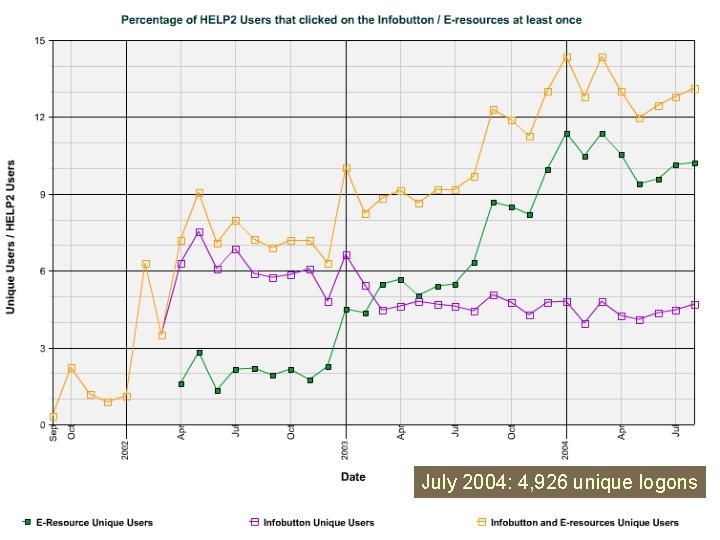
July 2004: 4, 926 unique logons
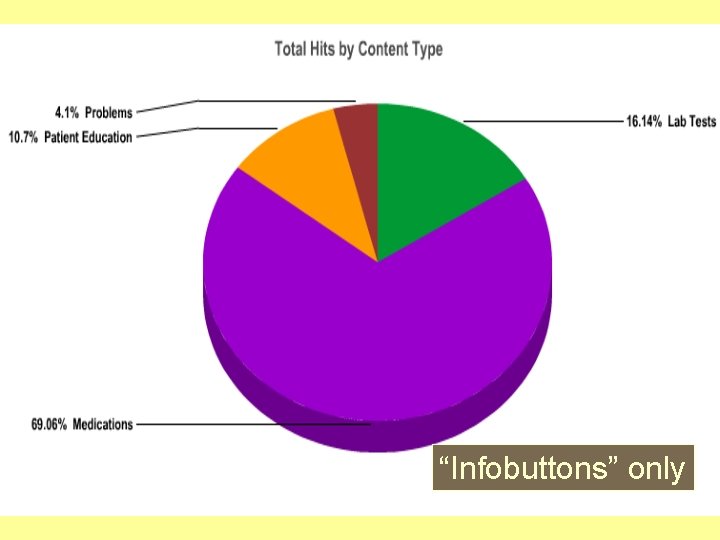
“Infobuttons” only
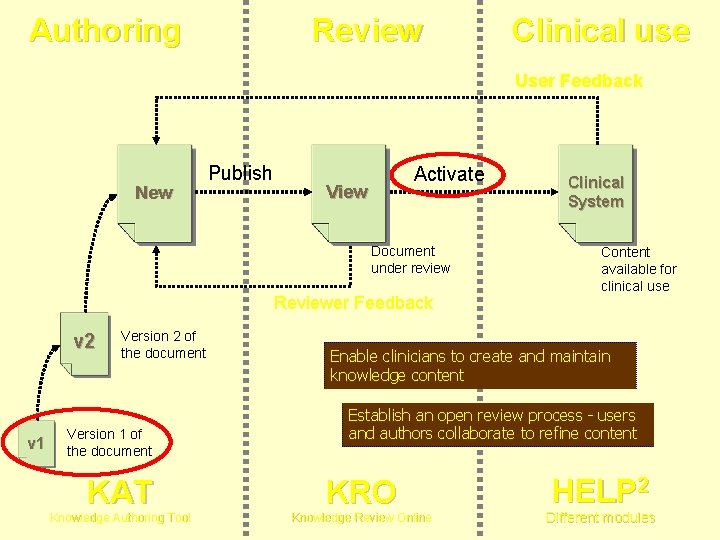
Authoring Review Clinical use User Feedback New Publish Activate View Document under review Reviewer Feedback v 2 v 1 Version 2 of the document Version 1 of the document Clinical System Content available for clinical use Enable clinicians to create and maintain knowledge content Establish an open review process - users and authors collaborate to refine content KAT KRO Knowledge Authoring Tool Knowledge Review Online HELP 2 Different modules
What are the issues? w People – w w NIH syndrome (not invented here) Commercial knowledge bases Integration with workflow – – Expert systems - not in clinical use Community Acquired Pneumonia Protocol • – EHR functions • • • w Different environment in different clinicals Alerts Flowsheets Data drive, time drive, “ask drive” The “Curly braces” problem – Al Pryor and George Hripcsak experiment
Too many ways to say the same thing (2) w A single name/code and value – Weight at birth is 3500 g w Combination of two names/codes and values – Weight is 3500 g • Weight circumstance is at birth
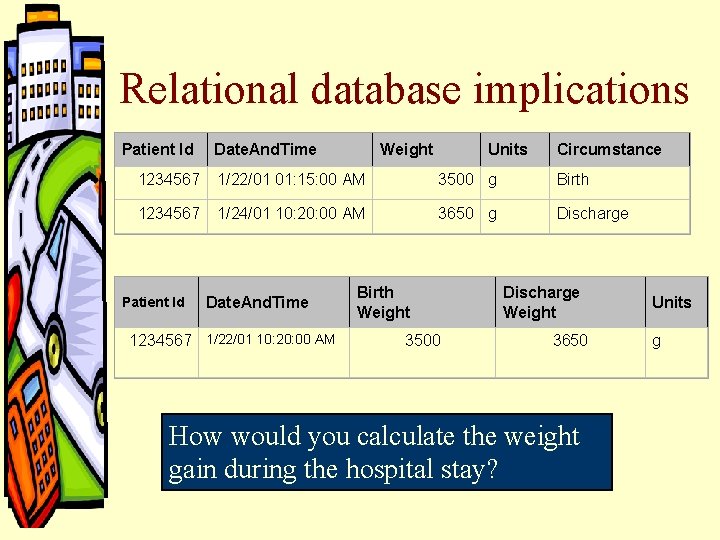
Relational database implications Patient Id Date. And. Time Weight Units Circumstance 1234567 1/22/01 01: 15: 00 AM 3500 g Birth 1234567 1/24/01 10: 20: 00 AM 3650 g Discharge Patient Id Date. And. Time 1234567 1/22/01 10: 20: 00 AM Birth Weight 3500 Discharge Weight 3650 How would you calculate the weight gain during the hospital stay? Units g
SAGE experience w Nick Beard to present
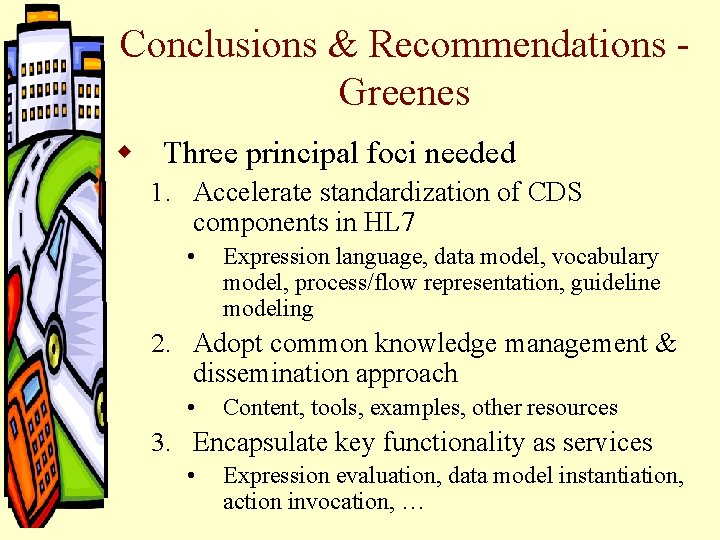
Conclusions & Recommendations Greenes w Three principal foci needed 1. Accelerate standardization of CDS components in HL 7 • Expression language, data model, vocabulary model, process/flow representation, guideline modeling 2. Adopt common knowledge management & dissemination approach • Content, tools, examples, other resources 3. Encapsulate key functionality as services • Expression evaluation, data model instantiation, action invocation, …
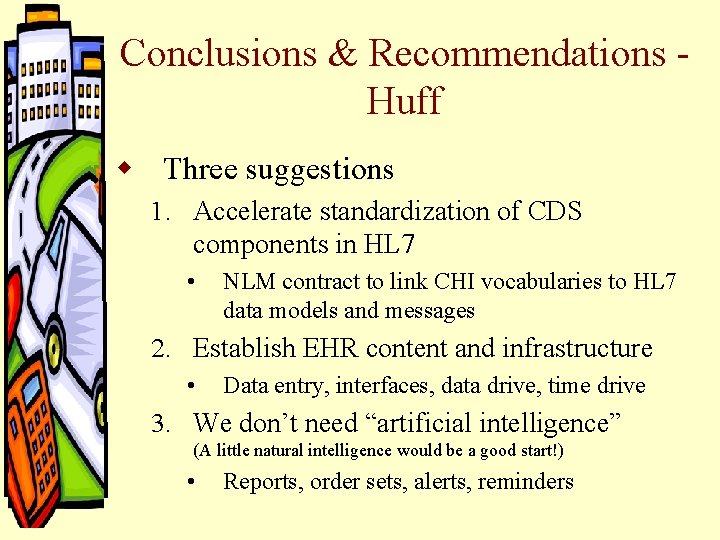
Conclusions & Recommendations Huff w Three suggestions 1. Accelerate standardization of CDS components in HL 7 • NLM contract to link CHI vocabularies to HL 7 data models and messages 2. Establish EHR content and infrastructure • Data entry, interfaces, data drive, time drive 3. We don’t need “artificial intelligence” (A little natural intelligence would be a good start!) • Reports, order sets, alerts, reminders
Conclusions & recommendations Beard w To be added